
Can Cats Eat Raw Meat? What Vets Say About the Risks
Can cats eat raw meat — and should you feed it to them? It is one of the most genuinely contested questions in cat care, and it splits owners right down the middle. Whether you are weighing a raw food diet for cats, wondering can cats eat raw chicken from the supermarket, or trying to make sense of the conflicting advice online, the honest answer is: cats are biologically built for meat, but most veterinarians caution against feeding it raw. This article lays out both sides — the biology, the risks, and what the vet consensus actually says — so you can decide for your cat rather than have someone decide for you.
Key takeaways
- Cats are obligate carnivores biologically capable of digesting raw meat, yet most veterinary bodies advise against feeding it raw due to pathogen and nutritional risks.
- The main risks are bacterial infection (Salmonella, E. coli, Listeria), parasites such as Toxoplasma, and nutritional imbalance in homemade recipes.
- Commercially formulated, pathogen-tested raw diets are far safer than homemade raw meat from the kitchen — the form you choose matters as much as the choice itself.
Raw Meat for Cats — Quick Reference
| Raw meat form | Safe for cats? | Notes |
|---|---|---|
| Commercially prepared raw diet | Conditionally safer | Formulated to AAFCO standards, often pathogen-tested; residual bacterial risk remains |
| Homemade raw meat | Not recommended | High bacterial risk and almost never nutritionally complete without a veterinary nutritionist |
| Raw supermarket chicken or beef | Not recommended | Carries domestic pathogen load (Salmonella, E. coli) without formulation or testing |
| Raw bones | Use caution only under vet guidance | Less brittle than cooked bones, but still a choking, tooth-fracture, and bacterial risk |
| Raw fish | Not recommended | Destroys thiamine and carries marine parasites; see our can cats eat salmon verdict |
| Cooked plain meat (for comparison) | Safe as a treat | No pathogen risk; not complete on its own but a safe way to share — see what cats should eat |
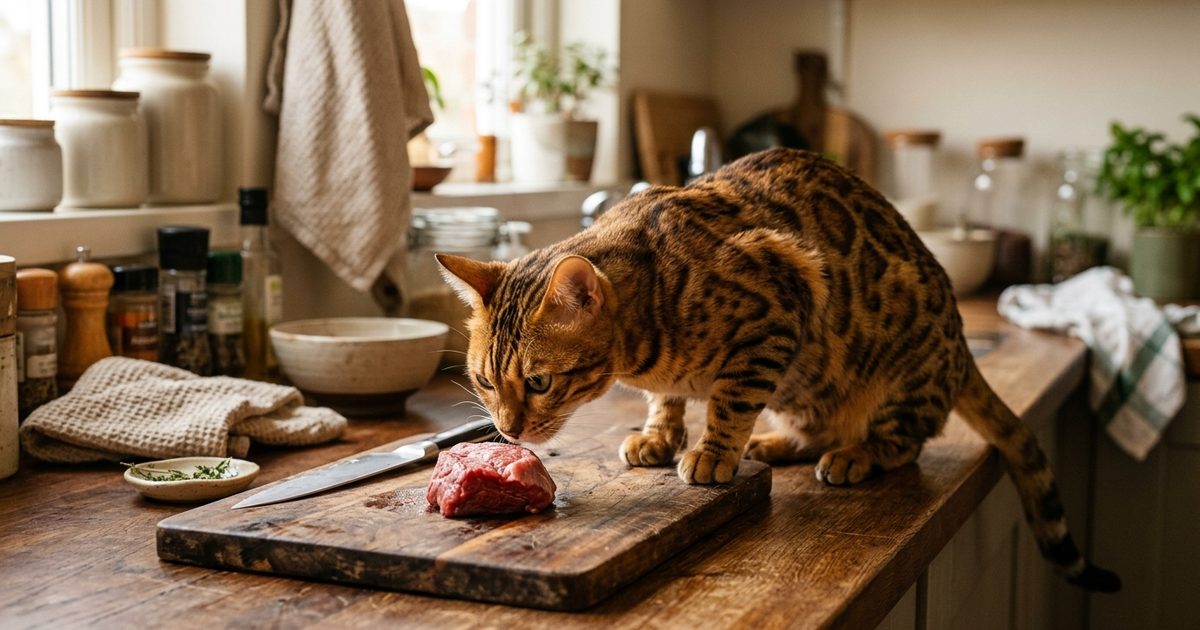
Can Cats Eat Raw Meat?
Cats can digest raw meat — they evolved as obligate carnivores that eat whole prey. But most veterinarians advise against feeding raw meat, because domestic raw meat carries bacteria and parasites, and homemade raw diets often lack the nutrients a cat needs. It is a genuinely debated choice.
The short, honest answer
Biologically, your cat is built to eat meat — and raw meat at that. Cats are obligate carnivores whose wild ancestors survived on whole prey, so the question "can cats eat raw meat?" has a clean physical answer: yes, their digestive system handles it. The harder question is whether they should, and that is where the honest answer splits. The veterinary consensus, echoed by major bodies like the Cornell Feline Health Center, is that the risks of feeding raw — bacteria, parasites, and nutritional gaps in homemade recipes — outweigh the theoretical benefit. So "is raw meat good for cats" is a genuinely contested question, not a yes-or-no. Rather than decide for you, this article lays out both sides fairly.
Why this question splits cat owners
Few topics divide cat people like raw feeding. On one side are passionate advocates who point to feline biology and swear by shinier coats and cleaner teeth. On the other is firm veterinary opposition grounded in documented pathogen and nutritional failures. Both camps have real points. But notice where the disagreement actually sits: it is not about whether cats are carnivores (they are). It is about whether domestic supermarket meat equals wild prey — and it does not. That single gap is where the raw debate lives.
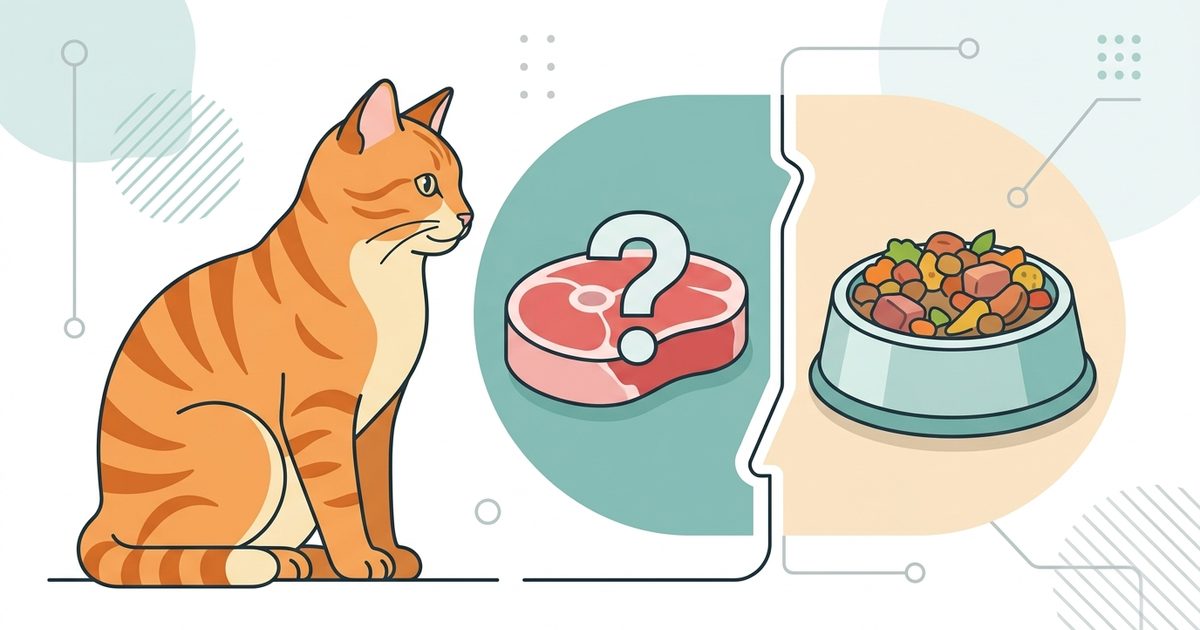
Why Do People Think Raw Meat Is Natural for Cats?
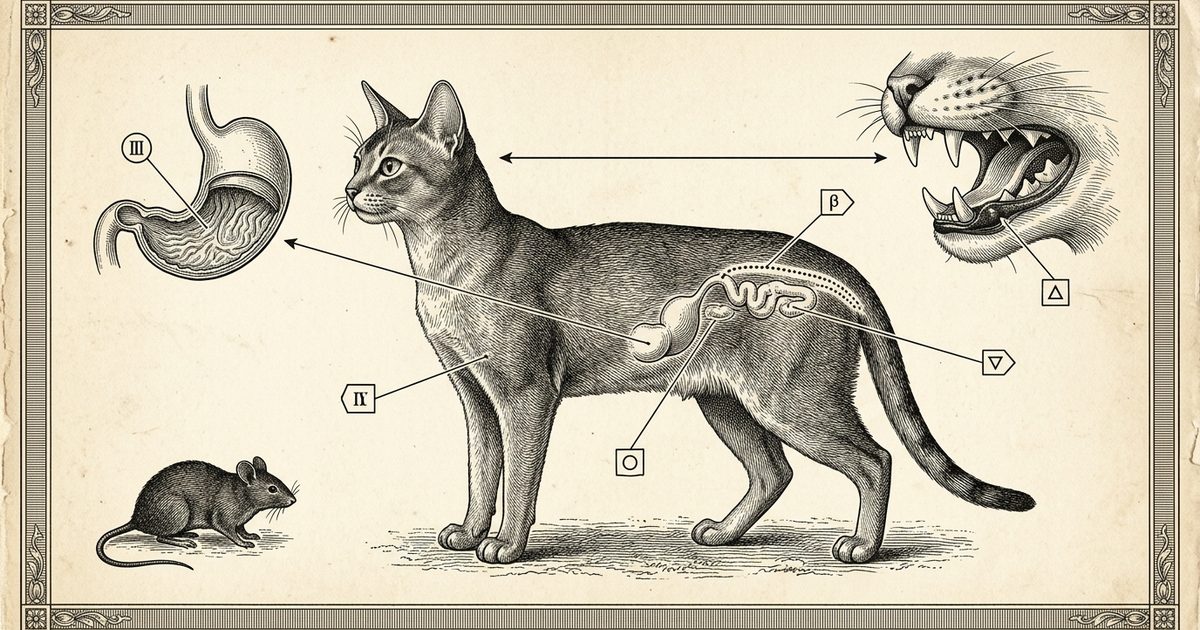
The case for raw rests on real biology. Cats are obligate carnivores whose wild ancestors ate whole prey, and they have highly acidic stomachs and a short digestive tract that handles bacteria better than ours. The instinct is genuine — the question is whether modern meat matches that wild model.
Obligate carnivores built for meat
The raw-feeding argument has genuine scientific weight because cats are obligate carnivores — animals that must derive certain nutrients from animal tissue to survive. Their bodies cannot manufacture taurine, preformed vitamin A, or arachidonic acid from plant sources the way ours can, so these essentials come from meat, organs, and bone. A cat's teeth, hinged jaw, and short gut are all built for tearing and digesting flesh, not grinding plants. This is why the wider obligate-carnivore diet is the foundation underneath every commercial cat food, and why the "natural" framing of raw feeding resonates: cats really did evolve eating whole prey. The Cornell Feline Health Center details exactly which nutrients cats require from animal tissue and why their biology is locked into meat.
Strong stomach acid and a short gut
Here is the biological kernel of truth behind "cats can handle raw." Feline stomach acid ranks among the most acidic of any mammal, a pH low enough to neutralize many of the bacteria that would sicken a human. Pair that with a short intestinal transit — food moves through quickly, leaving little time for pathogens to colonize — and you can see why people assume a cat's gut is bulletproof. There is real physiology here. But "handle better than humans" is not the same as "immune," and that distinction matters more than it sounds when the cat is your kitten or your elderly companion.
Wild prey vs supermarket meat
This is the gap that breaks the "natural" argument. A wild cat does not eat a boneless muscle fillet from a plastic tray — it eats fresh, whole prey: muscle, organs, bone, even fur, delivering a complete and balanced nutrient profile in one package. Supermarket meat, by contrast, is muscle-only; it has sat through a cold chain, been cut, ground, and packaged, and it carries a domestic pathogen load — Salmonella, E. coli, Listeria — that fresh wild prey largely does not. It is true that wild cats eat raw and survive, but they also carry heavy parasite loads and live far shorter lives than a pampered indoor cat. The wild model is real biology; the grocery aisle is a different animal.
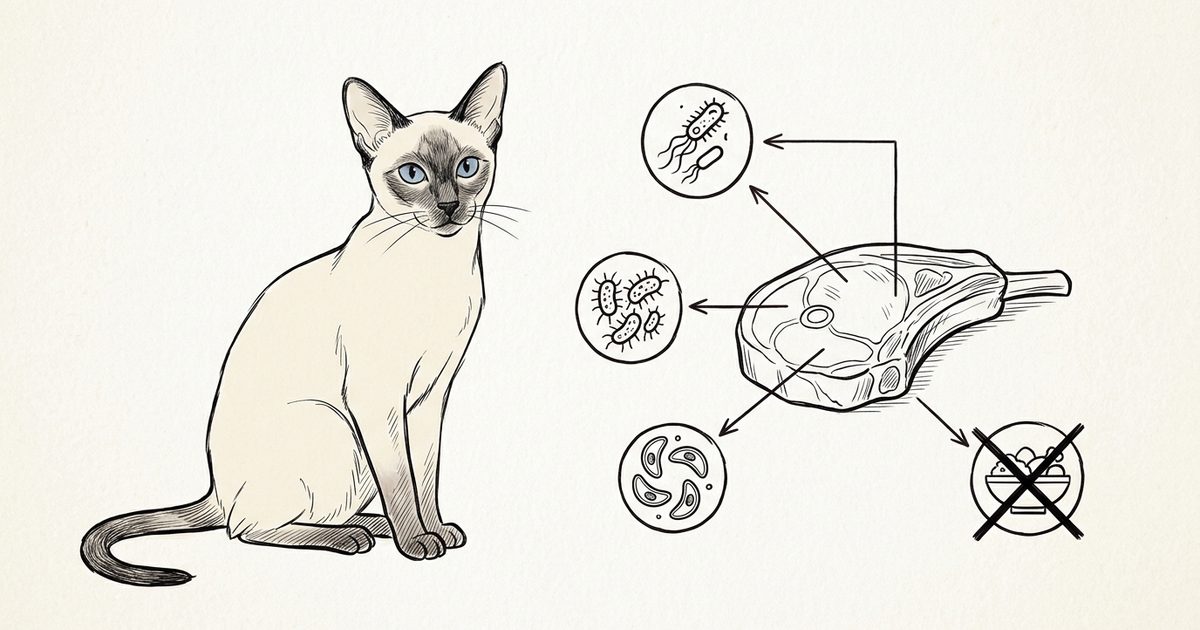
What Are the Risks of Feeding Raw Meat to Cats?
The main risks are bacterial infection (Salmonella, E. coli, Listeria), parasites like Toxoplasma, and nutritional imbalance in homemade diets. Cats can shed these pathogens without looking sick — meaning raw feeding can also expose the humans in the home, not just the cat.
This is the part of the raw-feeding question where the debate stops being philosophical and gets concrete. A cat can digest raw meat and still be harmed by what is on it — and, less obvious but just as important, can pass that harm along to the people living with it.
Bacteria: Salmonella, E. coli, Listeria
These three bacteria are reliably found on raw meat from the domestic food supply — they are not rare contaminants but the predictable result of how meat is processed, packaged, and stored. A healthy adult cat often tolerates the load better than a human would, which is exactly why owners assume raw is fine. But kittens, senior cats, and cats with weakened immune systems can and do fall genuinely ill, with vomiting, diarrhea, lethargy, and fever. If you see those signs after raw feeding, call your vet immediately rather than waiting it out.
The subtler problem is asymptomatic shedding: a cat that looks perfectly healthy can still carry Salmonella or E. coli in its gut and shed them in feces and saliva for weeks. International Cat Care covers the infectious-disease side of raw feeding in depth, and it is the angle most owners underestimate — the risk is not only to the cat in front of you.
Parasites and toxoplasmosis
Raw meat can also carry Toxoplasma gondii tissue cysts, along with other parasites depending on the meat's source. Cats are the definitive host for toxoplasmosis, meaning the parasite can complete its life cycle inside them and shed infectious oocysts into the environment. For most healthy adult humans this is a minor concern, but it matters a great deal for pregnant and immunocompromised household members, where toxoplasmosis can cause serious harm.
Freezing raw meat before feeding reduces the parasite load but does not eliminate it — freezing is harm reduction, not a guarantee. For the parasite itself explained in full — lifecycle, symptoms, and how cats actually fit in — see our dedicated guide to cat toxoplasmosis.
Nutritional imbalance in homemade raw
Even meat that is perfectly free of pathogens can quietly harm a cat over months. Formulating a complete raw diet requires precise calcium-to-phosphorus ratios, adequate taurine, the right vitamins, and trace minerals in the right proportions — and most homemade recipes, however lovingly prepared, fall short. The damage shows up slowly: skeletal problems, heart muscle wasting, and eye or vision issues that develop long before an owner connects them to the food bowl. This is why "raw" without careful formulation is not the same thing as "balanced" — a distinction that matters enormously over a cat's lifetime.
The human-health angle
This is the reason public-health bodies weigh in rather than leaving raw feeding as a private choice between you and your cat. A cat that eats raw meat and then grooms itself, licks a food bowl, or uses the litter box can spread bacteria onto its fur, your surfaces, and the air around the box. The risk extends past the cat to everyone sharing the home — which is why the Cornell Feline Health Center and major veterinary associations treat raw feeding as a household-level decision, not just a feline one.
Commercial Raw vs Homemade Raw Diets
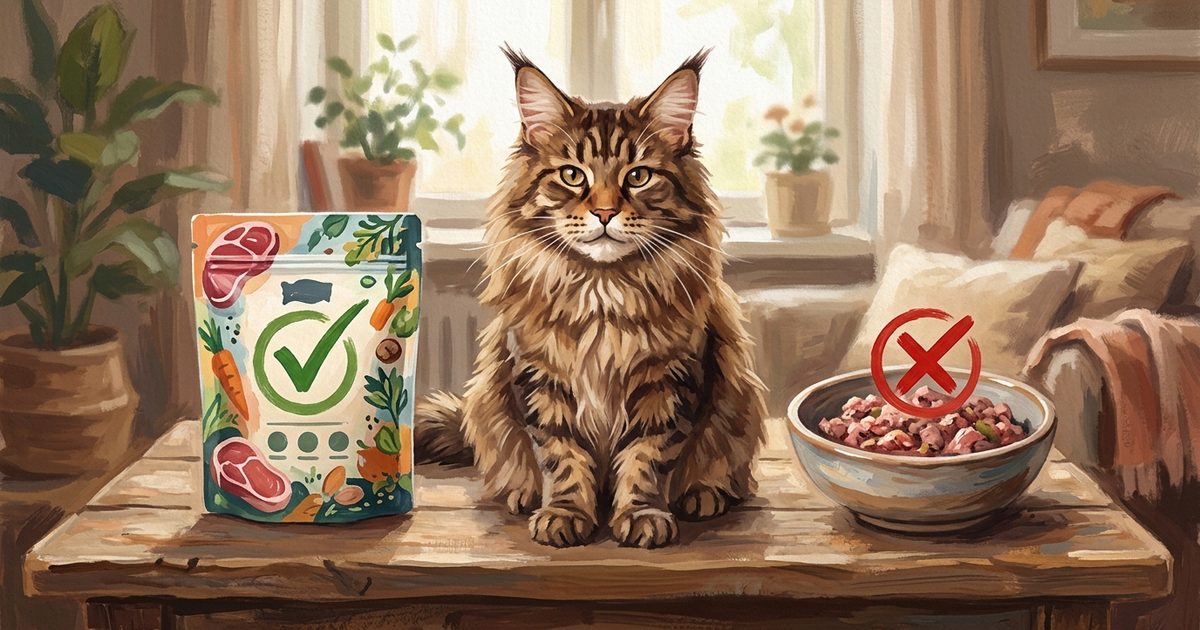
If you choose raw, commercial diets formulated to AAFCO standards and tested for pathogens are far safer than homemade. Homemade raw meat from the kitchen is the highest-risk option, because it is both untested for bacteria and almost never nutritionally complete without a veterinary nutritionist's recipe.
If you have read the risks above and are still considering raw, the form of that raw matters more than most owners realize. There is a meaningful gap between a carefully manufactured product and meat ground up in your own kitchen — and the gap is where most of the danger actually lives.
Commercial raw diets
Commercial raw foods — sold freeze-dried, frozen, or as complete patties — are formulated to meet established feline nutrient profiles and typically undergo high-pressure processing or routine pathogen testing before they reach the shelf. They reduce, but do not eliminate, the bacterial risk: a commercial raw product is safer than loose supermarket meat, yet it is still raw and still carries some residual contamination. Many veterinarians who otherwise counsel against raw feeding will accept a commercial, pathogen-tested product as a lesser-evil option for an owner who is committed to the approach — which is exactly why a raw food diet for cats, done responsibly, usually means a commercial one rather than a homemade one.
Homemade raw is the real danger
Homemade raw is where veterinary concern concentrates. Grinding supermarket meat at home combines the domestic pathogen load — the same Salmonella and E. coli present on any retail meat — with effectively zero formulation oversight. Published analyses of popular homemade raw recipes have repeatedly found most of them nutritionally incomplete, missing taurine, calcium, or essential vitamins in amounts that cause real harm over time. This is not a fringe warning: every major veterinary body singles out this form of raw feeding — the unsupervised homemade kind — as the one to avoid. For context on how that compares to the broader question of what cats should eat, the core issue is not meat itself but whether the diet is complete.
If you feed raw, do it safely
If you go ahead, apply the same hygiene you would use handling raw chicken for yourself: separate cutting surfaces, thorough handwashing, prompt refrigeration, and no sharing of utensils with human food. Then have a vet — ideally a board-certified veterinary nutritionist — review the actual diet for nutritional completeness before it becomes your cat's daily meal.
Can Cats Eat Raw Bones?
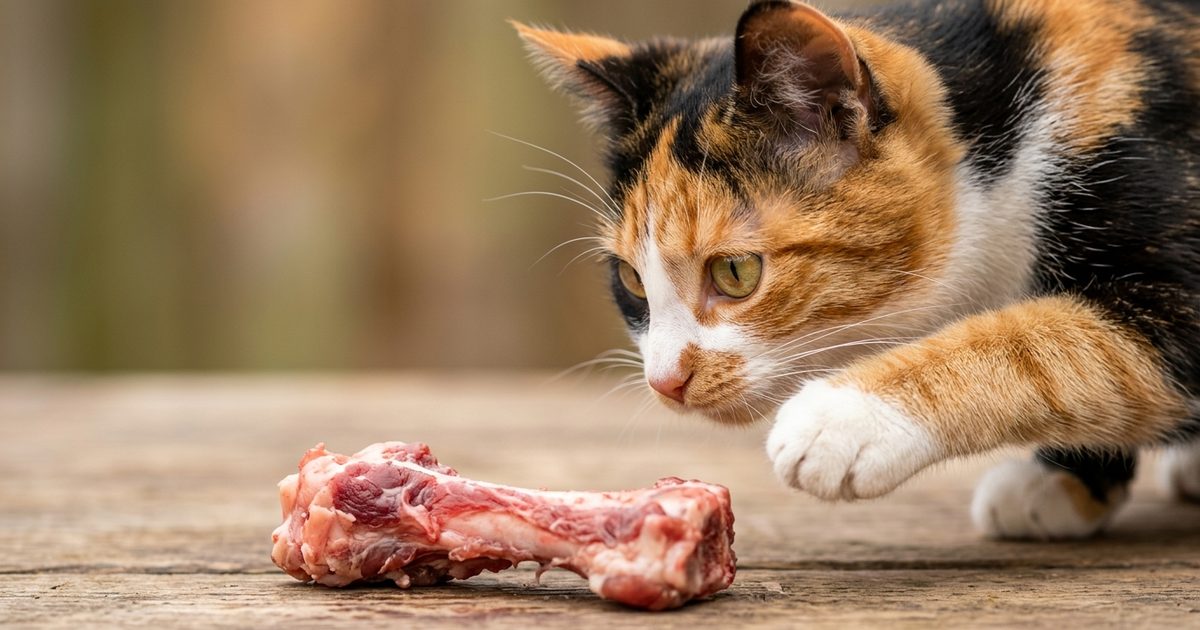
Raw bones are less dangerous than cooked bones, which splinter into sharp shards. But raw bones still carry choking, tooth fracture, and bacterial risks, so most vets do not recommend them. If offered at all, they should be raw, meaty, size-appropriate, and given under veterinary guidance.
Why cooked bones are off-limits
Cooking drives the moisture out of bone and makes it brittle, so it does not crunch cleanly — it shatters into long, needle-like fragments that can puncture the mouth, throat, stomach, or intestines. A swallowed cooked bone is a genuine emergency, not a "wait and see" situation. If your cat is drooling, gagging, vomiting, refusing food, or goes quiet and lethargic after a bone, call your vet immediately. For the dedicated poultry-bone verdict — including why even raw chicken bones divide opinion — see our breakdown of whether cats can eat chicken.
The raw-bone debate
This is one of the most contested corners of raw feeding, and the disagreement is real. On one side, some raw feeders offer raw meaty bones — chicken necks, wings, small ribs — arguing they provide natural dental wear, calcium, and phosphorus, and give a cat something to actually chew. On the other side, many vets point to the documented harms: choking, fractured teeth, gastrointestinal blockage, and the same bacterial load that clings to any raw meat. There is no clean consensus, and I will not pretend there is one. If you are weighing raw bones, the only honest recommendation is to ask a vet who knows your specific cat — her age, teeth, and health — rather than following a blanket rule from the internet.
Bones in commercial food
There is a form of bone that avoids most of this argument. Complete commercial diets — both raw and cooked — often include finely ground bone as a calculated source of calcium and phosphorus. It has been mechanically processed and nutritionally balanced, so it is not the same thing as a whole bone lifted off your dinner plate. If the "bone" question is really about minerals, a formulated food already solves it.
What Do Veterinarians Recommend About Raw Meat?
Most veterinary bodies, including the AVMA, advise against feeding raw or undercooked animal-sourced proteins to cats because of pathogen and nutritional risks. If you still choose raw, vets recommend a commercially formulated, pathogen-tested diet combined with regular veterinary oversight.
The AVMA and major bodies
The professional consensus is clearer than the online debate suggests. The American Veterinary Medical Association, the FDA, the CDC, and the American Animal Hospital Association all formally caution against feeding raw or undercooked animal-sourced proteins to cats. Their position is not the caricature "cats cannot eat meat" — they know cats are obligate carnivores. The concern is the documented reality: routine bacterial contamination of raw meat on the domestic supply chain, and the recurring nutritional failures seen in unbalanced homemade raw diets. You can read the AVMA's raw diet policy directly, and the Cornell Feline Health Center covers the same evidence from a feline-nutrition angle. Treat this as a professional consensus built on data, not as dogma to be waved away.
When a vet may support raw
That said, "advises against" is not "forbids." Some veterinarians will help a genuinely committed owner build a complete raw diet — typically by starting with a commercially formulated base mix and layering a recipe designed or reviewed by a board-certified veterinary nutritionist, then monitoring the cat over time. That is informed, supervised raw feeding, and it is a completely different animal from slicing raw meat off a supermarket tray and dropping it in a bowl. The vet's involvement is exactly what lowers the risk.
Talk to your vet first
The real first step is not this article, or any article — it is a conversation with your own vet. Every cat changes the calculus: kittens with developing immune systems, senior cats, pregnant or nursing queens, and any immunocompromised cat shift the risk sharply upward. So does the human side of the household — if anyone is pregnant, elderly, or immunocompromised, the pathogen-shedding risk matters more. The honest answer to "can cats eat raw meat" is: it depends on the cat, the kitchen, and the people under that roof. Your vet is the one who can actually weigh all three.
Curious What Your Cat Would Say?
Upload a photo and get a warm, personalized reading from your cat's perspective.
Start Your Free ReadingRaw Meat for Cats at a Glance — Summary
| Question | Short answer |
|---|---|
| Can cats eat raw meat? | Biologically yes, but most vets advise against it due to bacteria, parasites, and nutritional imbalance |
| Can cats eat raw chicken? | The same risks apply — Salmonella and Campylobacter make supermarket poultry a poor choice raw |
| Is raw meat good for cats? | Debated; cats are obligate carnivores, but domestic meat is not wild prey, so "natural" does not mean risk-free |
| Can cats eat raw bones? | Safer than cooked bones, which splinter, but raw bones still carry choking, tooth, and bacterial risks |
| Are commercial raw diets safe? | Safer than homemade — formulated and pathogen-tested, but not entirely risk-free |
| Are homemade raw diets safe? | Highest risk; usually nutritionally incomplete and untested for bacteria without a vet nutritionist |
| What do vets say about raw feeding? | The AVMA and major bodies advise against raw, citing documented contamination and nutritional failures |
| What are the main risks? | Salmonella, E. coli, Listeria, Toxoplasma, plus nutritional imbalance and human exposure through shedding |
Frequently Asked Questions
Can cats eat raw meat?
Biologically yes — cats are obligate carnivores that evolved eating raw whole prey. But most veterinarians advise against feeding raw meat, because domestic supermarket meat carries bacteria and parasites and homemade raw diets are often nutritionally incomplete. It is a genuinely debated choice.
Can cats eat raw chicken?
The same risks apply. Raw supermarket chicken carries Salmonella and Campylobacter from the domestic poultry supply chain, so feeding it raw to a cat is not recommended. Cooked plain chicken is safe as a treat; raw chicken is the high-risk form.
Is raw meat good for cats?
It is debated. Cats are obligate carnivores biologically built for meat, but domestic supermarket meat is not the same as fresh wild whole prey, so natural does not mean risk-free. The form and formulation of the raw diet matter as much as the choice itself.
Can cats eat raw bones?
Raw bones are safer than cooked bones, which splinter into sharp shards, but raw bones still carry choking, tooth-fracture, and bacterial risks. If offered at all, they should be raw, meaty, size-appropriate, and given under veterinary guidance.
Are commercial raw diets safe for cats?
They are safer than homemade raw. Commercial raw diets are formulated to AAFCO nutrient profiles and often pathogen-tested, but they are still raw and carry some residual bacterial risk. Vets may accept them as a lesser-evil option for committed owners.
Why do vets advise against raw diets?
Major bodies like the AVMA, FDA, CDC, and AAHA cite documented bacterial contamination of the raw meat supply chain and recurring nutritional failures in unbalanced homemade raw recipes. They also flag asymptomatic shedding, which exposes the humans in the home, not just the cat.
Can kittens eat raw meat?
Kittens are especially vulnerable because their immune systems are still developing, so raw feeding carries a higher risk of serious bacterial illness. Most veterinarians do not recommend raw diets for kittens. Talk to your vet before making any diet decision for a young cat.
What are the risks of feeding raw meat to cats?
The main risks are bacterial infection (Salmonella, E. coli, Listeria), parasites such as Toxoplasma, and nutritional imbalance in homemade recipes. Cats can also shed these pathogens asymptomatically, spreading bacteria to the humans and surfaces in the home.
Sources & References
You Might Also Like
Can Cats Eat Chicken? Safety, Benefits, and How to Feed It
Can cats eat chicken? Yes — plain cooked chicken is one of the safest human foods for cats and a great protein source. Learn the safe form, portion, and risks.
18 min readKitten Teething: Timeline, Symptoms & How to Help
Kitten teething runs from 3 to 7 months as baby teeth fall out. Learn the timeline, signs to watch for, and how to soothe a teething kitten safely.
15 min readWhen Do Cats Stop Growing? A Complete Timeline
When do cats stop growing? Most cats reach adult size by 12-18 months, but large breeds like Maine Coons keep growing until 3-4 years. Full timeline inside.
14 min read