
Can Cats Eat Salmon? Safety, Benefits, and How Much Is Safe
Cats can eat salmon — and salmon oil for cats is one of the better-known omega-3 sources you'll see recommended for skin and coat health. But the answer to "can cats eat salmon" comes with a sharp condition: only plain, fully cooked salmon, in small amounts, as a treat. Raw salmon carries real risks, smoked and salted forms are off the table, and even the good kind stays a treat, never a meal. Here's how to tell the safe from the risky in one read.
Key takeaways
- Plain cooked salmon is safe for cats as an occasional treat; raw, smoked, salted, and most human-canned forms are not.
- Salmon's real value is its omega-3 fatty acids (EPA and DHA), which support skin, coat, and joints — but it's nutritionally incomplete on its own.
- Keep salmon to roughly 10% of daily calories, in teaspoon-sized pieces, a couple of times a week at most.
Can Cats Eat Salmon? — Quick Reference
| Salmon form | Safe for cats? | Notes |
|---|---|---|
| Plain cooked salmon | Yes — as a treat | Bake, steam, or poach with nothing added; debone fully |
| Raw salmon | No | Thiaminase destroys vitamin B1; may carry parasites and bacteria |
| Smoked salmon | No | Very high in sodium and often spiced |
| Salmon with salt or seasoning | No | Salt, garlic, onion, and many spices are harmful or toxic to cats |
| Canned salmon for humans | Usually no | Often high in salt and packed with soft bones |
| Salmon oil supplement | Yes — with vet guidance | A source of omega-3s, but not a replacement for complete food |
Can Cats Eat Salmon?
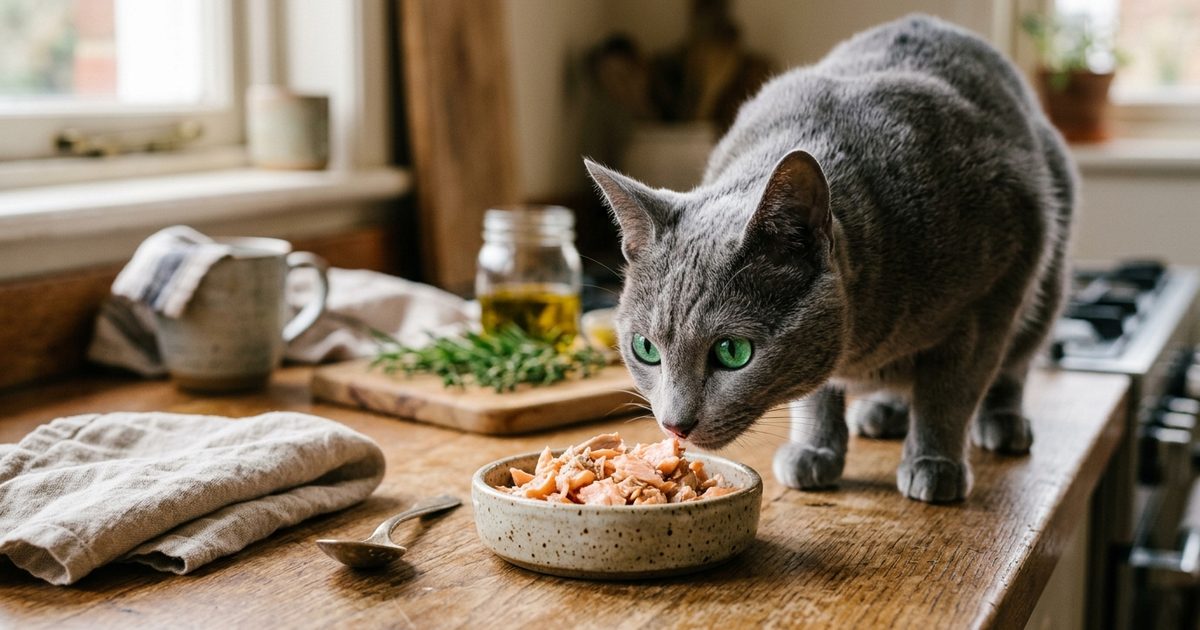
Yes — cats can eat salmon, but only plain cooked salmon in small amounts as an occasional treat, never as a dietary staple. Keep it to about 10% of daily calories; the rest of the diet should be a complete cat food that gives your cat the taurine and nutrients salmon alone lacks.
The short answer
The verdict is simple: plain, fully cooked salmon, with no salt, oil, or seasoning and no bones, is safe for most healthy adult cats in small amounts. So if you've been wondering can cats eat cooked salmon, the answer is yes — as a treat, not as a meal. Salmon is genuinely valuable food for cats because of its omega-3 content, but it's nutritionally incomplete on its own, which is why it can never be the centerpiece of the bowl. Think of it the way you'd think of a rich dessert for yourself: a pleasure, not a foundation. Treat, not meal — that one line prevents most of the problems that come from feeding salmon.
Why cats love salmon
Most cats go visibly excited the moment salmon appears — and there's a clear sensory reason. Salmon carries a strong, marine scent that hits a cat's powerful olfactory system hard, and its naturally rich, oily mouthfeel is unlike anything in standard dry food. That enthusiasm is real, but it doesn't equal nutritional fit. A cat's preference is shaped by smell and texture, not by what its body actually needs long-term. This is the trap with high-value foods like salmon: a cat's eagerness can quietly rewrite the diet if you let it, pushing out the complete food that supplies the taurine, calcium, and balanced nutrients salmon lacks. The Cornell Feline Health Center reminds owners that a complete and balanced commercial diet should always remain the bulk of what a cat eats — salmon is the garnish on top, not the main course.
Can Cats Eat Raw Salmon?
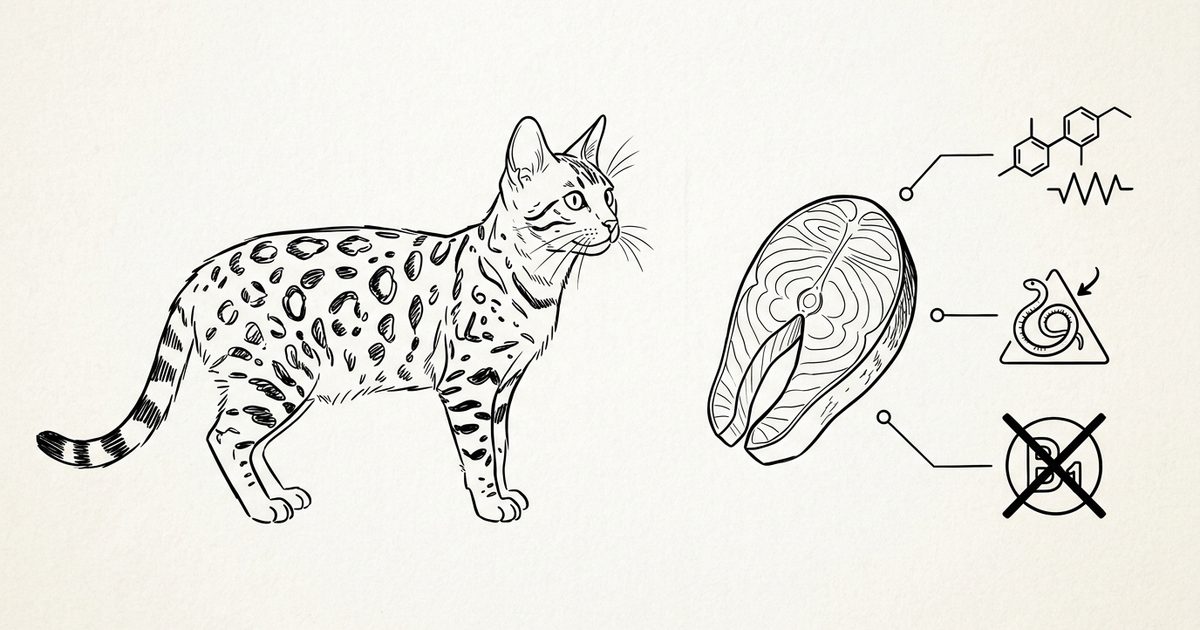
No — raw salmon is not safe for cats. Raw fish contains thiaminase, an enzyme that destroys vitamin B1, and raw salmon can also carry parasites and harmful bacteria. Always cook salmon fully before offering even a small piece to your cat.
If you're asking can cats eat raw salmon, the answer is a clear no — and the reasons sit on two separate levels. One is chemical: raw fish carries an enzyme that breaks down a vitamin your cat can't afford to lose. The other is biological: raw salmon can harbor parasites and bacteria that cooking reliably destroys. Neither problem is rare or theoretical, which is why even a small piece of raw salmon isn't worth the risk.
The thiaminase problem
Raw fish, salmon included, contains an enzyme called thiaminase. Thiaminase destroys thiamine — vitamin B1 — which cats need for normal nerve and brain function. A single meal of raw fish won't cause harm, but feeding raw fish regularly or in larger amounts can slowly deplete thiamine, and the consequences are serious: loss of appetite, weakness, neurological signs, and in advanced cases seizures. This isn't a scare story — it's a well-documented deficiency in cats fed raw-fish-heavy diets. The reliable fix is also the simple one: heat deactivates thiaminase. Fully cooking salmon removes the enzyme entirely, which is why cooked salmon is fine and raw salmon is not.
Parasites and bacteria
The second issue is infection. Raw salmon can carry parasites such as flukes and roundworms, along with bacteria like Salmonella and Listeria. Commercial sushi-grade fish is frozen to standards that kill many human-targeted parasites, but that process reduces rather than eliminates risk, and it does nothing to address a cat's much smaller body weight or the thiaminase issue. International Cat Care advises against feeding raw fish to cats precisely because of the combination of thiamine loss and parasitic and bacterial load. Cooking through to a safe internal temperature is the one step that reliably kills both the parasites and the bacteria — there is no shortcut around it.
Sushi-grade is still not safe for cats
It's tempting to think that "sushi-grade" or "sashimi-grade" salmon must be safe — after all, humans eat it raw. But that grade refers to freezing and handling standards designed for human parasite risk, not to thiaminase and not to a cat's far smaller body weight. A portion that's negligible for a person can still deliver enough thiaminase and microbial load to matter for a 4 kg cat. The label tells you about human food safety; it tells you nothing about feline safety. If you want to share salmon's benefits with your cat, the rule doesn't change: cook it plain, debone it, and keep the piece small — and reach for salmon oil for cats as a safer way to give the omega-3 benefit without the raw-fish risk.
Is Salmon Good for Cats?
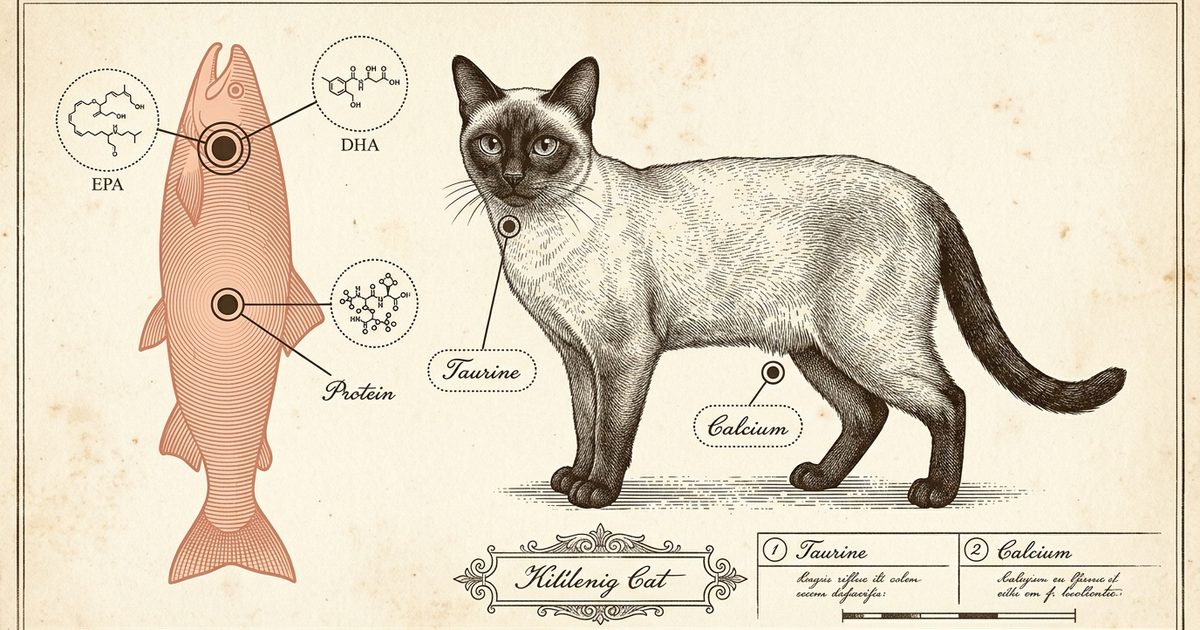
Salmon is rich in omega-3 fatty acids (EPA and DHA) and high-quality protein, which can support a cat's skin, coat, joints, and reduce inflammation. But salmon is nutritionally incomplete on its own — it lacks enough taurine, calcium, and other nutrients — so it is a beneficial treat, not a meal.
Salmon has a genuine nutritional upside that most treat foods can't match: it's one of the few readily available sources of long-chain marine omega-3s. That makes it stand apart from tuna as a treat and from rotation proteins like chicken as a staple. But the same properties that make it valuable also make it easy to misuse — a cat that loves salmon is not the same as a cat that should live on it.
Omega-3 fatty acids
The standout nutrient in salmon is long-chain omega-3 — specifically EPA and DHA, the forms cats can actually use, which come almost entirely from marine sources. Plant-based omega-3s (like flax) provide ALA, which cats convert to EPA and DHA very poorly, so the marine form in salmon is genuinely more useful. EPA and DHA are linked to skin and coat condition, a calmer inflammatory response, and joint comfort in older cats. This is salmon's real edge over most treat foods, and it's why a vet-recommended salmon oil for cats can make sense as a supplement — concentrated, dosable, and free of the bones and salt that come with the fish itself. The Cornell Feline Health Center's guidance on feeding your cat places essential fatty acids among the nutrients a complete feline diet must deliver, which is precisely why salmon's omega-3 content earns its place as a supplement angle rather than a meal.
High-quality protein
Salmon also supplies complete animal protein with an amino acid profile cats can digest efficiently. In small amounts, that makes it a useful appetite stimulant or topper for a picky eater — a few flakes stirred into a complete food can coax a reluctant cat back to the bowl without displacing the nutrition that matters. Where this goes wrong is treating salmon's palatability as proof it should be the main event. It's a flavor and protein boost layered onto a complete diet, never a replacement for one.
Why it is still not a complete diet
For all its strengths, salmon falls short of what a cat needs to thrive. Relative to a cat's requirements, it carries too little taurine, calcium, and vitamin E — and a salmon-heavy or salmon-only diet causes real harm: taurine deficiency can damage the heart and eyes, and a diet high in unsaturated fish oils without enough vitamin E leads to steatitis, a painful inflammatory condition of body fat. Cats evolved on small whole prey — muscle, organs, bone, and all — not fillets of ocean fish, so "natural" is not the right frame for a strip of salmon on its own. This is the same reason no single food completes the picture: the obligate-carnivore diet cats are built for is a balance of many parts, and salmon is just one of them.
How Should I Prepare Salmon for My Cat?
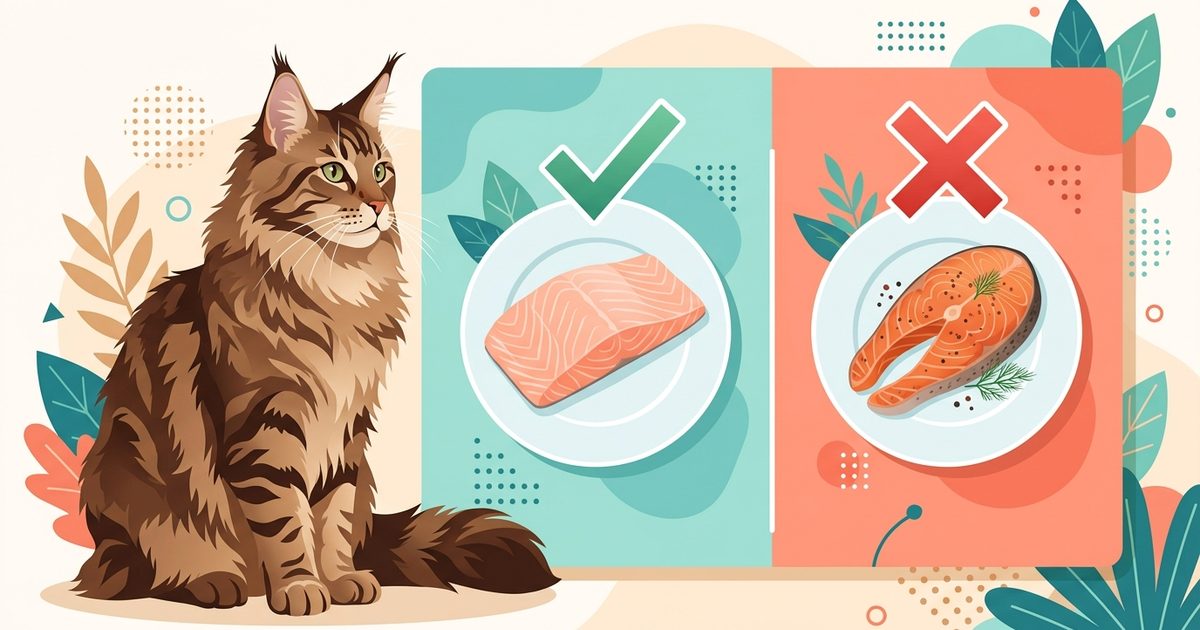
Cook salmon fully with no salt, oil, butter, garlic, onion, or seasoning, and remove all bones before serving. Bake, steam, or poach it plain and flake it into small pieces; never give smoked, cured, or seasoned salmon, which are too salty and often spiced for cats.
Preparing salmon for a cat is mostly an exercise in subtraction — take away everything a human cook would add, and you're left with the safe version. The fish itself is fine; the salt, fat, alliums, and processing that make it taste good to us are what make it risky for them.
Plain cooking methods
The only safe route is plain: bake, steam, or poach the salmon with nothing added, and cook it fully through to kill any parasites. Once cooked, flake it and check every piece by hand for bones, which can hide inside the flakes even after cooking. Let it cool before serving — a cat's mouth is sensitive, and a piece that feels merely warm to your finger can still burn. The goal is a few plain flakes, not a fillet.
What to never add
Nothing belongs in the pan with the salmon: no salt, no oil or butter, no garlic or onion, no lemon, no herbs, no sauces. Many of these aren't just unhealthy — they're toxic. Garlic and onion, in any form, damage a cat's red blood cells and can cause serious harm even in small amounts, which is why the allium toxicity in garlic and the risks of onion are treated as hard limits rather than portion questions. If you wouldn't serve it plain, don't serve it.
Smoked, canned, and cured salmon
Smoked, cured, and otherwise prepared salmon may look like the same fish, but for a cat they're a different food. Smoking and curing pile on sodium and often spices, and the salt load is well beyond what a cat's kidneys are built to handle. Human canned salmon is its own trap: it can be high in salt and is frequently packed with soft bones that are easy to miss. The only forms that belong in a cat's bowl are plain cooked salmon you prepared yourself, or a cat-formulated salmon food from a reputable brand.
How Much Salmon Can a Cat Eat?
Keep salmon to a small treat — roughly a teaspoon-sized piece of plain cooked salmon for a healthy adult cat, and never more than about 10% of daily calories. Kittens, pregnant cats, and cats with health conditions need a vet's guidance before any new treat is introduced.
Salmon is a treat, not a meal — and that single distinction is where most cat owners go wrong. A cat begging for fish is not telling you anything about its nutritional needs; it's telling you it finds salmon delicious. The gap between what your cat wants and what its body actually requires is exactly the gap the 10% rule exists to protect.
The 10% treat rule
Veterinarians and feline nutrition authorities generally agree that treats of all kinds — salmon included — should make up no more than about 10% of a cat's daily calorie intake. The other 90% should come from a complete and balanced cat food, because salmon on its own is missing the taurine, calcium, and vitamin mix a cat needs to stay healthy. The Cornell Feline Health Center is clear on this point: a nutritionally complete diet, not any single treat food, is what keeps a cat well.
The math is humbling. A typical adult cat eats around 200–250 calories a day, which means the entire treat budget is roughly 20–25 calories. Plain cooked salmon runs about 130 calories per ounce, so even a single ounce — a piece smaller than a matchbox — already blows past the limit. A whole fillet, the kind a human would eat for dinner, is absurdly too much: it's a meal for a person, and for a cat it's several days' worth of calories, fat, and fish oil all at once. If you're offering salmon oil for cats as a supplement rather than the fish itself, the same restraint applies — a few drops, not a pour.
Frequency and portion size
Aim for salmon as an occasional treat: a couple of times a week at most, not daily. Each serving should be roughly teaspoon-sized for an average adult cat — a few flakes, not a slab. Smaller cats, senior cats, and any cat carrying extra weight should get even less; for an overweight cat, a single flake as a topper on regular food is plenty, and frankly many cats are perfectly thrilled with exactly that.
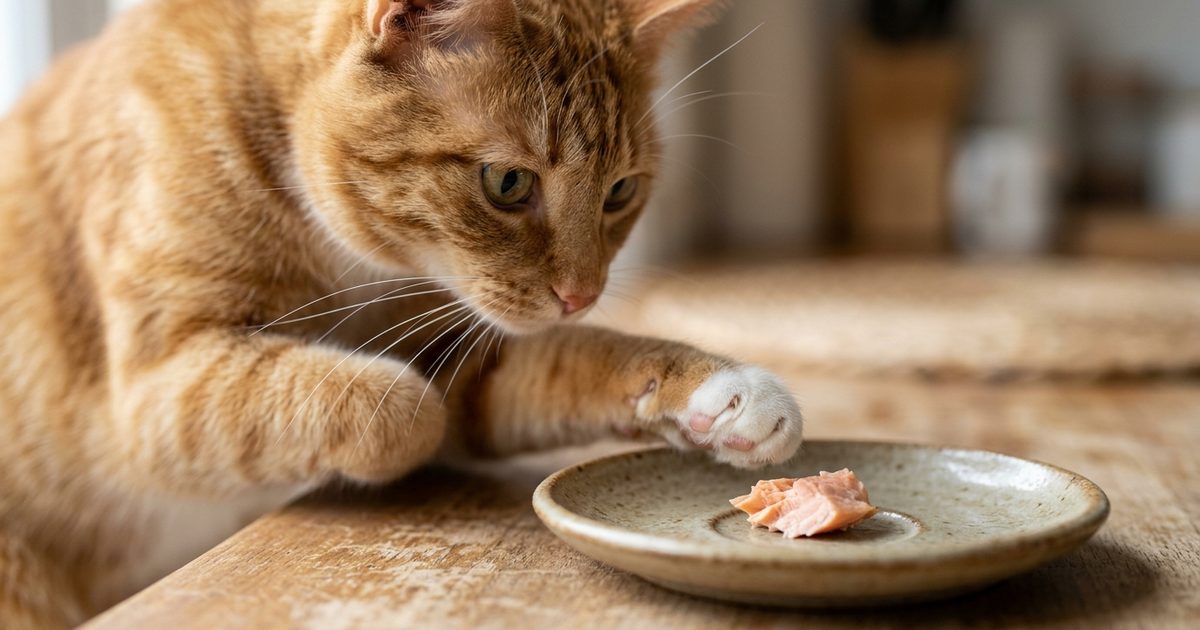
The reason frequency matters is not just calories — it's habit. Cats form strong food preferences quickly, and a fish they get every day fast becomes a fish they expect every day. Irregular, tiny portions keep salmon special and keep your cat eating the complete food that actually sustains it. If you'd like more on how treat-portioning works across high-value foods, our piece on whether cats can eat eggs walks through the same discipline for another protein-rich treat.
What Are the Risks of Feeding Salmon to Cats?
The main risks are bones (choking or internal injury), salt and seasoning from prepared salmon, cumulative mercury — lower than tuna but still treat-only — and salmon fixation, where a cat refuses its regular food. Any vomiting, lethargy, or refusal of normal food after salmon warrants a vet call.
Most problems with salmon don't come from the fish itself — plain cooked salmon in a sensible portion is safe. They come from the form it's served in, the bones left inside it, and the habit it can become. Knowing the specific risks lets you keep what's genuinely good about salmon without stumbling into the avoidable ones.
Bones
Cooked salmon bones are the most underestimated hazard. Cooking makes fish bones brittle, and brittle bones splinter into sharp shards that can lodge in a cat's throat, puncture the digestive tract, or cause internal injury that's hard to spot until it's serious. The fix is simple and non-negotiable: remove every bone before serving, and then check the flakes by hand — run your fingers through the fish and feel for anything stiff or needle-like. Even "boneless" fillets from the store can hide small pin bones, so don't skip the check.
Sodium, seasoning, and additives
Smoked, cured, and otherwise prepared salmon are a different food entirely from plain cooked salmon. They're loaded with sodium — often several times what a cat should have in a day — and frequently spiced with garlic, onion, dill, or other seasonings that range from harmful to outright toxic to cats. Salt poisoning in cats shows up as vomiting, lethargy, excessive thirst and urination, and in serious cases tremors or seizures. The sodium theme is the same one we cover in our article on whether cats can eat tuna, since the human-canned and prepared versions of both fish carry the same salt trap. The International Cat Care guidance on feline nutrition makes the point plainly: foods prepared for human palates are rarely appropriate for cats.
Mercury and salmon fixation
Two risks round out the picture. First, mercury: salmon is lower in mercury than large predatory fish like tuna, but it still bioaccumulates methylmercury, which is exactly why frequency and portion matter — a treat a couple of times a week keeps exposure trivial, while daily feeding lets even small amounts add up over time. Second, and often the sneakier problem, is salmon fixation. Salmon is a high-value, intensely flavored food, and a cat that gets it often can start refusing its regular diet in protest. The way to avoid fixation is the same as the way to avoid every other risk on this list: irregular schedule, tiny portions, and never — ever — letting salmon replace a meal.
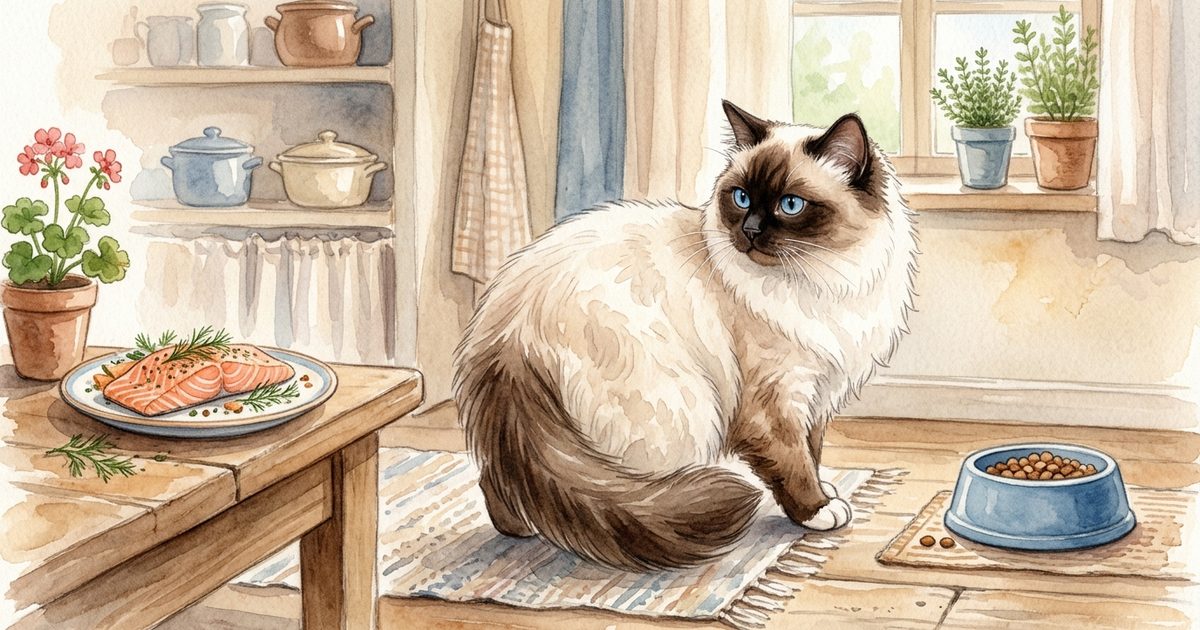
If your cat vomits, goes quiet or lethargic, refuses its normal food, or shows any distress after eating salmon — especially if bones or seasoned salmon were involved — don't wait it out. Call your vet. Most incidents are preventable with plain cooking and small portions, but when something does go wrong, prompt attention makes all the difference.
Salmon for Cats at a Glance — Summary
| Question | Short answer |
|---|---|
| Can cats eat salmon? | Yes — plain cooked salmon, in small amounts as an occasional treat |
| Can cats eat raw salmon? | No — raw salmon has thiaminase and may carry parasites and bacteria |
| Is salmon good for cats? | Yes, in moderation — rich in omega-3s and protein, but nutritionally incomplete alone |
| How should I prepare it? | Plain cooked (baked, steamed, poached), fully deboned, no salt or seasoning |
| How much can a cat eat? | A teaspoon-sized piece, never more than 10% of daily calories |
| What are the main risks? | Bones, salt and seasoning, cumulative mercury, and salmon fixation |
Curious What Your Cat Would Say?
Upload a photo and get a warm, personalized reading from your cat's perspective.
Start Your Free ReadingFrequently Asked Questions
Can cats eat salmon every day?
No. Salmon is a treat, not a daily food — feeding it daily risks crowding out the complete diet your cat needs and can lead to food fixation where she refuses regular meals. Keep it to a couple of small servings a week at most.
Can cats eat raw salmon?
No. Raw salmon contains thiaminase, an enzyme that destroys vitamin B1, and it can carry parasites and bacteria like Salmonella and Listeria. Even sushi-grade salmon isn't safe for cats — always cook it fully first.
Can cats eat cooked salmon?
Yes — plain, fully cooked salmon with no salt, oil, garlic, onion, or seasoning, and with all bones removed, is safe for most healthy adult cats as an occasional small treat. Bake, steam, or poach it plain.
How much salmon can I give my cat?
Roughly a teaspoon-sized piece of plain cooked salmon for an average adult cat, no more than about 10% of daily calories, a couple of times a week. Smaller, senior, or overweight cats should get even less — a single flake on top of regular food is plenty.
Can kittens eat salmon?
Only with your vet's guidance. Kittens need a precisely balanced growth diet, and their small bodies are more sensitive to salt, bones, and dietary imbalance. Plain cooked salmon is generally fine in a tiny pinch of a flake, but ask your vet before offering any new treat.
Is salmon good for cats?
Yes, in moderation. Salmon is one of the few readily available sources of marine omega-3s (EPA and DHA) that support skin, coat, and joints, plus high-quality protein. But it's nutritionally incomplete on its own, so it stays a treat rather than a meal.
Can cats eat smoked salmon?
No. Smoked and cured salmon are loaded with sodium — often several times what a cat should have in a day — and frequently spiced with garlic, onion, or herbs that are toxic to cats. Only plain cooked salmon belongs in a cat's bowl.
Is salmon oil good for cats?
It can be, with vet guidance. A vet-recommended salmon oil supplement delivers concentrated, dosable marine omega-3s (EPA and DHA) for skin and coat, without the bones and salt of the fish itself. It's a supplement to a complete diet, never a replacement for one.
What happens if my cat eats salmon bones?
Cooked salmon bones are brittle and can splinter into sharp shards that may lodge in the throat or puncture the digestive tract. Always debone fully and check flakes by hand before serving. If your cat shows vomiting, lethargy, or distress after eating fish, call your vet promptly.
Sources & References
You Might Also Like
Kitten Teething: Timeline, Symptoms & How to Help
Kitten teething runs from 3 to 7 months as baby teeth fall out. Learn the timeline, signs to watch for, and how to soothe a teething kitten safely.
15 min readWhen Do Cats Stop Growing? A Complete Timeline
When do cats stop growing? Most cats reach adult size by 12-18 months, but large breeds like Maine Coons keep growing until 3-4 years. Full timeline inside.
14 min readCan Cats Eat Cherries? Flesh, Pit & Toxicity Facts
Can cats eat cherries? Pitted flesh is safe in tiny amounts — but the pit, stem, and leaves are toxic (cyanide precursors). Learn what's safe and what isn't.
15 min read