
Can Cats Eat Tuna? Safety, Risks, and How Much Is Safe
So, can cats eat tuna? Yes — as an occasional treat, never as a dietary staple. The safe form is plain cooked tuna or tuna made specifically for cats. The short answer matters here because plenty of cats will beg for it, and plenty of owners will wonder whether can cats eat canned tuna means the can sitting in their own pantry is fair game. The human-grade stuff often isn't — it carries too much sodium and sometimes oil or seasonings — and that gap between what a cat craves and what's actually good for it is what this article unpacks.
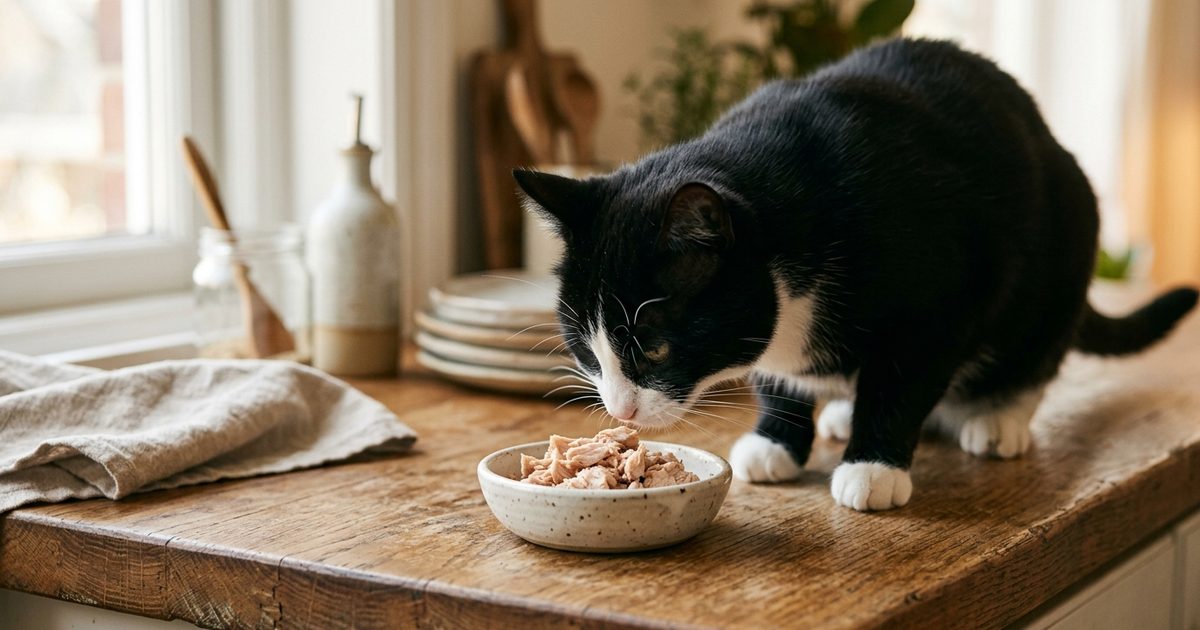
This guide walks through the safety verdict, the mercury and sodium risks that put a hard ceiling on frequency, why raw tuna isn't the "natural" choice it might seem, and how much — roughly a teaspoon, about once a week — is the right ceiling. If you want the deeper context of how tuna fits into a complete feline diet, that's the backdrop; here we're zooming in on one food.
Key takeaways
- Verdict: Yes — tuna is safe as an occasional treat, never as a staple or meal replacement.
- Safe form: Plain cooked tuna, or tuna formulated specifically for cats (the latter is nutritionally balanced).
- Frequency cap: Keep it to about a teaspoon, no more than once a week, and never more than 10% of daily calories.
Tuna for Cats — Quick Reference
| Tuna form | Safe for cats? | Notes |
|---|---|---|
| Plain cooked tuna | Yes, as a treat | Bake or boil with nothing added; small pieces only |
| Cat-formulated canned tuna | Yes, regularly | Balanced with taurine and vitamins; fine in rotation |
| Human canned tuna in water | Rarely, in tiny amounts | Choose no-salt-added and rinse well first |
| Human canned tuna in oil | No | Extra fat and calories; risks GI upset and pancreatitis |
| Raw tuna | No | Contains thiaminase; can also carry parasites and bacteria |
| Tuna with salt or seasoning | No | Salt is toxic in small doses; onion and garlic are dangerous |
Can Cats Eat Tuna?
Yes — cats can eat tuna, but only as an occasional treat, never as a dietary staple. The safe form is plain cooked tuna or tuna made specifically for cats; it should replace no more than about 10% of your cat's daily calories and appear at most around once a week.
The short answer
So, can cats eat tuna? Yes — in small amounts, tuna is safe for cats, and most cats adore it. The key word is small. A little plain cooked tuna, or a treat made for cats, is perfectly fine now and then. What it is not is a meal. Tuna is a treat, not a staple, and the difference matters more than most owners assume. A cat that loves tuna is not a cat that should eat tuna every day — enthusiasm and nutritional fit are two separate things, and we'll see exactly why in the next section.
If you want the one-line version: a teaspoon of plain cooked tuna, once a week or less, is a safe way to share. Anything beyond that — daily feeding, replacing regular food, sharing your own canned tuna — moves from treat into territory where the risks start to outweigh the joy.
Why cats go crazy for tuna
Cats are famously enthusiastic about tuna, and there's a real sensory explanation. A cat's nose has roughly 200 million scent receptors, far more than a human's — so the strong, fishy aroma of tuna hits a cat's olfactory system at full intensity. Tuna is also rich in umami compounds, the savory taste cats are wired to seek out in meat. Together, the smell and the taste make tuna one of the most appealing foods you can offer a cat.
The danger is letting that enthusiasm make the decision for you. A cat that begs for tuna is not telling you tuna is good for it — it's telling you tuna is exciting. Left to choose, many cats would happily eat tuna until it crowded out everything else, and that's precisely the scenario that causes harm. Preference is not the same as nutrition, which is why a complete and balanced diet has to stay in charge of the bowl.
Why Is Tuna a Treat and Not a Staple?
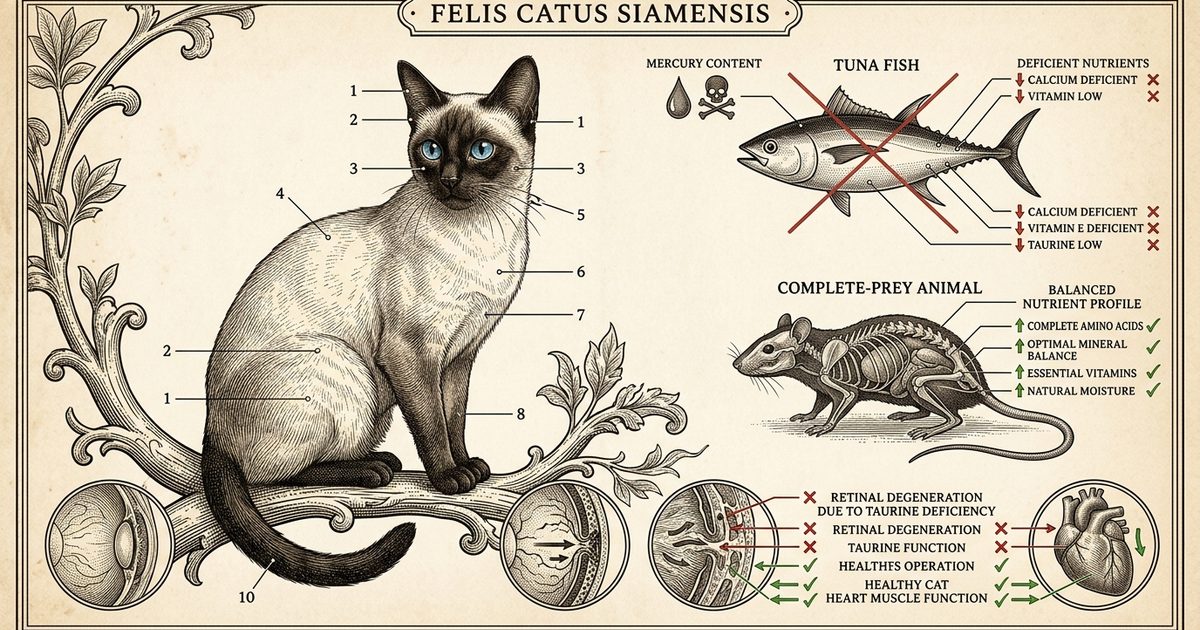
Tuna is nutritionally incomplete for cats — it lacks enough taurine, calcium, vitamin E, and other nutrients a cat needs, and the mercury in tuna builds up over time. A tuna-only or tuna-heavy diet causes malnutrition, heart and eye damage, and eventual mercury toxicity.
Nutritionally incomplete
A complete cat food is built around everything an obligate carnivore needs: the right amino acids, fatty acids, vitamins, and minerals in the right ratios. Tuna, on its own, is not that. It's high in protein, yes, but it's low in calcium relative to phosphorus, short on vitamin E, and — critically — it doesn't supply enough taurine, an amino acid cats must get from food because their bodies can't make it. Sustained taurine deficiency leads to dilated cardiomyopathy, a serious heart condition, and to degeneration of the retina that can end in blindness. A bowl of plain tuna, however fresh, is missing the very nutrients that keep a cat's heart and eyes working.
There's also a common myth worth correcting: the idea that fish is a "natural" food for cats. It isn't, in the way most people assume. Domestic cats evolved from desert-dwelling ancestors that hunted small terrestrial prey — rodents, birds, lizards — not ocean fish. The tuna in your kitchen is a modern indulgence, not an ancestral staple. For a full picture of what a complete feline diet actually looks like, the Cornell Feline Health Center is a reliable authority on feline nutrition.
Mercury accumulation
Tuna sits near the top of the ocean food chain, and like other long-lived predator fish, it bioaccumulates methylmercury — a form of mercury that builds up in tissue over time rather than being cleared quickly. That means the risk from tuna isn't about any single meal. A one-off teaspoon won't hurt a healthy cat. The danger is frequency: a cat fed tuna daily, or several times a week, takes in small doses of mercury that compound over weeks and months into a real toxic burden.
This is why the serving size and the once-a-week ceiling both matter, but the frequency matters most. An occasional spoonful is well within what a cat can handle; daily feeding is not. The distinction between an occasional treat and a regular habit is exactly where tuna crosses from safe to harmful, and International Cat Care covers fish and mercury in feline diets in more depth.
Steatitis (yellow fat disease)
One lesser-known risk of a tuna-heavy diet is steatitis, also called yellow fat disease. Tuna is high in polyunsaturated fatty acids but relatively low in vitamin E, and that imbalance matters: vitamin E is what protects fat tissue from oxidative damage. When a cat eats enough tuna that the polyunsaturated fat outpaces the available vitamin E, the body's fat tissue becomes inflamed, hardened, and painful. Steatitis is a documented consequence of diets built around oily fish, and it's one more reason tuna belongs in the treat category, not the daily bowl — a genuine risk to be aware of, not a scare to fear when tuna stays occasional.
Tuna for Humans vs Tuna Made for Cats
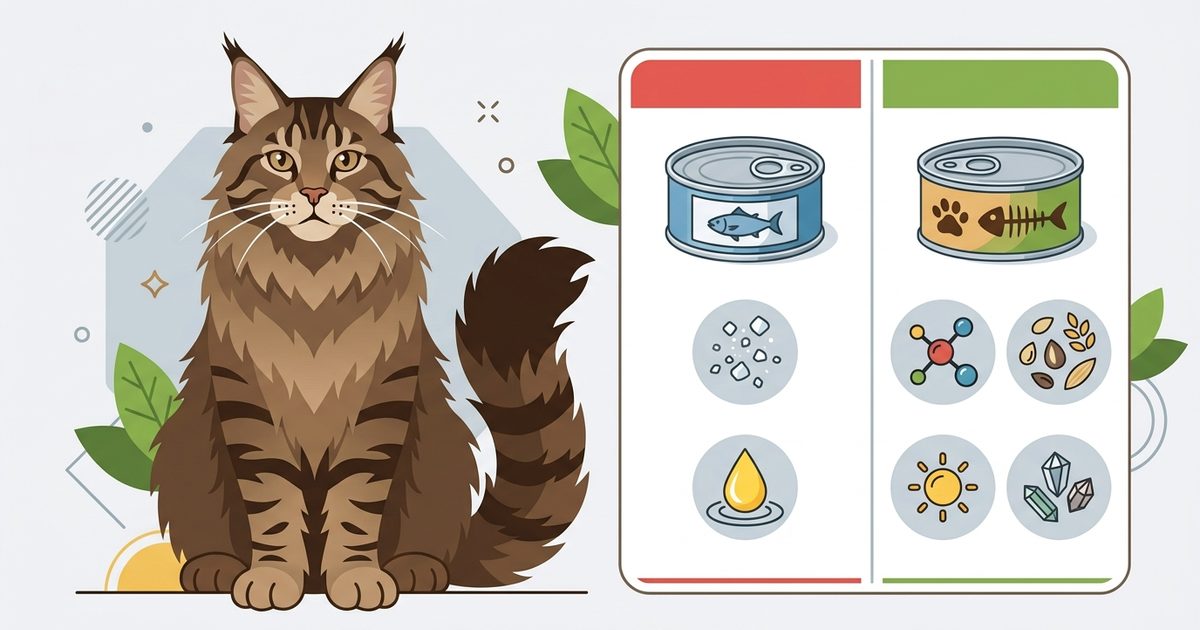
Human canned tuna is high in sodium and often packed in oil or salted broth, both of which are bad for cats. Tuna formulated for cats is nutritionally balanced and far safer; if you share your own tuna, choose no-salt-added tuna in water and rinse it first.
The can in your pantry and the can on the pet-shop shelf are not the same product, even when both say "tuna." Understanding the difference is what keeps a shared treat from becoming a vet visit — and it answers one of the most common questions owners type into a search bar: can cats eat canned tuna? The honest answer is "it depends entirely on which can."
The sodium problem
Human canned tuna is often processed with added salt to make it taste better to people. That seasoning is fine for a 70 kg human and a serious load for a 4 kg cat, whose kidneys are far more sodium-sensitive than ours. If you've ever wondered whether cats can eat canned tuna straight off your plate, the sodium content is the first reason to hesitate. Signs of too much salt — vomiting, lethargy, excessive thirst, and wobbliness — warrant a vet call. Plain cooked tuna, or cat-formulated tuna, sidesteps the issue entirely.
Oil-packed vs water-packed
Oil-packed tuna is the worse choice for cats. The oil adds unnecessary fat and calories a house cat does not need, and a sudden fatty meal can trigger gastrointestinal upset or, in sensitive cats, pancreatitis — a painful inflammation of the pancreas. Water-packed, no-salt-added tuna is the lesser evil if you are sharing your own, and a quick rinse under the tap reduces residual sodium. The safest route, though, remains tuna made for cats.
Cat-formulated tuna foods
Commercial tuna made for cats is a different category. These foods are supplemented with the taurine, vitamins, and minerals that plain tuna lacks, so they are nutritionally complete rather than a treat-only snack. That is the form you can feed regularly as part of a rotation alongside other complete cat foods, unlike human tuna, which should stay occasional. Many owners rotate it with other proteins like chicken or salmon to keep meals interesting without leaning too hard on any one fish.
Can Cats Eat Raw Tuna?
No — raw tuna is not safe for cats. Raw fish contains thiaminase, an enzyme that destroys thiamine (vitamin B1), and can carry parasites and harmful bacteria. Always cook tuna fully before offering it to your cat, even a small piece.
It's tempting to think raw fish must be natural for a cat — after all, cats and fish feel like an obvious pairing. But biology disagrees. Cats evolved hunting small terrestrial and aquatic prey, not large ocean fish, and raw tuna brings two distinct problems that cooking reliably solves. If you are asking can cats eat raw tuna, the answer is a clear no.
The thiaminase problem
Raw tuna contains thiaminase, an enzyme that destroys thiamine — vitamin B1 — as the fish is eaten and digested. Thiamine is essential for nerve function, and a cat that regularly eats raw fish can slide into a deficiency. According to International Cat Care, thiamine deficiency in cats shows up as loss of appetite, vomiting, seizures, a head tilt, and a progressive neurological decline that can become life-threatening if feeding continues. Cooking deactivates thiaminase, which is why cooked tuna is safe while raw tuna is not. The danger is in repeated exposure: a single sushi-bit is unlikely to cause harm, but raw tuna given often will.
Parasites and bacteria
Raw ocean fish can carry live parasites — Anisakis roundworms are a known concern — along with bacteria such as Salmonella and Listeria. Freezing at home does not reliably eliminate all of these, contrary to common belief; commercial deep-freezing for specific times and temperatures does, but it is not something a household freezer can reproduce. Cooking remains the one dependable kill step.
Sushi-grade is still not safe for cats
"Sushi-grade" sounds reassuring, but it refers to human-parasite freezing standards for raw consumption — not to thiaminase, and not to the broader risks a small cat faces. The label does not make raw tuna appropriate for a cat. The safe rule, with no exceptions: cook tuna fully before it reaches your cat's bowl, whether it came from a can, a steak, or a sushi counter.
One more caution on seasoned human tuna products: some flavored pouches and tins contain onion or garlic, which are toxic to cats in even small amounts. See our guides on onion and garlic for why allium seasonings turn a "tuna treat" into something genuinely dangerous.
How Much Tuna Can a Cat Eat?
Keep tuna to a small treat — roughly a teaspoon of plain cooked tuna, no more than once a week for a healthy adult cat, and never more than 10% of daily calories. Kittens, pregnant cats, and cats with health conditions need a vet's guidance first.
If you've ever wondered how much tuna can a cat eat, the answer is deliberately modest. Tuna is a treat, not a meal — and "treat" means a quantity small enough that it can't meaningfully unbalance the diet your cat relies on the other six days of the week.
The 10% treat rule
The widely cited guideline in feline nutrition is the 10% rule: everything that isn't a complete-and-balanced cat food — treats, table scraps, tuna — should add up to no more than 10% of your cat's daily calories. The other 90% has to come from a formulated diet that supplies the taurine, calcium, vitamins, and minerals tuna lacks. Cornell Feline Health Center reinforces that treats should never displace nutritionally complete food.
A typical adult cat eats around 200–250 calories a day, so the entire treat budget is roughly 20–25 calories. A teaspoon of plain cooked tuna is about 5–7 calories — well within budget. A whole can, at 100+ calories, blows past it several times over and crowds out real nutrition. That's also why tuna belongs inside the same portion discipline as any other high-protein tidbit — the logic in our can cats eat eggs guide applies here too: a complete food it is not. For the wider dietary picture tuna fits into as a rare accent, see what do cats eat.
Frequency and portion size
Frequency matters as much as amount, because mercury and the habituation risk both build with repetition. For plain cooked tuna, once a week is a sensible ceiling for a healthy adult cat, and less is always fine. Portion size scales to the cat: a teaspoon is right for an average 4–5 kg cat, but a small or overweight cat should get less — half a teaspoon, or even the residue left when you lick a spoon clean. For many cats that spoon-lick is genuinely enough; they want the taste and the smell, not volume.
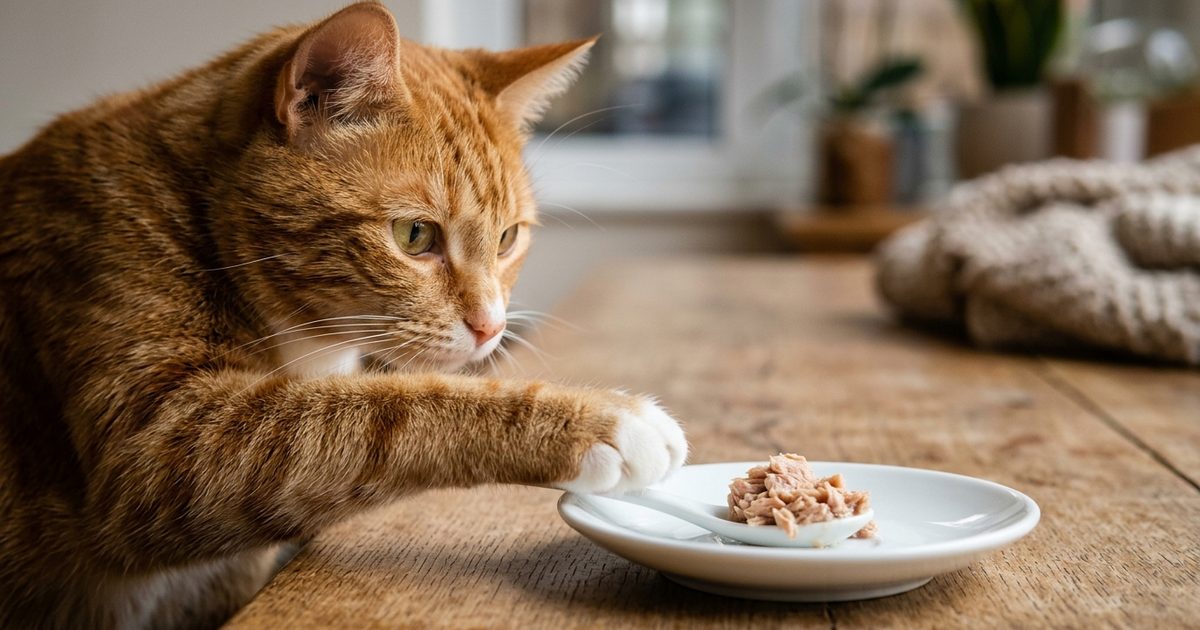
Two practical guardrails keep this sustainable. First, never let tuna arrive on a predictable schedule — irregular timing prevents a cat from learning to hold out for it and refusing regular food, a pattern International Cat Care flags with highly palatable foods. Second, if your cat has kidney disease, diabetes, is pregnant, or is a kitten under a year, skip the experiment and ask your vet first — their tolerances for sodium, mercury, and nutritional imbalance are tighter than a healthy adult's.
What Are the Risks of Feeding Tuna to Cats?
The main risks are mercury buildup from frequent feeding, malnutrition if tuna replaces complete food, sodium poisoning from human canned tuna, and tuna addiction — where a cat refuses regular food and holds out for tuna. Any sudden vomiting, lethargy, or refusal of normal food after tuna warrants a vet call.
Even a safe treat carries some risk if you misunderstand how to use it. The four concerns below aren't reasons to panic — they're reasons to keep tuna as an occasional treat and to choose the right form.
Mercury poisoning
Tuna is a long-lived predatory fish, so it accumulates methylmercury over its lifetime, and that mercury builds up in a cat's tissues over months of frequent feeding — this is a chronic-exposure concern, not a single-meal one. Signs of mercury toxicity in cats include ataxia (loss of coordination), weakness, tremors, and in severe cases seizures. A teaspoon once a week is well within safe territory; daily tuna is where the math turns against you. For contrast, salmon carries a lower mercury load than tuna, which is one reason fish rotation matters if your cat eats fish regularly.
Sodium and additives
Human canned tuna often contains added salt, oil, or flavorings that are bad news for a small cat. Excess sodium causes vomiting, lethargy, and excessive thirst, and a cat's kidneys are far less tolerant of salt than ours. Some flavored tuna products also contain onion or garlic — both genuinely toxic to cats and capable of damaging red blood cells even in small amounts. If you're weighing seasonings, the risks go well beyond taste: read our guides on why cats can't eat onion and garlic toxicity in cats. Plain cooked tuna, or tuna made specifically for cats, sidesteps all of this.
Tuna addiction and food refusal
The hardest risk to manage isn't chemical — it's behavioral. Tuna is so high-value and so powerfully smelly that a cat who gets it too often can develop a fixation, refusing regular food and holding out for the good stuff. This isn't stubbornness; it's a real behavioral trap where the treat outcompetes the complete diet. The fix is simple discipline: keep tuna on an irregular schedule, offer tiny portions rather than a meal-sized amount, and never let it replace a real meal. The Cornell Feline Health Center stresses that a cat's enthusiasm for a food is not a good measure of whether that food should be a dietary staple.
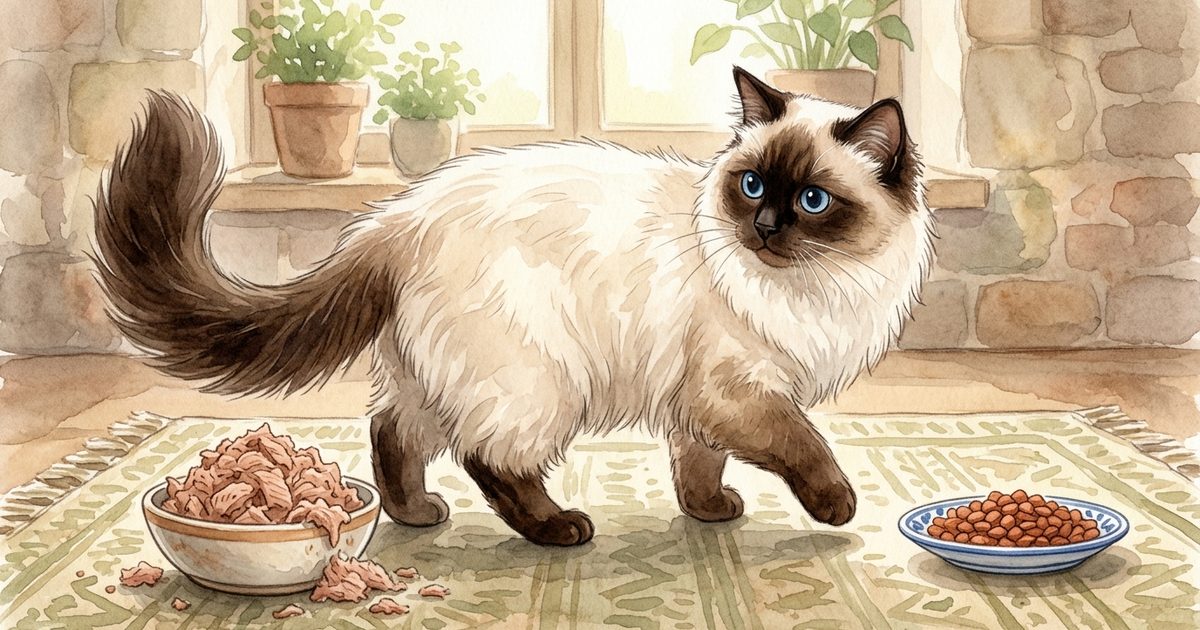
Tuna for Cats at a Glance — Summary
| Question | Short answer |
|---|---|
| Can cats eat tuna? | Yes — but only as an occasional treat, never a dietary staple |
| Is tuna a complete food? | No — it lacks taurine, calcium, and vitamin E; a tuna-heavy diet causes malnutrition |
| Human tuna vs cat tuna? | Human canned tuna is high-sodium and often oil-packed; cat-formulated tuna is nutritionally balanced |
| Can cats eat raw tuna? | No — raw fish has thiaminase (destroys vitamin B1) and can carry parasites; always cook it |
| How much is safe? | Roughly a teaspoon of plain cooked tuna, at most weekly, never more than 10% of daily calories |
| Main risks? | Mercury buildup, malnutrition if it replaces meals, sodium poisoning, and tuna addiction |
The pattern is simple: tuna is a treat that earns its place through rarity, not regularity. Keep it plain, keep it cooked, keep it small — and a cat that goes wild for the smell will still get all its real nutrition from a complete food, with the tuna as an occasional joy rather than a daily habit.
Curious What Your Cat Would Say?
Upload a photo and get a warm, personalized reading from your cat's perspective.
Start Your Free ReadingFrequently Asked Questions
Can cats eat tuna every day?
No. Tuna is high in mercury and nutritionally incomplete, so daily feeding causes mercury buildup and malnutrition over time. Keep it to an occasional treat — roughly a teaspoon, once a week or less — and let a complete cat food make up the rest of the diet.
Can cats eat canned tuna?
It depends on the can. Human canned tuna is usually high in sodium and often oil-packed, both of which are bad for cats. If you share your own, choose no-salt-added tuna in water, rinse it, and offer only a small amount. Tuna formulated specifically for cats is nutritionally balanced and the safer everyday choice.
Can cats eat raw tuna?
No. Raw tuna contains thiaminase, an enzyme that destroys thiamine (vitamin B1), and repeated feeding can cause neurological decline. Raw fish can also carry parasites and bacteria. Always cook tuna fully before offering even a small piece to your cat.
How much tuna can I give my cat?
Roughly a teaspoon of plain cooked tuna, no more than once a week for a healthy adult cat, and never more than 10% of daily calories. Smaller or overweight cats should get less — for many cats, the residue left when you lick a spoon clean is genuinely enough.
Can kittens eat tuna?
Tuna is best avoided as a regular treat for kittens. Their tolerances for sodium, mercury, and nutritional imbalance are tighter than an adult cat's, and they need every calorie to come from a complete growth-formulated food. If you want to share a tiny taste, ask your vet first.
Why is my cat obsessed with tuna?
Cats have around 200 million scent receptors, so the strong fishy aroma hits their olfactory system at full intensity, and tuna is rich in umami compounds cats are wired to seek out. Enthusiasm is sensory excitement, not proof the food is good for them — which is exactly why preference shouldn't dictate the bowl.
Is tuna good for cats?
As an occasional treat, plain cooked tuna is fine and most cats love it. But tuna is not a complete food: it lacks enough taurine, calcium, and vitamin E, and it carries mercury that builds up with frequent feeding. Good as a treat, not as a staple.
Can cats eat tuna in oil?
No. Oil-packed tuna adds unnecessary fat and calories a house cat does not need, and a sudden fatty meal can trigger gastrointestinal upset or, in sensitive cats, pancreatitis. If you are sharing human tuna, choose water-packed, no-salt-added, and rinse it first.
Is tuna-flavored cat food the same as human tuna?
No. Commercial tuna cat food is supplemented with the taurine, vitamins, and minerals that plain tuna lacks, so it is nutritionally complete and can be fed regularly as part of a rotation. Human tuna is a treat-only food — the two are different categories.
What happens if a cat eats too much tuna?
Too much tuna can cause mercury buildup, malnutrition if it displaces complete food, sodium poisoning from salted human products, or a behavioral fixation where the cat refuses regular meals. Watch for vomiting, lethargy, wobbliness, or refusal of normal food, and call your vet if any appear.
Sources & References
You Might Also Like
Kitten Teething: Timeline, Symptoms & How to Help
Kitten teething runs from 3 to 7 months as baby teeth fall out. Learn the timeline, signs to watch for, and how to soothe a teething kitten safely.
15 min readWhen Do Cats Stop Growing? A Complete Timeline
When do cats stop growing? Most cats reach adult size by 12-18 months, but large breeds like Maine Coons keep growing until 3-4 years. Full timeline inside.
14 min readCan Cats Eat Cherries? Flesh, Pit & Toxicity Facts
Can cats eat cherries? Pitted flesh is safe in tiny amounts — but the pit, stem, and leaves are toxic (cyanide precursors). Learn what's safe and what isn't.
15 min read