
What Do Cats Eat? A Complete Guide to a Healthy Cat Diet
Curious What Your Cat Would Say?
Upload a photo and get a warm, personalized reading from your cat's perspective.
Start Your Free ReadingWhat do cats eat, and what counts as a healthy cat diet? These are the first questions most new cat owners ask — and the answers matter more than any other choice you'll make for your cat. At the core, cats are obligate carnivores: animals built to run on meat. The bulk of what can cats eat should be a complete commercial cat food, with a short list of safe treats and an even shorter list of foods that are genuinely toxic.
A good cat diet rests on three ideas. Cats must eat animal protein — their bodies cannot make several essential nutrients from plants. A complete, life-stage-appropriate commercial food should form the large majority of every day's meals. And knowing the handful of foods that can hurt your cat — onion, garlic, chocolate, grapes — is non-negotiable. This guide covers the biology behind a cat's diet, what to feed, what to avoid, and how feeding shifts from kittenhood through the senior years.
Key takeaways
- Cats are obligate carnivores — they must eat meat to stay healthy, and several of their essential nutrients come only from animal tissue.
- A complete commercial cat food, labeled for your cat's life stage, should be the daily base of every healthy cat diet.
- Know the short toxic-food list (onion, garlic, chocolate, grapes, raisins) and adjust what you feed as your cat ages.
What Cats Can and Can't Eat — Quick Reference
| Food | Cats can eat it? | Notes |
|---|---|---|
| Commercial complete cat food | Yes — daily base | Look for an AAFCO "complete and balanced" statement for your cat's life stage. |
| Plain cooked meat (chicken, salmon) | Yes — as a treat | Unseasoned, deboned, no oil or salt; keeps to under 10% of daily calories. |
| Cat grass | Yes | Safe and many cats enjoy it; not a nutritional need. |
| Small amounts of some veggies & fruits | Yes — sparingly | A little cooked pumpkin, steamed carrot, or seedless watermelon is fine as a rare treat. |
| Onion, garlic, and chives | No — toxic | Damage red blood cells and cause anemia, even in powdered form. |
| Chocolate | No — toxic | Theobromine and caffeine affect the heart and nerves; dark chocolate is most dangerous. |
| Grapes and raisins | No — toxic | Can cause kidney failure; even a single raisin isn't worth the risk. |
| Dog food | No — not adequate | Missing the protein and cat-essential nutrients a cat needs; a stolen bite is harmless, a steady diet is not. |
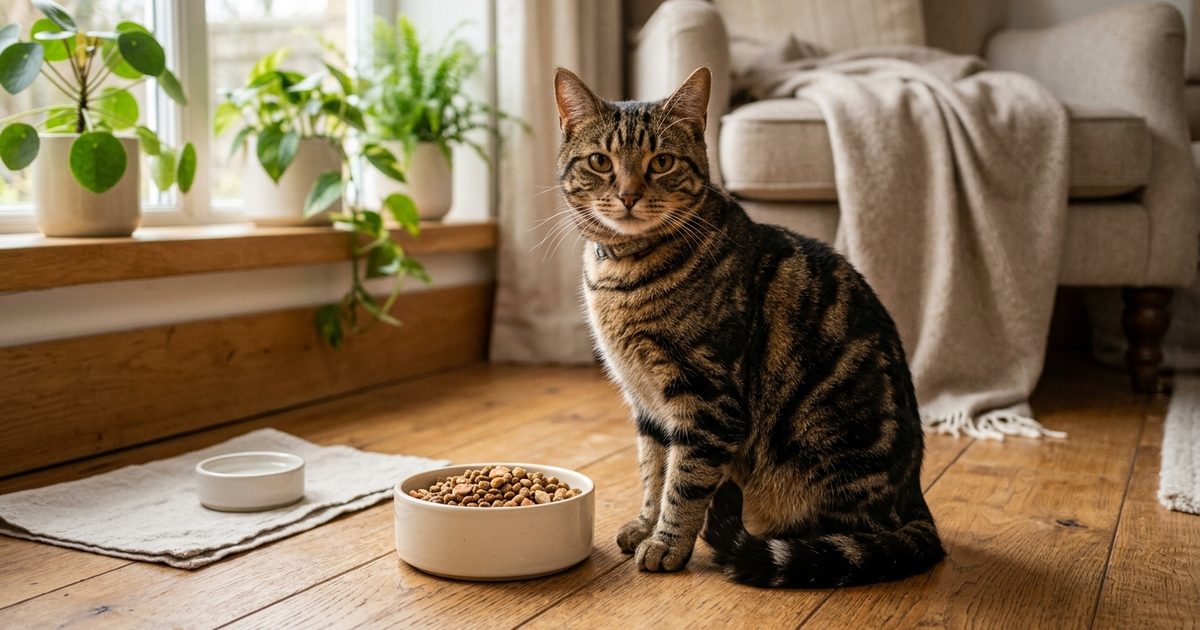
What Do Cats Eat? Cats Are Obligate Carnivores
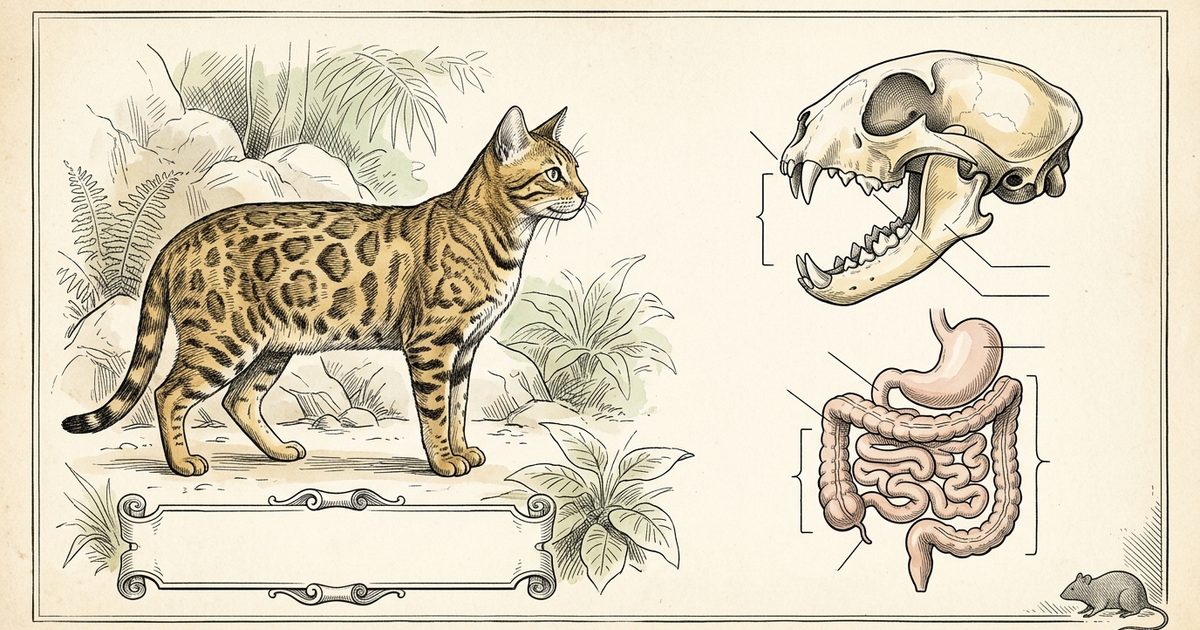
Cats are obligate carnivores — they must eat meat to survive. Animal tissue supplies the taurine, arginine, preformed vitamin A, and arachidonic acid a cat's body cannot synthesize from plant sources. A plant-only diet will make a cat seriously ill, so the bulk of their food must come from animal tissue.
So what do cats eat? The honest, biological answer is meat. Cats are obligate carnivores, and that single fact shapes nearly every other decision about their diet — from the food you pour into the bowl to the foods that are outright dangerous. Understanding why cats need meat makes the rest of cat nutrition click into place.
What "obligate carnivore" means
An obligate carnivore is an animal whose body has lost the metabolic machinery to thrive on plants. Unlike dogs or humans, who can flex between meat and plant foods, cats have, over millions of years of evolution as hunters, narrowed their biochemistry to run on animal tissue. Their teeth are built for shearing flesh, not grinding grain; their gut is short, reflecting a diet of protein and fat that moves through quickly; and their liver is tuned to a constant, high flow of protein.
"Obligate" is the key word — it means a cat cannot choose otherwise and stay healthy. A dog might tolerate a carefully planned plant-based diet; a cat cannot. The Cornell Feline Health Center describes cats as strict carnivores whose unique nutritional requirements must be met from animal sources. That distinction is the foundation of every recommendation that follows in this guide.
The nutrients cats can only get from meat
Several nutrients essential to a cat are either absent from plants or present in a form a cat cannot use. These are the reasons a "complete and balanced" commercial formulation matters so much.
- Taurine — an amino acid cats cannot synthesize in adequate amounts. Taurine deficiency causes dilated cardiomyopathy (a form of heart failure) and irreversible blindness. It is found almost exclusively in animal tissue.
- Arginine — a cat's liver depends on arginine to clear ammonia. A single arginine-deficient meal can trigger hyperammonemia, a rapid and dangerous toxicity.
- Preformed vitamin A — humans convert beta-carotene from plants into vitamin A; cats cannot do this efficiently. They need the preformed vitamin A found in liver and animal fats.
- Arachidonic acid — an essential fatty acid cats must obtain from animal fats, since they lack the enzyme to make it from plant oils.
These are not minor gaps that a supplement can patch around. International Cat Care catalogs the full set of feline essential nutrients, most of which trace back to animal tissue. This is why even the best-formulated homemade diet is hard to get right, and why a complete commercial food is the reliable base. Meat is not a preference, it is a biological requirement — and this single fact is why the vegan-diet question, covered later, has such a clear answer.
Why cats cannot be vegan
Because of the essential animal-derived nutrients covered above, a plant-only diet cannot meet a cat's needs — even when supplemented. Synthetic taurine and added vitamins are often poorly absorbed or unstable, and formulations drift over time. Documented cases of cats fed vegan diets include heart disease, blindness, and severe malnutrition. This isn't a matter of preference or ethics competing with nutrition; it is a hard biological limit. If a household cannot feed animal products, then a cat is, simply, not the right pet for that home. We revisit this in the myths section below.
Cats and water
There's one more thing cats "eat" that owners often overlook: water. Cats evolved to get most of their moisture from prey, so they have a naturally weak thirst drive. This is why wet food, which is roughly 70-80% water, meaningfully raises a cat's total water intake and supports urinary tract health. Dry food is perfectly fine as a base, but a cat on an all-dry diet will drink less than one eating wet food, so always keep a bowl of fresh water available. There's no single correct wet-to-dry ratio — that's an owner-and-vet decision based on the individual cat.
What Is a Balanced Cat Diet?
A balanced cat diet is a complete commercial cat food — wet, dry, or a formulated raw diet — labeled as meeting AAFCO or NRC nutrient profiles for the cat's life stage. This complete food should make up the large majority of what a cat eats; treats and toppers stay under 10% of daily calories.
If obligate carnivory is the why, the balanced diet is the how. Healthy cat food is, in practical terms, a commercially complete food that has been formulated to deliver every nutrient a cat needs — the proteins, fats, vitamins, and minerals we just listed — in the right proportions for the cat's stage of life. Treats, toppers, and the occasional bite of plain chicken are extras layered on top, not replacements.
Look for "complete and balanced"
The label that matters most on any cat food is the nutritional adequacy statement. In the US, that means a statement from AAFCO confirming the food is "complete and balanced" for a specific life stage — either validated through feeding trials or formulated to meet established nutrient profiles. The NRC (US/Canada) and FEDIAF (Europe) set equivalent standards. A food labeled "complementary" or sold as a topper is not a full diet; feeding it as one will cause deficiencies over time. Life-stage labeling matters too: a food marked for "growth" suits kittens, "maintenance" suits adults, and "all life stages" covers both but may be calorie-rich for a sedentary adult.
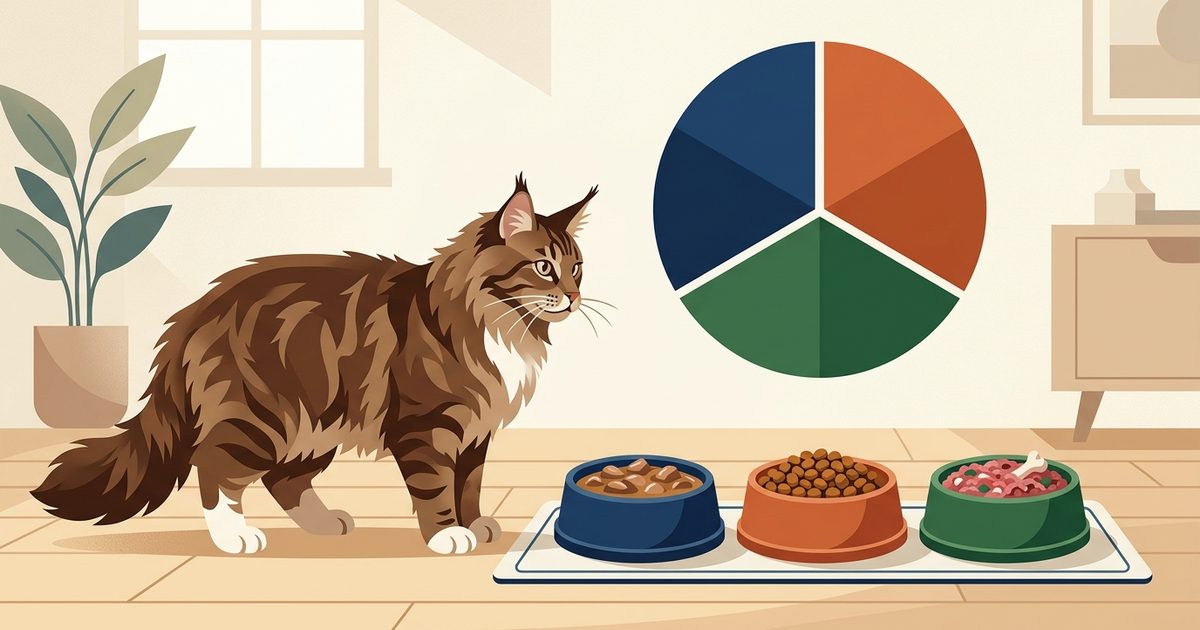
Wet, dry, and formulated raw
All three formats can form the base of a balanced diet, and each has trade-offs:
- Wet food — high moisture (great for hydration and urinary health), palatable, but spoils quickly once opened and costs more per calorie.
- Dry food — convenient, cost-effective, and easy to store and portion; the dental benefit is often overstated (we cover that myth below), and its low moisture means fresh water matters more.
- Formulated raw — commercially frozen or freeze-dried raw diets produced to pathogen-control standards. This is a genuinely different proposition from homemade raw, which carries real nutritional-balance and bacterial risk. Whether raw is right for a given cat is a decision best made with a vet.
None of these is inherently "best." The right mix depends on the cat's health, the owner's routine, and budget. It's worth noting that chicken is already the protein base of most commercial foods — if you're curious why, our can cats eat chicken guide breaks it down.
Reading a cat food label
Once you know what to look for, a cat food label is straightforward. Check for a named animal protein at the top of the ingredient list — "chicken" or "salmon," not a vague "meat." Then scan the guaranteed analysis for minimum protein and fat, and maximum fiber and moisture. Most importantly, find the AAFCO nutritional adequacy statement — that's the line that tells you the food is actually complete. Ignore marketing words like "gourmet," "natural," or "premium"; these have no standard nutritional meaning and tell you nothing about whether the food meets your cat's needs. The adequacy statement is the one label that counts.
How much and how often
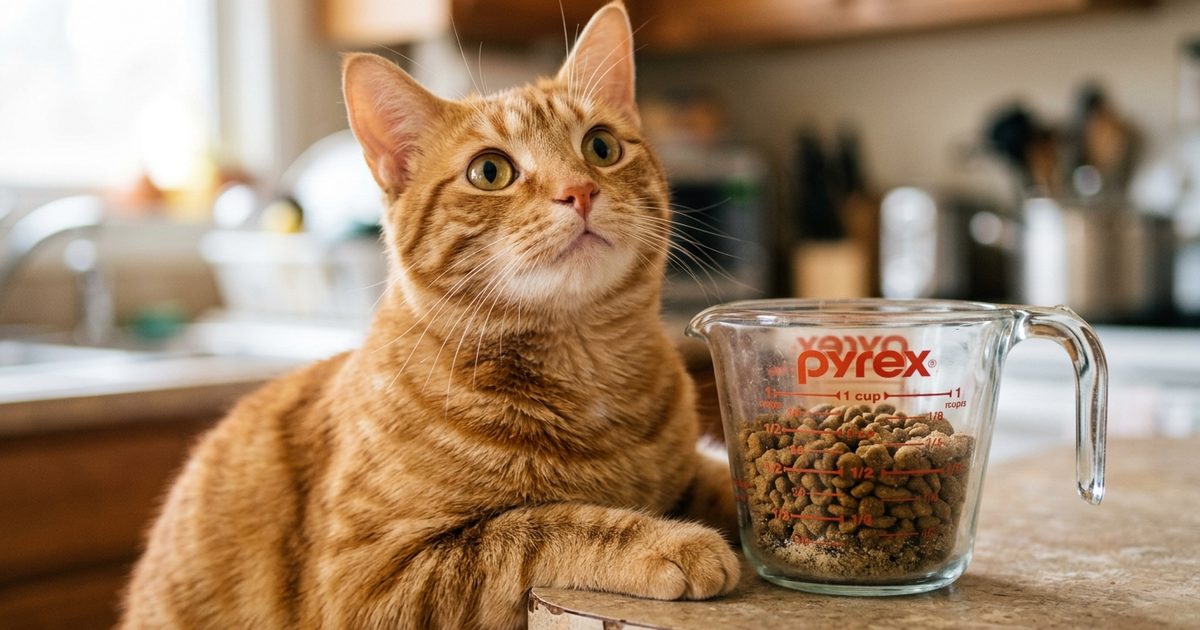
Calorie needs vary with a cat's weight, age, activity, and whether they're neutered, but a typical adult cat eats roughly 200-300 kcal per day. The most reliable approach is measured meals — portioning out the food's recommended amount — rather than free-pouring, which quietly leads to the most common adult-cat nutrition problem: obesity. Check the package's feeding guide as a starting point, then adjust based on your cat's body condition (you should be able to feel the ribs without pressing hard). Whatever format you feed, keep treats and toppers under 10% of daily calories so they don't crowd out the complete food. For kittens, who eat more frequently and need growth-formula calories, our how much to feed a kitten guide has the portion math.
What Foods Can Cats Eat as Treats?
As treats, cats can eat small amounts of plain cooked meat like chicken or salmon, cat grass, and a little of some cat-safe vegetables and fruits like pumpkin or watermelon. Treats should stay under 10% of daily calories — they are extras, not a replacement for complete cat food.
If you've ever wondered what human food cats can eat, the honest answer is: less than you'd think, and only as an occasional extra. Because cats are obligate carnivores, the bulk of what they eat should always be a complete commercial cat food. The foods below are safe additions — a small reward, a training tidbit, a bit of enrichment — never the meal itself. Keep every treat combined under about 10% of your cat's daily calories, and your cat's balanced diet stays intact.
Plain cooked meat and fish
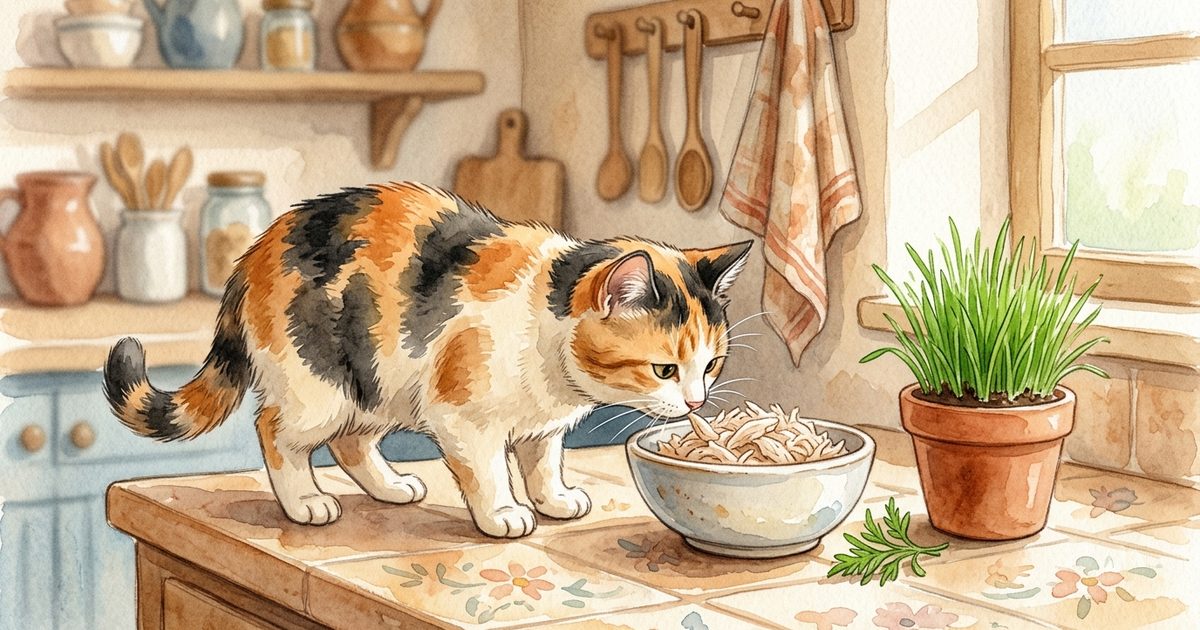
The safest and most natural treats for a cat are small pieces of plain cooked meat or fish. Cooked, unseasoned chicken or turkey, and cooked salmon or tuna, all make excellent protein tidbits. The rules that matter: no salt, no oil, no butter, and absolutely no onion or garlic — not even as a marinade or cooking flavor — because those alliums are toxic even in small amounts. Remove all bones (cooked bones splinter), and cut the meat into pea-sized pieces. It doesn't take much: a teaspoon of shredded chicken is a generous treat for an average cat. If you want the full safety picture for any one protein, our deep dives on can cats eat chicken, can cats eat salmon, and can cats eat tuna cover portions, frequency, and the specific cautions for each.
Cat grass and safe greens
Many cats enjoy nibbling grass, and providing cat grass — usually oat, wheat, or barley grass grown specifically for cats — is a safe way to satisfy that urge. You may notice your cat sometimes regurgitates afterward; this is normal grass-eating behavior and not usually cause for concern. Small amounts of cooked plain pumpkin, steamed carrot, or steamed broccoli are also tolerated by some cats and can add a little fiber. If you're curious why cats seek out greens in the first place, we explore the reasons in why do cats eat grass — the short version is a mix of instinct, fiber, and sometimes settling the stomach.
Some fruits, in tiny amounts
A few fruits are safe in truly small amounts: a bite of seedless watermelon, a thin slice of banana, or one or two blueberries. These are mostly sugar and water, so they are a novelty rather than any kind of nutritional need — keep them rare and small, and never let fruit crowd out complete food. Always remove seeds, pits, and rinds. Our can cats eat watermelon and can cats eat bananas guides cover the specifics.
Cooked eggs and cheese, sparingly
A small amount of fully cooked plain egg — scrambled or hard-boiled with nothing added — is a dense, protein-rich treat many cats love. Cheese is more complicated: a tiny crumb is usually tolerated, but most adult cats are lactose-intolerant, and dairy commonly causes diarrhea. Keep cheese to a rare, minimal tidbit, and if your cat reacts badly, stop. For the full picture, see can cats eat eggs, can cats eat cheese, and our guide to whether cats can drink milk — the short answer is no, the classic saucer of milk is a myth that doesn't serve most cats.
What Foods Are Toxic to Cats?
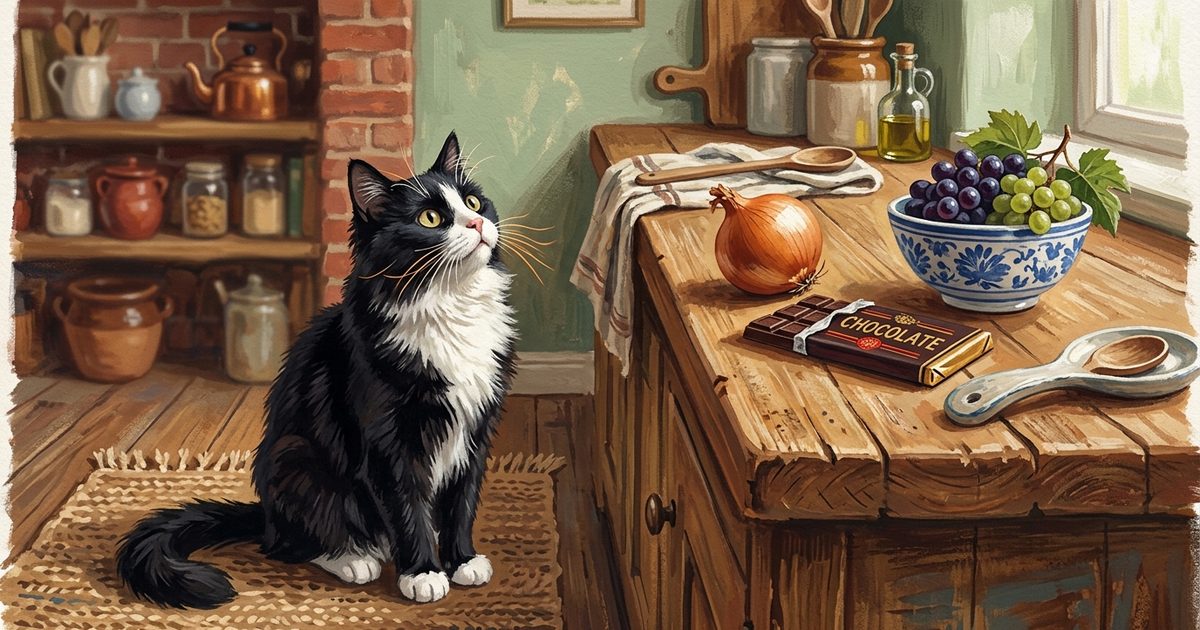
Several common foods are toxic to cats: onion, garlic, and chives damage red blood cells; chocolate and caffeine affect the heart and nerves; grapes and raisins can cause kidney failure; xylitol, alcohol, and raw yeast dough are dangerous. Any suspected ingestion warrants a vet call.
This is the list every cat owner should know cold. These foods aren't "unhealthy" in the way too many treats are — they are poisonous, and the line between a harmless nibble and an emergency can be surprisingly thin. If you ever suspect your cat has eaten something on this list, call your vet or a pet poison helpline immediately rather than waiting for symptoms. Cats are small, their metabolism handles toxins differently from ours, and early action is the single biggest factor in outcomes. The Cornell Feline Health Center and International Cat Care both maintain reliable reference material on common feline toxins.
Onion, garlic, and chives (alliums)
Onion, garlic, leeks, and chives — the allium family — destroy a cat's red blood cells, causing a condition called Heinz body anemia. This is true of every form: raw, cooked, dried, and powdered. The danger hides in places owners don't expect: onion powder in broth, onion in baby food, garlic in pasta sauce licked off a plate. There is no safe "small amount" here, because the damage is cumulative — repeated tiny exposures add up just as a single large one does. Symptoms — lethargy, pale gums, weakness — can take days to appear. We cover the mechanism and recovery in can cats eat onion and the broader condition in cat anemia.
Chocolate and caffeine
Chocolate contains theobromine and caffeine, both of which cats process poorly — and cats are more sensitive to these compounds than dogs, which is saying something. Dark chocolate and baking chocolate are the most dangerous because they carry the highest concentration; milk chocolate is less potent but still toxic in meaningful amounts. Symptoms range from vomiting and restlessness to tremors, abnormal heart rhythm, and seizures. Caffeinated drinks, energy drinks, and coffee grounds carry the same risk. See can cats eat chocolate for the full breakdown.
Grapes and raisins
Grapes and raisins can cause acute kidney failure in cats. The exact mechanism isn't fully understood, but the link is well documented, and the toxic dose appears to vary widely between individuals — meaning there's no reliable "safe" amount. Because the outcome can be severe and is unpredictable, even a single raisin isn't worth the risk. If you know your cat has eaten grapes or raisins, treat it as a potential emergency and call your vet. Our can cats eat grapes guide covers the details and what to watch for.
Xylitol, alcohol, and raw dough
Xylitol, a sweetener found in sugar-free gum, candy, and some peanut butters, is firmly toxic to dogs; the evidence in cats is less complete, but veterinary authorities advise treating it as dangerous and keeping all xylitol products away from cats. Alcohol in any amount is harmful — cats are far more sensitive to ethanol than humans, and even a small amount of a sweet liqueur can cause dangerous drops in blood sugar, body temperature, and coordination. Raw yeast dough is a double hazard: it produces ethanol as it rises, and it expands in the stomach, which can cause painful and dangerous bloating. Never let a cat access any of the three.
Lilies and other plants
This isn't strictly a food, but it belongs on the same danger list because cats routinely nibble plants, and lilies are among the most lethal things a cat can ingest. Every part of a lily is toxic — the petals, the leaves, the stem, the pollen, and even the water in the vase — and ingestion causes rapid, often irreversible kidney failure. A cat that brushes against a lily and later grooms the pollen off its fur can be poisoned. If lilies are ever in the home, assume the cat will find them. Our are lilies toxic to cats guide covers the emergency response, and cat-safe plants lists greens you can keep without worry.
Other household dangers
A few more to keep out of reach: macadamia nuts, unbaked bread dough, and very salty or fatty table scraps. Salty, greasy leftovers can trigger gastrointestinal upset or pancreatitis, a painful and serious inflammation of the pancreas. When in doubt about anything your cat has eaten, call your vet or a poison helpline rather than guessing — fast, cautious advice is almost always free and can prevent a bad situation from getting worse.
How Does a Cat's Diet Change by Life Stage?
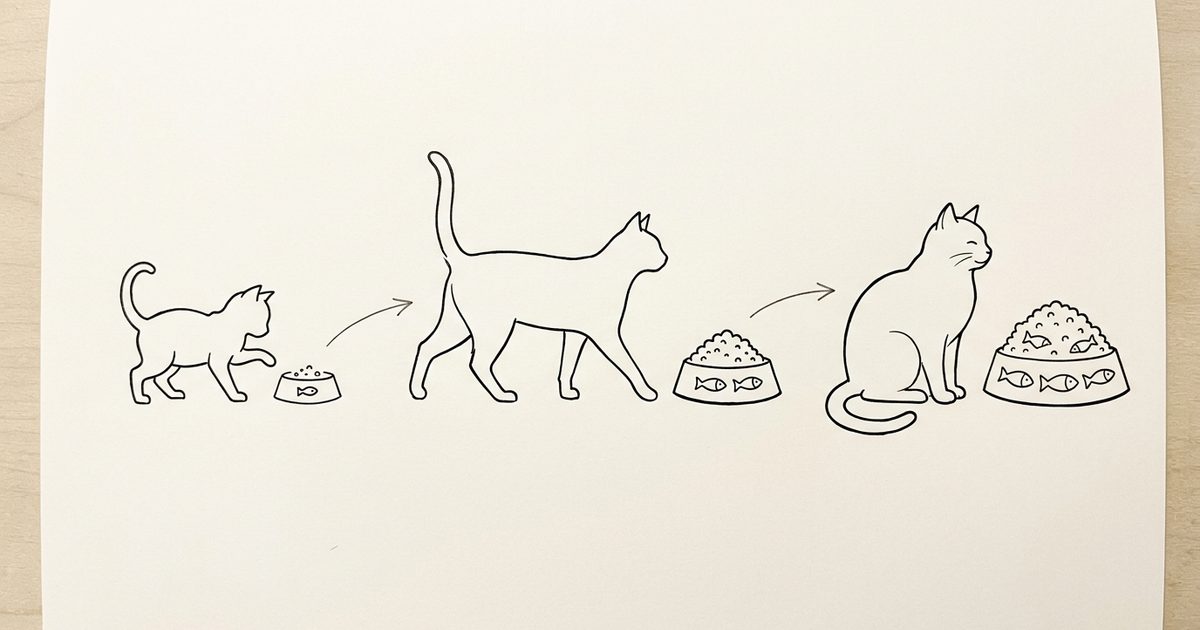
A cat's diet changes with age: kittens eat calorie- and protein-dense growth formula several times a day; healthy adults eat a maintenance formula in measured portions; seniors often need fewer calories but more easily digestible protein and sometimes kidney or joint support chosen with a vet.
The single biggest mistake an owner can make is feeding the same food, in the same amount, from kittenhood through old age. A cat's body reinvents its nutritional priorities three or four times across a lifespan, and a "one food for life" approach slowly drifts out of sync with what that body actually needs. Here's what changes, and when. The Cornell Feline Health Center walks through each life-stage window in more depth.
Kittens (0–12 months)
A kitten is building bone, muscle, brain, and immune tissue all at once, on a frame that may double in weight in a matter of weeks. That burns fuel fast. A growing kitten needs a food explicitly labeled for growth or all-life-stages — meaning it meets the higher protein, fat, calcium, and DHA targets a developing body demands. DHA, an omega-3 fatty acid, supports brain and vision development; protein and calcium build the skeleton and muscle.
Kittens also eat more often than adults — typically three to four small meals a day — because their stomachs are small and their energy needs are relentless. Feeding adult-only maintenance food to a kitten is a real and common error: it's diluted for a slower metabolism, and a kitten eating it will grow more slowly and may fall short on the nutrients that matter most in this narrow window. For the actual portion math, see our guide on how much to feed a kitten.
Adult cats (1–7ish years)
Once a cat is fully grown — usually around 12 months — it shifts onto a maintenance formula. The growth surges are over; the job now is to hold a healthy weight, not pile on new tissue. This is also the life stage where the most common feline nutrition problem appears: obesity. An adult cat's appetite did not evolve to match a bowl that never empties, so feeding measured meals rather than free-pouring is the single highest-leverage habit an owner can build.
Calories need to track reality. A neutered, indoor, low-activity cat burns noticeably fewer calories than an intact, active one, and the food guide on the bag is a starting estimate, not a verdict. Adjust portions to what the scale and the cat's body condition actually tell you over a few weeks. Wet, dry, or a mix is an owner-and-vet decision; what matters most is that the total calories land where they should.
Senior cats (7+ / 10+ years)
Older cats often need fewer calories — they slow down, lose muscle mass, and metabolize differently — but the quality of the protein they do eat becomes more important, not less. A senior's body is less efficient at hanging onto muscle, so easily digestible, high-quality protein helps preserve lean mass.
Some seniors develop conditions that change the diet itself: kidney disease may call for a lower-phosphorus, kidney-friendly formula, and joint stiffness may benefit from foods with joint-support nutrients. Dental disease is common in older cats and can make eating painful — if a cat starts eating less or dropping food, that's a vet flag, not "just aging," and the underlying dental issue matters more than the food choice. Read more in our guide on cat dental health. One rule to internalize: weight loss in a senior cat is never normal aging. It warrants a vet visit, because it so often points to hyperthyroidism, kidney disease, or another treatable condition.
Pregnant and nursing queens
A pregnant or lactating cat is, metabolically, running a kitten's growth program inside her own body — and then feeding those kittens on top of it. The simplest approach is to feed her kitten-formula food throughout pregnancy and nursing, because it carries the extra calories, protein, and calcium the job demands. During active nursing, free-feeding is reasonable: she will regulate her own intake, and her needs can be two to three times her normal. For the full timeline, see how long cats are pregnant.
What Should Cats NOT Eat? Common Diet Mistakes
Cats should not eat dog food, milk, too many treats, or plant-only diets. Dog food lacks enough protein and cat-specific nutrients; most adults are lactose-intolerant; treats above ten percent of calories crowd out complete food and cause obesity; and plants alone cannot supply the animal-derived nutrients covered above.
The foods below aren't poisons — a single bite won't send you to the emergency vet the way an onion or a grape will. They're a different kind of mistake: things owners feed intentionally, believing they're doing right, that quietly unbalance a cat's diet over weeks and months. These are worth naming clearly because they're built on persistent images — the saucer of milk, the shared bowl with the dog — that are hard to shake.
Dog food
Dog food looks like cat food and sits in a similar bowl, so it's an easy assumption that they're interchangeable. They're not. Dog food is lower in protein, and it's missing or short on several of the cat-specific nutrients explained under obligate carnivores above — most notably taurine, along with arachidonic acid and preformed vitamin A. A dog can manufacture or tolerate lower levels of these; a cat cannot.
A stolen bite from the dog's bowl is harmless — cats are remarkably resilient to a single off-meal. The problem is dog food as a staple. Fed long-term, it causes the slow, quiet malnutrition that comes from missing the nutrients only animal tissue, properly formulated, supplies. If you have both pets, feed them separately, from their own food. For the full breakdown, see can cats eat dog food.
Milk and dairy
The saucer of milk beside a sleeping cat is one of the most enduring images in pet culture, and it's also one of the most wrong. Most adult cats are lactose-intolerant. As kittens, they produce lactase, the enzyme that breaks down milk sugar; after weaning, lactase production drops sharply in the majority of cats. Drink milk as an adult, and the undigested lactose ferments in the gut — the result is gas, cramping, and diarrhea, often within hours.
This is true of cow's milk and most dairy. A tiny taste of cheese or yogurt is usually tolerated because the lactose content is lower, but it's still not doing the cat any nutritional favor. The right drink for a cat is clean, fresh water, always available. If you want to give milk as a treat, lactose-free cat milk exists — but water is what the body actually needs. We go deeper on this in can cats drink milk.
Vegan and vegetarian diets
This is worth restating plainly, because it gets reframed as a lifestyle choice and it isn't one for a cat. As covered under obligate carnivores, the nutrients a cat's body runs on exist in bioavailable form in animal tissue and not reliably anywhere else, and supplementation cannot reliably close that gap. The attempts to make plant-based cat food "complete" have, in documented cases, caused serious illness — dilated cardiomyopathy from taurine deficiency, eye damage, and metabolic crashes from missing amino acids.
The honest framing is this: a plant-only diet is not a reliable substitute for the nutrients meat supplies, because absorption, formulation drift, and the sheer number of cat-essential gaps make plant-based formulations fragile. If a household cannot feed animal product, a cat may not be the right companion for that household. International Cat Care is blunt on this point, and the biology backs them up.
Too many treats and obesity
Treats feel like love, and a begging cat is hard to refuse — but treat overload is one of the most common ways a cat's diet quietly breaks. The rule of thumb is the 10% ceiling: treats and toppers should stay under 10% of a cat's daily calories. Above that line, the treats begin to crowd out the complete food that actually supplies balanced nutrition, and the cat ends up overfed but undernourished.
The downstream cost is real. Feline obesity is widespread, and it's not cosmetic — excess weight drives insulin resistance and diabetes, stresses joints, and shortens lifespan. The fix isn't complicated: measure the daily food, count treats against it, and resist the urge to top up the bowl every time a cat asks. A cat asking for food is very often asking for attention or play, not calories — reading that signal correctly does more for the cat's health than any single treat decision.
Common Myths About What Cats Eat
Cats do not need milk, dry food does not clean their teeth, and cats cannot be vegan. A raw diet is not automatically best, poultry-by-product meal is not filler, and a cat begging for food is often asking for attention, not nutrition.
Cats have lived alongside us for thousands of years, so a thick layer of folk wisdom has built up around feeding them — much of it inherited from a time before we understood feline nutrition. Some of these beliefs are harmless; others quietly steer owners toward choices that don't serve the cat. Here are the ones worth correcting.
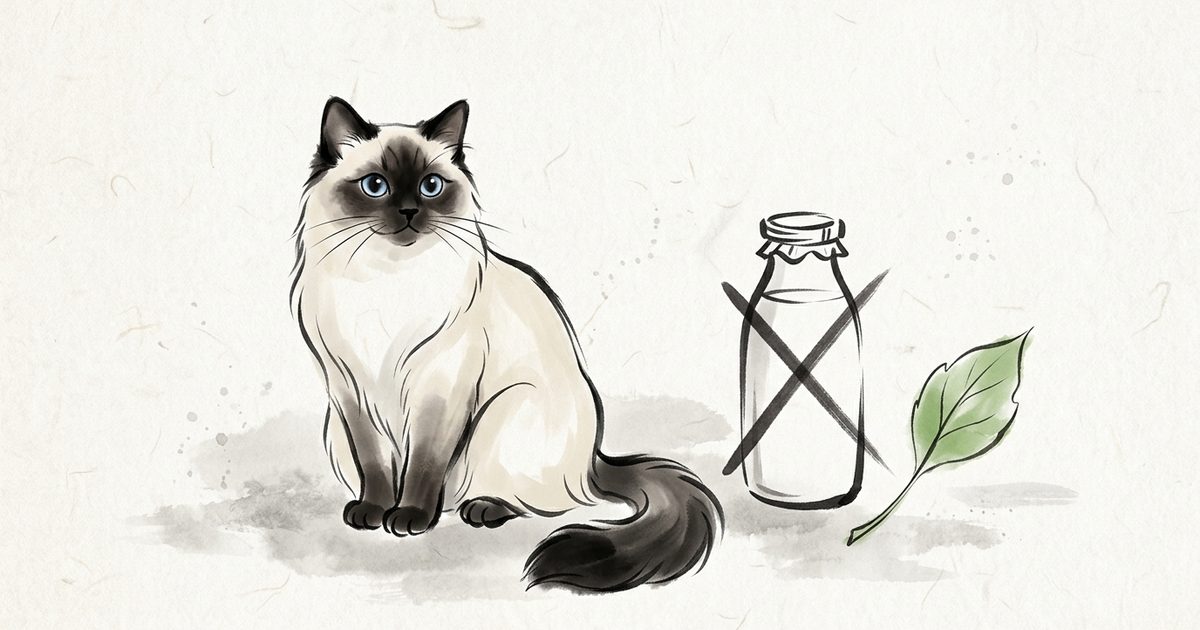
Myth: Cats should drink milk. Fact: Most adult cats are lactose-intolerant — they lose the enzyme that breaks down milk sugar after weaning, so a saucer of milk typically causes diarrhea and stomach upset rather than nourishment. Fresh water is the right drink. Read the full breakdown in can cats drink milk.
Myth: Dry food cleans a cat's teeth. Fact: This is one of the most persistent myths, and it doesn't hold up — dental disease remains endemic in cats fed exclusively on kibble. Most dry food shatters on contact, so it never actually scrubs the tooth surface the way a true dental diet would. Dental health comes from brushing, veterinary cleanings, and dental-specific products, not from the shape of the kibble.
Myth: Cats can be healthy on a vegan diet. Fact: They cannot. As obligate carnivores, cats require several nutrients their bodies cannot synthesize from plant sources (see the full list under obligate carnivores above). Supplemented plant-based diets have caused documented illness, and supplementation is not a reliable substitute for animal tissue.
Myth: A raw diet is always the best diet. Fact: Raw feeding is genuinely debated among veterinarians and owners, and there is no consensus that it is automatically superior. The key distinction is that commercially formulated raw — frozen or freeze-dried to pathogen-control standards — is a very different proposition from homemade raw, which carries real pathogen and nutritional-balance risk. The right call depends on your cat, your diligence, and a conversation with your vet; decide there rather than assuming raw is a universal upgrade.
Myth: "By-product meal" means filler. Fact: Properly processed poultry or meat by-product meal is organ and tissue — liver, heart, kidney, and similar parts — that supplies real, bioavailable nutrients cats can use. It is not inherently low-quality, though ingredient quality and sourcing do vary by brand. The word to watch is not "by-product" but whether the food meets AAFCO nutrient profiles and is transparent about its sourcing.
One more that isn't a formal myth but trips up many owners: a cat circling and meowing near the bowl is often asking for attention or interaction, not more food. Cats are small animals whose daily calorie needs are modest — and obesity, not underfeeding, is the far more common problem in pet cats today.
What Cats Eat at a Glance — Summary
| Question | Short answer |
|---|---|
| What do cats eat in the wild? | Small prey — mice, birds, and insects; mostly muscle meat, organ, and bone |
| What should the bulk of a pet cat's diet be? | A complete commercial cat food labeled to meet AAFCO or NRC profiles for its life stage |
| What meat can cats eat as treats? | Small amounts of plain cooked chicken, turkey, salmon, or tuna — unseasoned and deboned |
| Can cats be vegan? | No — cats are obligate carnivores and cannot stay healthy without animal-derived nutrients |
| What foods are toxic to cats? | Onion, garlic, and chives; chocolate; grapes and raisins; xylitol; alcohol; lilies |
| Do cats need milk? | No — most adult cats are lactose-intolerant; fresh water is the right drink |
| How does diet change with age? | Kittens need growth formula fed often; adults need measured maintenance food; seniors often need fewer calories but higher-quality protein |
| How many treats are too many? | Anything over roughly 10% of daily calories — treats are extras, not a replacement for complete food |
If you remember one thing about what cats eat, let it be this: a cat is an obligate carnivore that thrives on complete commercial food, knows a short list of toxic foods to avoid, and eats differently at each life stage. Get those three right and the rest is fine-tuning.
Curious What Your Cat Would Say?
Upload a photo and get a warm, personalized reading from your cat's perspective.
Start Your Free ReadingFrequently Asked Questions
What do cats eat naturally in the wild?
In the wild, cats eat small prey — mainly mice, birds, and insects. A prey carcass is mostly muscle meat, with organ tissue and some bone, which together supply the taurine, protein, and moisture a cat's body is built to run on.
What is the healthiest food to feed a cat?
The healthiest base is a complete commercial cat food labeled as meeting AAFCO or NRC nutrient profiles for your cat's life stage. Wet, dry, or a formulated raw diet can all work — the right choice depends on your cat's health, your routine, and a conversation with your vet.
Can cats eat human food?
Cats can eat small amounts of certain human foods as treats — plain cooked chicken or salmon, a little cooked pumpkin, or a bite of seedless watermelon. Keep all treats under 10% of daily calories, and avoid toxic foods like onion, garlic, chocolate, and grapes entirely.
What foods are toxic to cats?
Onion, garlic, and chives damage red blood cells; chocolate and caffeine affect the heart and nerves; grapes and raisins can cause kidney failure; and xylitol, alcohol, and raw yeast dough are dangerous. Lilies are also lethally toxic. Call your vet if you suspect ingestion.
Can cats be vegan?
No. Cats are obligate carnivores whose bodies cannot synthesize taurine, arachidonic acid, preformed vitamin A, and several other essential nutrients from plants. Even supplemented plant-based diets have caused documented illness, so meat is a biological requirement, not a preference.
Should cats drink milk?
Most adult cats are lactose-intolerant and lose the enzyme needed to digest milk after weaning, so a saucer of milk usually causes diarrhea and stomach upset. Clean, fresh water is the right drink for a cat — always available.
How is a kitten's diet different from an adult cat's?
Kittens need a growth-formula food with higher protein, fat, calcium, and DHA to support rapid development, fed in three to four small meals a day. Adults shift to a maintenance formula in measured portions, because their growth is finished and the main risk becomes obesity.
How many treats can a cat eat a day?
Treats and toppers should stay under roughly 10% of a cat's daily calories. Above that, treats begin to crowd out the complete food that supplies balanced nutrition, and the cat ends up overfed but undernourished — a common path to obesity.
Is a raw diet better for cats?
Raw feeding is genuinely debated, and there is no consensus that it is automatically superior. Commercially formulated raw — frozen or freeze-dried to pathogen-control standards — is very different from homemade raw, which carries real nutritional-balance and bacterial risk, so decide with your vet.
Sources & References
You Might Also Like
Kitten Teething: Timeline, Symptoms & How to Help
Kitten teething runs from 3 to 7 months as baby teeth fall out. Learn the timeline, signs to watch for, and how to soothe a teething kitten safely.
15 min readWhen Do Cats Stop Growing? A Complete Timeline
When do cats stop growing? Most cats reach adult size by 12-18 months, but large breeds like Maine Coons keep growing until 3-4 years. Full timeline inside.
14 min readCan Cats Eat Cherries? Flesh, Pit & Toxicity Facts
Can cats eat cherries? Pitted flesh is safe in tiny amounts — but the pit, stem, and leaves are toxic (cyanide precursors). Learn what's safe and what isn't.
15 min read