
Can Cats Eat Dog Food? It's Wrong, Not Just Bigger Kibble
So you've noticed your cat lingering around the dog's bowl — and the question lands fast: can cats eat dog food, or is that harmless sharing actually a slow harm? It's one of the most common multi-pet puzzles, and the honest answer splits cleanly in two: a few stolen kibbles won't hurt your cat, but dog food is the wrong meal for her, every time. That gap — between "won't poison" and "isn't suitable" — is exactly where so much confusion about whether is dog food bad for cats lives.
This guide walks through the nutritional mismatch in plain terms: why the kibble looks similar but is built for a different species, what your cat actually needs that dog food quietly omits, and how to keep mealtimes separate without turning your kitchen into a standoff.
Key takeaways
- A few stolen kibbles won't harm a cat, but dog food is not a safe meal — it is nutritionally wrong, not toxic.
- Cats are obligate carnivores with needs dog food does not meet — higher protein, taurine, pre-formed vitamin A, and arachidonic acid.
- Long-term feeding causes serious deficiencies (heart disease, vision loss), so feed cats and dogs separately.
Can Cats Eat Dog Food? — Quick Reference
| Form | Safe for cats? | Why |
|---|---|---|
| A few stolen kibbles | Yes — harmless | One-off trace exposure; a cat's stored nutrients buffer it |
| A single dog-food meal | Mostly fine, not ideal | No emergency, but it's a meal built for a dog's needs |
| Dog food as a regular diet | No | Leads to taurine and vitamin-A deficiency over time |
| Canned dog food | No | The moisture is irrelevant; the nutrient profile is still canine |
| Puppy or senior dog food | No | Higher or lower in some nutrients, but still not feline-formulated |
Can Cats Eat Dog Food?
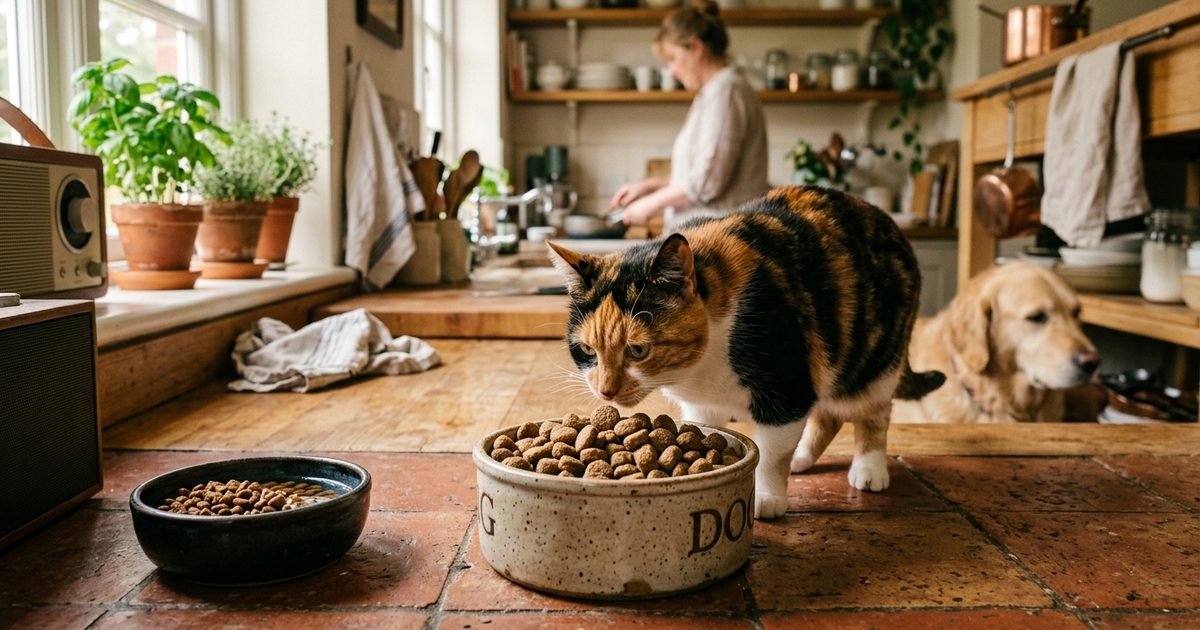
A few kibbles of dog food won't harm a cat — it's not toxic. But dog food is nutritionally wrong for cats and should never become a regular meal. Cats are obligate carnivores whose needs dog food doesn't meet. Think of it as a stolen snack: fine; as a steady diet: not fine.
The short version is reassuring and the longer version is the one that matters. Dog food is not poison. A cat who sneaks a piece or two from the dog's bowl is in no danger, and there's no need to panic-call your vet. But "not an emergency" and "good for your cat" are different sentences, and conflating them is how well-meaning owners end up feeding the wrong food for months.
Not toxic, but nutritionally wrong
This is the distinction owners miss most. Dog food is not formulated to poison anything — it's formulated to meet a dog's nutritional profile, the canine AAFCO standard. Your cat has her own, stricter, feline profile. The kibble looks almost identical to cat kibble: similar shape, similar crunch, similar smell to our noses. But the nutrient matrix underneath — the protein level, the amino acids, the vitamin sources — is engineered for a different species with different biology.
That means a one-off raid on the dog bowl is not a toxin event. It's a meal that happens to be missing several things your cat needs and oversupplies things calibrated for a dog. No single piece hurts her. The harm, if it comes, comes from repetition — from that "harmless" bowl quietly becoming a habit. So if you catch her stealing a kibble, shrug it off. If she's eating from the dog bowl every day, that's the problem to fix.
Why cats are drawn to the dog's bowl
Cats aren't plotting nutritionally when they raid the dog bowl — they're drawn in by everything that makes a different food interesting. Dog kibble is often larger and crunchier than their own, which is novel under the teeth. It smells different, sometimes meatier or oilier. And there's the simple social fact that anything the other animal in the house eats must, by feline logic, be worth investigating. Novelty, crunch, smell, and curiosity are a powerful combination.
None of that means the food is right for her. Palatability — how eagerly a cat eats something — tells you almost nothing about nutritional suitability. A cat will happily eat things that are wrong for her, because eagerness tracks interest, not need. The attraction is real and understandable; it just isn't a green light.
Why Is Dog Food Wrong for Cats?
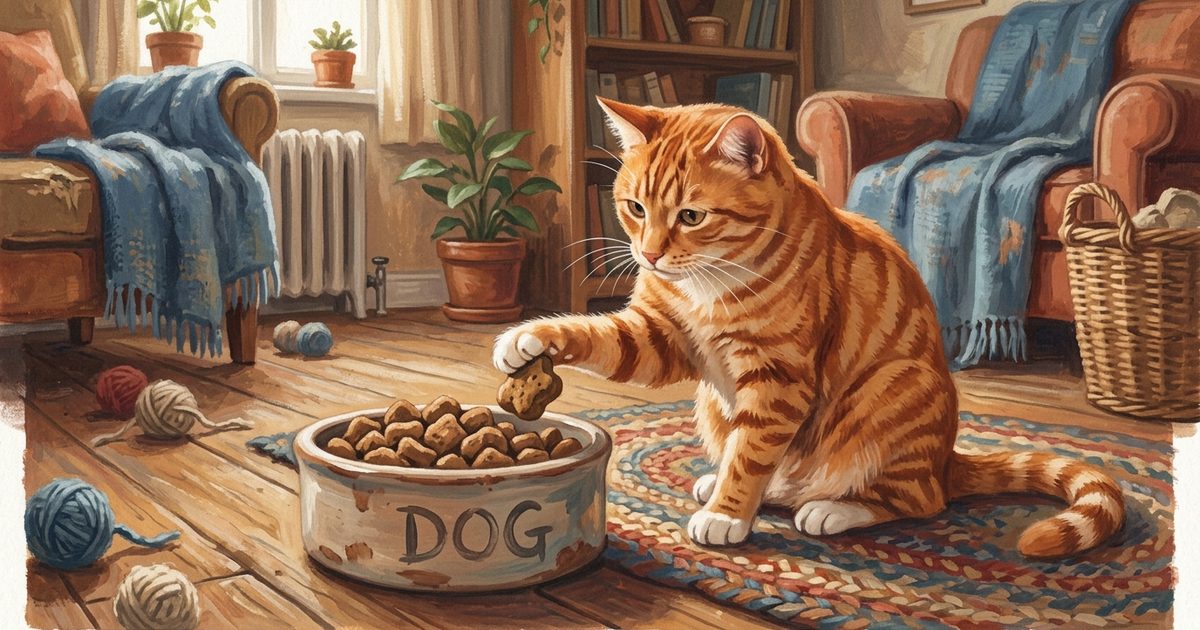
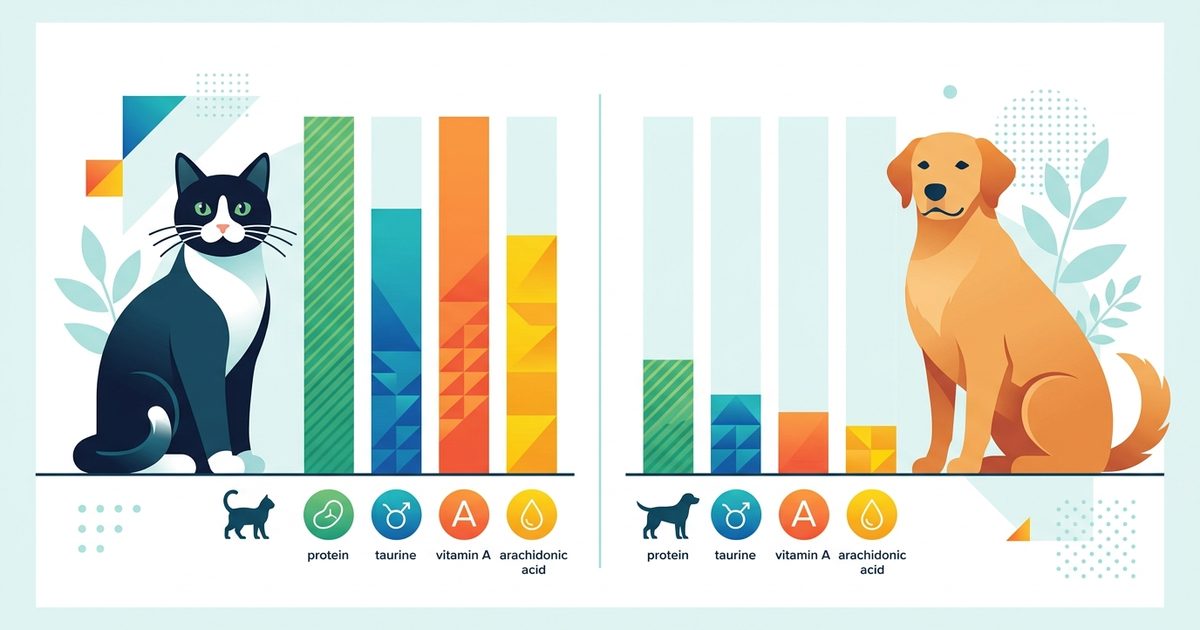
Dog food is wrong for cats because cats are obligate carnivores with stricter needs: more protein, plus taurine, pre-formed vitamin A, and arachidonic acid that dog food supplies in lower amounts. It's not poison — it's an incomplete diet for a species built to eat meat.
Saying dog food is "wrong for cats" isn't a vague judgment — it points at a specific, measurable nutritional mismatch. Cats and dogs sit on different branches of the evolutionary tree when it comes to food, and their bodies reflect that. Dog food is built to the canine blueprint; your cat runs on the feline one. Several nutrients that look fine on a dog's label fall short for a cat, and the four below are where the gap shows up most clearly.
Cats are obligate carnivores, dogs are not
The foundational frame is this: cats are obligate carnivores, meaning they must get certain nutrients from animal tissue because, somewhere in their evolutionary past, they lost the ability to make those nutrients themselves. Their meat-heavy diet supplied taurine, pre-formed vitamin A, and arachidonic acid so reliably that the metabolic machinery to synthesize them was simply no longer needed — and evolution is an unforgiving editor of unused parts. Dogs, descended from more omnivorous scavengers, kept those pathways. A dog can convert plant precursors into the nutrients he needs; a cat, in several cases, cannot.
This is why a dog food labeled "complete and balanced" can still be incomplete for your cat. It meets the canine standard — and it does — but the canine standard is a different, more forgiving bar than the feline one. The Cornell Feline Health Center is an excellent reference on the essential nutrients cats specifically require, many of which simply aren't guaranteed by a canine formulation.
Lower protein
Dog food typically contains less protein than cat food — sometimes markedly less. Cats use protein not just for building tissue but as a primary energy source, with a higher baseline protein requirement than dogs. Their liver constantly runs gluconeogenesis, converting protein to glucose, so protein is fuel as much as structure. A chronic shortfall is a slow erosion of muscle and overall condition that's easy to miss because it creeps. For the broader picture of what a complete feline diet looks like, see our guide on what cats eat.
Missing or low arachidonic acid
Arachidonic acid is an essential fatty acid dogs can synthesize from plant-based linoleic acid — but cats can't, or only barely. They depend on getting it pre-formed from animal fat. Because dog food is built to a dog's requirements, it may supply arachidonic acid at a level that's adequate for a dog but marginal or insufficient for a cat. Exactly when and how that shortfall shows up varies with the food and the individual cat, so the safe principle is simpler than any timeline: don't rely on a dog's food to meet a cat's fatty-acid needs.
The niacin and B-vitamin gap
Cats also need pre-formed niacin and carry higher B-vitamin requirements than dogs, and dog food's vitamin mix is calibrated to canine, not feline, needs. This is a real gap, but it's the supporting fourth one — it matters without being the headline. The nutrients that drive the most serious consequences of feeding dog food to a cat are taurine and pre-formed vitamin A, covered in depth in the sections that follow. Think of the B-vitamin and niacin shortfall as part of the same pattern: a food formulated to a different species' standard will, predictably, undershoot a cat in several places at once.
What About Taurine — the Critical Missing Nutrient?
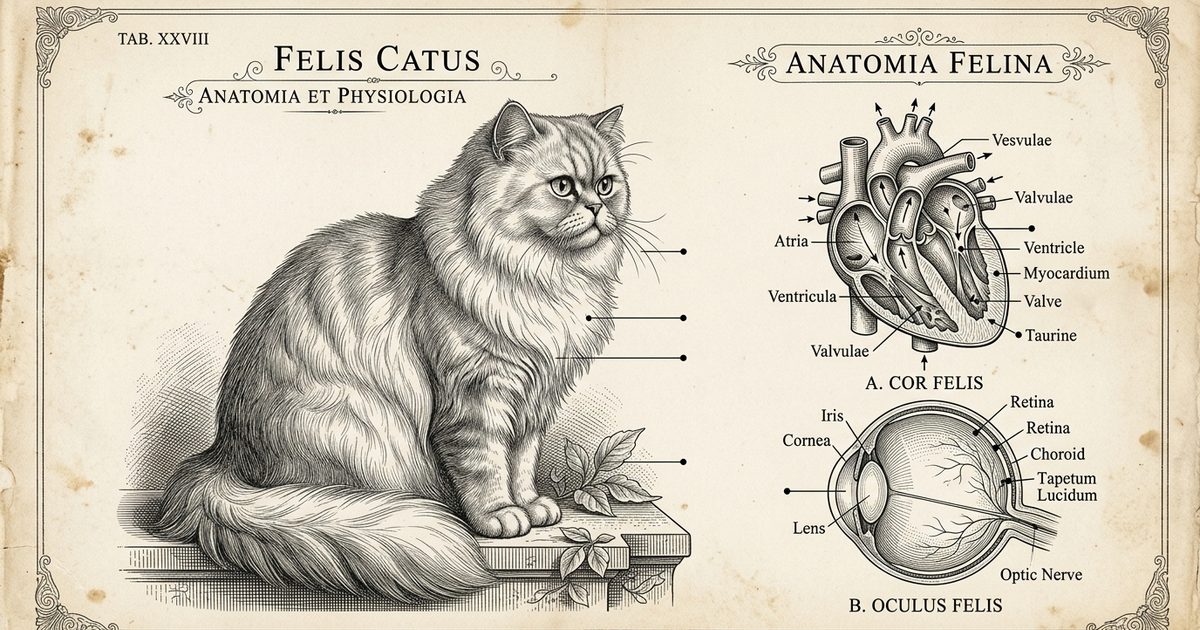
Taurine is the single most critical nutrient dog food lacks for cats. Cats can't make enough of it themselves, so they need it from meat. Without enough taurine, cats develop dilated cardiomyopathy (a fatal heart disease) and retinal degeneration that can cause blindness.
Taurine is the nutrient that turns "dog food is nutritionally wrong for cats" from a general principle into a specific, serious warning. It's an amino-sulfonic acid — not used to build proteins, but essential for a cat's heart muscle and the retina at the back of the eye. Cats lose it constantly and can only replace it from animal tissue, which is exactly the ingredient profile dog food is short on.
Why cats can't make their own taurine
Most mammals — including dogs and humans — synthesize taurine from two other amino acids, cysteine and methionine, using a short enzymatic pathway. Cats inherited that same pathway, but the key enzymes (cysteine dioxygenase and cysteinesulfinic acid decarboxylase) run at very low activity in a cat's body. Evolution streamlined cats toward their prey: a wild cat eating small animals every day takes in so much ready-made taurine that making more would be wasteful, so the machinery was largely shut down. That's the same obligate-carnivore logic behind the overall nutritional mismatch — here made chemical and concrete. International Cat Care covers taurine as one of the essential nutrients cats must obtain pre-formed from their diet, and the reason feline nutrition is treated as a distinct science from canine nutrition.
Taurine deficiency → heart disease (DCM)
When taurine intake falls below what a cat loses, the heart muscle is among the first organs to suffer. Dilated cardiomyopathy (DCM) is the classic outcome: the heart's chambers enlarge and the muscular walls thin and weaken, so the heart pumps poorly and fluid begins to back up. Before the 1980s, DCM was a leading cause of heart failure in cats — until researchers traced many cases to taurine deficiency and commercial cat foods were reformulated to include enough of it. This is the honest reason "complete and balanced cat food" is a regulated nutritional claim rather than marketing language: the specification exists precisely to prevent diseases like this. It also fits a broader pattern — nutrition shows up across the body, where dental and cardiac health are both nutrient-sensitive systems that quietly reflect what a cat is actually eating.
Taurine deficiency → blindness
The other organ that depends on taurine is the retina. In feline central retinal degeneration, the photoreceptor cells at the back of the eye progressively deteriorate without enough taurine, and the resulting vision loss is irreversible. A cat's celebrated night vision is built on retinal health, so this is a particularly cruel gap to open. The mechanism is well understood and general — a persistently taurine-poor diet damages the retina over time — but it isn't something to self-diagnose from a symptom list; any change in a cat's eyes or vision belongs with a vet.
What About Vitamin A — and the Conversion Problem?
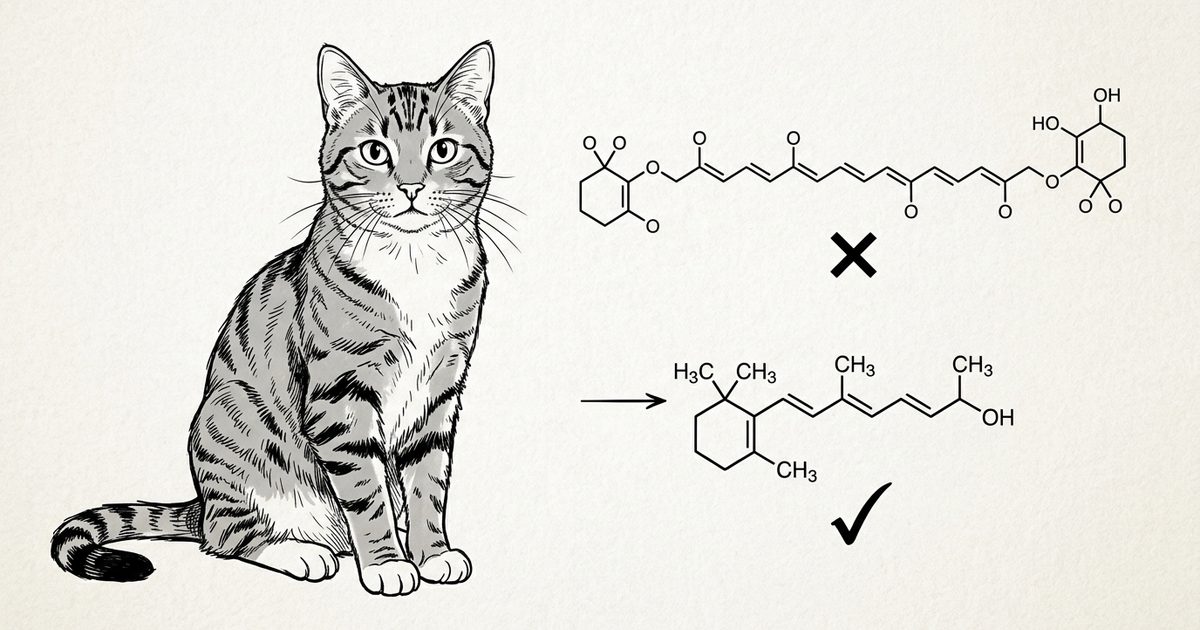
Cats need pre-formed vitamin A from meat — they can't convert plant beta-carotene the way dogs and humans can. Some dog foods use plant-source vitamin A, which a cat's body largely can't use. Over time, that gap contributes to skin, coat, and eye problems.
Vitamin A is the second nutrient where a dog and a cat part ways, and the reason is subtler than taurine: it's not that dog food contains too little vitamin A on paper, but that the form of vitamin A it contains may be one a cat's body can't actually use.
Pre-formed vs plant vitamin A
Vitamin A enters food in two forms. Pre-formed vitamin A — retinol — is found in animal tissue: liver, fish oils, egg yolks. The other form is provitamin A carotenoids, especially beta-carotene, the orange pigment in carrots, sweet potato, and many leafy greens. Dogs convert beta-carotene to retinol efficiently in the intestine; humans do too, which is why carrots are said to be good for your eyes. Cats do not. Their intestinal conversion of beta-carotene to retinol is very low, because the relevant dioxygenase activity is limited — again, a meat-only evolutionary diet supplied retinol ready-made, so cats never needed the conversion machinery. The practical consequence: a dog food that hits its vitamin-A target using beta-carotene has met the spec, but for a cat that same amount of beta-carotene delivers very little usable vitamin A. We go deeper on the beta-carotene-to-retinol conversion mechanism, and why it matters for single plant foods too, in can cats eat carrots.
Why dog food can miss for cats
This isn't a flaw in any one brand — it's a formulation reality across commercial dog food. Plant-source carotenoids are cheaper and more shelf-stable than animal-source retinol, and for a dog they do the job perfectly well, so a manufacturer building food to the canine AAFCO profile has every reason to use them. The same product, evaluated against a cat's needs, is delivering vitamin A in a form a cat can barely convert. That's the conversion problem in one sentence: dog food can be complete for a dog and still fall short for a cat, because completeness is species-specific.
What vitamin-A deficiency looks like
Because vitamin A supports skin, coat, and vision, a slow shortfall tends to show up there — a dull or thinning coat, dandruff, dry skin, and a gradual decline in night vision. In kittens, serious deficiency can also slow growth. These signs are non-specific and develop gradually, which is exactly why vitamin-A gaps are easy to miss: nothing looks acute, and an owner may not connect a rough coat with the food in the dog's bowl. The point isn't to check off symptoms, but to recognize that when a cat eats the wrong species' food long enough, the body quietly reflects it.
What Happens if a Cat Eats Dog Food — Short-Term vs Long-Term?
Short-term: a few kibbles cause no harm — maybe mild stomach upset at most. Long-term: feeding dog food as a regular diet leads to serious deficiencies affecting the heart, eyes, skin, and coat. A stolen snack is harmless; dog food as a staple is dangerous.
A few kibbles — no harm
If your cat sneaks one or two pieces of dog food off the floor, there is nothing to worry about. A cat's body keeps small reserves of taurine and vitamin A that comfortably bridge a brief, occasional gap — so a single stolen snack, even repeated now and then, will not cause any deficiency. You might see mild stomach upset if the kibble is unfamiliar, and that is the full extent of it.
This is also where the contested question — can cats live on dog food? — starts to trip people up. Short-term tolerance is real, but it is not the same as long-term viability. A cat appearing unharmed after a raid tells you nothing about what weeks of the wrong diet would do.
Weeks to months — deficiencies emerge
Once dog food becomes a regular part of what a cat eats, those internal stores begin to run down. Depending on the individual cat, the first signs of taurine deficiency can surface over weeks to months — a dulling coat, lower energy, subtle weight loss — before the more serious cardiac and retinal damage follows if the wrong diet continues. The decline is gradual rather than sudden, which is exactly what makes it easy to miss.
The broader principle here is that it is the overall quality of a cat's diet, not any one snack, that shapes long-term disease risk — something we explore in more depth in our piece on cat diabetes. A well-formulated cat food, fed consistently, is what protects the heart and eyes over time.
Why "they look fine" is misleading
Cats are remarkably good at hiding early deficiency. The slow damage to heart muscle and the retina can be quietly underway for weeks before an owner notices anything outwardly wrong — by the time a cat looks unwell, the problem is often advanced. So if you have heard someone say "my cat ate dog food for a few months and looked fine," that is not evidence the food was suitable. It is evidence of how well cats conceal decline. This is the honest, cautionary spine of the whole question: short-term peace is not long-term safety, and it is worth taking seriously rather than dismissing.
How Do I Stop My Cat Eating the Dog's Food?
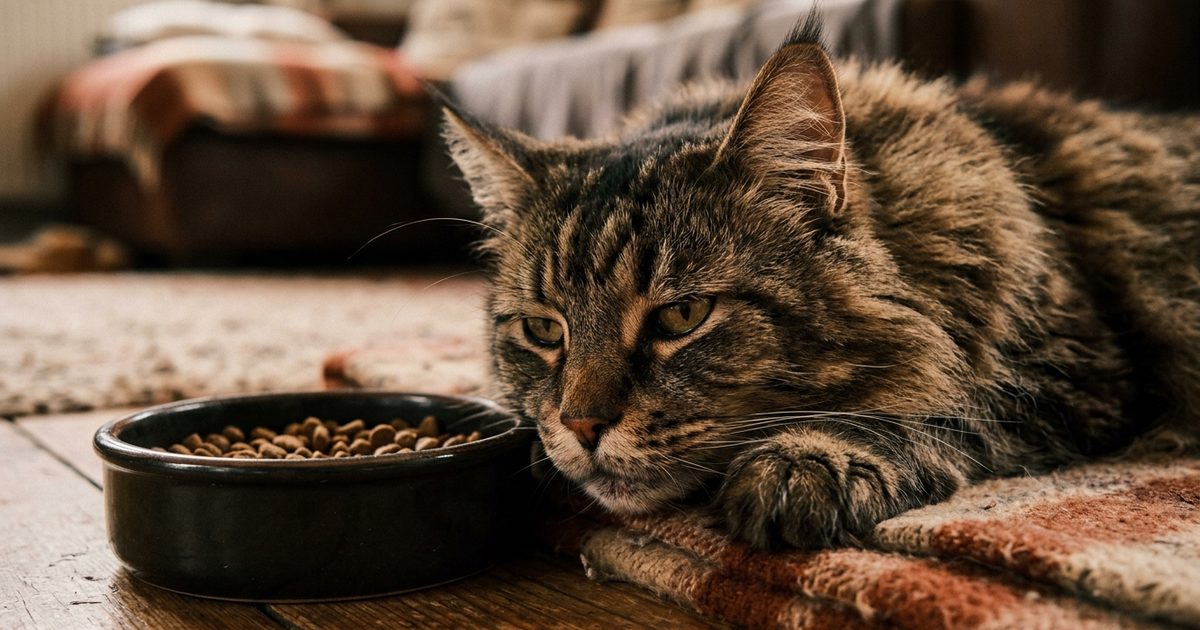
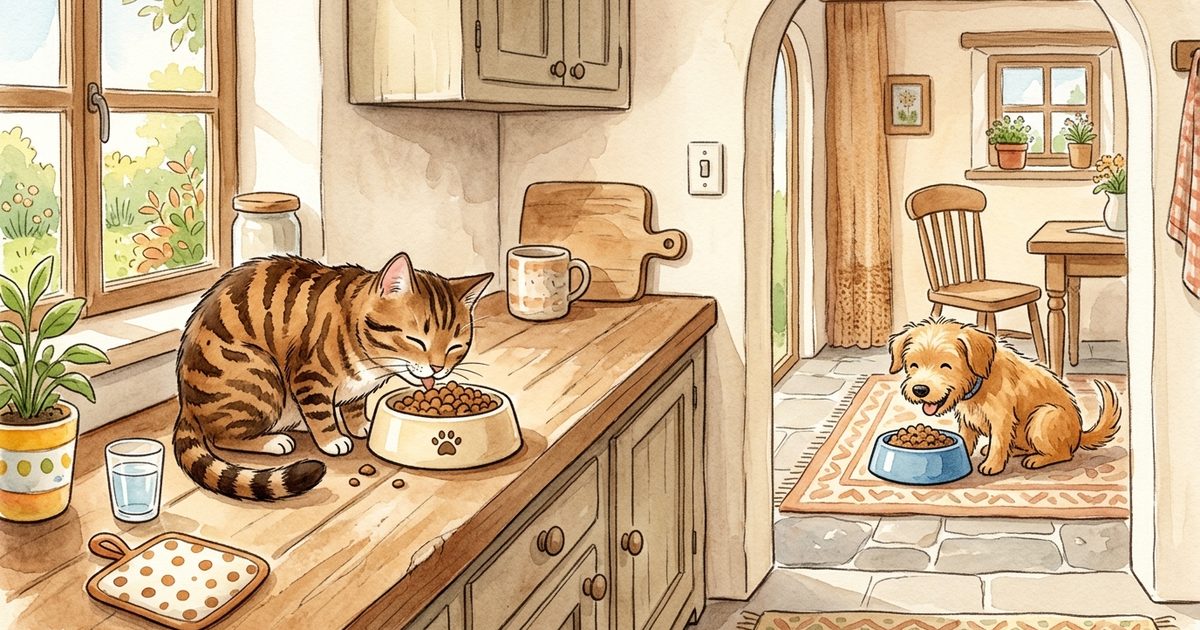
Feed your cat and dog separately — different rooms or different times, and pick up bowls between meals. Microchip-activated feeders and elevated feeding stations (a cat can reach, a dog can't) are reliable fixes. Don't rely on the animals self-regulating — they won't.
Feed in different rooms or at different times
The simplest and most effective strategy is physical separation at mealtimes. Feed your cat and dog in different rooms, or at different times with one safely confined while the other eats — then pick up both bowls within fifteen to twenty minutes so neither can graze the other's food afterward. Free-feeding both pets from open bowls in the same space is the setup most likely to cause cross-raiding, so moving away from it is the single change that solves most of the problem. Treat this as the default recommendation: if you do nothing else, do this.
Microchip and collar-tag feeders
For households where separation is genuinely hard — open-plan homes, multiple pets, or schedules that do not allow supervised mealtimes — smart feeders that open only for a registered pet's microchip or collar tag are the cleanest solution. The bowl stays locked until the right animal approaches, so a cat's food is inaccessible to the dog and vice versa, with no need for you to stand guard. As a product category these have matured into a reliable option; the point is the mechanism (identity-locked access), not any specific brand, so choose one that fits your home and budget.
Elevated feeding and other physical fixes
A complementary approach is to change the environment rather than the animals. Put the cat's food up where the dog cannot reach — a counter, a shelf, a feeding shelf the cat can jump to — and consider serving the dog's food in a slow-feeder that a cat finds unappealing to raid. The honest caveat here is that you cannot reliably "train" a cat out of a freely available bowl; if the food is there and smells interesting, the cat will help itself. So the workable move is to change the layout so the wrong food simply is not within reach, rather than expecting willpower from either pet. For the foundations of feeding a cat the right way, our guide on how much to feed a kitten covers species-appropriate cat-feeding in detail.
Dog Food and Cats — Quick Summary
| Question | Short answer |
|---|---|
| Can cats eat dog food safely? | A few stolen kibbles, yes; as a meal, no |
| Is dog food toxic to cats? | No, but it's nutritionally wrong for them |
| Can cats live on dog food long-term? | No — serious deficiencies develop over weeks to months |
| What nutrient is missing? | Taurine most critically, plus pre-formed vitamin A, arachidonic acid, and protein |
| What happens short-term? | No harm from an occasional stolen snack |
| What happens long-term? | Heart disease, vision loss, and skin/coat decline |
| How do I stop it? | Feed separately — different rooms or times, microchip feeders, elevated stations |
The short version: dog food isn't poison, it's the wrong fuel. Cats are obligate carnivores built to run on meat, and a complete-and-balanced dog food simply isn't built for them. A curious calico sneaking a piece of kibble from the dog's bowl is a harmless moment; dog food as her everyday diet is a slow path to heart, eye, and coat problems nobody wants to watch unfold.
Curious What Your Cat Would Say?
Upload a photo and get a warm, personalized reading from your cat's perspective.
Start Your Free ReadingFrequently Asked Questions
Can cats eat dog food safely?
A few stolen kibbles are safe — they won't harm your cat. But dog food is not a safe meal, because it's nutritionally wrong rather than toxic. As an occasional stolen snack it's fine; as a regular diet it is not.
Is dog food toxic to cats?
No, dog food is not toxic or poisonous to cats. The problem is that it's formulated to meet a dog's nutritional needs, not a cat's. So it's nutritionally unsuitable rather than dangerous in the way a true toxin would be.
Can cats live on dog food long-term?
No. Cats cannot live on dog food long-term because it lacks enough taurine, pre-formed vitamin A, arachidonic acid, and protein. Weeks to months of it can lead to heart disease, vision loss, and a declining coat.
What happens if my cat eats dog food every day?
Her stored nutrients gradually run down, and deficiencies emerge — usually a dulling coat and lower energy first, then more serious damage to the heart muscle and retina if the wrong diet continues. A stolen snack is harmless; daily dog food is not.
Why is dog food bad for cats?
Because cats are obligate carnivores with stricter needs than dogs, and dog food is built to a canine standard. It supplies less protein and lower amounts of the feline-specific nutrients a cat must get from meat.
What nutrient is missing from dog food for cats?
Taurine is the most critical one — without it cats develop heart disease and vision loss. Dog food is also short on pre-formed vitamin A, arachidonic acid, and the protein level a cat's body depends on.
How do I stop my cat eating the dog's food?
Feed your cat and dog separately — different rooms or different times, and pick up both bowls within fifteen to twenty minutes. For harder setups, microchip feeders and elevated feeding stations work reliably.
Can kittens eat dog food?
No. Kittens are even more vulnerable than adult cats because they are still growing, so the gaps in dog food — especially protein and taurine — can slow their development and cause lasting harm.
Is canned or wet dog food safer than dry for cats?
No. The moisture in wet dog food is irrelevant, because the underlying problem is the nutrient profile, not the water content. Wet or dry, dog food is still formulated for a dog, not a cat.
Sources & References
You Might Also Like
Kitten Teething: Timeline, Symptoms & How to Help
Kitten teething runs from 3 to 7 months as baby teeth fall out. Learn the timeline, signs to watch for, and how to soothe a teething kitten safely.
15 min readWhen Do Cats Stop Growing? A Complete Timeline
When do cats stop growing? Most cats reach adult size by 12-18 months, but large breeds like Maine Coons keep growing until 3-4 years. Full timeline inside.
14 min readCan Cats Eat Cherries? Flesh, Pit & Toxicity Facts
Can cats eat cherries? Pitted flesh is safe in tiny amounts — but the pit, stem, and leaves are toxic (cyanide precursors). Learn what's safe and what isn't.
15 min read