
Can Cats Eat Carrots? Serving Size & the Vitamin A Truth
Can cats eat carrots? Yes — but the honest answer is more interesting than a simple yes or no, and whether are carrots good for cats depends almost entirely on how you serve them (and whether can cats eat raw carrots is even the right question — it usually isn't). Carrots are non-toxic to cats and a small piece of plain cooked carrot now and then won't cause harm. But cats are obligate carnivores, built to get everything they need from meat, and the famous "carrots are full of vitamin A" story doesn't really transfer to felines the way most owners assume.
Here's what actually matters: cook the carrot plain, keep it to a tiny occasional treat, and don't think of it as a health boost — think of it as the safe, curious little snack your cat might enjoy sniffing off your plate.
Key takeaways
- Plain cooked carrots are non-toxic and safe for cats as a rare, small treat — not part of their regular diet.
- Always cook them. Raw carrots are hard, dense, a genuine choking hazard, and difficult for a cat's short digestive tract to break down.
- Carrots aren't a vitamin strategy for cats. Cats convert plant beta-carotene to active vitamin A inefficiently and rely on pre-formed vitamin A from meat instead.
Can Cats Eat Carrots — Quick Reference
| Question | Short answer |
|---|---|
| Can cats eat carrots? | Yes — plain cooked carrots are non-toxic and safe as an occasional treat |
| Can cats eat raw carrots? | Not recommended — raw carrots are a choking hazard and hard to digest |
| Are carrots good for cats nutritionally? | Only modestly — cats can't use plant beta-carotene efficiently |
| How much carrot can a cat eat? | A teaspoon or two of cooked carrot, once in a while, as a treat |
| How should I prepare carrots for my cat? | Cooked plain (steamed or boiled), cut small or grated, no seasoning |
| Can cats eat carrot cake or glazed carrots? | No — the added sugar, fat, and spices are unsafe |
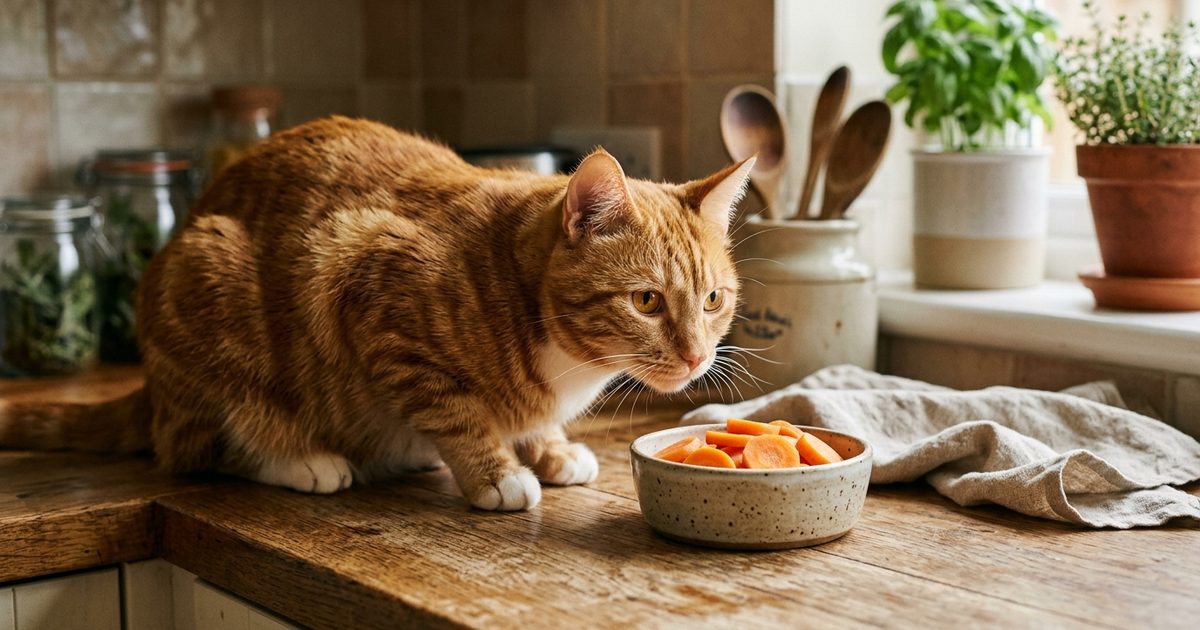
Can Cats Eat Carrots?
Yes — carrots are non-toxic to cats, and plain cooked carrots are safe as an occasional treat. They contain beta-carotene, which the body can turn into vitamin A, plus some fiber. But cats convert that beta-carotene far less efficiently than humans, so carrots are a snack, not a health supplement.
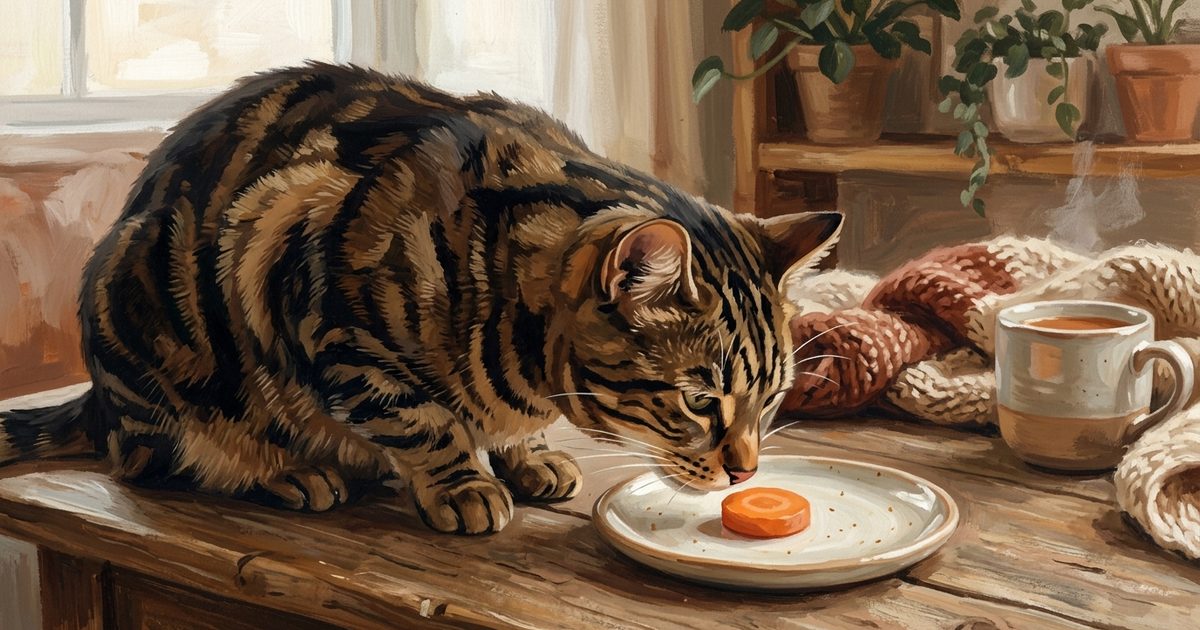
The short answer
Carrots themselves are genuinely non-toxic to cats — the vegetable, on its own, will not poison your cat. So if your curious cat steals a piece of plain cooked carrot off your plate, there's no need to panic. A small piece here and there is harmless. That's the honest safety verdict, and it's worth saying plainly because a lot of owners worry unnecessarily.
But it has to be framed against what cats actually are: obligate carnivores. Cats do not need plant matter to be healthy. Their bodies are built to run on animal protein and fat, and a complete commercial cat food already supplies every nutrient they require — including the pre-formed vitamin A they must get from meat, not from vegetables. So a carrot is never filling a gap in a well-fed cat's diet. It's variety, novelty, a small texture experience — not nutrition they were missing.
Non-toxic, but not necessary
This is the distinction the whole article hinges on: "safe to eat" is not the same as "good for them." Carrots sit firmly in the first category. A plain, cooked carrot, given occasionally, will not harm your cat. But it does not do for a cat what it does for a human.
The two things that actually matter for owners are coming up. First, the beta-carotene and vitamin-A story — which, as we'll see in the nutrition section, does not work the way most people assume in a cat's body. Second, the cooking requirement — raw carrots are a real choking hazard, which is why this article recommends cooked only. If you keep those two things straight, you already know everything essential about cats and carrots. Everything else is detail.
Can Cats Eat Raw or Cooked Carrots?
Cook them. Raw carrots are hard, dense, and a real choking hazard for cats, and their tough cell walls are difficult for a cat's short digestive tract to break down. Cooked, steamed, or boiled carrots are softer, far more digestible, and the safe way to offer a small piece as a treat.
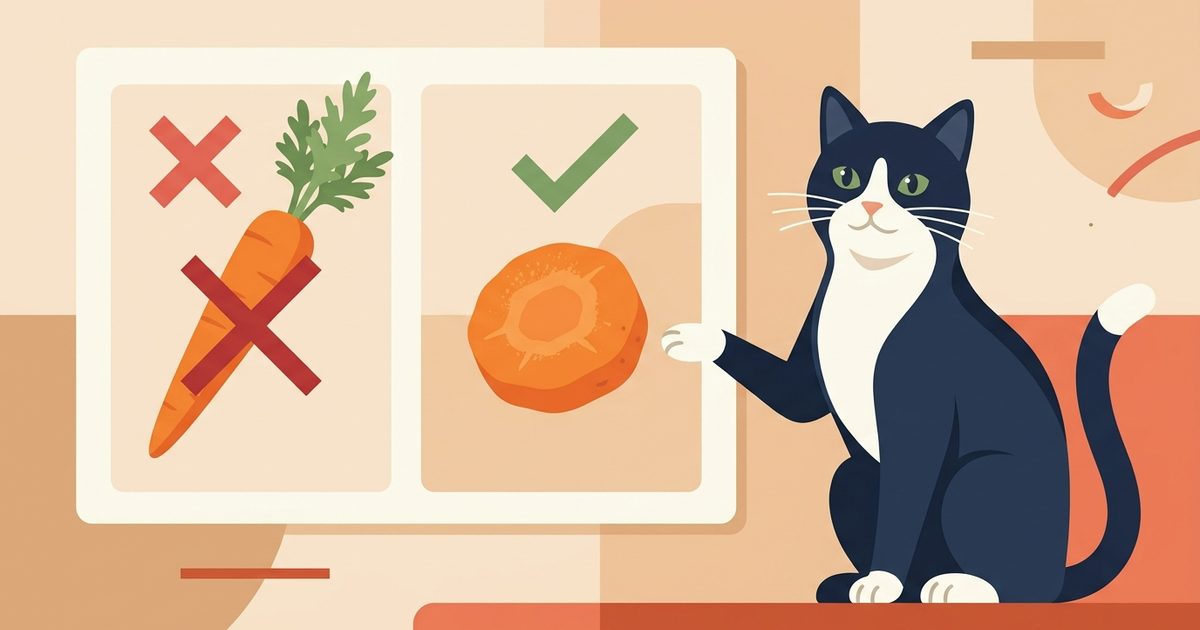
Why raw carrots are risky
Raw carrots are the single biggest reason carrots get a bad reputation as a cat treat, and the concern is legitimate. A raw carrot is hard, dense, and snaps into sharp fragments — exactly the kind of object that can lodge in a cat's throat or scratch the digestive tract on the way down. Cats that gulp their food, or that try to bite off more than they can chew, are at particular risk. The choking hazard is real, not theoretical.
There's also a digestibility problem underneath the choking risk. A cat's digestive tract is short and optimized for breaking down meat, not raw plant fiber. The tough cellulose cell walls of a raw carrot largely pass through undigested, which means even the small nutritional value a carrot offers is mostly locked away where a cat's gut cannot reach it. So a raw carrot gives your cat the danger of a hard chunk with very little of the upside.
To be clear: if your cat already swiped a small raw nibble off the floor, that's not an emergency. Watch for coughing or distress, but a tiny piece usually passes without incident. It's just not a feeding strategy you'd choose on purpose — and it's certainly not the form any veterinary source would recommend.
Why cooking fixes both problems
Cooking is what turns a carrot from a hazard into a safe, harmless treat. Steaming, boiling, or roasting softens the dense fiber and bursts the cell walls, so the texture becomes something a cat can manage and the modest nutrients inside become slightly more available to a short, meat-oriented gut. A cooked carrot is soft enough to be eaten in small pieces without risk of choking.
The one non-negotiable when you cook for a cat is to keep it plain. No oil, no butter, no salt, no seasoning. Garlic, onion, and many common spices that share a roasting pan with carrots are genuinely toxic to cats, so anything that has touched them is off the table. Plain means water and heat, nothing else — then cool it, chop it small, and it's ready as an occasional treat.
Are Carrots Good for Cats Nutritionally?
Only modestly, and not the way most owners assume. Carrots offer beta-carotene and some fiber, but cats are obligate carnivores that convert plant beta-carotene into active vitamin A inefficiently — they rely on pre-formed vitamin A from meat. So carrots' reputation as a vitamin-A boost for cats is mostly myth.
A plain, cooked piece of carrot is a safe little treat, and that's worth saying plainly. But "safe to eat" and "good for your cat" are two different questions, and the honest answer to the second one is: not really. If you came here wondering whether cats can eat carrots as a way to boost their health, the nutrition story lands closer to "harmless snack" than "superfood." Everything your cat actually needs nutritionally — protein, taurine, pre-formed vitamin A, the right fats — comes from meat, and a complete commercial cat food already supplies it in the correct balance. A carrot adds a bit of variety and a few plant compounds, but it doesn't fill a gap that exists.
Beta-carotene and the vitamin-A catch
This is the heart of the misunderstanding. Carrots are famous for beta-carotene, the orange pigment that the human body converts into vitamin A — and that reputation is well-earned, for humans. The catch for cats is that the conversion happens poorly. Cats have low intestinal beta-carotene conversion, tied to limited activity of the dioxygenase enzymes that split beta-carotene into active retinol. Where humans turn a generous fraction of plant beta-carotene into usable vitamin A, cats convert only a small amount, and they don't rely on it. Instead, cats are built to take in vitamin A already formed — as pre-formed retinol from animal tissue like liver and muscle meat. That's why any nutritionally complete commercial cat food lists vitamin A as an added nutrient already present: the cat's requirement is met from meat-derived sources, not from plant pigments. The Cornell Feline Health Center is a strong reference for feline essential nutrients, including why pre-formed vitamin A — not beta-carotene — is the form cats actually use. Net result: a carrot is not how your cat meets its vitamin A needs, and feeding one doesn't meaningfully top up that requirement.
Fiber and other nutrients
Carrots do carry some genuinely useful minor nutrients: modest amounts of soluble and insoluble fiber, a little potassium, and a fair bit of water. At treat-sized portions that's supportive but small — a pinch of fiber, a bit of hydration, nothing a complete diet doesn't already cover more reliably. It's worth being clear that carrots are not a digestive tool in the way pumpkin is. If your cat is dealing with loose stools or mild constipation and you reached for this article looking for a fiber remedy, carrots are the wrong vegetable for that job — pumpkin is the food veterinarians actually reach for, because its soluble fiber works in both directions. A carrot just adds a little bulk, and not in a therapeutically useful way. For an obligate carnivore, what cats eat day to day is built around meat, and plant fiber is incidental rather than essential.
Why the "good for eyes" idea doesn't transfer
You've probably heard that carrots are good for your eyes — and that's the one claim most likely to drift, wrongly, onto cats. The backstory matters: the carrots-improve-night-vision idea came from a wartime human propaganda campaign, and even in humans it's overstated. It certainly doesn't transfer to cats, and here's the key reason — cats already have extraordinary low-light vision, and it has nothing to do with plant beta-carotene. Their night vision is built from a reflective layer behind the retina called the tapetum lucidum and a very high density of rod cells, and it's sustained by meat-derived, pre-formed vitamin A. Feeding a cat carrots does nothing for eyes that a complete diet isn't already doing far better. If you're curious how that remarkable low-light vision actually works, our piece on whether cats can see in the dark goes into the mechanism — and it makes clear why no root vegetable is part of that equation.
How Should I Prepare Carrots for My Cat?
Cook the carrot plain — steam, boil, or roast with nothing added — then cut it into small pieces or grate it so there is no choking risk. No salt, no oil, no butter, no seasoning, and no sugared or spiced carrot dishes. Offer a tiny amount on its own or mixed into regular food.
Cooked and plain
The only carrot worth offering your cat is one that has been cooked with nothing in it. Steam it, boil it, or roast it dry — then let it cool. That's the entire recipe. Once the carrot is plain, soft, and unseasoned, it's as safe as a root vegetable gets for a cat.
What you leave out matters more than what you put in. Oil and butter add fat a cat doesn't need and can upset a sensitive stomach; salt raises sodium intake for an animal whose kidneys are far less tolerant of it than ours. Seasonings are the bigger worry. Garlic and onion are genuinely toxic to cats — they damage red blood cells — and they often share a roasting pan with carrots in human cooking. A piece of carrot that picked up garlic butter or onion residue is no longer a safe treat. If you keep those two ingredients far away from anything your cat eats, you've handled most of the risk. Read more on garlic and onion if you want the full breakdown. The Cornell Feline Health Center is a reliable reference for which common foods are unsafe for cats.
Cut small or grate
Even cooked, a carrot needs to be the right size for a cat's mouth. Aim for pea-sized pieces, or grate the cooked carrot so the texture is soft and crumbly. You can also puree a small amount and stir it into your cat's regular food — some cats accept it more readily that way, and it removes any chewing work entirely.
One shape to avoid: thin coin-shaped rounds, even when cooked. A flat disc can sit against the roof of the mouth or the back of the throat and cause a cat to gag. Small irregular chunks or a fine grate sidestep that problem entirely. The goal is a piece so small and soft that swallowing it is never in question.
Forms to avoid
A few carrot forms belong on the "not for cats" list, and none of them are emergencies — they're just not food for a cat. Raw carrots, including the bagged "baby" carrots, are too hard and carry the choking and digestibility problems we covered above. Carrot tops and greens aren't a known cat toxin, but they aren't food either — there's no reason to offer them. Anything glazed, honey-roasted, spiced, or baked into carrot cake adds sugar, fat, and often ingredients that are genuinely unsafe. None of these belong in your cat's bowl; keep the treat to plain cooked root and you've covered the safe ground.
How Much Carrot Can a Cat Eat?
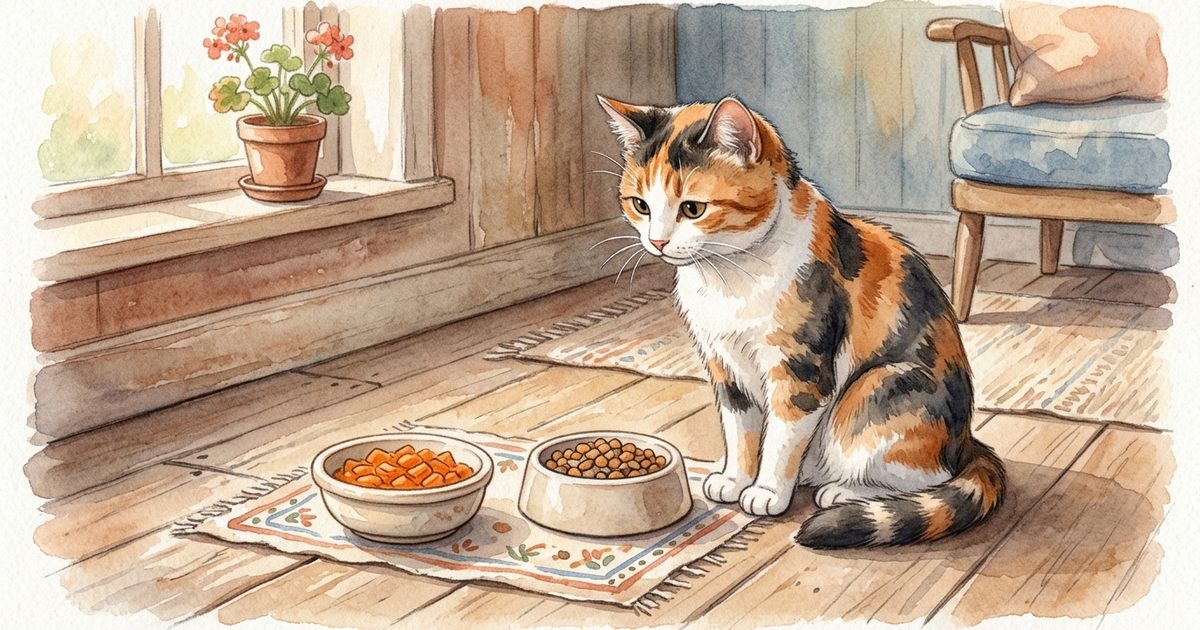
Very little. A teaspoon or two of cooked, plain, chopped carrot, once in a while, is the upper end for an average adult cat — and only as a treat, never as a meal. Treats of all kinds, carrots included, should stay under about 10 percent of your cat's daily calories.
Serving size and frequency
Veterinarians generally recommend that treats of every kind — carrots, commercial treats, the odd piece of your dinner — together make up no more than about 10 percent of a cat's daily calories. The other 90 percent should come from a complete and balanced cat food. That's a guideline, not a prescription; your own vet can tailor it to your cat's weight, age, and health.
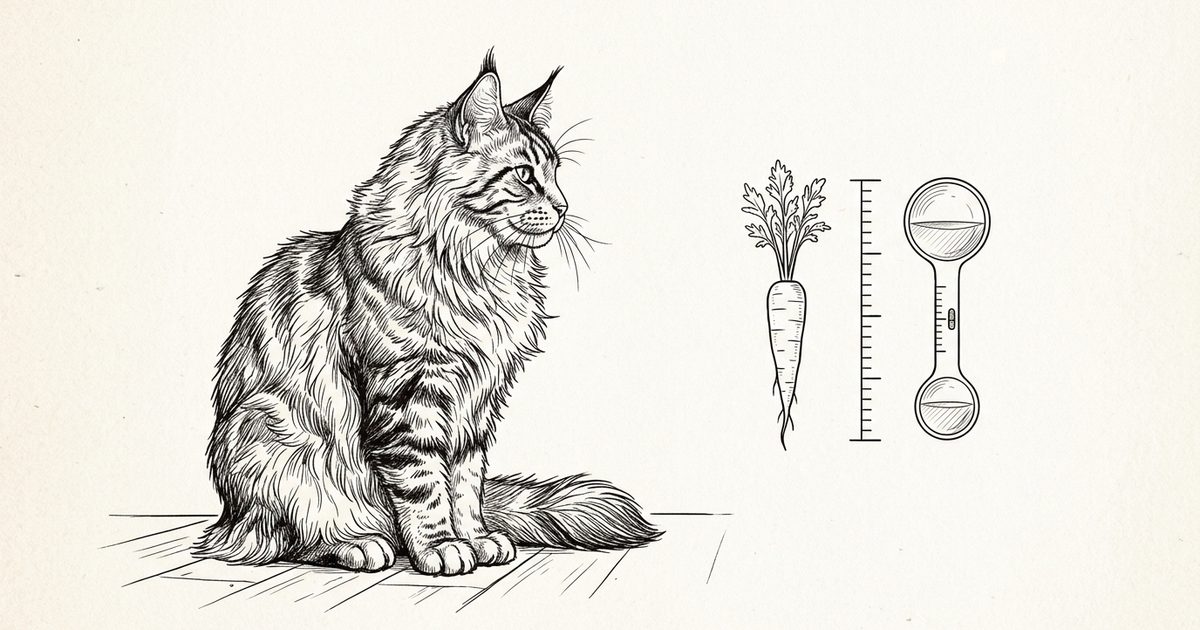
Translated into actual carrot, 10 percent of a typical adult cat's daily calories is a surprisingly small amount: roughly a teaspoon or two of cooked, chopped carrot. Offer it occasionally, not every day, and never a bowl of it. A cat that eats too much of any new food at once can get a mild stomach upset — loose stool or a turned-up nose at the next meal — so start with a single small piece and see how she handles it before offering more another day. International Cat Care has straightforward guidance on treating and treat portions if you want a second reference.
Not a meal, not a staple
The reason the portion is so small is that carrots, for all their good press in the human nutrition world, don't give a cat what she actually needs. They're low in the protein, fat, and taurine that an obligate carnivore runs on, and they offer none of the pre-formed vitamin A that cats must get from animal tissue. A cat cannot live on carrots, and she can't be "topped up" on them nutritionally either — they're variety and novelty, not fuel. For the full picture of what a cat's diet is actually built around, our guide on what cats eat walks through the obligate-carnivore frame. Keep the carrot to a tiny, occasional treat, and let complete cat food do the real work.
What About the Sugar in Carrots?
Carrots carry natural sugar, and that's perfectly fine in the tiny treat amounts we're discussing — but for a cat it's empty carbohydrate. Cats can't even taste sweetness (their sweet receptor is broken), so the sugar offers them nothing but calories they simply don't need.
Natural sugar, small amounts are fine
Carrots are moderately sweet root vegetables — that's their nature, and there's nothing harmful about it. In a teaspoon-sized treat, the actual sugar load is trivial: a few grams at most, a small fraction of the carbohydrates your cat's regular food already provides. On its own, a piece of cooked carrot given now and then is not a diabetes trigger. Feline diabetes risk is driven by the overall diet and body condition over time — sustained weight gain, an inappropriate food, prolonged inactivity — not by an occasional plant treat. If you want the broader context on how diet patterns shape that risk, our guide on cat diabetes walks through it. The short version: one carrot treat does not move that needle.
Cats can't taste sweet
Here's the part that genuinely surprises most owners. Cats — all cats, from your house cat to a lion — lack a functional sweet taste receptor. The gene that builds it, called Tas1r2, is broken in felines; it's what geneticists call a pseudogene, a relic that no longer produces a working protein. So when your cat shows interest in a piece of carrot, it isn't chasing sweetness — they literally cannot perceive it. That makes the carrot's sugar empty carbohydrate: calories in, no sensory reward, no nutritional purpose a cat can actually use. The sugar just sits there as energy a cat burning a meat-based diet didn't ask for. If you're curious about the mutation itself and what else it means for how cats experience food, we go deep on it in can cats taste sugar — it explains why a cat will walk past a bowl of fruit and straight to the tuna.
Carrots for Cats at a Glance — Summary
If you've read this far, you already have the full picture. Here it is condensed into one table you can come back to anytime — the seven questions owners actually ask about cats and carrots, with the short, honest answer to each.
| Question | Short answer |
|---|---|
| Are carrots safe for cats to eat? | Yes — plain cooked carrots are non-toxic and safe as a rare treat |
| Raw or cooked? | Cook them — raw carrots are hard, a choking hazard, and hard to digest |
| Are carrots nutritionally valuable for cats? | Only modestly — beta-carotene converts to vitamin A poorly in cats |
| How should I prepare them? | Plain cooked (steamed, boiled, or roasted), small pieces or grated, no seasoning |
| How much can a cat eat? | A teaspoon or two, offered occasionally — never as a meal |
| What about the natural sugar? | It's empty carbs for a cat — cats can't taste sweetness, so the sugar gives nothing |
| Are carrots a vitamin A source for cats? | No — cats need pre-formed vitamin A from meat, not plant beta-carotene |
The pattern across every row is the same: carrots are a safe, occasional treat when cooked plain and cut small, but they are not how your cat meets any nutritional need. Your cat's complete food does that work; the carrot is just a little something extra, now and then.
Curious What Your Cat Would Say?
Upload a photo and get a warm, personalized reading from your cat's perspective.
Start Your Free ReadingFrequently Asked Questions
Can cats eat raw carrots?
Not recommended. Raw carrots are hard and dense, a real choking hazard for cats, and their tough cell walls are difficult for a cat's short digestive tract to break down. A stolen raw nibble isn't an emergency, but cooked plain carrots are the only safe form to offer on purpose.
Can cats eat cooked carrots?
Yes — plain cooked carrots are non-toxic and safe as an occasional treat. Steam, boil, or roast them with nothing added, then cut into small pieces or grate them. Keep it to a teaspoon or two at most, offered now and then rather than daily.
Are carrots good for a cat's eyes?
No, not in any meaningful way. The idea that carrots improve vision is a wartime human myth, and it doesn't transfer to cats. Cats already have extraordinary low-light vision built from their tapetum lucidum and high rod density, fed by meat-derived pre-formed vitamin A.
How much carrot can I give my cat?
Very little — roughly a teaspoon or two of plain cooked, chopped carrot, once in a while, as a treat. All treats combined should stay under about 10 percent of your cat's daily calories, with the rest coming from a complete and balanced cat food.
Can kittens eat carrots?
It's best to wait. Kittens need a complete, balanced kitten-formulated food to support rapid growth, and their smaller mouths make even cooked carrot a potential choking risk. If you do offer any, keep it to a tiny smear of plain cooked carrot and only occasionally, once she's eating solid food reliably.
Can cats eat baby carrots?
Only if cooked and plain — the bagged 'baby' carrots are just raw carrots shaped small, so they carry the same hardness, choking risk, and digestibility problems as any raw carrot. They aren't safer simply because they're smaller. Cook them plain first if you want to offer one.
Do carrots give cats vitamin A?
Not in any useful way. Carrots contain beta-carotene, but cats convert plant beta-carotene to active vitamin A inefficiently because of limited dioxygenase enzyme activity. Cats rely on pre-formed vitamin A from meat — which a complete commercial cat food already supplies.
Can cats eat carrot cake?
No. Carrot cake, glazed carrots, and honey-roasted carrots all add sugar, fat, and often spices like nutmeg or a touch of garlic and onion that are genuinely unsafe for cats. The only form worth offering is a plain cooked root vegetable, cut small, as a rare treat.
Sources & References
You Might Also Like
Kitten Teething: Timeline, Symptoms & How to Help
Kitten teething runs from 3 to 7 months as baby teeth fall out. Learn the timeline, signs to watch for, and how to soothe a teething kitten safely.
15 min readWhen Do Cats Stop Growing? A Complete Timeline
When do cats stop growing? Most cats reach adult size by 12-18 months, but large breeds like Maine Coons keep growing until 3-4 years. Full timeline inside.
14 min readCan Cats Eat Cherries? Flesh, Pit & Toxicity Facts
Can cats eat cherries? Pitted flesh is safe in tiny amounts — but the pit, stem, and leaves are toxic (cyanide precursors). Learn what's safe and what isn't.
15 min read