Can Cats Taste Sweet? The Strange Truth About Sugar & Cats
If you've ever shared a bite of cake with your cat and wondered, can cats taste sweet — the answer is one of the strangest facts in feline biology. No, cats can't taste sugar, and the question of do cats like sweet things has a counterintuitive answer: not for the reason you'd think. Cats belong to a small group of mammals that are, effectively, sweet-blind. Their tongues simply lack the receptor that lets the rest of us experience sugar.
This isn't a minor gap in their sense of taste — it's a complete, hard-wired absence, written into their genes. Yet cats will still beg for ice cream, lick cream from a bowl, and stare down a slice of cake. The reason isn't the sugar. It's the fat, the dairy aroma, and the texture — the things their senses can detect. Understanding why a whole dimension of flavor is invisible to your cat changes how you think about treats, diet, and what "delicious" even means to her.
Key takeaways
- Cats cannot taste sweet or sugar at all — they lack a working sweet taste receptor because the Tas1r2 gene is a non-functional pseudogene.
- When a cat seems to enjoy ice cream, cream, or cake, the draw is the FAT and the TEXTURE, never the sweetness.
- Cats' strongest taste is umami — the savory, meaty, amino-acid taste — which is why meat-based treats work and sugary ones do not.
Can Cats Taste Sweet or Sugar? — Quick Reference
| Question | Short answer |
|---|---|
| Can cats taste sweet or sugar? | No — cats have no working sweet receptor and cannot taste sugar at all. |
| Why can't cats taste sweet? | Their Tas1r2 gene is a broken pseudogene, so the sweet receptor never assembles. |
| Do cats like sweet foods? | Not for the sweetness — they're drawn to the fat, smell, and texture of rich foods. |
| What do cats taste best? | Umami, the savory amino-acid taste of meat, is their strongest and most important taste. |
| Can I give my cat sugar? | It's best not to — she can't enjoy it, and it can cause weight gain and dental harm. |
| Are all mammals able to taste sweet? | Most can, but cats and some other obligate carnivores cannot — it tracks a meat-only diet. |
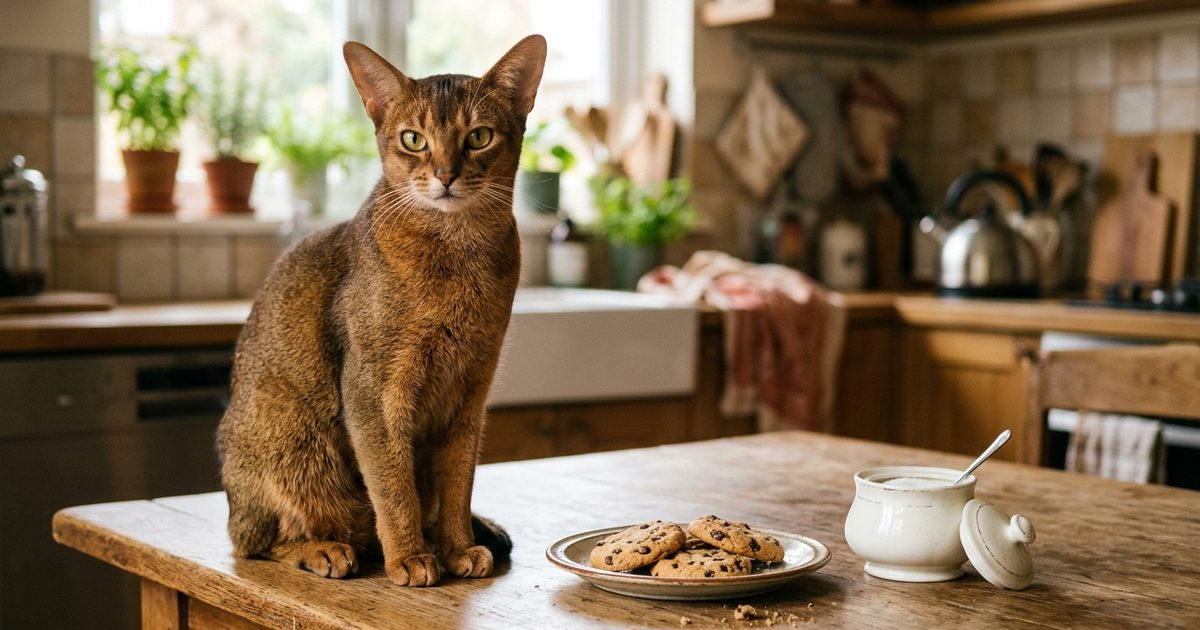
Can Cats Taste Sweet?
No — cats cannot taste sweet or sugar at all. Domestic cats, and all felines studied so far, lack a working sweet taste receptor. Sugar on a cat's tongue registers as nothing; a cookie, a piece of cake, and a plain piece of paper all taste equally un-sweet to her.
The short answer
It's a flat no — not "a little," not "sometimes," not "depends on the cat." Cats are functionally sweet-blind. The receptor that lets you taste a ripe strawberry or a spoonful of honey simply does not exist on your cat's tongue, so the question of whether can cats taste sugar is settled at the hardware level: they can't, full stop. To your cat, the sweetness in a frosting swirl or a cube of sugar carries no signal at all, the same way ultraviolet light carries no signal to your eyes — the detector isn't there to fire.
And yes, this invites an obvious objection: but my cat ate cake. We'll take that one apart properly later in Do Cats Like Sweet Things? — but the short version is that what she's tasting is the fat, the cream, the dairy aroma, and the novelty, never the sugar. The sweetness dimension is invisible to her the whole time.
This is true of cats big and small
This isn't a quirk of the house cat. Every feline species scientists have examined shares the same sweet-blindness — lions, tigers, leopards, and their wild relatives appear to be cut from the same receptor blueprint. The pattern points to something ancient and family-wide rather than a recent domestic mishap, and it sets up the evolutionary story we'll get to shortly in Why Did Cats Lose the Ability to Taste Sweet? Be careful not to over-read it: not every wild felid has been individually tested, so the honest framing is that the trait looks consistent across the Felidae that have been studied, rather than proven in every last species.
Why Can't Cats Taste Sweet? The Sweet-Receptor Science
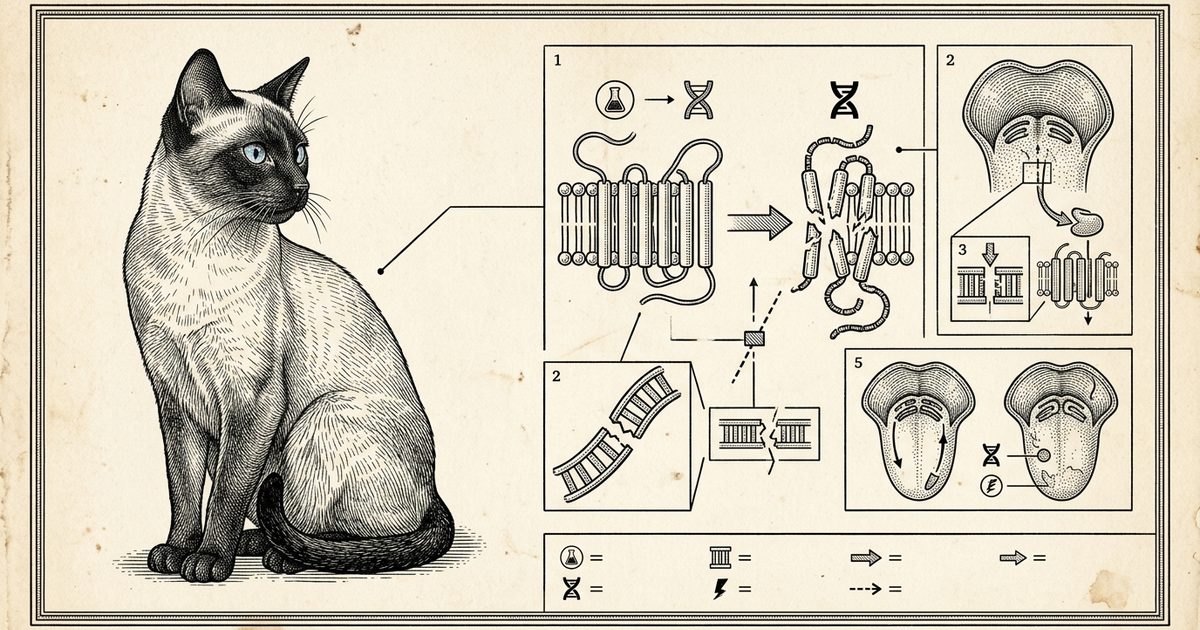
Sweet taste in mammals needs two receptor parts working together — Tas1r2 and Tas1r3. Cats have Tas1r3, but their Tas1r2 gene carries mutations that make it a broken pseudogene, so no functional sweet receptor ever assembles on the tongue. Without that receptor, sugar molecules have nothing to bind to.
How the sweet receptor normally works
In a typical mammal, "sweet" isn't a single switch — it's a two-part lock that only opens when both halves come together. Specialized cells in the taste buds carry a receptor built from two protein subunits, Tas1r2 and Tas1r3, which must pair up (a so-called heterodimer) to form the working sweet detector. When a sugar molecule drifts in and docks onto that paired receptor, the cell fires a "sweet" signal up the nerve to the brain, and you — or your dog, or a fruit bat — taste sweetness. Take away either subunit and the lock stays shut, because the receptor literally cannot assemble. The whole mechanism is detailed in the landmark paper by Li et al. 2005 in PLOS Genetics, the study that first pinned down exactly why cats are the exception.
Where the cat's Tas1r2 is broken
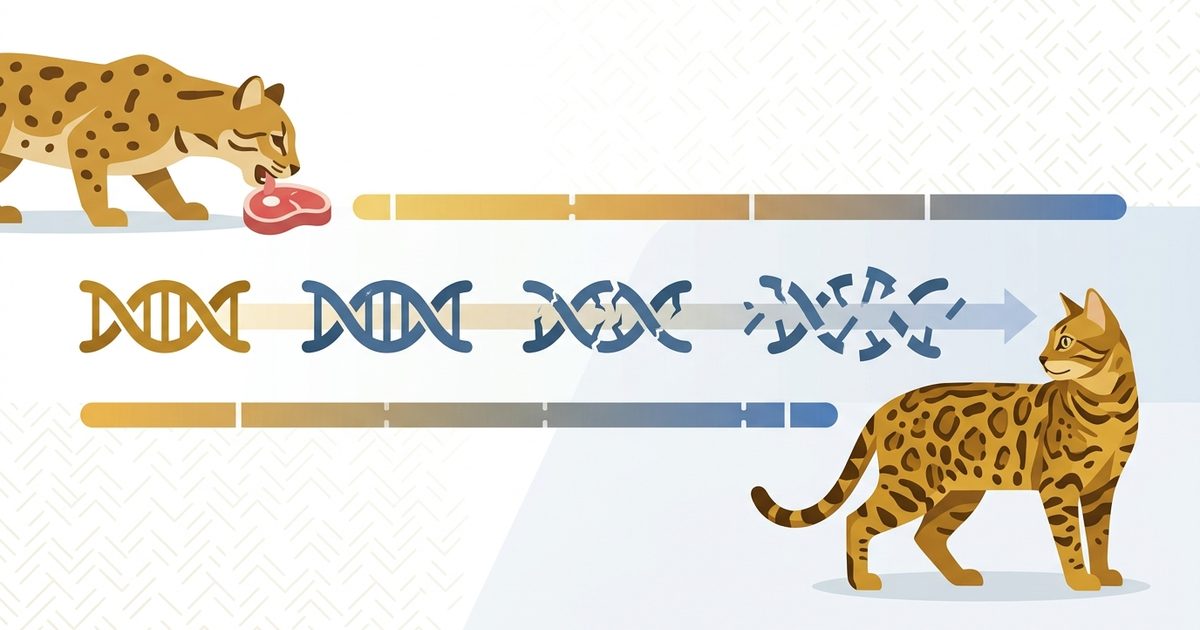
This is the crux of why cats can't taste sweet, and it comes down to a single broken gene. The cat's Tas1r2 carries a 247-base-pair deletion in exon 3 plus several premature stop codons, so when the cell tries to read it, the instructions cut off early and produce a truncated, non-functional protein — what geneticists call a pseudogene, a gene-shaped relic that no longer works. The partner subunit, Tas1r3, is perfectly intact in cats; the problem is that one good half can't form the pair alone. With Tas1r2 broken, the two-part receptor never assembles, which means sugar molecules arrive on the tongue and find no docking site at all — no matter how much frosting is on the cake. That's the molecular answer to why cats can't taste sweet: the receptor isn't merely weak, it's structurally impossible.
Confirmed at the genetic level
This isn't a single-lab, single-cat finding. The same broken Tas1r2 turned up across multiple cat species — domestic cats, tigers, and cheetahs all carry the disabling mutations — and behavioral tests line up with the genetics: these animals show no preference for sugar water over plain water. Taken together, the receptor is missing, the gene is broken in the same way across the family, and the behavior confirms the absence. It's settled genetics, not a hypothesis awaiting proof. For a broader, vet-backed view of how this shapes feline nutrition and feeding, the Cornell Feline Health Center is a reliable reference on why a cat's diet belongs firmly on the meat side of the plate.
Why Did Cats Lose the Ability to Taste Sweet?
Cats are obligate carnivores — their natural diet is meat, which contains essentially no sugar. With no sugar to detect, evolution had no reason to maintain the sweet-receptor gene, so mutations in Tas1r2 accumulated unchecked over millions of years until the gene broke. A useless sense, evolution quietly deleted.
Obligate carnivores don't meet sugar
A cat's ancestral diet is prey — muscle, organ, and bone, with almost zero carbohydrate and essentially no free sugar. Everything a wild cat needs arrives wrapped in protein and fat, never in a ripe fruit or a starchy root. This is what "obligate carnivore" actually means: a cat's body is built to run on meat, and it has lost the metabolic machinery to thrive on anything else.
That matters here because taste evolves around diet. Omnivores — humans, dogs, bears — forage fruit, tubers, and other sugar-rich foods, so for them, detecting sweetness is a survival skill: it points toward ripe, calorie-dense food. A cat never had a sugar-rich food to find. There was nothing in her world for a sweet receptor to locate, and so there was nothing for evolution to protect. If you want the broader diet context, our guide to what cats eat walks through the obligate-carnivore picture in full.
Use-it-or-lose-it gene decay
Here is the strange part: the cat's sweet-receptor gene didn't vanish overnight. It broke slowly.
When a gene is actively useful, natural selection weeds out harmful mutations — any individual carrying a broken copy is at a disadvantage, so the damage doesn't spread. But when a gene is under no selective pressure at all — because what it detects never appears in the diet — there's no penalty for it breaking. Random mutations simply accumulate, generation after generation, with nothing to stop them.
Over millions of years, the cat lineage's Tas1r2 picked up disabling mutations — deletions, stop codons — until it could no longer code for a working protein. It became what geneticists call a pseudogene: a gene-shaped relic that still sits in the DNA but does nothing. This is the classic pattern of "evolutionary relaxation," and it explains something important: the gene isn't simply absent. It's still there, just broken — like a light switch left in the wall after the wiring was cut.
Cats aren't the only ones
Cats aren't unique in this. Studies have found sweet-receptor loss in other obligate-carnivore lineages too — among them, in some research, spotted hyenas and sea lions. The pattern repeats wherever a meat-only diet makes sugar detection pointless.
Sweet-blindness, in other words, tracks the carnivore lifestyle, not the cat family alone. It's the same evolutionary logic arriving at the same answer in different branches of the mammal tree.
Do Cats Like Sweet Things?
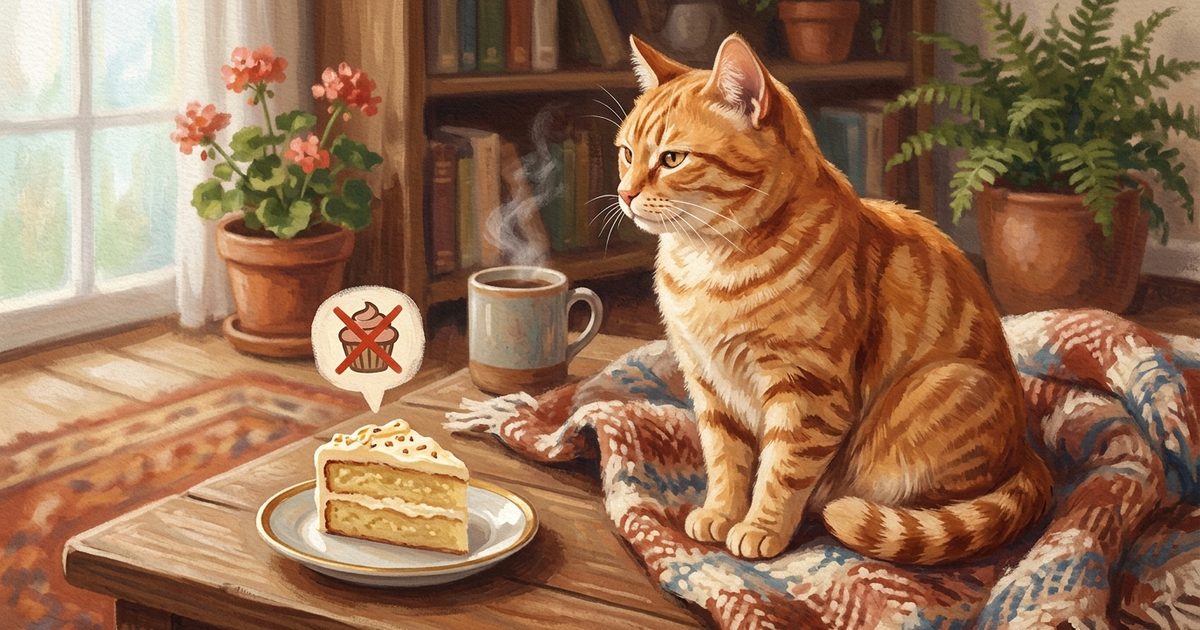
If your cat begs for ice cream, cream, or cake, it is almost never the sugar — it is the FAT, the smell, and the smooth, fatty texture. Cats are exquisitely sensitive to fat and the mouth-feel of rich foods, and dairy carries strong meaty-adjacent aromas. The sweetness itself your cat cannot perceive at all.
The fat, not the sugar
This is the question that trips up almost every cat owner: do cats like sweet things? The honest answer is that they like the things, but not the sweetness.
Cream, ice cream, butter, and most sweet baked goods are, first and foremost, high-fat foods. And cats have strong fat detection and a strong preference for the rich, smooth mouth-feel that fat creates. That is the real attractant — a bowl of cream reads to a cat's tongue and nose the way a piece of marrow might. The sugar is, for her, completely inert.
So when your cat comes running for your ice cream, she is not chasing a sugar craving she can't even sense. She's chasing fat. For the food-by-food breakdown — including why a lick of ice cream is about the dairy, not the dessert — see our verdicts on whether cats can eat ice cream and whether cats can eat bananas.
Texture and novelty
There's a second pull besides fat: novelty. Cats are curious eaters, and a cold, unusual substance with a strange mouth-feel is interesting in itself. A lick of something icy and new can be simple exploration — the feline equivalent of poking at a thing to see what it is.
That's worth separating out, because it's easy to mistake curiosity for craving. A cat who tries a new food once isn't telling you her diet is missing something; she's telling you she noticed something unfamiliar. Novelty is not a nutritional signal to act on.
Smell does most of the work
Finally, remember how a cat decides what counts as food in the first place. A cat's sense of smell drives her food interest far more than taste ever does — the aroma, not the flavor on the tongue, is what tells her "this is worth eating."
The dairy and protein notes in ice cream carry exactly the kind of warm, savory-adjacent smell that reads as "food" to a cat, even though the sugar dimension is entirely invisible to her. This is also why it's misleading to frame cats as "loving" sweets — they live in a sensory world built around smell and umami, not sugar, and treating that world on its own terms matters more than projecting ours onto it. If that species-specific-sensory framing interests you, our piece on whether cats are smarter than dogs explores how differently each species reads the same room.
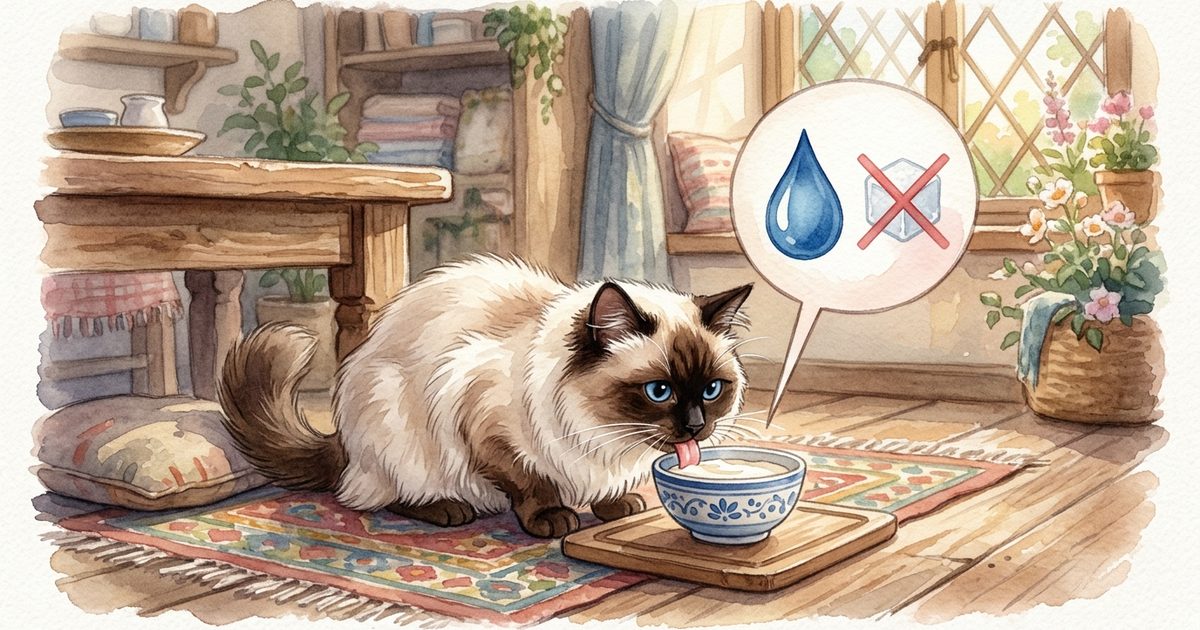
Curious what your cat would say about all of this? Get a MeowMind reading — your cat can't taste the cookie you're eating, but she absolutely has an opinion about you eating it without her. Upload a photo and hear what she'd actually say.
What Can Cats Taste, Then?
Cats taste umami (the savory, amino-acid taste of meat) most strongly — it is their dominant, most important taste channel. They also taste bitter (to detect toxins), sour (to detect spoilage), and salty. Sweet is the one basic taste that is entirely missing from a cat's sensory world.
Losing sweetness sounds like a deficit, but only if you measure a cat by a human yardstick. Strip away the one taste a carnivore never needed, and what's left is a tongue exquisitely tuned to the flavors that actually matter for an animal that lives on meat.
Umami — the cat's signature taste
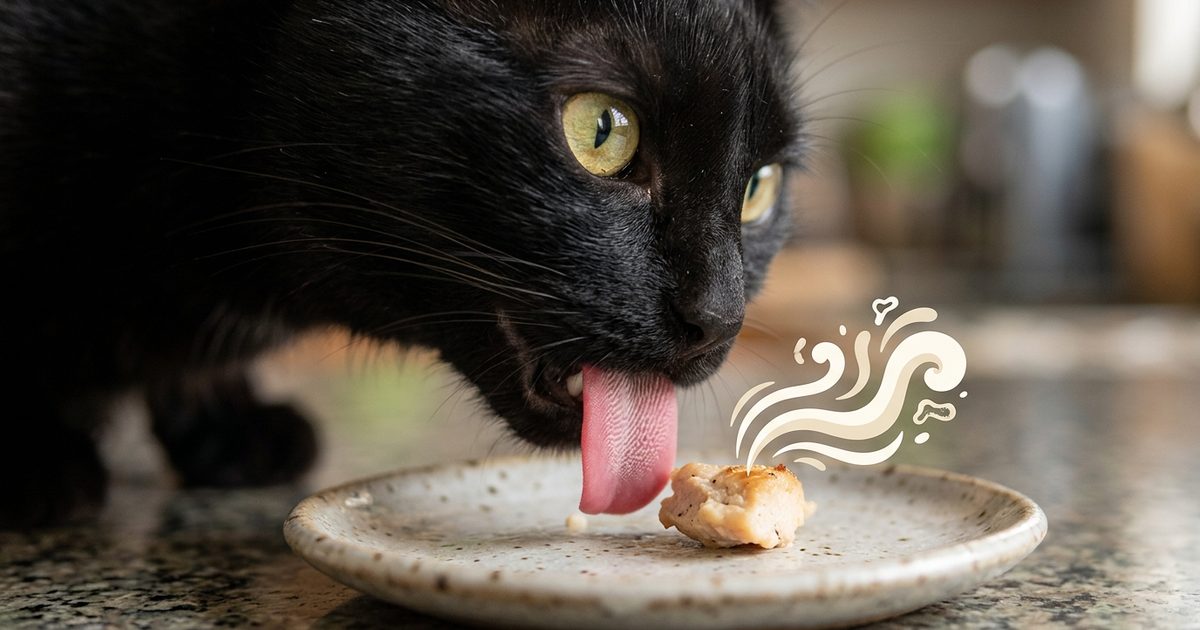
A cat's tongue carries a robust umami receptor built from two working proteins, Tas1r1 and Tas1r3 — the same machinery a human uses to taste the savory depth of broth or aged cheese, but in a cat it's tuned to amino acids: the building blocks of protein and meat. For a cat, umami is the taste that announces "this is food." It's the sensory green light behind every successful hunt and every clean bowl. This is precisely why a sliver of chicken or a lick of tuna juice lands with such intensity, and why meat-free treats so often get sniffed and abandoned. The deeper logic of what a cat should eat — and why her whole body is organized around meat — is laid out in our guide to what cats eat.
Bitter, sour, and salty
The other three taste channels round out a carnivore's survival toolkit. Bitter detection is the tongue's poison alarm — and it still matters for a meat-eater, because a sick prey animal, a contaminated carcass, or a nibbled houseplant can all carry toxins that bitter receptors flag before they're swallowed. Sour taste signals fermentation and spoilage, steering a cat away from food that has gone off. Salt is detected too, but here cats differ sharply from humans: the blood and tissue of prey already supply all the sodium a cat needs, so she has no biological drive to seek out extra salt the way we do. Salty is present, but it isn't a craving.
Fewer taste buds than humans, sharper where it counts
Cats have only about 470 taste buds, compared to a human's roughly 9,000 — roughly one twentieth the count. But the raw number undersells the design. A cat's taste receptors are concentrated in exactly the channels that serve a carnivore (umami and bitter) and absent in the one that doesn't (sweet). It's not a diminished sense; it's a specialized one. The Cornell Feline Health Center covers how this carnivore-tuned sensory and nutritional profile should shape what you actually feed your cat.
What Should You Feed a Cat That Can't Taste Sweet?
Do not feed your cat sugary treats — she cannot taste the sweetness, so the sugar brings her zero pleasure, and it brings real harm: weight gain, dental disease, and diabetes risk. Reward her instead with small amounts of meat-based treats that hit the umami taste her tongue is built for.
This is the practical turning point of everything above. The question isn't really "can my cat have sugar?" — it's "why would I give her something she can't even taste, when it quietly hurts her?"
Sugar is pleasure-free for cats and harmful
Because a cat literally cannot taste sweet, the sugar in cake, cookies, icing, or sweetened yogurts gives her nothing she can enjoy — the pleasure dimension is simply switched off for her. What the sugar does deliver is harm: empty calories that drive obesity, fermentable carbohydrates that feed the bacteria behind dental decay, and repeated sugar loads that, over time, raise the risk of feline diabetes. There is no upside to sugar for a cat and a measurable downside. The same carnivore-first logic that explains what cats eat is why fruit like bananas is safe only as a rare, tiny taste — not because of the sweetness, which she can't perceive, but because her metabolism isn't built to handle the sugar load.
Meat-based treats hit the right taste
Freeze-dried chicken, salmon, or liver treats land directly on the umami receptor a cat actually possesses — and that's why a single meat treat can send her into a more genuine frenzy than any cookie ever will. They're working with her tongue instead of against it. The only guardrail is portion size: keep all treats, however healthy, under about 10% of her daily calories so they don't unbalance her diet. For the single-ingredient verdicts, see our guides on whether cats can eat chicken and salmon — both are excellent umami-forward treats in small amounts.
If she sneaks a lick of something sweet
A single accidental lick of cake frosting or a drop of ice cream is almost always harmless — the concern with sugar is frequency and quantity, not a one-off taste. Don't panic, don't scold, and just don't let sweets become a habit. The instinct to keep sweet foods away from her isn't about toxicity in the moment; it's about not building a pattern that her body has no way to enjoy and every reason to pay for later.
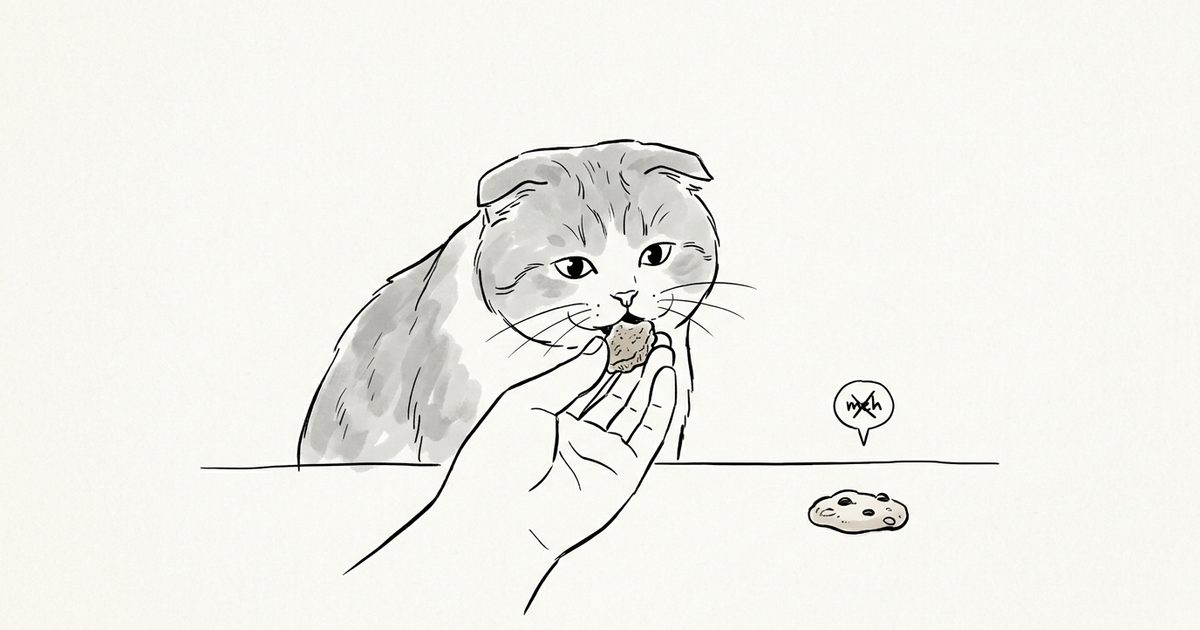
The simplest version: your cat can't taste sugar, so a sugary treat gives her nothing and costs her health. Reach for a meat treat instead — it's the one her tongue was actually built to love.
Curious What Your Cat Would Say?
Upload a photo and get a warm, personalized reading from your cat's perspective.
Start Your Free ReadingSweet Taste & Cats at a Glance — Summary
| Question | Short answer |
|---|---|
| Can cats taste sweet or sugar? | No — cats lack a working sweet receptor; sugar registers as nothing on their tongue |
| Why can't cats taste sweet? | Their Tas1r2 gene is a broken pseudogene, so the sweet receptor never assembles |
| Why did cats lose sweet taste? | As obligate carnivores, cats never met sugar in their diet, so the gene decayed |
| Do cats like sweet foods? | What they like is the fat, the smell, and the texture — never the sweetness |
| What do cats taste best? | Umami, the savory amino-acid taste of meat — their strongest, most important channel |
| Should I give my cat sugar? | No — she can't taste it, so it gives her no pleasure and can cause real harm |
Frequently Asked Questions
Can cats taste sweet at all?
No — cats cannot taste sweet at all. They lack a working sweet taste receptor because their Tas1r2 gene is a broken pseudogene, so sugar on a cat's tongue registers as nothing. A cookie, a cube of sugar, and a plain piece of paper all taste equally un-sweet to her.
Why can't cats taste sugar?
Sweet taste needs two receptor parts — Tas1r2 and Tas1r3 — working together. Cats have a normal Tas1r3, but their Tas1r2 gene carries disabling mutations that make it a non-functional pseudogene, so the sweet receptor never assembles and sugar has nothing to bind to.
Do cats like sweet things like ice cream and cake?
Not for the sweetness — when your cat begs for ice cream or cake, she is drawn to the fat, the dairy aroma, and the smooth mouth-feel, never the sugar itself. The sweetness dimension is completely invisible to her tongue the whole time.
What tastes can cats actually detect?
Cats detect umami most strongly — the savory, amino-acid taste of meat — which is their most important channel. They also taste bitter, sour, and salty. Sweet is the only basic taste entirely missing from a cat's sensory world.
Is it okay to give my cat sugar or sweet treats?
It's best not to. Because she can't taste sweet, the sugar gives her zero pleasure while bringing real harm — weight gain, dental decay, and a higher diabetes risk. Reward her instead with small meat-based treats that hit her umami receptor.
Can kittens taste sweet?
No — kittens have the same broken Tas1r2 gene as adults, so they cannot taste sweetness either. Even nursing kittens respond to the rich milk and its amino acids, not to any sweetness, because the receptor is absent from birth.
Do big cats (lions, tigers) taste sweet?
All feline species studied so far share the same sweet-blindness. Lions, tigers, and cheetahs carry the same disabling mutations in Tas1r2 and show no preference for sugar water, so the trait appears family-wide across the Felidae.
What treats do cats actually enjoy if they can't taste sweet?
Cats enjoy meat-based treats — freeze-dried chicken, salmon, or liver — because these land directly on the umami receptor their tongue is built for. A single meat treat is far more rewarding than any cookie, which is why sugary treats so often get ignored.
Are cats defective because they can't taste sweet?
No — the loss is adaptive, not a defect. Evolution simply removed a receptor a carnivore never needed, while sharpening the senses that do matter for a meat-eater, like umami, smell, and hearing. Cats live in a different sensory world, not a lesser one.
Sources & References
You Might Also Like
Kitten Teething: Timeline, Symptoms & How to Help
Kitten teething runs from 3 to 7 months as baby teeth fall out. Learn the timeline, signs to watch for, and how to soothe a teething kitten safely.
15 min readWhen Do Cats Stop Growing? A Complete Timeline
When do cats stop growing? Most cats reach adult size by 12-18 months, but large breeds like Maine Coons keep growing until 3-4 years. Full timeline inside.
14 min readCan Cats Eat Cherries? Flesh, Pit & Toxicity Facts
Can cats eat cherries? Pitted flesh is safe in tiny amounts — but the pit, stem, and leaves are toxic (cyanide precursors). Learn what's safe and what isn't.
15 min read