Are Cats Smarter Than Dogs? What Science Actually Says
If you have ever stood in the kitchen while your cat opened a cabinet and your dog waited for a command, you have probably wondered: are cats smarter than dogs? It is one of the oldest questions in pet ownership, and the honest answer is that the question itself is a little broken. When people ask how smart are cats, or whether are dogs smarter than cats, they are usually imagining one invisible ladder with a single top rung — and cats and dogs were never built for the same ladder.
Key takeaways
- Neither species is "smarter." Intelligence is species-specific — cats and dogs were shaped by different pressures and excel at different things.
- Dogs have more cortical neurons than cats, but neuron count measures processing capacity, not a single intelligence score.
- The whole comparison is flawed: pack-social evolution produced one kind of mind, solo-predator evolution produced another.
Cats vs Dogs Intelligence — Quick Reference
| Measure | Cats | Dogs |
|---|---|---|
| Cortical neuron count | ~250 million | ~530 million (golden retriever) |
| Trainability | Moderate — learns with motivation | High — bred to absorb instruction |
| Reading human cues (pointing, gaze) | Can learn it; not automatic | Intuitive from puppyhood |
| Solo problem-solving | Strong — independent strategy | Weaker without social cues |
| Spatial memory | Excellent — long-term territory recall | Good, more cue-dependent |
| Vocal learning toward humans | Meows tuned to people | Barks modulated to people |

Are Cats Smarter Than Dogs?
No — and dogs are not smarter than cats either. Intelligence is species-specific: dogs excel at social, cooperative, and trainable tasks, while cats excel at solo hunting, spatial problem-solving, and independent adaptation. There is no single scale where one ranks above the other.
The temptation is to crown a winner. It feels like there should be one answer, one number, one species that takes the title. But every serious attempt to compare cat and dog cognition lands in the same place: they are not running the same race. Dogs were shaped by thousands of years of cooperative life with humans, and their minds reflect that — they read us, work with us, and learn from us with an ease that can look like obvious intelligence. Cats were shaped by a different pressure entirely: the need to hunt, hide, and survive alone, often without instruction or backup.
So when the question is "who is smarter," the most accurate answer is that the word "smarter" does not fit. There is no universal cognitive yardstick where a cat and a dog can be placed side by side and one scores higher. There are only different minds, evolved for different problems, each astonishing in its own niche.
The short answer: neither wins
The scientific consensus is that cross-species intelligence is not a ladder. Different evolutionary niches selected for different cognitive toolkits, and a toolkit built for cooperative herding is not "higher" than one built for solo ambush hunting — it is built for a different job. Ethologists and veterinary behaviorists generally treat "smarter" as the wrong word entirely, because it implies a single dimension of comparison that does not exist in biology. The Cornell Feline Health Center frames feline cognition not as a ranking against dogs but as a set of adaptations to a particular way of life. That framing is the honest one. A cat that remembers the layout of a three-acre territory for years is not less intelligent than a dog that learns to guide a blind human across a city — it is intelligent in a different direction.
Why people keep asking anyway
The debate refuses to die because it reflects human projection more than biology. Dog loyalty reads to us as intelligence — a dog that comes when called, learns commands, and works alongside us looks obviously smart, because we value cooperation and we recognize our own kind of social intelligence in it. Cat independence reads the opposite way: a cat that does not come when called, ignores a command, or solves a problem without us can look aloof, stubborn, or "untrainable," which we quietly translate as less intelligent. Both readings are projections. The same instinct — assuming an animal that behaves like us must be smarter — also shapes the parallel debate over whether cats have feelings, where the same projection cuts both ways. The question persists because it is really about us, not about them.
How Does Science Measure Cat vs Dog Intelligence?
Researchers compare brain structure, cortical neuron counts, problem-solving tasks, and memory tests. Dogs generally have more cortical neurons than cats, but neuron count correlates with processing capacity — not with a single "smartness" score. Behavior on puzzles and memory tests paints a mixed picture.
If neither species wins outright, how do scientists even begin to compare them? The work falls into a few broad categories: measuring the physical brain, counting the cells that do the thinking, and watching how each animal actually behaves on puzzles, detours, and memory tests. Each method tells us something real — and each one has a blind spot.
Cortical neuron count: the headline number
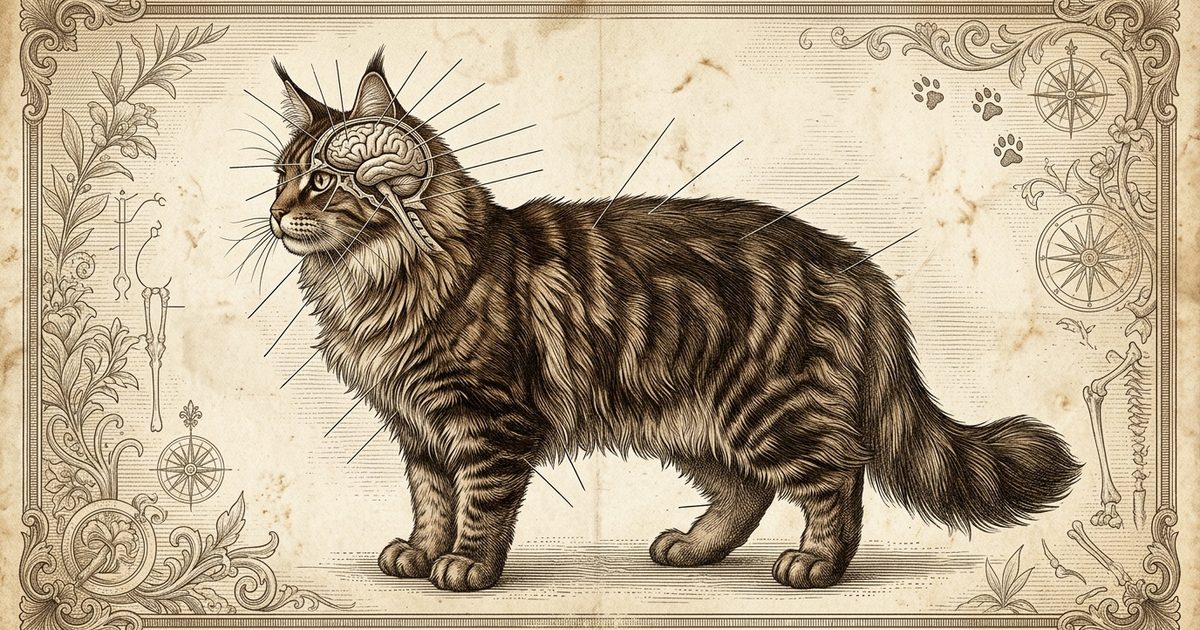
The number most often quoted in this debate comes from a 2017 study by neuroscientist Suzana Herculano-Houzel and colleagues, published in Frontiers in Neuroanatomy. They counted neurons in the cerebral cortex — the outer brain layer associated with complex thinking, planning, and problem-solving — and found that a golden retriever had roughly 530 million cortical neurons, while a cat had roughly 250 million. That is a striking gap, and it is real.
What does it mean? Cortical neurons are the cells that process information, so a higher count generally suggests greater raw information-processing capacity. But — and this is the crucial caveat — neuron count does not translate into a single intelligence ranking. Structure, wiring, and how neurons connect matter as much as the raw number. The Herculano-Houzel finding tells us dogs likely have more cortical processing power on average; it does not tell us dogs are smarter, because "smarter" is not a thing neurons can be counted to settle. You can read the original research in Frontiers in Neuroanatomy (2017).
Brain size and structure
A second approach looks at the brain as a whole: its size, the thickness of the cerebral cortex, and the encephalization quotient, which compares actual brain size to the size expected for a given body weight. Here the picture gets muddier. Absolute brain size misleads badly — an elephant brain is far larger than a human's, but elephants do not out-think humans, because density, folding, and wiring matter more than mass. The same logic applies across cats and dogs: bigger brain does not automatically mean sharper mind. Structure and connectivity are what carry the cognitive load.
Problem-solving and memory tasks
The most direct approach is behavioral: put cats and dogs through puzzles, detour tests, object-permanence tasks (does the animal know a hidden object still exists?), and memory challenges. Here the results are genuinely mixed, and they fall out in species-predictable ways. Dogs tend to excel at tasks that involve a social partner — following a human's point or gaze, learning by watching a demonstrator. Cats tend to excel at solo tasks that reward patience, stealth, and independent trial-and-error, like working out how to reach food in a puzzle box without help. Both species pass object-permanence tests, both remember solutions over time, and both fail in ways that map onto what their evolution prepared them for. Memory and recognition are core pieces of this picture — see our deeper look at what cats actually know — and they are exactly where cats often surprise people who assumed they were the "less intelligent" species.
Why every metric is incomplete
Every metric above has the same blind spot: each task is built to one species' ecology, so the yardstick quietly picks the winner before the test begins. We unpack this fully below — in Why Is the Cats-vs-Dogs Comparison Flawed? — where the mechanism is argued once, in full.
What Are Cats Smart At?
Cats are exceptional at solo hunting, spatial memory, stealthy problem-solving, and independent adaptation. They remember the layout of their territory for years, work out how to open doors and puzzles on their own, and adjust their hunting strategy to each prey type — all without instruction.
Hunting and predatory strategy
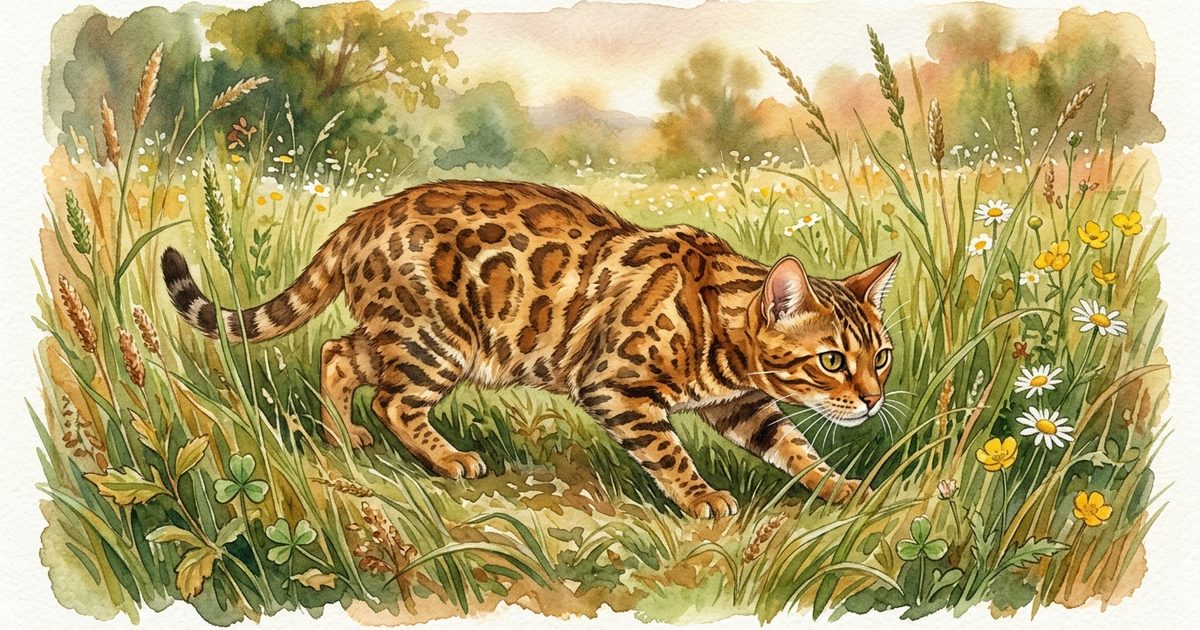
A cat hunting alone is running a complex real-time calculation. She stalks low, reads the wind, breaks her outline behind cover, and times the pounce to the millisecond her prey looks away. That sequence — stalk, ambush, calculated strike — is the cognitive centerpiece of feline intelligence, and it has to work every single time, because there is no pack to flush prey toward her.
What makes this genuinely sophisticated is the adjustment. The same cat hunts a bird with a long flat sprint and an early launch; she hunts a mouse with a tight, patient ambush from inches away; she flips a beetle with a quick paw-flick and waits for it to right itself before biting. Each prey type demands a different technique, learned through observation and failure rather than demonstration. Solo predation is one of the most cognitively loaded things a mammal can do — and the cat does it without a teacher.
Spatial memory and navigation
Cats hold remarkably durable mental maps. A cat who has lived in a home will, after months away or even after a move, still walk directly to the corner where her food bowl used to be, the shelf she liked to hide behind, the window where the afternoon sun came in. Outdoor and feral cats track territory, multiple food caches, safe resting spots, and escape routes — and recall them over long stretches of time.
This is the same machinery behind the well-documented "homing" ability, in which lost or displaced cats travel surprising distances back to familiar ground. Spatial memory is a core piece of how cats know their world, and it overlaps with the recognition and recall we explore in whether cats know their humans — a cat who remembers the geography of her territory also remembers the beings in it.
Independent problem-solving
Any owner who has watched a cat work out a closed door has seen feline cognition in action. Cats learn to pull handles, hook paws under lever latches, slide drawer stops, and crack open puzzle feeders — and they work these out alone, through trial and error, without another cat or a human showing them the move.
The independence here is not a side note; it is the cognitive adaptation itself. A solo predator cannot wait for instruction, so evolution pressed cats toward persistent, self-directed problem-solving. The same stubbornness that makes a cat "untrainable" by dog standards is exactly the self-reliant reasoning that lets her dismantle a feeder she has never seen before. This is a real, measurable strength — it just doesn't look like compliance.
Adaptability and self-sufficiency
Strip away the human household and the cat's intelligence is still obvious. Feral cats survive, hunt, raise young, and navigate social competition without any human scaffolding — and house cats placed in a new environment typically size up the exits, the hiding spots, and the safe vertical routes within hours. The solo hunter's life forces fast, flexible learning.
International Cat Care, a leading authority on feline welfare and behavior, frames much of cat intelligence in exactly these terms — as adaptive capacity tuned to a self-sufficient life. A cat's cleverness is built for independence, not for cooperation, and that shapes everything she is good at.
Get a MeowMind reading — wondering what's actually going on inside that clever head? Upload a photo and hear your cat's take on the world, in her own words.
What Are Dogs Smart At?
Dogs are exceptional at social cognition, trainability, reading human cues, and cooperative problem-solving. They follow a human pointing gesture intuitively, learn complex multi-step commands, and work alongside humans and other dogs — skills shaped by thousands of years of cooperative selection.
Reading human social cues
This is the headline dog advantage, and the evidence is striking. From early puppyhood, dogs follow a human pointing finger and a human gaze to locate hidden food — a skill that comes close to automatically, with little training. Wolves, our closest comparison, generally do not do this even when raised by humans. Something about the dog's evolutionary path tuned her attention to us.
Cats can learn the same cue, and studies suggest many do pick it up over time. But they do not do it as readily or as early — and they often simply choose not to. That is not a deficit in raw processing power so much as a difference in what each animal was selected to pay attention to. The dog's genius is social attention; she reads a glance the way a cat reads a rustle in the grass.
Trainability and working roles
Herding sheep, guiding a blind handler, detecting explosives or medical alert scents, performing service tasks — the range of jobs dogs hold is a genuine cognitive achievement. These roles require absorbing and executing long chains of instruction, generalizing a learned behavior across contexts, and inhibiting impulse on command. That is real intelligence, not merely compliance.
The temptation is to call this "obedience" and write it off, but obedience itself is a cognitive skill: it means holding a learned rule in mind, suppressing a more tempting action, and tracking a human's shifting signals across time. A working dog running a complex task is solving a moving problem in cooperation with a partner. Few animals on earth can do it, and dogs do it because thousands of years of cooperative selection wired them to.

Cooperative problem-solving
Dogs often learn by watching. A dog who sees another dog — or a human — solve a task will frequently pick up the method and reproduce it. This kind of social learning is the heritage of cooperative, pack-hunting ancestry, where watching and coordinating with groupmates carried real survival value.
Contrast this with the cat's solo approach: a cat faced with the same puzzle typically ignores any demonstrator and works it out herself, by trial and error. Neither strategy is superior — one is tuned to a social ecology, the other to a solitary one. They are different intelligences, shaped by different pressures, answering different questions.
Vocal learning directed at humans
Dogs modulate their barks — varying pitch, rhythm, and repetition — to signal different things to the humans around them, and they shape these sounds based on what gets a response. This is a learned, human-directed vocal flexibility, and it has a direct feline parallel in the human-directed meow, which cats also tune specifically for us rather than for each other. Both species, it turns out, learned to talk to people.
Why Is the Cats-vs-Dogs Comparison Flawed?
The comparison is flawed because cats and dogs were shaped by opposite evolutionary pressures. Dogs descended from cooperative pack hunters selected to read and work with social partners; cats descended from solo predators selected to hunt, hide, and survive alone. Different problems, different minds — not a ranking.
Pack-social vs solo-predator evolution
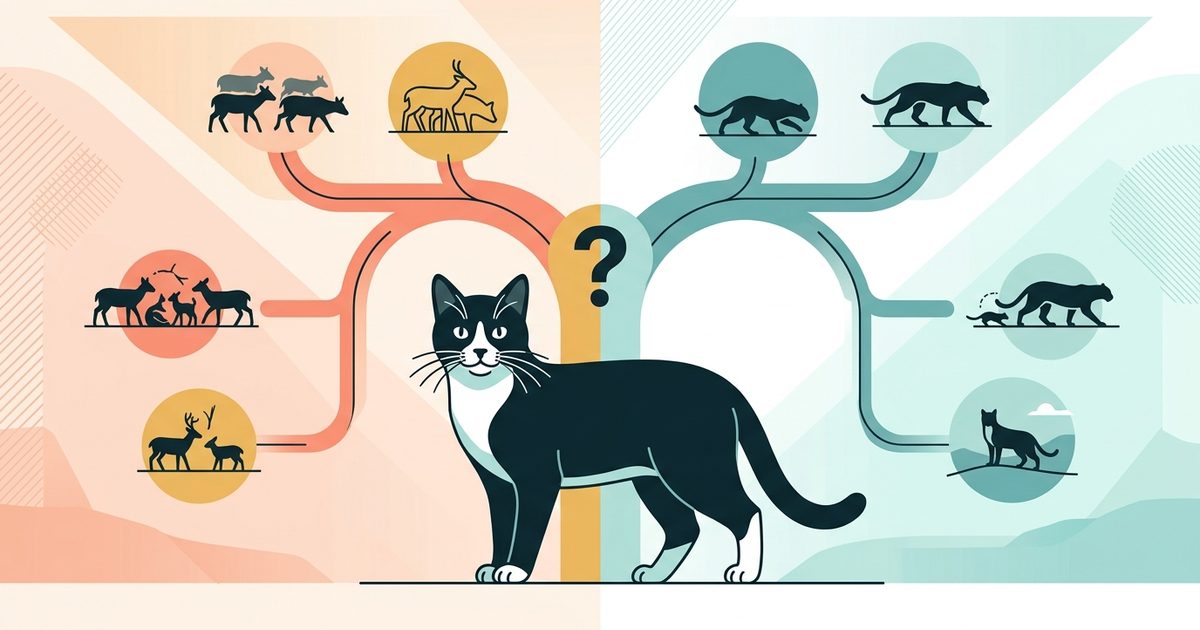
Dogs inherited a cooperative-hunting heritage. Their canid ancestors survived by coordinating — reading each other's signals, dividing roles within the pack, and trusting partners during a chase. Natural selection rewarded animals that could interpret intent and act on shared goals. Cats inherited the opposite template. Felids are obligate solitary hunters; a house cat's wild ancestors caught small prey alone, concealed themselves from larger predators, and relied on stealth rather than teamwork. One ecology rewarded social attunement; the other rewarded self-sufficiency, spatial memory, and fast independent decisions. This is the structural reason "neither is smarter" is the honest answer — they were optimized for different cognitive jobs.
Domestication pressed on different levers
Domestication widened that gap further. Dogs were actively bred to cooperate with humans in working roles — herding, guarding, retrieving — so selection repeatedly favored animals that followed human cues. Cats largely domesticated themselves around grain stores, where their value lay in pest control and a tolerant distance from people, not obedience. Humans shaped dogs' minds; cats shaped their own. The Cornell Feline Health Center notes that cats retain far more of their wild ancestors' behavioral repertoire than dogs do, which is precisely why their intelligence points so strongly toward independent survival rather than cooperative work.
A ranking requires one yardstick
Every "who's smarter" test quietly embeds a choice of yardstick, and the yardstick usually reflects the tester's species. A pointing-and-gaze test is a social-cooperation test, and a pack animal was always going to win it. A solo puzzle-box test is a stealth-and-patience test, and a lone predator was always going to win that. Each metric is built to one species' scale, so the result tells you more about the test than about the animals. The fairer question is not "who's smarter" but "smart at what?" — and once you ask it that way, cats and dogs stop being competitors and start being two different answers to two different problems.
The honest framing
Species-specific intelligence, not a ladder. Restated once, plainly: a cat's mind is built for solo survival, a dog's mind is built for cooperative work, and neither is higher or lower than the other.
Do Breed and Individual Variation Matter More Than Species?
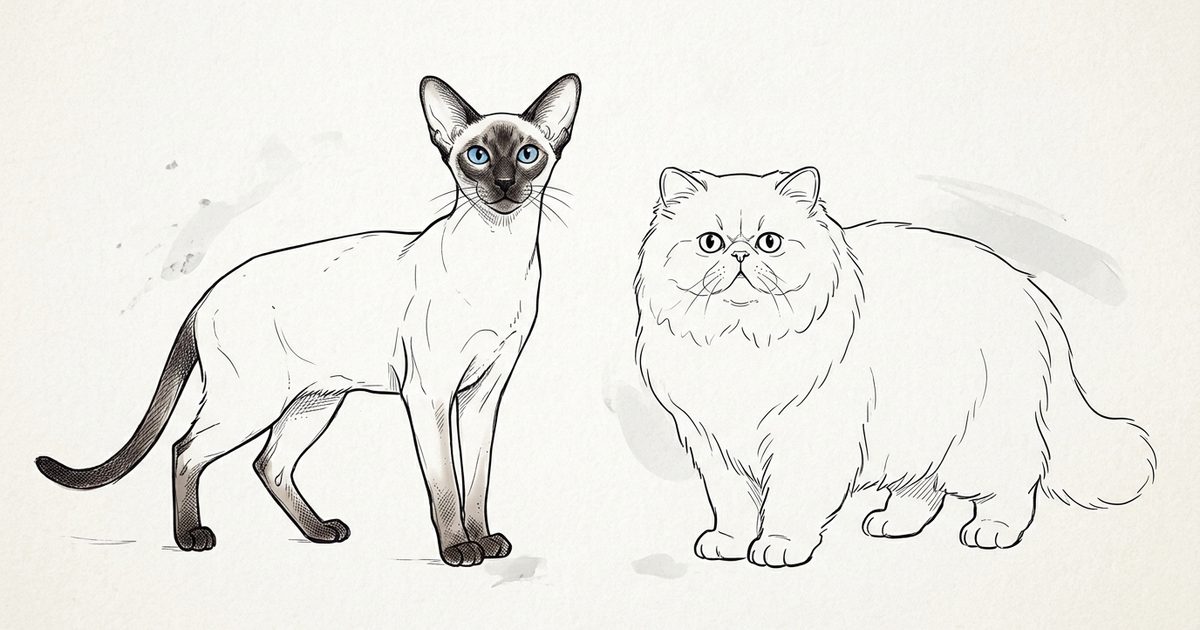
Often yes. A working-line border collie and a scent-trailing bloodhound differ enormously in cognition, and a problem-solving Bengal differs from a placid Persian. Within-species variation — breed, individual personality, and life experience — frequently exceeds the average gap between cats and dogs.
Breed differences inside each species
Within dogs, working and show lines of the same breed can diverge sharply in cognition. Border collies were shaped for sustained attention to human guidance; bloodhounds for independent scent-work that often requires ignoring the handler. Within cats, Bengals retain problem-solving intensity from their wild ancestry, while Persians were bred toward calm companionship. Some lines were selectively bred for pest control, others for coat and conformation. We can generalize about what a breed tends to be good at, but crowning a single "smartest breed" just smuggles one yardstick back in — the same trap as the cat-vs-dog ranking, one rung down.
Individual personality and experience
Breed is only part of the story. Enrichment, training history, and innate temperament shape any individual cat or dog's measured intelligence more than the species average does. A cat who lives in a stimulating environment with puzzle feeders, climbing routes, and regular interaction tends to show more recognizable problem-solving — and is often read, fairly or not, as smarter. The same is true of dogs: a bored, under-stimulated dog of a "smart" breed can look dull, while an engaged dog of an "ordinary" breed can look sharp. This is part of why how cats show affection tracks so closely with enrichment — enriched, bonded animals simply express more.
What this means for owners
The practical takeaway is to meet the animal in front of you. Species averages tell you almost nothing about your specific companion's mind. Your cat may be a relentless puzzle-solver or a placid lounger; your dog may be a keen working partner or a happy goofball. Neither is a defect — they are individuals, and the most useful question is not "is my pet smart?" but "what is my pet smart at, and how do I meet that?"
Cats vs Dogs Intelligence at a Glance — Summary
| Question | Short answer |
|---|---|
| Are cats smarter than dogs? | Neither — intelligence is species-specific, not a ranking |
| Do dogs have more neurons? | Yes, more cortical neurons, but that's processing capacity, not a "smartness" score |
| Are dogs easier to train? | Generally yes — cooperative selection shaped trainable cognition |
| Do cats have good memories? | Excellent spatial and long-term memory for territory and routine |
| Which is better at reading humans? | Dogs follow human cues more readily; cats can learn it but less automatically |
| Which is better at solo hunting? | Cats — stealth, ambush, and independent strategy are their evolutionary niche |
| Is the comparison fair? | Only if you ask "smart at what?" — one yardstick always favors one species |
| Does breed matter more than species? | Often yes — within-species variation frequently exceeds the cat-vs-dog average gap |

So the honest answer to are cats smarter than dogs is really neither — they're each brilliant at exactly what evolution asked them to be, and your companion is the proof in front of you.
Curious What Your Cat Would Say?
Upload a photo and get a warm, personalized reading from your cat's perspective.
Start Your Free ReadingFrequently Asked Questions
Are cats smarter than dogs?
No — and dogs are not smarter than cats either. Intelligence is species-specific: dogs excel at social, cooperative, and trainable tasks, while cats excel at solo hunting, spatial problem-solving, and independent adaptation. There is no single scale where one ranks above the other.
Do dogs really have more brain cells than cats?
Yes, on average. A 2017 study found dogs have roughly 530 million cortical neurons compared with about 250 million in cats. But neuron count measures information-processing capacity, not a single smartness score — wiring, structure, and ecology all matter too.
Why are dogs easier to train than cats?
Dogs were shaped by thousands of years of cooperative selection for working alongside humans, so following cues and absorbing instruction come naturally to them. Cats largely domesticated themselves around pest control, where independence mattered more than obedience — so they learn, just on their own terms.
Do cats have good memories?
Excellent ones, especially for space and routine. Cats remember the layout of their territory, food caches, and hiding spots for years, and many displaced cats can travel surprising distances back home. Their long-term recall is among their strongest cognitive skills.
Which is better at reading human emotions, cats or dogs?
Dogs generally read human cues — pointing, gaze, tone — more readily and from earlier in life, because social attention was selected for in their evolution. Cats can learn the same cues, but they often simply choose not to act on them, which says more about motivation than raw ability.
Are cats smarter than they look?
Often yes. The aloof, independent image makes cats seem less clever than they are, but that same independence reflects real problem-solving intelligence — opening doors, navigating territory, and hunting solo. Their intelligence just points in a different direction than a dog's.
Does breed matter more than whether it's a cat or a dog?
Frequently, yes. A working border collie differs sharply in cognition from a scent-trailing bloodhound, and a problem-solving Bengal differs from a placid Persian. Within-species variation — breed, personality, and life experience — often exceeds the average gap between cats and dogs.
Is comparing cat and dog intelligence even fair?
Only if you ask 'smart at what?' rather than 'who's smarter.' Every test embeds a bias toward one species' ecology — a cooperative task favors a pack animal, a solo hunting task favors a lone predator. The yardstick quietly picks the winner before the test even begins.
Sources & References
You Might Also Like
Kitten Teething: Timeline, Symptoms & How to Help
Kitten teething runs from 3 to 7 months as baby teeth fall out. Learn the timeline, signs to watch for, and how to soothe a teething kitten safely.
15 min readWhen Do Cats Stop Growing? A Complete Timeline
When do cats stop growing? Most cats reach adult size by 12-18 months, but large breeds like Maine Coons keep growing until 3-4 years. Full timeline inside.
14 min readCan Cats Eat Cherries? Flesh, Pit & Toxicity Facts
Can cats eat cherries? Pitted flesh is safe in tiny amounts — but the pit, stem, and leaves are toxic (cyanide precursors). Learn what's safe and what isn't.
15 min read