Why Do Cats Meow? All the Reasons Behind Every Meow
Cat meowing is one of the first things we notice about living with a cat — and one of the most overlooked. If you've ever wondered why do cats meow at all, or tried to tell apart the different cat meow sounds echoing from your kitchen at 6 a.m., you're asking exactly the right question. The short answer is surprising: adult cats rarely meow at each other. Meowing is a signal house cats have kept from kittenhood and aimed almost entirely at humans. The longer answer involves hunger, greeting, boredom, stress, mating, and sometimes pain — and every one of those reasons sounds a little different.
Key takeaways
- Meowing is mostly a human-directed signal — adult cats meow at us far more than they meow at other cats.
- Cats vary pitch, length, and repetition to change meaning, so a greeting meow, a demand meow, and a distress yowl are genuinely different sounds.
- A sudden change in how much or how loudly your cat meows — especially at night in an older cat — is a legitimate reason to call your vet.
Cat Meowing — Quick Reference
| Meow type | What it sounds like | What it usually means |
|---|---|---|
| Short meow | Brief, mid-pitch, single syllable | Greeting — "hello, I noticed you" |
| Trill or chirp | Rolling, musical, rising at the end | Friendly recognition and excitement |
| Long, drawn-out meow | Sustained, lower in pitch, insistent | A demand — food, an open door, attention |
| Yowl | Deep, drawn-out, often repeated | Alarm, mating urge, or pain |
| Chatter | Rapid clicking or staccato squeaks | Frustration at prey, usually aimed at a bird |
| Excessive or night meowing | Frequent, loud, new in pattern | Stress, boredom, hunger, or a medical issue |
Why Do Cats Meow? The Main Reasons
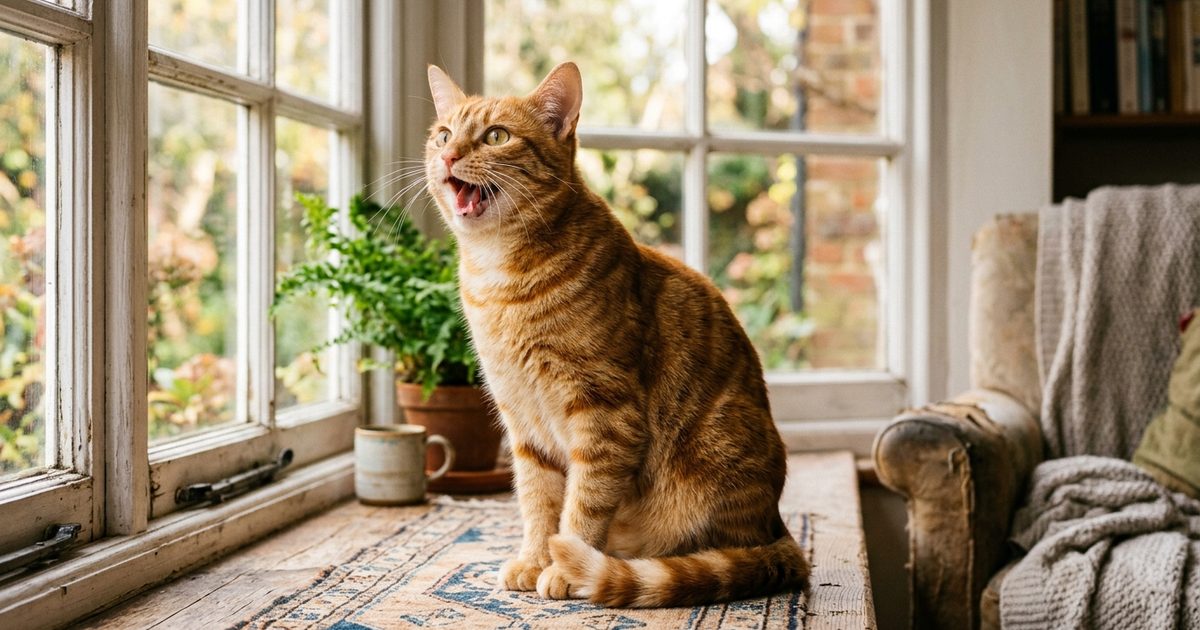
Adult cats meow mostly at humans — to greet them, ask for food, request attention, express boredom, signal stress, or broadcast mating readiness. Meowing is a flexible, learned signal: your cat has discovered that the right meow makes you fill a bowl, open a door, or stop what you're doing.
Most cat meowing fits into a handful of everyday categories. Once you can tell them apart, the noise stops feeling random and starts sounding like a sentence. Here are the reasons that cover the great majority of meows you'll hear around the house.
Greeting and recognition
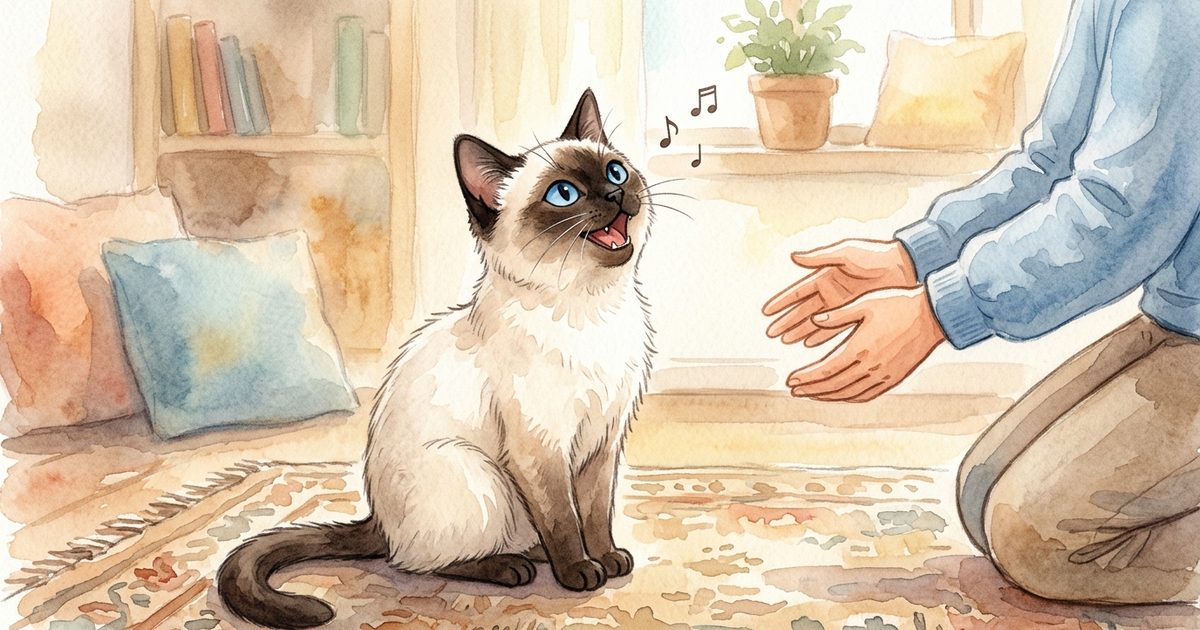
When you walk through the door and your cat trots over with a short, rising "mrrp," that's a greeting meow — one of the friendliest sounds a cat makes. Cats recognize the specific sound of their person's footsteps, car door, or keys, and many will call out the moment they hear you arrive. It's often paired with an upright tail or a headbutt against your ankle, the full-body version of "hello, I noticed you." A greeting meow tends to be brief and mid-pitched — not demanding, just acknowledging. Some cats save it almost exclusively for their favorite human.
Hunger and food requests
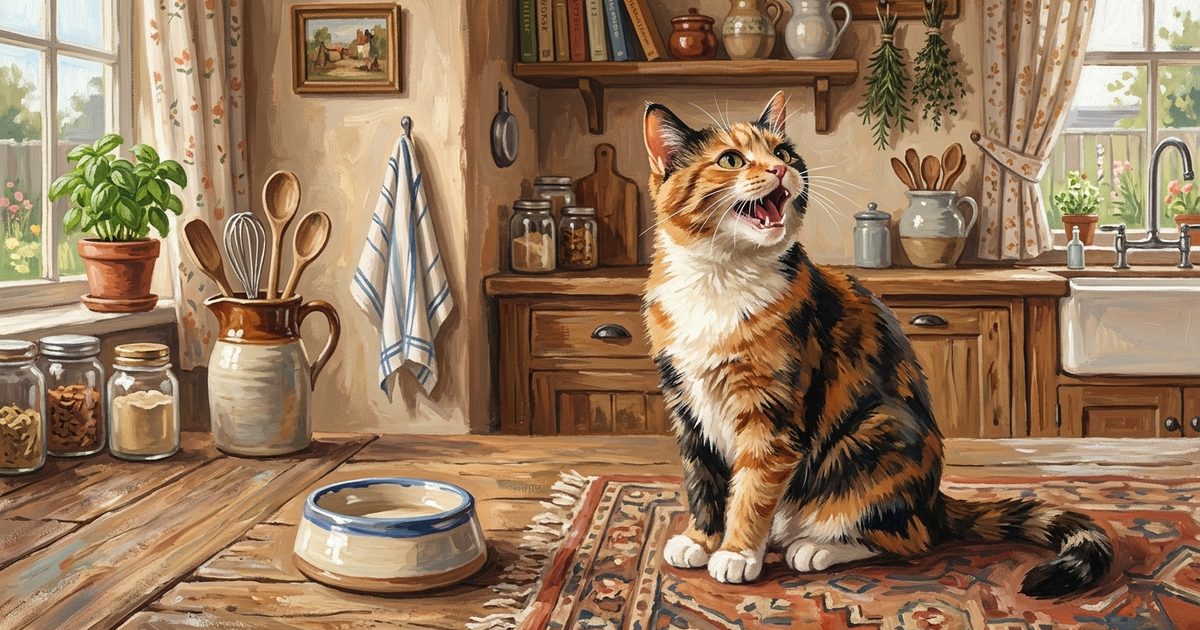
The food meow is the one most owners learn first. It usually sharpens around mealtimes and follows you toward the kitchen or the spot where the bowl lives. Researchers have found that cats use a particular higher-pitched "solicitation" meow when they want food, and it works partly because the frequency overlaps with the pitch range humans are biologically wired to respond to. This is strikingly similar to the solicitation purr, which cats also deploy specifically to prompt humans to act. Your cat isn't being greedy; she's using the sound that experience has taught her gets results.
Attention and play
Sometimes the meow has nothing to do with food and everything to do with you. A cat who wanders over, meows once, and glances at a toy or a closed closet is asking for interaction — play, petting, or just acknowledgment. This is especially common in indoor cats, who rely entirely on us for stimulation. Without enough enrichment, boredom turns into vocalizing: the meow becomes a stand-in for "I have energy and nowhere to put it." The same understimulation can show up as play aggression.
Stress, anxiety, and displacement
Not every meow is a request. Cats also vocalize when something in their world has shifted — a move, a new pet, a changed work schedule, a strange smell, or being left alone longer than usual. In these cases the meowing is often lower, longer, and more relentless, and it can drift into what people describe as crying. Long, mournful yowling at night is a classic pattern, and it can sound genuinely distressed because it is: the cat is broadcasting discomfort she can't resolve on her own. The Cornell Feline Health Center notes that sudden vocalization in an unfamiliar or changed environment is a normal stress response, not bad behavior. The fix is usually environmental — time, safe hiding spots, and a predictable routine — rather than anything you say back.
Mating behavior
In cats that are not spayed or neutered, meowing can take on a whole different intensity. Intact females in heat produce loud, persistent yowls designed to attract a mate, and intact males answer in kind. These mating calls are among the loudest, most insistent vocalizations a cat makes, and they can go on for days. This isn't distress or illness — it's biology doing exactly what it evolved to do. The reliable solution is spaying or neutering, which resolves the hormone-driven vocalizing in the great majority of cases.
Why Do Cats Meow at Humans but Not Other Cats?
Adult cats almost never meow at each other. Meowing is a kitten behavior that domestic cats have retained specifically to communicate with humans. Wildcats outgrow it, but house cats discovered we respond to meowing, so they keep using it well past kittenhood.
A kitten sound kept for humans
The meow starts life as a neonatal distress call. Newborn kittens are blind, deaf, and entirely dependent, so they meow to bring their mother back for warmth, milk, or rescue. As kittens mature and gain independence, they naturally stop meowing at other cats.
What's striking is that domestication rewired this timeline. Living alongside humans for thousands of years selected for cats that stayed vocal into adulthood — because the humans who fed and sheltered them kept answering. Feral and wild adult cats meow far less; the kitten-to-adult drop-off is much steeper in them. Your house cat essentially kept a piece of kittenhood alive because it paid off with you. It's one of several kittenhood behaviors cats carry into adulthood, and arguably the most human-directed of all of them.
What cats use with each other instead
If adult cats aren't meowing at each other, what are they doing? Their native language is overwhelmingly non-vocal: scent marking through cheek-rubbing and scratching, body language like tail position and ear angle, and deliberate posturing that resolves territory and hierarchy without a sound. We pick up almost none of this — it's built for other cats to read. When cats do vocalize at each other, it's the sharp sounds of conflict: hisses, spits, and full-throated yowls that mean "back off." The meow, in effect, is a dedicated "people channel." For the full range of sounds in that feline vocabulary, see our complete cat noises guide, and for the threat end of the spectrum, our piece on why cats hiss.
What Do Different Cat Meows Mean?
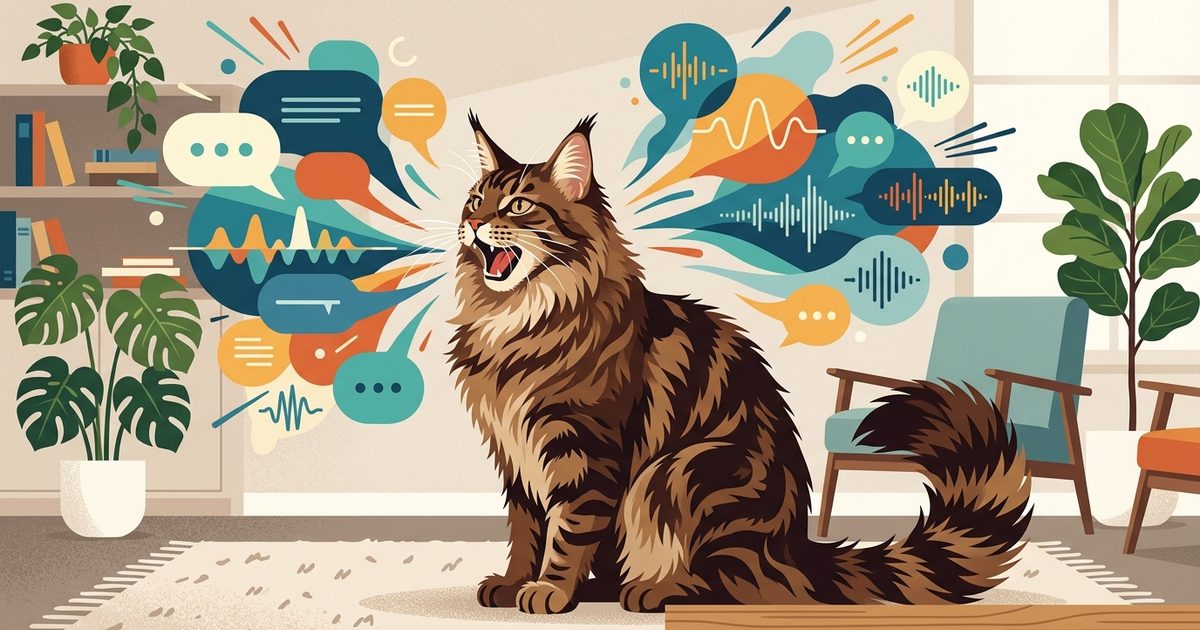
Cats shift pitch, length, and repetition to change what a meow means: a short high meow is a greeting, a long low wail signals distress or mating, a trill is friendly recognition, and a yowl is alarm or pain. Tone and context — not the sound alone — tell you which is which.
A cat meowing at you is running a surprisingly flexible little instrument. By stretching a meow shorter or longer, raising or dropping the pitch, and repeating it, your cat builds a whole vocabulary out of one basic sound. International Cat Care describes the meow as the most human-directed of all feline vocalizations, and the meaning lives in the modulation.
The short meow (greeting)
The short, single meow — quick, mid-to-high pitch, almost a syllable — is the everyday "hello." You'll hear it most when you walk in the door, when your cat strolls into the room, or when you make eye contact across the house. It's a recognition sound: I see you, you see me, we're good. Some cats fire off a rapid string of these when they're especially glad you're home. Think of the short meow as your cat's default check-in, the feline equivalent of waving. It pairs naturally with other friendly signals like a soft headbutt or a relaxed tail held high.
The trill and chirp (friendly)
A trill is that short, rolled, almost musical "brrrp" — part meow, part purr, part chirp. Queens trill to their kittens, and kittens trill back, so the sound carries an unmistakably warm origin. Adult cats trill at humans they like as a greeting and an invitation to follow or pay attention. A chirp — a sharper, birdlike note — tends to show up at windows when your cat spots something exciting. Both are friendly, non-demanding sounds: your cat is acknowledging you, not asking for anything. The trill is one of the clearest ways cats show affection vocally.
The long, drawn-out meow (demand or distress)
Stretch a meow out and the tone drops — this is the demand meow, and it's usually aimed squarely at you. A long, mournful meow outside a closed door, next to an empty bowl, or while staring at a favorite toy is a request: let me out, feed me, play with me. The pitch and urgency climb the longer the need goes unmet. The same long meow can tip into distress if it carries a flattened, wailing quality and keeps repeating. Context separates a bored complaint from real discomfort — a cat meowing at a door is asking; a cat meowing and pacing, panting, or hiding may be struggling. When in doubt, run the whole-cat check: posture, ears, and tail tell you whether it's a want or a worry.
The yowl (alarm, mating, pain)
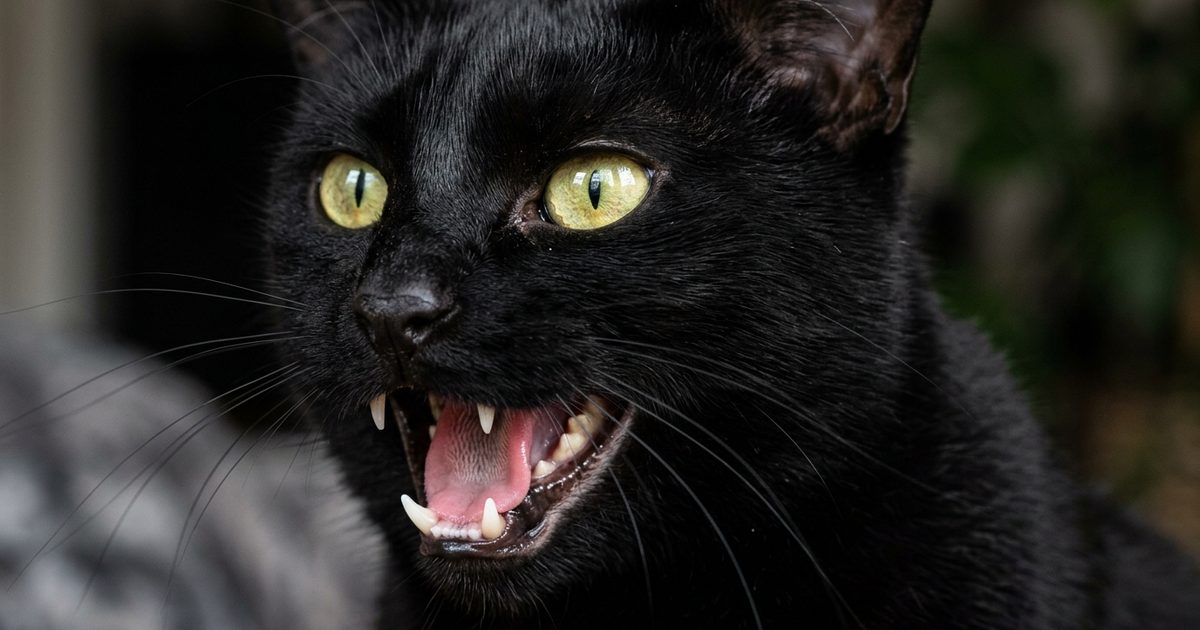
The yowl is the meow's darker cousin — long, low, and openly distressed. An unspayed female in heat will yowl to advertise to males; an intact male will yowl in response. In that context it's normal hormonal signaling, fixed by spaying or neutering. But yowling in a neutered pet means something else: it can be territorial alarm, the threat vocalization that accompanies conflict, or — importantly — pain. Senior cats that begin yowling at night may be experiencing cognitive decline or an underlying illness like hyperthyroidism. This is the sound most owners describe as their cat "crying," and persistent yowling is always worth a vet conversation.
The chatter (prey frustration)
When your cat sits at the window watching a bird and starts clicking, chattering, or making rapid "ek-ek-ek" sounds, that's the chatter — a distinct, staccato vocalization linked to predatory excitement and frustration. Feline behaviorists see it as the cat rehearsing the killing bite on prey it can't reach. It's not distress; it's bottled-up hunting energy leaking out as sound. The chatter sits in the broader catalog of cat noises, and once you've heard your cat chatter at a squirrel, you'll know it instantly.
Curious what that particular meow means coming from your cat? Get a MeowMind reading — upload a photo and hear your cat's request in her own words.
Why Is My Cat Meowing So Much?
Excessive meowing usually means your cat wants food, attention, or mating, or is stressed, bored, or in pain. Sudden loud meowing at night — often called cat crying — in a senior cat can signal cognitive decline or hyperthyroidism, so it's worth a vet check rather than assuming it's behavioral.
When a normally quiet cat turns into a chatterbox overnight, that's information. Persistent cat meowing is almost always a request with a specific cause behind it, and the fix depends on reading the cause correctly. Before assuming your cat has "become demanding," it helps to know the usual suspects.
Learned meowing (you trained it)
This is the most common cause of excessive meowing, and here's the uncomfortable part: most owners create it themselves. Every time you respond to a meow — feeding, opening a door, petting, even scolding — you teach your cat that the meow works. Cats are practical; they repeat what produces results. A cat that meows relentlessly at 5 a.m. has learned that meowing long enough eventually makes the human get up.
The tricky part is that trying to stop it makes it worse before it gets better. When a behavior that once worked suddenly stops working, animals go through an extinction burst — a temporary spike before the behavior fades. Your cat isn't being spiteful; she's thinking, "this always worked, let me try harder." If you give in during the burst, you've trained her that more meowing is the key. The only way through is consistency: pick the behaviors you won't reward, and hold the line. Cats are exceptional operant learners — no two sound quite alike because each builds a personal meow vocabulary around what makes you respond, and certain breeds like Siamese are widely described by owners as exceptionally talkative (anecdotally, not as a hard rule).
Boredom and under-stimulation
Indoor cats live in a world sized for humans — and that world can be genuinely under-stimulating. A cat with nothing to hunt, climb, or puzzle over has a lot of waking hours and very little to fill them. Meowing becomes a self-entertainment strategy: it gets your attention, and attention — even annoyed attention — is interaction.
The fix is enrichment, not silence. Daily play sessions that let your cat stalk, chase, and "catch" a toy burn off the hunting drive that otherwise turns into vocal demands. Puzzle feeders, window perches for bird-watching, and rotating toys give a bored cat something to do besides meow at you. A tired, engaged cat is usually a quieter cat.
Stress and environmental change
The long, low, distressed meowing that follows a move, a new pet or person, a changed schedule, or rearranged furniture is covered above in Stress, anxiety, and displacement — the same mechanism applies when it becomes excessive. The classic nighttime crying pattern often shows up here: a cat unsettled by recent change paces and vocalizes after dark, when the house is quiet. Restoring predictability helps — consistent feeding times, a safe retreat space, and calming pheromone diffusers can settle a stressed cat.
Hunger, thirst, litter box
Before searching for a deeper meaning, check the obvious. An empty food bowl, a dry water dish, or a dirty litter box are all legitimate reasons a cat meows — she's telling you something is wrong and wants it fixed. A separate note: increased hunger or thirst that doesn't resolve after feeding can point to a medical issue rather than a behavioral one, and is a vet conversation, not a training problem.
What to do about excessive meowing
The approach depends on the cause, but a few principles hold across all of them:
- Rule out medical first. Any sudden change in meowing — louder, more frequent, at odd hours, or a new distressed tone — warrants a vet visit before you assume it's behavioral. Cats hide illness well, and vocalization is often the earliest sign.
- Don't reward demand meowing. If the meow is a learned demand, the only effective response is no response — no eye contact, no words, no scolding. Meet your cat's needs on your schedule, not hers. International Cat Care has a useful guide on managing attention-seeking vocalization: reward the quiet, ignore the noise.
- Enrich the environment. If boredom is the driver, more play and stimulation will reduce the meowing more reliably than any correction.
- Reduce stress where you can. For change-related meowing, restore routine and give your cat safe, predictable spaces. Time and consistency do most of the work.
- Expect an extinction burst. We covered this above — when you stop rewarding a long-trained meow, it gets worse for a few days before it improves. Hold the line.
The owners who succeed pick one approach and stick with it for a week or two, not the ones who try everything once. When in doubt, let your vet weigh in — sudden vocalization changes are exactly the signal a professional should hear.
Why Do Kittens Meow?
Kittens meow constantly because for the first weeks of life it is their only way to call their mother for warmth, milk, or rescue. As they grow and learn adult communication, they meow less at other cats — but keep meowing at humans, who keep responding.
If you have ever raised a kitten, the sound is unforgettable: a tiny, insistent voice calling out from a nest box or the foot of your bed. Kittens are the most vocal cats of all — for a newborn cat, meowing is survival.
The neonatal meow
Kittens are born blind and deaf. Their eyes stay shut for roughly the first seven to ten days, and their ears only open fully around two weeks of age. Well before they can see or hear, they can meow. That tiny cry is the queen's cue to find a kitten that has crawled away from the warmth of the litter, to nudge it back toward her belly, or to settle it against her fur when it is cold. The meow predates sight and hearing because it has to — it is the only channel a helpless newborn has. International Cat Care describes neonatal vocalization as the foundation of kitten communication with the mother, used to signal hunger, chill, or distress.
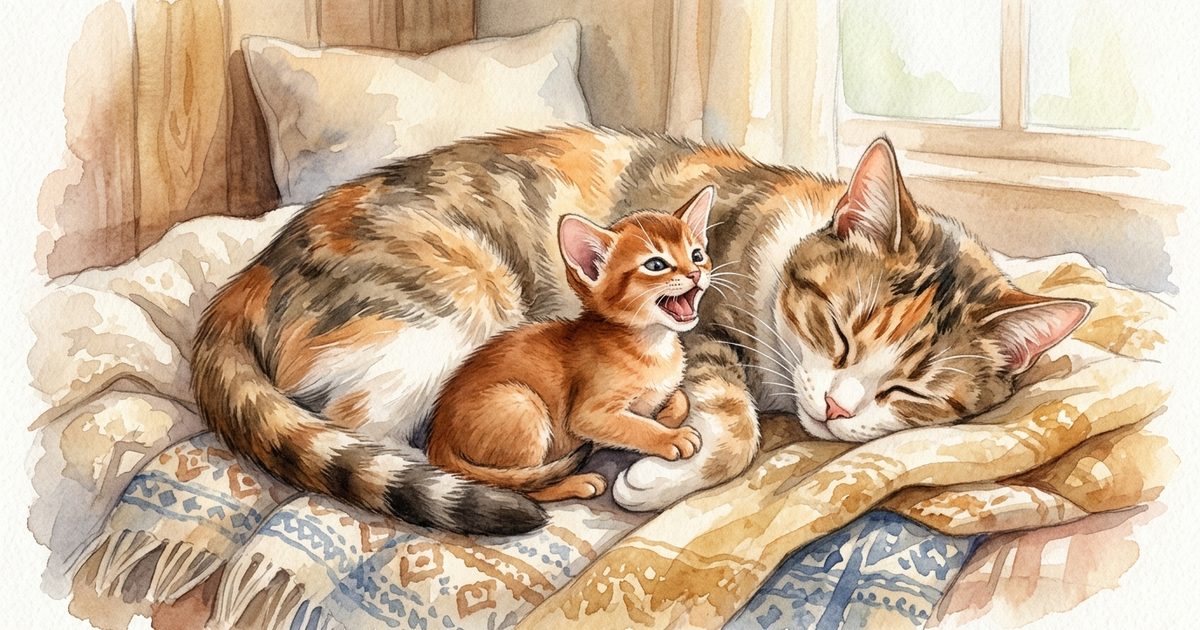
A newborn's meow sounds thinner and higher than an adult's, and the queen can distinguish her own kittens' calls. If a kitten is cold, hungry, or trapped under a sibling, that urgent, climbing cry is meant to bring her fast.
Kitten to adult transition
As kittens grow, something quietly shifts in who they talk to. Once their eyes and ears open and they begin walking, they start learning the full adult repertoire — scent-marking, body language, and the subtle signals cats use with each other. You can see some of this in how kittens begin to knead and rub against their littermates, trading vocal calls for a richer, quieter language. And as covered above in Why Do Cats Meow at Humans but Not Other Cats?, meowing toward other cats drops away in adulthood while meowing toward humans strengthens — the kitten meow gets repurposed as a lifelong "people channel."
When a kitten's meowing is concerning
A kitten that meows steadily while nursing and sleeping is being a kitten. But certain patterns deserve attention. Persistent, sharp, non-stop crying from a very young kitten often means it is cold, hungry, or unwell — newborns cannot regulate their own body temperature, so a chilled kitten will cry with real urgency. If a kitten keeps crying even after warmth, milk, and comfort are offered, or if the crying is paired with lethargy, refusing to nurse, or feeling cool to the touch, that is a reason to call a vet promptly. Young kittens can decline quickly.
For healthy, growing kittens, frequent meowing is simply the sound of a small creature doing exactly what it was born to do: calling the one who keeps it safe.
When Should I Worry About My Cat's Meowing?
A sudden change in your cat's meowing — much louder, more frequent, at odd hours, or a new yowl or cry tone — can signal pain, illness, cognitive decline in seniors, or hyperthyroidism. Any abrupt shift in a lifelong habit is a legitimate reason to call your vet.
Most meowing is normal cat communication — a greeting, a request, a complaint about an empty bowl. What separates everyday cat meowing from a worry signal is change: a pattern that breaks from what your individual cat has always done. A quiet cat who suddenly starts yowling at 3 a.m. is telling you something new.
Red-flag patterns
The clearest warning signs are abrupt shifts in the pattern of vocalizing, not the volume alone. Watch for:
- Sudden, dramatic increase in meowing — especially in a cat who has always been quiet.
- Night-yowling in a senior cat — a new habit of loud, disoriented crying in the dark hours.
- Meowing paired with other changes — hiding, lethargy, not eating, litter box avoidance, or sudden clinginess. Vocalization rarely shows up alone when illness is behind it.
- A new tone — a higher pitch, a longer wail, or a harsh cry your cat has never used before.
The key is reading the whole cat. If your cat's meowing has shifted, it helps to look at the bigger picture of body language and how cats show discomfort rather than judging the meow in isolation. A vocal change plus a tucked body, flattened ears, or a rigid posture is a far stronger signal than noise alone.
Senior cat yowling
Among older cats, a newly loud, repetitive yowl — often at night — is a recognized pattern, and one possible cause is feline cognitive dysfunction (FCD), a decline in mental sharpness comparable to dementia in humans. Disoriented cats may yowl because they've lost track of where they are in a dark room, or because their sleep-wake cycle has fragmented. This is a general phenomenon, not a diagnosis: night-yowling in seniors can also stem from pain, hearing loss, hyperthyroidism, or anxiety. Night-yowling in a cat over 10, especially when it's brand new, is not "just aging" and is worth investigating. International Cat Care covers the range of behavior changes in older cats in depth.
Pain and hyperthyroidism
Cats hide pain extraordinarily well, and increased or changed vocalization is one of the few outward clues some cats give. Hyperthyroidism — common in middle-aged and senior cats — frequently shows up as restlessness, weight loss despite a big appetite, and noticeably more vocalizing, often at night. None of these are things to self-diagnose from a meow; a meaningful change in cat meowing is a symptom a veterinarian can trace to a cause, and the Cornell Feline Health Center consistently frames any behavior change as a valid reason to make an appointment.
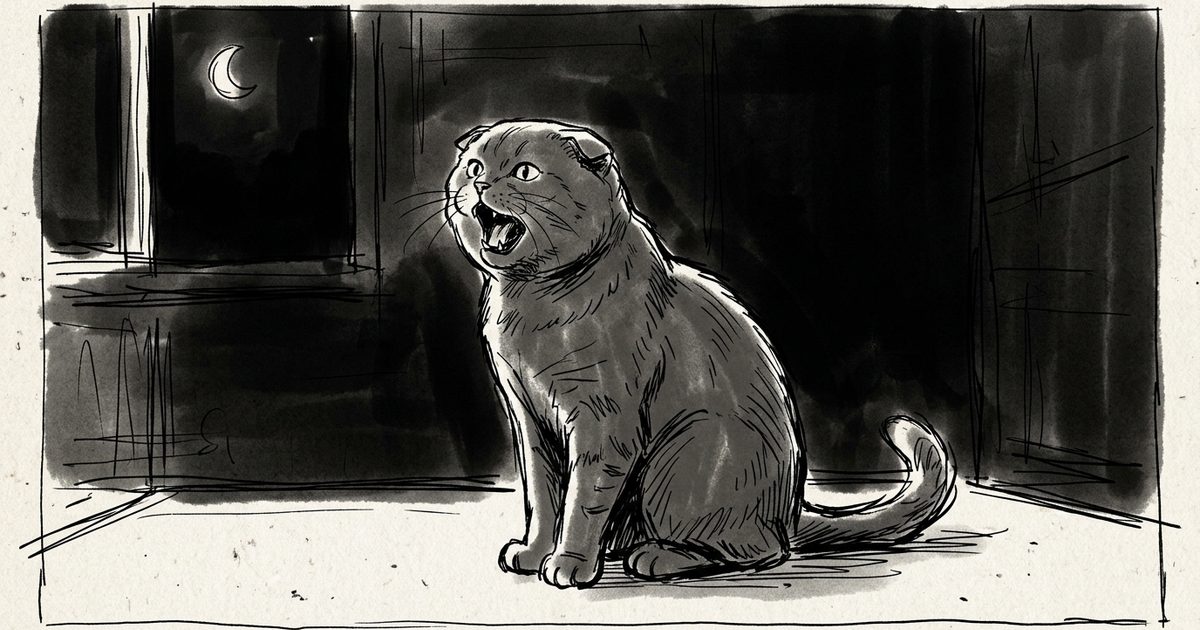
A useful rule of thumb: if your gut says "this isn't normal for her," trust it and call your vet. You're worried about the cat whose voice has changed, not the one who has always been vocal.
Common Myths About Cat Meowing
Cats do not meow out of spite, a loud cat is not necessarily an unhappy one, and meowing is not a wild instinct — it is a learned, human-directed signal. Yowling is usually mating rather than distress, and a quiet cat is not always a content cat.
Cat meowing has accumulated a surprising amount of folklore, partly because humans tend to project complex emotional motives onto a sound that is actually a practical request signal. Here are the most persistent myths — and what they mean.
Myth: Cats meow to be spiteful or punish you. Fact: There is no evidence that cats meow out of malice. A cat meowing at 5 a.m. is not getting revenge for a closed door — it is making a request (food, access, attention) because the strategy has worked before. Meowing is a learned, human-directed signal, not an attitude problem. The fix is to change what gets rewarded, not to assign blame.
Myth: A very talkative cat must be unhappy. Fact: Some cats are simply vocal by nature. Breed and personality matter far more than mood: Siamese and other Oriental-type cats are widely reported by owners to be more talkative than average, though this is anecdotal tendency rather than rule. A chatty cat who otherwise eats, plays, and engages is likely just expressive — not distressed.
Myth: Cats cry real tears when they are sad. Fact: Cats do not produce emotional tears. What people call "crying" is vocal — yowling, especially at night or in senior cats. Watery eyes do occur, but they point to irritation, infection, or blocked tear ducts, not sadness. If your cat's eyes are runny alongside a change in meowing, that is a reason to consult the Cornell Feline Health Center rather than read it as weeping.
Myth: All meowing means the cat is hungry. Fact: Hunger is only one of many meanings. A meow can be a greeting, a demand for play, a mating call, a stress signal, or a response to pain. Pitch, length, and context tell you which — not the sound alone. International Cat Care emphasizes that interpreting any vocalization means reading the whole cat: posture, ears, eyes, and situation, not just the noise.
Meowing at a Glance — Summary
| Question | Short answer |
|---|---|
| Why do cats meow? | To greet us, ask for food or attention, signal stress, or seek a mate — meowing is a learned, human-directed signal |
| Why at humans but not other cats? | Adult cats keep the kitten meow specifically for us; with each other they rely on scent, body language, and yowls |
| What do different meows mean? | Pitch, length, and repetition change the message — a short high meow greets, a long low wail signals distress or mating |
| Why is my cat meowing so much? | Usually learned demand, boredom, stress, hunger, or mating — sudden loud meowing at night in a senior cat warrants a vet check |
| Why do kittens meow? | It's their only way to call their mother for warmth, milk, or rescue in the first weeks of life |
| When should I worry? | When meowing suddenly changes — louder, more frequent, at odd hours, or shifts to a yowl or cry — call your vet |
| Do cats cry real tears? | No — cats vocalize (yowl) and may have watery eyes from medical causes, but they do not produce emotional tears |
Curious What Your Cat Would Say?
Upload a photo and get a warm, personalized reading from your cat's perspective.
Start Your Free ReadingFrequently Asked Questions
Why does my cat meow so much all of a sudden?
A sudden spike in meowing usually points to a new need or a change: hunger, a dirty litter box, boredom, stress from a recent move or new pet, or — in older cats — a medical issue like hyperthyroidism. If the change is abrupt and persistent, a vet check is the right first step before assuming it's behavioral.
Why do cats meow at humans but not other cats?
Adult cats almost never meow at each other. Meowing is a kitten call that domestic cats have kept specifically for humans, because we reliably respond to it. With each other, cats rely on scent marking, body language, and threat sounds like hisses and yowls rather than the conversational meow.
What does it mean when a cat meows at night?
Night meowing in a younger, healthy cat is often boredom, hunger, or learned demand — she has discovered that vocalizing eventually gets you up. In a senior cat, new loud yowling after dark can be a sign of cognitive decline, hearing loss, pain, or hyperthyroidism, so it's worth discussing with your vet rather than writing it off.
Why do kittens meow so much?
For the first weeks of life, kittens are blind and deaf, so meowing is their only way to call their mother for warmth, milk, or rescue. As they mature and learn adult communication, they meow less at other cats — but keep meowing at humans, who keep answering them.
Do cats meow when they are in pain?
They can. Cats hide pain very well, and increased or changed vocalization is sometimes the only outward clue. Persistent yowling, a new higher-pitched cry, or meowing paired with hiding, not eating, or restlessness can all signal discomfort and should prompt a vet visit.
How do I get my cat to stop meowing so much?
First rule out medical causes with a vet. If the meow is a learned demand, the only effective response is no response — no eye contact, no words, no scolding — while you meet her needs on your schedule. Add daily play and enrichment to tackle boredom, and expect a short extinction burst where it gets worse before it improves.
Why does my cat meow when I come home?
That short, rising meow at the door is a greeting — one of the friendliest sounds a cat makes. Your cat recognizes your footsteps, keys, or car door, and is acknowledging you, often paired with an upright tail or a headbutt against your ankle. Some cats save it almost exclusively for their favorite human.
Do cats cry real tears?
No. Cats do not produce emotional tears. What people call crying is vocal — usually yowling, especially at night or in older cats. A cat's eyes can water, but that points to irritation, infection, or blocked tear ducts, not sadness, and is worth a vet check if it shows up alongside a change in meowing.
Is it normal for an older cat to meow a lot?
Some increase can be normal for an aging cat, but a sudden, loud, or new pattern of meowing — especially at night — is not just aging. It can reflect cognitive dysfunction, hearing loss, hyperthyroidism, arthritis pain, or other illness. Any abrupt shift in a lifelong habit is a legitimate reason to call your vet.
Sources & References
You Might Also Like
Kitten Teething: Timeline, Symptoms & How to Help
Kitten teething runs from 3 to 7 months as baby teeth fall out. Learn the timeline, signs to watch for, and how to soothe a teething kitten safely.
15 min readWhen Do Cats Stop Growing? A Complete Timeline
When do cats stop growing? Most cats reach adult size by 12-18 months, but large breeds like Maine Coons keep growing until 3-4 years. Full timeline inside.
14 min readCan Cats Eat Cherries? Flesh, Pit & Toxicity Facts
Can cats eat cherries? Pitted flesh is safe in tiny amounts — but the pit, stem, and leaves are toxic (cyanide precursors). Learn what's safe and what isn't.
15 min readA message, in your cat's voice
Upload a photo, get a warm note written from your cat's perspective — just for fun. Plus 121 vet-cited articles, offline.