
Why Do Cats Hiss? What It Means & What to Do
If you want to understand why do cats hiss, the first thing to know is that a hiss sounds hostile but is usually the opposite — a cat's way of asking for distance before anything worse happens. Your cat isn't declaring war; she's saying "please back off." Behind that sharp sound are a handful of common triggers: fear, pain, being startled, or feeling her territory threatened. Once you can read the hiss, you'll know exactly what your cat needs.
Key takeaways
- A hiss is a warning and a request for space — it's de-escalation, not an attack or a sign of a "mean" cat.
- The most common triggers are fear, pain, being startled, new animals or people, and a mother protecting her kittens.
- Read the whole body — flattened ears, puffed tail, arched back, and dilated pupils confirm what the hiss is really about.
- If a cat who never hisses suddenly starts — especially when touched — treat it as a possible sign of pain or illness and check with a vet.
Why Cats Hiss — Quick Reference
| Trigger | Body language | What to do |
|---|---|---|
| Fear / feeling threatened | Crouched, ears flat, wide eyes | Stop, back off, give space |
| Pain or illness | Hisses when touched or picked up | Don't force handling — call your vet |
| Surprise / startle | Jump, puffed fur, wide eyes | Hold still, let the cat reset |
| New pet or person | Arched back, puffed tail, staring | Slow introductions, safe retreat |
| Maternal protection | Mother guards kittens, blocks approach | Leave her and the kittens alone |
Why Do Cats Hiss?
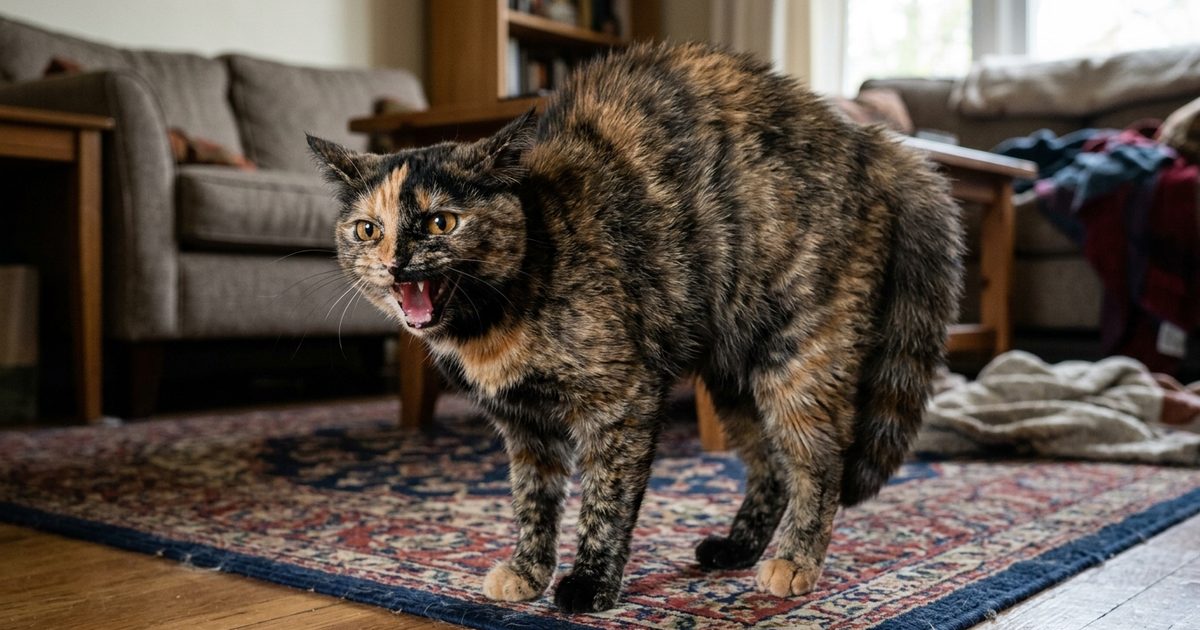
Cats hiss as a warning when they feel threatened, afraid, in pain, startled, or protective of kittens. The sound mimics a snake — an instinctive "back off" that says go away without needing to fight. A hiss is de-escalation, not aggression: a hissing cat is asking for distance, not starting a battle.
A hiss can sound alarming, but it's one of the clearest, most honest signals your cat can give you. It's a built-in boundary, older than domestication itself. Understanding why your cat hisses means understanding what she's asking for in that moment, which almost always comes down to one thing: space.
Fear and feeling threatened
The most common reason a cat hisses is fear. When your cat feels cornered, overwhelmed, or genuinely threatened — by a stranger reaching in, a loud machine, a trip to the carrier — the hiss is her first line of defense. She's not being mean or aggressive; she's saying "please don't come any closer." This is the step before conflict: if the threat backs off, nothing further happens. If it doesn't, a frightened cat may escalate to swatting, scratching, or biting. For the full escalation ladder, read why cats bite.
Pain or illness
A cat in pain will often hiss when touched, picked up, or approached — even by someone she loves. Because cats hide discomfort well, a hiss can be one of the few outward signs that something hurts. If your normally gentle cat suddenly hisses when you stroke a specific area or lift her, treat it as a signal, not an attitude problem — see the full guidance below in When Hissing Signals a Health Problem.
Startle and surprise
Sometimes the cause is simply surprise. A cat who's been sleeping deeply, or who didn't see you coming, may hiss on reflex before she even registers who you are. This startle hiss is short, sharp, and usually over in seconds — once your cat realizes there's no real threat, she'll settle again. It's the feline equivalent of jumping when someone taps your shoulder in the dark. Moving a bit more slowly and giving a soft verbal cue before approaching a resting cat can reduce these moments.

Territorial — a new animal or person
A hiss is also how cats enforce boundaries around territory and introductions. When a new pet, a visiting guest, or a familiar person enters a space your cat considers hers, the hiss communicates "this is my space — not yet." It's not hostility so much as a request for a slower, more controlled introduction. Giving each animal their own space, scent swapping, and progressing at the cats' pace is what lowers the tension over time.
Across all of these, the thread is the same: a hiss is a request for distance, delivered in the clearest language your cat has. To know exactly what kind of distance she needs, read the rest of her body — what a cat's tail is telling you and the meaning behind a warning stare are useful next steps.
What Does It Mean When a Cat Hisses?
A hiss means "I'm uncomfortable and I want space" — it's a boundary, not an attack. Read the whole body: flattened ears, a puffed tail, an arched back, and dilated pupils confirm fear or feeling threatened. A hiss is your cue to back off, not push through.
The single most common mistake people make when they hear a hiss is to read it as the opening move of a fight. It's almost always the opposite — a verbal fence your cat puts up so nothing worse has to happen. But the hiss alone is only half the message: cats rarely rely on one signal when threatened, they stack them, and those signals tell you what kind of discomfort you're looking at.
Reading the hiss with body language
When your cat hisses, her body is doing most of the talking. Here's how to decode the most common cluster of signals:
- Flattened or airplane ears — ears pressed sideways or pinned back are the classic fear marker. A relaxed cat's ears face forward; when they rotate out flat, she's bracing for trouble.
- Puffed tail and fur — when the fur along the back and tail stands on end, she's trying to look bigger than whatever is scaring her.
- Arched back — an arched spine does the same job: making herself appear larger and harder to attack. It often pairs with the puffed tail.
- Dilated pupils — wide, black pupils signal a surge of adrenaline. Combined with a hiss, it confirms the arousal is fear, not play.
- Tense, rigid body or crouching low — a cat pressed flat to the ground is trying to disappear; a cat standing tall and rigid is bracing. Both say "do not come closer."
One cluster worth recognizing: a puffed tail plus a hiss almost always means the threat feels big and immediate — often another animal or a fast approach. We break down the full range of what a cat's tail is telling you separately.
A quick rule of thumb: the more of these signals you see at once, the more seriously you should take the hiss. A short hiss with ears forward is often just startle; a hiss wrapped in flattened ears, a rigid body, and wide pupils is a genuine plea for distance.
Curious what your cat would say if she could put all of this into words? Get a MeowMind reading — upload a photo and hear what your cat is really asking for.
Why Do Cats Hiss at You?
If your cat hisses at you, she feels threatened, cornered, hurt, or startled by something you did. It's rarely personal — check for pain, give space, and ask what changed. Back off calmly and let her reset.
A hiss aimed at a familiar human almost always traces back to one of a handful of avoidable triggers. None of them mean your cat has turned against you — they mean something in the last few seconds made her feel unsafe.
The most common one is cornering. Cats need an exit. If you reach toward a cat on a high shelf, in a carrier, or backed against a wall with no clear escape route, the hiss comes out before the bite does — it's the same escalation pattern covered in our guide to why cats bite, where hissing is the early warning that a bite may follow if the pressure continues.
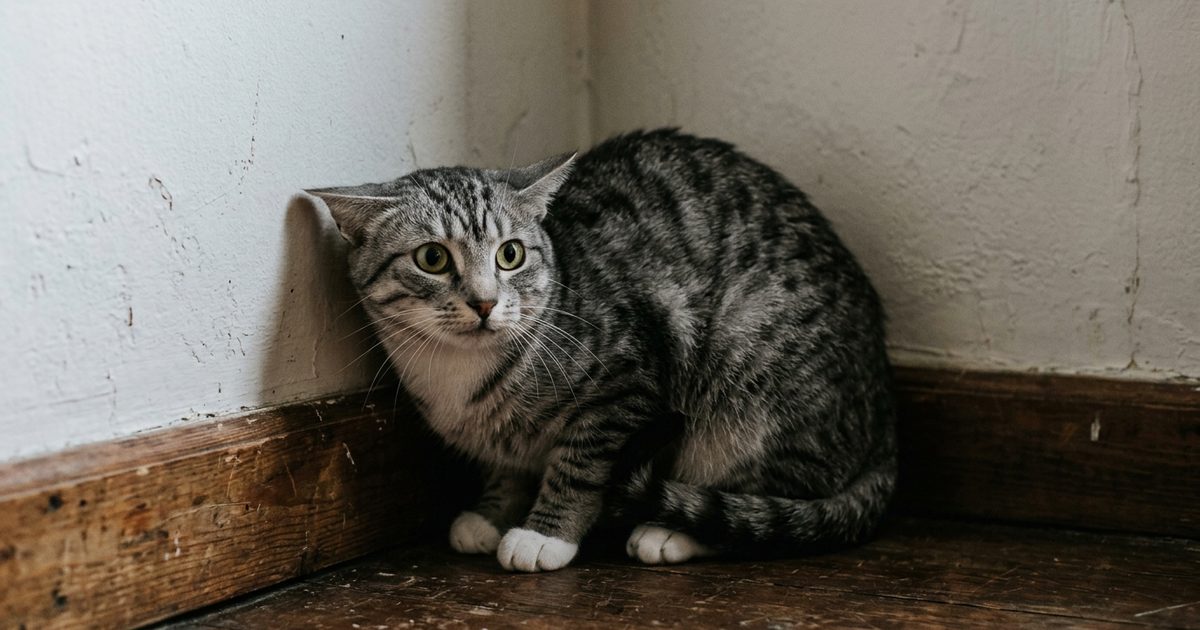
Sudden movements are the next trigger. Lunging, grabbing, or moving fast across a cat's visual field can startle her into a defensive hiss before she even registers who you are. Cats process motion before identity; a hand coming in quickly reads as a threat until proven otherwise.
Touching a sore spot is the one to take seriously. If your cat hisses the moment you pick her up, pet a particular area, or put on a harness, pain is a real possibility — we dig into this more below in When Hissing Signals a Health Problem.
Less often, a hiss is about play overstimulation. A cat who's been petted for too long, or riled up during play, can tip past her threshold and hiss as an overflow signal. The fix is the same in every case: freeze, pull back slowly, and let her reset on her own terms. Don't chase or correct — your cat isn't angry at you, she's asking for space.
How to Respond When a Cat Hisses
When your cat hisses, the right response is to back off and give her space — don't punish, reach in, or stare her down. Remove the trigger if you can, let her decompress, and approach again later on her own terms. Punishment only escalates fear and makes the next hiss come sooner.
A hiss is a request for distance, so the best thing you can do is grant it. The goal isn't to "correct" the behavior — it's to show your cat that her warning was heard. Cats who learn that hissing works, and that humans respect it, tend to hiss less over time, because they never need to escalate to a bite or a swipe.
Do: give space and remove the trigger
The moment you hear a hiss, stop and slowly pull back — ease out of her space with calm, unhurried movement, and avoid direct eye contact, which cats read as a challenge. If you can identify what set her off, remove or reduce that trigger. Then give her a clear path to a safe retreat: a high perch, a quiet room, or a hiding spot she already trusts. Let her come back out when she's ready; don't follow or coax. Most cats reset within minutes once the perceived threat is gone.
Don't: punish or force contact
It's tempting to push through a hiss — to "show her it's fine" by petting her anyway, or to scold her for hissing at a guest. Both backfire. Reaching into a hissing cat's space confirms her fear that you won't listen, which teaches her to skip the warning next time and go straight to scratching or biting. And punishment — yelling, spraying water, or grabbing her — deepens the association between you and danger. International Cat Care is blunt on this point: punishment-based handling increases feline fear and aggression rather than reducing it. The same logic applies to carrier training, vet visits, and introductions: go at the cat's pace, pair new experiences with food or play, and never use force.
When Hissing Signals a Health Problem
A cat that never normally hisses suddenly hissing — especially when touched, picked up, or approached — can be in pain or unwell. Sudden, unexplained hissing is a cue to check for injury or illness with a vet before assuming the behavior is fear or attitude.
Most hissing is emotional, not medical — fear, surprise, a boundary being pushed. But there's one pattern that should change how you read it: a calm cat who rarely hisses starts hissing out of nowhere, particularly when you touch a specific area, lift her, or move toward her. When a usually gentle cat suddenly treats your hand like a threat, pain is one of the first things to rule out.
A sore spot, dental pain, a urinary issue, or an unseen injury can all turn a normally tolerant cat defensive — and a hiss is often the only warning you get. Notice whether the hissing clusters around being handled, jumping, or using the litter box, and whether it comes with other subtle changes: hiding more, eating less, grooming differently, or moving stiffly.
The practical rule: if the hissing is new, persistent, and has no obvious emotional trigger, treat it as a possible medical sign first. The Cornell Feline Health Center notes that sudden changes in a cat's usual behavior can be an early indicator of illness or pain, and International Cat Care advises that pain-related behavior changes warrant a vet check rather than a behavioral assumption.
The takeaway: new hissing in a cat who doesn't normally hiss is a signal worth listening to, and your vet is the right next step.
Common Myths About Hissing
Myth: A hissing cat is mean or angry. Fact: A hiss is almost never malice — it's fear. A cat that hisses is saying "give me space," not "I want to hurt you." The sharp sound and hostile-looking body language — flattened ears, puffed fur, a stiff posture — are defensive, not offensive. A threatened cat wants distance, and hissing is how she asks for it before anything worse happens.
Myth: You should discipline a hissing cat. Fact: Punishing a hiss is one of the worst things you can do. A hiss is already a de-escalation — the cat is trying not to fight. Yelling, spraying water, or grabbing her only confirms that the world is unsafe, deepening the fear that caused the hiss. International Cat Care is clear that punishment-based handling increases feline anxiety and damages trust. The right response is the opposite of discipline: back off, remove the trigger, and let the cat reset.
Myth: Cats hiss because they're aggressive. Fact: Hissing is the step before aggression, not aggression itself. Think of it as the cat's brake, not her accelerator. A cat who hisses is actively choosing a warning over a fight — she's broadcasting "I don't want this to escalate." When a hiss is ignored and the pressure continues, a swat or a bite may follow. The hiss isn't the aggression — it's the cat's last polite request to avoid it.
The pattern: hissing is a plea, not a threat. Treat it that way and you'll read your cat far more accurately.
Cat Hissing at a Glance — Summary
A hiss is your cat's clearest way of saying "give me space." It signals fear, pain, surprise, or feeling cornered — not anger or meanness. Back off, remove the trigger, and let her reset. A hissing cat wants distance, not a fight.
Here's the whole picture in one place, so you can recognize a hiss the moment you hear it and respond to build trust.
| Question | Short answer |
|---|---|
| Why do cats hiss? | A warning when they feel threatened, afraid, in pain, startled, or protective |
| What does a hiss mean? | "I'm uncomfortable and I want space" — a boundary, not an attack |
| Why do cats hiss at you? | You cornered, startled, or touched a sore spot; it's rarely personal |
| How should I respond? | Back off, give space, remove the trigger — never punish or force contact |
| Is hissing aggression? | No — it's de-escalation, the step before a bite or swipe |
| When is hissing a health problem? | A cat that never hisses suddenly hissing — especially when touched — warrants a vet check |
If you take away one thing: a hiss is information, not hostility. Your cat is telling you exactly what she needs — space, safety, and a moment to reset. Meet that need, and the hiss usually stops on its own. When it doesn't, or when it shows up out of nowhere in a cat who has never hissed before, that's the signal to look deeper — sometimes with help from your vet.
Curious What Your Cat Would Say?
Upload a photo and get a warm, personalized reading from your cat's perspective.
Start Your Free ReadingFrequently Asked Questions
Why do cats hiss?
Cats hiss as a warning when they feel threatened, afraid, in pain, startled, or protective. The sound mimics a snake — an instinctive 'back off' that asks for distance. A hiss is de-escalation, not aggression; a hissing cat wants space, not a fight.
What does it mean when a cat hisses at you?
It usually means you cornered her, moved too fast, or touched a sore spot. It's rarely personal — your cat is asking for the pressure to stop. Back off calmly, give her an exit, and let her reset on her own terms.
Should I be worried if my cat hisses at me?
Most of the time, no — a hiss is just a request for space. But if a cat who never hisses suddenly starts, especially when touched or picked up, treat it as a possible sign of pain or illness and check with your vet.
Why is my cat hissing all of a sudden?
Sudden hissing usually has a clear trigger — a new pet, a loud noise, or being startled. If there's no obvious cause and the hissing is new, pain or illness becomes more likely, so a vet visit is the right next step.
How should I respond when my cat hisses?
Stop, back off slowly, and give her space. Avoid direct eye contact, remove the trigger if you can, and let her retreat to a safe spot. Never punish or force contact — that only deepens fear and makes the next hiss come sooner.
Why do cats hiss at each other?
Cats hiss at each other to set boundaries, especially during introductions or when one feels cornered. It's a request for distance, not an attack. Slow, scent-swapped introductions at the cats' own pace lower the tension over time.
Do cats hiss when they're in pain?
Yes. A cat in pain will often hiss when touched, picked up, or approached, even by someone she loves. Cats hide discomfort well, so a hiss can be one of the few outward signs that something hurts and a vet check is warranted.
Is hissing a sign of aggression in cats?
No — hissing is the step before aggression, not aggression itself. Think of it as the cat's brake, not her accelerator. She's choosing a warning over a fight, and if that warning is respected, nothing worse needs to happen.
Sources & References
You Might Also Like
Kitten Teething: Timeline, Symptoms & How to Help
Kitten teething runs from 3 to 7 months as baby teeth fall out. Learn the timeline, signs to watch for, and how to soothe a teething kitten safely.
15 min readWhen Do Cats Stop Growing? A Complete Timeline
When do cats stop growing? Most cats reach adult size by 12-18 months, but large breeds like Maine Coons keep growing until 3-4 years. Full timeline inside.
14 min readCan Cats Eat Cherries? Flesh, Pit & Toxicity Facts
Can cats eat cherries? Pitted flesh is safe in tiny amounts — but the pit, stem, and leaves are toxic (cyanide precursors). Learn what's safe and what isn't.
15 min readA message, in your cat's voice
Upload a photo, get a warm note written from your cat's perspective — just for fun. Plus 121 vet-cited articles, offline.