Cat Tail Meanings: What Your Cat's Tail Is Telling You
Learning cat tail meanings is like getting a private channel into how your cat feels in real time — that long, expressive appendage is a mood antenna that broadcasts confidence, fear, affection, and annoyance before a single meow. An upright tail says "I'm happy to see you," a puffed tail says "I'm terrified," and a swishing tail usually means "I've had enough." Cats even wrap their tails around the people they love. Once you can read these signals, the rest of feline body language falls into place — the tail tells you what your cat can't say in words.
Key takeaways
- A cat's tail position is the fastest single cue to its current mood — upright, puffed, swishing, tucked, wrapped, and twitching each carry a distinct message.
- Unlike a dog's wag, a cat's swishing or wagging tail almost never means happiness — it usually signals annoyance, overstimulation, or intense focus.
- Read the tail alongside the ears and eyes; one signal alone can mislead you, but all three together give the full picture.
- A sudden change in tail carriage — a limp, drooping, or pain-sensitive tail — can signal injury or illness and warrants a vet check.
Cat Tail Meanings — Quick Reference
| Tail position | What it means | Mood |
|---|---|---|
| Upright (vertical), often with a curved tip | Confident, friendly greeting — the "happy to see you" tail | Confident, friendly |
| Puffed or fluffed ("bottlebrush") | Fur stands on end to look bigger — fear and defensive arousal | Scared, threatened |
| Swishing or wagging side to side | Annoyed, overstimulated, or locked onto prey — not happy like a dog | Annoyed, overstimulated |
| Tucked low or wrapped under the body | Insecure, fearful, submissive, or feeling unwell | Fearful, insecure |
| Wrapped around your leg, hand, or another cat | Affectionate bonding and comfort — the feline arm-around-the-shoulder | Affectionate, trusting |
| Twitching just at the tip | Mild interest, curiosity, or mild irritation — a quiet internal debate | Interested, mildly alert |
What Your Cat's Tail Is Telling You
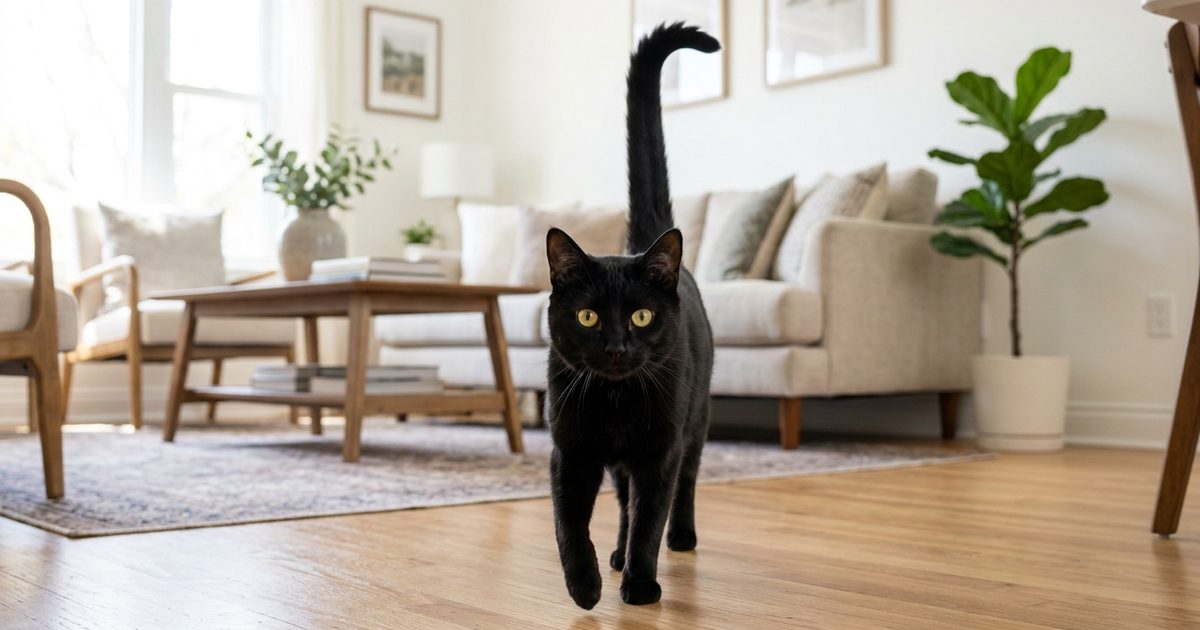
A cat's tail position reveals its mood: upright means confident and friendly, puffed signals fear, swishing shows annoyance or overstimulation, tucked indicates insecurity, and a tail wrapped around you is feline affection. Read the tail alongside ears and eyes for the full picture.
A cat's tail is essentially a mood antenna in constant motion. It's one of the clearest, fastest-reading pieces of cat body language your cat has — and unlike vocalizations (which cats evolved largely to communicate with humans), the tail speaks in a private channel cats use with each other too. Feline behavior experts at International Cat Care describe the tail as one of the primary ways cats broadcast emotional state to the world around them.
The positions below cover the range you'll see most often. For each, remember the same rule that applies to all cat body language: a single signal is just one data point. The tail tells you most when you read it with the ears, eyes, and overall posture together — the same way your cat reads you as a whole, not piece by piece.
Upright or vertical
A tail held straight up — vertical, with maybe a small bend at the tip — is one of the most welcome sights in cat ownership. It signals a confident, relaxed, friendly cat. This is the "greeting tail": when your cat walks toward you with its tail held high, it's essentially saying "I'm glad you're here." Cats also use the upright tail to signal friendly intent to other cats, which is why a confident cat meeting a new cat often approaches tail-up first — it's the feline equivalent of an open handshake rather than a standoff.
You'll see this tail most when your cat is content, exploring, or coming to check on you. Paired with forward-facing ears and soft eyes, an upright tail is about as clear a "all is well" signal as a cat sends. It's the resting mood of a cat that feels secure in its territory — the everyday posture of a happy house cat going about its business.
Upright with a quiver at the tip
If the upright tail has a fast, vibrating quiver right at the very tip, dial the friendliness up another notch. This is the "extra excited" version of the greeting tail — the signal cats give when they are especially happy to see you. Many cats do this exact quiver when their person comes home after being out, or right before a meal they've been waiting for. Some cats quiver their tail tips so intensely they seem to vibrate their whole rear end.
It reads as an overflow of positive excitement that the cat literally can't contain. If your cat trots to the door, tail up and tip quivering, that's a genuine, delighted greeting — the closest thing a cat does to a happy dance. It's one of the most affectionate tail signals there is, and a reliable sign your cat is genuinely thrilled you're around.
Curved like a question mark
When the tail is held up but curls over at the top like a question mark (or a candy cane), you're looking at a relaxed, approachable, mildly playful mood. The curve softens the confidence of the straight-up tail with a touch of curiosity — the cat is interested in something and open to interaction, but not locked in. This is the tail of a cat that's wandering over to investigate, or sizing up whether it wants to play or simply observe.
Think of the question-mark tail as the "I'm available" signal. The cat feels good and is in a social mood, which makes it a great moment to offer a toy or some gentle attention. A cat carrying its tail this way is typically one you can approach without breaking the spell — unlike a flat or puffed tail, the curved tip says the cat is relaxed enough to engage, and may even welcome it.
Puffed or fluffed (bottlebrush)
A puffed tail — when the fur stands straight out so the whole tail looks like a bottlebrush — is a fear and defense response. The cat's hair stands on end to make it look bigger than it really is, which is the same instinct that makes a frightened cat arch its back. This is the fight-or-flight signal: the cat feels threatened and is puffing up to look intimidating in case whatever scared it decides to push the issue. You'll often see it paired with an arched back, dilated pupils, and ears flattened or turned sideways.
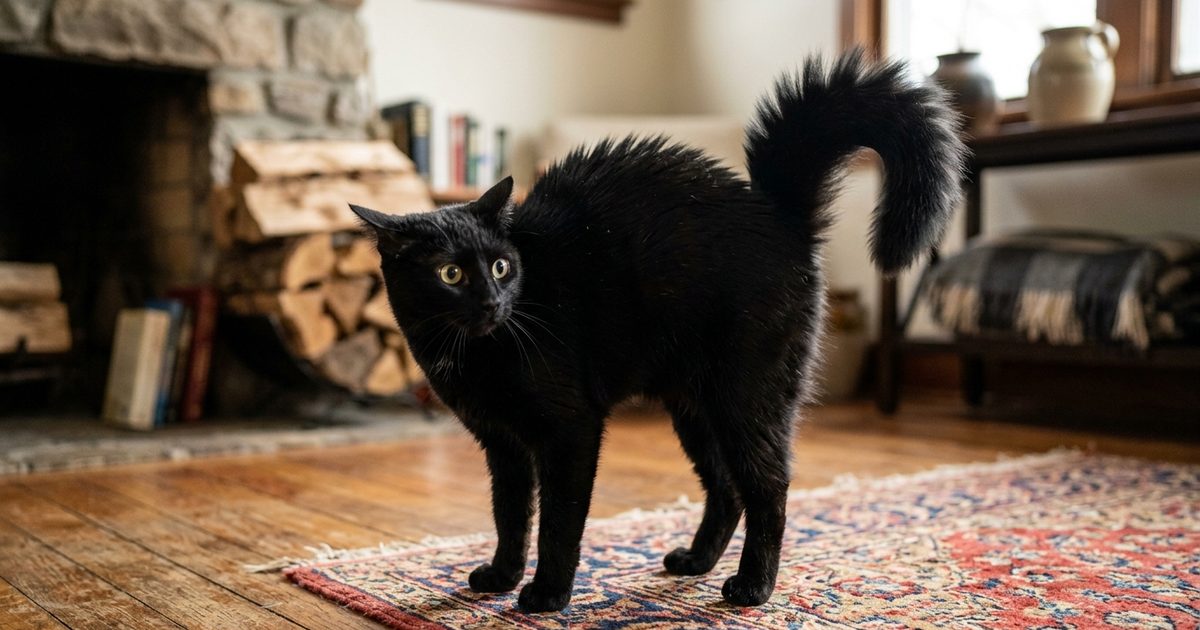
Important nuance: a puffed tail is not aggression — it's fear. The cat isn't preparing to attack so much as bracing itself, hoping to look too big and scary to bother. The best response is to back off and remove whatever startled it if you can. Let the cat decompress; don't try to comfort or reach for it while it's still puffed, because from the cat's point of view that's more threat, not reassurance. Cornell Feline Health Center notes that the piloerection (fur-standing) response is an involuntary reflex tied to the sympathetic nervous system — the cat isn't choosing to puff up, its body is doing it automatically.
Swishing or wagging
A slow side-to-side swish usually means your cat has had enough — the classic overstimulation or "I'm getting annoyed" signal. You'll often see it when you're petting a cat that's reaching its limit: the tail starts moving before the cat escalates to a bite or a swipe, so it's a warning worth heeding. The same motion can also signal prey focus — a cat locked onto a toy, a bug, or a bird outside the window swishes in concentration as it lines up a pounce.
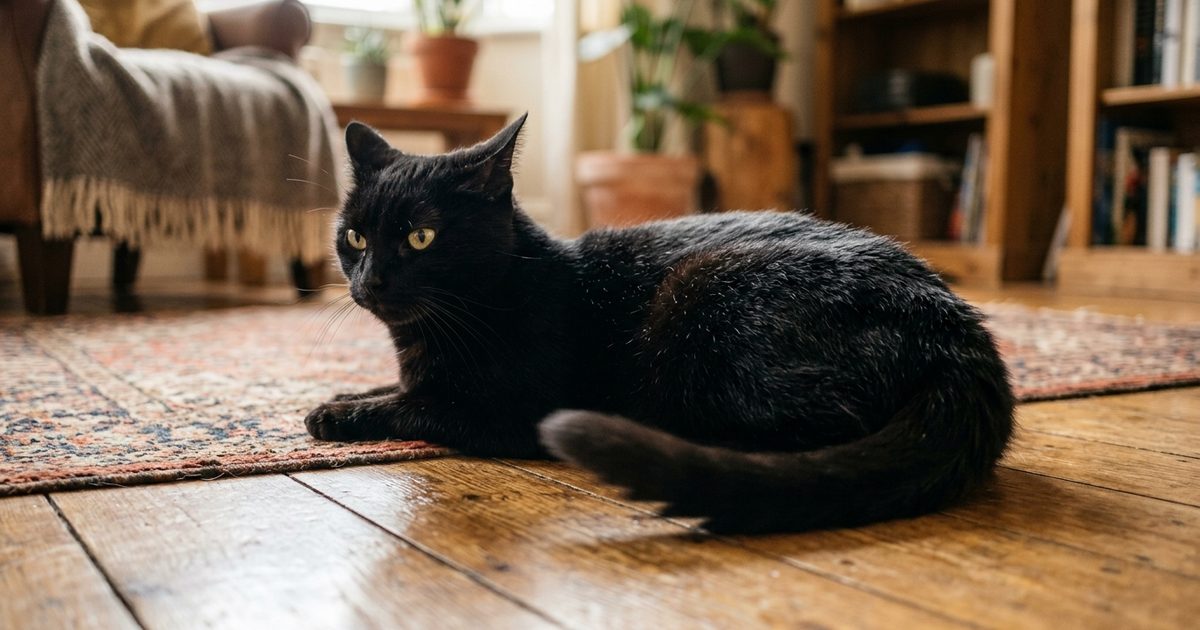
Either way, a swishing cat tail is not a sign of happiness — and it's nothing like a dog's wag. We go deep on why cats and dogs diverge so sharply (and unpack the overstimulation and prey-focus meanings) below, in Why Do Cats Wag Their Tails?.
Thrashing or thumping
When a cat's tail slaps hard against the floor — thump, thump, thump — it's delivering a clear warning. Thrashing is the escalated cousin of swishing: bigger motion, more force, more irritation. Your cat has moved past "mildly annoyed" and into "I've had enough."
This is the moment to back off. If you're petting, stop. If you're holding the cat, set her down. Reaching in anyway risks a swat or a bite — and the cat isn't being mean; she told you she was done, in the most obvious tail language she has. A thrashing tail often appears alongside flattened ears or dilated pupils, which is the full overstimulation pattern. International Cat Care notes that escalating tail movement is one of the most reliable early-warning signs a cat is reaching its limit.
Tucked or low
A tail held low — or worse, tucked tight against the body or between the legs — signals fear, insecurity, or submission. The cat is trying to make herself small and unremarkable, the way a nervous person crosses their arms and shrinks into a chair. You'll often see this at the vet, with a new visitor, or when something sudden spooks her.
A tucked tail can also mean the cat simply feels unwell. A cat that normally carries her tail upright and then lets it droop low for a day or two may be in pain or running a fever. Cornell's feline body language guidance treats a tucked or limp tail as a cue worth watching — not always an emergency, but a reason to pay attention. If it comes with hiding, appetite loss, or lethargy, a vet visit is the right call. Otherwise, give her a quiet retreat and let her decompress on her own timeline.
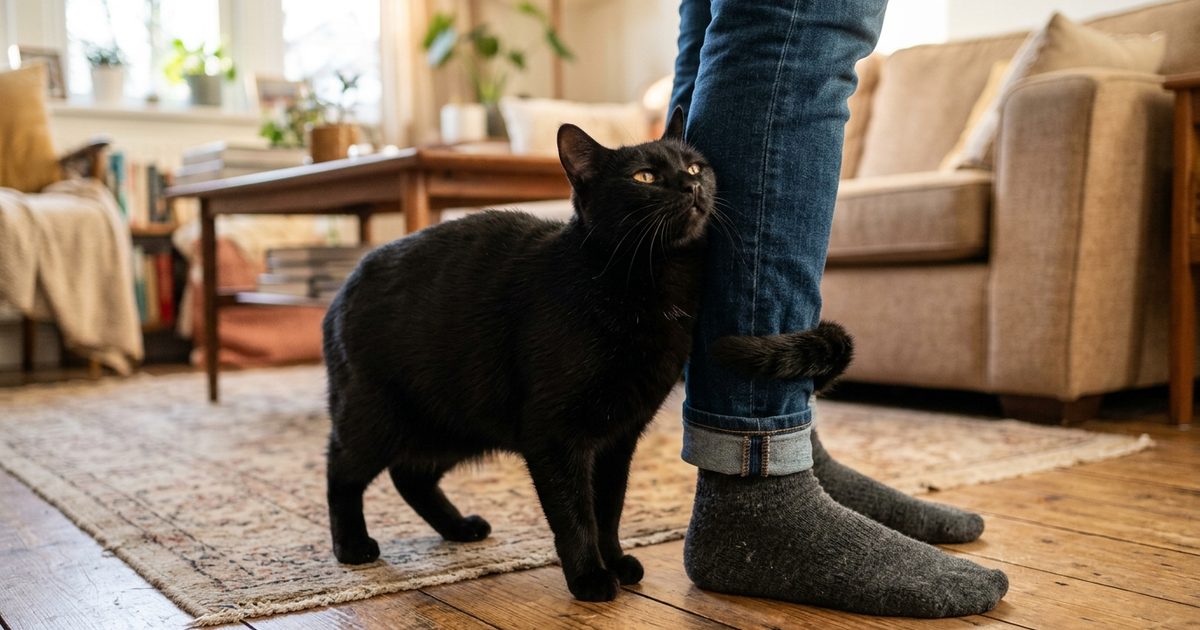
Wrapped around you or another cat
A cat draping her tail around your ankle, your arm, or another cat's back is performing a small, deliberate act of affection — the feline equivalent of an arm around your shoulder. She's claiming closeness, sharing scent, and showing that she feels safe enough to physically link up with you. Among cats, the same gesture is a bonding ritual between family members.
The wrapped tail usually comes with other soft signals: a relaxed body, slow approach, perhaps a headbutt against your leg or a gentle purr. Read together, it's one of the clearest ways cats show affection — quieter than a lap cat, but just as meaningful. If your cat wraps her tail around you when you walk past, she's saying you're hers, in the gentlest possible way.
Twitching at the tip
A subtle twitch at the very tip of the tail — just the last few inches flicking back and forth — is the quietest tail signal, and it cuts both ways. Your cat may be mildly interested: locked onto a dust mote, a shadow, or the sound of a bird outside. The tip-twitch is the hunting focus leaking through, the same energy you see in bigger swishes but turned down to a whisper.
The same motion can also signal mild irritation. If you're one stroke past where your cat wanted the petting to end, that little flick is her polite way of saying "not that." Context tells you which: a cat whose ears are forward and eyes are tracking something is interested; a cat whose ears are starting to rotate sideways is getting annoyed. Either way, the twitch is a small leak of emotion — often happening before the cat has fully decided how she feels.
Why Do Cats Wag Their Tails?
Unlike dogs, a wagging cat tail almost never means happiness — it usually signals annoyance, overstimulation, or intense focus. Cats wag to warn they've had enough or that they're locked onto something, so a swishing tail is generally a cue to give your cat space, not more attention.
It's the single most common cat tail meanings misread — and for an understandable reason. We grow up learning that a wagging tail on a dog is joy. So the first time a cat thumps its tail while we're petting it, we assume it's loving the attention. Often, the opposite is true. Understanding why cats wag their tails is one of the fastest ways to read them accurately and to avoid a bite or swat that comes out of nowhere.
The dog-vs-cat wagging difference
A dog's tail wag is, broadly, a social signal — loose, full-body, often welcoming. A cat's tail wag is a much sharper, more deliberate movement, and it tends to broadcast a rising internal state rather than contentment. The faster and harder the tail moves, the more worked up the cat is getting. Where a dog wags to say "I'm happy to see you," a cat swishes to say "pay attention — something is shifting." Cornell Feline Health Center explains feline body language as a constant negotiation between arousal and calm, and the tail is one of the clearest gauges of that balance. The deeper layer of cat tail meanings is that a wag almost always points to escalating arousal, not relaxation.
The overstimulation wag
This is the wag you'll see during petting. Your cat is in your lap, you're stroking its back, and slowly the tip of the tail begins to flick — then the whole tail starts to thump. That thumping tail is your cat telling you it's reaching its limit. Petting has tipped from pleasant into too much, and the wag is the warning before claws or teeth follow. The right response is simple: stop petting and let the cat reset. Many people miss this signal because everything else about the cat still looks relaxed — but the tail is the early alarm. If you want a cat that stays comfortable being handled, the tail is where you'll first see overstimulation, often before the ears flatten or the purr stops.
The prey-focus wag
Not every wag is annoyance. A cat crouched at the end of the hallway, eyes wide, rear wiggling, tail lashing back and forth — that cat is locked on. The wag here is the visible proof of pure predatory focus, the feline body building tension for a pounce. You'll see the same tail movement watching a bird through the window or tracking a wand toy. In this context the swish isn't "leave me alone" — it's "I'm about to explode into action." The tell is the whole posture: the cat is low, the pupils are big, and the attention is fixed. That's the prey-drive wag, and it's one of the cat tail meanings that excites owners rather than warns them.
Can Cats Control Their Tails?
Cats have partial voluntary control over their tails, but much of the movement is involuntary — driven by emotion and reflex. A swishing or twitching tail often happens before a cat has consciously decided it's annoyed, which is why the tail can reveal a mood the cat hasn't shown yet.
The short answer to one of the more searched cat tail meanings questions is "partly." A cat can certainly choose to move its tail — wrapping it around your arm, draping it over a paw, lifting it into a greeting. But a great deal of tail movement is reflex, closer to a flinch than a decision. That mix is exactly what makes the tail such a rich signal: it sits right on the line between intention and instinct.
Voluntary vs involuntary tail movement
The voluntary side is easy to spot. A confident cat walking up to you raises its tail deliberately; an affectionate cat wraps its tail around your leg as it passes. Cats also use the tail consciously for balance — a cat walking a narrow fence rail swings the tail as a counterweight. The involuntary side is more interesting. The sudden twitch at the tip while resting, the puff that erupts when a cat startles, the thump that begins during petting — these are reflexive, driven by the autonomic nervous system and the cat's emotional state. The cat isn't deciding to do them; they happen. International Cat Care notes that much of feline body language is this kind of unconscious emotional leakage, which is exactly why it's so honest.
Why the tail reveals emotion early
Because so much tail movement is involuntary, it leaks information before the cat has assembled a visible response. A cat can hold its face neutral and keep its ears forward while its tail is already thumping — the conscious signals are managed, the tail isn't. For anyone trying to read their cat, this is the tail's superpower. The tail is often the first place an early mood shows up: mild irritation flicks the tip before the cat looks annoyed; rising excitement lashes the tail before the pounce. Reading the tail alongside the eyes and the rest of the body gives you the fullest picture of cat tail meanings — and often a few seconds of advance notice before your cat acts.
How to Read Your Cat's Full Body Language
Read the tail together with the ears and eyes: an upright tail, forward ears, and soft eyes mean a friendly, confident cat, while a puffed tail, flattened ears, and dilated pupils signal fear or aggression. The tail is one signal — the whole cat tells the story.
Cat tail meanings are powerful, but a tail on its own is only one-third of the picture. Cats don't communicate in single gestures — they broadcast emotion across their whole body at once, and the most reliable reads come from triangulating three signals: the tail, the ears, and the eyes. Vets and behaviorists consistently advise reading the whole cat, because any one signal in isolation can mislead you. A swishing tail might mean annoyance — or it might mean your cat has spotted a toy. The ears and eyes tell you which.
The three-signal read: tail, ears, and eyes
The cleanest way to decode your cat is to run all three checks together. The tail tells you the mood's general direction — up means confident and friendly, low or tucked means fearful, puffed means threatened, and thrashing means "back off." The ears confirm or sharpen that reading — ears forward and relaxed match a confident, curious cat; ears turned sideways ("airplane ears") signal irritation or uncertainty; ears flattened against the head are a strong fear or aggression marker. The eyes add the final layer — soft, half-closed eyes or a slow blink signal trust and contentment, while wide-open eyes with fully dilated (black) pupils point to high arousal, whether that's play excitement or defensive fear. When all three point the same way, you can read your cat with real confidence. The Cornell Feline Health Center stresses that feline body language is meant to be read as a whole, not signal by signal, and International Cat Care makes the same point: a cat "in conflict" often shows mixed signals as its emotions shift.
For a deeper look at the eye half of that triangle, see our guide to why cats stare — and for the full-body overview, start with our cat body language primer.
The pattern is simple once you practice it: read the tail for direction, the ears for intensity, and the eyes for the cat's actual feeling. Three signals, one answer. Curious what your cat is really telling you across all three? Get a MeowMind reading — what's your cat really telling you?
Common Myths About Cat Tails
Cat tail meanings are surrounded by myths, most of them borrowed from dogs or oversimplified to the point of being wrong. Here are the three that mislead owners most often.
Myth: A wagging tail means a happy cat. Fact: This is the single most common misunderstanding in cat body language. Unlike dogs — where a loose, full-body wag usually signals friendliness — a wagging cat tail almost always means the opposite: annoyance, overstimulation, or intense focus. A cat thumping or swishing its tail while you're petting it is typically warning you it's had enough. International Cat Care is explicit that tail-wagging in cats is a sign of irritation, not pleasure. Assuming a wagging cat is happy is the fastest route to an overstimulation hiss or bite.
Myth: A puffed tail means the cat is aggressive. Fact: A puffed or "bottlebrush" tail is a fear response, not an offensive one. The cat is trying to look bigger to discourage a threat — it's defensive, cornered, and would usually rather escape than fight. Calling it "aggressive" misreads a scared cat as a mean one.
Myth: Cats only use their tails for balance. Fact: Balance is part of it, but the tail is equally a communication and emotion-signaling organ. That's the whole point of cat tail meanings — the tail broadcasts mood constantly, often before the cat has decided how it feels.
When Tail Changes Signal a Problem
A sudden change in tail carriage — a limp or drooping tail, or sensitivity when touched — can signal injury, nerve damage, or illness. A limp tail warrants a prompt vet check, because cats hide pain and the tail is one sign they can't mask.
Cats are remarkably good at hiding discomfort, which is why reading feline body language isn't only an emotional exercise — it's a health tool too. Gradual shifts in carriage are often just aging, but a sudden change in how your cat holds, moves, or tolerates its tail being touched is a different matter.
Limp or drooping tail
A tail that hangs low, limp, and won't lift properly is a strong reason to see a vet as soon as possible. The most common cause is a tail pull injury — usually sustained when the tail is yanked or caught (for example, slammed in a door) — which damages the nerves controlling the tail. In some cases this can also affect bladder or bowel control, which is why a vet checks more than just the tail itself. Fractures and ligament tears from falls or collisions look similar. The bottom line: a limp, weak tail is not a "watch and wait" situation — call your vet.
Sudden behavior change
The key word is sudden. A cat that used to greet you with an upright tail and now drags it low and tucked; a cat that becomes unexpectedly sensitive to a touch at the base of the tail; a normally relaxed cat turning lethargic and hiding — these are behavioral clues that your cat is in pain or sick. International Cat Care advises that any sudden change in a cat's behavior is worth a professional assessment, because cats don't show symptoms until a condition has progressed. A cat that feels unwell may also stop purring or stop sleeping on you — read the tail as part of the whole picture.
Over-grooming or chewing the tail
If your cat is obsessively licking, chewing, or pulling the fur off its own tail, that isn't grooming — it's a warning sign. Over-grooming can stem from fleas, allergies, or pain in the glands at the base of the tail, but it can also be a stress-related compulsive behavior (a feline OCD-like tendency). Cornell Feline Health Center notes that repeated self-grooming with no medical cause usually needs both a vet and a behaviorist to address. Start by booking a check-up — rule out the physical cause first, then work from there.
Cat Tail Meanings at a Glance — Summary
| Tail position | What it means |
|---|---|
| Upright, straight up | Confident, friendly, a happy greeting |
| Upright with a quivering tip | Extra excited, very happy to see you |
| Curved like a question mark | Relaxed, approachable, playful |
| Puffed or bottlebrush | Scared, startled, a defensive fight-or-flight response |
| Slowly swishing or wagging | Annoyed, overstimulated, or locked onto prey |
| Fast thrashing or thumping | Very angry — give your cat space |
| Low or tucked between the legs | Fearful, insecure, submissive, or unwell |
| Wrapped around you | Deep affection, bonding, and trust |
| Twitching only at the tip | Mild interest or mild irritation |
| Limp or drooping | Possible injury, nerve damage, or illness — see a vet |
Curious What Your Cat Would Say?
Upload a photo and get a warm, personalized reading from your cat's perspective.
Start Your Free ReadingFrequently Asked Questions
What does it mean when a cat wags its tail?
A wagging cat tail almost never means happiness — unlike a dog, a cat wags to signal annoyance, overstimulation, or intense focus on prey. If your cat swishes or thumps its tail while you're petting it, that's usually a warning to stop before it escalates to a bite or swat.
Why do cats puff up their tails?
A puffed or bottlebrush tail is a fear response, not aggression. The fur stands on end to make the cat look bigger and discourage a threat. It's an involuntary reflex tied to the nervous system, and the cat is usually scared rather than looking for a fight.
What does an upright tail mean on a cat?
An upright, vertical tail is the friendliest cat tail signal — it means your cat feels confident, relaxed, and happy to see you. Cats use it as a greeting toward people and other cats, and a quivering tip dials that friendliness up into pure excitement.
Why does my cat wrap its tail around me?
When a cat drapes its tail around your ankle, arm, or hand, it's a deliberate act of affection — the feline version of an arm around your shoulder. It signals trust, bonding, and a gentle claim that you belong to your cat.
Can cats control their tails?
Partly. Cats can choose to move their tails for balance or to wrap around you, but much of the movement is involuntary and driven by emotion. That's why a twitching or thumping tail often appears before a cat has consciously decided it's annoyed.
What does a tucked tail mean?
A tail held low or tucked tight against the body signals fear, insecurity, or submission — the cat is trying to feel small and safe. It can also mean the cat feels unwell, so a tucked tail paired with hiding or appetite loss is worth a vet check.
Do cats wag their tails when happy?
Rarely. Unlike dogs, a wagging cat tail almost always points to annoyance, overstimulation, or locked-on prey focus rather than joy. The closest thing cats have to a happy tail is an upright tail with a quivering tip, which signals excited greeting, not a side-to-side wag.
Why is my cat's tail limp?
A limp, drooping tail that can't lift normally can signal a tail pull injury, nerve damage, a fracture, or illness, and it warrants a prompt vet check. Because cats hide pain, a limp tail is one of the few signs they can't easily mask, so don't wait and see — call your vet.
Sources & References
You Might Also Like
Cat Body Language: The Complete Guide to Reading Your Cat
Cat body language decoded — how to read your cat's ears, eyes, tail, posture, fur, and voice at once. The complete guide to understanding what your cat feels.
29 min readKitten Teething: Timeline, Symptoms & How to Help
Kitten teething runs from 3 to 7 months as baby teeth fall out. Learn the timeline, signs to watch for, and how to soothe a teething kitten safely.
15 min readWhen Do Cats Stop Growing? A Complete Timeline
When do cats stop growing? Most cats reach adult size by 12-18 months, but large breeds like Maine Coons keep growing until 3-4 years. Full timeline inside.
14 min readA message, in your cat's voice
Upload a photo, get a warm note written from your cat's perspective — just for fun. Plus 121 vet-cited articles, offline.