
Why Does My Cat Bite Me? Causes & How to Stop It
If you're wondering why does my cat bite me, the honest answer is almost never what it first feels like. A bite that lands on your hand or ankle can seem personal — even spiteful — but cats bite to communicate. The same mouth a cat uses to groom a littermate, carry a kitten, or warn off a threat is the one now closing on your wrist, and what it means depends almost entirely on the seconds just before it happened.
Most bites fall into a handful of categories: play and hunting practice that got aimed at you, overstimulation during petting, gentle affectionate "love" nibbles, fear or feeling cornered, pain from an unseen medical issue, and redirected aggression sparked by something your cat can't reach. Learning to read the body language that precedes each one — the tail warnings, the pre-bite stare, the ears turning — turns a confusing bite into a clear message.
Key takeaways
- Cats bite to communicate, not out of spite — the context and body language tell you which message they're sending.
- The six common bite types are play, overstimulation, love nibbles, fear, pain, and redirected aggression, each with different warning signs and fixes.
- A normally gentle cat that suddenly starts biting may be in pain or unwell — a vet visit rules out medical causes first.
Cat Bites — Quick Reference
| Type of bite | What triggers it | What to do |
|---|---|---|
| Play biting | Hunting instinct, under-stimulation | Redirect to toys — never hands |
| Overstimulation bite | Petting past your cat's threshold | Stop petting at the first warning sign |
| Love nibble | Affection, grooming-based mouthing | Redirect if it hurts; otherwise let it be |
| Fear / defensive bite | Feeling cornered, scared, trapped | Give space; don't force contact |
| Pain / medical bite | Hidden injury, illness, dental pain | See a vet to rule out a medical cause |
| Redirected bite | Agitation from an unreachable trigger | Identify and remove the hidden trigger |
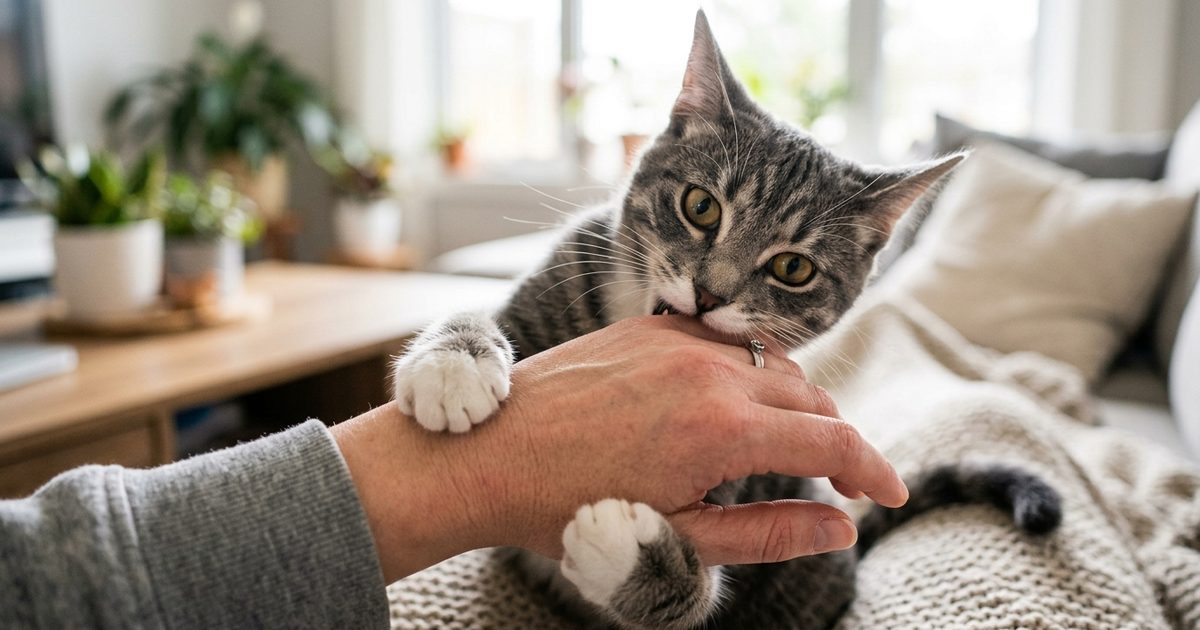
Why Does My Cat Bite Me?
Cats bite for clear, identifiable reasons: play and hunting practice, overstimulation during petting, gentle love nibbles, fear or feeling cornered, pain or illness, and redirected aggression. The context and body language in the seconds before the bite tell you which one it is.
When your cat bites you, it rarely comes out of nowhere — and it almost never comes from spite. Biting is one of the most direct tools in a cat's communication toolkit, and cats use it for strikingly different purposes depending on what they're trying to say. A playful nip during a wrestling match, a sharp clamp when you've petted one stroke too many, and a soft gnaw while you're cuddling are all "bites," but they mean entirely different things.
Here are the five most common reasons your cat bites, and how to tell them apart.
Play biting
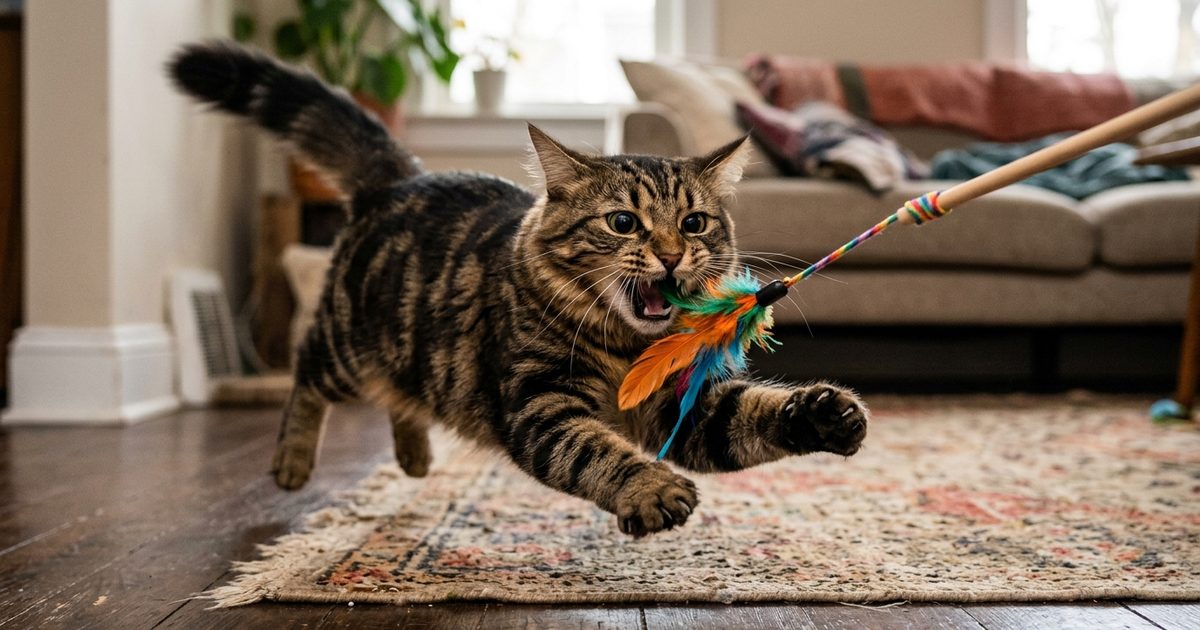
Play biting is the most frequent kind — your cat is treating your hand as prey. Cats are ambush predators, and play is how they rehearse the full hunting sequence: stalk, pounce, grab, bite. A bored or under-stimulated cat will invent a game out of whatever's available, and a moving hand is an irresistible target. Dilated pupils, a lowered prowl, and that intense pre-pounce stare are the giveaways. Play bites can still hurt, and they tend to escalate if the cat learns that biting hands gets a reaction. The fix isn't to stop the play — it's to redirect it onto toys so your cat never learns that your body is an acceptable target.
Overstimulation biting
This is the bite that catches owners off guard because everything seemed fine — and then suddenly wasn't. Cats have a finite tolerance for physical contact, and petting accumulates sensory charge in a way humans don't experience. Pet for too long, or touch a sensitive area, and the pleasure flips into discomfort; the bite is your cat's blunt way of saying "that's enough." The threshold varies wildly between cats — one might tolerate five minutes of full-body petting, another might max out at thirty seconds. Crucially, the body warns you first: a lashing or thumping tail, skin rippling over the back, ears rotating sideways. Reading those early signs lets you stop petting before your cat has to. (We go deeper on this threshold in Why Does My Cat Bite Me When I Pet Her? below.)
Love bites and gentle nibbles
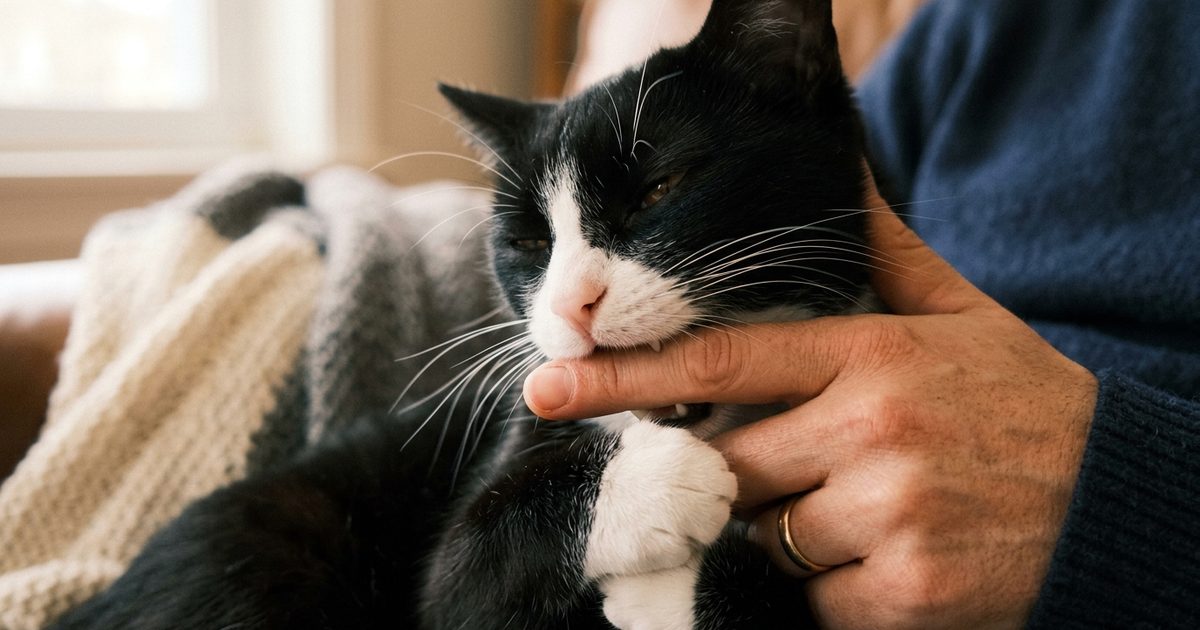
Not every bite is a complaint. Love bites — those soft, sustained little mouthing pressures, often while your cat is relaxed beside you — are a mild, affectionate behavior rooted in grooming. Cats groom each other with gentle nibbles as part of social bonding, and a cat that gives you a slow, deliberate love nip is treating you the way it treats a trusted companion. These bites usually don't break the skin and come with relaxed body language: half-closed eyes, a soft posture, often purring. It's the same affectionate channel as licking, which is why a nibble and a grooming session often run together — we explore the full grooming-bond in why does my cat lick me.
Fear and defensive biting
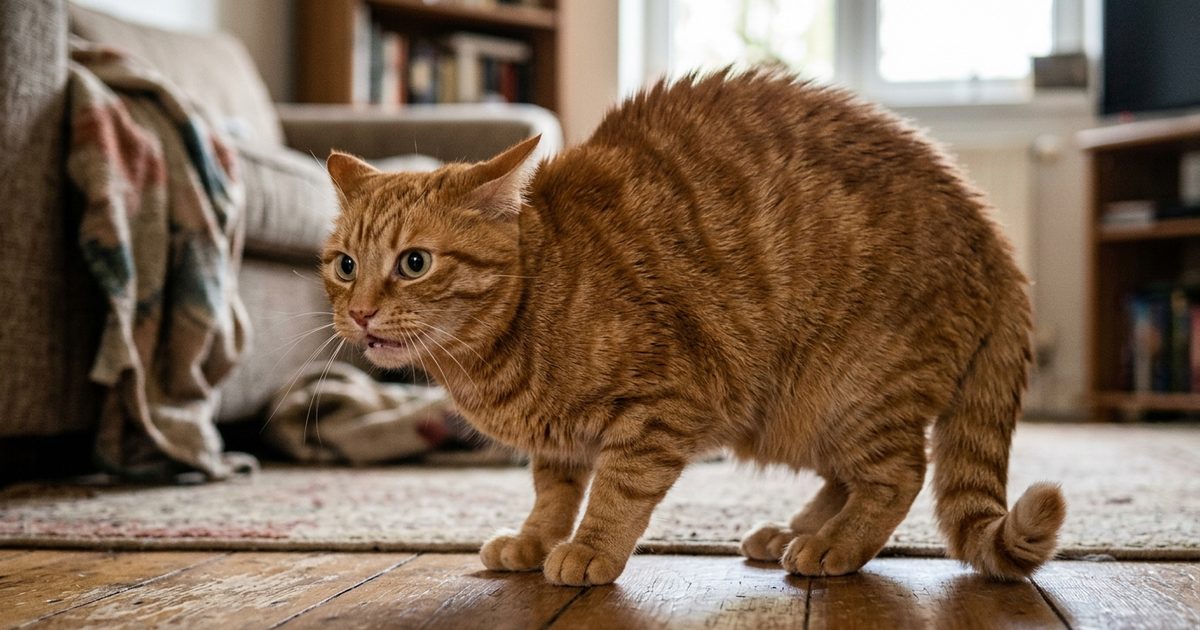
When a cat feels cornered, trapped, or genuinely frightened, biting becomes a defensive weapon rather than a signal. This is the hardest bite to misread because it's loud: the cat is usually hissing or growling, ears are pinned flat, the body is crouched and tense. Defensive biting almost always comes after a clear escalation — the cat wanted to leave, couldn't, warned you, and finally bit. Understanding the warning chain that precedes it, starting with a hiss, is the best way to never reach this point. A cat that bites from fear isn't aggressive by nature; it's a cat that ran out of options.
Pain or medical biting
Sometimes the kindest, most gentle cat bites because something hurts. Pain-induced biting is a reflex response to touch in a tender area — a sore joint, dental disease, a hidden injury — and the cat isn't choosing to bite so much as reacting to discomfort. If your normally docile cat suddenly snaps when you pick her up, or bites specifically when touched in one spot, pain is the first explanation to consider, not the last. Sudden uncharacteristic aggression is widely treated by veterinarians as a medical red flag until proven otherwise; the Cornell Feline Health Center and International Cat Care both emphasize ruling out physical causes before labeling any new biting as a behavior problem.
Why Does My Cat Bite Me When I Pet Her?
Biting during petting is classic overstimulation — your cat's tolerance for touch has a threshold, and once crossed, the bite is her way of saying "enough." Watch the early warnings: tail lashing, skin twitching, ears turning. Stop petting before she does.
This is the most common version of the overstimulation bite described above. A cat's skin is rich with nerve endings, especially along the back, the base of the tail, and the belly, and petting accumulates stimulation in the sensory system. Some cats tolerate ten minutes of continuous petting, others hit their limit after thirty seconds. Once that input crosses the cat's threshold, the same touch that felt pleasant turns unbearable. According to International Cat Care, this pattern has a name — petting-induced aggression — and it's a matter of tactile tolerance, not bad behavior. Your job is to learn where her specific threshold sits and to stop petting before she has to enforce the boundary herself.
Reading the warning signs
Your cat always warns you before she bites — the problem is that the signals are subtle and last only a second or two. The first and most reliable cue is the tail: when it starts to twitch, lash, or thump hard back and forth, your cat's tolerance is running out. See our cat tail meanings guide for the full vocabulary. Watch the skin too — a slight twitch or rippling along the back means stimulation is building.
The ears are the second indicator. When they rotate from their alert, upright position to the side or back — even slightly — your cat is shifting from enjoying the contact to enduring it. This often comes with the eyes widening a little or the stare going stiff — the same locked gaze you may notice in the moment before a bite. The rule of thumb: stop petting the first second you see these signs. Don't wait for a second confirmation.
Want to know exactly what's pushing your cat over the edge? Get a MeowMind reading — upload a photo and hear her explain her touch limits in her own voice.
Why Does My Cat Bite Me Gently Out of Nowhere?
A gentle, unprovoked nibble is usually a "love bite" — a mild, affectionate overture rooted in grooming behavior, or a soft attention-seek from a cat who wants something. It's not aggression, though it can harden into a habit worth redirecting if those teeth start to hurt.
That soft, surprising pinch — no force behind it, no hiss, no flattened ears — catches most owners off guard. One moment your cat is settled beside you or walking past; the next, she's mouthing your hand or wrist with just enough pressure to feel, then releasing. It feels random because there's no obvious trigger. But "out of nowhere" usually just means the trigger was internal: a flicker of affection, a surge of playfulness, or a quiet request for your attention.
Love bites explained
What most people call a "love bite" is a leftover piece of grooming behavior. When cats groom each other — a bonding ritual called allogrooming — they lick in long strokes and occasionally give gentle nibbles along the fur, mouthing the skin without breaking it. When your cat directs the same mouthing at your hand or arm, she's treating you the way she'd treat a cat she trusts and feels close to. It's the same affectionate instinct behind why your cat licks you — the grooming channel opened up, and a nibble came with it.
The key tells are soft, relaxed body language: loose shoulders, ears facing forward or neutral, half-closed eyes, maybe a purr. There's no tension in the jaw and no follow-through. A love bite is brief, light, and self-limited — your cat isn't trying to communicate "stop," she's showing you something closer to "you're mine."
Attention-seeking nibbles
The second common version is the attention nibble — a gentle bite that functions like a tap on the shoulder. Your cat wants something: food, play, a door opened, or simply for you to look up and acknowledge her. A soft bite on a dangling finger or an exposed ankle is remarkably effective at getting a human's attention, which is why cats repeat it. They learn the same way they learn any behavior: it worked once, so they try it again.
Distinguishing the two comes down to context. A love bite usually happens during calm, close contact; an attention nibble tends to happen when you're otherwise occupied. Both are gentle, neither is aggressive, and neither needs punishment — which cats don't understand anyway. If the nibbles are landing harder than you'd like, the fix is redirection rather than reaction: pull your hand away calmly, offer a toy, and reward the behavior you do want. Over time, your cat learns that gentle gets your attention and hard doesn't.
Why Does My Cat Bite Me Then Lick Me?
The bite-then-lick sequence is grooming behavior — cats lick to groom, gently mouth the skin or fur as part of that routine, then lick again to soothe the spot. When your cat does it to you, it's affection and bonding, mirroring exactly how cats groom each other.
If your cat nibbles your hand and immediately follows it with a slow, raspy lick, you're watching a piece of feline social behavior unfold — and you happen to be the other cat in the room.
This pattern can throw owners off because the bite and the lick feel like opposites. The nibble can startle you, and the lick that follows seems like an apology. Neither reading is quite right. Both are part of the same behavior: grooming. Cats that live together, especially bonded pairs, spend large portions of their day grooming one another. The sequence often involves licking, gentle mouthing or nibbling at the fur, and then more licking. Your cat is simply applying that same routine to you, because to your cat, you are a companion worth grooming.
Grooming is one of the deepest social bonds a cat has — for the full background on what each lick means on its own, see our guide to why your cat licks you. The short version: licking is care, scent-sharing, and comfort all at once, and the gentle nibble is part of the same toolkit rather than a separate act.
The grooming sequence, decoded
Grooming between cats is rarely a single lick and done. A typical session runs in stages: one cat settles in, begins licking a specific area, works the teeth in to nibble or "comb" through the fur, then returns to licking to smooth everything down. The nibble serves a practical purpose in the coat — it helps dislodge debris and untangle fur that the tongue alone can't manage. When your cat does this on your arm or hand, there's no fur to comb, but the motor pattern is the same. This is also why the nibble feels qualitatively different from a play or defensive bite: it's slow, light, and unhurried, with soft eyes and loose shoulders — the same settled, trusting posture you'll recognize from our breakdown of how cats show affection.
Why the lick follows
The lick that comes after the nibble isn't an apology; it's the closing half of the grooming cycle. After working an area with teeth, a cat returns to licking to smooth the fur and deposit scent from its own saliva. Cats have a strong drive to finish grooming sequences once they start, which is why the pattern tends to be predictable rather than random. According to International Cat Care, allogrooming is a primary bonding behavior, and its appearance toward humans is a clear marker of trust and social attachment.
Most bite-then-lick interactions are harmless and affectionate, and the best response is usually to let them happen. If your cat gets enthusiastic enough that the nibble crosses into an actual pinch, you don't need to stop the behavior — just redirect it. Offer a soft toy or a blanket your cat can groom instead, and quietly withdraw your hand when the nibbling gets too firm. And if the nibble is preceded by a stiff body, flattened ears, or a thrashing tail, you're likely looking at overstimulation rather than grooming — in which case the fix is to stop petting earlier, not to interpret the bite as affection.
Why Does My Cat Randomly Bite Me?
Seemingly random bites are rarely random — they're usually redirected aggression, where your cat is agitated by something she can't reach (a cat outside, a loud noise) and strikes the nearest target: you. Sometimes it's a sudden overstimulation spike. Either way, a hidden trigger is driving it.
A bite that comes "out of nowhere" usually isn't nowhere at all. Your cat was already wound up about something you couldn't see or hear, and the tension discharged onto whatever was closest — your ankle, your hand, your leg. The randomness is only from your perspective; from hers, there was a clear cause.
Redirected aggression
Redirected aggression is the classic explanation for the "my cat attacked me for no reason" story. Your cat sees, hears, or smells something intensely stimulating — a strange cat outside the window, a squirrel, a loud bang — and her whole body floods with arousal. She wants to respond to the source, but she can't reach it. That pent-up energy has to go somewhere, and if you happen to walk past or reach down to pet her at that moment, you become the outlet. The bite has nothing to do with you; you were simply the nearest available target when the pressure released.
The tell is the aftermath. A cat in a redirected-aggression episode stays highly agitated — dilated pupils, ears flattened, tail lashing, body low and tense — long after the original stimulus is gone. She may stay keyed up for hours. This is very different from a love bite or a play nip, where the cat is relaxed seconds later. If your cat launches a serious bite and then remains visibly wound up, redirected aggression is the most likely culprit. The right response is to give her space — touching her again before she fully settles risks a second redirected bite. You can read more about the warning body language that precedes these episodes in our guide to cat tail meanings.
The milder version is the overstimulation spike: your cat was lying calmly, but her internal arousal threshold tipped over in an instant — a passing shadow, a sudden sound, or simply the accumulated tension of a boring day — and the bite was the release valve. Same mechanism, smaller charge. In both cases the move is the same: identify the hidden trigger, reduce it where you can (block window access to outdoor cats, enrich a boring environment), and learn to read the early warning signs so the bite stops feeling random.
How to Stop Your Cat from Biting
To stop biting, match the cause: redirect play biting to toys (never hands), stop petting at the first warning sign, ignore attention-seeking bites, and rule out pain with a vet. Consistency and reading the warnings matter more than punishment — which cats don't understand.
The single most important idea: biting is communication, so the fix is always to address what your cat is trying to say, not to punish the words. Different bites have different solutions, and applying the wrong one — scolding a play bite, or waving a toy at a pain bite — makes things worse.
Match the fix to the cause: play biting → toys
If your cat treats your hands as prey, the cause is unmet hunting instinct, and the answer is to give that instinct somewhere legal to go. Use a wand toy, a kicker toy, or a toy mouse so your hands are never the target — International Cat Care specifically recommends interactive play that lets the cat stalk, chase, and grab, rather than rough-handling that rewards biting skin. Schedule two or three short, vigorous play sessions a day, ending with a "catch" and a small snack so the hunt cycle closes naturally.
Match the fix to the cause: overstimulation → stop early
For the cat that bites while you pet her, the fix happens before the bite. Count your strokes: most cats have a finite tolerance, and the bite is simply "I'm done." Once you know roughly where her threshold sits — often around the tail, belly, or after a stretch of petting — pull your hand away a beat before she reaches it. Watch the early warnings: a flicking tail, skin rippling along the back, or ears turning sideways. If she still seems to want contact, offer a chin scratch instead of a full-body stroke — a smaller input is often welcome when a big one would tip her over. The goal is to always end on her terms, so touch stays a good thing.
What NOT to do: punishment backfires
This is where most people reach for the wrong tool. Yelling, spraying water, scruffing, or tapping your cat's nose does not teach her not to bite — it teaches her that you are unpredictable and sometimes frightening, which makes defensive biting more likely, not less. Cats don't connect a punishment to something they did seconds ago; they connect it to whoever delivered it. A loud "ow" can work as a signal to end play, but only if you immediately stand up and withdraw attention for a few minutes — the withdrawal is the lesson, not the noise. The same principle applies to attention-seeking nibbles: the bite worked because it got a reaction, so the fix is to give none. Pull your hand back, look away, and wait.
When Biting Might Signal a Health Problem
A normally gentle cat that suddenly starts biting, or one that bites when touched in a specific spot, may be in pain or unwell. Sudden aggression is a medical red flag — a vet visit rules out dental pain, injury, arthritis, or illness before you assume the biting is behavioral.
Most biting has a behavioral explanation — play, overstimulation, fear, or affection. But when the pattern breaks, health should be your first thought, not your last. Cats are remarkably good at hiding discomfort, so a bite is sometimes the clearest signal they give that something hurts.
Watch for a few specific shifts. A cat that has never bitten suddenly nipping, especially when you touch a particular area — the back, a hip, the mouth — is a classic pain response. Biting that replaces normal petting tolerance overnight, or comes with hiding, lethargy, a dropped appetite, or grooming changes, points to illness rather than mood. Older cats that begin biting when handled often have arthritis; the touch that used to feel fine now aches.
The reason to start with a vet rather than training is that you cannot train away pain. The Cornell Feline Health Center advises that any abrupt change in a cat's behavior — aggression included — warrants ruling out a medical cause first, because cats so often mask the early signs of disease. The simple rule: if the biting is new, unusual for your cat, or tied to a specific spot on her body, book the visit before you reach for a training guide.
Common Myths About Cat Bites
A lot of cat owners assume the worst when teeth meet skin, but the science tells a more generous story. Cats don't scheme, hold grudges, or plot revenge — they react to internal states and external triggers using the tools evolution gave them.
Myth: Cats bite out of spite. Fact: They don't. Cats lack the cognitive wiring for spite or premeditated revenge. A bite is almost always communication — your cat is telling you something it can't say any other way: "I'm overstimulated," "I'm scared," "that hurts," or "play with me." Spite requires imagining a future in which you suffer and wanting that future — that's a human capacity, not a feline one.
Myth: A biting cat is just mean or aggressive by nature. Fact: A cat that bites is usually a cat that's been pushed past a threshold, not a cat with a mean personality. Play drive, overstimulation, fear, and pain are the real culprits — and all of them are situational. The context, not the character, predicts the bite.
Myth: You should punish a biting cat so it learns. Fact: Punishment backfires with cats, and the Cornell Feline Health Center and International Cat Care both advise against it. Cats don't connect a delayed scolding to something they did seconds earlier. What they do learn is that you are unpredictable and unsafe, which raises their baseline stress and increases future biting. The path that works is the opposite: redirect play energy to toys, stop petting at the first warning sign, and reward the behavior you want — covered above in How to Stop Your Cat from Biting.
The pattern across all three myths is the same: humans project human motives onto a creature that operates on instinct, thresholds, and immediate context. Drop the projection and the bites start making sense — and once they make sense, they get far easier to prevent.
Cat Bites at a Glance — Summary
| Type of bite | What triggers it | What to do |
|---|---|---|
| Play biting | Hunting instinct with too little outlet — your hands become the prey | Redirect to wand and kicker toys; never use hands as toys |
| Overstimulation | Petting past your cat's touch threshold | Stop at the first warning — tail lashing, skin twitching, ears turning |
| Love nibble | Affection and grooming behavior, or attention-seeking | Ignore it if it's attention-seeking; redirect to a toy if it hurts |
| Fear / defensive | Feeling cornered, startled, or trapped | Back off, give space, don't force contact |
| Pain / medical | Undisclosed injury, dental pain, or illness | Book a vet visit — sudden biting is a medical red flag |
| Redirected | Agitation from an unreachable trigger (a cat outside, a loud noise) | Identify the hidden source and remove it if you can |
Curious What Your Cat Would Say?
Upload a photo and get a warm, personalized reading from your cat's perspective.
Start Your Free ReadingFrequently Asked Questions
Why does my cat bite me when I pet her?
Biting while you pet her is almost always overstimulation. Cats have a finite touch threshold, and once petting crosses it, the bite is her blunt way of saying 'enough.' Watch the early warnings — a lashing tail, twitching skin, ears turning sideways — and stop petting before she has to tell you.
Why does my cat bite me gently out of nowhere?
A gentle, unprovoked nibble is usually a 'love bite' — a mild, affectionate behavior rooted in grooming — or a soft attention-seek when your cat wants something. It isn't aggression. If the nibbles start to hurt, redirect her to a toy rather than reacting.
Why does my cat bite me then lick me?
The bite-then-lick sequence is grooming behavior. Cats lick, gently mouth the skin as part of the routine, then lick again to smooth and soothe. When she does it to you, she's treating you the way she grooms a trusted companion — a clear marker of bonding.
Why does my cat randomly bite me?
Seemingly random bites are rarely random. The usual cause is redirected aggression — your cat is agitated by something she can't reach, like a cat outside the window, and discharges onto the nearest target: you. Identify and remove the hidden trigger, and give her space until she settles.
How do I stop my cat from biting me?
Match the fix to the cause: redirect play biting to wand and kicker toys (never hands), stop petting at the first warning sign, ignore attention-seeking nibbles, and rule out pain with a vet. Consistency works; punishment doesn't — cats don't connect it to the bite.
Why does my kitten bite me so much?
Kittens bite more because play is how they rehearse the full hunting sequence — stalk, pounce, grab, bite — and they're still learning bite inhibition. Channel that drive into toys, avoid rough-handling, and the behavior usually fades as she matures and learns boundaries.
Is my cat's bite a sign of affection?
Often yes. A soft, slow nibble during relaxed close contact — half-closed eyes, loose posture, maybe a purr — is a love bite rooted in grooming and bonding. It's the same affectionate channel as licking, and it usually doesn't break the skin.
When should I worry about a cat bite?
Worry when the bite is sudden and uncharacteristic, tied to a specific spot on the body, or paired with hiding, lethargy, or appetite loss — these point to pain or illness. Any deep puncture also needs prompt cleaning and possibly antibiotics, since cat bites infect easily.
Sources & References
You Might Also Like
Kitten Teething: Timeline, Symptoms & How to Help
Kitten teething runs from 3 to 7 months as baby teeth fall out. Learn the timeline, signs to watch for, and how to soothe a teething kitten safely.
15 min readWhen Do Cats Stop Growing? A Complete Timeline
When do cats stop growing? Most cats reach adult size by 12-18 months, but large breeds like Maine Coons keep growing until 3-4 years. Full timeline inside.
14 min readCan Cats Eat Cherries? Flesh, Pit & Toxicity Facts
Can cats eat cherries? Pitted flesh is safe in tiny amounts — but the pit, stem, and leaves are toxic (cyanide precursors). Learn what's safe and what isn't.
15 min readA message, in your cat's voice
Upload a photo, get a warm note written from your cat's perspective — just for fun. Plus 121 vet-cited articles, offline.