Why Does My Cat Lick Me? All the Reasons
If you're asking yourself "why does my cat lick me," you're in good company — it's one of the most common questions cat owners have. That rough, sandpapery tongue on your hand or wrist is one of the clearest "you're family" signals a cat knows how to give. Licking is rooted in kittenhood, when a mother cat grooms her kittens to keep them clean, warm, and bonded. Adult cats carry that instinct forward, and the reasons range from grooming and affection to scent-marking, self-soothing, taste, and — occasionally — stress. This guide breaks down every reason your cat licks you, when it's perfectly normal, and when it's worth a closer look.
Key takeaways
- Licking is grooming behavior — and grooming is how cats say "you belong to my family."
- Cats have scent glands around their mouth, so licking also marks you as theirs.
- Persistent or sudden licking can signal anxiety or overgrooming, not just affection.
- Occasional licking is harmless, but cat saliva carries bacteria, so keep it away from open wounds.
Why Cats Lick You — Quick Reference
| Reason | What it looks like | What it usually means |
|---|---|---|
| Affection grooming | Slow, gentle licking of your hand or arm while relaxed | "You're family — let me care for you" |
| Scent-marking | Licking combined with rubbing against you | Claiming you as part of their territory |
| Comfort and self-soothing | Repetitive licking when you're sitting still | Calming herself, easing mild anxiety |
| Tasting salt or residue | Quick licks after you've handled food or sweat | Curiosity about something on your skin |
| Kittenhood memory | Licking while kneading or drooling | Replaying the safety of being groomed by mom |
| Overgrooming | Obsessive licking focused on one spot | Stress, anxiety, or a possible medical issue |
Why Does My Cat Lick Me?
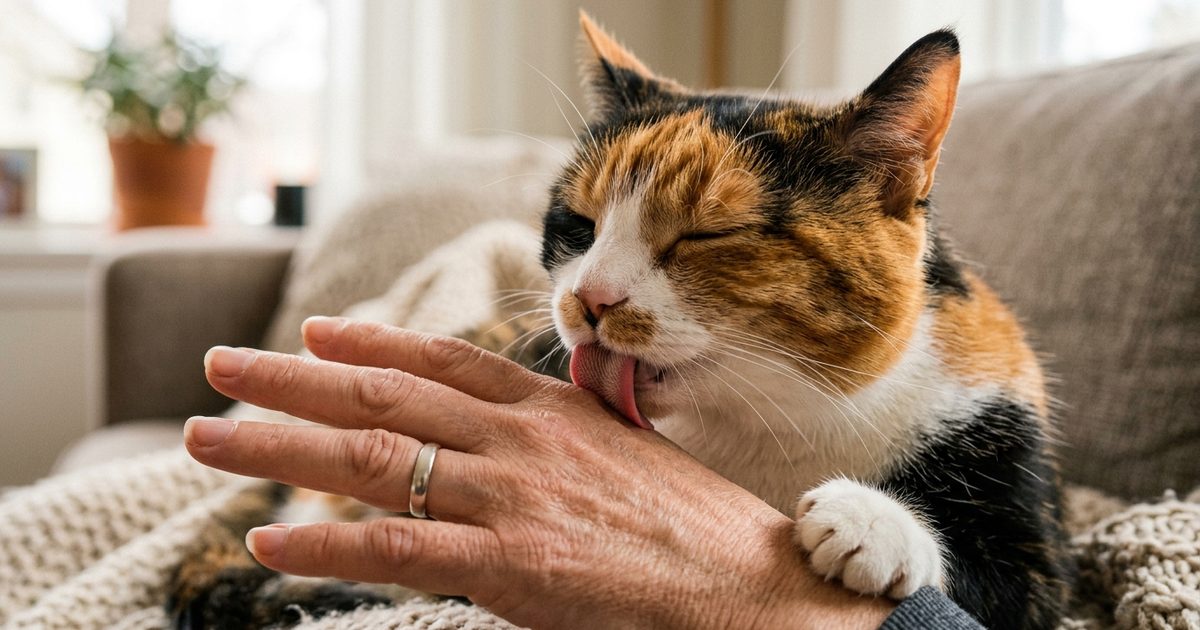
Cats lick humans to show affection and trust — grooming is how cats bond — to mark you with their scent, to self-soothe when anxious, or simply because you taste interesting. The behavior is rooted in kittenhood and mother-cat grooming, where being licked means "you're mine."
When you ask why does my cat lick me, you're really asking what your cat is trying to say. A cat's tongue is a precise instrument — covered in tiny backward-facing barbs called papillae, built for grooming — and licking is one of the most expressive tools in a cat's communication kit. Most of the time, licking carries a warm, social message directed squarely at you. The reasons overlap, and a single licking session can mix several of them at once.
Grooming and affection
The deepest root of licking is allogrooming — mutual grooming between cats who belong to the same family group. If you've wondered why do cats lick you, this shared grooming instinct is where the answer starts. Cats that groom each other are reinforcing a bond, and when your cat licks you, she's extending that same instinct to you. You are, in her mind, a large, oddly shaped member of her family. Licking in this context means trust, attachment, and belonging, and it often comes with a purr or half-closed eyes. It's one of the clearest answers to how cats show affection — quiet, physical, and unmistakably tender.
Scent-marking
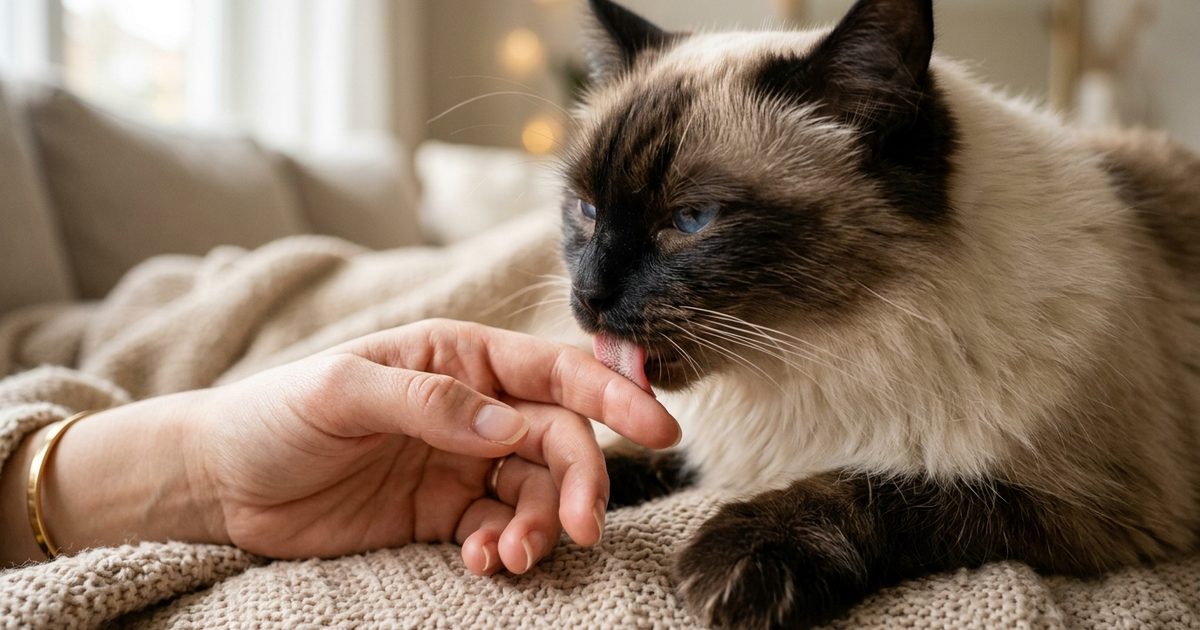
Cats have scent glands around their mouth, chin, and cheeks, and licking leaves a faint signature of those pheromones on your skin. If you're asking what does it mean when cats lick you, part of the answer is this quiet claiming. When your cat licks you, she's partly claiming you — marking you as part of her territory and her circle. It's the same chemical logic behind why cats rub against your legs or headbutt the people they love. To your nose, nothing happened; to every other cat, you now carry a clear message: this human is taken.
Comfort and self-soothing
Licking is also self-soothing. The repetitive motion releases comforting endorphins, so an anxious or uncertain cat may lick you — or herself — to calm down. Some behaviorists link especially intense licking to early weaning, where the comfort of nursing was cut short, but the evidence is limited and individual personality matters more than any single cause. Either way, licking to self-soothe is normal feline behavior, not a sign something is wrong. International Cat Care notes that repetitive comfort behaviors are a standard part of how cats regulate emotion.
You taste interesting
Sometimes the explanation is purely sensory. Human skin carries salt from sweat, traces of food you just handled, or the lotion you put on this morning — and to a cat, all of it is worth investigating with her tongue. A cat that suddenly licks your fingers after you've eaten, or zeroes in on your hands after cooking, is often just following an interesting flavor. There's no deep emotion required; she's tasting you the way she'd taste anything novel. If the licking is new and focused on a specific scent, taste is usually the answer.
Kittenhood memory
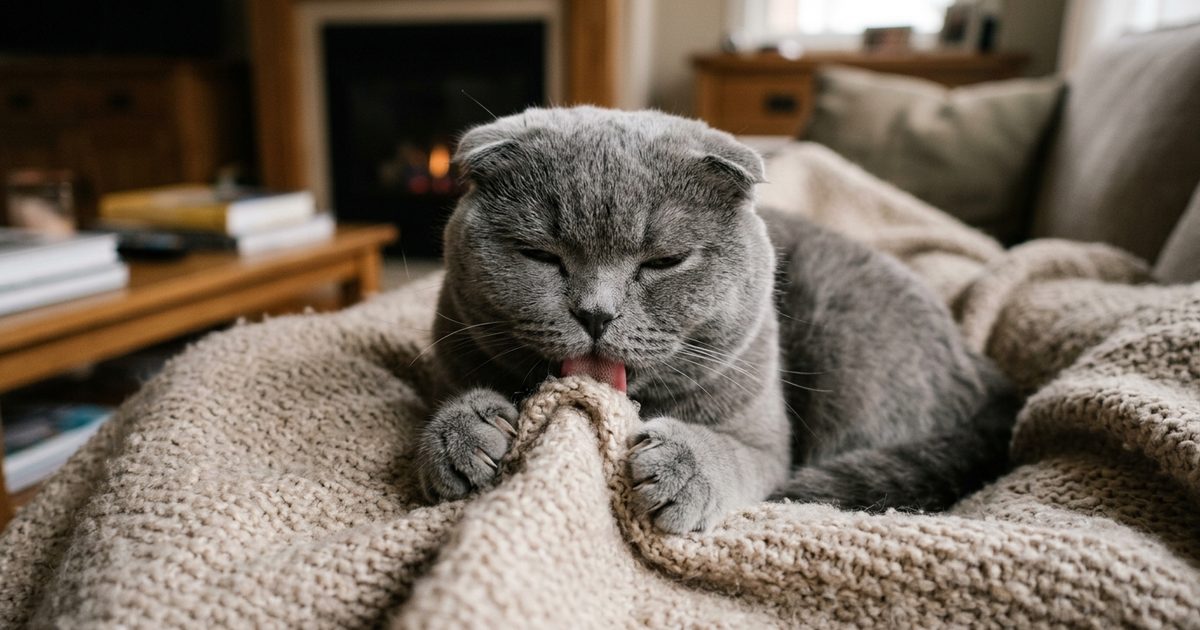
The earliest sensation most cats know is being groomed by their mother — licked clean, kept warm, and guided. That early imprint stays for life, and some adult cats replay it toward the people they love, licking you the way their mother once licked them. Cats that were separated from their mother very young sometimes lick more intensely, as if reaching back for a comfort they remember, though again the link to early weaning isn't proven and many well-raised cats lick just as much. Paired with kneading or a soft blanket, this kind of licking is your cat revisiting the safest feeling she ever knew.
Why Does My Cat Lick Me So Much?
Excessive licking is usually deep affection and bonding — your cat has chosen you as family and grooming you is how she says so. But when licking is new, sudden, intense, or compulsive, it can signal anxiety, stress, or early-weaning behavior. A calm, long-time licker is devoted to you.
Normal devotion vs. anxiety-driven licking
A cat that licks you every time you sit down isn't necessarily anxious — she may simply be a devoted groomer who considers you part of her family group. Some cats are just more orally fixated than others, the same way some cats are constant kneaders while others never make biscuits at all. If the licking is relaxed, rhythmic, and paired with soft body language — half-closed eyes, a loose posture, maybe a quiet purr — it's affection, full stop. The tongue is doing what the paws do during a contented knead: replaying the safest feelings your cat knows.
Anxiety-driven licking feels different. It tends to be faster, more focused, and harder to interrupt — your cat licks as if she can't easily stop, and she may target the same patch of skin over and over. This kind of licking is self-soothing: the repetitive motion helps her regulate nerves, much like a person biting their nails. It doesn't mean anything is wrong with your bond; it means something in her environment — a move, a new pet, a change in routine — is rattling her, and licking is her coping tool.
When to notice a change
The single most useful question isn't "how much does my cat lick me?" but "has the licking changed?" A cat who has licked you gently for years is almost certainly just loving you. What warrants attention is a sudden shift — licking that appears out of nowhere, escalates sharply, turns frantic, or starts leaving your skin raw. We cover the full mechanism — and what to do about it — in When Licking Becomes a Problem.
Why Does My Cat Lick Me Then Bite Me?
Lick-then-bite is usually grooming behavior spilling over into overstimulation. Your cat licks you as a gesture of affection, then the repetitive sensation tips her past her sensory threshold and she gives a nip. It is the same affection-driven cycle as bite-then-lick, just in reverse — rooted in love, not aggression.
If your cat has ever groomed your hand with focused, rhythmic licks and then — without warning — clamped down, you have met one of the most commonly misread patterns in cat behavior. The sequence feels contradictory: affection, then a bite. Owners often read the bite as betrayal or sudden anger, but the two actions usually share the same emotional root.
The mechanism is overstimulation. Grooming you is, for your cat, an act of bonding and care — the same way her mother groomed her, and the same way she grooms a trusted companion. But cats have a sensory threshold, and repetitive contact — licking, petting, focused touch — can build up until it crosses that line. At that point the nibble is less an attack than a release valve for a nervous system that has had enough input for the moment.
Reading the warning signs lets you interrupt the cycle before the teeth. A tail that starts flicking or thumping, ears that rotate sideways or flatten, a tensing body, or skin that begins to twitch are all signals that the threshold is approaching. When you notice them, simply stop petting and let your hand go still — most cats will calm and reset within seconds rather than escalate to the bite.
Two things are worth keeping in mind. First, the nibble that follows grooming is typically gentle and inhibited, very different from a true aggressive bite — your cat is not trying to hurt you. Second, some cats reverse the order and bite then lick, "kissing" the spot they just nipped; it is the same affection-bonding loop, just sequenced differently. Either way the behavior is communication, not malice. For a fuller breakdown of the bite itself — the different types, what each one means, and when a bite is genuinely a warning — see our guide on why your cat bites you.
Why Does My Cat Lick Me When I Pet Her?
Licking while you pet her is reciprocal grooming — you're "grooming" her with your hands, and she grooms you back. It's a mutual-bonding loop and a clear sign she sees you as part of her family group, returning affection in the only language she knows.
Reciprocal grooming — returning the favor
In a cat colony, grooming flows both ways. Cats that consider each other family take turns licking each other's heads, ears, and necks — spots a cat can't easily reach alone. Behaviorists call this allogrooming, and it's one of the strongest social bonds cats form. When you stroke your cat, you're doing something remarkably close to what a trusted feline companion would do: rhythmic, repetitive touch on the very areas cats groom on each other.
So your cat licks you back. It's the most literal "you groom me, I groom you" response she can offer. She doesn't have paws that work like yours, but she has a tongue built for exactly this — and she uses it to complete the loop you started. This reciprocal exchange is one of the clearest ways how cats show affection plays out in everyday life.
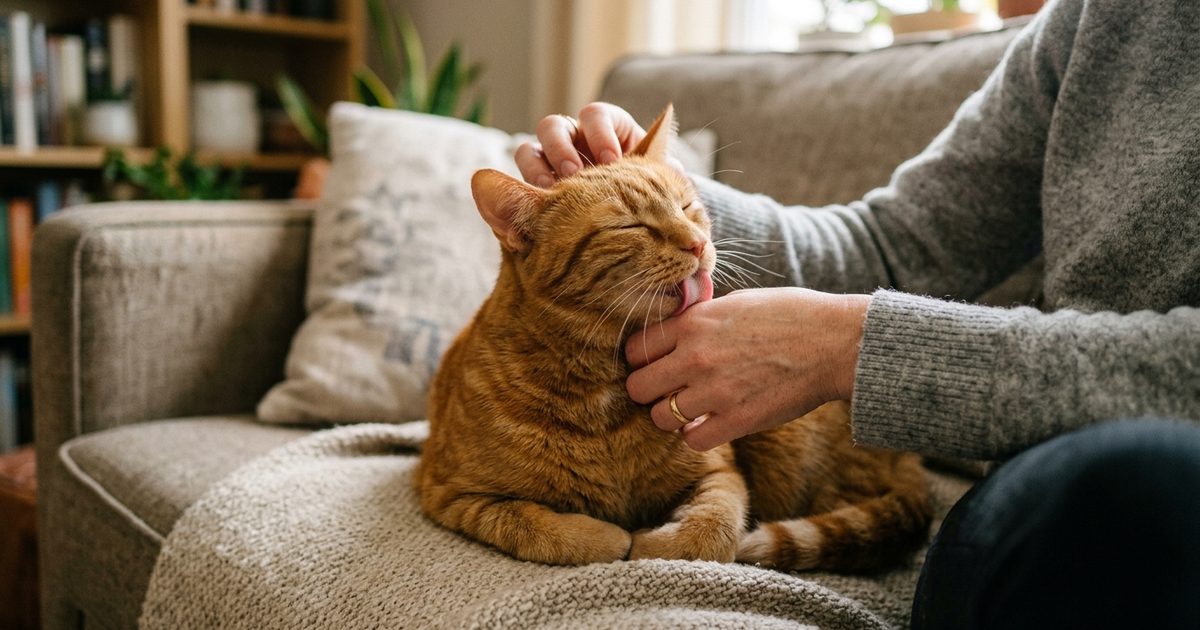
You'll often notice the pattern is mutual and turn-taking: you scratch her cheek, she licks your hand; you stroke her back, she licks again. If she's also purring, eyes half-closed and posture loose, you're watching a cat who feels completely safe with you — the same comfort response behind why cats purr. Some cats escalate the loop into gentle nibbles; if that happens, the lick-to-bite shift is usually overstimulation, not rejection, and it's worth understanding the full why does my cat lick me then bite me pattern.
Not every cat licks while being petted — some just lean in, slow-blink, or go still — and that's equally valid. The cats that do lick during petting tend to be the same ones most deeply attached to hands-on interaction. Either way, when she grooms you back, she's telling you that the bond runs both directions.
Why Does My Cat Keep Licking Me?
Persistent licking is usually a strong bond or a self-soothing habit — the same grooming instinct that bonded your cat to you in the first place. But if the licking is obsessive, fixed on one spot, or appears suddenly, it can point to anxiety or compulsion. Most chronic licking is harmless affection.
When a cat keeps coming back to lick you day after day, the simplest explanation is usually the right one: you matter to her. A cat that returns to the same person for the same grooming ritual has decided, in her own quiet way, that you are part of her family group. We dig into the roots of this in our guide on why cats groom — and the persistent, repeated version is just that same bonding behavior on a loop.
Still, "keep licking" is worth a closer look, because the line between devoted and compulsive is a real one.
Devotion, not obsession — most of the time
A cat who licks you every time you sit down, or who seeks out your hand to groom each evening, is showing consistency, not a problem. Cats are creatures of habit, and a fixed, repeated behavior toward a trusted person is one of the most common and healthy expressions of feline attachment. It often runs alongside other calm signals — a relaxed, gently swaying tail (covered in cat tail meanings) or a soft purr — that tell you the licking is part of feeling safe and settled.
When persistent becomes a concern
The pattern to watch for is a change. If your cat has always been a licker, that's just who she is. But if a cat who rarely licked suddenly starts, or the licking becomes frantic, focused on one patch of skin, or paired with restlessness, hiding, or appetite changes, it may have shifted from affection into self-soothing. We walk through the warning signs and when to call a vet in When Licking Becomes a Problem.
Most of the time, though, a cat who keeps licking you is simply a cat who keeps choosing you. If the sandpaper tongue gets to be too much, redirect her gently to a toy or a soft blanket rather than pulling away sharply — affection is never something to punish. And if you've ever wondered what's behind all that devoted grooming, Get a MeowMind reading — what would your cat say while licking you?
Is It Safe to Let Your Cat Lick You?
Occasional licking is harmless for healthy skin, but cat saliva carries bacteria, so avoid letting your cat lick open wounds, your face, or mouth — and wash afterward if you're immunocompromised. A cat's rough tongue can also irritate skin with repeated licking over time.
For the vast majority of healthy adults, a lick on the hand from your cat is nothing to worry about. Cat saliva is a normal part of the grooming and bonding behavior we've covered, and intact skin is an effective barrier against most of what it contains. The warmth and affection behind the gesture far outweigh the small risk for an everyday owner.
There are, however, a few sensible boundaries. Cat saliva does contain bacteria — including Pasteurella and other organisms naturally present in a cat's mouth — so you'll want to keep that tongue away from open cuts, scrapes, rashes, and your eyes, nose, and mouth. People with compromised immune systems, the very young, and the elderly should be more cautious and wash the area afterward. The Cornell Feline Health Center is a reliable source on zoonotic considerations like these, and International Cat Care offers practical guidance on everyday cat hygiene.
One old myth worth addressing: cat saliva is not "clean" or antiseptic in the way folklore suggests. While it does contain some enzymes, it also carries bacteria — so don't treat a cat lick the way a cat would treat its own wound. That said, for healthy skin on a healthy person, the everyday lick your cat gives you is safe, and it's a gesture worth enjoying rather than fearing. If you want to understand what that lick is really telling you, how cats show affection is a good place to start.
When Licking Becomes a Problem
Licking is normal cat behavior, but a sudden surge, licking that leaves raw skin on you or bald patches on the cat, or compulsive licking paired with hiding, appetite loss, or restlessness can signal stress or a medical issue. A vet or feline behaviorist can help you pinpoint the cause.
Most licking is nothing to worry about — it's affection, bonding, and scent-marking wrapped into one rough-tongued gesture. The time to pay attention is when the licking changes. Cats are creatures of habit, so an abrupt shift in any established behavior is worth noticing, and licking is no exception.
Watch for a few specific patterns. If your cat suddenly licks you far more than usual, or focuses on one spot until your skin is red and sore, something has shifted — possibly anxiety, a change in the household, or discomfort. The same applies to self-licking: if your cat starts overgrooming — licking herself until the fur thins or disappears, often on the belly or legs — that's a well-documented stress or allergy signal rather than ordinary cleanliness.
Compulsive licking that comes with other signs is the clearest red flag. Licking paired with hiding, reduced appetite, vocalizing, or a tense, thrashing tail suggests the behavior has crossed from comfort into a coping mechanism for something wrong. Cats hide pain and distress remarkably well, so a new repetitive behavior is often the first visible clue.
The good news: you don't have to diagnose it yourself. If the licking feels new, intense, or damaging — to your skin or your cat's coat — that's exactly when to call your vet or a feline behaviorist. They can rule out medical causes (allergies, pain, skin conditions) and help you identify the stressor if it's behavioral. The Cornell Feline Health Center offers reliable guidance on when a behavior change warrants a visit, and most overgrooming cases improve once the underlying trigger is addressed.
How to Gently Redirect Licking
If the licking is affection, you can let it happen — but when it gets too intense, hurts, or becomes compulsive, redirect gently: offer a toy, withdraw your hand calmly, and never punish. Punishment breaks trust and rarely works, because licking is instinct, not misbehavior.
The first step is reading the moment. Affection licking — slow, relaxed, eyes half-closed, a soft body against yours — is a compliment, and you don't need to stop it at all. Let it run its course; your cat is bonding with you the only way she knows how. It's the licking that crosses a line — the kind that grinds your skin raw, goes on past the point of comfort, or tips into a frantic, repetitive rhythm — that you want to gently redirect.
Redirect, don't punish
The golden rule: never punish licking. Yelling, pulling your hand away sharply, or pushing your cat off feels like rejection to an animal whose deepest instinct this is, and it erodes the very trust the licking was built on. Licking isn't naughtiness your cat can simply decide to stop — it's wired into her from kittenhood. Punishment doesn't teach her not to lick; it teaches her to be afraid of you.
Instead, redirect the behavior somewhere appropriate. When the licking gets to be too much, calmly offer a wand toy, a kicker, or a grooming brush — something that gives her mouth or paws a different job. Many cats accept the swap happily because they're seeking sensory engagement, not specifically your skin. If she ignores the toy and keeps going, simply and quietly withdraw your hand, stand up, and leave her for a minute. No drama, no scolding — just a calm end to the session. She learns that gentle licking keeps you close, while over-the-top licking makes the attention go away.
A simple redirect routine
- Catch it early. Watch for the shift from soft grooming to hard, focused licking — that's your cue to act before skin gets sore.
- Offer an alternative. A toy, a treat puzzle, or a brush lets her redirect the same grooming energy onto something acceptable.
- Withdraw calmly. If she won't switch, quietly pull your hand back and step away for a short break. Consistency teaches the limit faster than any single correction.
- Reward the calm. When she settles without overlicking, a quiet stroke or soft word reinforces that gentle beats intense.
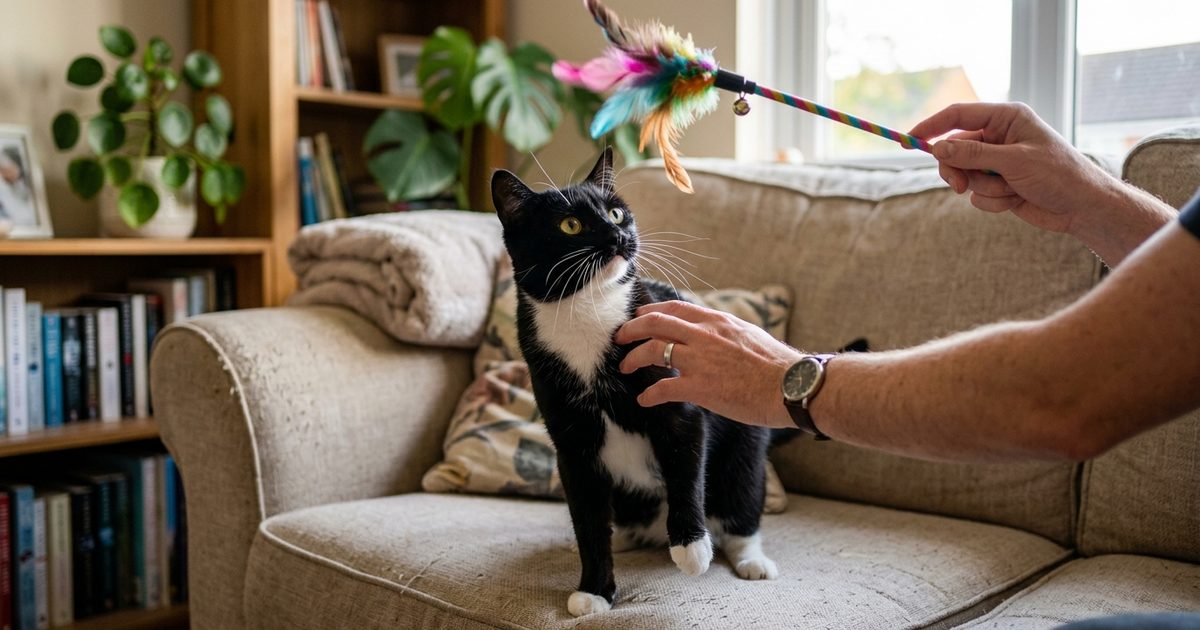
If the licking is truly compulsive — focused on one spot, impossible to interrupt, or paired with overgrooming of her own body — gentle redirection may not be enough. That pattern can point to underlying anxiety or a medical issue, and it's worth a conversation with your vet or a feline behaviorist rather than a battle of wills at home. Most licking, though, is just love with rough edges — and a patient redirect is all it takes.
Common Myths About Cats Licking
A few stubborn ideas about why cats lick humans circulate widely, and most of them miss what licking actually is — a social, bonding behavior rooted in kittenhood. Clearing them up helps you read your cat more accurately instead of overlaying human logic onto feline instinct.
Myth: Licking means the cat is hungry. Fact: Licking you has essentially nothing to do with food. A hungry cat meows, paces the kitchen, or stares at the bowl — it doesn't groom your hand. Licking is affection, scent-marking, or self-soothing, the same way cats purr for comfort rather than to ask for dinner. If your cat only licks around mealtime, the timing is coincidence, not a request.
Myth: Cats only lick to clean themselves. Fact: Self-grooming is real, but licking you is a different behavior called allogrooming — grooming another member of the family group. How cats show affection often looks like care-taking, and licking you is your cat treating you the way a mother cat treats her kittens. It's social bonding, not a comment on your hygiene.
Myth: Cat saliva is clean and antiseptic, so licking helps heal wounds. Fact: This one is partly true and partly dangerous, so it's worth being precise. Cat saliva does contain some enzymes with mild antibacterial properties, which is where the "antiseptic" idea comes from. But it also carries plenty of bacteria — including species that can cause infection in broken skin. Veterinary sources like the Cornell Feline Health Center advise against letting cats lick open wounds, your face, or your mouth. Occasional licking of intact skin is harmless for most people; treating saliva as medicine is not.
Understanding what licking isn't makes what it is — trust, familiarity, and a small daily claim of "you're mine" — that much easier to recognize.
Why Cats Lick at a Glance — Summary
| Question | Short answer |
|---|---|
| Why does my cat lick me? | Affection and grooming-bonding — being licked means "you're mine" |
| Why does my cat lick me so much? | Usually deep devotion; if new or compulsive, possible anxiety or early-weaning habit |
| Why does my cat lick me then bite me? | Grooming that tips into overstimulation — affection, not aggression |
| Why does my cat lick me when I pet her? | Reciprocal grooming — you groom her, she grooms you back |
| Is it safe to let my cat lick you? | Mostly yes for healthy skin; avoid wounds, face, and mouth, and wash if immunocompromised |
| How do I get my cat to stop licking me? | Redirect to a toy, withdraw calmly — never punish an affection behavior |
Curious What Your Cat Would Say?
Upload a photo and get a warm, personalized reading from your cat's perspective.
Start Your Free ReadingFrequently Asked Questions
Why does my cat lick me?
Cats lick humans as a grooming and bonding behavior rooted in kittenhood, when a mother cat licks her kittens clean and keeps them close. Licking you means your cat sees you as family — and is claiming you with scent glands around her mouth at the same time.
Why does my cat lick me so much?
Frequent licking is usually deep affection — your cat has chosen you as family and grooms you to say so. But if the licking is new, sudden, intense, or focused on one spot, it can signal anxiety, stress, or an early-weaning habit rather than simple devotion.
Why does my cat lick me then bite me?
Lick-then-bite is grooming that tips into overstimulation. Your cat licks you as affection, then the repetitive sensation crosses her sensory threshold and she gives a quick, usually gentle nip. It's the same bonding cycle in reverse — rooted in love, not aggression.
Why does my cat lick me when I pet her?
Licking while you pet her is reciprocal grooming. You're grooming her with your hands, and she grooms you back with her tongue — a mutual-bonding loop and a clear sign she sees you as part of her family group.
Why does my cat lick my hair or face?
Hair and face licking are the same grooming instinct aimed at spots cats groom on each other — the head and neck. Your hair may also carry interesting scents from shampoo or products. It's affection and investigation, though you should keep licking away from your eyes and mouth.
Is it safe to let my cat lick me?
Occasional licking of healthy, intact skin is harmless for most adults. But cat saliva carries bacteria, so avoid letting your cat lick open wounds, your face, or your mouth, and wash the area if you're immunocompromised. A rough tongue can also irritate skin over time.
Why does my cat keep licking me?
Persistent, repeated licking is usually a strong bond or a self-soothing habit — the same grooming instinct that first connected your cat to you. If it becomes obsessive, fixed on one spot, or appears suddenly, it may point to anxiety or compulsion rather than affection.
How do I get my cat to stop licking me?
Redirect gently — offer a toy, a treat puzzle, or a brush when the licking gets too intense, and calmly withdraw your hand if she keeps going. Never punish licking, since it's an affection instinct rather than misbehavior; punishment breaks trust and rarely works.
Sources & References
You Might Also Like
Kitten Teething: Timeline, Symptoms & How to Help
Kitten teething runs from 3 to 7 months as baby teeth fall out. Learn the timeline, signs to watch for, and how to soothe a teething kitten safely.
15 min readWhen Do Cats Stop Growing? A Complete Timeline
When do cats stop growing? Most cats reach adult size by 12-18 months, but large breeds like Maine Coons keep growing until 3-4 years. Full timeline inside.
14 min readCan Cats Eat Cherries? Flesh, Pit & Toxicity Facts
Can cats eat cherries? Pitted flesh is safe in tiny amounts — but the pit, stem, and leaves are toxic (cyanide precursors). Learn what's safe and what isn't.
15 min readA message, in your cat's voice
Upload a photo, get a warm note written from your cat's perspective — just for fun. Plus 121 vet-cited articles, offline.