Why Do Cats Groom? The Science Behind All That Licking
Cats groom themselves — and each other — for reasons rooted in survival, not vanity. Why do cats groom each other at all, and why do cats groom themselves so often? When you watch your cat methodically licking its flank, or notice two cats in your home quietly grooming each other, you are looking at an ancient, self-maintaining system. The short answer: grooming keeps a cat hidden from prey and predators, removes loose fur and parasites, spreads natural oils through the coat, cools the body, and — between cats — builds trust through a shared scent and a quiet, physical language.
It is one of the most defining behaviors in the feline repertoire, and the more you understand it, the better you can read your own cat's mood, health, and relationships.
Key takeaways
- Grooming is a survival behavior, not vanity — scent removal, parasite control, temperature regulation, and coat-oil distribution all keep a cat alive in the wild.
- A cat's tongue is a built-in comb: backward-facing keratin spines (papillae) wick saliva deep into the fur and trap loose hair and dirt.
- Roughly 30 to 50 percent of a cat's waking hours spent grooming is normal — a sudden jump or a sudden stop is the real warning sign.
Why Cats Groom — Quick Reference
| Grooming behavior | What it means | Normal or concern? |
|---|---|---|
| Licking the coat after eating or waking | Routine scent removal, oil distribution, and self-cleaning | Normal |
| Two cats grooming each other's head and neck | Allogrooming — bonding, trust, and shared group scent | Normal, often a good sign |
| Paw-washing the face in a set sequence | The standard grooming routine, face to shoulders to body | Normal |
| A kitten clumsily licking its paws | Learning the skill from its mother, starting around 3–4 weeks | Normal development |
| Sudden increase in licking, short broken hairs | Possible overgrooming — stress, fleas, allergy, or pain | Worth a vet check |
| Grooming that stops almost entirely | Often pain, stiffness, or illness; older cats are prone to this | Worth a vet check |
Why Do Cats Groom Themselves?
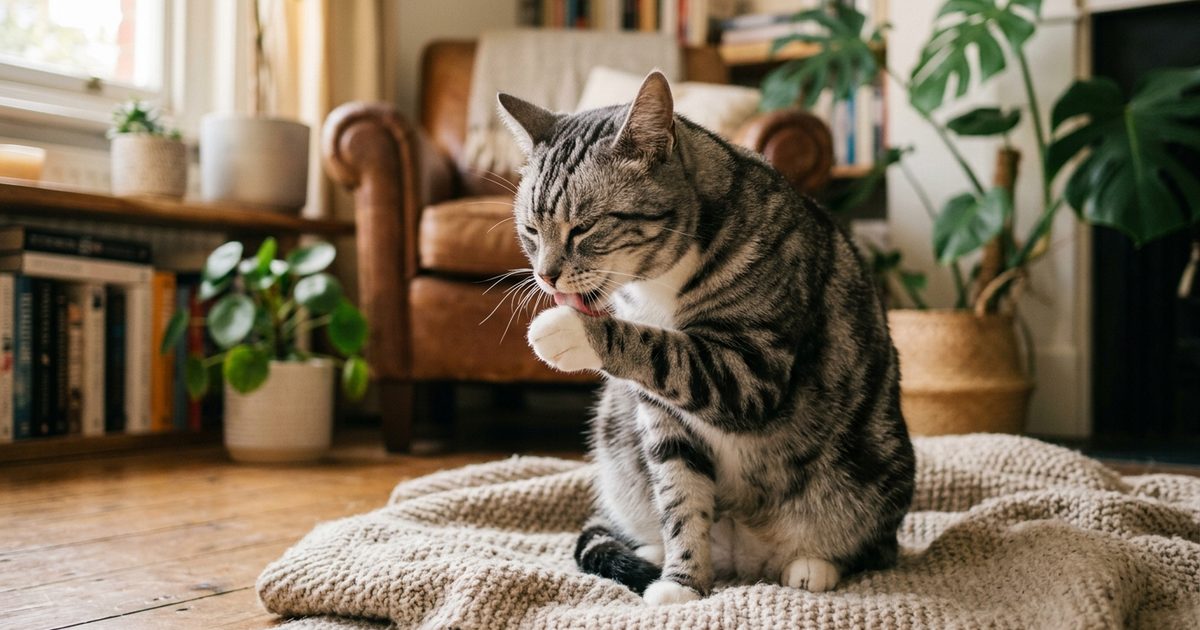
Cats groom themselves to survive, not out of vanity. Licking strips away scent that prey and predators could otherwise detect, clears loose fur, dirt, and parasites, spreads natural oils that waterproof the coat, and uses saliva evaporation to cool the body in hot weather.
We tend to read a fastidiously clean cat as a fussy perfectionist, but the real driver is evolutionary, not aesthetic. Every one of those five motivations traces back to staying alive as a small, solitary hunter that is also, inconveniently, a meal for something larger. Grooming is the maintenance routine that keeps a cat's three core survival tools — stealth, a functioning coat, and a cool body — in working order. Understanding why cats groom themselves also lays the groundwork for the more social question of why do cats groom each other, because the same mechanics power both.
Removing scent to stay hidden
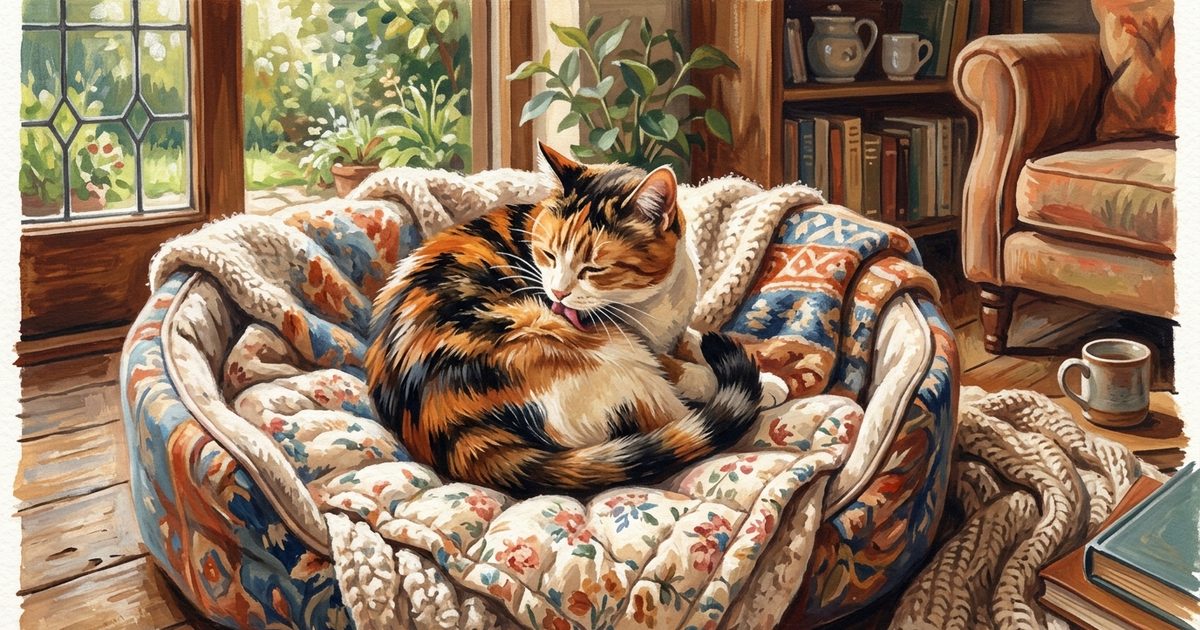
A cat is an ambush predator and prey at the same time, and scent is the tell that gives it away in both directions. The smell of a recent meal — blood, tissue, digested residue — would telegraph its position to both the mouse it is hunting and the fox or coyote that would hunt it. Licking the fur and washing the face after eating scrubs that signal off, restoring the cat's default state of olfactory near-invisibility. International Cat Care describes grooming as one of the most essential maintenance behaviors in the domestic cat's repertoire precisely because it underwrites this stealth. So when your cat washes its face the instant it finishes a meal, it's not being dainty — it's running a millions-of-years-old concealment protocol.
Parasite and debris control
The tongue's combing action does double duty as a first line of parasite defense. As it rakes through the coat, it dislodges fleas, flea dirt, loose dander, and shedding hair before they can build up or irritate the skin. The fur that gets pulled loose is swallowed, which is why heavy shedding seasons can tip over into hairballs — a normal, if occasionally unpleasant, side effect of this same cleaning routine. Regular self-grooming won't replace flea prevention, but it meaningfully reduces the parasite load a cat carries between treatments, and it keeps the coat free of the grit and debris a roaming hunter inevitably picks up.
Temperature regulation
Cats don't sweat across their bodies the way we do; their main cooling strategy is respiratory and evaporative. Grooming is the second half of that system. By spreading saliva onto the fur, a cat creates the same evaporative-cooling effect that sweat gives us — as the moisture evaporates, it pulls heat off the skin. On a warm day you may notice your cat groom more frequently, then settle into a stretched-out sprawl; that sequence is deliberate, combining the cooling lick with a posture that maximizes heat loss. This is also why grooming drops off sharply in cold rooms — there is no evaporative benefit to chase.
Coat oil (sebum) distribution
Skin constantly produces sebum, a natural oil that conditions the fur and helps keep the skin supple and water-resistant. Left in place, it builds up and leaves the coat greasy; spread evenly along each hair shaft, it produces the sleek, water-shedding finish we recognize as a healthy cat. Grooming is the mechanism that does that spreading — the tongue strokes pull sebum from the skin out toward the tips of the fur. A cat that stops grooming (often because of pain, illness, or obesity) will quickly develop a dull, clumped, slightly oily coat, and that visual change is one of the earliest outward signs something is off.
Wound care and self-soothing
Cats lick small abrasions and minor skin irritations as a matter of course, and there is a calming dimension to the behavior as well. The repetitive, rhythmic motion of grooming appears to release endorphins, which is why a mildly stressed cat will often groom to settle itself — a self-soothing loop rather than a sign of distress in its own right. This should be generalized, not read as medical advice: a little post-scrape licking is normal, but a cat that returns to the same spot obsessively until the skin is raw or the fur is gone has crossed from maintenance into a problem worth a vet's attention. The line is frequency and consequence, not the lick itself.
How Do Cats Groom? The Barbed Tongue and the Sequence
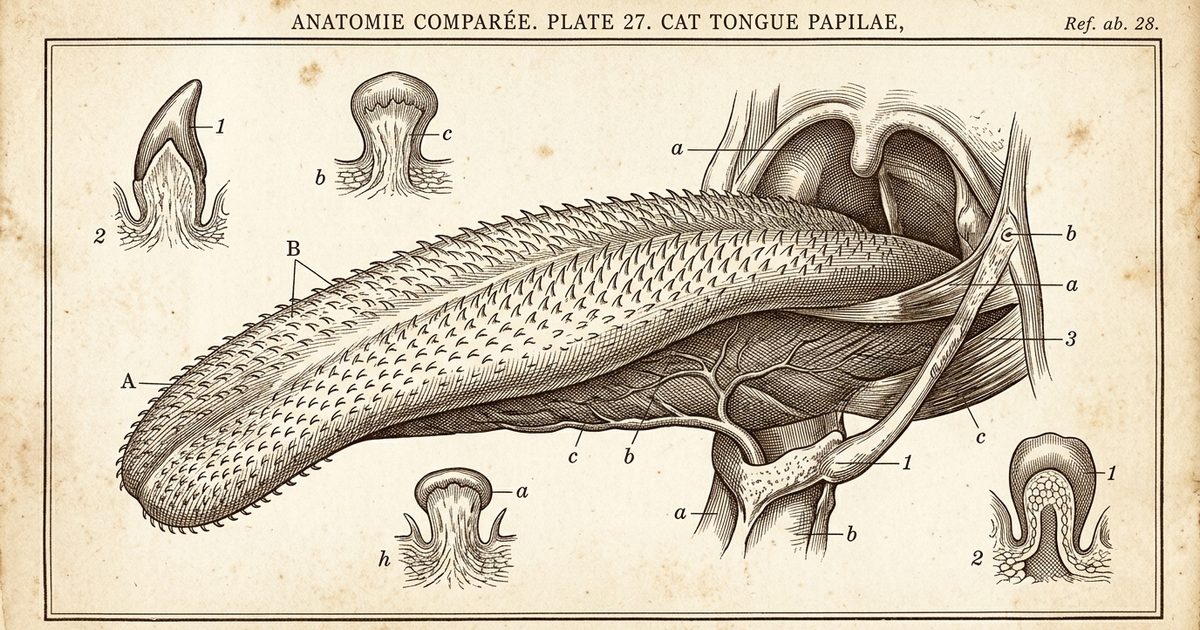
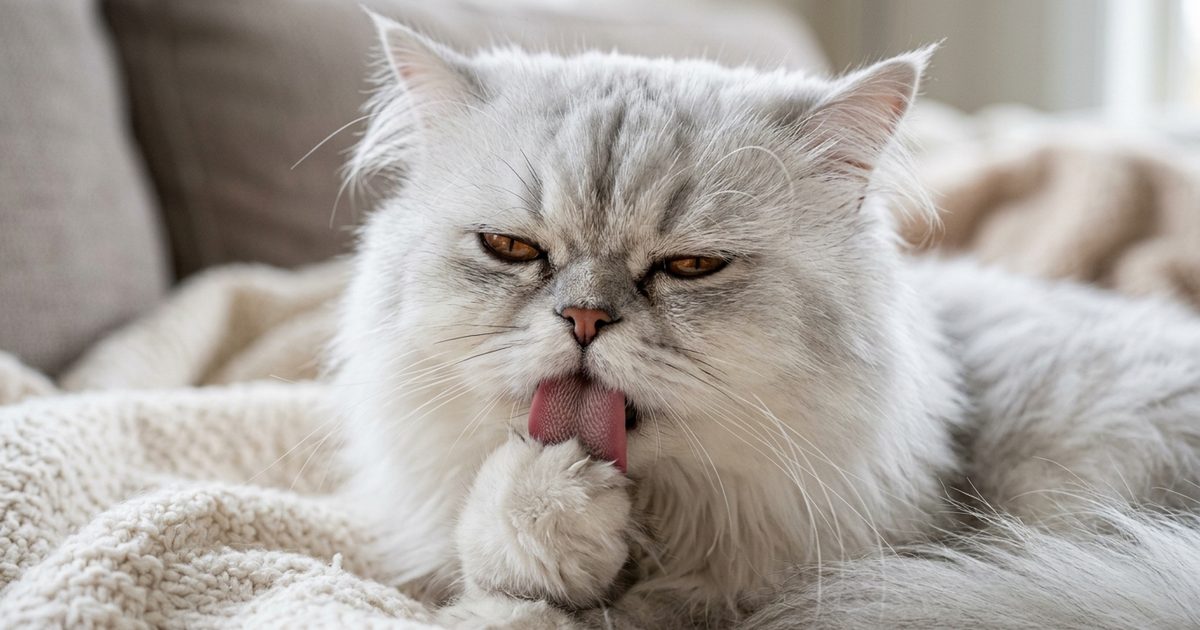
A cat's tongue is covered in hollow, backward-facing keratin spines called papillae that act like a built-in comb, wicking saliva deep into the fur and trapping loose hair and dirt. Cats then groom in a predictable sequence — face, shoulders, body, tail — most often after eating or waking.
The grooming behavior looks simple — lick, repeat — but the hardware is remarkable. A house cat's tongue is one of the most specialized grooming tools in the animal kingdom, and it works together with the paws and teeth in a fixed, stereotyped sequence. The mechanics explain both why cats groom themselves so effectively and why a cat that cannot complete the full sequence — because of arthritis, obesity, or dental pain — ends up with a visibly compromised coat.
The papillae: a keratin comb
The surface of a cat's tongue is carpeted with hundreds of tiny, backward-curving spines called papillae. They are made of keratin — the same protein as human fingernails — and for a long time they were assumed to be solid, cone-shaped hooks. Recent research overturned that: the papillae are actually hollow, U-shaped scoops. That hollow shape is the key to their function. Through capillary action, each papilla wicks saliva off the tongue's surface and holds it; when the tongue presses against the fur, the saliva is deposited deep down to the skin, not just smeared on the topcoat. The same spines then catch and hold the loose hair, dirt, and debris being pulled out. The Cornell Feline Health Center highlights this barbed-tongue anatomy as central to how cats maintain skin and coat health. The practical upshot: a cat's tongue isn't rough for roughness's sake — it is a precision fluid-delivery and filtration tool.
Wonder what your cat is really doing during all those quiet licking sessions? Get a MeowMind reading — upload a photo and let her tell you what's on her mind while she grooms.
The grooming sequence
Cats don't groom randomly. The sequence is remarkably consistent across individuals: they start at the face, using a dampened forepaw as a washcloth — wiping around the eyes, behind the ears, and along the muzzle — then transition to direct tongue strokes down the shoulders, sides, back, belly, and finally the tail and hindquarters. This is a stereotyped pattern, meaning it runs in a predictable order, and it is most likely to appear right after a meal or immediately on waking from a nap. The post-meal burst ties back to scent removal; the post-nap burst tidies a coat ruffled by sleep and helps the cat re-settle its body temperature. If you watch closely, the rhythm itself is part of the point — the steady, repeated strokes are self-regulating as much as they are cleaning.
The dew claw as a comb
The tongue can't reach everywhere, and cats have a backup tool: the dewclaw on the inside of each forepaw, along with the incisor teeth. To groom the head, neck, chin, and the backs of the ears — the zones the tongue physically cannot reach — a cat licks its paw or dewclaw until it is wet, then drags that damp claw through the fur, effectively using it as a small comb. The teeth come in for fine work around the neck and the base of the ears. This is why an older cat with painful dewclaws or dental disease may develop a scruffy neck and head even while the rest of the coat still looks cared for — the localized tool has gone offline.
Saliva: the multi-purpose fluid
Saliva is the working fluid of the whole system, and it does more than wet the fur. As the papillae deposit it, saliva helps redistribute sebum from the skin out along the hair shafts, supports evaporative cooling, and carries a range of natural compounds — including some with mild antimicrobial properties — that help keep the skin's microbial balance in check. It's worth keeping these effects general rather than overstating them: cat saliva is not a disinfectant, and the old idea that a cat's mouth is somehow "clean" is a myth best retired. What saliva reliably does is serve as a multi-purpose carrier — for cooling, for oil distribution, and for moving loose debris out of the coat — and it does that job exceptionally well.
How Much Grooming Is Normal for a Cat?
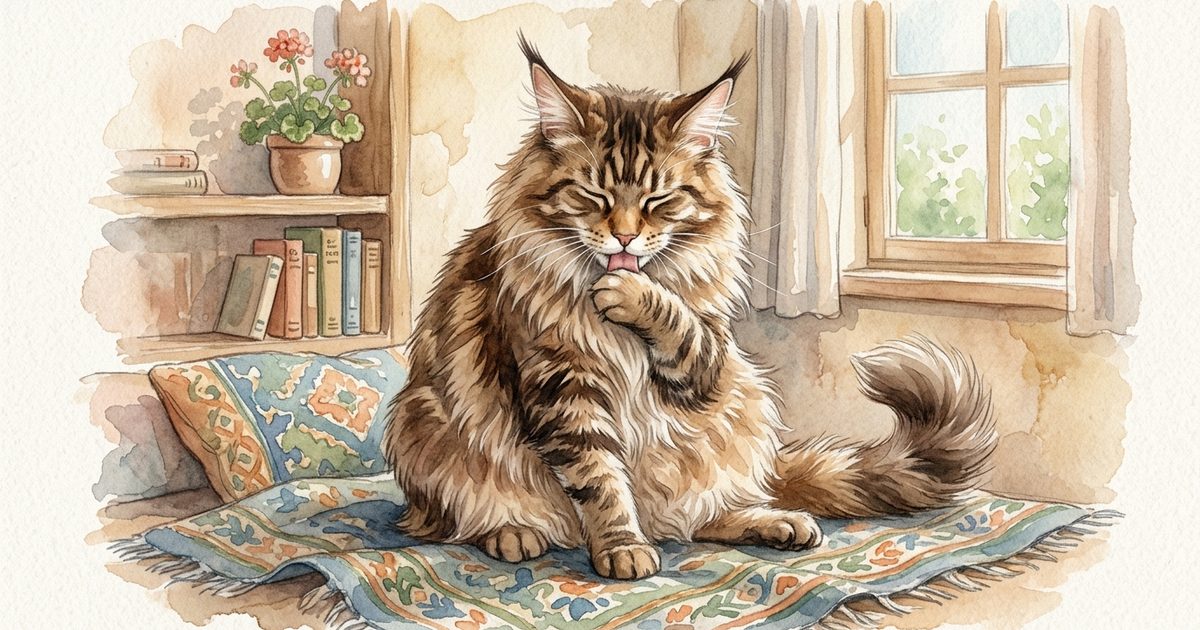
Adult cats spend roughly 30 to 50 percent of their waking hours grooming, usually in short bursts spread through the day. Longhaired breeds and cats in multi-cat homes may groom more. A sudden jump — or a sudden stop — is a more useful warning sign than the raw total.
If that number sounds high, it should. Cats are awake for only a portion of the day, and they spend up to half of that waking time on self-care. The Cornell Feline Health Center lists grooming as one of the most reliable indicators of a healthy cat — not because cats are vain, but because the behavior is woven through almost every part of their daily rhythm: after eating, after waking, before settling somewhere new.
The 30-50% baseline
The 30 to 50 percent figure comes from time-budget studies that tracked what cats actually do across a full day. It's a range, not a target — most healthy adult cats land somewhere in the middle, and the spread is wide. What matters is that grooming shows up in many short sessions rather than one long block. A cat might lick a paw for a minute, pause, look out the window, then resume. You can estimate without a stopwatch: if your cat grooms in small stretches scattered between naps, play, and meals, that's the normal pattern. If grooming has become the main activity crowding everything else out, the pattern itself has changed.
Breed, coat, and age variation
Not every cat grooms the same amount, and most differences come down to physics, not personality. A longhaired cat has more coat to maintain, and longer fur tangles and traps debris more easily, so the grooming time goes up — coat mechanics, not a fussier temperament. Age pulls in the opposite direction. Senior cats often groom less because arthritis and stiffness make it painful to twist into the positions grooming demands, and an overweight cat may simply be unable to reach parts of its body. If an older cat's coat starts looking dull, matted, or unkempt, the cause is usually physical limitation rather than laziness — and it's worth a conversation with your vet.
When the amount itself is the signal
Because the baseline varies so much from cat to cat, the single most useful question isn't "how much?" but "has it changed?" A sustained, sharp increase in grooming — especially focused on one spot — often points to itch, pain, or stress rather than a sudden interest in cleanliness. A drop can be just as telling: a cat that stops grooming the back half of its body, or lets the coat go entirely, may be hurting or unwell. Either direction, a real shift is a reason to look closer. We cover what overgrooming looks like, and when to act on it, in the section below.
Why Do Cats Groom Each Other?
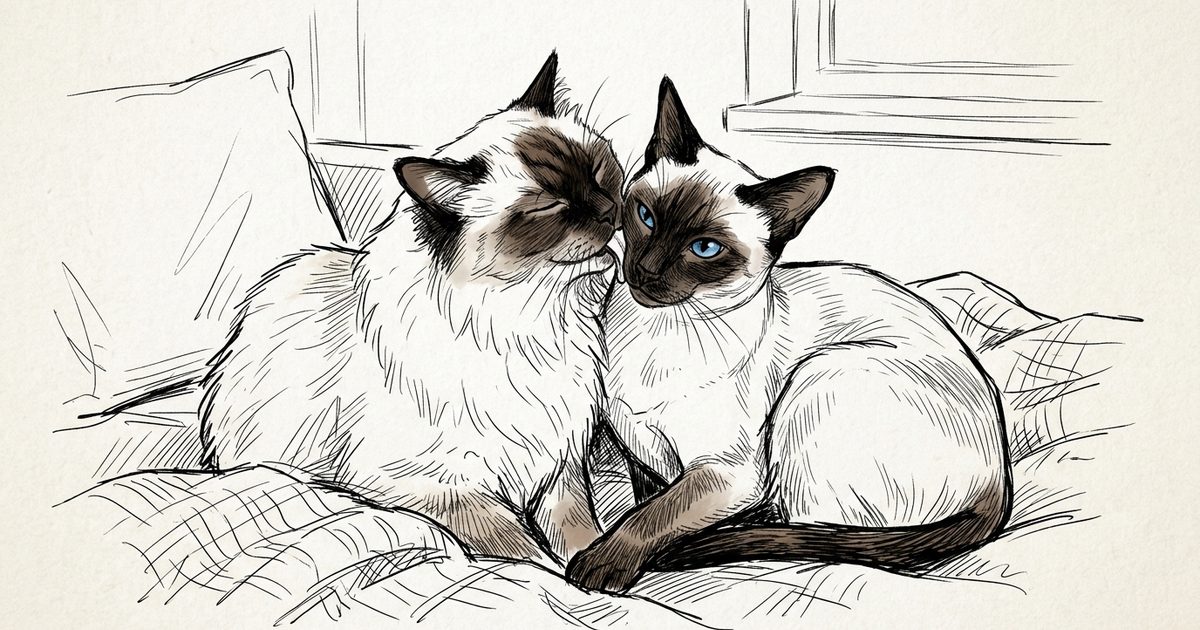
Cats that groom each other — called allogrooming — are usually bonded family or group members reinforcing trust and a shared group scent. Higher-status cats often groom lower-status ones, and the head and neck are the favorite targets because they are hard for a cat to reach alone.
When two cats sit side by side and one begins methodically licking the other's face, you're watching one of the most intimate social behaviors in the feline repertoire. This isn't random friendliness — it's a structured ritual, and researchers who study cat social behavior describe allogrooming as a core way affiliated cats maintain their relationships. International Cat Care notes that cats who groom one another are usually kin or long-standing group members who have chosen to share space, scent, and trust.
Social bonding and group scent
Allogrooming does two things at once. The first is emotional: the rhythmic licking reinforces affiliation, calms both cats, and appears to release the same soothing endorphins that self-grooming does. The second is chemical — cats carry scent glands on their heads and flanks, and mutual grooming mingles those scents into a shared "group smell." A cat that smells like family is treated like family. This is the same affiliative logic behind other quiet gestures of closeness, and you can read more about how cats signal warmth in our guide to how cats show affection and how grooming posture fits into the wider picture of cat body language.
Hierarchy and who grooms whom
Studies of allogrooming in groups of cats found a recurring pattern: it often flows from the higher-ranking or more confident cat toward the lower-ranking one, rather than being perfectly mutual. Read cautiously, though — this isn't a rigid dominance rule. Some bonded pairs groom each other quite evenly, and the direction can flip depending on mood and context. The reasonable takeaway is that allogrooming tends to be asymmetrical in groups but mutual in tight pairs, and it serves affiliation as much as hierarchy. The relationship between the two cats, not a fixed rank, determines what the grooming means.
Target zones: head and neck
If you watch closely, most allogrooming lands on the head, ears, cheeks, and the back of the neck. That's not an accident. These are exactly the spots a cat struggles to groom thoroughly on its own — the face is reached only awkwardly with a damp paw, and the neck is a blind spot for the tongue. So one cat grooms another where the other literally cannot return the favor alone. This mutuality — filling in each other's gaps — is part of why the behavior reads as care rather than control.
What about grooming humans?
When your cat licks your hand, your hair, or your arm after you've been petting her, she's often extending this same social behavior to you. By her logic, you're part of the group: you share space, you share scent, and grooming is how cats tend to the beings they've accepted as family. There's a small scent-marking component, but the dominant reading is affiliative, not territorial. The reasons cats lick people in more detail — affection, attention, taste, the claim of comfort — are a topic of their own, and we cover them fully in why does my cat lick me.
How Do Kittens Learn to Groom?
Kittens are not born knowing how to groom — the mother cat demonstrates and the kittens start copying around three to four weeks of age. By weaning they have the full sequence, but adult-level efficiency takes months of practice and trial-and-error.
Grooming looks effortless in an adult cat, but it is genuinely a learned skill — part instinct, part tutelage. A kitten separated too early from its mother often grows into a cat that grooms clumsily or skips steps, which is one reason early newborn kitten care matters for more than just feeding.
The mother's demonstration
The queen (mother cat) does most of the early work. From the first hours after birth she licks her kittens constantly — stimulating them to urinate and defecate, keeping them clean, and laying down the first template of what grooming is supposed to look like. That licking is not just hygiene; it cues the kittens' own grooming reflex. As they begin to watch her rhythmic strokes across their bodies and her own fur, the motion gets encoded alongside the feeling of being groomed. The queen is both cleaner and instructor, and kittens raised without this demonstration often take noticeably longer to coordinate their own tongues and paws.
The 3-4 week onset
Around three to four weeks, as a kitten's motor control and coordination sharpen, the first genuine self-grooming attempts appear — usually a paw dragged awkwardly across the face, or a few clumsy licks at the chest. These early sessions are uncoordinated and short: the kitten is still figuring out where its body ends and how to balance while licking. Over the following week or two the strokes lengthen, the sequence starts to resemble an adult's, and grooming becomes a regular part of waking life. This is the same developmental window where kittens begin walking steadily and exploring, so grooming arrives hand in hand with mobility.
Practice into adulthood
By the time a kitten is weaned, at roughly seven to eight weeks, it has the basic grooming sequence in place — face, shoulders, body, tail. But efficiency keeps refining for months. Adult cats groom with an economy of motion a kitten simply does not have: they know which spots need the dewclaw, where to bite-pull matted fur, how long to spend on each region. So self-grooming is best understood not as pure instinct that simply switches on, but as an instinct sharpened into a skill through thousands of repetitions — which is also why it can quietly fall apart later in life if arthritis or pain make the practice painful.
What Is Overgrooming, and When Should You Worry?
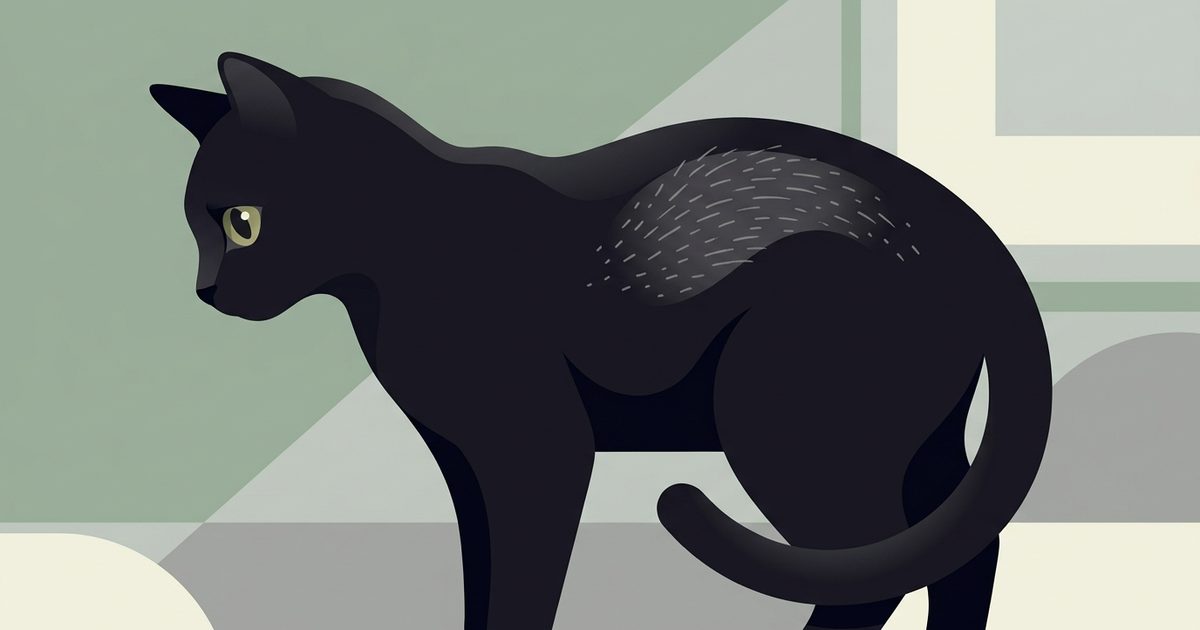
Overgrooming means a cat grooms past the point of maintenance, often producing thinning fur, bald patches, or raw skin — most often on the belly, inner thighs, or flanks. It is usually driven by stress, fleas, allergies, or pain, and a vet visit is the right first move.
Overgrooming is one of the most common grooming-related reasons owners end up at the vet, and it is also one of the easiest to miss early on — because a cat that is overgrooming still looks like it is simply being a clean cat. The line between fastidious and compulsive is not always obvious, which is why knowing the physical signs matters more than trying to time your cat's sessions with a stopwatch.
Signs of overgrooming
The classic sign is hair loss in places a cat can easily reach with its tongue — the belly, the inner thighs, the lower back and flanks — often in roughly symmetrical patches. The single most useful tell is the hairs: in true overgrooming, the fur in the thinned area is not shed cleanly from the root but broken off short, leaving stubble rather than bare skin from natural shedding. You may also see reddened skin, small scabs, or the cat interrupting other activities (eating, playing) to lick. International Cat Care has a useful overview of this pattern, sometimes called psychogenic alopecia when the cause is behavioral — though that label is debated, since many "behavioral" cases turn out to have a medical driver underneath.
Stress and environmental causes
Cats are creatures of territory and routine, and disruption is a frequent trigger. A new pet or baby in the home, a move, a change in your work schedule, construction noise, or tension between cats in a multi-cat household can all push a cat into compulsive grooming as a self-soothing behavior — grooming releases endorphins, so a stressed cat can essentially medicate itself by licking. Because this overlaps heavily with emotional states, it is worth reading up on the connection between chronic stress and whether cats can get depressed — sustained overgrooming is often one of its visible symptoms.
Medical causes — fleas, allergy, pain
Never assume overgrooming is "just stress" until a vet has ruled out physical causes — this is the single most important caveat. Flea allergy dermatitis is a leading culprit: a single flea bite can set off itching that lasts for days, and the cat licks its lower back and belly raw in response. Food and environmental allergies produce a similar itch, often around the head, neck, and ears — we cover the broader picture in our guide to cat allergies. Pain is the sneakier driver: a cat with arthritis may lick obsessively over a painful joint, and urinary or abdominal pain can trigger focused licking at the belly. There is also overlap with respiratory allergy — cats with allergic airway disease (see cat asthma) often have skin allergy as well, since the same immune pathway drives both. A vet distinguishes these by examination, history, and sometimes a trial treatment.
When to call the vet
The threshold is low and deliberately so. Any new bald patch, any patch of broken short hairs, any reddened or raw skin, or any sudden change in how much or where your cat grooms is worth a vet visit. Do not wait for it to "resolve on its own," and do not assume stress is the cause without a physical workup — because if fleas or pain are driving it, every week of waiting is a week of worsening skin and deeper discomfort for your cat.
What owners can do
While the vet investigates the cause, you can support the skin and reduce triggers. Keep flea prevention current year-round. Offer enrichment — puzzle feeders, play sessions, vertical space — to lower stress and give the cat something to do besides lick. In a multi-cat home, make sure each cat has its own resources (litter boxes, food bowls, resting spots) to ease tension. These steps help, but they are not a substitute for a diagnosis: overgrooming is a symptom, and the answer is to find and treat whatever is underneath it.
Common Myths About Cat Grooming
Cats do not groom purely out of vanity — grooming is a survival behavior. A very clean-looking cat can still be overgrooming in secret, and cats that groom their humans are not claiming ownership so much as extending a social, affiliative behavior they use with family.
Some ideas about cat grooming stick around longer than the facts support. Here are the most common myths, and the truth behind each one.
Myth: Cats groom themselves because they are naturally clean animals. Fact: Cats are clean, but grooming is about survival, not vanity. Licking removes scent that would alert prey and predators, clears parasites and debris, distributes skin oils that keep the coat waterproof, and cools the body through saliva evaporation. Cleanliness is a byproduct, not the goal. The Cornell Feline Health Center describes grooming as a fundamental functional behavior, not an aesthetic one.
Myth: A well-groomed cat can't be overgrooming. Fact: Overgrooming often hides in plain sight until fur visibly thins or bald patches appear. Short broken hairs (rather than clean shedding) and symmetrical hair loss on the belly, inner thighs, or flanks are the tells. Any new hair loss is worth a vet check — don't assume it's "just stress."
Myth: Cats groom humans to mark territory. Fact: Scent-marking (building a shared group scent) is part of it, but the dominant meaning is social bonding — an extension of the allogrooming cats do with family members they've accepted. It's about closeness, not ownership.
Myth: More grooming means a happier cat. Fact: Past a point, the opposite is true. A sharp jump in grooming time usually signals stress, flea-related itch, allergy, or pain. To understand how cats express distress in other ways, see our guide on whether cats can get depressed.
Cat Grooming at a Glance — Summary
| Question | Short answer |
|---|---|
| Why do cats groom themselves? | Survival — scent removal, parasite control, temperature regulation, oil distribution |
| How do cats groom? | With a barbed, keratin-papillae tongue that acts as a comb, wicking saliva into the fur |
| How much grooming is normal? | Roughly 30 to 50 percent of a cat's waking hours, in short bursts |
| Why do cats groom each other? | Allogrooming builds trust and a shared group scent between bonded cats |
| How do kittens learn to groom? | The mother demonstrates; kittens start copying around 3 to 4 weeks of age |
| What is overgrooming? | Grooming past the point of maintenance, causing hair loss — usually from stress or itch |
| When do cats groom humans? | As a social extension of allogrooming, treating you as family |
Curious What Your Cat Would Say?
Upload a photo and get a warm, personalized reading from your cat's perspective.
Start Your Free ReadingFrequently Asked Questions
Why do cats groom themselves so much?
Cats groom themselves for survival, not vanity. Licking removes scent that prey and predators could detect, clears loose fur and parasites, spreads natural skin oils that keep the coat waterproof, and uses saliva evaporation to cool the body. Clean fur is a byproduct, not the goal.
Why do cats groom each other?
Cats that groom each other — a behavior called allogrooming — are usually bonded family or group members reinforcing trust and a shared group scent. It tends to land on the head and neck because those are spots a cat struggles to groom well on its own.
How much time does a cat spend grooming each day?
Adult cats spend roughly 30 to 50 percent of their waking hours grooming, usually in short bursts spread through the day. Longhaired breeds and cats in multi-cat homes may groom more, and a sudden jump or stop is a more useful warning sign than the raw total.
What does it mean when a cat grooms you?
When a cat grooms you, it is extending the same social, affiliative behavior it uses with bonded feline family. There is a small scent-marking component, but the dominant meaning is bonding — it has accepted you as part of its group, not as territory to claim.
How do kittens learn to groom themselves?
Kittens are not born knowing how to groom. The mother cat demonstrates by licking them constantly, and kittens start copying around three to four weeks of age. By weaning they have the basic sequence, but adult-level efficiency takes months of practice.
What is overgrooming in cats?
Overgrooming means a cat grooms past the point of maintenance, often producing thinning fur, bald patches, or raw skin — usually on the belly, inner thighs, or flanks. The classic tell is short broken hairs rather than clean shedding, and it is usually driven by stress, fleas, allergy, or pain.
Why is my cat grooming more than usual?
A sudden increase in grooming most often points to itch, pain, or stress rather than a new interest in cleanliness. Flea allergy, food or environmental allergy, arthritis pain, and disruption like a move or a new pet can all push a cat into compulsive licking as self-soothing.
When should I worry about my cat's grooming?
Any new bald patch, patch of broken short hairs, reddened or raw skin, or a sudden change in how much or where your cat grooms is worth a vet visit. Do not assume stress is the cause until a vet has ruled out fleas, allergy, and pain.
Do older cats groom less?
Many senior cats groom less because arthritis and stiffness make the twisting positions grooming demands painful, and an overweight cat may simply be unable to reach parts of its body. A dull, matted, or unkempt coat in an older cat is usually physical limitation, not laziness, and is worth a vet conversation.
Why does my cat groom after eating?
Cats are both ambush predators and prey, and the scent of a recent meal would telegraph their position. Washing the face and licking the fur right after eating scrubs that signal off, restoring the cat's default state of olfactory near-invisibility — an ancient concealment instinct, not table manners.
Sources & References
You Might Also Like
Kitten Teething: Timeline, Symptoms & How to Help
Kitten teething runs from 3 to 7 months as baby teeth fall out. Learn the timeline, signs to watch for, and how to soothe a teething kitten safely.
15 min readWhen Do Cats Stop Growing? A Complete Timeline
When do cats stop growing? Most cats reach adult size by 12-18 months, but large breeds like Maine Coons keep growing until 3-4 years. Full timeline inside.
14 min readCan Cats Eat Cherries? Flesh, Pit & Toxicity Facts
Can cats eat cherries? Pitted flesh is safe in tiny amounts — but the pit, stem, and leaves are toxic (cyanide precursors). Learn what's safe and what isn't.
15 min readA message, in your cat's voice
Upload a photo, get a warm note written from your cat's perspective — just for fun. Plus 121 vet-cited articles, offline.