Why Do Cats Rub Against Your Legs? The Meaning
When you ask why do cats rub against your legs, the short answer is one of the clearest "you're mine" gestures a cat makes. That weaving figure-eight around your ankles is scent-marking, a greeting, an act of affection, and a claim of belonging — all happening at once.
Key takeaways
- Leg-rubbing is scent-marking: cats have scent glands on their cheeks, forehead, chin, and flanks, and rubbing transfers that scent onto you.
- It doubles as a greeting — the feline version of "welcome home" — especially when paired with a raised tail.
- Rubbing is affection and bonding, reserved for people the cat trusts.
- Cats also rub furniture and doorways to build a shared scent map that makes their territory feel safe and familiar.
Why Cats Rub — Quick Reference
| Type of rub | Where on the body | What it usually means |
|---|---|---|
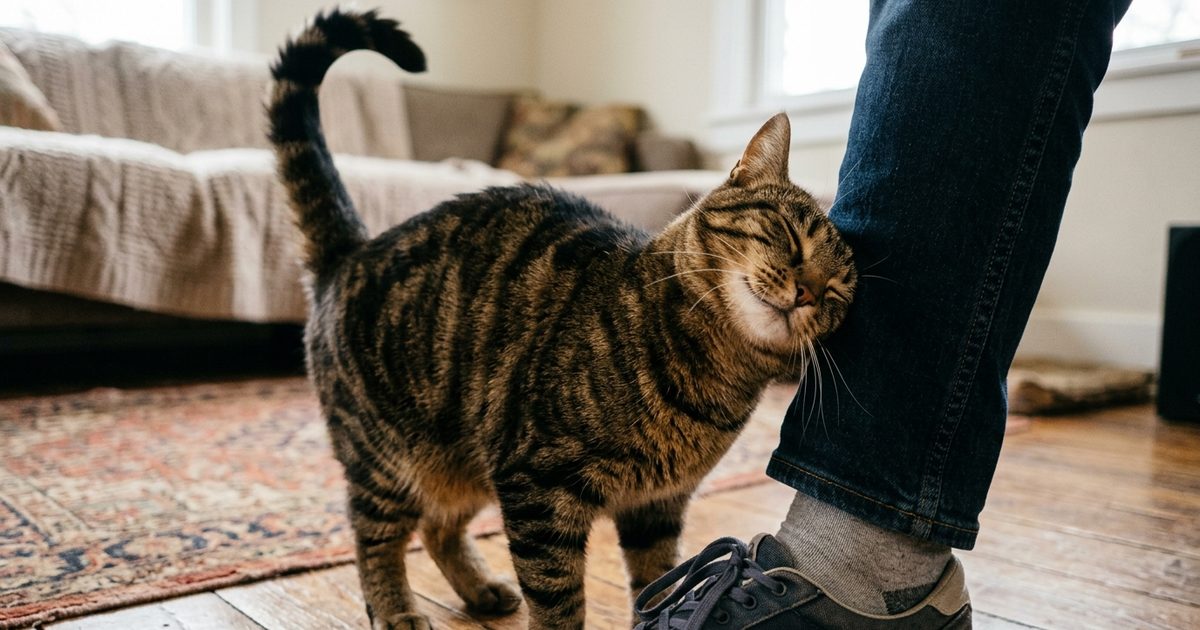
| Leg-weave | Flanks against your legs | Greeting, claiming you with scent |
| Head-bunt | Forehead or cheeks pressed to you | High-trust affection, "you're safe" |
| Cheek-rub | Cheeks along your hand or furniture | Scent-marking, bonding |
| Full-body | Whole side dragged along your leg | Deep claim, comfort and ownership |
| Tail-curl | Tail wrapped around your calf | Affectionate greeting, attachment |
Why Do Cats Rub Against Your Legs?
Cats rub against your legs to mark you with their scent — a claim of ownership and belonging. They carry scent glands on their cheeks, forehead, chin, and flanks, and pressing those glands against you transfers the scent onto your clothing and skin. It's affection, greeting, and territory-marking all wrapped into one motion.
When your cat threads a figure-eight between your ankles the moment you walk in, it's easy to read it as a simple hello. But the leg-rub is one of the most information-dense gestures in the feline playbook — a single behavior doing four jobs at once. To understand the full meaning, you have to look at scent chemistry, social bonding, and the greeting ritual cats inherited from their wild ancestors.
Scent-marking and "claiming" you
The core mechanism is chemical. Cats have specialized sebaceous scent glands on their cheeks, forehead, chin, lips, and along their flanks, and these glands release pheromones — chemical signals other cats can read but humans cannot smell. When your cat presses its cheek or flank against your calf, it's depositing those pheromones onto you, effectively writing its signature on a surface it considers important.
This is the same mechanism behind why cats rub furniture, doorways, and corners. The difference is that you, a living moving person, are a much higher-value target than a chair leg. By marking you, your cat is declaring to the rest of the feline world that this particular human is spoken for. International Cat Care explains that this kind of scent communication is the backbone of how cats build a sense of safety and familiarity in their world. It's also why your cat often follows up a leg-rub by licking you — saliva layers a second scent on top, which is the same grooming-based bonding we dig into in why does my cat lick me.
The greeting
There's also a social layer. In free-roaming cat colonies, cats that share a group scent will rub against each other when they reunite as a way of confirming group membership — a feline handshake that says "I know you, you're safe." Your cat is doing the same thing to you when you come home. The figure-eight around your legs, often paired with a tail held high and curled at the tip, is the domestic version of that reunion ritual.
The raised tail is the part most owners miss, because it's easy to focus on the rubbing and forget the rest of the posture. A vertical, quivering tail signals friendly excitement, and it changes the meaning of the rub from territory-marking into active welcome. If you want to decode the full greeting, our guide to cat tail meanings breaks down what each tail position adds to the message.
Affection and bonding
Scent-marking sounds clinical, but for cats the chemistry and the feeling are inseparable. A cat only deposits its scent on beings it trusts — rubbing is a vulnerable behavior that leaves the head and eyes close to you, so a wary cat won't do it. When your cat leans its whole body into your shin, it's choosing to be near you, choosing to mark you, and choosing to do both at once.
That makes the leg-rub a reliable barometer of your relationship. A cat that rubs you regularly has decided you belong to its inner circle, and a cat that starts rubbing you after weeks of distance has crossed a trust threshold. It's one of the quieter, more physical ways cats show attachment — alongside the behaviors we catalog in how do cats show affection, from slow blinks to following you from room to room.
Spreading a shared group scent
There's one more layer that ties it all together. Cats don't just mark individuals — they build a communal group scent by mixing their pheromones with those of their family members, human and feline alike. Every time your cat rubs you, it's refreshing its contribution to that shared scent, which is part of what makes a household feel like "home" to a cat. The scent needs regular topping up because it fades, which is why the rubbing is repetitive and why a cat will often rub you the moment you've showered or changed clothes — you've wiped off the old signature and need a fresh one.
So when you wonder about the figure-eight at your feet, the honest answer is that no single reason captures it. Marking, greeting, affection, and group-scent maintenance are four names for the same motion, and your cat does all four every time it weaves between your ankles.
Why Do Cats Headbutt (Bunt) You?
A headbutt — properly called "bunting" — is a cat pressing its forehead or cheeks against you to deposit scent from glands concentrated there. Bunting is a high-trust, affectionate gesture: your cat is marking you as safe and familiar, literally and lovingly claiming you.
What bunting means
Bunting is the most committed version of the same instinct behind leg-rubbing. Where a leg-weave sweeps scent along your ankle in passing, a bunt plants it deliberately: the cat stops, leans in, and presses its forehead — sometimes the cheek or chin — firmly against you, often holding the contact for a second or two. The scent glands on a cat's forehead and cheeks are among the densest on its body, so a bunt transfers a heavy, concentrated dose of pheromones. When your cat headbutts you, it's not being casual — it's signing its name in the most durable ink it has.
Because it requires proximity and stillness, bunting is reserved for beings a cat already trusts — never a stranger. International Cat Care describes bunting as one of the clearest affiliative, scent-exchange behaviors in feline communication — the chemical equivalent of a hug among family. It's why cats that live together often rub heads: they're blending scents into one shared group signature.
Not every cat bunts, and that's not a verdict on your bond. Some cats prefer the lighter, moving contact of a leg-rub or cheek-rub, and many head-bunt only their single favorite person while greeting everyone else with a tail-raise. If you want to deepen the conversation, you can answer a bunt in kind: gently press your forehead toward your cat's, slow-blink, and scratch the cheek and chin where those scent glands cluster. To your cat, that reads as "I'm marking you back." A bunt is, in plain terms, a cat choosing you as home — and you can read more about the broader language of how cats show affection to place it in the full picture.
Why Does My Cat Rub Against Me?
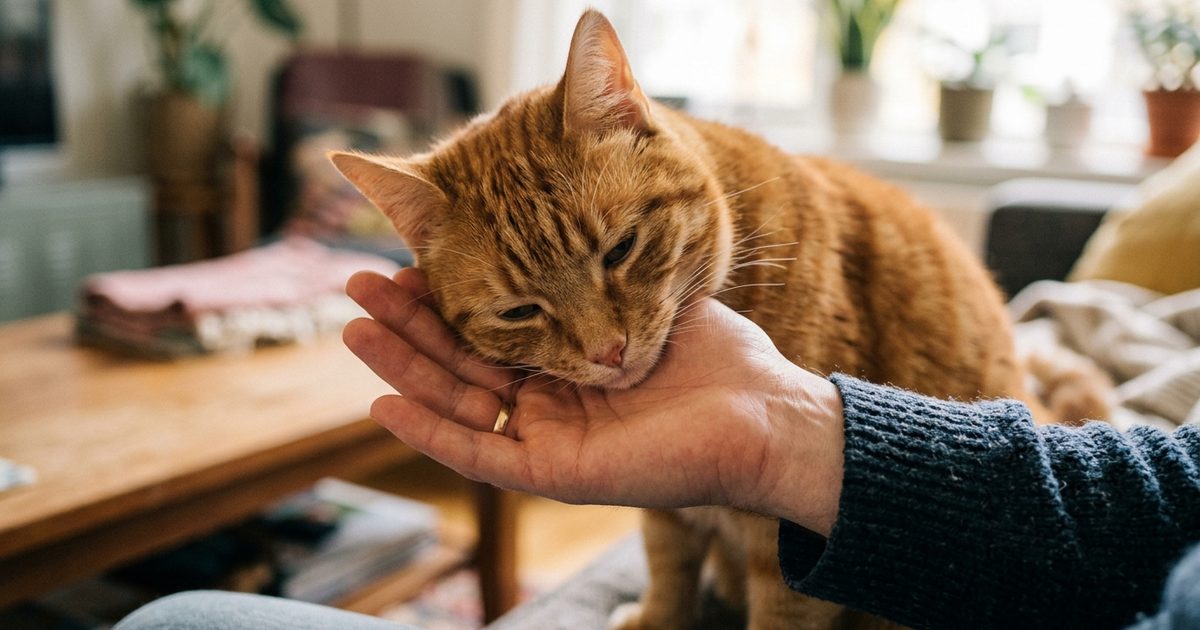
When your cat rubs against you specifically, it's reinforcing the bond — refreshing its scent on you, greeting you, and asking for attention. Cats repeat it because it works: rubbing usually earns a response, and it deepens the shared scent that defines your relationship.
There's a difference between the broad, sweeping rub a cat gives the room — chair legs, doorframes, the corner of the sofa — and the deliberate rub it aims at you. When the target is a person rather than an object, the behavior narrows in both meaning and intensity. It becomes a bid, not just a label.
Refreshing the scent
Cats don't mark you once and consider the job done. Scent fades — yours gets washed off, covered by other smells, and diluted every time you walk through the world. A cat that returns to rub your ankles or press its cheek against your hand is, in part, topping up the marker it left last time. Think of it as maintenance on a "you're mine" signature it wants to keep fresh. This is the same grooming-and-scent logic behind why cats lick their people — depositing scent and intertwining smells are two halves of one bonding instinct.
A greeting and a request
The rub aimed at you is also a greeting. After an absence — even a short one — many cats will weave between your legs or butt their head into your shin as a way of saying "you're back." Paired with a raised, quivering tail, it's the feline version of a warm welcome; the meaning of a cat's tail position makes that greeting layer unmistakable.
But it's not only hello. Rubbing that persists once you're settled — circling, leaning, pressing harder — usually contains a request: pet me, talk to me, feed me, open that door. Cats are practical learners, and rubbing tends to earn a response. A hand reaches down, a voice speaks, a lap opens up. Whatever the cat was after, the rub produced it, so the rub gets filed under "works." Over time the behavior self-reinforces.
Curious what your cat would say while claiming you? Get a MeowMind reading — upload a photo and hear it from her perspective.
There's a quieter layer too: every time your cat rubs you, the boundary between "your smell" and "the cat's smell" blurs. Behaviorists at International Cat Care describe this mingling as how cats build a family group — shared scent is how a cat decides who belongs. That's why a cat that follows you from room to room often rubs along the way, keeping the shared scent active.
Is Leg-Rubbing a Sign of Affection or Just Scent?
It's both — scent-marking and affection are inseparable in cats. The act of marking you with scent IS the cat's way of saying "you're family." A cat that rubs you is showing trust and claiming you as part of its group, not just "tagging" you.
It's tempting to split this into two boxes — a cold "scent" motive and a warm "affection" motive. With cats, that separation doesn't hold up. The same cheek glands that lay down a scent signature are the ones a cat presses against the beings it trusts most; marking you and loving you are one motion, not two.
That's why a cat will rub a brand-new piece of furniture (claiming) but rarely with the slow, half-closed-eyed softness it brings to your ankle — the scent is the same gesture, but the tenderness marks you out as more than an object. The Cornell Feline Health Center describes feline social bonding as built on these shared scent rituals — cats who consider each other family literally exchange scent, and a cat including you in that is treating you as part of its group. The depth and duration of the rub scales with trust: the full figure-eight leg-weave with a raised tail is reserved for beings the cat has decided are safe. You can read more in our guide on how cats show affection.
Why Does My Cat Rub Against Everything?
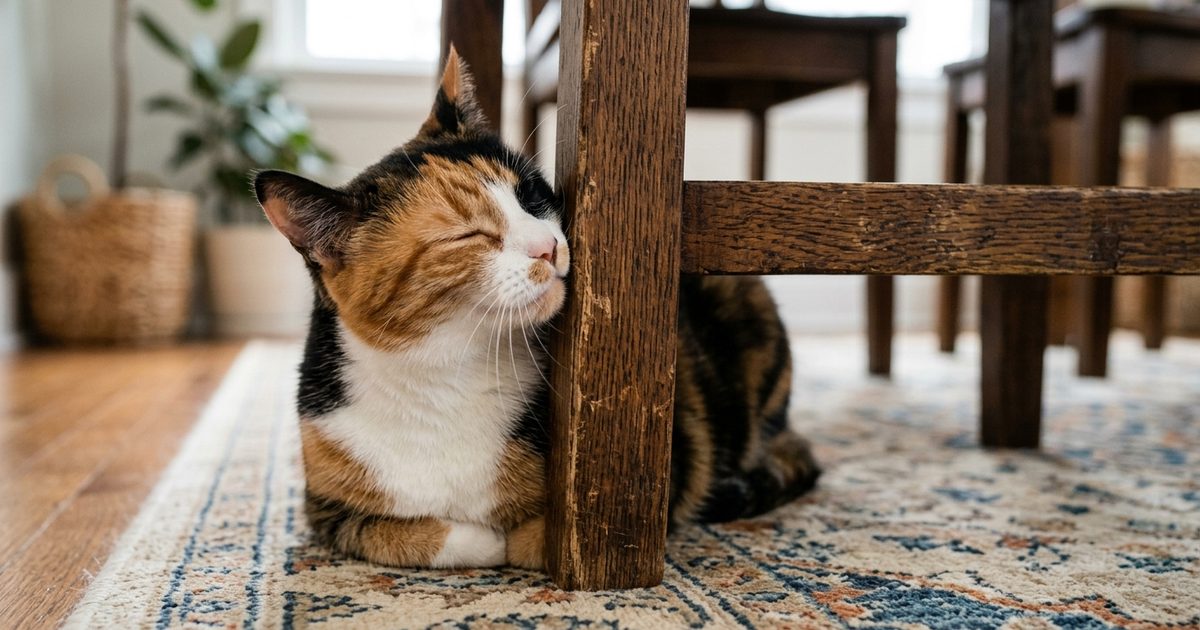
Cats rub furniture, corners, and doorways to build a familiar scent map of their territory — it makes the environment feel safe and "theirs." Rubbing objects is the same instinct as rubbing you: claim it, mark it, feel secure.
When your cat drags its cheek along the corner of the sofa, presses its chin into a doorframe, or slides the side of its body down a chair leg, it isn't being random. Cats are land mammals that live or die by their knowledge of the terrain, and they read that terrain in scent, not in sight. Every surface a cat rubs gets a thin layer of pheromones from the glands on its cheeks, chin, forehead, flanks, and the base of the tail. Layer by layer, those deposits build an invisible map that says safe, known, mine.
This is why a cat often rubs the same objects day after day. Scent fades — air currents, sunlight, and the passage of people all erode it — so the cat refreshes the marks the way you might re-hang a familiar picture in a new house. New objects are rubbed especially hard, because they carry unfamiliar smells that need to be folded into the map. A fresh shopping bag, a guest's coat, a new piece of furniture: the cat isn't greeting them so much as processing them, stamping its own signature over the stranger's.
It's also why a cat denied access to a room can become agitated — its scent map has a hole in it, and the unfamiliar space reads as unclaimed and therefore potentially threatening. International Cat Care describes this scent-based mapping as the backbone of how cats feel secure in their territory: the familiar smell isn't a luxury, it's the signal that lets the cat relax enough to eat, sleep, and play.
So when your cat weaves around your legs and then rubs the table leg two seconds later, it's the same mechanism pointed at two things that matter: you, refreshed constantly as the most important "object" in the territory, and the landscape, kept legible.
This is also why synthetic pheromone diffusers can help a stressed or newly adopted cat settle — they top up the "familiar territory" signal, which the Cornell Feline Health Center recognizes as part of managing feline anxiety.
How to Respond When Your Cat Rubs Against You
When your cat rubs against your legs, the best response is to lean into the gesture: gently pet the cheeks, forehead, or chin where the scent glands sit, return a slow blink, and speak softly. It's a bid for connection, so meet it rather than ignore or push the cat away.
When your cat weaves around your ankles or presses its cheek into your hand, it's offering you a clear invitation. How you answer shapes whether that gesture keeps coming back. The rub is a social ritual, and like any ritual, it thrives on being received well.
Pet where the scent glands are
A cat that rubs you is, in part, asking to be touched in the very spots it just marked. The cheeks, forehead, chin, and the base of the ears carry the densest scent glands, so light scratching there feels like a direct reply. Use slow, gentle strokes to match the calm energy of the rub itself. If your cat also grooms you with licks, petting these same areas reinforces the same bond through a different channel. Most cats lean into your hand or lift their chin for better access when you've found the right spot — follow that feedback.
Return a slow blink and keep your voice soft
A slow blink — eyes half-closed, held for a beat — is feline body language for "I trust you." Returning one when your cat rubs you closes the loop and tells it the feeling is mutual. A quiet, low voice works the same way; cats respond to tone, not vocabulary. For the full silent vocabulary, see how cats show affection.
Don't ignore, shove, or interrupt mid-rub
It's easy to dismiss leg-rubbing when you're carrying groceries, walking through a doorway, or trying to get somewhere. But from the cat's perspective, a rub that goes unanswered is a rejected handshake. Repeatedly ignoring the gesture won't necessarily break the bond, but it does teach the cat that this particular bid for connection doesn't land — and over time, some cats will offer it less. Shoving a cat away with a leg or foot is harsher still; it can read as rejection or even mild aggression, especially to a sensitive or timid cat.
When you're genuinely busy, a brief acknowledgment — a downward stroke, a soft word, or just pausing two seconds so the cat can complete its circuit — is usually enough. According to International Cat Care, consistent gentle responsiveness is one of the most reliable ways cats learn humans are safe, predictable social partners.
Read the cat, then calibrate
Not every rub is a request for the same thing. A slow, lingering cheek-press usually means relaxed affection; a rapid, insistent figure-eight between your feet while you're near the kitchen may carry a hint of "feed me." Neither is wrong, and the difference matters for how you respond. For affection rubs, petting and a slow blink are perfect. For the more urgent variety, a brief calm response plus attending to whatever the cat is actually asking for resolves it without rewarding pushiness. If the rubbing comes with a raised, quivering tail, you're likely seeing a full greeting display — meet it warmly.

The short version: your cat rubs you to say something, and the best answer is to say something back — with your hand, your eyes, or your voice. Match the warmth, keep it gentle, and the rub becomes one of those small daily exchanges that quietly builds trust in both directions.
When Rubbing Might Signal Something Else
Rubbing is normal affection and scent-marking — but a sudden, intense surge of it can mean something else. If the rubbing comes with loud meowing, restlessness, or your cat presenting her rear, she may be in heat or seeking urgent attention. Any abrupt change in a long-standing habit is worth noticing.
Most of the time, a cat that rubs against your legs is doing exactly what it looks like: greeting you, claiming you, and reinforcing the bond you share. But behavior never exists in isolation, and context is what turns a gesture into a message. The same rubbing motion that means "welcome home" at 6pm can carry a completely different meaning at 3am — and the difference is almost always in the surrounding body language.
When rubbing is part of being in heat
Unspayed female cats in estrus (heat) often rub frantically against people, furniture, and corners — far more than usual. This intense rubbing typically comes bundled with other unmistakable signs: persistent, loud vocalizing (the classic yowl), restlessness, a lowered "lordosis" posture with the rear raised and tail held to one side, and sometimes rolling or pacing. The rubbing isn't insincere — the same scent glands and the same claiming instinct are in play — but the driving force is hormonal urgency rather than calm affection.
This is a good place to be honest about the limits of a behavior article. Whether and when to spay is a veterinary decision that depends on your cat's age, health, and your living situation, and it's outside what a piece on body language can responsibly answer. If you suspect your cat is in heat, or you're weighing the timing of spaying, the right move is to talk to your vet. The Cornell Feline Health Center publishes reliable, owner-facing guidance on the reproductive cycle and the spay decision, and that's a better source than anything a behavior article can offer.
When rubbing is an urgent attention bid
Even outside of heat, a cat can weaponize rubbing. If your cat suddenly ramps up rubbing — weaving hard between your ankles, headbutting your hand repeatedly, and meowing — she has learned that rubbing works. Cats repeat behaviors that earn a response, and a leg-rub that lands you in the kitchen fetching food will be filed away as a reliable strategy. This overlaps with the broader pattern of why your cat follows you: persistent physical closeness paired with vocalizing is usually a polite, feline-formulated request for something specific — a meal, play, a clean litter box, or simply you.
The key distinction is the shift. A cat who has always rubbed moderately and suddenly doubles down is communicating something new; a cat who has always been a vigorous rubber is just being herself. As International Cat Care notes, sudden changes in any established behavior — including increases in scent-marking and rubbing — are one of the clearest signals that something in a cat's environment, routine, or health has shifted, and they're worth paying attention to rather than dismissing as "just cat stuff."
The bottom line on change
Rubbing itself is healthy and normal. What warrants a second look is the pattern: a sudden surge, rubbing that appears alongside vocalizing and restlessness, or any rubbing that feels out of character for your cat. Most of the time the explanation is simple — she's in heat, she's hungry, or she's just extra glad you're home. But when a long-standing habit changes abruptly and stays changed, a quick call to your vet is the cheapest peace of mind you can buy.
Common Myths About Leg-Rubbing
Leg-rubbing is widely misread. It's usually scent-marking, greeting, and affection combined — not a food demand, not exclusive to friendly cats, and not a "love hormone" transfer. The behavior signals trust and belonging, even when the reasons people assume are off the mark.
Myth: Rubbing means the cat is hungry.
Fact: This is the most common one, and it's easy to see why — a cat weaving between your ankles near the kitchen often ends with you reaching for the food bag. But the rubbing itself isn't a food request. It's the same scent-marking and greeting behavior your cat does throughout the day. What happens is that rubbing is often a precursor to a bid for attention (which might be food), and owners learn the association. The rub is affection and connection first; any food request comes layered on top, not as the core meaning. You can read more on how cats use scent communication from International Cat Care, which describes rubbing and bunting as social and affiliative behavior rather than begging.
Myth: Only friendly cats rub.
Fact: Not so. The vast majority of cats rub against the people they live with — even cats who are shy, selective, or slow to warm up. Rubbing is tied to familiarity and trust within a cat's own group, not to a "friendly personality" in the broad sense. A reserved cat may rub only one person in the household, or only at certain times, and still be doing exactly what the bold, sociable cat does: refreshing the shared scent that defines "family." The Cornell Feline Health Center notes that scent-marking is a normal part of feline social behavior across temperaments, not a trait reserved for outgoing cats.
Myth: Rubbing spreads "love hormones."
Fact: This framing oversells what's actually happening. When your cat rubs you, the primary mechanism is scent-marking — pheromones from the cheek, forehead, and chin glands being deposited onto you. Those chemical signals are about recognition and territory, not a measurable "love hormone" transfer. Rubbing absolutely accompanies affection and bonding (we get into that in the connection to why cats purr), but it's cleaner to describe it as scent communication that reinforces the bond, rather than imagining a hormonal exchange. The affection is real; the "hormone" story is an overstatement of the science.
The common thread across all three myths is that people reach for a single, dramatic explanation when leg-rubbing is really a layered behavior doing several jobs at once: marking, greeting, and bonding. Get that blend right and the rest of your cat's body language — from the raised-tail greeting to the headbutt — starts to make a lot more sense.
Cat Rubbing at a Glance — Summary
Leg-rubbing, bunting, and cheek-rubbing are all the same instinct in slightly different forms: your cat is depositing scent to claim you, greet you, and strengthen the bond. Most rubbing means affection and belonging — not hunger or demand. The only red flag is a sudden change in frequency or intensity.
If you've read this far, you already understand the gesture better than most owners. Here's the whole story in one table.
Cat Rubbing — The Complete Summary
| Question | Short answer |
|---|---|
| Why do cats rub against your legs? | To mark you with scent — claiming you as theirs while greeting you |
| What does a headbutt (bunt) mean? | High-trust affection; your cat is marking you as safe and familiar |
| Why does my cat rub against me specifically? | To refresh scent on you, greet you, and ask for your attention |
| Is rubbing affection or just scent? | Both — scent-marking and affection are one inseparable act for cats |
| Why does my cat rub against everything? | To build a familiar scent map of its territory so it feels safe |
| How should I respond? | Pet the cheeks, forehead, or chin; slow-blink back; speak softly |
| When is rubbing a concern? | Only if a sudden surge pairs with meowing, restlessness, or presenting the rear |
The simplest version: when your cat weaves around your ankles or presses its forehead into your hand, it is telling you that you belong to it — and that it belongs to you. Return the gesture with a slow blink and a scratch where the scent glands are, and you're speaking fluent cat.
Curious What Your Cat Would Say?
Upload a photo and get a warm, personalized reading from your cat's perspective.
Start Your Free ReadingNote on a transition fix applied during assembly: the original Section 2 closing ("when you wonder why do cats rub against your legs") repeated the H2 question verbatim as prose and would read as keyword-stuffing/repetition, so I rewrote it as "when you wonder about the figure-eight at your feet" — same meaning, no awkward self-quote. Similarly, Section 6's "why do cats rub against your legs and then turn around..." was rephrased to "weaves around your legs and then turns around and rubs the table leg" to avoid re-asking the article's own H2. The primary keyword "why do cats rub against your legs" remains in the title, H1, first body sentence, and the summary table — first-50-words requirement is satisfied by Section 1's opening line. No self-links to /blog/why-do-cats-rub-against-your-legs were introduced.
Frequently Asked Questions
Why do cats rub against your legs?
Cats rub against your legs to mark you with scent from glands on their cheeks, forehead, chin, and flanks. It's a claim of ownership, a greeting, and an act of affection all in one motion — your cat's way of saying you belong to its inner circle.
Why does my cat rub against me?
When your cat rubs against you specifically, it's refreshing its scent on you, greeting you after an absence, and often asking for attention. Cats repeat it because it works — rubbing usually earns a response, which deepens your shared bond.
Why do cats headbutt you?
A headbutt, properly called bunting, is a cat pressing its forehead or cheeks against you to deposit concentrated scent. It's a high-trust, affectionate gesture reserved for beings the cat has folded into its family — a literal and loving claim.
Is a cat rubbing against you a sign of affection?
Yes. Scent-marking and affection are inseparable in cats — the act of marking you with scent is itself the way a cat says you're family. A cat only rubs beings it trusts, so the gesture is a reliable barometer of your bond.
Why do cats rub against furniture?
Cats rub furniture, corners, and doorways to build a familiar scent map of their territory. Depositing pheromones on objects makes the environment feel safe and theirs, and the same instinct drives rubbing both you and the furniture.
Why does my cat rub against me and then walk away?
The rub itself was the message — your cat refreshed its scent on you and confirmed the bond, then moved on. Rubbing doesn't always require a follow-up; many cats treat it as a quick greeting and claim before returning to their own routine.
Why does my cat rub its face on me?
Face-rubbing uses the dense scent glands on a cat's cheeks, forehead, and chin to deposit pheromones onto you. It's the same claiming and bonding instinct as a leg-rub, delivered through the most gland-rich part of the face for a concentrated scent signature.
Why does my cat present its rear to me?
Presenting the rear is a high-trust greeting cats use with their closest companions — it's how friendly cats greet each other. Paired with a raised tail, it signals comfort and invitation, and returning a gentle scratch at the tail base answers in kind.
Sources & References
You Might Also Like
Kitten Teething: Timeline, Symptoms & How to Help
Kitten teething runs from 3 to 7 months as baby teeth fall out. Learn the timeline, signs to watch for, and how to soothe a teething kitten safely.
15 min readWhen Do Cats Stop Growing? A Complete Timeline
When do cats stop growing? Most cats reach adult size by 12-18 months, but large breeds like Maine Coons keep growing until 3-4 years. Full timeline inside.
14 min readCan Cats Eat Cherries? Flesh, Pit & Toxicity Facts
Can cats eat cherries? Pitted flesh is safe in tiny amounts — but the pit, stem, and leaves are toxic (cyanide precursors). Learn what's safe and what isn't.
15 min readA message, in your cat's voice
Upload a photo, get a warm note written from your cat's perspective — just for fun. Plus 121 vet-cited articles, offline.