
Can Cats Eat Chicken? Safety, Benefits, and How to Feed It
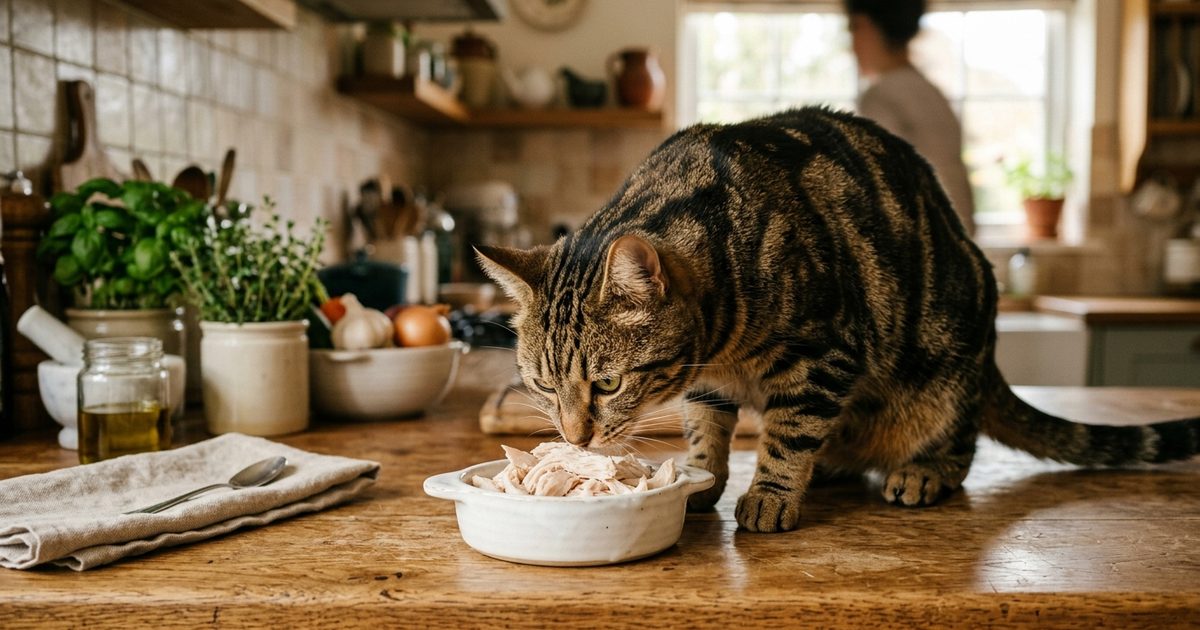
Yes — cats can eat chicken, and for most cats it is one of the safest and most useful human foods you can share. If you have ever wondered whether cats can eat raw chicken, cooked chicken, or even the bones, the short version is that plain cooked chicken is welcome while raw meat, cooked bones, and anything glazed in sauce are not. Plain cooked chicken is a lean, high-quality protein that already forms the base of most commercial cat foods, so it suits a cat's biology far better than most table scraps. The form matters enormously: the chicken on your plate is only safe if it is plain, fully cooked, and free of bones, salt, oil, garlic, and onion. The same bird, raw or seasoned, flips from a healthy protein into a genuine risk. Used right, it can be a regular topper or treat rather than a rare indulgence — a rare advantage among human foods, which we cover in more depth in our guide to what cats eat.
Key takeaways
- Plain cooked chicken — breast or thigh, no skin, bones, salt, oil, or seasoning — is safe and beneficial for cats, and can be a regular topper rather than just a rare treat.
- Raw chicken is not recommended, because domestic poultry routinely carries Salmonella and Campylobacter; cooking fully removes that risk.
- Never give a cat cooked chicken bones — they splinter into sharp shards that can puncture the digestive tract. Raw bones are a separate, debated question best made with a vet.
Chicken for Cats — Quick Reference
| Chicken form | Safe for cats? | Notes |
|---|---|---|
| Plain cooked chicken breast | ✅ Yes | Lean, high-quality protein; ideal for weight-conscious cats; shred or dice small |
| Plain cooked chicken thigh | ✅ Yes | Slightly more fat and flavor; good for tempting a picky or sick appetite |
| Raw chicken | ⚠️ Not recommended | Carries Salmonella and Campylobacter; cooking fully removes the pathogen risk |
| Chicken with seasoning, salt, oil, or sauce | ❌ No | Salt, fat, and alliums (garlic, onion) are harmful or toxic; fried/sauced chicken is off the table |
| Cooked chicken bones | ❌ Never | Cooking makes bones brittle; they splinter into shards that can puncture the GI tract |
| Raw chicken bones | ⚠️ Debated | Some raw feeders offer them; choking and bacterial risk are real — decide with a vet, never from your plate |
Can Cats Eat Chicken?
Yes — cats can eat chicken, and plain cooked chicken is one of the safest human foods you can share. It is a lean, high-quality protein that already forms the base of most commercial cat foods, so it suits a cat's biology far better than most table scraps.
The short answer
The short answer is a clear yes. When the chicken is plain, fully cooked, and free of seasoning, oil, bones, and skin, it is not only safe for cats — it is one of the most beneficial human foods you can offer. Can cats eat cooked chicken? Absolutely, and many cats already eat it every day in their normal food, just in processed form.
What makes chicken stand out is that it is a legitimate protein base rather than a rare indulgence. Unlike fish-based treats that carry a frequency ceiling, plain cooked chicken fits the way a cat is built to eat, so a small portion a few times a week genuinely adds to the diet instead of just being a token reward.
Why chicken suits a cat
Cats are obligate carnivores, which means animal protein is their core fuel — not an optional part of the diet, but the part their bodies are built around. Their systems are designed to extract energy and nutrients from meat, and chicken happens to be one of the leanest, most digestible, and most calorie-dense options available.
A cat's digestive machinery handles plain cooked chicken cleanly: it is low in the fats that trigger upset stomachs, high in the complete protein a cat needs to maintain muscle, and soft enough that even a senior cat with sensitive teeth can manage it shredded. That biological match is exactly why chicken shows up so often in commercial foods, and why a little plain cooked chicken fits so naturally into what cats eat day to day.
Can Cats Eat Raw Chicken?
No — raw chicken is not recommended for cats. Domestic raw poultry routinely carries Salmonella and Campylobacter, and even a cat with a strong stomach can shed these bacteria or fall ill. Cooking chicken fully removes the pathogen risk while keeping the protein intact.
Salmonella and Campylobacter
This is the central reason can cats eat raw chicken gets a cautious answer: the domestic chicken supply is not clean raw. Poultry sold for human consumption reliably carries bacteria such as Salmonella and Campylobacter, and those pathogens do not disappear just because a cat's stomach is more acid-tolerant than ours.
Cats can withstand more microbial challenge than humans, but they are not immune. Kittens, senior cats, and cats with weakened immune systems are especially vulnerable, and a healthy adult cat that never shows symptoms can still shed bacteria in its stool — a real risk in a household with children or other pets. The kill step is straightforward: cooking the meat to a safe internal temperature eliminates the pathogen load while leaving the protein value essentially untouched. The Cornell Feline Health Center covers feline food safety and the risks of raw meat in more depth for owners weighing the question.
But wild cats eat raw prey
It is a fair point, and worth addressing directly. A wild cat's raw meal is whole, fresh prey — muscle, organs, bone, and the full nutrient profile a single fillet cannot replicate. Supermarket chicken, by contrast, is a cold-chain product that has been processed, packaged, and stored, which gives bacteria time and opportunity to multiply.
The lesson is that "natural" does not override pathogen load in the domestic supply. A cat's ancestors ate raw prey because they had no alternative, not because raw meat from a modern supply chain carries the same risk profile. For the broader debate on raw feeding as a philosophy, our piece on whether cats can eat raw meat walks through both sides in detail.
What about raw-food diets?
Some owners feed commercially prepared raw diets that are frozen to pathogen-control standards and formulated to be nutritionally complete. Those are a genuinely different proposition from handing a cat a piece of raw chicken straight from the kitchen — they are produced under controlled conditions and often balanced by a veterinary nutritionist.
Even so, this is best treated as an informed owner's choice made with veterinary guidance, not a general recommendation. The frozen raw route can work for some cats, but it asks more of you in handling, storage, and sourcing than plain cooked chicken ever will.
What Form of Chicken Is Safe for Cats?
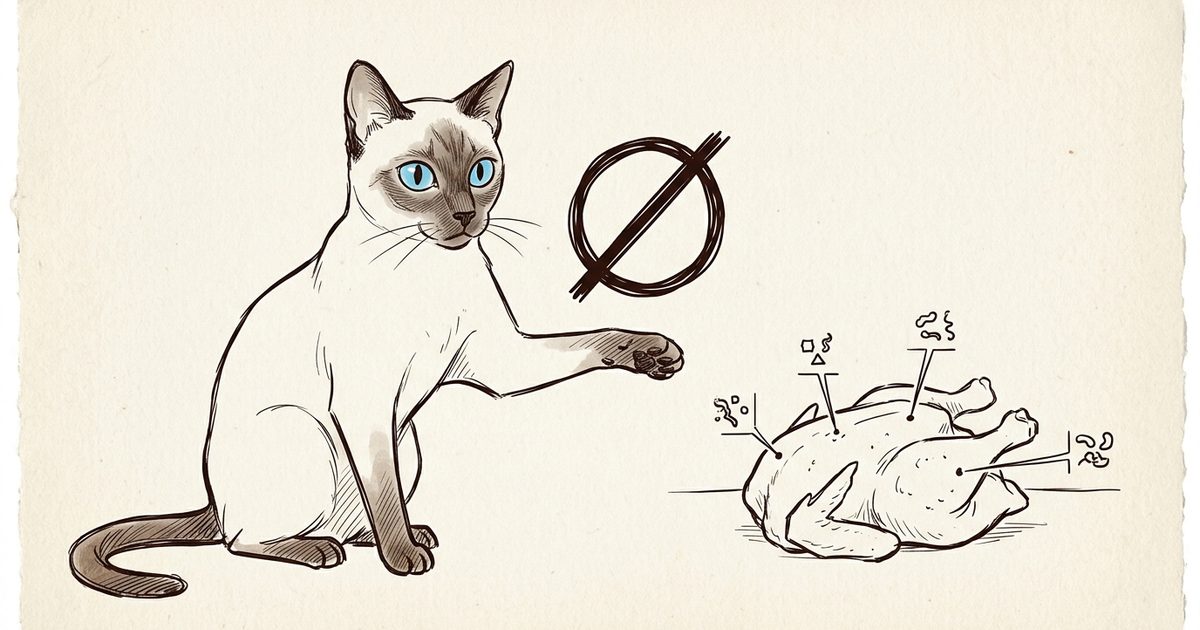
Only plain cooked chicken is safe — no salt, oil, butter, garlic, onion, herbs, sauces, or skin. Bake, steam, boil, or poach the meat through with nothing added, then shred or dice it small and cool it before serving. Seasoned, fried, or sauced chicken is off the table.
Plain cooking methods
Keep it deliberately boring. Bake, steam, boil, or poach plain chicken with nothing added — no salt, no oil, no butter, no seasoning. The goal is fully cooked, pathogen-safe meat, not a dish for humans that you happen to share. Cook it through to a safe internal temperature so any bacteria are killed, then let it rest until it is no longer hot to the touch — cats' mouths burn easily, and they will not wait for it to cool.
Once cool, shred the meat along the grain or dice it into bite-size pieces small enough for your cat to chew without struggling. Before serving, run your fingers through the portion and check carefully for bones — a stray splinter from a missed rib or wishbone is exactly the hazard we cover later in the bone section. Plain, cooked, deboned, and cut small: that is the entire safe-prep checklist.
What to never add
The seasonings that make chicken delicious for you are, in many cases, actively dangerous for your cat. Salt, oil, butter, herbs, spices, gravies, and sauces all belong on the human plate only — a cat's kidneys and liver are not built to clear the sodium and fat loads we tolerate. The most serious offenders are the alliums: garlic and onion (whether raw, cooked, powdered, or hidden in a rub) damage cats' red blood cells and can cause life-threatening anemia. If you want to understand just how little it takes, see our breakdowns on whether cats can eat garlic and whether cats can eat onion.
Fried chicken and crispy chicken skin are a separate trap. Even unseasoned, they carry far too much fat for a cat, and a fatty, greasy meal is a well-known trigger for gastrointestinal upset and, in severe cases, pancreatitis — a painful inflammation of the pancreas. The rule is simple: if it is fried, sauced, salted, or skinned, it is not for your cat.
Chicken broth and deli chicken
Store-bought chicken broth and deli-sliced chicken look like easy wins, but they are usually loaded with sodium, onion, and garlic added for flavor during processing — none of which belongs in a cat. Even "low-sodium" deli meats are far saltier than anything a cat would encounter in nature. The only broth that is genuinely safe is one you make yourself from plain chicken and water with zero additions, or a product specifically formulated for cats. The same logic applies to deli chicken: unless you cooked it plain yourself, assume it carries seasonings and skip it.
Is Chicken Good for Cats?
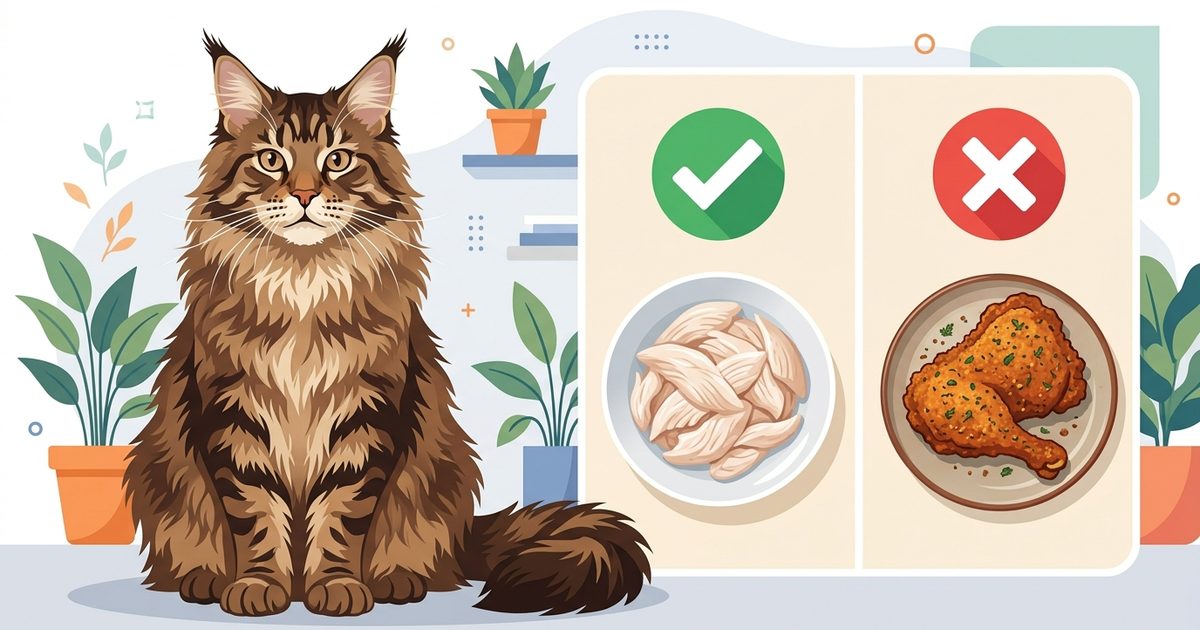
Chicken is rich in lean, high-quality protein with the amino acids a cat needs, and it is already the base of most commercial cat foods — so it is one of the most nutritionally appropriate human foods a cat can have. But chicken alone is not a complete diet.
High-quality protein
Chicken is one of the cleanest sources of complete animal protein you can offer a cat. It contains all the essential amino acids a cat's body cannot manufacture on its own, and it is lean enough that you are feeding mostly protein rather than empty calories. A plain cooked breast suits a cat that is watching its weight; a thigh offers a little more fat and flavor, which helps when you are coaxing a fussy or recovering appetite back to the bowl. Because chicken is so digestible and well-matched to feline biology, a tablespoon of shredded breast is one of the most reliable ways to restart a cat that has gone off its food. International Cat Care, a leading authority on feline health, emphasizes that animal-based protein is foundational to a cat's nutritional needs.
Already in their bowl
Here is the quiet truth that makes chicken unusual among human foods: it is probably already in your cat's bowl. Most dry and wet cat foods are built on chicken because it is affordable, highly digestible, and biologically well-matched to an obligate carnivore. When you share a little plain cooked chicken, you are not introducing something foreign — you are giving your cat more of what its food is already built on. That is also why chicken sits in a different category than fish treats: it is a routine protein base, not an occasional indulgence. For the bigger picture of how this fits into a cat's overall diet, see our guide on what cats eat.
Why chicken is not a complete diet on its own
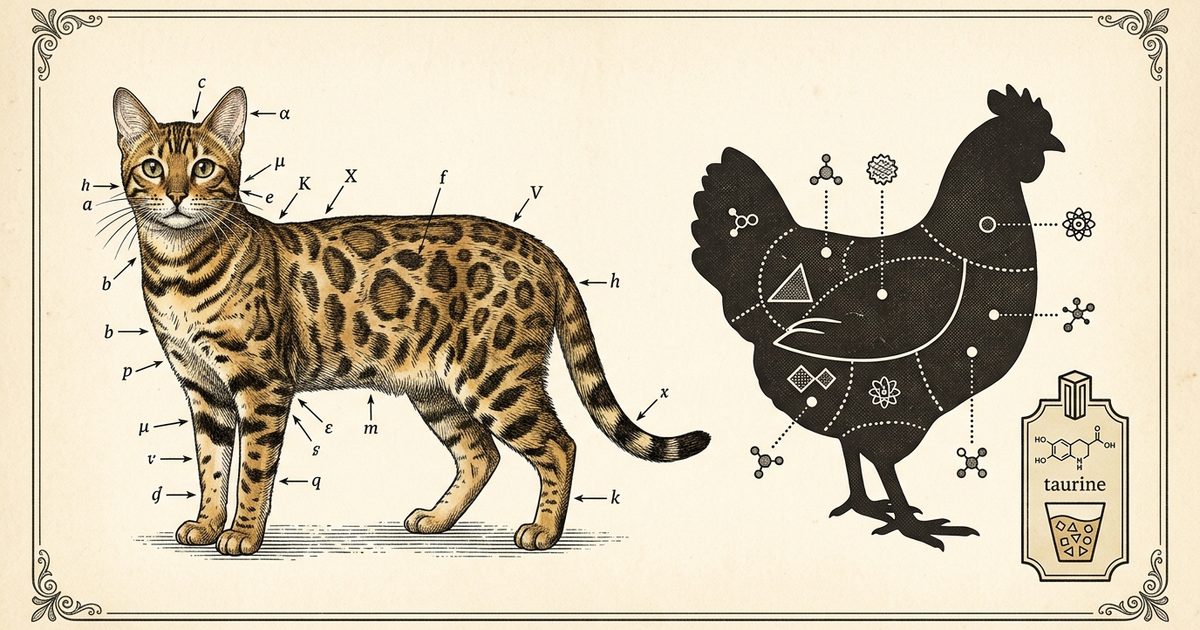
This is the catch, and it matters more than people assume. A boneless fillet of chicken, however plain and well-cooked, is muscle meat — and muscle meat alone is not a complete diet for a cat. It does not contain enough taurine, calcium, vitamin A, or the broader mix of micronutrients a cat needs to stay healthy. A chicken-only diet, fed over time, causes real malnutrition: taurine deficiency in particular can lead to dilated cardiomyopathy (a weakening of the heart muscle) and retinal degeneration that permanently damages vision.
The reason is evolutionary. Cats did not evolve on tidy fillets — they evolved eating whole small prey: muscle, organs, bone, and the full nutrient profile that comes with an entire animal. A plain chicken breast is "natural" only in the sense that it is meat; nutritionally, it is a stripped-down fraction of what a cat's body expects. Treat chicken as an excellent protein source and topper, but rely on a complete, balanced cat food for the nutrients a fillet cannot provide.
How Much Chicken Can a Cat Eat?
Chicken can be a larger share of a cat's food than treat-only items like tuna — up to about 10% of daily calories as a topper, or more under a vet-approved homemade diet. For a healthy adult cat, a tablespoon or two of shredded plain cooked chicken a few times a week is sensible.
The portion guide
Chicken is one of the few human foods that can show up in your cat's bowl more than occasionally. Unlike fish treats, it is not held back by mercury or heavy sodium concerns — it is lean muscle meat that already forms the base of most commercial cat foods, so a cat's digestive system is well accustomed to it. That said, portion still matters.
For a healthy adult cat eating a complete commercial diet, a tablespoon or two of shredded plain cooked chicken — roughly the equivalent of a small treat portion — as a meal topper or standalone treat, several times a week, is a reasonable guideline. That keeps chicken as a complement to, not a replacement for, the nutritionally complete food your cat relies on. A good rule of thumb is that treats and toppers should stay under about 10% of your cat's daily calories unless a vet has balanced the whole diet. (This is the same ceiling behind why we treat fish like turkey and salmon as occasional add-ons — chicken simply has more room to roam within it.)
If you are cooking for your cat as a significant part of their diet rather than a treat, that is a different conversation: the meal needs to be properly balanced with taurine, calcium, and other nutrients, ideally following a vet-formulated recipe. Unsupplemented chicken is not a complete diet, no matter how good the protein looks.
Kittens, seniors, and cats with conditions
Portion guidance assumes a healthy adult cat, and not every cat fits that profile. Kittens are still building bone, muscle, and organ systems, and they need a complete growth-formula food to do it — chicken should stay a small, occasional taste, not a dietary staple. Their nutrient requirements are far higher than an adult's, and a piece of breast meat can't meet them.
Senior cats and cats with kidney disease, food allergies, or pancreatitis need a vet's sign-off on any diet change, including adding chicken. Extra protein can be the wrong call for some kidney conditions, and sudden fat or new proteins can trigger flare-ups in sensitive cats. Whatever your cat's age or health, introduce any new food slowly and in small amounts, and watch for vomiting, diarrhea, or itching over the first few servings — those are signs to stop and check in with your vet.
Can Cats Eat Chicken Bones?
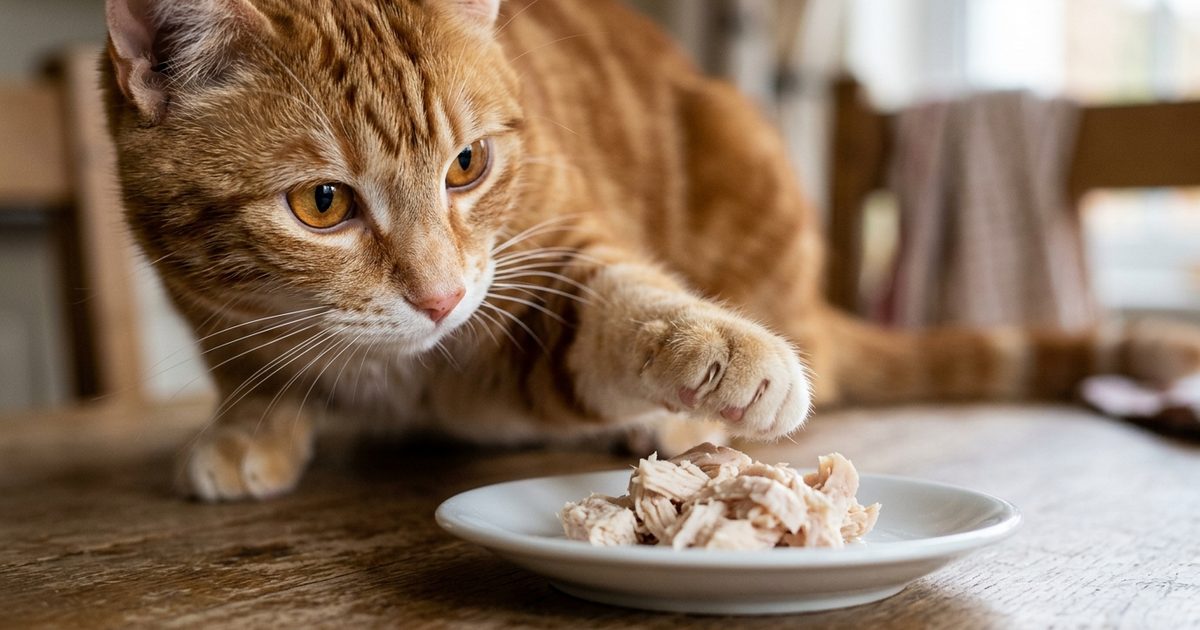
No — never give a cat cooked chicken bones. Cooking makes bones brittle, so they splinter into sharp shards that can puncture the mouth, throat, stomach, or intestines — a life-threatening emergency. Raw bones are a separate, debated question, but cooked bones are firmly off limits.
So when you search whether can cats eat chicken bones, the honest answer splits in two: cooked is a hard no, raw is an open conversation. They are not the same hazard, and they deserve to be talked about separately.
Why cooked bones are dangerous
Raw bone gets its resilience from collagen — the same protein that keeps tendons flexible and joints tough. Heat destroys that collagen matrix. Once a chicken bone has been roasted, boiled, or grilled, it loses its give and turns brittle, snapping into needle-like splinters rather than crumbling. In a cat's mouth, throat, stomach, or intestines, those splinters can lacerate tissue, lodge in the airway, or punch through the gut wall — each of them a documented, life-threatening emergency that can need surgery to fix.
The warning signs of a bone emergency come on fast and are not subtle: drooling, gagging or retching, vomiting, sudden lethargy, a tense or painful belly, and refusing to eat. If you even suspect your cat swallowed a cooked bone, do not wait to see if it passes — call your vet or an emergency clinic immediately. Minutes matter when the bowel is at risk of perforation.
What about raw bones?
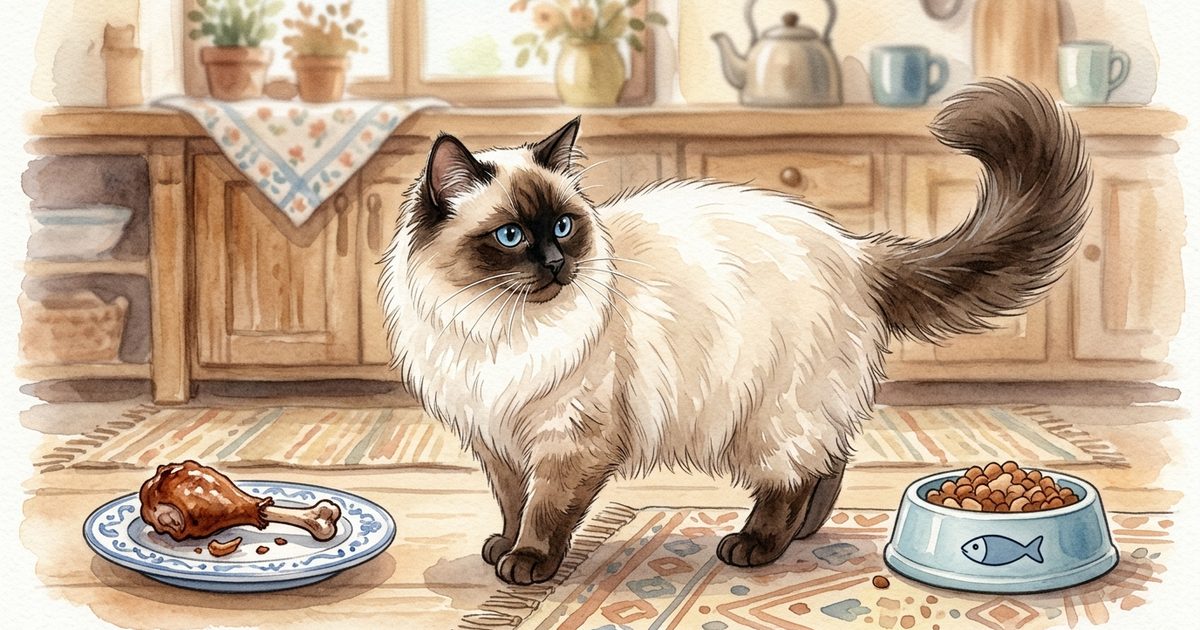
This is where the conversation gets genuinely contested. Some owners who feed raw diets offer small, raw, meaty chicken bones — necks or wing tips — arguing they scrape plaque, exercise the jaw, and supply natural calcium. Others refuse them outright, pointing to choking, tooth fractures, and the same bacterial load (Salmonella, Campylobacter) that makes raw chicken itself risky. Both camps have real points, and the honest position is that there is no consensus.
If you are weighing raw bones, treat it as a decision for one specific cat, not a rule — age, dental health, chewing style, and medical history all change the math, and a vet who knows your cat is the right person to run it with you. We unpack the wider debate over can cats eat raw meat in its own article.
Bones in cat food
It is easy to see "chicken by-product meal" or "bone meal" on a cat food label and conclude that bones must be fine for cats. They are not the same thing at all. Commercial foods use finely ground, mechanically processed bone that has been milled into a mineral-balanced powder and formulated alongside the rest of the diet. That is a world apart from a whole bone lifted off your dinner plate. A kibble that lists bone meal is proof of careful industrial processing, not permission to hand your cat a drumstick — so please do not extrapolate from the label to the table.
Chicken for Cats at a Glance — Summary
Plain cooked chicken is one of the safest human foods you can share with your cat — a lean, high-quality protein that already forms the base of most commercial cat foods. The danger lives in the wrong form: raw meat, seasoning, and cooked bones. Here is the whole verdict in one place.
| Question | Short answer |
|---|---|
| Can cats eat chicken? | Yes — plain cooked chicken is safe and one of the best human foods for cats |
| Can cats eat raw chicken? | Not recommended — domestic raw chicken carries Salmonella and Campylobacter |
| Can cats eat cooked chicken? | Yes, if fully cooked plain, with no salt, oil, garlic, onion, or skin |
| Can cats eat chicken bones? | Never cooked bones (they splinter); raw bones are debated — ask your vet |
| Is chicken good for cats? | Yes as a protein base — but not a complete diet on its own |
| How much chicken can a cat eat? | A tablespoon or two, a few times a week — under ~10% of daily calories |
| What chicken form is unsafe? | Raw, fried, seasoned, salted, sauced, with bones, or deli/broth with onion |
Curious What Your Cat Would Say?
Upload a photo and get a warm, personalized reading from your cat's perspective.
Start Your Free ReadingFrequently Asked Questions
Can cats eat raw chicken?
Not recommended. Domestic raw poultry routinely carries Salmonella and Campylobacter, and even a healthy cat can shed these bacteria or fall ill. Cooking chicken fully removes the pathogen risk while keeping the protein intact, so cooked is the safer default.
Can cats eat cooked chicken?
Yes, if it is plain and fully cooked with no salt, oil, butter, garlic, onion, herbs, sauces, or skin. Bake, steam, boil, or poach it through, shred or dice it small, cool it, and check for bones before serving.
Can kittens eat chicken?
Only as a tiny occasional taste. Kittens are still building bone, muscle, and organs and need a complete growth-formula food to meet far higher nutrient requirements than an adult's. A piece of breast meat cannot support that growth on its own.
Can cats eat chicken bones?
Never cooked bones — heat makes them brittle so they splinter into sharp shards that can puncture the mouth, throat, stomach, or intestines, a life-threatening emergency. Raw bones are a separate, genuinely debated question best made with your vet for that specific cat.
Can cats eat chicken every day?
A small portion a few times a week as a topper is fine for a healthy adult cat, but chicken alone is not a complete diet. It lacks enough taurine, calcium, and other micronutrients, so a chicken-only diet fed over time causes real malnutrition unless a vet has balanced the whole recipe.
Is chicken good for cats with sensitive stomachs?
Often yes. Plain cooked chicken is lean, highly digestible, and low in the fats that trigger upset, which is why a tablespoon of shredded breast is one of the most reliable ways to restart a cat that has gone off its food. Introduce it slowly and watch for vomiting or diarrhea.
Can cats eat chicken skin?
No. Even unseasoned, skin carries far too much fat for a cat, and a fatty, greasy meal is a well-known trigger for gastrointestinal upset and, in severe cases, pancreatitis. Skin belongs on the human plate, not in the bowl.
Can cats eat seasoned or fried chicken?
No. Salt, oil, herbs, spices, gravies, and sauces overload a cat's kidneys and liver, and the alliums — garlic and onion in any form — damage red blood cells and can cause life-threatening anemia. Fried chicken adds a dangerous fat load on top of all of that.
Is chicken a complete diet for cats?
No. A boneless fillet is muscle meat, and muscle meat alone lacks enough taurine, calcium, vitamin A, and other micronutrients a cat needs. Cats evolved on whole small prey, so treat chicken as an excellent protein topper and rely on a complete, balanced cat food for the rest.
Sources & References
You Might Also Like
Can Cats Eat Raw Meat? What Vets Say About the Risks
Can cats eat raw meat? Biologically yes, but vets advise against it due to bacteria, parasites, and nutritional imbalance. Learn the safer options.
17 min readKitten Teething: Timeline, Symptoms & How to Help
Kitten teething runs from 3 to 7 months as baby teeth fall out. Learn the timeline, signs to watch for, and how to soothe a teething kitten safely.
15 min readWhen Do Cats Stop Growing? A Complete Timeline
When do cats stop growing? Most cats reach adult size by 12-18 months, but large breeds like Maine Coons keep growing until 3-4 years. Full timeline inside.
14 min read