
Can Cats See in the Dark? The Truth About Cat Night Vision
So, can cats see in the dark? It's one of those questions every cat owner eventually asks, usually at 3 a.m. when a black blur rockets past them in an unlit hallway. Whether you've wondered about cat night vision, asked yourself "do cats have night vision," or simply stared at those wide dark pupils and wanted an answer — the short version is: not quite the way most people think. Cats do not have true night vision in the magical sense, but they do have extraordinary low-light vision — built for the dawn and dusk hours when their prey is most active. Their eyes are engineered around three adaptations (a reflective mirror layer, a rod-dense retina, and a slit pupil that opens wide) that let them run on roughly a sixth of the light humans need. That's the real story behind cat night vision: not superpower, just superior engineering.
Key takeaways
- Cats cannot see in total, pitch-black darkness — no animal can without any light at all. They need at least a sliver of ambient light.
- Cats need only about one-sixth the light humans do to navigate, hunt, and recognize shapes in dim conditions.
- That famous eye glow at night is reflected light bouncing off a mirror layer behind the retina — not the eye producing its own light.
Can Cats See in the Dark? — Quick Reference
| Question | Short answer | Detail |
|---|---|---|
| Can cats see in total darkness? | No | Like every animal, cats need some light to see; total blackness defeats even their eyes. |
| How much light do cats need? | About 1/6 of what humans need | A nightlight, moonlight, or streetlight through curtains is plenty for a cat. |
| Why do cats' eyes glow at night? | Reflected light | The tapetum lucidum, a mirror layer behind the retina, bounces light back out — it is not the eye glowing on its own. |
| Do cats see color at night? | Mostly muted blues and yellows | Night vision is handled by rod cells, which are sensitive to light and motion, not color. |
| Are cats better than dogs at night? | Slightly | Cats edge out dogs on both low-light sensitivity and sharpness, though both far outclass humans. |
| Should I leave a light on? | A small one helps | A dim nightlight near stairs or the litter box gives senior cats the sliver of light their eyes use best. |
Can Cats See in the Dark?
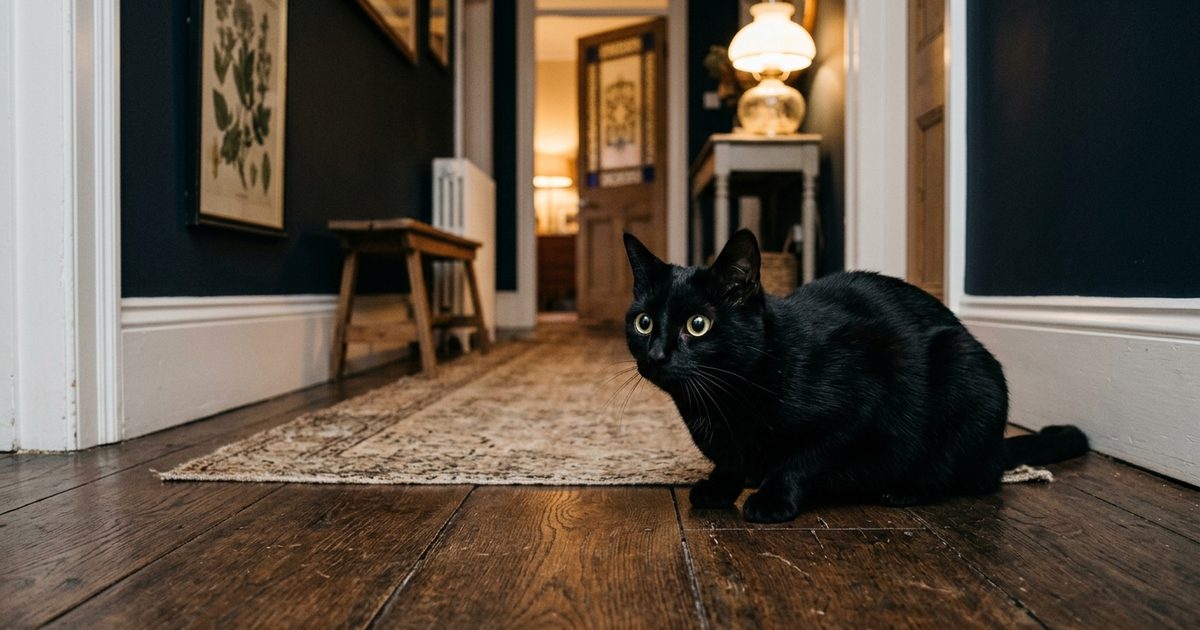
Cats cannot see in total, pitch-black darkness — no animal can without light. But cats need only about a sixth of the light humans do, so in conditions we would call near-dark, a cat can navigate, hunt, and recognize shapes with ease. Cat night vision is real, just not magical.
So can cats see in the dark? The honest answer is yes and no — and the distinction matters more than you might expect. If by "dark" you mean a sealed room with zero light, the answer is no: your cat is as blind in there as you are. But if you mean the dim glow of a streetlight through curtains, a hallway lit by a small nightlight, or the silver of a half-moon on the floor — then yes, your cat sees, and sees well. Cat night vision is not a supernatural trick; it is a beautifully tuned piece of anatomy built for exactly those conditions.
The short answer
Cats need roughly one-sixth of the light humans need to make sense of a scene. That single ratio is the whole headline. In a room where you would grope for a light switch and stub a toe on the corner of the bed, your cat walks across the floor, leaps onto the dresser, and lands on a toy she spotted from across the room.
Picture the light you actually live with at night: moonlight through a window, the amber leak of a streetlamp, the green dot of a charging phone, a nightlight left on for the kids. To your eyes those are afterthoughts — barely enough to find the door. To a cat's eyes, that same trickle of photons is plenty. Their eyes gather it, amplify it, and use it. The night is not a wall to a cat; it is just a dimmer version of the day.
What "dark" really means
Here is the line that gets blurred in every casual conversation about cat night vision: pitch black is not the same as low light. Pitch black means zero photons — a closed closet, a windowless basement with the bulb out, the inside of a cave. In true pitch black, a cat's remarkable eyes have nothing to work with, because vision is, at its core, the business of catching light. No light in, no picture out.
Low light is everything else — the near-dark we actually live in, where some photons are always falling. A sliver of ambient light is all it takes to unlock a cat's full toolkit. And that is the whole story behind those viral videos of a cat navigating a black-looking room: there was light. You just couldn't see it. The cat could.
This is also where we gently set aside the ghost talk. Cats do not see spirits, and their night prowling is not evidence of a sixth sense. What looks like supernatural awareness is anatomy — rods, a reflective layer, a pupil that opens wide. No mysticism required.
How much better than humans?
The number most often cited is about six times: in low light, cats are roughly six times more sensitive than humans. Treat that as a useful ballpark, not a lab-precise figure — the real advantage shifts with the exact conditions and the individual cat. The takeaway is the magnitude, not the decimal.
Six times is a big gap. It is the difference between a world that fades to guesswork for you and a world that stays legible for your cat. International Cat Care, a leading authority on feline health and behavior, describes cat vision as exquisitely adapted to the dim hours of dawn and dusk — the very times a small predator's prey is most active. Your cat was built for twilight.
How Do Cats See in the Dark? The Anatomy
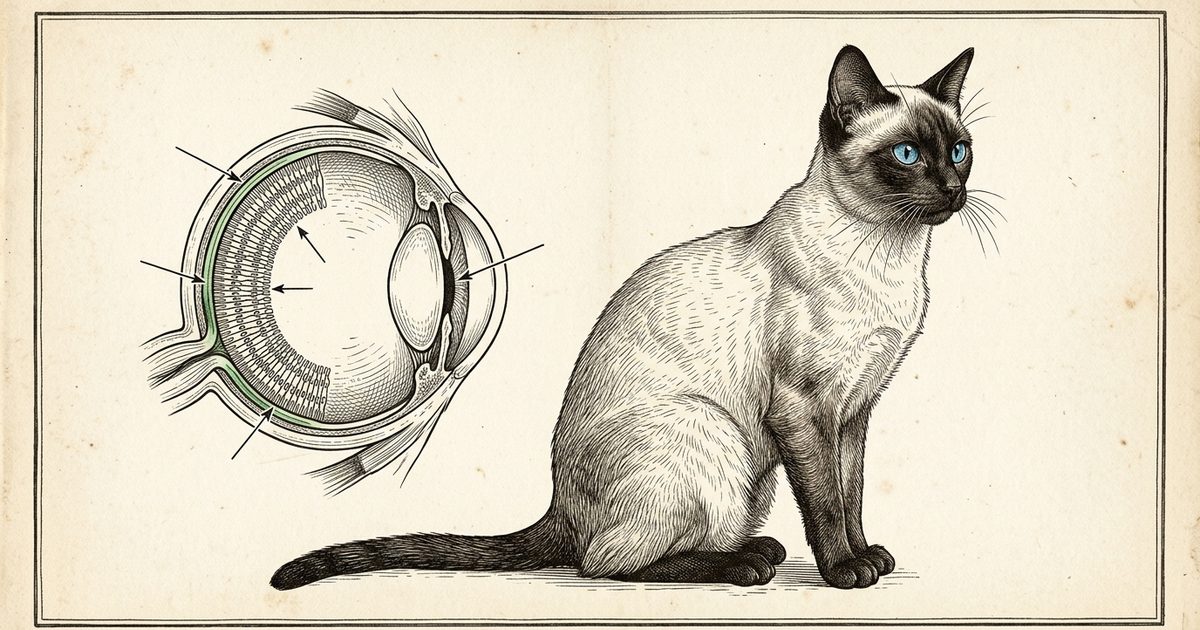
Three key adaptations power cat night vision: a reflective tapetum lucidum bounces light back through the retina for a second pass, a rod-dense retina maximizes dim-light sensitivity, and a vertical slit pupil opens wide to let in maximum available light.
How do cats see in the dark? The answer is not one trick but three, layered together in the same small eye. Every one of them pushes in the same direction: squeeze more use out of every photon that enters. Together they turn a near-dark room into a usable picture — and they are the reason your cat's eyes glow back at you when a headlight catches them at night.
The tapetum lucidum
Behind the retina sits a thin, mirror-like layer called the tapetum lucidum — Latin for "shining layer." When light enters the eye, it passes through the retina's light-sensing cells once, the way it does in your eye. But in a cat, the photons that miss those cells on the first pass don't escape. They hit the tapetum and bounce back, getting a second chance to be caught.
That second pass is the single biggest upgrade a cat eye has over a human eye. We get one shot at every photon; cats get two. It is the difference between a single exposure and a double exposure — more light captured, more signal built, more image assembled from the same dim scene. This is also the layer responsible for the famous eyeshine you see when a headlight or flashlight catches your cat at night: that glow is reflected light, not light the eye produces.
Rods versus cones
The retina is built from two main families of light-sensing cells: rods, which handle dim light and motion, and cones, which handle color and fine detail in bright light. Cats lean overwhelmingly on rods. Their rod-to-cone ratio runs roughly 6:1 — about six rods for every cone — whereas humans sit closer to 4:1. Treat those as approximate magnitudes rather than exact counts; what matters is the gap, and the gap is large.
The trade-off is straightforward. Rods give sensitivity — the ability to pull a picture out of very little light and to register the flick of a mouse's tail at the edge of vision. But rods don't give color or crisp detail. That is the cone's job, and cones are where cats are comparatively thin on the ground. So the same eye that excels at dawn is muted on palette and soft on fine print. If you want the full color side of that story — what cats can and can't see in daylight — we go deep on it in what colors cats can see.
The vertical slit pupil
Ever wonder what your cat sees when she stares into the dark? Get a MeowMind reading — upload a photo and hear her describe the room through her own eyes.
The third adaptation is the one you can watch happen in real time: the pupil. A cat's pupil is a vertical slit, and it is astonishingly mobile. In bright light it narrows to a hairline, a tiny vertical sliver that shields the light-hungry retina from being flooded — protection for an eye built to gather, not to squint. In dim light it opens wide, dilating into a near-circle to let in as much light as the cornea will pass.
Compare that to a human pupil, which is round in all conditions and simply grows or shrinks in diameter. The cat's slit gives a far wider range — from a pinpoint in noon sun to a wide dark-adapted disc at midnight — in a single eye. It is part of what makes the cat stare so striking: those huge black pools are pupils blown wide open, pulling in every available photon. For a detailed, vet-reviewed walkthrough of feline eye anatomy and what changes in the eye can signal about health, the Cornell Feline Health Center is an excellent reference.
What Do Cats Actually See at Night?
At night a cat sees mostly motion and silhouette — sharp on movement, blurry on fine detail, and almost colorless. It is a hunter's vision, tuned for spotting a scurrying mouse at the edge of perception, not reading a page. It is built for the conditions mice move in.
When the lights go down, your cat's world does not switch on like a flashlight — it shifts into a different register entirely. The same eye that delivers crisp detail in daylight reorganizes its priorities for the dark, and what it prioritizes above all is movement. Color fades, fine print dissolves, and what remains is a high-contrast, motion-first picture of the room. That is what cats actually see at night, and it is exactly what a small nocturnal hunter needs.
Motion first
A cat's retina is dense with rod cells — the photoreceptors that handle dim light and motion — and those rods are exquisitely tuned to register the dart of a mouse across a floor. A twitch, a skitter, a flicker of movement in the periphery: cats register that long before they would register the shape of the thing moving. The trade-off is sharp detail, because motion-sensitivity and fine-resolution acuity pull in opposite directions, and a hunter's eye bets on the former. So a cat in a dark room is less interested in what something is than in that it moved — which is exactly the cue that matters when dinner runs.
Silhouettes and edges
What cats see well in low light is contrast and edges. A chair against a wall, the lip of a sofa, the dark rectangle of a doorway — these read clearly as long as there is even a sliver of ambient light, which is how cats thread through a familiar room, leap onto furniture, and find the litter box without fumbling. Their vision excels at mapping the geometry of a space by silhouette rather than by surface detail. This is also why a rearranged living room can briefly disorient a cat: the edges it navigates by have moved, and its motion-tuned, edge-detecting eyes have to relearn the map. For the bigger picture of how cats perceive their environment through senses beyond sight, cat hearing works as the other half of the same hunter's sensor array.
The blur of detail
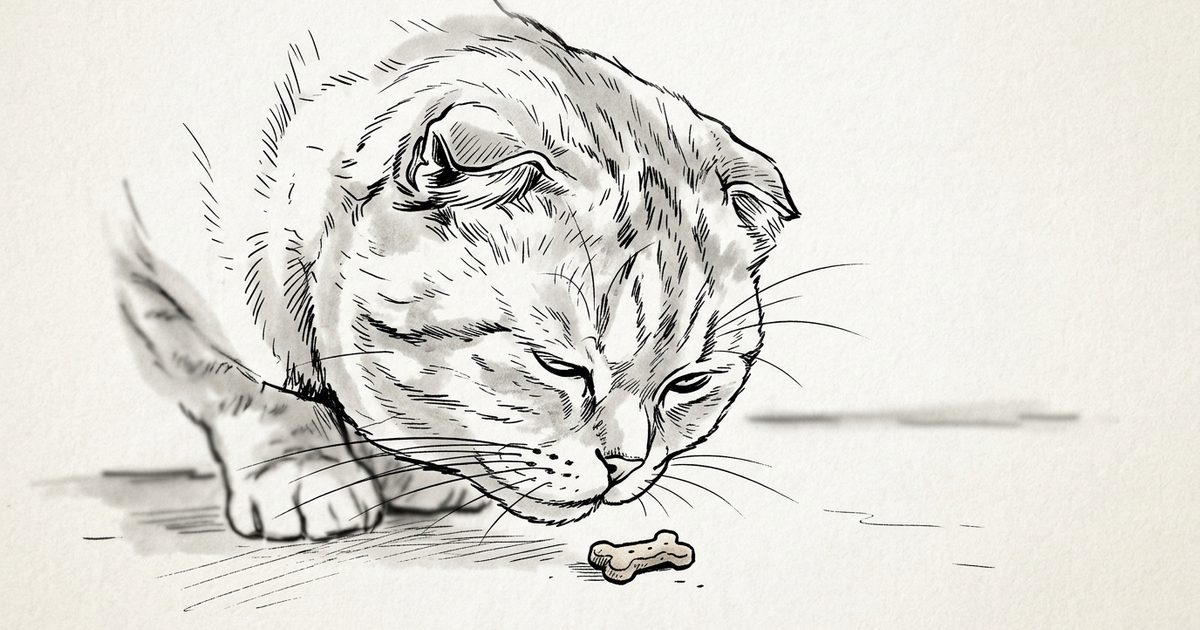
Here is the part that surprises people: cats are actually farsighted by human standards. Their visual acuity lands somewhere around 20/100 to 20/200, which means an object a cat sees clearly at 20 feet, a human with normal vision could read at 100 to 200 feet. Up close, a cat's world is blurrier than ours — which is why a cat may seem to "miss" a treat placed directly under its nose, sniffing in a small confused circle until scent and whiskers take over. Sight is not how cats handle the up-close world; that job falls to smell and touch. For how those senses compensate, see how cats smell, and for the daytime color side of feline vision, our companion piece on what colors cats can see covers the cone cells this article leaves aside.
Why Do Cats' Eyes Glow in the Dark?
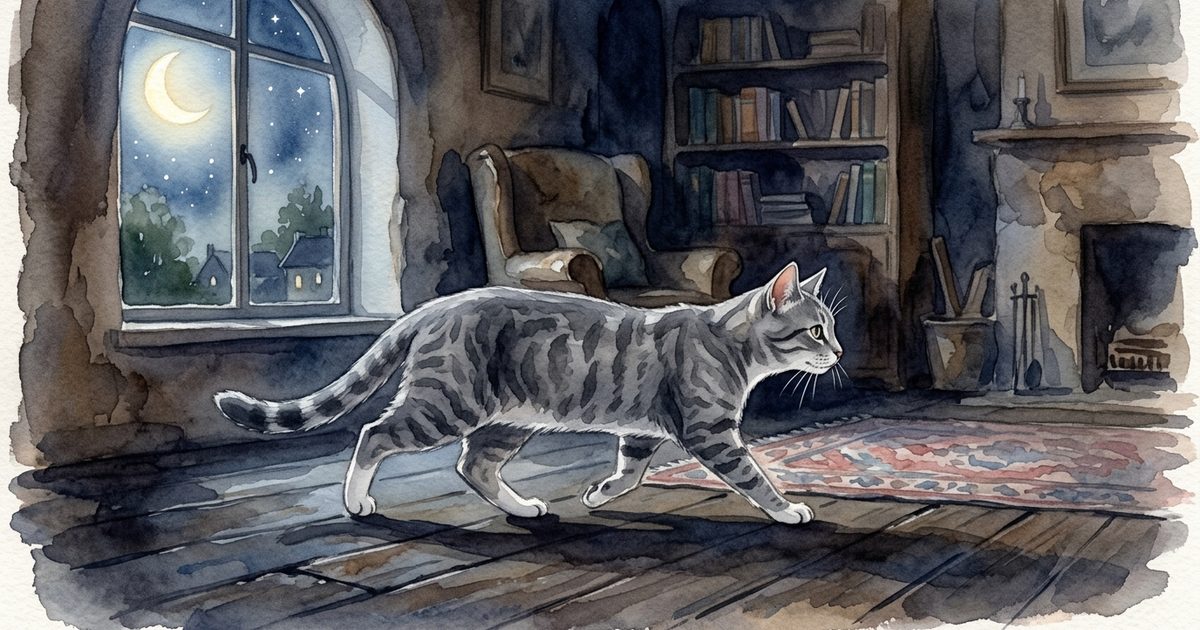
The glow in a cat's eyes at night is not the eye producing light — it is reflected light bouncing off the tapetum lucidum, the mirror layer behind the retina. The color, often green or gold, depends on the cat and the viewing angle, and the effect is called eyeshine.
That eerie flash when a cat turns to look at you in a dark hallway — two green or gold coins floating at eye level — is one of the most recognizable sights in the animal world, and also one of the most misunderstood. People assume the cat's eyes are glowing, producing light the way a firefly does. They are not. The glow is borrowed light, returned to you by the very same structure that gives cats their night vision. Nothing is being generated; everything is being reflected.
Eyeshine, explained
The physics is simple and beautiful. Light from an external source — a hallway lamp, a flashlight, moonlight through a window — enters the cat's eye and passes through the retina, where the rod cells absorb some of it. The photons that slip past the rods hit the tapetum lucidum, a mirror-like reflective layer sitting just behind the retina, and bounce back outward through the retina a second time. The viewer — you — catches that returning light, and it reads as a glow. The key point is that the glow vanishes the instant there is no external light source to reflect. In true, photon-free darkness, a cat's eyes are as dark as anything else. International Cat Care describes eyeshine as the visible signature of this same tapetum lucidum that underpins feline night vision.
What color is the glow?
In most cats the eyeshine reads as green or gold, and a black cat's large golden-green eyes show this pairing off to striking effect — the warm eyeshine against the dark coat is the look people associate with cats in the dark. The exact color depends on the cat and the viewing angle, and on the chemistry of the tapetum itself. Some blue-eyed or predominantly white cats show a reddish or pinkish eyeshine, because their tapetum is reduced or absent and the reflection picks up the red of the retina's blood supply instead — a normal variation, not a defect. It is also distinct from other animals' eyeshine: dogs tend toward a warmer gold, deer toward a silvery white. The color is a fingerprint of species, and sometimes of the individual cat.
Why humans don't glow
We have no tapetum lucidum. Our eyes absorb incoming photons in a single pass, with no mirror layer to send them back out — which is the whole reason you will never catch a human's eyes glowing in a photograph the way a cat's do. That single-pass absorption is a genuine advantage: it is what gives us our fine detail and rich color vision in good light, because nothing scatters the light on its way through. But it is a disaster at night, because every photon that misses a photoreceptor on the first pass is simply lost. The cat's reflective "second chance" — letting each photon take a second run at the rod cells — is the entire trick behind cat night vision, and the eyeshine you see is simply the spill of that same mechanism pointed back at you. For the broader picture of feline eye health and what changes in the eye can signal, the Cornell Feline Health Center is the reference veterinarians rely on.
Cat Vision vs Human vs Dog
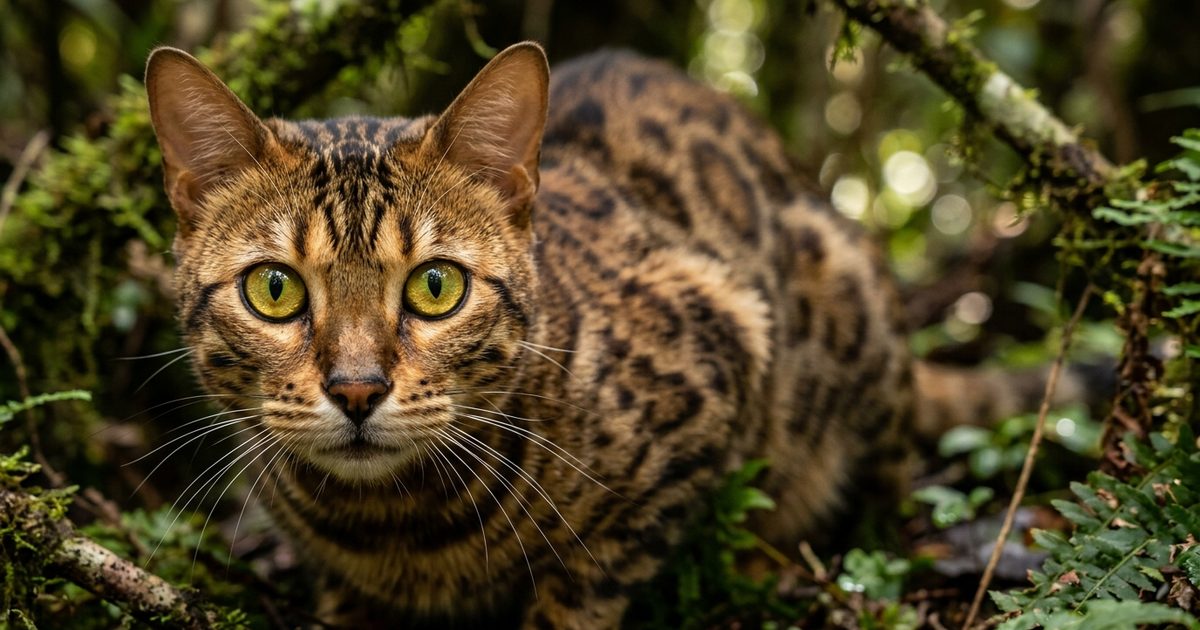
Compared to humans, cats see far better in low light but worse on detail and color. Compared to dogs, cats edge ahead on dim-light sensitivity and sharpness. Humans own the daytime, dogs sit in the middle, and cats are built for dawn and dusk when prey is most active.
Picture three animals in the same dim hallway. You reach for a light switch. Your dog picks up the shape of the doorway. Your cat is already three steps ahead, reading the room through the faint glow leaking under a door. None of them see the same scene, because each species tuned its eyes to a different slice of the day.
Low-light sensitivity ranking
Cats need only about a sixth of the light humans do to make sense of a room, which is why the question of whether cats can see in the dark usually resolves to "yes, far better than us." Dogs land close behind, needing roughly a fifth. The gap isn't huge in raw numbers, but it lines up with a deeper difference in lifestyle. Cats are crepuscular hunters — their ancestors evolved to chase mice and small birds at dawn and dusk, the hours when prey moves and light is thin. Their entire visual system, from rod density to pupil shape, is tuned for those gold-light hours. You can read more about feline sensory design from International Cat Care.
Detail and color trade-off
Sensitivity at night comes at a daytime cost. Humans see the sharpest detail and the richest color of the three — our cone-rich retinas are built for bright, complex scenes. Cats and dogs both see a muted palette, leaning toward blues and yellows, with reds and greens largely washed out. The difference between cat and dog color vision is small and contested, so it's fair to generalize: both see a softer, less saturated world than you do. For the full breakdown of the feline color spectrum, see our deep dive on what colors cats can see.
Field of view and motion
Cats also take in more of the world at once. Their field of view stretches to about 200 degrees, wider than a human's 180, and their peripheral motion detection is exceptional — a flicker at the far edge of their vision snaps their attention before you've even registered movement. It's a hunter's sensor array, built to catch the dart of prey across a floor rather than study a static scene. Vision is only half of that array, though; cat hearing fills in the rest, and the two systems work together to map a room the way a predator needs it mapped.

What Can't Cats See Well?
Cats struggle with fine detail up close, they see a much smaller slice of the color spectrum than we do, and their world is blurrier than ours in bright light. Their eyes are tuned for dim conditions and motion, not for reading, color fidelity, or close-up inspection.
For all their night-vision prowess, cats have real blind spots in daylight. Their eyes made a trade: supercharged sensitivity in the dark, paid for with acuity and color in the light. Knowing where cat vision falls short explains a lot of everyday feline behavior — from the treats they miss to the way they navigate your face.
Close-up blur
Cats are functionally farsighted by human standards. Objects right under their nose sit in a soft blur, which is why a cat often seems to "miss" a treat placed directly in front of her, only to find it a moment later by scent. Up close, she's not really looking — she's sniffing and reading the world through her whiskers. Smell and touch step in to cover the gap in sharp near vision. For how that chemical and tactile map works, see our guide on whether cats can smell, where smell and whiskers take over where eyes leave off.
Limited color range
The old idea that cats see the world like a black-and-white television is simply wrong. Cats do see color — just a narrower band of it, mostly blues and yellows, with reds and greens fading into grayish hues. Their world is muted, not monochrome. A red toy on a green lawn is a low-contrast target for a cat, which is why blue and yellow toys often catch their eye faster. If you want the full science of feline cones and the "colorblind" myth, our article on what colors cats can see walks through it in detail.
Distance and detail in daylight
In bright light, humans clearly outperform cats on visual acuity — we resolve finer detail at greater distance, which is why we read signs and cats do not. A cat's visual acuity sits roughly in the 20/100 to 20/200 range, meaning what you see clearly at 100 feet, she might need at 20. That sounds like a deficit, but it's the right design for her job: a cat doesn't need to read a label across the room. She needs to detect motion, lock onto prey, and pounce. Cornell Feline Health Center notes that feline vision is optimized for the hunting task, not the inspection task — and in that arena, her eyes are exactly what they need to be.
How to Help Your Cat at Night
Leave a small nightlight or let curtain light in so your cat has the sliver of light their eyes need. Keep pathways clear, avoid rearranging furniture your cat navigates in the dark, and remember the night is genuinely their element — your cat is not lost, she is at home.
A little light goes a long way
Remember that your cat's night vision depends on at least some light entering the room. In a truly lightless room, even a cat's superb eyes fail — no photons in, no vision out. So you don't need to switch on a lamp; just a small amount of dim light is enough: a faint nightlight, the glow of a microwave button, or the streetlamp leaking through the curtains. To a cat, that reads like a bright, crisp morning.
Staircases, hallways, and the litter box
These are the spots worth keeping a little light on. A small nightlight near stairs, on the long hallway to the litter box, and around food bowls prevents stumbles and hesitation for senior or arthritic cats — those jumps may no longer be so certain. Cats map their home through multiple senses, which is why understanding how cats use their ears and why cats stare for long stretches gives you the full picture of how they move through the dark without seeming rushed or lost.
Night is their element
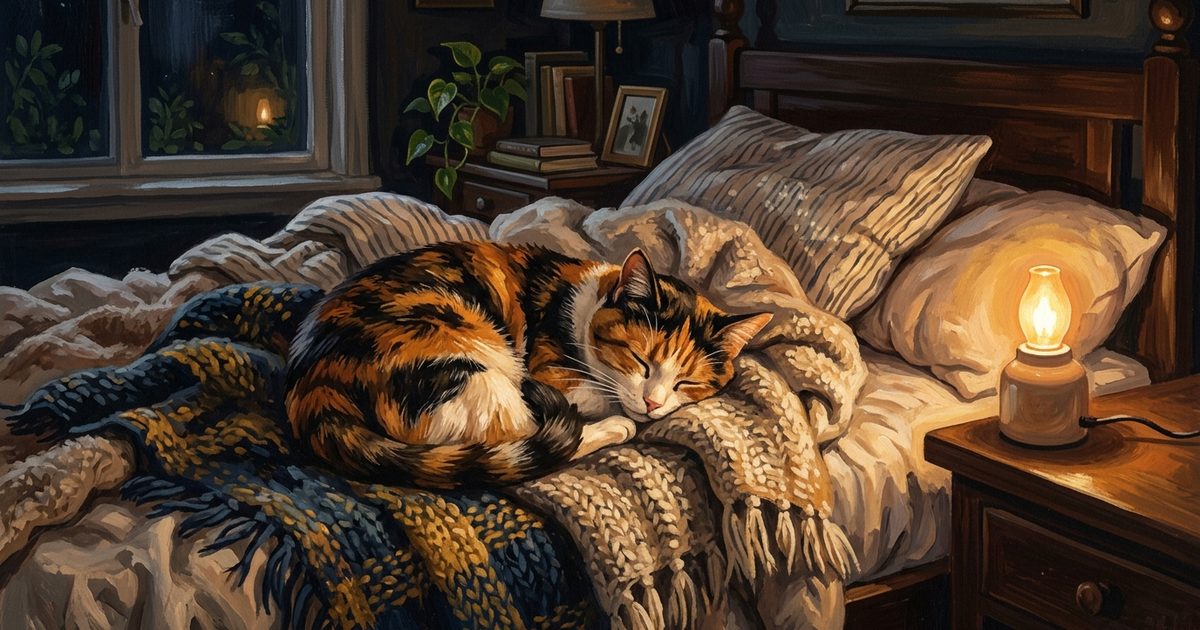
Finally, a reassuring thought. If you wake in a dim apartment and find your cat sitting quietly by the window, watching the room, she is not sad, not bored, and not in need of rescue. She is doing what cats evolved to do: stay quiet, stay alert, and be at home in her own senses. The dark room is her workplace. When she finally curls up at your feet, it is because her patrol is over — not because she has fled from the dark.
Cat Night Vision at a Glance — Summary
| Question | Short answer |
|---|---|
| Can cats see in the dark? | In near-dark, yes; in total blackness, no — no animal sees without light. |
| How much light do cats need? | About a sixth of what humans need; a faint sliver is plenty. |
| What makes cat night vision so good? | A reflective tapetum lucidum, a rod-rich retina, and a dilating vertical pupil. |
| Why do cats' eyes glow? | Light reflects off the tapetum lucidum — it is reflected light, not the eye glowing. |
| Do cats see color at night? | Rarely — rods handle the dim, motion-led vision, with almost no color. |
| Are cats better than dogs at night? | Slightly better in dim light and slightly sharper; both are built for twilight. |
| What can't cats see well at night? | Fine close-up detail and full-spectrum color — traded away for motion. |
| Should I leave a light on for my cat? | A dim nightlight near stairs and the litter box helps senior cats. |
Curious What Your Cat Would Say?
Upload a photo and get a warm, personalized reading from your cat's perspective.
Start Your Free ReadingFrequently Asked Questions
Can cats see in complete darkness?
No. Like every animal, cats need at least a sliver of light to see, so in true pitch-black darkness they are as blind as we are. Their night vision only works when some ambient light — moonlight, a nightlight, a streetlamp — is present.
How much better is cat night vision than human night vision?
Cats need roughly one-sixth of the light humans do to navigate, hunt, and recognize shapes in dim conditions. That's a useful ballpark rather than a lab-precise figure, but the gap is large enough to be the whole headline of cat night vision.
Why do cats' eyes glow in the dark?
The glow is reflected light, not light the eye produces. Photons that miss the rod cells hit a mirror-like layer behind the retina called the tapetum lucidum and bounce back out — that returning light is what you see as green or gold eyeshine.
Do cats see color at night?
Almost none. Night vision is handled by rod cells, which are sensitive to light and motion but not color, so a cat's night-time world is mostly muted blues and yellows, with fine detail and rich color reserved for brighter conditions.
Can cats see in the dark better than dogs?
Slightly. Cats edge out dogs on both dim-light sensitivity and visual sharpness, though both species far outclass humans at night. The gap is small and reflects the cat's more specialized crepuscular hunting design.
What is the tapetum lucidum and what does it do?
The tapetum lucidum is a thin, mirror-like reflective layer sitting just behind the retina. It bounces photons that missed the rod cells back through the retina for a second chance, roughly doubling the light the eye can use and producing the famous eyeshine.
Should I leave a light on for my cat at night?
A small dim nightlight helps, especially for senior or arthritic cats. Place one near stairs, long hallways, and the litter box so your cat always has the sliver of ambient light her eyes are built to use — total darkness defeats even feline vision.
Why does my cat stare into dark corners?
Cats are exquisitely sensitive to motion and have exceptional peripheral detection, so a flicker of movement or a shift in light that you can't register easily catches their attention. It's hunter's anatomy at work, not evidence of anything supernatural.
Do kittens have the same night vision as adult cats?
Kittens are born with their eyes sealed shut and vision develops over the first few weeks, so very young kittens do not see well in any light. Once their eyes mature, their night-vision anatomy matches that of an adult cat.
Why do cats' pupils change from slits to circles?
A cat's vertical slit pupil narrows to a hairline in bright light to protect the light-hungry retina from being flooded, and opens into a near-circle in dim light to let in maximum light. That wide range, in one eye, is a key part of cat night vision.
Sources & References
You Might Also Like
Kitten Teething: Timeline, Symptoms & How to Help
Kitten teething runs from 3 to 7 months as baby teeth fall out. Learn the timeline, signs to watch for, and how to soothe a teething kitten safely.
15 min readWhen Do Cats Stop Growing? A Complete Timeline
When do cats stop growing? Most cats reach adult size by 12-18 months, but large breeds like Maine Coons keep growing until 3-4 years. Full timeline inside.
14 min readCan Cats Eat Cherries? Flesh, Pit & Toxicity Facts
Can cats eat cherries? Pitted flesh is safe in tiny amounts — but the pit, stem, and leaves are toxic (cyanide precursors). Learn what's safe and what isn't.
15 min readA message, in your cat's voice
Upload a photo, get a warm note written from your cat's perspective — just for fun. Plus 121 vet-cited articles, offline.