
Why Do Cats Eat Grass? The Science (and When to Worry)
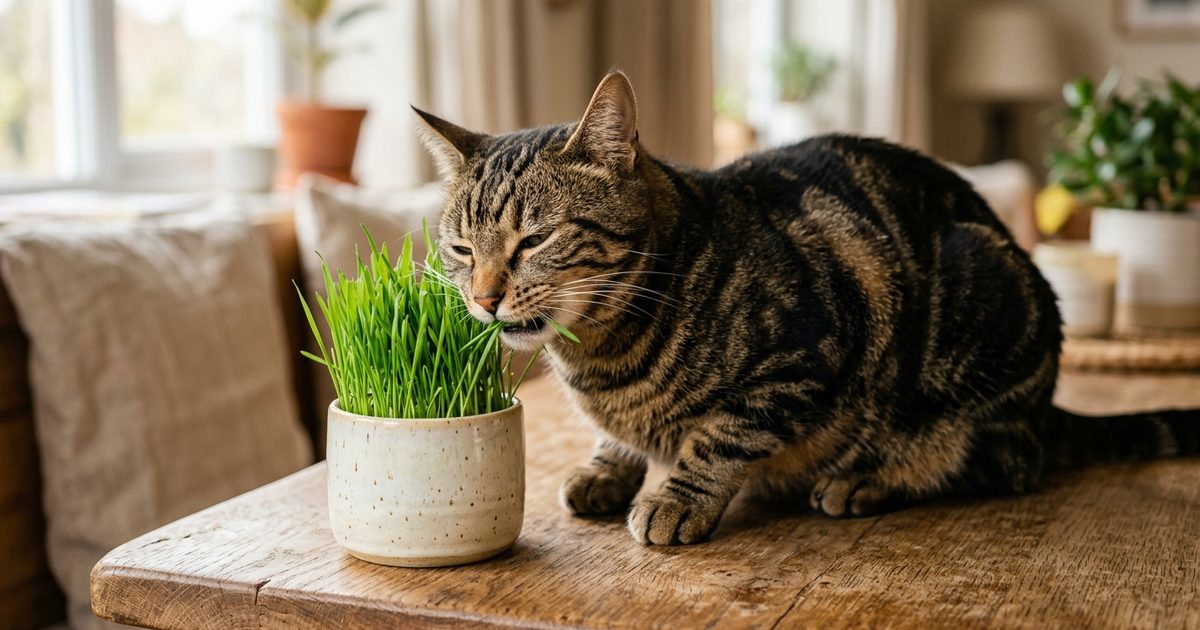
If you've ever watched your cat nibble a blade of grass and wondered why, you're not alone — "why do cats eat grass" is one of the most common questions owners ask. The short answer: yes, cats can eat grass, and most do. Offering safe cat grass (typically wheatgrass, oat, or barley) is a normal, healthy form of enrichment that dates back to their wild ancestors.
Key takeaways
- Grass-eating is widespread, normal behavior in cats — including wild felids like lions and panthers — and is not, by itself, a sign of illness or nutritional deficiency.
- Only about a quarter of cats vomit after eating grass; the leading thinking is that it's an instinctive parasite-defense and gut-motility behavior, not primarily a way to induce vomiting.
- Offer safe grasses like wheatgrass, oat, or barley, and keep cats away from chemically treated lawns and toxic houseplants such as lilies.
Grass-Eating — Quick Reference
| Question | Short answer |
|---|---|
| Is it normal? | Yes — most cats eat plant material at some point; wild felids do it too |
| Why do they do it? | Likely fiber, trace nutrients, and an inherited parasite-defense instinct |
| Does it make them vomit? | Only in about a quarter of cats — vomiting is a side effect, not the goal |
| Which grasses are safe? | Wheatgrass, oat grass, and barley grass (sold as "cat grass") |
| Which are dangerous? | Treated lawn grass and toxic houseplants like lilies, tulips, and daffodils |
| Should I offer cat grass? | Yes — it's safe enrichment and easy to grow from seed in a small pot |
Do Cats Eat Grass, and Is It Normal?
Yes — grass-eating is widespread, normal cat behavior. Surveys of cat owners find the majority of cats eat plant material at some point, and the same habit appears in wild felids like lions and panthers. It is not, by itself, a sign that your cat is sick or missing nutrients.
If you've caught your cat gnawing on a blade of grass and felt a flicker of worry, you're in good company — it's one of the most common questions cat owners ask. The short answer is reassuring: chewing on grass is something cats have done for millions of years, long before there were living rooms or bags of kibble. Understanding why do cats eat grass begins with recognizing how ordinary the behavior actually is.
How common is it?
Quite common. In owner surveys, a large majority of cats — roughly seven in ten — have been observed eating plants at least a handful of times in their lives, and only a small minority (around one in ten) rarely or never touch greenery. These numbers are owner-reported, so they're better read as "this is widespread" than as a precise figure. The practical takeaway: if your cat nibbles grass, it's doing something countless other cats do, not something unusual. The behavior spans cats of every age, breed, and diet.
Wild cats do it too
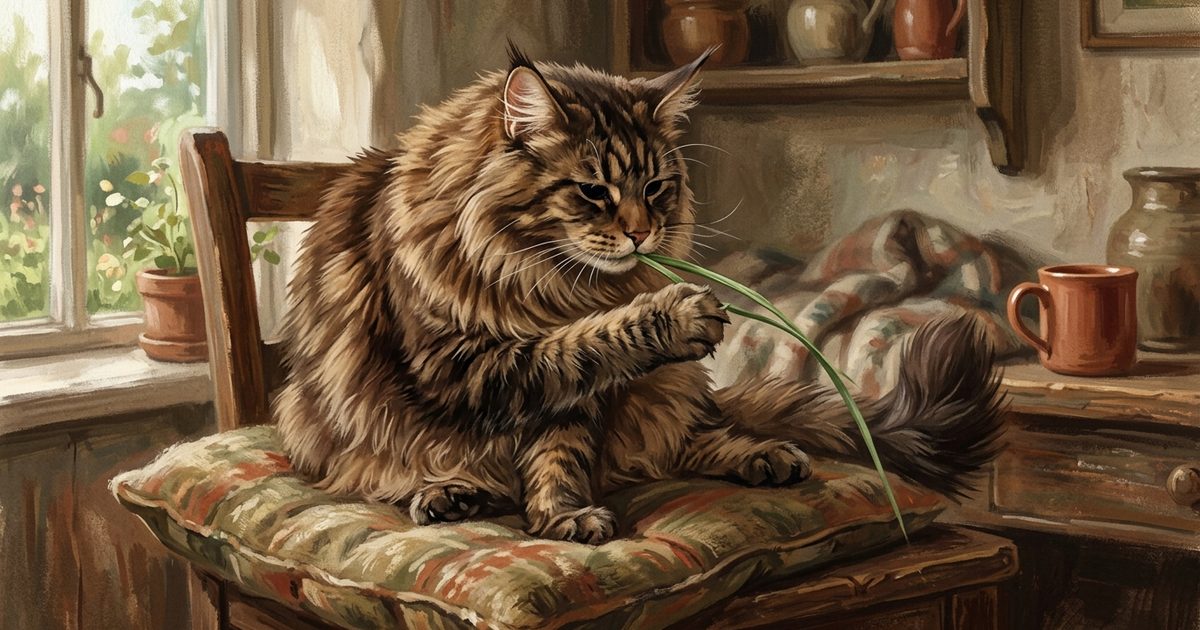
The most telling evidence that grass-eating is instinctive, not learned, comes from wild felids. Researchers have found plant material in the scat of lions, panthers, and other wild carnivores — cats that have never lived indoors, never eaten commercial food, and never been taught by a human. This means the habit predates domestication entirely. Your house cat is replaying an ancestral behavior shared with its much larger relatives. International Cat Care describes plant-eating as a normal part of feline behavior, not a quirk of pampered pets. The same instinct that raises questions about how domesticated cats really are is at work here — they retain many behaviors from their wild ancestors, and grass-eating is one of them.
Does it mean my cat is sick or deficient?
This is the worry that brings most owners to search for answers, and it's worth addressing directly: in the great majority of cases, no. Most cats that eat grass are healthy, well-fed, and on complete diets that supply every nutrient they need. Grass-eating is not reliable evidence of illness, hunger, or a nutritional gap. It's a behavior driven by instinct, not by deficiency.
That said, context matters. If the grass-eating is brand new, compulsive, or paired with other changes — vomiting, weight loss, lethargy, refusing food — then it's worth a conversation with your vet. In those cases the grass isn't the problem, but it may be a clue. And if you're trying to tell the difference between harmless grass-related vomiting and vomiting that signals a real issue, our guide to cat vomiting walks through the colors, patterns, and warning signs to watch for.
Why Do Cats Eat Grass? The Leading Theories
Researchers propose several reasons: grass provides fiber that aids digestion and gut motility, may supply trace folic acid, and — per a 2019 study — may be an inherited instinct that helps clear intestinal parasites by speeding the digestive tract. None of these means your cat is unwell.
So if it's not illness or deficiency driving the behavior, what is? Scientists have offered several explanations over the years, and the honest answer is that no single theory has closed the case — grass-eating likely serves more than one purpose. What's changed recently is that a compelling new hypothesis, grounded in comparative biology across the cat family, has reframed how veterinarians think about it. Here are the leading theories, from the oldest to the newest.
Digestive aid and fiber
The most mechanically straightforward explanation: grass is mostly cellulose, a structural fiber that cats can't digest. When a cat swallows grass, those tough blades pass through the stomach and intestines largely intact, adding bulk and roughage to whatever else is in the digestive tract. This extra bulk may help move gut contents along — the same reason humans are told to eat more fiber. For an animal that grooms constantly and swallows a good deal of fur (which you can read more about in why cats groom), anything that keeps the digestive tract moving has real value. The fiber theory doesn't explain everything about grass-eating, but it's consistent with the observation that grass often passes through and shows up, intact, in the litter box.
Folic acid and nutrients
A second, older theory points to folic acid — a B vitamin found in the juice of young grasses and, notably, in mother's milk. The idea is that cats instinctively seek out grass to top up a trace nutrient. There's a wrinkle, though: a complete commercial diet supplies all the folic acid a cat needs, yet cats on those diets eat grass anyway. That suggests the drive is instinctive rather than need-driven — your cat isn't correcting a deficiency, it's following an ancient impulse that once, in the wild, may have pointed it toward a useful nutrient. The nutrient theory is plausible but partial; it doesn't account for the behavior on its own.
The parasite-defense instinct (2019 research)
The most consequential recent work comes from a 2019 comparative study led by researchers at UC Davis and the Smithsonian, examining plant-eating across the order Carnivora — cats, dogs, bears, and their relatives. The peer-reviewed research, published in PLOS ONE, found that plant-eating is widespread across carnivore species and proposed a striking hypothesis: regular consumption of non-digestible plant material increases gut motility — it speeds the digestive tract — which in turn helps expel intestinal parasites.
On this view, grass-eating is an inherited defense mechanism. Wild ancestors who ate plants regularly were better at clearing parasites, and the instinct stuck — even though today's dewormed house cats don't need it. This is now considered a leading hypothesis for why do cats like to eat grass, though it's worth stating plainly: it's the best-supported current explanation, not settled fact. It reframes grass-eating as an ancient survival behavior retained from wild ancestors, which fits neatly with the observation that lions and panthers do the same thing.
To induce vomiting (the old theory, now questioned)
For decades, the conventional wisdom was that cats eat grass specifically to make themselves throw up — to purge hairballs, settle an upset stomach, or clear something they shouldn't have swallowed. It's the explanation most owners have heard, and it gives the behavior a tidy purpose. Whether the data actually backs it up is a separate question — and we tackle it in the next section.
Does Eating Grass Make Cats Throw Up?
Only about a quarter to a third of cats vomit shortly after eating grass — most do not. The idea that cats eat grass specifically to make themselves throw up is largely a myth; vomiting is a common side effect of the roughage, not the goal.
What the surveys actually show
The "cats eat grass to vomit" story has been the default explanation for decades, but the numbers tell a different story. In owner surveys — where hundreds of cat owners were asked to report what happens after their cat eats plant material — only about a quarter to a third of cats actually vomit afterward. The rest, roughly seven in ten, show no sign of being sick at all. You can often spot the grass later, intact, in the litter box: it has passed through the digestive tract largely unchanged.
That asymmetry matters. If the goal of grass-eating were to trigger vomiting, you'd expect a far higher rate of emesis — closer to most cats, most of the time. Instead, the behavior ends in an upset stomach for only a minority, while the majority simply carry on. International Cat Care treats plant-eating as a normal, routine feline behavior rather than a sign that something needs to come back up.
Why some cats do vomit
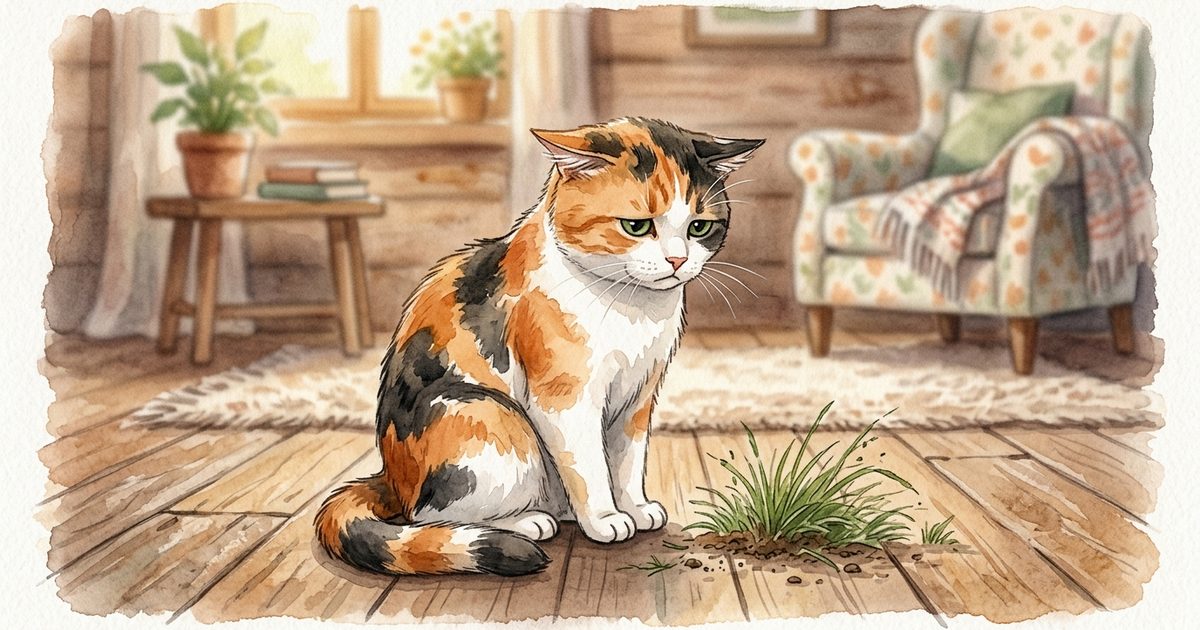
So why do some cats throw up at all? The explanation is largely mechanical, not intentional. Grass blades are tough, fibrous, and almost entirely indigestible — cats lack the enzymes to break down cellulose. When a cat swallows longer blades whole, those undigested strands can tickle or irritate the back of the throat and the lining of the stomach. That irritation is enough to trigger the emetic reflex — the same reflex that fires when something scratchy or irritating lands in the back of your own throat.
In other words, the vomiting isn't a deliberate "purge" the cat is engineering on purpose. It's a side effect of swallowing roughage that the body wants to push back out. Shorter blades, smaller bites, and cats with less sensitive stomachs often never reach that threshold at all — which lines up neatly with why most grass-eating cats keep their meals down.
When grass-linked vomiting is a concern
An occasional blade of grass coming back up — once in a while, with no other symptoms — is usually nothing to worry about. What's worth paying attention to is a change in pattern. If your cat starts vomiting more frequently, brings up blood, seems lethargic, refuses food, or the vomit contains something that isn't grass, those signs point to a separate problem rather than the grass itself. That's the moment to call your vet. The Cornell Feline Health Center is clear that persistent or repeated vomiting is always a reason to seek professional advice.
If you're working out whether the grass is the real culprit or a bystander, our guides on cat vomiting and cat hairballs walk through the distinctions. The short version: a single grass-linked episode is normal, a pattern is not.
Which Grasses Are Safe for Cats to Eat?
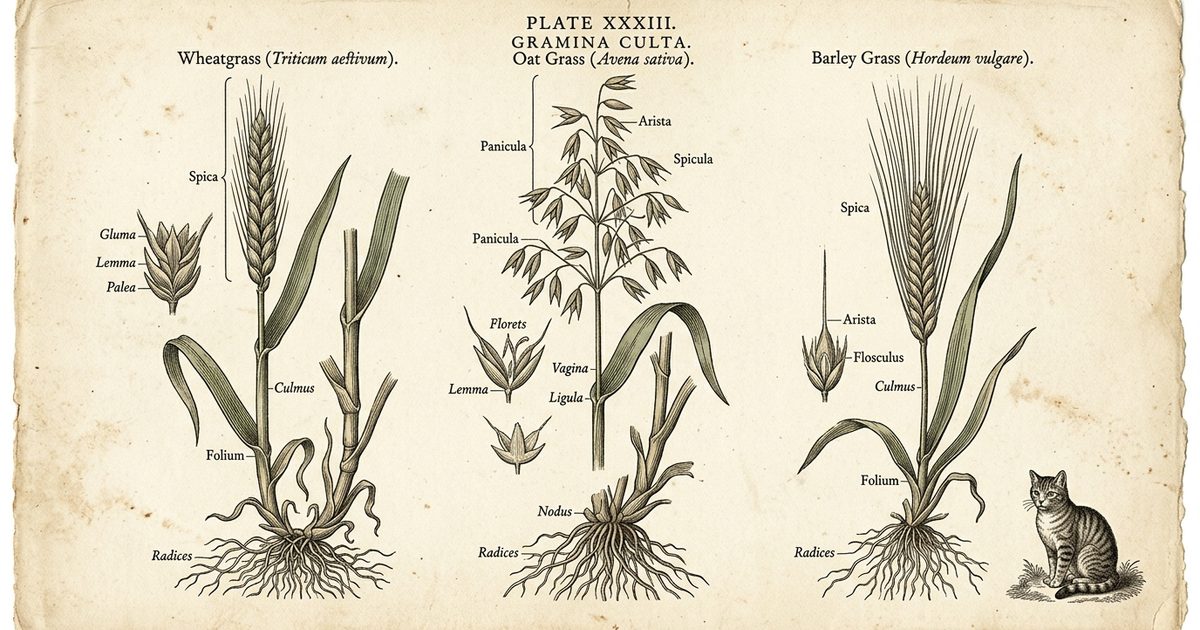
Safe "cat grass" is usually wheatgrass, oat grass, or barley grass — fast-growing, untreated, and sold specifically for pets. These are the grasses to grow or buy if you want to offer your cat something to nibble. They are non-toxic and pass through the gut harmlessly.
Wheatgrass, oat, and barley
When a product is labeled "cat grass," it almost always refers to one of three fast-growing cereal grasses: wheatgrass, oat grass, or barley grass. All three belong to the Poaceae family — the true grasses — and all three sprout from seed within a week to ten days, reaching a few inches tall and ready for a cat to nibble. They're sold in several convenient forms: ready-to-grow cat grass seeds kits with soil and a pot, loose seeds you can sow yourself, or pre-grown pots you simply set on the windowsill.
Nutritionally, these grasses are nothing dramatic — they're mostly water and fiber, with trace amounts of vitamins like folic acid and a little chlorophyll. Cats don't digest the cellulose for calories; the value is the roughage and the nibbling itself, not nutrition. That's exactly why they're safe: there's nothing in them to cause harm when they pass through intact.
Why these and not just any grass
You might reasonably wonder why a cat can't just graze on whatever grass is growing outside. The answer is safety and consistency. Grass you grow yourself, from labeled pet-safe seed, in a controlled pot of untreated soil, is exactly what it claims to be — no surprises. Outdoor grass is a different story: it may carry pesticide, herbicide, or fertilizer residue from lawn treatments, fertilizers tracked in by foot traffic, or chemical runoff from neighbouring gardens. You have no way to verify what's on it, and a cat that licks its fur after grazing ingests whatever was on the blades.
Home-grown cat grass removes that uncertainty entirely. It's the same logic as washing produce before you eat it — controlled input, predictable output. For a cat that loves to nibble, a small pot of home-grown grass is the clean, reliable version.
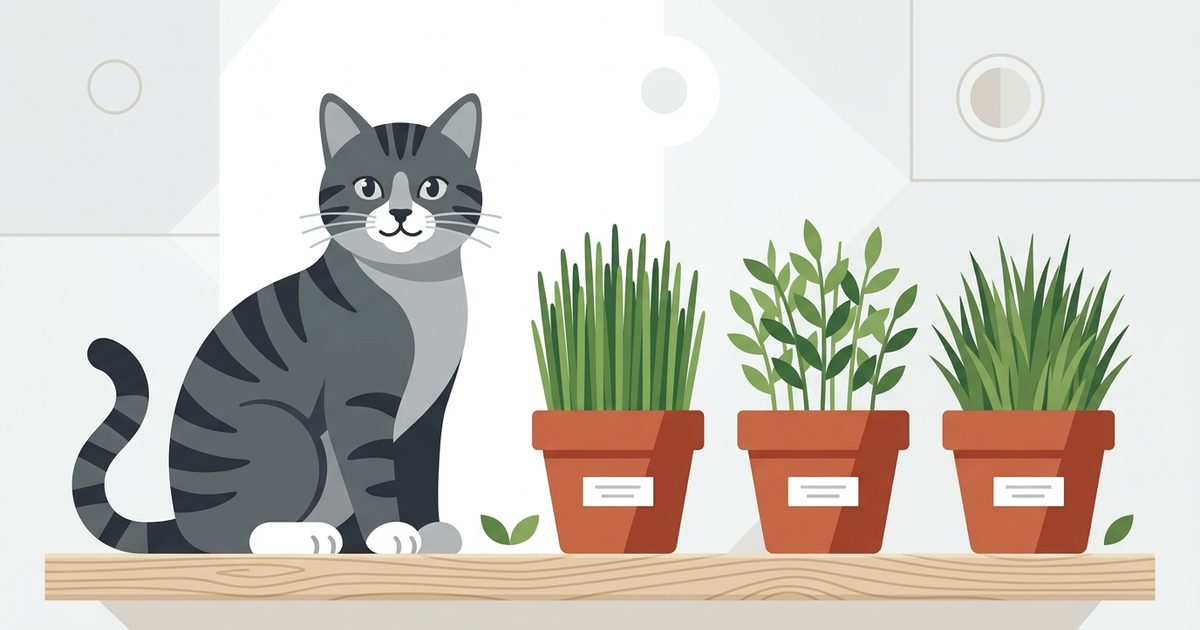
Cat grass vs. catnip — not the same plant
This is the single most common mix-up in the whole topic, and it's worth setting straight: cat grass and catnip are completely different plants. Cat grass is a true grass (family Poaceae) — fibrous, mild, and eaten for gut function and roughage. Catnip is Nepeta cataria, a member of the mint family (Lamiaceae), and it contains a compound called nepetalactone that binds to receptors in a cat's nose and triggers a brief, euphoric "high" — the rolling, rubbing, drooling frenzy every cat owner recognizes.
The purposes are entirely different. Cat grass is about digestion; catnip is about stimulation. One is roughage the cat swallows, the other is an herb the cat mostly rolls in and sniffs. If you want the full picture of the stimulant plant and the intoxicating response it produces, our deep dive on what catnip does to cats covers it in detail — but the load-bearing point here is simple: when you're choosing what to grow for your cat to nibble, reach for wheatgrass, oat, or barley seeds, not catnip seeds. They are not interchangeable.
Which Plants and Grasses Are Dangerous for Cats?
Treated lawn grass (pesticides, herbicides, fertilizers), grass with chemical runoff, and many common houseplants are dangerous — lilies, tulips, daffodils, and sago palm can be fatal. Assume any grass you did not grow yourself is off-limits, and keep cats away from chemically treated lawns.
The grass itself isn't the danger — it's everything we spray on it, and the look-alike plants sitting on the windowsill. A cat seeking greenery can't tell wheatgrass from a lily, so the risk lives in the environment you let them graze in.
Treated lawns and chemicals
Suburban and park lawns are routinely treated with pesticides, herbicides, and fertilizers, and residue clings to grass blades for days or weeks after application. The timing matters most: recently sprayed grass carries the heaviest load, but even dry-treated lawns can leave trace chemicals on a cat's fur and paws, which are then ingested during grooming. Because you can't verify what a neighbor or grounds crew has applied, unknown outdoor grass is a gamble. If your cat goes outside, assume any grass you didn't grow yourself is off-limits — and keep them off lawns for the full re-entry window stated on any treatment signage.
Toxic houseplants often confused with grass
This is the more common and more dangerous hazard indoors. A cat drawn to nibble something green will sample whatever's within reach, and several ubiquitous houseplants are highly toxic:
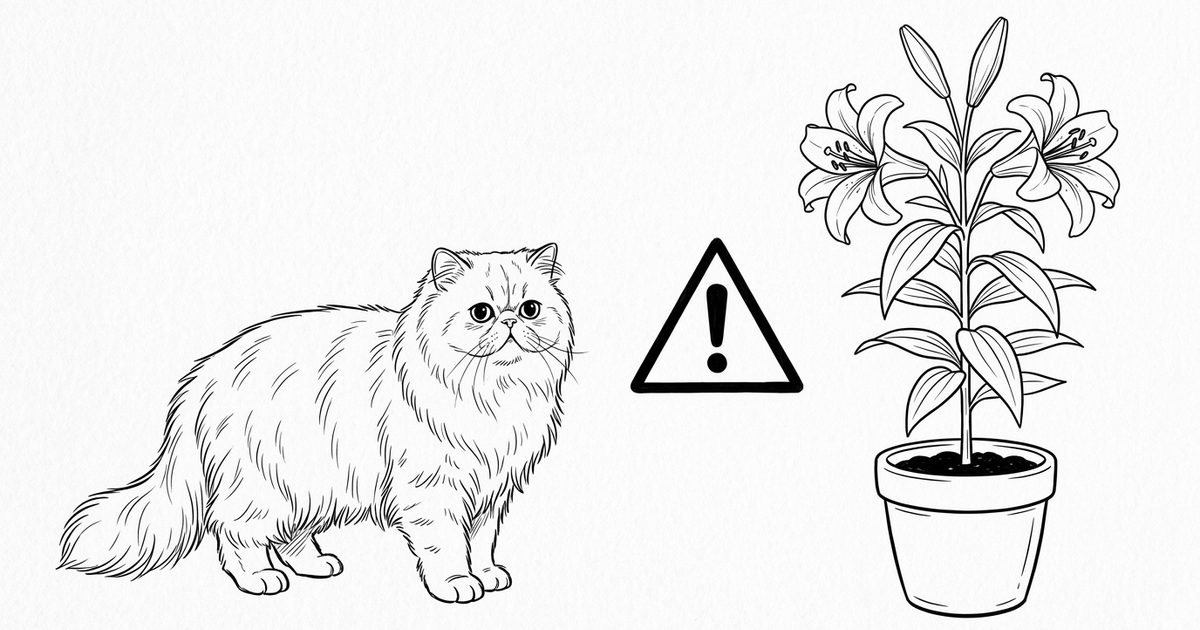
- Lilies (Lilium and Hemerocallis species) are the headline danger — every part is lethal to cats, including the pollen they walk through and lick off their fur.
- Tulips and daffodils concentrate toxins in the bulb but can cause illness from any part.
- Sago palm, dieffenbachia (dumb cane), and philodendron round out the frequent offenders.
The safe move is to either remove these plants entirely or keep them in a room your cat can't reach. For a full catalog of what's safe and what isn't, see our guide to cat-safe plants, and read the detailed breakdown of why lilies are toxic to cats.
Signs of plant poisoning and what to do
If you suspect your cat has chewed a toxic plant, watch for drooling, repeated vomiting, lethargy, loss of appetite, or visible irritation around the mouth and tongue. Don't wait for symptoms to worsen — contact your vet immediately, or call a poison control line like the ASPCA Animal Poison Control Center. Fast action is the single biggest factor in outcomes with lily ingestion in particular. This is general guidance, not a diagnosis; let a veterinarian decide treatment.
Should You Offer Your Cat Grass?
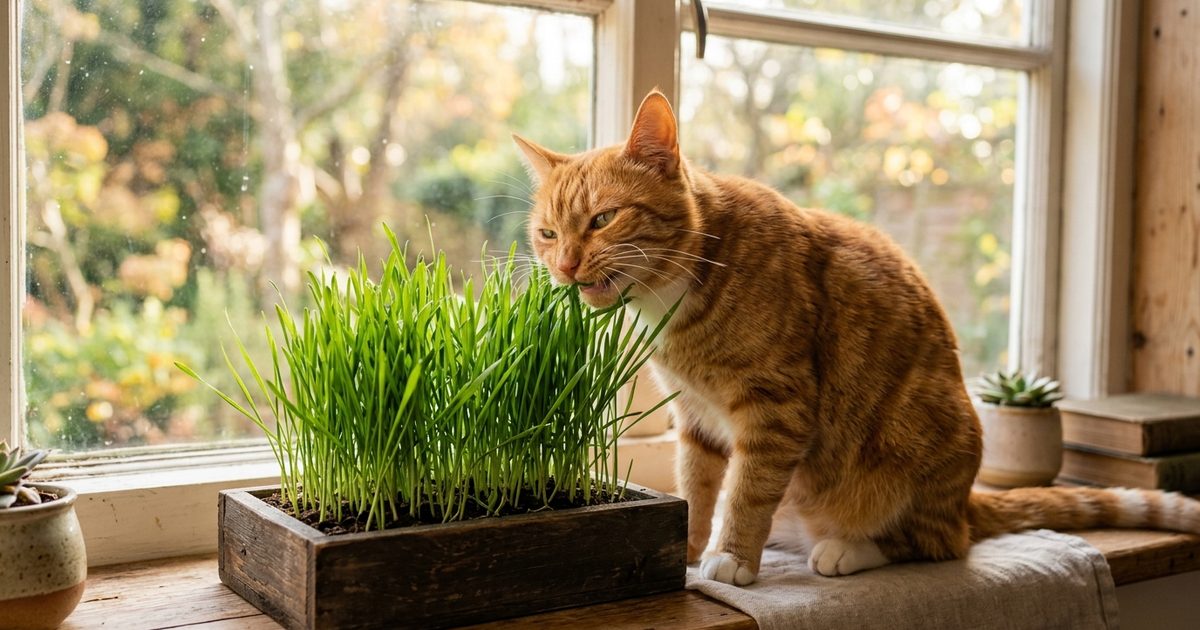
Yes — offering cat grass is safe enrichment for most indoor cats. It gives them something natural to nibble, can reduce boredom-driven chewing on houseplants, and is easy to grow from seed in a small pot. Offer it as a supplement, not a meal.
For an indoor cat with no access to the outdoors, a small tray of cat grass is one of the simplest, lowest-cost enrichments you can provide.
Benefits as enrichment
Wild and outdoor cats graze on grass routinely — it's an ancestral behavior, not a quirk. An indoor cat has the same instinct but none of the outlet, which is part of why bored house cats turn to chewing houseplants, electrical cords, or fabric. A dedicated pot of cat grass gives them a legal, safe target for that drive, redirecting the nibbling impulse away from toxic greenery and toward something you grew on purpose. It's enrichment in the truest sense: a natural behavior, given an appropriate place to happen.
How to grow and offer cat grass
Growing your own is straightforward and removes every variable that makes outdoor grass risky:
- Buy a cat grass seed kit — wheatgrass, oat, or barley seeds are the standard; most kits include a shallow pot, soil disc, and seeds.
- Use untreated soil — no fertilizers, no moisture crystals, nothing added. Plain potting mix is fine.
- Sow densely and keep moist — seeds sprout in 3–7 days; set the pot in a sunny spot.
- Offer once blades are a few inches tall — short enough to nibble, tall enough to pull.
- Replace when it wilts, yellows, or your cat uproots it — fresh growth is more appealing and easier on the gut.
That's the whole system. A new pot every two to three weeks keeps a steady supply.
How much is too much?
Occasional nibbling is entirely normal and harmless — most cats take a few blades and move on. Large volumes eaten quickly can trigger the vomiting reflex (the mechanical throat-tickle we covered earlier) or mild gastrointestinal upset, so if your cat is bingeing rather than grazing, offer smaller amounts more often. The pattern worth mentioning to a vet is pica — obsessive consumption of grass or non-food items like fabric, plastic, or soil — which can signal an underlying nutritional or behavioral issue rather than simple grazing. For the broader picture on when grass-linked vomiting crosses into a real concern, see our guide on cat vomiting.
Curious What Your Cat Would Say?
Upload a photo and get a warm, personalized reading from your cat's perspective.
Start Your Free ReadingGrass-Eating at a Glance — Summary
| Question | Short answer |
|---|---|
| Is it normal? | Yes — grass-nibbling is widespread, normal behavior in both house cats and wild felids |
| Why do they do it? | An inherited instinct that may aid gut motility and parasite clearance; not a sign of illness |
| Does it make them vomit? | Only about a quarter to a third of cats vomit — most don't; vomiting is a side effect, not the goal |
| Which grasses are safe? | Cat grass — wheatgrass, oat grass, barley grass — untreated and grown for pets |
| Which are dangerous? | Chemically treated lawn grass and toxic houseplants like lilies, tulips, and daffodils |
| Should I offer cat grass? | Yes — as safe, enriching nibbling, especially for indoor cats |
| When to worry? | Only if grazing becomes compulsive, or comes with frequent vomiting, lethargy, or appetite loss |
If you've ever wondered what your cat is thinking all day — that blade of grass she chewed, the way she sits on the windowsill — get a MeowMind reading and hear it from her perspective.
Frequently Asked Questions
Is it normal for cats to eat grass?
Yes — grass-eating is widespread and normal in cats. Surveys find the majority of cats eat plant material at some point, and the same habit shows up in wild felids like lions and panthers. It is an ancestral instinct, not a sign of illness or a nutritional gap, in the great majority of cases.
Why do cats eat grass and then throw up?
Only about a quarter to a third of cats vomit after eating grass — most don't. When it happens, it's usually a mechanical side effect: the tough, indigestible blades irritate the throat or stomach lining and trigger the vomiting reflex, rather than the cat deliberately purging itself.
What kind of grass is safe for cats to eat?
Safe cat grass is almost always wheatgrass, oat grass, or barley grass — fast-growing, untreated cereal grasses sold specifically for pets. They're non-toxic, pass through the gut harmlessly, and are easy to grow from seed in a small pot at home.
Can cats eat grass from the lawn outside?
It's best to treat unknown outdoor grass as unsafe by default. Suburban and park lawns are routinely treated with pesticides, herbicides, and fertilizers, and residue clings to the blades. A cat that grazes then grooms its fur ingests whatever was sprayed, so home-grown cat grass is the safer choice.
Should I grow cat grass for my indoor cat?
Yes — for an indoor cat with no outdoor access, a small pot of cat grass is one of the simplest, lowest-cost enrichments you can offer. It gives them a natural nibbling outlet, can reduce boredom-driven chewing on houseplants, and is easy to grow from a seed kit.
Is cat grass the same thing as catnip?
No — they are completely different plants. Cat grass is a true grass (family Poaceae) eaten for fiber and gut function. Catnip is Nepeta cataria, a member of the mint family, whose oils trigger a brief euphoric high. They serve entirely different purposes and aren't interchangeable.
How often should I let my cat eat grass?
Occasional nibbling is normal and harmless — most cats take a few blades and move on. Offer smaller amounts more often if your cat tends to binge, since large volumes eaten quickly can trigger vomiting or mild stomach upset. Steady supply from a fresh pot every two to three weeks works well.
When should I worry about my cat eating grass?
Worth a vet conversation only when the pattern changes — compulsive grazing, frequent vomiting, bringing up blood, lethargy, or refusing food. A single grass-linked episode is normal; a persistent shift may point to a separate issue like pica, and the grass is a clue rather than the cause.
Does eating grass mean my cat is nutritionally deficient?
Almost certainly not. Most cats that eat grass are healthy and on complete commercial diets that supply every nutrient they need, including folic acid. The drive to eat grass appears to be instinctive rather than need-driven — an ancient impulse retained from wild ancestors, not a signal of a dietary gap.
Sources & References
You Might Also Like
Cat Safe Plants: The Complete List of Non-Toxic Houseplants
Cat safe plants: the full list of non-toxic houseplants cats can live with — spider plants, ferns, palms, cat grass, catnip. Which to avoid, and safety rules.
22 min readKitten Teething: Timeline, Symptoms & How to Help
Kitten teething runs from 3 to 7 months as baby teeth fall out. Learn the timeline, signs to watch for, and how to soothe a teething kitten safely.
15 min readWhen Do Cats Stop Growing? A Complete Timeline
When do cats stop growing? Most cats reach adult size by 12-18 months, but large breeds like Maine Coons keep growing until 3-4 years. Full timeline inside.
14 min read