
What Does Catnip Do to Cats? The Science, Safety & Effects
If you've ever wondered what does catnip do to cats, the short answer is that this common herb flips a switch in roughly two-thirds of domestic cats — sending them into a few blissful minutes of rolling, rubbing, and leaping before they reset as if nothing happened. It's the closest thing the feline world has to a guaranteed party trick, and understanding catnip for cats — the plant, the chemistry, and the behavior it unlocks — answers the question every owner eventually asks: why do cats like catnip so much? This guide walks through what catnip is, how it works in the brain, why only some cats react, whether it's safe, and the best alternatives for the cats who don't.
Key takeaways
- Catnip (Nepeta cataria) is a perennial herb in the mint family whose essential oil, nepetalactone, triggers a temporary euphoric response in cats through their sense of smell — not through their stomach.
- Only about 50–70% of domestic cats react, and the trait is hereditary; kittens under roughly six weeks and many elderly cats show little to no response.
- Catnip is non-toxic, non-addictive, and a cat cannot fatally overdose on it — used in moderation, it's a safe, low-cost enrichment tool.
Catnip at a Glance — Quick Reference
| Question | Short answer | Detail |
|---|---|---|
| What is catnip? | A perennial mint-family herb (Nepeta cataria) containing the oil nepetalactone | What Is Catnip, Exactly? |
| What does it do to cats? | Triggers rolling, rubbing, drooling, and play lasting 5–15 minutes | The Classic Response |
| Why do only some cats react? | It's a dominant hereditary trait — about 50–70% carry the gene | Why Do Only Some Cats React? |
| How does it work? | Nepetalactone binds olfactory receptors that signal the brain's emotion centers | How Does Catnip Actually Work? |
| Is it safe? | Yes — non-toxic, non-addictive, no fatal overdose; only mild stomach upset if overeaten | Is Catnip Safe for Cats? |
| What are the alternatives? | Silver vine, valerian, and honeysuckle reach many catnip non-responders | Catnip Alternatives |
What Is Catnip, Exactly?
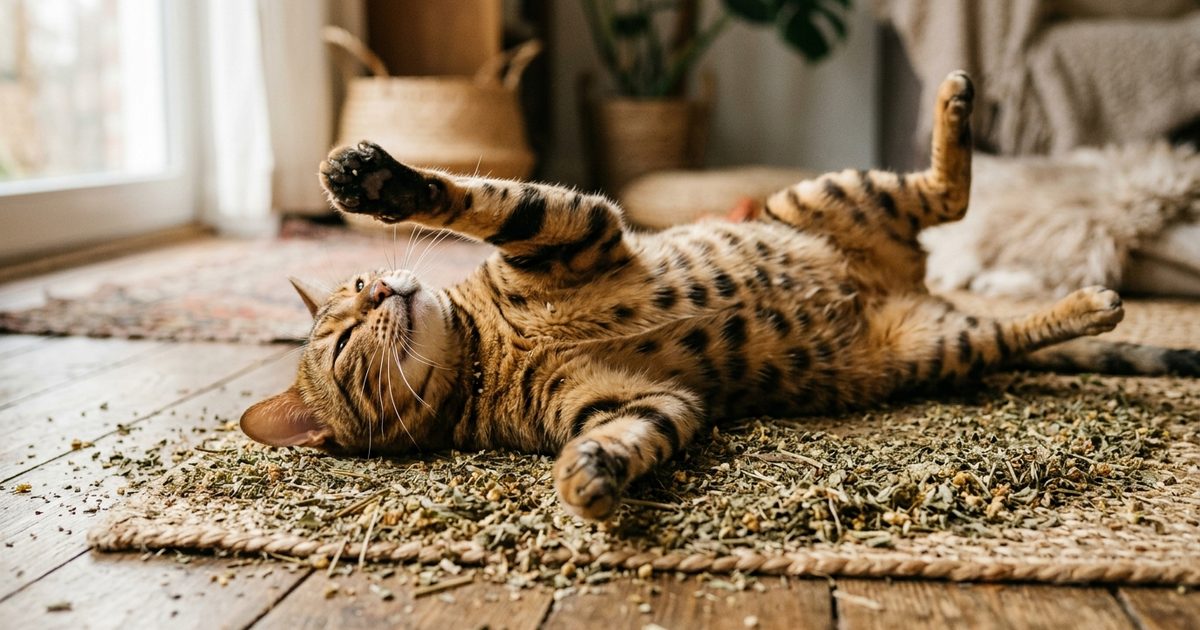
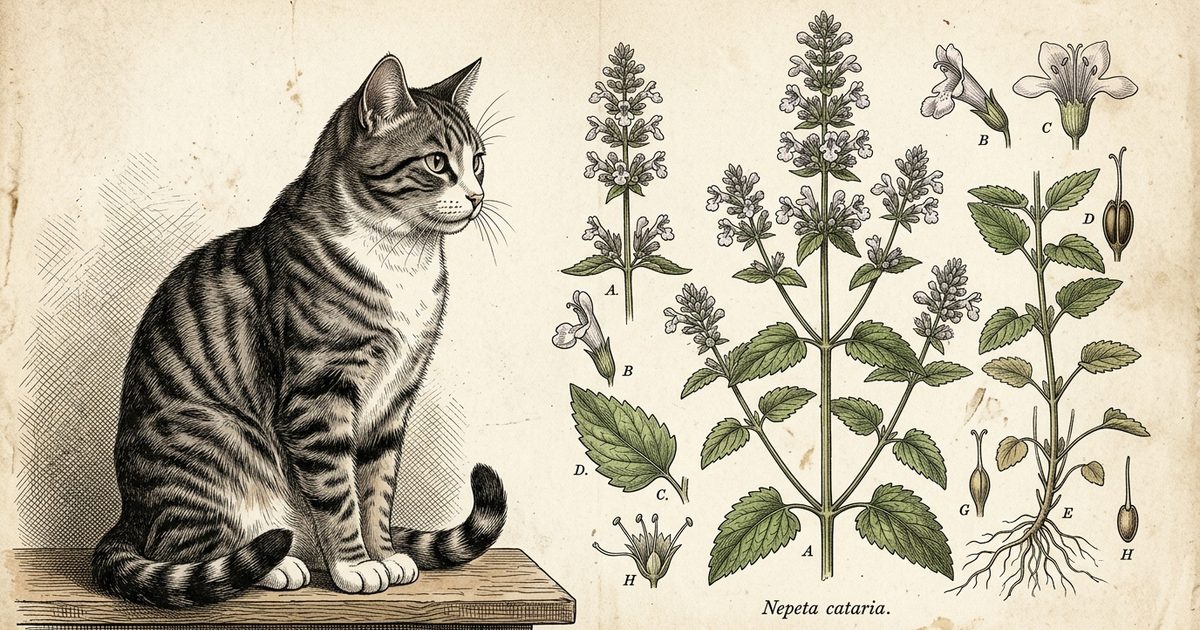
Catnip is a perennial herb in the mint family, Nepeta cataria, also called catmint. Its leaves and stems release an essential oil called nepetalactone — the compound that triggers the famous feline reaction. Native to Europe and Asia, it is easy to grow and entirely unrelated to cat grass.
Nepeta cataria and the mint family
Catnip belongs to Nepeta, a genus within the Lamiaceae — the mint family, which also includes basil, rosemary, and lavender. Like its relatives, it has square stems, toothed heart-shaped leaves, and a pungent herbal fragrance. The species that matters to cats is specifically Nepeta cataria, native to southern and eastern Europe, the Middle East, and parts of Asia, though it now grows wild across much of the temperate world.
The naming can trip owners up. "Catmint" and "catnip" are used almost interchangeably in garden centers, and many ornamental Nepeta plants sold as "catmint" are actually other species (like Nepeta × faassenii) bred for their flowers rather than their effect on cats. True catnip — the plant that sends cats into their rolling, blissed-out episode — is N. cataria, and it's the one worth growing or buying if the reaction is the point.
One common confusion worth clearing up early: catnip is not cat grass. Cat grass is usually oat, wheat, or barley seedlings that cats nibble for fiber and digestion, whereas catnip is a flowering herb cats respond to primarily through smell. If you've watched your cat eat grass and wondered whether catnip does the same thing — it doesn't. Different plant, different behavior, different reason.
Where nepetalactone comes from
The magic ingredient is nepetalactone, an essential oil stored in microscopic bulbs across the surface of catnip's leaves, stems, and seed pods. The plant doesn't release much of it on its own — the oil sits behind the leaf surface until something breaks the tissue.
That's why a cat's interaction matters so much. Sniffing a whole, intact leaf does almost nothing; but the moment a cat bites, rubs, or even just brushes hard against the plant, tiny leaf hairs rupture and a cloud of nepetalactone-rich vapor heads straight for the nose. Growers and foragers also note that the oil concentration in the plant peaks just before it blooms — which is why catnip harvested right before flowering tends to be the most potent, and why dried catnip sold for cats is usually cut at that stage.
Fresh, dried, spray, and live plants
Owners mostly encounter catnip in four forms, and potency varies meaningfully between them. Dried catnip — crumbled leaves and flowers sold in tubs and sachets — is the most common and cost-effective; it loses potency over months once exposed to air, so keeping it sealed matters. Fresh leaves and stems, snipped from a live plant, are more pungent but fragile and don't keep long. Sprays are catnip-infused water or low-concentration extracts, much milder but convenient for refreshing old toys. And live plants — a potted N. cataria on a sunny sill — give a cat access to the freshest, most intact form, released only when she bruises the leaves herself.
What Does Catnip Do to Cats? The Classic Response
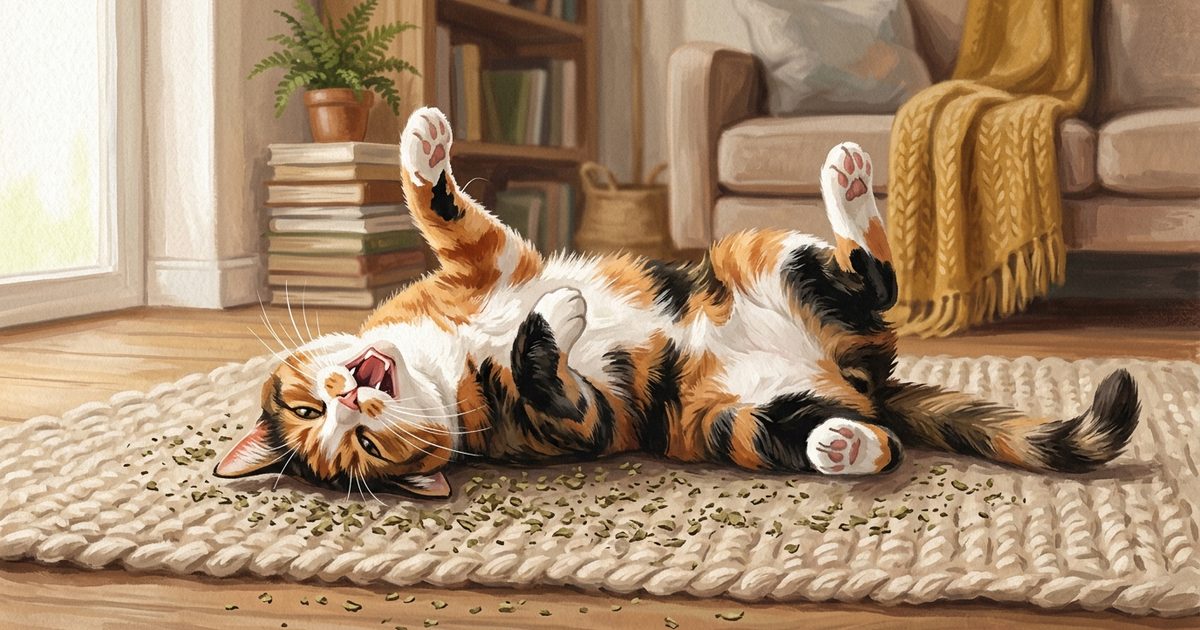
Within seconds of sniffing catnip, a responsive cat rolls, rubs, flips, leaps and paws at the air, often drooling and vocalizing. The episode lasts about five to fifteen minutes, then the cat resets and cannot be triggered again for roughly an hour or two — a built-in cooldown.
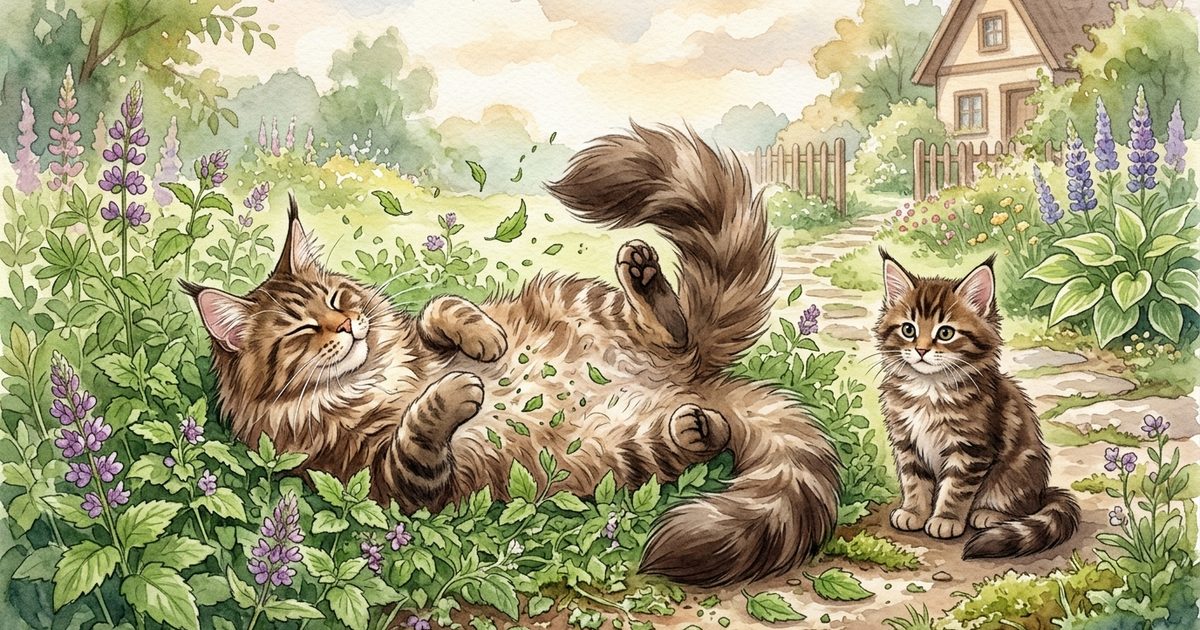
If you've ever watched a cat meet catnip for the first time, you know the look: a few quick sniffs, then a sudden, joyful unraveling. The cat drops one shoulder, rolls onto its back, rubs its cheeks into the leaves, and kicks its hind legs at nothing in particular. Some cats leap up mid-roll and charge across the room; others stay flat on the floor, eyes glassy with pleasure, drooling faintly. This is the classic cats on catnip response — and it is one of the most reliably entertaining things a cat will ever do.
What catnip does to cats, in plain terms, is flip a switch in the brain that produces a short burst of intense, playful, often affectionate behavior — and then, just as reliably, turns itself off. The whole arc is brief, self-limiting, and entirely harmless. Below is what it looks like up close, how long it lasts, and why smelling and eating catnip produce surprisingly different effects.
The four classic behaviors
The catnip response tends to unfold in a recognizable sequence, though every cat improvises on the theme. First comes sniffing — focused, deep inhalations with the nose close to the source, sometimes with the mouth slightly open as the cat draws scent over the vomeronasal organ. Within seconds the behavior escalates. Next is head-rubbing and rolling: the cat presses its chin, cheeks, and the top of its skull into the catnip, often flipping onto its back and writhing with paws curled. This cheek-rubbing overlaps with the same scent-and-pleasure circuit behind why cats rub against your legs, and the full-body rolling looks remarkably like the affectionate display described in how cats show affection. Third, some cats begin drooling or rhythmic kicking with the hind legs, lost in a kind of bliss that can trigger contentment behaviors like kneading. Finally, the leaping and play phase: sudden bursts of energy, chasing imaginary prey, batting at the air. Afterward, many cats settle into a long, satisfied purr — the comedown after the party.
Individuals vary enormously. Some cats stop at rolling; others never sit still. A lucky few do all four stages in five frantic minutes. There is no "correct" response — the spectrum is the point.
How long it lasts
The whole episode is strikingly short. Onset begins within seconds of the first deep sniff, the peak response typically runs five to fifteen minutes, and then the cat simply walks away or sits down and grooms itself as if nothing happened. Try to re-trigger the response immediately and almost nothing occurs — the cat enters a refractory period of roughly one to two hours during which the olfactory pathway is effectively reset. This refractory period is biological, not boredom: the receptors need time to recover sensitivity to nepetalactone. The self-limiting nature of the response is part of what makes catnip so easy to live with — there is no way to sustain it, and the cat decides when the session is over.
Sniffing vs eating — two different effects
Here's a detail that surprises many owners: smelling catnip and eating it do different things. The famous euphoric rolling-and-leaping response is triggered by scent — nepetalactone hitting the olfactory epithelium on the way to the brain. Eating catnip takes a different route. When a cat ingests a meaningful quantity, the effect tends to shift toward mild sedation: the cat may become quieter, sleepier, and more mellow rather than excitable.
So, can cats eat catnip? Yes, in small amounts it is harmless, and some cats seem to enjoy nibbling the leaves — but it tends to mellow rather than stimulate, which is why a cat that eats its catnip may simply curl up for a nap instead of throwing a party. The two routes, smell and stomach, produce two different experiences, and which one your cat gets depends mostly on whether it sniffs or chews.
How Does Catnip Actually Work? The Science
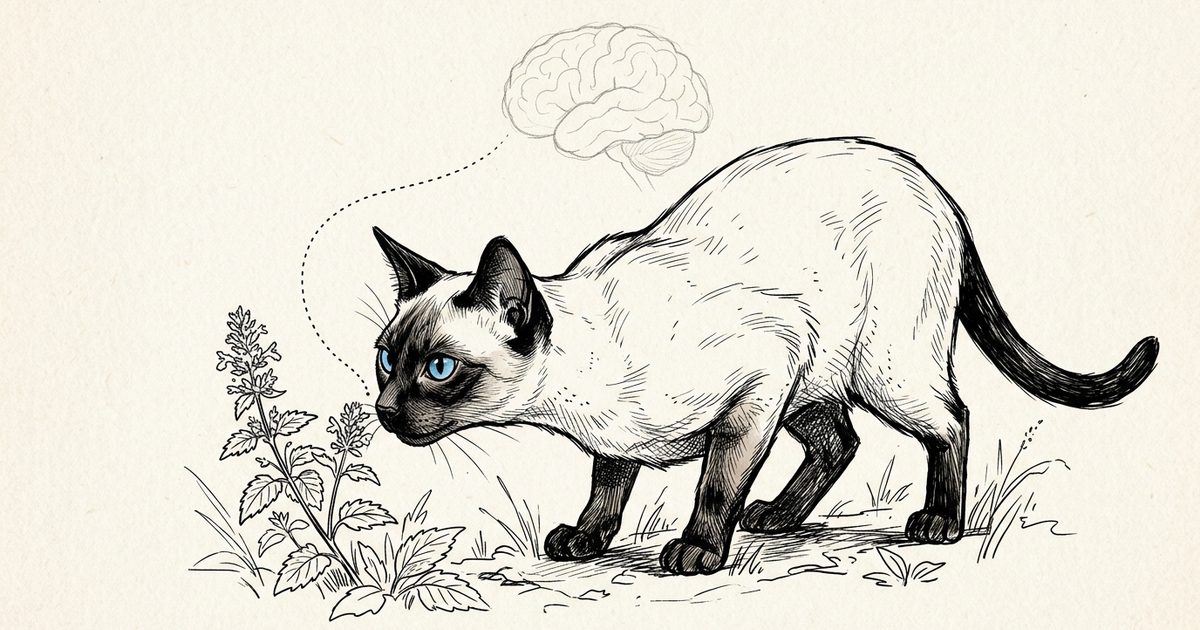
Nepetalactone binds to olfactory receptors in a cat's nose, which then signal the amygdala and hypothalamus. The pathway resembles a feline sex pheromone's, so the reaction looks romantic — though catnip is not a pheromone and works in neutered cats.
The visible catnip response — the rolling, the drooling, the sudden leaping — is dramatic, but the mechanism behind it is more elegant than it looks. It is not a drug high in any meaningful sense; it is a fast, specific, scent-driven conversation between a plant compound and a cat's olfactory system. Understanding the route nepetalactone takes, and the brain regions it ultimately reaches, explains both why the response is so intense and why it is so brief, so harmless, and so impossible to get addicted to.
Nose to brain in seconds
The response begins, and can only begin, through the nose. When a cat sniffs catnip, nepetalactone molecules bind to specialized olfactory receptors in the nasal epithelium. Those receptors fire signals along the olfactory nerve directly into the brain — notably the amygdala, which processes emotion, and the hypothalamus, which governs behavioral and autonomic responses. The whole relay takes seconds, which is why the onset is so sudden. This is strictly a smell phenomenon: cats that are anosmic, or whose olfactory epithelium is compromised, do not respond at all, even to fresh, potent catnip. Equally telling, injecting nepetalactone or feeding it in large amounts does not reproduce the classic euphoric response — only inhalation does. The compound needs the olfactory route to trigger the cascade; bypassing the nose bypasses the entire effect.
A pheromone pathway, not a drug high
The reason the response looks romantic — the rolling, the lordosis, the affectionate rubbing — is that the hypothalamic circuit nepetalactone activates closely resembles the one fired by feline sexual pheromones. But the resemblance is where the comparison ends. Catnip itself is not a pheromone; it is a plant compound that happens to stimulate a pathway evolution built for chemical signaling between cats. Crucially, the response is non-sexual: neutered and spayed cats react just as strongly as intact ones, which would be impossible if this were truly a reproductive signal. This is also why the popular "marijuana for cats" framing is misleading — catnip does not act on cannabinoid, opioid, or dopamine reward systems at all. It works through scent and hypothalamic behavioral circuits, a completely different mechanism. International Cat Care describes the catnip response as a short-lived, olfactory-driven behavioral reaction rather than any form of intoxication.
Why it is not addictive
Because nepetalactone does not engage the brain's reward circuitry in the way addictive substances do, catnip produces no dependency, no tolerance spiral, and no withdrawal. There is no opioid or dopamine loop reinforcing repeated use; the cat does not "need" catnip, and giving it more often does not deepen the effect. In fact, the opposite is true — cats can develop a degree of habituation with overexposure, where the response becomes blunted after too-frequent use, which is one reason experienced owners offer catnip only occasionally rather than daily. The refractory period after each session is biological, not behavioral craving: the olfactory receptors need time to reset their sensitivity, and no amount of fresh catnip will override it. A cat begging for catnip is excited by the novelty and the play, not driven by a chemical need — and a cat that never receives catnip again will be entirely fine. For safety context, the Cornell Feline Health Center treats catnip as a non-toxic, enrichment-appropriate herb for healthy adult cats.
Curious what your cat would say about her catnip moments? Get a MeowMind reading.
Why Do Only Some Cats React to Catnip?
The catnip response is a dominant hereditary trait — roughly half to two-thirds of domestic cats carry the gene that lets them react. Kittens under about six weeks and many elderly cats show little to no response, and the trait is absent in some entire species, including most tigers.
If you've ever sprinkled catnip in front of two cats and watched one melt into the floor while the other walks away unimpressed, you've witnessed genetics in action. The split is real, predictable, and has nothing to do with how much your cat loves you.
A dominant gene, not preference
Whether a cat reacts to catnip is wired into its DNA. The sensitivity is inherited as an autosomal dominant trait, which means a cat only needs one copy of the "responder" gene to feel the effect. Estimates from behavioural studies put the responder rate somewhere around 50 to 70 percent of domestic cats — so non-reactors are not rare, and they are not broken. They simply lack the gene.
This is the real answer to why do cats like catnip: the ones who do, do so because their olfactory hardware is built to bind nepetalactone, not because they've developed a taste for it. A non-responder sniffing the same pinch of dried herb gets nothing — the receptors just aren't there. For both parents to produce a non-responder kitten, neither parent can carry the gene, which is why the trait runs in family lines and why some breed groupings show a noticeably higher or lower reactor rate. International Cat Care describes the response as inherited and automatic, not learned.
Age and the kitten window
Even a genetically responsive cat won't always react. The sensitivity needs time to switch on. Kittens under roughly six weeks old ignore catnip entirely — their olfactory and neurological pathways haven't matured enough to register it. The response typically emerges around three to six months of age, which is why offering catnip to a tiny kitten is usually wasted.
At the other end of life, many senior cats see their reaction fade or disappear as sensory acuity declines. So if your older cat who once went wild for catnip now barely flicks an ear, that's a normal age-related change, not a sign something is wrong. For context on where your cat sits in the life-stage timeline, our guide on how to tell a cat's age breaks down the physical markers.
Species and breed variation
The catnip gene reaches beyond domestic cats into the wider feline family — but unevenly. Lions, leopards, and jaguars often react enthusiastically, rolling and rubbing just like a house cat. Tigers, curiously, almost never do; they appear to lack the relevant sensitivity across the species. This pattern is one of the strongest pieces of evidence that the response is genetic rather than learned, since no one is teaching a leopard to enjoy Nepeta cataria.
Within domestic cats, there is no reliable breed predictor. You'll see claims that certain breeds react more than others, but the evidence is anecdotal and inconsistent — individual lineage matters far more than breed label. A supposedly "high-response" breed can be a total non-responder, and a common mixed-breed moggy can be the most euphoric catnip fan on your block. Promise your cat nothing by breed; just offer and see.
Is Catnip Safe for Cats?
Catnip is non-toxic, non-addictive, and a cat cannot fatally overdose on it. The main risk if a cat eats too much is mild stomach upset or overstimulation that leads to a brief grumpy comedown — not poisoning. Used in moderation, it is safe for healthy adult cats.
Catnip has been offered to cats for centuries, and the safety record is reassuring. That doesn't mean it's consequence-free — moderation and a few common-sense rules are what keep it enjoyable.
Toxicity and overdose — the real picture
Nepeta cataria is classified as non-toxic to cats by veterinary poison-control authorities. The Cornell Feline Health Center lists catnip among the safe herbs for feline enrichment, and the ASPCA likewise records it as non-toxic. There is no documented case of a cat suffering a fatal overdose from catnip.
That is not a license for unlimited access. If a cat eats a large amount of dried catnip in one sitting, the most likely outcome is mild gastrointestinal upset — vomiting or diarrhea — as the stomach objects to the volume of plant material. The effects are self-limiting and pass within hours. So to the common question is catnip bad for cats: no, not in normal use. The compound is processed and cleared quickly, and the refractory period described earlier means a cat literally cannot keep stimulating itself indefinitely.
Overstimulation and aggression
The more realistic risk isn't poisoning — it's arousal spilling over into conflict. Catnip amps up playfulness and excitability, and in a multi-cat household that heightened energy can tip into chasing, posturing, or a brief squabble, especially between cats who already have a tense relationship.
The fix is straightforward. If you have more than one cat, offer catnip in separate spaces and watch the first few sessions to see how each individual handles it. Some cats become giddy and harmless; others get a little too full of themselves. If play turns aggressive, a short break and a calm reset is usually all that's needed. This nuance is the honest answer to is catnip good for cats: yes, as enrichment, with the caveat that you read the room — and the cats in it. Many cats wind down a catnip session with a stretch and a purr, which is a good sign the experience landed as pleasure rather than overload.
Who should avoid it
A few cats are better off skipping catnip, or at least getting a vet's nod first. Pregnant cats are often advised to avoid it, as the uterine-stimulating folklore around catnip — debated and unproven — is reason enough for caution during pregnancy. Cats with a history of seizures should not be given catnip without consulting a veterinarian, since there are anecdotal reports (not firmly established) of it lowering seizure threshold in susceptible animals. And kittens under six months typically don't respond anyway, so there's no reason to offer it.
The general principle: if your cat has any ongoing health condition, ask your vet before introducing catnip — not because it's dangerous, but because no single herb is right for every medical situation, and your vet knows your cat's full picture.
Catnip Alternatives: Silver Vine, Valerian & More
If your cat ignores catnip, about four out of five will respond to silver vine (Actinidia polygama), and many react to valerian root, Tatarian honeysuckle, or honeysuckle wood. These plants use different compounds, so a catnip non-responder is not a catnip-plant non-responder across the board.
Roughly a third to half of domestic cats give catnip the cold shoulder — the response is hereditary, and they simply lack the gene for it. The good news is that catnip is only one of several plants that trigger a feline euphoric reaction, and they don't all use the same chemistry. If your cat walks away from a catnip mouse, she may still flip for silver vine. International Cat Care notes that offering a range of these plants is a simple, low-cost way to enrich the lives of cats that don't respond to catnip — and even many that do.
Silver vine (matatabi)
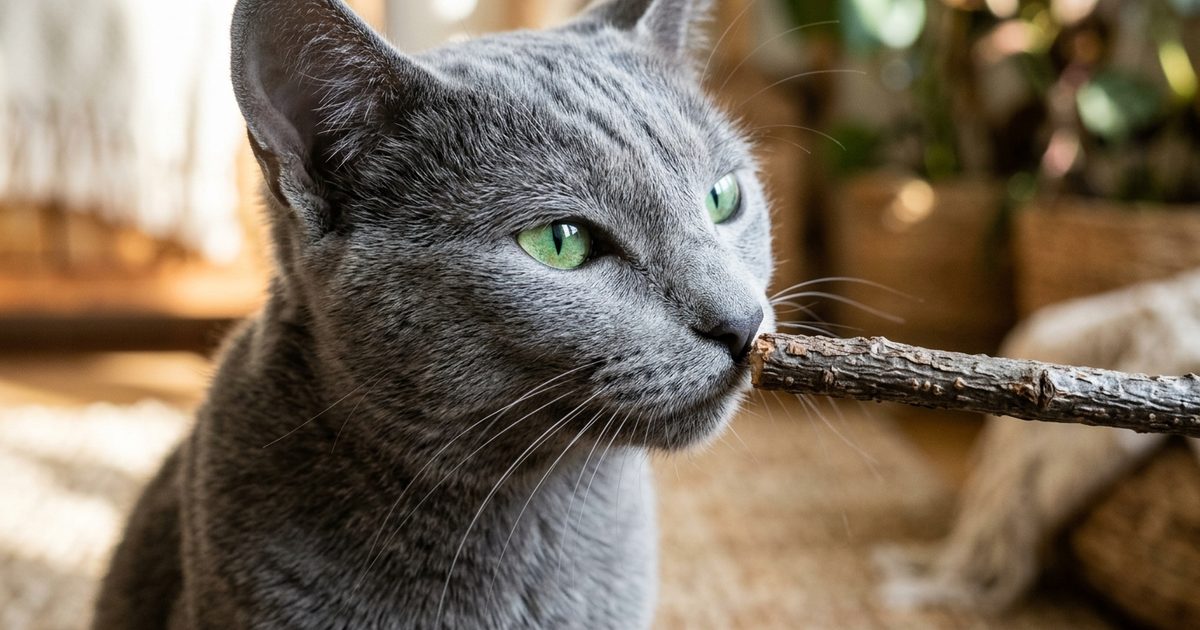
Silver vine, known in Japan as matatabi, is the strongest and best-studied alternative. Made from the gall of the Actinidia polygama plant (a kiwi relative), it produces a response in around 80% of domestic cats — including many that completely ignore catnip. Its active compounds are actinidine and dihydroactinidiolide, which bind to different olfactory receptors than nepetalactone, which is why the non-responder overlap isn't total. A silver vine stick gives your cat something to sniff, chew, and bat, and most cats that react show the same rolling, rubbing, and leaping display as a catnip responder — just triggered by a different molecule.
Valerian, honeysuckle, Tatarian
Beyond silver vine, three other plants reliably trigger a catnip-like response, each through a distinct active compound. Valerian root contains actinidin and isovaleric acid and tends to produce a mellower, more lounging reaction. Tatarian honeysuckle (Lonicera tatarica) wood, along with ordinary honeysuckle, contains compounds cats respond to when the wood is moistened. Each plant has a slightly different effect profile — some cats get playful, others get sleepy — so it's worth offering more than one to see which suits your cat. They're sold as dried loose herb, wood chunks, or stuffed toys, and most cats respond within seconds of sniffing.
Rotating plants to prevent tolerance
Cats can grow temporarily less responsive to any one plant compound if they encounter it constantly — the novelty that fires the response dulls with repetition. Rotating catnip with silver vine, or alternating a valerian toy one week and a honeysuckle chunk the next, keeps each one fresh and the response strong. A practical rhythm: offer a plant-based enrichment item once or twice a week, then put it away for several days. The refractory period after each session handles the short-term reset, and the rotation handles the long-term one.
How to Use Catnip: Toys, Enrichment & Training
Use catnip as enrichment, not as a daily treat: a pinch in a toy or on a play mat turns a boring afternoon into a lively five-minute party. Limit sessions to a couple of times a week so it stays special.
The practical appeal of catnip is that it's a cheap, safe way to inject novelty into a house cat's day. Indoor cats live in a small, predictable world, and a brief, intense play session triggered by scent mimics the stimulation of a hunt. The key is restraint — catnip works best as an occasional event, because the response stays sharpest when it remains surprising. Used well, it doubles as a gentle training tool for steering behavior toward where you'd prefer it.
Catnip toys and refillables
Catnip-filled toys are the everyday workhorse form. Refillable mice, pouches, and kickers let you top up the dried herb as the scent fades, which it does after a week or two of regular play. A small pinch — roughly a quarter teaspoon — is plenty; more doesn't intensify the response, it just wastes the herb. To revive a tired toy, rub fresh dried catnip between your fingers to bruise the leaves and release the oil, then stuff it in. The Cornell Feline Health Center treats catnip-toy enrichment as a standard, low-risk way to encourage activity in indoor cats.
Scratching posts and training redirects
Catnip is a useful ally for encouraging scratching where you'd rather it happen. Rubbing dried catnip directly into a new scratching post — working it into the sisal fibers — draws a cat to investigate and claw, which builds the habit of using the post instead of the sofa. This works for the same reason cats rub against your legs to claim you: scent is how they decide a surface is worth their attention, so the same scent-attraction logic that drives head-butting and leg-rubbing applies to a post you've catnip-scented. As broader indoor enrichment, pairing a catnip session with a cardboard box hideaway or a favorite box gives a cat both stimulation and a retreat — the two things an indoor environment most often lacks.
Live plants and safe DIY
Growing your own Nepeta cataria indoors is easy and rewarding — it's a hardy mint relative that does well in a sunny window and lets you harvest fresh, bruise-and-offer leaves on demand. If you buy a plant or seeds, source from a supplier that doesn't use pesticides or systemic treatments, since your cat will be chewing and rolling on the leaves. One caution worth flagging: avoid catnip essential oil concentrates. Catnip oil is not the same as the herb — it's a highly concentrated distillation that can be overwhelming to a cat's sensitive nose and skin, and the safety profile of the dried plant doesn't transfer to the pure oil. Stick with the dried herb, fresh leaves, or a live plant, and skip the oils entirely.
Catnip at a Glance — Summary
| Question | Short answer |
|---|---|
| What is catnip? | A mint-family herb (Nepeta cataria) that releases the oil nepetalactone |
| What does catnip do to cats? | Triggers rolling, rubbing, leaping, and a brief euphoric play episode |
| How does catnip work? | Nepetalactone binds olfactory receptors, signaling emotion brain regions |
| Why do only some cats react? | The response is a dominant hereditary trait — about 50–70% of cats |
| Is catnip safe for cats? | Yes — non-toxic, non-addictive, and no fatal overdose in normal use |
| Can cats eat catnip? | Yes, in small amounts — eating tends to sedate rather than stimulate |
| What are the best alternatives? | Silver vine (~80% response), valerian root, and Tatarian honeysuckle |
| How often should I give catnip? | A couple of times a week, so each session stays special |
Curious What Your Cat Would Say?
Upload a photo and get a warm, personalized reading from your cat's perspective.
Start Your Free ReadingFrequently Asked Questions
What does catnip do to cats?
Catnip triggers a short burst of rolling, rubbing, drooling, and leaping that lasts about five to fifteen minutes, followed by a built-in cooldown. The response is driven by smell — the oil nepetalactone hits olfactory receptors that signal the brain's emotion centers.
Why do cats like catnip?
Cats that react do so because they inherited the gene that lets their olfactory receptors bind nepetalactone — not because they developed a taste for it. Roughly 50 to 70 percent of domestic cats carry this dominant trait and react automatically.
Is catnip safe for cats?
Yes. Catnip is classified as non-toxic by veterinary poison-control authorities, and there is no documented case of fatal overdose. The main risk is mild stomach upset if a cat eats a large amount, or overstimulation in multi-cat homes — both easy to manage with moderation.
Can cats eat catnip?
Yes, in small amounts. Eating catnip tends to have a mellowing, mildly sedative effect rather than the euphoric rolling triggered by smell. If your cat eats its catnip and then naps instead of playing, that is normal — just keep quantities modest.
Why doesn't my cat react to catnip?
Most likely your cat simply lacks the hereditary gene — about 30 to 50 percent of cats are non-responders. Kittens under six weeks and many senior cats also show little response, and some entire species, like tigers, do not react at all.
How long does a catnip response last?
The peak reaction runs about five to fifteen minutes from the first deep sniff, then the cat resets and grooms itself. A refractory period of roughly one to two hours follows, during which the receptors recover and the cat cannot be re-triggered.
Is catnip addictive for cats?
No. Nepetalactone does not engage the brain's reward circuitry the way addictive drugs do, so there is no dependency, tolerance spiral, or withdrawal. In fact, overexposure can blunt the response through habituation, which is why occasional use works best.
Can kittens have catnip?
Kittens under about six weeks old ignore catnip entirely, and the response typically only emerges around three to six months of age. It is safe but usually wasted on very young kittens — there is no reason to offer it until they are old enough to react.
What is a good alternative to catnip?
Silver vine (matatabi) is the strongest alternative, producing a response in around 80 percent of cats, including many catnip non-responders. Valerian root, Tatarian honeysuckle, and ordinary honeysuckle wood also trigger a similar reaction through different compounds.
How often can I give my cat catnip?
Aim for a couple of times a week rather than daily. Occasional use keeps the response sharp, since cats can become habituated with overexposure, and each session is naturally self-limiting thanks to the built-in refractory period.
Sources & References
You Might Also Like
Kitten Teething: Timeline, Symptoms & How to Help
Kitten teething runs from 3 to 7 months as baby teeth fall out. Learn the timeline, signs to watch for, and how to soothe a teething kitten safely.
15 min readWhen Do Cats Stop Growing? A Complete Timeline
When do cats stop growing? Most cats reach adult size by 12-18 months, but large breeds like Maine Coons keep growing until 3-4 years. Full timeline inside.
14 min readCan Cats Eat Cherries? Flesh, Pit & Toxicity Facts
Can cats eat cherries? Pitted flesh is safe in tiny amounts — but the pit, stem, and leaves are toxic (cyanide precursors). Learn what's safe and what isn't.
15 min read