Why Do Cats Like Boxes? The Science of the Obsession
If you've ever wondered why do cats like boxes, the answer is that an ordinary cardboard box hits nearly every feline comfort trigger at once. Leave one on the floor and your cat appears within minutes — it's practically a law of nature. Walls on all sides offer protection, the cardboard holds warmth, a hiding spot lowers stress, and the low edge makes a perfect ambush post. A box isn't random furniture to a cat; it's a personal fortress.
Key takeaways
- A box delivers safety, warmth, stress relief, and an ambush point all in one — which is why it's almost irresistible.
- Enclosed spaces tap a deep instinct for den-like security; cats feel protected when they can't be approached from behind.
- Cardboard insulates, so a box stays cozy — and cats consistently seek out warm spots to rest.
- A hiding spot helps a stressed cat regain control over its environment, which is why boxes calm anxious cats.
Why Cats Like Boxes — Quick Reference
| Reason | What the cat does | The science |
|---|---|---|
| Safety and enclosure | Slips inside, turns to face the opening, settles | Walls on all sides satisfy a wild instinct for den-like protection |
| Warmth | Curling up tightly, often dozing | Cardboard insulates, holding the cat's body heat |
| Stress relief | Hiding when visitors or noise arrive | A hiding spot lowers anxiety and helps cats regain control |
| Ambush post | Crouching low, peeking over the edge, pouncing | Low vantage point mirrors the stalk-and-pounce hunting sequence |
| Play and territory | Batting, rubbing, claiming a new box | Novel objects trigger investigation and scent-marking |
Why Do Cats Like Boxes?
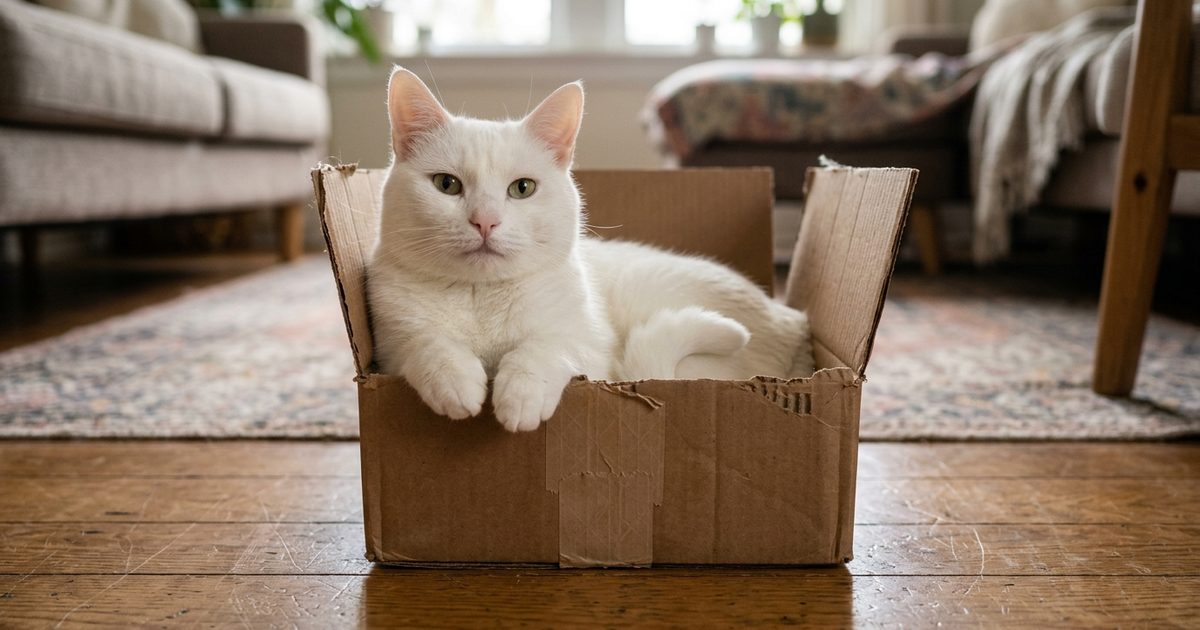
Cats like boxes because an enclosed space satisfies core feline instincts at once: walls on all sides provide safety, cardboard traps warmth, a hiding spot lowers stress, and the confined shape becomes an ambush point. In short, a box is a cat's personal fortress.
The pull of a cardboard box is so reliable it feels like a punchline, but underneath the comedy is genuine biology. A box checks nearly every comfort trigger a cat carries in its wiring — and unlike an expensive cat bed, it does all of it simultaneously. To understand why your cat abandons the fancy bed for the box it came in, it helps to break the appeal into the four instincts a box satisfies.
Safety and enclosure
A box is four walls and a floor — and to a cat, that geometry reads as protection. Cats are both predators and prey by ancestry, and an animal that can be hunted wants its back covered. Walls on every side mean nothing can approach unseen, which lets a cat fully drop its guard and rest rather than stay half-alert. The same instinct pushes cats into drawers, closets, and the gap behind the sofa. A box is simply the cleanest version of that safe space, and it's one reason a hidden, defensible spot is part of how cats show affection — a cat that feels secure enough to settle is a cat that trusts its home.
Warmth
Cardboard is a surprisingly good insulator, and that matters more than you'd think. A cat's resting body temperature runs a few degrees higher than a human's, and cats actively seek out warmth to conserve energy — the same drive behind them sprawling in sunbeams or curling on your laptop. A box holds the cat's body heat in a small enclosed pocket of air, so it stays noticeably warmer than the open room. That cozy microclimate is a big part of the draw: the box isn't just hiding your cat, it's actively keeping it comfortable.
Stress relief
This is where the box obsession crosses from folk wisdom into real evidence. In a well-known study in a Dutch animal shelter, cats given cardboard boxes adapted faster and showed lower stress levels than cats without them (we cover the study in detail below). A hiding spot gives an anxious cat something crucial — control over its environment — because it can choose when to be seen and when to retreat. That sense of control is exactly what lowers stress, and it's why a box can calm a cat in an unfamiliar place. International Cat Care treats access to a hiding place as a basic element of good cat welfare.
Ambush and play
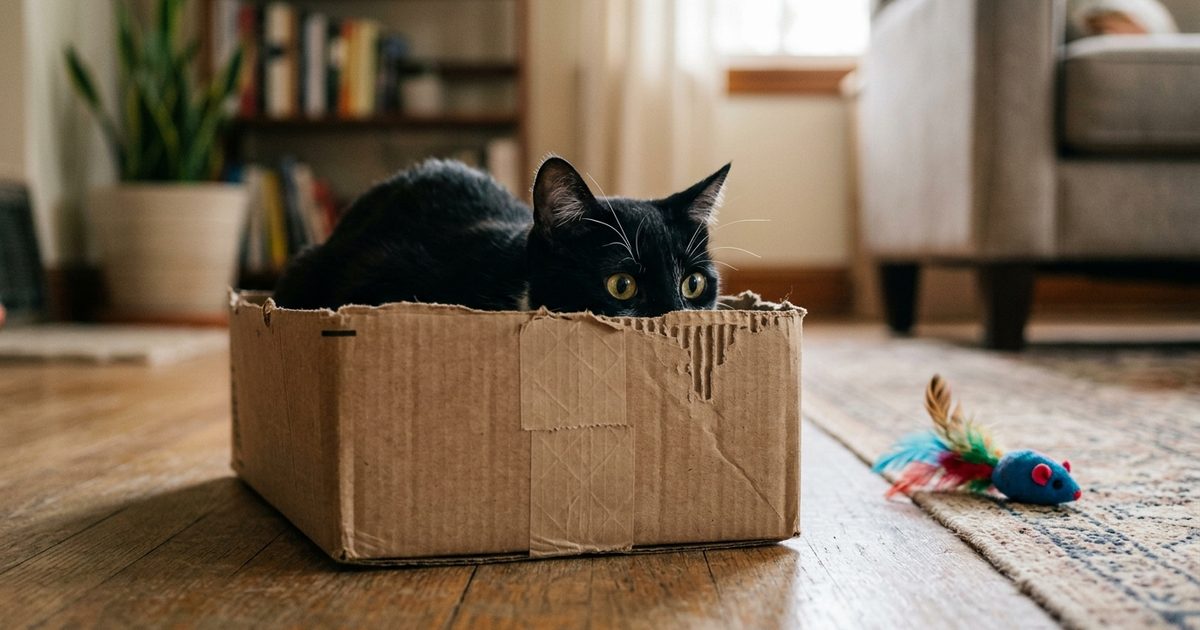
A box is also a blind, and cats know it. Crouched low inside, peering over the edge with only their ears and eyes visible, a cat gets a covered vantage point to stalk a toy, a passing ankle, or another pet. This taps straight into the predatory sequence — watch, stalk, pounce — and a box sets up the "watch" and "stalk" stages perfectly. The same ambush logic is why cats freeze and fixate before they spring, a pattern we break down in why cats stare. A box lets your cat rehearse the hunt in safety, which is deeply satisfying work for a predator.
Why Are Cats Obsessed With Boxes?
The obsession is instinctive: a box delivers safety, warmth, and a vantage point all at once. Cats are also wired to investigate anything new in their territory — and a box is both novel and instantly claimable.
The all-in-one appeal
We saw in the intro that a box hits nearly every feline comfort trigger at once — and that is exactly what elevates it from one good spot to the object. Most hiding places manage only the safety half; a box also positions a cat to spring. Novelty seals it: cats are territorial, and a fresh box is an uncharted, smellable, claimable new room. That is why a cat ignores the bed you bought months ago but fights for the box it was shipped in — the same novelty-seeking instinct behind why cats knead new blankets.
Do Boxes Really Help Cats With Stress?
Yes — a study in a Dutch animal shelter found that cats given boxes recovered from stress and adapted to the shelter faster than cats without them. A hiding spot gives a stressed cat control over its environment, which is exactly why boxes calm anxious cats.
The shelter study
The strongest evidence comes from a 2014 study at a Dutch animal shelter. Researchers split newly arrived cats into two groups: one with hiding boxes, one without. Using a standard feline stress-scoring system, they tracked how quickly each group settled in. The cats with boxes showed lower stress scores within days, reached a relaxed state sooner, and adapted to shelter life significantly faster than cats left in the open.
What this tells us isn't really about shelters — it's about what cats fundamentally need. A hiding spot restores a sense of control, and for a prey animal that's also a predator, control over whether you're seen is the difference between feeling safe and exposed. When your cat ducks into a box during a thunderstorm, a move, or a new pet's arrival, it's doing exactly what those shelter cats did: self-regulating through retreat. Access to a secure hiding place is also the first pillar of the AAFP and ISFM Feline Environmental Needs Guidelines, which name "a safe place to retreat, rest, and hide" as the foundation of feline welfare.
It's worth being honest about the limits. This is one well-designed study, not a vast literature — but it lines up with everything else we know: cats seek enclosed spaces when uncertain, and removing them reliably makes cats more anxious. The practical takeaway is simple — if your cat is stressed, a box is one of the cheapest, lowest-risk interventions you can offer. For more on how hiding fits into what your cat is feeling, see our guide on how cats show affection and how a hidden resting spot connects to the way cats choose where to sleep.
Why Do Cats Squeeze Into Boxes That Are Too Small?
Cats cram into tiny boxes because tight, enclosed contact feels safe — almost like being held — and recreates the security of a den. Gentle pressure from a snug space is itself soothing, which is why a cat will choose a box far smaller than its own body.
Snug means safe
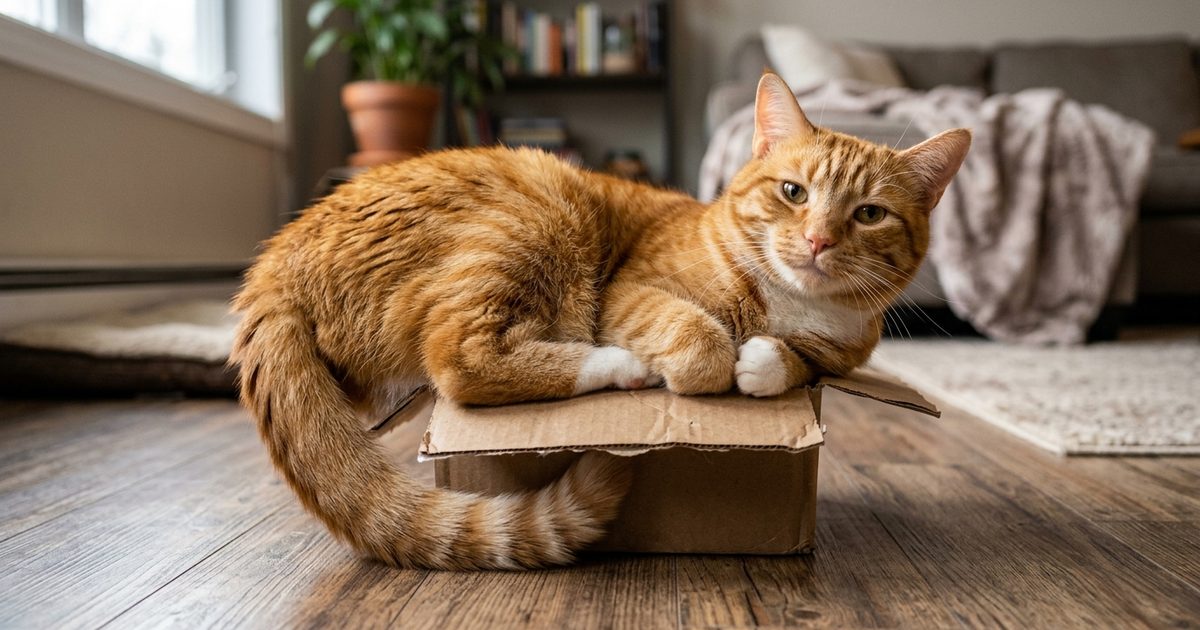
Anyone who has lived with a cat knows the math never adds up: a 12-pound cat will try to fit into a shoebox, limbs spilling over every edge, looking completely at peace. The reason isn't poor spatial judgment — cats actively seek out tight contact.
Firm, even pressure against the body is calming — the feline version of a weighted blanket. When a cat is surrounded on all sides, nothing can sneak up behind it, and the constant contact signals the same safety a newborn feels curled against its mother. A box that forces the cat into a compressed, tucked shape delivers that sensation far more intensely than a roomy one — which is why the "too small" box usually wins over the bed right next to it.
This also explains why cats often prefer boxes over open beds, even when the open bed looks more comfortable to us. The bed is soft but exposed; the tiny box is cramped but protected. If your cat treats a cardboard box as its favorite sleep spot, that cramped posture is doing real emotional work — not just providing a quirky photo.
One practical note: a cat wedged in tightly can overheat or struggle to exit quickly, so keep an eye on boxes in warm rooms and avoid anything so tight the cat has to be pulled out. Snug is soothing; stuck is not.
What About Cat Window Boxes?
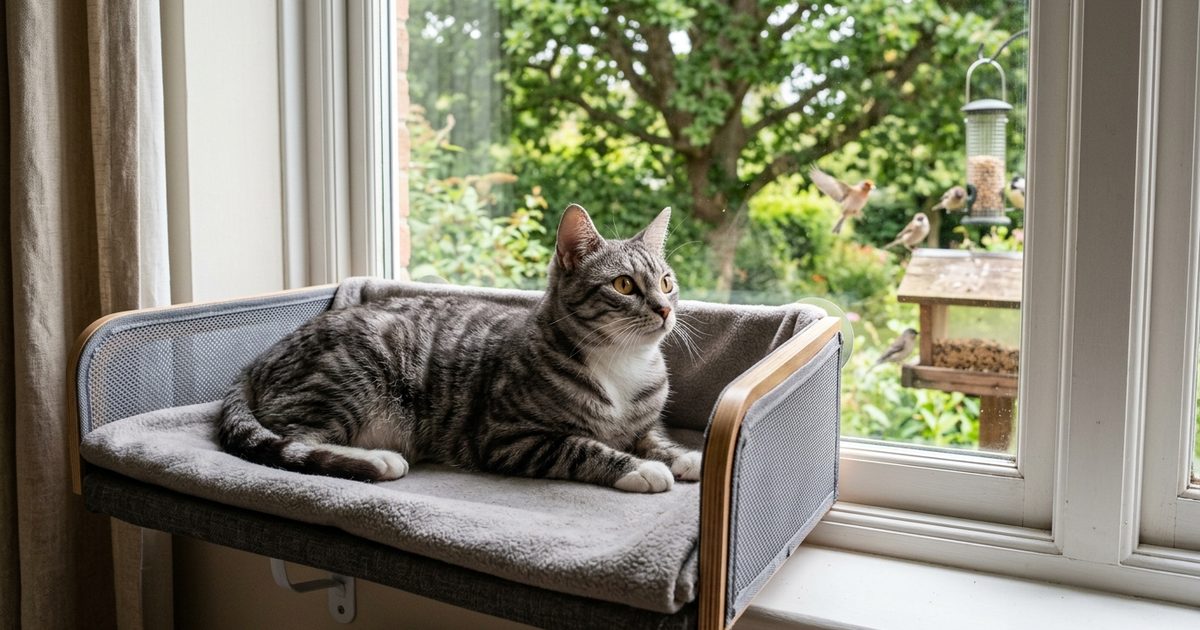
A cat window box — a perch or enclosed shelf suctioned to a window — taps the same instincts as a cardboard box: a safe, enclosed vantage point — with the added thrill of watching the outside world. It is the box obsession meets window-watching, the fortress with a view.
When you see your cat curled inside a cardboard box, you're watching the same logic that powers a window box. Both deliver enclosure, elevation, and a clear line of sight. The difference is the view: a window box trades cardboard walls for glass, opening onto birds, squirrels, and changing light — a moving show a floor-level box cannot offer.
For an indoor cat, that visual access is meaningful. Cats are visually oriented hunters, and a window perch turns the outside into a low-effort enrichment channel. The cat stays safe and enclosed while stimulation arrives on its own. This is why you may catch your cat chattering or chirping at the glass; that chirping is the same excitement a window box channels every day.
It is worth keeping the two "boxes" distinct. A cardboard box is a free, disposable hideout that satisfies the den and safety instincts. A cat window box is a purpose-built product for the vantage-point and enrichment instincts. They serve overlapping but not identical needs — which is why plenty of cats happily use both.
Curious what your cat would say from inside its box fortress — cardboard or window? Get a MeowMind reading and hear it told from your cat's point of view.
How to Make Boxes Better for Your Cat
A plain cardboard box already makes your cat happy, but a few small tweaks turn it into a safer, cozier, longer-lasting haven.
Start with a safe box. Before you hand it over, remove every staple, piece of packing tape, sticky label, plastic handle, and small loose part. Cats chew and shred cardboard, and swallowed tape or a metal staple can cause a gastrointestinal blockage. Pull out any foam peanuts or bubble wrap first. Plain, untreated corrugated cardboard is the only safe kind; skip boxes that held chemicals, cleaning products, or anything fragranced.
Make it comfortable. Drop a soft blanket, towel, or fleece mat inside so your cat has something warm to knead and curl up on — the same nesting instinct behind why cats knead their beds. A liner also keeps the bottom from getting damp or chilly.
Add doors and windows. Cut a second opening on the opposite side so your cat always has an escape route. A single-entrance box can make a cat feel cornered, and two doors turn a hiding spot into a confident lookout post. Round the edges to prevent snagging.
Rotate and refresh. Swap in a new box every couple of weeks — novelty is half the appeal, and cats lose interest once a box goes flat or starts to smell.
Know when to discard. Once a box is heavily chewed, shredded, soggy, or packed with shed fur, it's time to recycle it. Frayed edges can irritate skin, and a flattened box no longer offers the enclosed feeling that makes it worth sitting in.
Common Myths About Cats and Boxes
Boxes are so wrapped up in cat lore that a few stubborn myths have grown around them. Most of them sound reasonable — and most of them miss what's actually going on.
Myth: Cats hide in boxes because they're avoiding you. Fact: A cat in a box is usually seeking safety and comfort, not sending a cold-shoulder message. Hiding is a healthy way cats regulate their environment and lower stress — the same instinct behind why a relaxed cat sleeps on you when it feels secure. If your cat is box-bound for long stretches and also avoiding food, play, or the litter box, withdrawal may signal something deeper — but the box itself isn't the problem.
Myth: Only lazy cats like boxes. Fact: This flips the behavior upside down. A box is an active hunting tool — a vantage point a cat uses to stalk and pounce. The cat crouched in a box peeking over the edge isn't being lazy; it's rehearsing ambush. Even the peaceful box-napper is conserving energy the way a predator does.
Myth: Any cardboard box is safe for your cat. Fact: Most plain cardboard boxes are fine, but not every box is. Staples, packing tape, glue, and treated cardboard can be chewed or swallowed, and small loose parts are a choking risk. Strip out staples and tape before handing a box over, and discard anything shredded — the basics are covered above in How to Make Boxes Better for Your Cat.
The pattern across all three: the box isn't hiding a secret meaning. It's doing exactly what it looks like — a safe, warm, controllable corner of the world.
Cats and Boxes at a Glance — Summary
Cats love boxes because one cardboard square hits nearly every feline comfort trigger at once — safety, warmth, stress relief, an ambush post, and a claimable piece of territory (as we saw in the intro). No other household object delivers so much, which is why a box beats even the fanciest cat bed.
Here's the whole story of why do cats like boxes, distilled into one table.
| Reason | What your cat does | The science |
|---|---|---|
| Safety and enclosure | Sits deep inside, often with only the head visible | Walls on all sides satisfy the wild instinct for a den-like, defensible hiding spot — how cats show affection often starts from feeling safe |
| Warmth | Settles into the base and tucks its paws | Cardboard insulates, and a cat's thermoneutral zone sits around 86–100°F (30–38°C), so it actively seeks out warm, enclosed spots |
| Stress relief | Hides in a box when guests arrive or during a move | A hiding spot restores a stressed cat's sense of control over its environment, helping it adapt faster |
| Ambush and play | Crouches low, then pounces on a passing toy or ankle | Boxes turn a room into a hunting ground, tapping the same stalk-and-pounce drive behind why cats stare before they spring |
| Territory and novelty | Rubs its cheeks on the edges, then naps inside | A new box is both novel and instantly claimable — cats scent-mark it as theirs, the same impulse behind why they knead boxes and blankets |
The one-line takeaway: a box is a safe, warm, defensible, claimable little fortress — and for a small predator wired to want exactly those things, that's hard to resist.
Curious What Your Cat Would Say?
Upload a photo and get a warm, personalized reading from your cat's perspective.
Start Your Free ReadingFrequently Asked Questions
Why do cats like boxes?
Cats like boxes because an enclosed space satisfies several instincts at once: walls on all sides provide safety, the cardboard traps body heat, a hiding spot lowers stress, and the low edge makes a perfect ambush post. A box is, in effect, a cat's personal fortress.
Why do cats love boxes so much?
The pull is instinctive and unusually strong because one cheap object hits nearly every feline comfort trigger simultaneously. Few things in a home offer safety, warmth, a hiding spot, and a vantage point all at once — which is why a box reliably wins over a fancy cat bed.
Why do cats squeeze into small boxes?
Tight, enclosed contact feels safe, much like being held. Firm, even pressure against the body is calming — the feline version of a weighted blanket — and a snug space recreates the security of a den. That soothing pressure is why a cat will cram into a box smaller than its own body.
Do boxes really help cats with stress?
Yes. A Dutch shelter study found that cats given hiding boxes recovered from stress and adapted to their new environment faster than cats without them. A hiding spot gives a stressed cat control over when it is seen, and that control is exactly what lowers anxiety.
Why does my cat prefer the box over its bed?
To us a soft open bed looks comfortable; to a cat it looks exposed. A box offers walls, warmth, and a defensible shape, satisfying the den instinct in a way an open bed cannot. Novelty adds to it — a freshly arrived box is new territory waiting to be claimed.
Are cardboard boxes safe for cats?
Most plain corrugated cardboard boxes are safe, but not every box is. Remove staples, packing tape, sticky labels, plastic handles, and any small loose parts before offering one, and avoid boxes that held chemicals or fragranced products. Discard a box once it is heavily chewed, soggy, or shredded.
What about cat window boxes?
A cat window box — a perch or enclosed shelf suctioned to a window — taps the same instincts as a cardboard box, with the added thrill of watching the outside world. It is a purpose-built product for the vantage-point instinct, while a cardboard box serves the den and hiding instinct. Many cats happily use both.
Why does my cat sleep in boxes?
Boxes combine the three things cats want in a sleeping spot: enclosure for safety, insulation for warmth, and a hidden, defensible position. A cat that sleeps in a box feels protected from approach on all sides, which lets it fully relax — the same logic behind the enclosed, tucked postures cats favor when they rest.
Sources & References
You Might Also Like
Kitten Teething: Timeline, Symptoms & How to Help
Kitten teething runs from 3 to 7 months as baby teeth fall out. Learn the timeline, signs to watch for, and how to soothe a teething kitten safely.
15 min readWhen Do Cats Stop Growing? A Complete Timeline
When do cats stop growing? Most cats reach adult size by 12-18 months, but large breeds like Maine Coons keep growing until 3-4 years. Full timeline inside.
14 min readCan Cats Eat Cherries? Flesh, Pit & Toxicity Facts
Can cats eat cherries? Pitted flesh is safe in tiny amounts — but the pit, stem, and leaves are toxic (cyanide precursors). Learn what's safe and what isn't.
15 min read