Why Do Cats Chirp? Those Bird-Like Sounds Explained
If you've ever wondered why do cats chirp, you already know the sound: that bird-like chatter your cat makes at the window, the rolling trill she greets you with at the door, the rapid chitter aimed at a squirrel she can't reach. These are some of the most revealing sounds in a cat's vocabulary. Chirping and trilling come from hunting excitement and frustration, friendly greetings, and the earliest mother-to-kitten communication. Decoding them tells you what your cat is feeling in the moment.
Key takeaways
- Chirping and chattering are hunting sounds — excitement and frustration when a cat sees prey it can't reach.
- Trilling is a friendly greeting rooted in mother-to-kitten communication, kept into adulthood as a "hello."
- Chattering may be a reflexive jaw motion that mimics the killing bite cats use on caught prey.
- Most chirping is normal and harmless, but a sudden change in vocal habits can be worth a vet check.
Cat chirps, trills, chatters, chitters, and twitters are close cousins — the full comparison table sits at the end of this article, but first, let's break down why cats make these sounds.
Why Do Cats Chirp?
Cats chirp and chatter mostly out of hunting excitement and frustration — the sound erupts when a cat spots prey (a bird, a bug) it can't reach. Chirping and trilling also work as friendly greetings and mother-kitten calls, rooted in the earliest feline communication.
The short answer to "why do cats chirp" is that chirping is your cat's hunting instinct breaking through into sound. But it isn't only about prey — cats also use chirp-like sounds to say hello, call their kittens, and get your attention, so the same little noise carries different meanings depending on the moment.
Hunting excitement and frustration
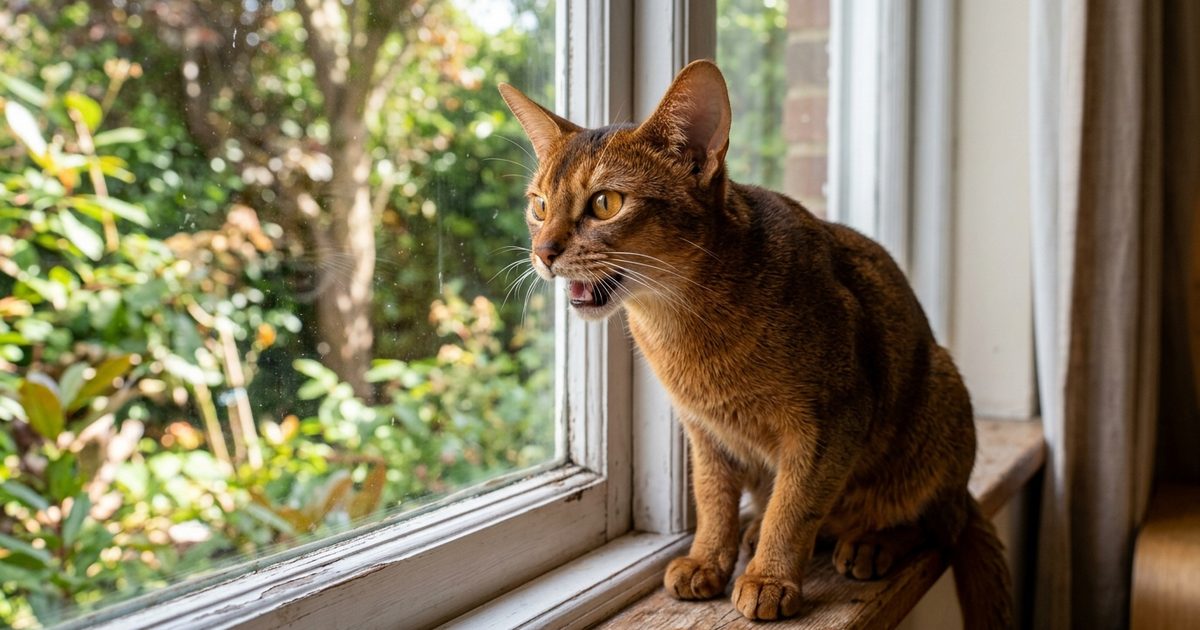
The classic chirp happens at the window. Your cat sees a bird, a squirrel, or a fly on the other side of the glass, and out comes that rapid, stuttering chatter — jaw vibrating, eyes wide, body tense. It's the sound of a fully primed hunter with nowhere to go.
Feline behaviorists describe chattering as excitement at the sight of prey colliding with frustration at being unable to reach it. The arousal is real — pupils dilate, muscles lock, and the same fixed stare a hunting cat gives a mouse takes over the face. The chirp is that pent-up hunting energy leaking out as sound because the body can't complete the chase. International Cat Care treats it as normal thwarted predatory drive, not distress.
The trill as a greeting
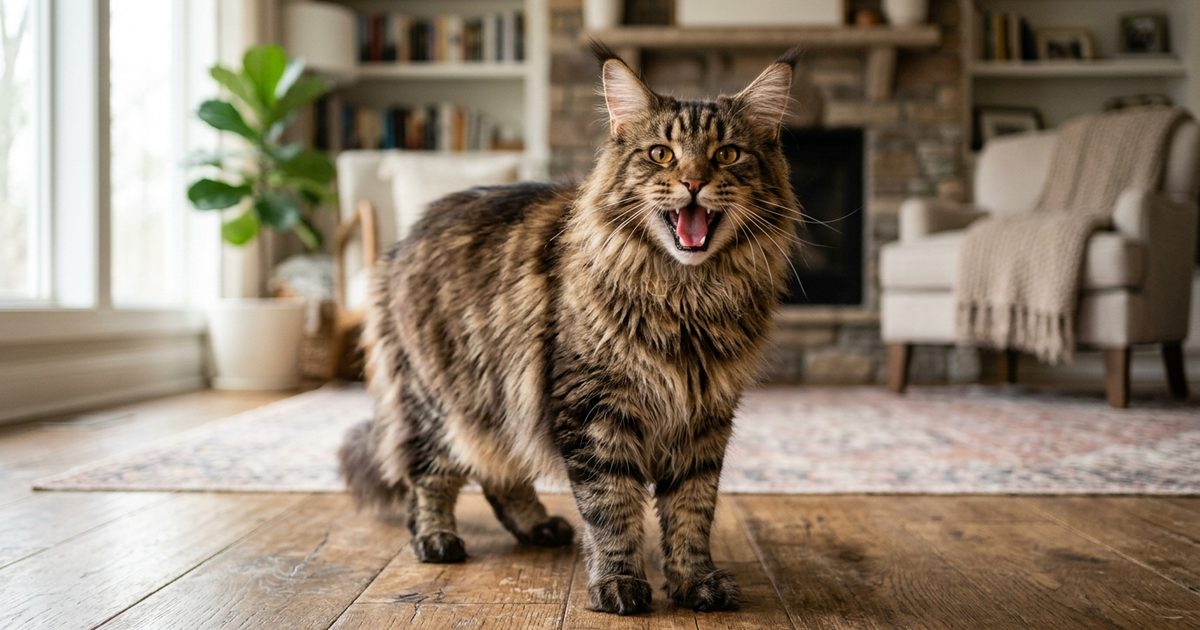
Not every chirp is about hunting. The trill — a soft, rolling, chirp-meets-purr sound — is one of the friendliest noises in a cat's vocabulary. A cat that trills when you walk into the room, or approaches you with tail held high, is saying hello in the clearest way it knows how.
Trilling tends to come from relaxed, socially connected cats, and it's closely tied to how cats show affection. Some trill constantly; others save it for the people they're closest to. Either way, a trill is a good sign.
Mother-kitten origins
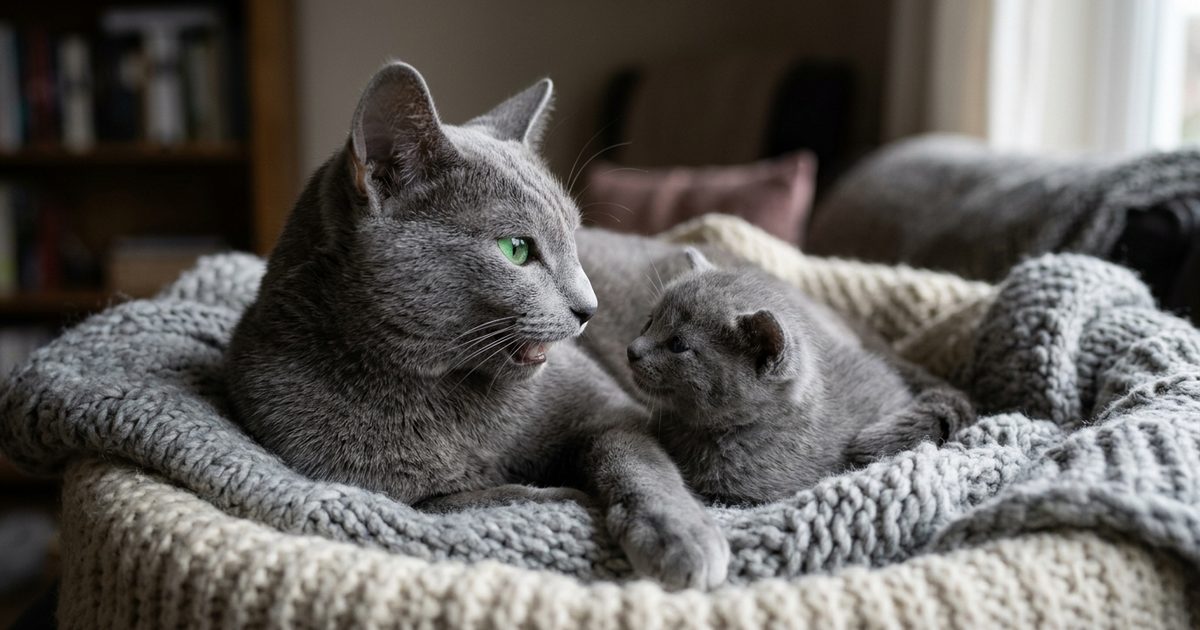
Where did these chirps and trills come from? Long before a cat used them on you, they began between a mother cat and her kittens. Queens chirp and trill to summon, guide, and call back their kittens, and kittens learn to respond within their first weeks — one of the first forms of communication they recognize.
Those early associations are why the trill survives into adulthood as a greeting. When your grown cat trills at you, it's reaching for the same warm, summoning tone a mother used on her kittens — repurposed for the human she treats as family. The Cornell Feline Health Center notes that much adult cat vocalization is built on these kittenhood patterns.
The chatter as a reflex
There's one more layer to the window-chatter. Some researchers believe the rapid jaw movement behind chattering is a reflexive rehearsal of the killing bite — the precise motion a cat uses to dispatch prey. We unpack that reflex fully under What Is Cat Chattering?; here, the key point is that when a chattering cat's tail twitches and lashes too, you're seeing the whole hunting blueprint — arousal, frustration, and the muscle memory of the bite — firing at once.
Why Do Cats Chirp at Birds?
Cats chirp and chatter at birds because of pent-up hunting drive — they're excited by the prey but frustrated they can't reach it through the glass. The chatter may be a reflexive jaw motion mimicking the fatal bite, expressing sheer arousal and thwarted instinct.
The window is where you see it most clearly: your cat spots a sparrow or a pigeon, the eyes lock, the pupils blow wide, and out comes that rapid clicking and chattering. What you're watching is a predator with its switch flipped — but no way to act on it.
That tension is the heart of it. The chirping and chattering aren't annoyance or anger — they're a hardwired hunting sequence that starts but can't finish. Notice the tail twitching, the ears pinned forward, the body crouched and vibrating. That's why cats stare at the same window every morning: the prey drive is fully engaged. For why the jaw itself chatters, see What Is Cat Chattering?; read more about prey drive from International Cat Care.
Curious what your cat would say about the bird she can never catch? Get a MeowMind reading — upload a photo and hear it straight from her.
Why Do Cats Trill?
A trill is a friendly, rolling chirp-like sound cats use as a greeting or to get your attention. It's a mother-to-kitten call that adult cats keep using with cats and humans they love. A trilling cat is usually happy, relaxed, and simply saying hello.
A trill sounds like a short, musical "brrrp" — somewhere between a meow and a purr, with the mouth briefly open then closed. Unlike the chatter aimed at a bird through the window, a trill is low-arousal: the body is loose, the ears point forward, and the tail is often held up with a gentle curl. It almost always means "I see you, and I'm glad you're here."
The trill begins as a mother's tool: queens trill to call kittens back, guide them, and signal "follow me" without alarm. Kittens learn that this soft rolling note means safety, so they keep responding to it — and as adults, they keep making it toward the beings they trust. That's why your cat greets you at the door with a trill. It's the grown-up version of "come here, you're my family," and it sits on the affectionate end of how cats show affection.
Some cats trill far more than others, and that variation is personality, not a problem — we come back to breed and temperament under Why Does My Cat Chirp Instead of Meow?. If your cat trills when you make eye contact, when food is on the way, or when you enter the room, you're hearing a standing invitation to interact. The best reply is a soft trill back, a slow blink, or a pause to acknowledge it.
What Is Cat Chattering?
Chattering is the rapid, teeth-clicking sound cats make watching prey they can't reach — a mix of excitement, frustration, and a reflexive jaw movement that may mimic the killing bite. It's pure, harmless hunting instinct leaking out through a closed window.
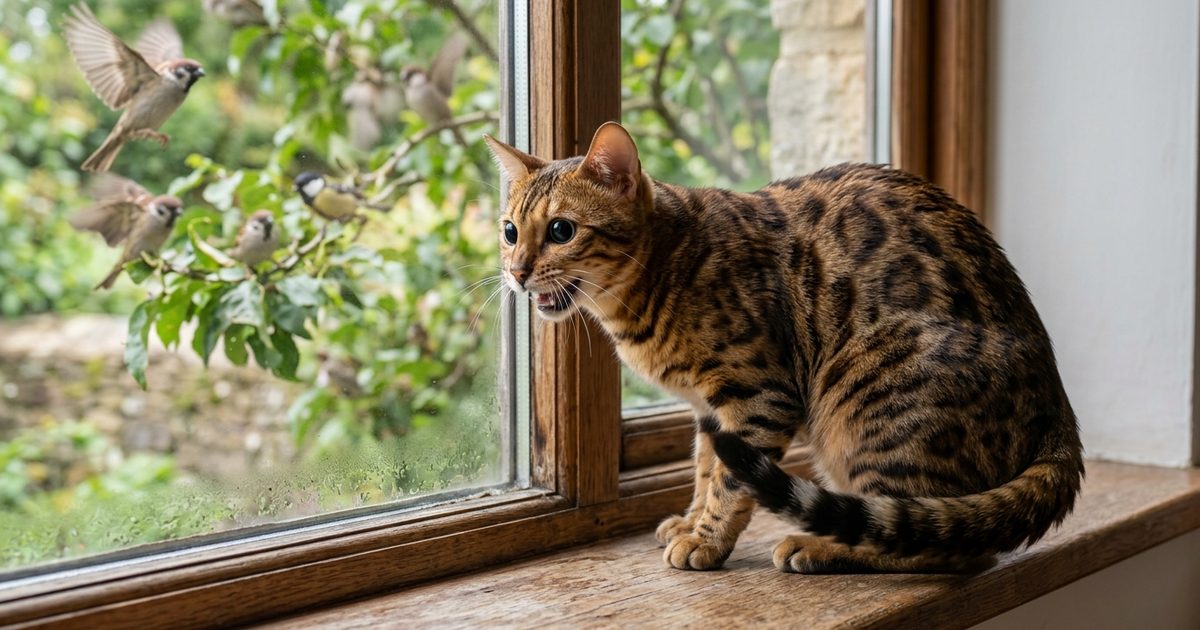
Chattering is distinct from a chirp or trill. Where a chirp is short and bright and a trill is a rolling greeting, chattering is what happens when a cat is stuck on the windowsill, locked on prey it can't reach. Instead of a clean sound it produces a staccato click-click-click of the jaw — sometimes audible, sometimes nearly silent — while the mouth opens and closes in rapid bursts and the body vibrates with thwarted energy.
The full window scene is under Why Do Cats Chirp at Birds?. What matters here is the sound: arousal the cat can't discharge, leaking out through the jaw. It isn't anger or pain; it's a hunter meeting an obstacle it can't solve.
The killing-bite reflex
The most common explanation from feline behaviorists is that the rapid jaw movement of chattering mirrors the motion a cat uses to deliver a killing bite. When a cat catches small prey, it bites down at the nape of the neck in a precise clench. Watching prey through a window, that bite reflex fires without a target — the jaw rehearses the motion against empty air. International Cat Care describes chattering as a frustration-linked response tied to the hunting sequence.
A competing, more cautious view holds that chattering is simply undirected arousal — excitement and frustration expressed through the jaw because that's the body part most activated, making the bite-mimicry coincidental. Neither theory is settled; both agree the behavior is harmless and rooted in healthy hunting instinct, so there's no need to interrupt it.
Why Does My Cat Chirp Instead of Meow?
Some cats chirp or trill more than they meow, usually down to personality, breed tendency, and learning — chirps and trills reliably get your attention. Cats reserve meows for humans; chirps and trills are closer to how cats speak to each other and to their mothers.
If your cat seems to prefer chirrups, trills, and window-chatter over a proper meow, you're not imagining it — and nothing is wrong. Cats have a large vocal repertoire, and which sounds they favor comes down to three things.
First, personality. Just as some people are quietly spoken and others talk constantly, individual cats lean on different sounds. A cat that naturally trills as a greeting may never add a meow — the trill already says "hello, I'm here." This is the most common explanation, and it tells you nothing bad about your cat's health or happiness.
Second, breed tendency — but stated carefully. Siamese and other Oriental cats are widely described as highly vocal, while others have a reputation for being quieter and more trill-oriented. These are broad, anecdotal tendencies, not hard rules: within any breed you'll find loud cats and near-silent ones, so treat breed as a gentle hint. A cat's individual temperament almost always matters more than the breed label.
Third, learning. Cats are excellent at noticing which sounds make you react. If a chirp reliably brings you to the kitchen, a smart cat reaches for the chirp next time. Meows work the same way — and because cats essentially reserve meowing for humans rather than other cats, both meows and attention-chirps are tools your cat has refined to talk to you.
Meows are a sound kittens use with their mother and mostly drop in adulthood — except when directed at people. Chirps and trills, by contrast, stay in the adult vocabulary as real cat-to-cat communication: friendly greetings, calls between companions, and the hunting chatter covered earlier. So a cat that chirps more than it meows is using more of its native language, and a "chirpy" cat is often a relaxed, attached one.
When Chirping Might Signal Something
Chirping is normal, but a cat that suddenly goes silent or starts making new, unusual sounds may be unwell or in pain. Sudden voice change warrants a vet check — most chirping is completely harmless, but new vocal patterns can sometimes be an early clue that something is off.
Most of the time, a chirping or trilling cat is a happy, excited, or affectionate cat. The sound itself is healthy feline communication. What's worth paying attention to isn't the chirping; it's change: a chatty cat suddenly falling quiet, or a usually silent cat making odd, strained sounds, can signal discomfort, stress, or a health issue.
Cats are remarkably good at hiding pain, so any abrupt change in a familiar behavior is worth noticing. Watch for a voice that sounds raspy, hoarse, or different from normal; chirping or meowing that seems pained or forced; or new vocalization paired with hiding, lethargy, loss of appetite, or litter box changes. None alone confirm a problem, but together they form a pattern your vet can assess. The Cornell Feline Health Center notes that changes in vocalization can accompany conditions from hyperthyroidism in older cats to pain or cognitive changes — which is why a sudden voice shift is a reasonable reason to call your vet, not wait.
Common Myths About Cat Chirping
Chirping and chattering have picked up a lot of folklore, mostly because the behavior looks dramatic. Here are the myths worth clearing up.
Myth: Chattering means the cat is angry. Fact: Chattering isn't aggression — it's hunting excitement and frustration layered over a reflexive jaw movement. A genuinely angry cat looks different: hissing, arched, and swatting. A chattering cat is a small predator whose instincts hit a wall of glass.
Myth: Only certain breeds chirp — Siamese, Maine Coons, that sort of thing. Fact: Vocal cats get noticed, so talkative breeds earn a reputation, but chirping and trilling aren't breed-exclusive. Any cat can chirp, because the behavior is rooted in universal feline instincts — the mother-kitten call and the hunting reflex — not a breed trait. Personality and learned chattiness matter more than breed.
Myth: Cats chatter to mimic the birds they're watching. Fact: There's no solid evidence cats deliberately mimic prey sounds to lure them. The chatter is better explained as the involuntary jaw motion covered under What Is Cat Chattering? — the bite-and-kill sequence firing without a target. It's reflex, not imitation; some researchers think the sound may startle prey into moving, but that too is unproven.
If your cat chatters, you're watching raw instinct — not anger, not a breed quirk, not mimicry. It's an unfiltered window into the hunter still living inside your house cat.
Cat Chirps at a Glance — Summary
Cat chirps, trills, and chatters are a small family of hunting- and greeting-driven sounds: chirp and trill are friendly calls rooted in mother-kitten communication, while chatter erupts when your cat watches prey it can't reach. Most chirping is harmless — only sudden vocal changes warrant a vet check.
Here's the whole vocal toolkit in one place.
| Sound | What it sounds like | What it usually means |
|---|---|---|
| Chirp | A short, bright, bird-like "brrt" or squeak | A friendly acknowledgment or mild excitement — often a casual "I see you" |
| Trill | A rolling, musical chirp-meow blend rising in pitch | A warm greeting or affectionate "hello," rooted in mother-to-kitten calls |
| Chatter | Rapid, rhythmic teeth-clicking and jaw-vibrating noise | Pent-up hunting excitement and frustration at prey seen but not reached |
| Chitter | A fast, staccato version of chattering, softer and lighter | High arousal and anticipation while watching birds, bugs, or toys |
| A continuous, light, high-pitched series of tiny chirps | Sustained excitement and social engagement, often between familiar cats |
The thread connecting all five is arousal — hunting drive, greeting warmth, or kittenhood instinct turning into sound. A cat that chirps, trills, or chatters at the window is doing what cats do; nothing needs fixing, except a sudden change in the sounds themselves, which can be worth a vet conversation.
Curious what your cat would say if she could put all of this into words? Get a MeowMind reading — upload a photo and hear it straight from her.
Curious What Your Cat Would Say?
Upload a photo and get a warm, personalized reading from your cat's perspective.
Start Your Free ReadingFrequently Asked Questions
Why do cats chirp?
Cats chirp mostly out of hunting excitement and frustration — the sound erupts when a cat spots prey it can't reach. Chirps and trills also work as friendly greetings and mother-to-kitten calls, rooted in the earliest feline communication.
Why do cats chirp at birds?
Cats chirp and chatter at birds because of pent-up hunting drive. They're excited by the prey but frustrated they can't reach it through the glass. The chatter may also be a reflexive jaw motion mimicking the killing bite.
Why do cats trill?
A trill is a friendly, rolling chirp-like sound cats use as a greeting or to get your attention. It's a mother-to-kitten call that adult cats keep using with the people they love, and a trilling cat is usually happy, relaxed, and saying hello.
What is cat chattering?
Chattering is the rapid, teeth-clicking sound cats make while watching prey they can't reach — a mix of excitement, frustration, and a reflexive jaw movement that may mirror the killing bite. It's pure hunting instinct leaking out through a closed window.
Why does my cat chirp instead of meow?
Some cats chirp or trill more than they meow because of personality, breed tendency, or learning that chirps reliably get your attention. Cats reserve meows mostly for humans, while chirps and trills are closer to how cats speak to each other and their mothers.
Do kittens chirp?
Yes — chirping and trilling begin between a mother cat and her kittens. Queens chirp and trill to summon, guide, and call back their kittens, and kittens learn the sound within their first weeks, responding to it instinctively long before they meow much.
Why does my cat chatter its teeth at birds?
Teeth-chattering at birds is your cat's hunting sequence firing without a target. The jaw appears to rehearse the killing bite it would deliver to caught prey, producing the rapid clicking. Researchers debate whether it's bite-mimicry or undirected arousal, but agree it's harmless.
Is cat chirping a sign of happiness?
Often yes — trills and greeting chirps usually signal a happy, relaxed, affectionate cat. Window-chatter is more about hunting excitement than happiness, and a sudden change in vocal habits can sometimes signal discomfort, so watch for new or strained sounds.
Sources & References
You Might Also Like
Kitten Teething: Timeline, Symptoms & How to Help
Kitten teething runs from 3 to 7 months as baby teeth fall out. Learn the timeline, signs to watch for, and how to soothe a teething kitten safely.
15 min readWhen Do Cats Stop Growing? A Complete Timeline
When do cats stop growing? Most cats reach adult size by 12-18 months, but large breeds like Maine Coons keep growing until 3-4 years. Full timeline inside.
14 min readCan Cats Eat Cherries? Flesh, Pit & Toxicity Facts
Can cats eat cherries? Pitted flesh is safe in tiny amounts — but the pit, stem, and leaves are toxic (cyanide precursors). Learn what's safe and what isn't.
15 min readA message, in your cat's voice
Upload a photo, get a warm note written from your cat's perspective — just for fun. Plus 121 vet-cited articles, offline.