Cat Sleep Positions & What They Mean (With Photos)
Cat sleep positions are a real-time readout of how safe, warm, and relaxed your cat feels at any given moment. From the tidy paws-tucked "cat loaf" to the sprawling belly-up sprawl, each pose carries a specific message about comfort, temperature, trust, and alertness. Learning to read the common cat sleeping positions turns ordinary naps into a running mood report from your cat.
Below is a quick guide to what this article decodes — eight common sleep positions and what each one reveals.
Key takeaways
- Each sleep position reflects a distinct mix of warmth, safety, alertness, and trust — a tight curl conserves heat, while a belly-up sprawl signals total relaxation.
- The "cat loaf" — paws tucked under, body upright — is relaxed-but-ready comfort, not unhappiness; your cat can spring up fast if needed.
- A sudden change in how your cat sleeps (hiding to rest, sleeping hunched, or abandoning a usual sprawl) is worth watching and may warrant a vet visit.
- Read the pose together with the setting — location, temperature, and time of day all shift what a position means.
Cat Sleep Positions — Quick Reference
| Position | What it looks like | What it means |
|---|---|---|
| The loaf | Upright, paws tucked under the body, eyes half-closed | Resting but ready to move; relaxed alertness |
| The curl / donut | Nose-to-tail tight ball, tail wrapped around the body | Conserving heat and protecting organs; security |
| Belly-up / sprawled | On the back, underside exposed, legs loose | Peak trust and total comfort in the environment |
| Side-sprawled | Stretched out on one side, legs extended | Deep, relaxed sleep in a safe, comfortable spot |
| Head-tucked | Head folded under or pressed into the body | Conserving warmth; deep, compact sleep |
| Chin on paws | Lying upright, chin resting on forepaws, eyes open or half-shut | Light sleep; watching the room while resting |
| The contortionist | Twisted, limp, seemingly impossible angles | Very deep sleep and complete muscle relaxation |
| Eyes half-open / third eyelid | Partially open eyes, sometimes a whitish membrane visible | Resting the surface of the eye; light dozing |
Cat Sleep Positions: What Each Pose Means
A cat's sleep position is a real-time mood readout — how safe, warm, and relaxed it feels. A tight curl conserves heat and guards organs; the belly-up sprawl shows total trust; the loaf is ready-to-move comfort. Read the pose together with the setting to decode your cat's mood.
The loaf
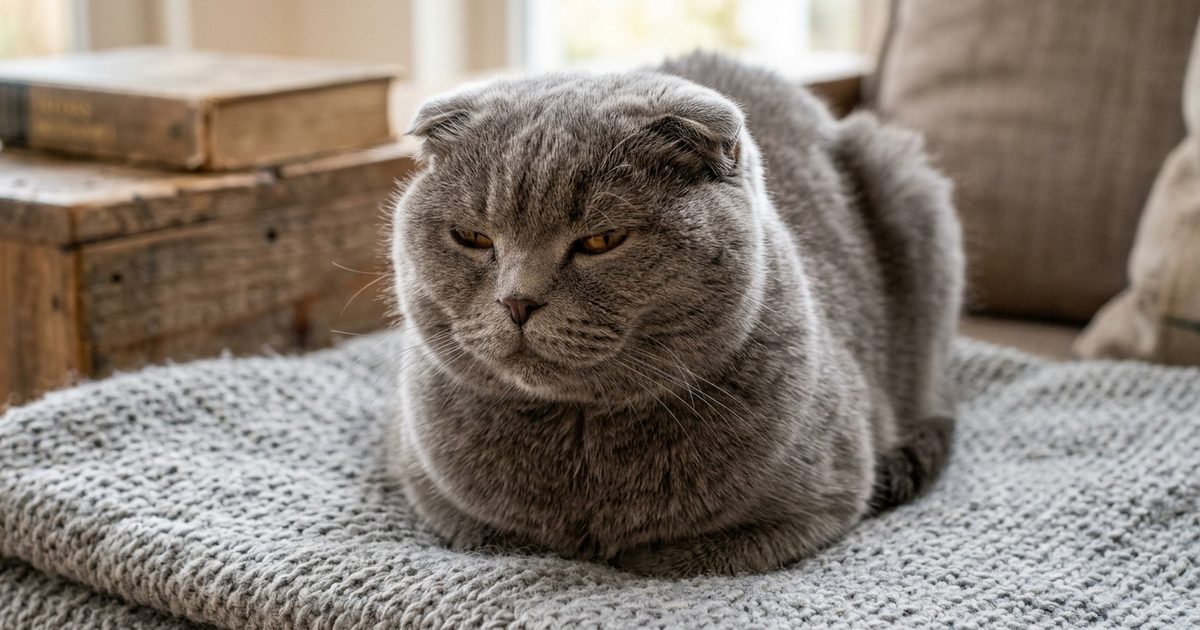
The loaf is the position that gave this whole guide its most-searched name: your cat sits upright, paws tucked neatly underneath, body compact and rounded like a fresh-baked loaf of bread. Nothing is exposed — paws hidden, tail wrapped close, head up. A cat in a perfect loaf is resting, but it has not committed to deep sleep. The tucked paws stay warm, the core stays protected, and the posture keeps every limb coiled under the body so the cat can spring up in a fraction of a second if something moves. It is relaxed-but-alert comfort, the feline equivalent of dozing with one eye open — your cat feels safe enough to rest, but not so safe that it's willing to go fully limp. If you want to go deeper into what this pose reveals, we break it out in its own section below on why cats loaf.

The curl (donut)
Curling into a tight ball — nose buried into the belly, tail wrapped around the body to seal the gap — is one of the oldest sleep positions in the feline playbook. A cat in a donut curl is conserving body heat (the round shape minimizes surface area exposed to the air) and shielding its most vulnerable organs behind a wall of muscle and fur. This is a wild-ancestral instinct: small predators sleeping in the open slept curled precisely because an exposed belly was an invitation. A tighter curl usually means more conservation — your cat is cold, or settling into a deeper, more secure rest.
Belly-up / sprawled
A cat rolled onto its back, legs splayed, belly fully exposed and soft, is showing you the single most vulnerable pose in a cat's repertoire. The underside holds the organs with the least protection, so a cat will only expose it where it feels completely safe. A belly-up cat is relaxed at a level most cats never reach around people at all — it signals deep trust in you and total comfort in its surroundings. It's also one of the clearest ways cats show affection: offering up the part of themselves they would never risk otherwise.
The side-sleep
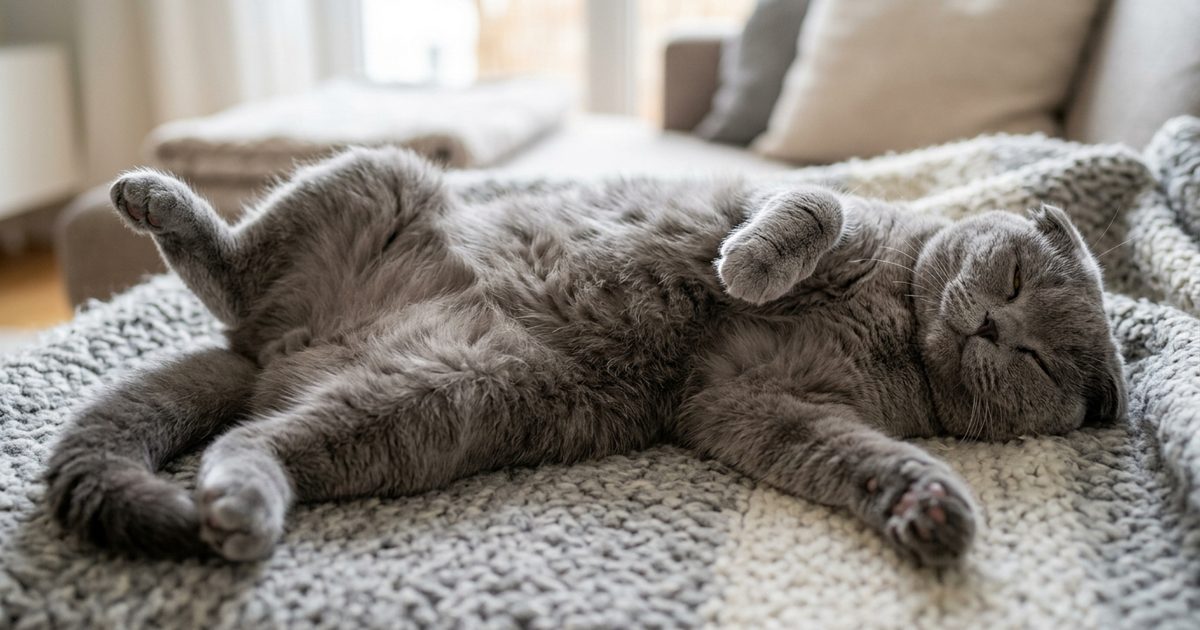
Lying stretched out on one side, legs extended and loosely curled, is a moderate-trust position — deeper than the loaf, less surrendered than the belly-up. A side-sleeping cat has let its guard down enough to extend its limbs and slow its breathing, but it's still oriented to wake and move quickly. Side-sleep often shows up in a familiar spot: a favored chair, a patch of sun, the foot of your bed. It's a "I'm comfortable here and I know where I am" pose, and you'll usually see it grow more sprawling the longer your cat has lived in the home.
Chin on paws
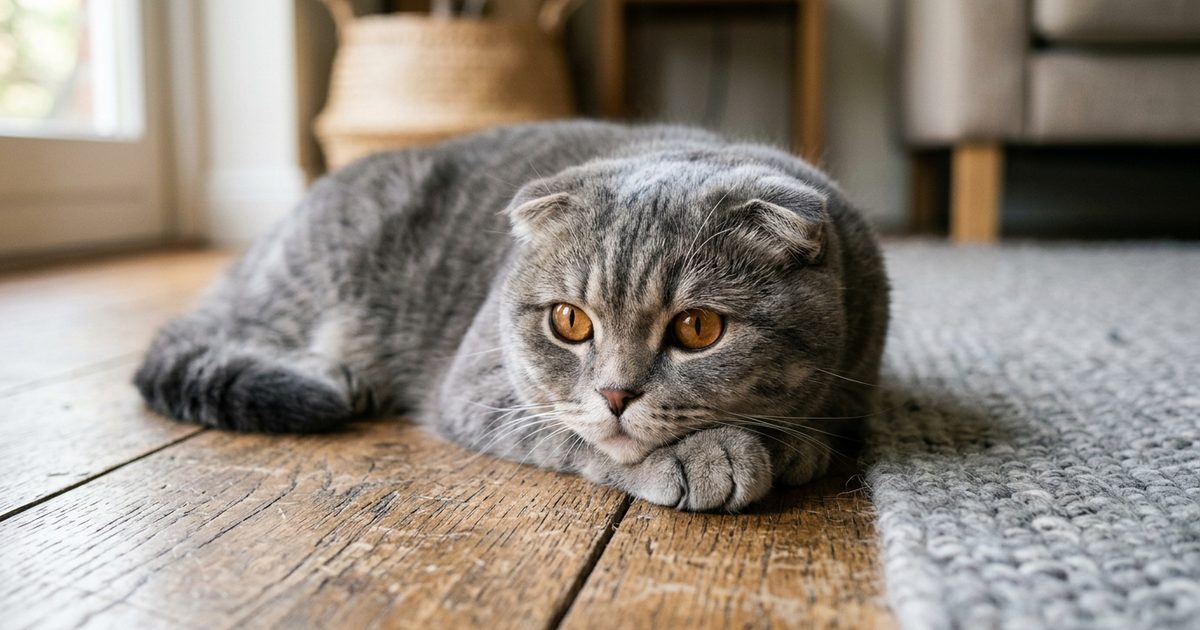
With the body settled flat and the chin resting squarely on the front paws, eyes open or half-lidded, this is light sleep — the cat is dozing but actively monitoring. Ears swivel toward sounds; a footstep or a door can bring the head up instantly. It's the resting version of a cat on watch, common in the middle of the day or when your cat has settled in a room where the family is moving around. The cat isn't anxious — it just isn't ready to go fully offline. Think of it as standby mode: present, comfortable, but listening.
The contortionist
This is the position that makes owners snap photos: a cat folded into a shape that looks physically impossible — head tucked under a leg, body twisted, paws pointing in opposite directions, utterly boneless. The contortionist pose only happens in deep sleep, when muscle tone drops and the cat's body goes completely limp. A cat this slack has let go of every last bit of tension, which means it feels profoundly safe. The weirder the angle, the deeper the trust — and that full-body release is a close cousin of the deep, contented purring you hear when your cat is fully at ease. According to the Cornell Feline Health Center, the muscle relaxation of deep sleep is a normal, healthy part of the feline sleep cycle.
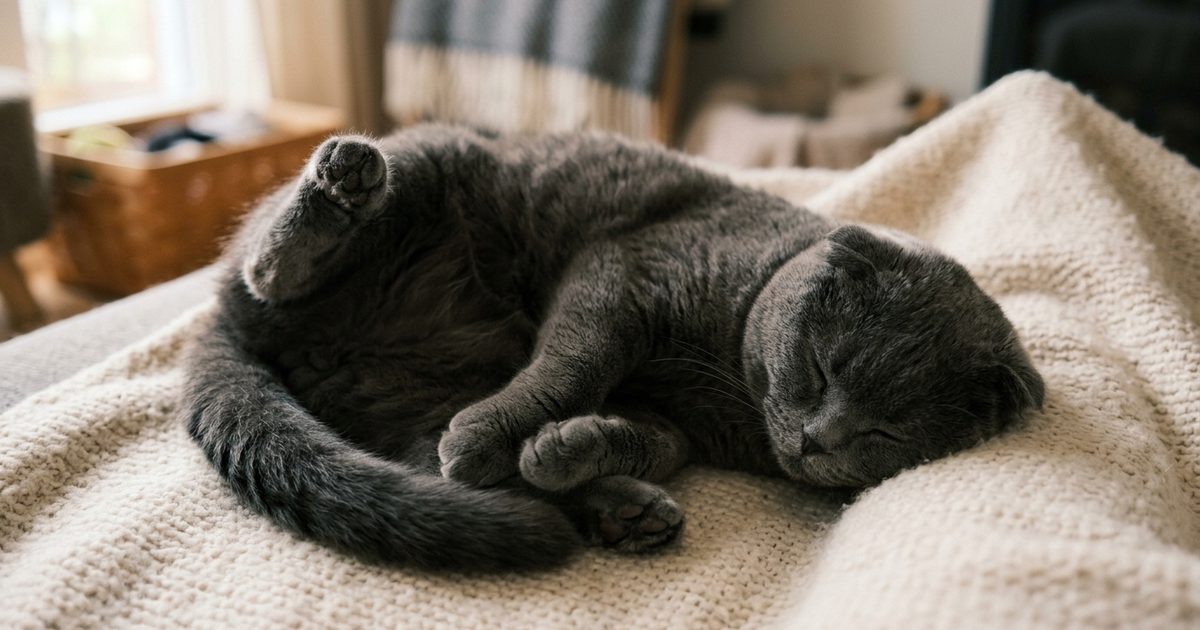
Eyes half-open / the third eyelid
Sometimes a sleeping cat's eyes drift partially open and a pale membrane — the third eyelid, or nictitating membrane — creeps across from the inner corner. It looks startling the first time, but it's normal: the membrane protects and moistens the eye while the cat rests, and many cats sleep with their eyes half or fully open during lighter stages of sleep. Some cats also do this when they've chosen to sleep pressed against you — a sign they're so comfortable they've stopped guarding even that instinct. You can read more about that closeness in our piece on why cats sleep on you. International Cat Care notes that the visible third eyelid during rest is a healthy, routine feature of feline anatomy, not a cause for concern unless it stays visible when the cat is awake.
Why Do Cats Loaf?
Cats "loaf" — paws tucked beneath them, body upright like a risen loaf of bread — to rest while staying ready to move. The pose conserves warmth, shields the paws, and lets the cat spring upright if something happens. It's relaxed-but-alert comfort: your cat feels safe but isn't fully asleep.
The loaf's function
The loaf isn't a deep-sleep pose. It's the in-between one. Your cat's body is settled, eyes often soft or half-closed, but the legs stay folded underneath, locked and loaded. That tucked position means the paws stay warm (cats lose heat through their extremities), the soft belly stays covered, and the whole body stays coiled for a split-second getaway.
Think of it as the feline equivalent of napping with your shoes on. A cat in a loaf has not fully committed to sleep the way it does when it rolls belly-up or curls into a deep donut. It is resting, but on its own terms — close enough to the surface that a sound, a movement, or a sudden footstep brings it upright immediately.
This is why the loaf shows up in specific moments: a sunny windowsill in the afternoon, the arm of the sofa while you're watching TV, the foot of the bed while the house is still lively. Your cat wants the comfort of settling down but isn't ready to surrender completely. International Cat Care notes that lighter sleep phases, where the cat stays semi-upright and ready to react, make up a large share of a cat's day — only the deepest sleep brings on the truly vulnerable poses.
The loaf also tells you something warm about your cat's trust. A cat that won't fully relax is a cat that isn't sure of its surroundings. Your loaf cat resting out in the open, in the middle of the room, in full view — that's a cat that has decided the environment is safe enough to rest without hiding. It's a long way from the curled, tucked, hiding-to-sleep posture of a nervous or new cat. The loaf says: I'm keeping one eye on things, but I'm not worried.
The same logic explains why does my kitten loaf so readily: kittens burn heat faster than adults and are still mapping out which corners of the home are safe, so they default to the tucked, ready-to-move pose more often than a settled older cat.
Curious what's running through your cat's head while it sits there like a little baked good? Get a MeowMind reading — what's your cat dreaming in that loaf?
What the Belly-Up Sleep Really Means
A belly-up cat is showing trust by exposing its most vulnerable area — but that trust is about you as a presence, not a request for contact. For many cats the exposed belly is a trap: a hand reaching for it triggers a grab-and-kick reflex. Admire it; reach for the chin or chest instead.
The deepest trust signal a cat gives
We've already covered the core meaning: the belly-up sprawl is a cat's most vulnerable pose, and it signals deep trust and total comfort in its surroundings. What deserves its own look is the trap underneath it.
What belly-up does not mean, despite the popular myth, is "please rub my belly." For many cats the exposed underside is a trap — the moment a hand reaches for it, the cat grabs, kicks, and bites. The belly is vulnerable, and a sudden touch there triggers the same defensive reflex a cat would use against a predator. The belly-up posture is a statement of trust in you as a presence, not a request for contact. Admire it; reach for the chin or chest instead.
Why Do Cats Curl Up in a Ball to Sleep?
Cats curl into a tight ball to conserve body heat and shield their vulnerable organs — a survival instinct inherited from wild ancestors. Cats curl more when they're cold, nervous, or seeking security; the tighter the curl, the more they're conserving warmth or self-comforting.
Warmth and protection
This is the same conserve-heat and protect-organs logic we covered above: a curled posture shrinks the surface area exposed to cooler air, and it brings the soft, vital-organ region inward and out of reach. What's worth adding here is how to read the tightness as a moment-by-moment signal.
A loose, half-curled cat is comfortable but still monitoring — light sleep. A nose-to-tail ball, especially in a corner or under furniture, usually means the cat feels the need to either conserve heat or stay a little hidden. Neither is a problem on its own. The cue worth noticing is context: a cat that suddenly starts curling tight when it never used to may be colder, stressed, or unwell — the posture itself is normal, but a sharp change in how your cat sleeps is always worth watching.
Do Sleep Positions Tell You About Your Cat's Health?
A single sleep position almost never diagnoses illness — but a sudden change in how your cat sleeps can be an early clue. If your cat stops sprawling belly-up, hides to sleep, or sleeps hunched and tense, it may be cold, stressed, or unwell. A persistent shift like that is worth a vet visit.
Here's the honest, reassuring truth: a cat that curls up tightly isn't sick, a cat that loafs isn't unhappy, and a belly-up sprawl isn't proof of perfect health. Sleep positions are mood readouts, not medical tests. What veterinarians actually watch for is change — a departure from your cat's own normal pattern over days or weeks.
The signals worth noticing tend to cluster together. A cat that used to sleep sprawled in the open but now hides under the bed, hunches stiffly, or refuses to settle may be guarding a painful area. Sleeping in a tight, tense ball with the back arched can accompany abdominal discomfort, while breathing that looks labored during rest — flared nostrils, an exaggerated rise and fall of the chest — can point to respiratory or cardiac issues. None of these alone means your cat is ill, which is why context matters. The Cornell Feline Health Center notes that cats hide pain and illness remarkably well, so behavioral shifts like altered sleep are often the first thing an owner notices before any physical symptom appears. If a new sleep habit comes with appetite loss, hiding, vocalizing, or less grooming, that combination is a stronger reason to call your vet.
The simplest rule: one odd afternoon means nothing; a week of change means pay attention. You know your cat's baseline better than anyone, and trusting that instinct is one of the most reliable health tools you have.
How Cats Choose Where to Sleep
A cat rarely sleeps somewhere by accident. Every napping spot your cat picks is the result of a quiet checklist — warmth, height, enclosure, and the reassuring scent of the beings it trusts. Watch where your cat gravitates and you can read what it's optimising for.
Warmth comes first. Cats run a slightly higher resting body temperature than humans (around 38-39°C / 100-102°F), and they lose heat quickly because of their lean build. This is why your cat seeks out sunbeams, heating vents, laptops, and freshly laundered piles of laundry — a warm surface isn't a luxury, it's a fuel-saving strategy. A cold cat will also choose the curled or loaf positions we covered above, trapping heat against its body while it sleeps.
Height means safety. A bookshelf top, the back of a sofa, or a high cat tree gives your cat two things at once: a clear view of the room and a spot where nothing can sneak up from behind. In the wild, a sleeping cat is an easy target, so elevation is one of the oldest safety instincts your cat carries. If your cat consistently climbs to sleep, it's choosing the most defensible position available.
Enclosure adds a layer of security. Cats love boxes, drawers, and the corner behind the sofa because three enclosed walls reduce the angles a threat can approach from. This is the same instinct behind why cats like boxes — a small, bounded space reads as "safe" to a feline brain wired to avoid exposure. A covered bed or a quiet closet corner serves the same purpose.
Your scent is a magnet. When your cat chooses your lap, your pillow, or a pile of your clothes, it's following familiarity. Your scent signals the safest, most predictable thing in its world, which is why cats sleep on their owners even when a warmer, softer bed sits empty two metres away. Your cat isn't settling for the lap — it's choosing it on purpose.
Put it together and a "good" sleeping spot, in your cat's eyes, is warm, raised, at least partly enclosed, and steeped in the smell of home. That's why the same cat will rotate between three or four favourites across the day as the sun moves and the house warms and cools.
Common Myths About Cat Sleep Positions
Cat sleep positions get misread often: a belly-up sprawl invites a rub, loafing signals unhappiness, a tight curl means fear. In truth, the belly-up pose exposes a vulnerable area, the loaf is relaxed-but-alert comfort, and curling usually conserves warmth. Read the pose in context, not in isolation.
Myth: A belly-up cat wants belly rubs. Fact: This is one of the most common traps in cat body language. When your cat flops belly-up to sleep, it's showing deep trust by exposing its most vulnerable area — but that trust rarely extends to touch. Many cats interpret a hand reaching for the belly as a threat and respond with claws or a bite. The sprawl is a compliment, not an invitation; admire it, don't grab it.
Myth: Loafing means the cat is unhappy. Fact: The loaf — paws tucked, body propped upright — is relaxed-but-alert comfort, not a sign of distress. Your cat is resting while staying ready to move, which it only does when it feels safe enough to let its guard partway down. A tense, unhappy cat doesn't loaf; it hides or stays rigid. The loaf is a good sign.
Myth: Curling up in a ball means the cat is scared. Fact: A tight curl can signal a need for security, but far more often it's about warmth and instinct. Curling conserves body heat and shields the organs — a survival behavior cats share with their wild ancestors. Your cat may curl simply because the room is cool or the pose feels cozy. Fear is one possible reason among many, not the default read.
Cat Sleep Positions at a Glance — Summary
Every pose your cat takes is a small readout of how warm, safe, and relaxed it feels in that moment. No single position tells the whole story — a cat that belly-ups in the afternoon sun may curl tight by a drafty window at night — but together these eight poses cover nearly every sleeping posture you'll see around the house. Read the pose alongside the setting, the time of day, and your cat's usual habits, and the meaning sharpens.
Here's the full set in one place, so you can match what you're watching to what it usually signals.
| Position | What it looks like | What it usually means |
|---|---|---|
| The loaf | Upright, paws tucked under the body, eyes half-closed | Relaxed but alert — resting while ready to spring up |
| The curl / donut | Nose-to-tail in a tight circle, tail wrapped around | Conserving heat and protecting organs; comfort and security |
| Belly-up / sprawled | On the back, underside exposed, legs loose | Peak trust — total comfort, feeling completely safe |
| Side-sprawled | Lying on one side, legs stretched out | Deep, easy relaxation in a familiar, low-stress place |
| Head tucked | Head folded down or buried into the body or tail | Conserving warmth; deep sleep in a secure spot |
| Chin on paws | Lying prone, chin resting on the front paws, eyes open | Light, watchful sleep — resting while keeping an eye out |
| The contortionist | Twisted into an unlikely shape, fully limp | Deep sleep and total muscle relaxation — the cat feels safe |
| Eyes half-open / third eyelid | Eyelids partly open, pale third eyelid visible | Normal light sleep; not distress — cats sleep this way often |
A few things keep this picture honest. Position is a mood clue, not a diagnosis — the same curl can mean "I'm cold" or "I'm cozy," and only the rest of the body and the setting tell you which. Sudden change matters more than any single pose: a cat that stops sprawling, starts sleeping hunched, or begins hiding to rest is worth a closer watch, and a call to your vet if it persists. The Cornell Feline Health Center and International Cat Care both publish reliable guidance on reading feline body language alongside sleep behavior.
Most of the time, though, the reading is a happy one. A house cat that curls, loafs, sprawls, and twists through the day is a cat cycling through the comfort states of a safe life — and you're the reason the setting feels safe enough to show every one of them.
Curious What Your Cat Would Say?
Upload a photo and get a warm, personalized reading from your cat's perspective.
Start Your Free ReadingFrequently Asked Questions
What does it mean when a cat sleeps in a loaf?
The loaf — paws tucked under, body propped upright — means your cat is resting while staying ready to move. It's relaxed-but-alert comfort, a sign your cat feels safe enough to settle but isn't fully asleep.
Why do cats loaf?
Cats loaf to conserve warmth (they lose heat through their paws), shield the soft belly, and stay coiled for a quick escape. It's resting on their own terms, never fully committed to deep sleep.
What does it mean when a cat sleeps belly-up?
Sleeping belly-up with the underside exposed signals deep trust. A belly-up cat feels completely safe with you. It's a compliment, not an invitation to touch — many cats grab and kick when the belly is reached for.
Why do cats curl up in a ball to sleep?
Cats curl into a tight ball to conserve body heat and protect their organs — a survival instinct inherited from wild ancestors. The tighter the curl, the more warmth or security your cat is seeking.
What is the most relaxed cat sleep position?
The belly-up sprawl and the twisted contortionist pose both mark peak relaxation. In both, the muscles go fully limp and the underside is exposed, which only happens in deep sleep when the cat feels profoundly safe.
Why does my cat sleep with its head tucked?
Tucking the head helps a cat conserve warmth and settle into deep, compact sleep. It shields the face, traps heat around the head, and usually appears when the cat is secure and ready to fully switch off.
Do cat sleep positions show mood?
Yes — each position is a real-time readout of how safe, warm, and relaxed your cat feels. A tight curl signals conservation, the loaf means alert comfort, and a sprawl shows total trust.
Why does my cat change sleep positions?
Cats shift positions as temperature, light, and their sense of safety change through the day — sprawling in warm sun, curling by a drafty window, loafing when the house is lively. Sudden, lasting changes may warrant a vet visit.
Sources & References
You Might Also Like
Kitten Teething: Timeline, Symptoms & How to Help
Kitten teething runs from 3 to 7 months as baby teeth fall out. Learn the timeline, signs to watch for, and how to soothe a teething kitten safely.
15 min readWhen Do Cats Stop Growing? A Complete Timeline
When do cats stop growing? Most cats reach adult size by 12-18 months, but large breeds like Maine Coons keep growing until 3-4 years. Full timeline inside.
14 min readCan Cats Eat Cherries? Flesh, Pit & Toxicity Facts
Can cats eat cherries? Pitted flesh is safe in tiny amounts — but the pit, stem, and leaves are toxic (cyanide precursors). Learn what's safe and what isn't.
15 min readA message, in your cat's voice
Upload a photo, get a warm note written from your cat's perspective — just for fun. Plus 121 vet-cited articles, offline.