
How Many Lives Do Cats Have? The 9-Lives Myth Explained
So — do cats have 9 lives? It's one of the most quoted sayings about cats, repeated in cartoons, books, and playgrounds for centuries. And if you've watched your own cat walk away from a tumble that would have left anyone else bruised and bewildered, you might genuinely wonder whether cats really have 9 lives, or whether something else is going on.
The short answer is that cats have one life, exactly like every other animal. The "nine lives" idea is a saying rooted in a very real truth — cats are astonishingly resilient. They right themselves mid-fall, survive drops that would hospitalise a person, and bounce back from mishaps with a nonchalance that borders on theatrical. That real resilience is the seed the myth grew from. But it's still a myth, and a dangerous one if it makes us careless. This article separates the genuine biology from the folklore — and explains why the saying has lasted so long.
Key takeaways
- Cats have one life — biologically, they're mammals with a single lifespan, just like us.
- The "nine lives" idea is a centuries-old saying rooted in cats' real, observable resilience — not in any spare lives.
- Cats are not invincible — falls, cars, and accidents still injure and kill them every year. Resilient isn't the same as unbreakable.
The 9-Lives Myth — Quick Reference
| Question | Short answer | Reality |
|---|---|---|
| Do cats have 9 lives? | No — they have one | The "9" is a saying, not biology |
| Why do people say it? | Cats survive falls others wouldn't | Real resilience, turned into folklore |
| Do cats always land on their feet? | Usually, given enough height | Short falls don't allow time to right themselves |
| Can cats survive any fall? | No — injuries are common | High-rise syndrome is real and preventable |
| Do all cultures say 9 lives? | No — the number varies | Seven in Spain, Italy, Latin America; six in some Arabic traditions |
| Are cats more resilient than dogs? | In some ways, yes | But resilience is not invincibility |

How Many Lives Do Cats Really Have?
Cats have one life — exactly like every other living animal. The idea that they have nine lives is a saying, not a fact. It comes from how often cats walk away from accidents that would seriously injure other animals, not from any real spare lives.
It's worth being direct about this, because the question gets asked in earnest — by children, by new owners, sometimes by adults who've heard the phrase their whole lives without ever pausing to check it. Cats are mammals. They're born, they age, and they die on a single, fixed lifespan — there's no biological mechanism anywhere in their body that provisions a second, third, or ninth life. What cats do have is an unusually strong talent for survival: a body built to absorb impacts, a reflex that flips them feet-down in mid-air, and a low terminal velocity that gives them a genuine edge in falls. That edge is real. It's the whole reason the saying exists. But it's still a single life doing the surviving.
One life, biologically
A cat is a mammal — warm-blooded, live-bearing, and bound to the same one-lifespan rule that governs every other mammal on the planet, humans included. There is no organ, no cell process, no quirk of feline physiology that resets or restarts a cat's life once it ends. What's genuinely remarkable isn't the number of lives but the length of the one they get: a well-cared-for indoor cat commonly reaches 13–17 years, with many pushing past 20. If you want the real numbers behind that single life — indoor versus outdoor, breed differences, and what actually drives longevity — we cover them in detail in how long cats live. That's the lifespan question; the "nine lives" question is a different one entirely.
Why people ask the question at all
Honestly, it's a lovely question, and there's no shame in asking it. The "nine lives" saying is so deeply woven into everyday language — handed down through bedtime stories, cartoons, and offhand remarks from grandparents — that it's entirely reasonable for a child (or an adult who's never had reason to doubt it) to wonder whether there's a kernel of literal truth in there. The honest myth-bust is warm, not corrective: the saying exists because cats are exceptional survivors, and people noticed. It's a tribute to real resilience, dressed up in a number. Holding both of those things at once — the affection behind the phrase and the fact that it's not literally true — is the whole point. It's a beautiful idea precisely because cats are remarkable animals. We just shouldn't let it trick us into thinking they're unbreakable.

Where Does the '9 Lives' Myth Come From?
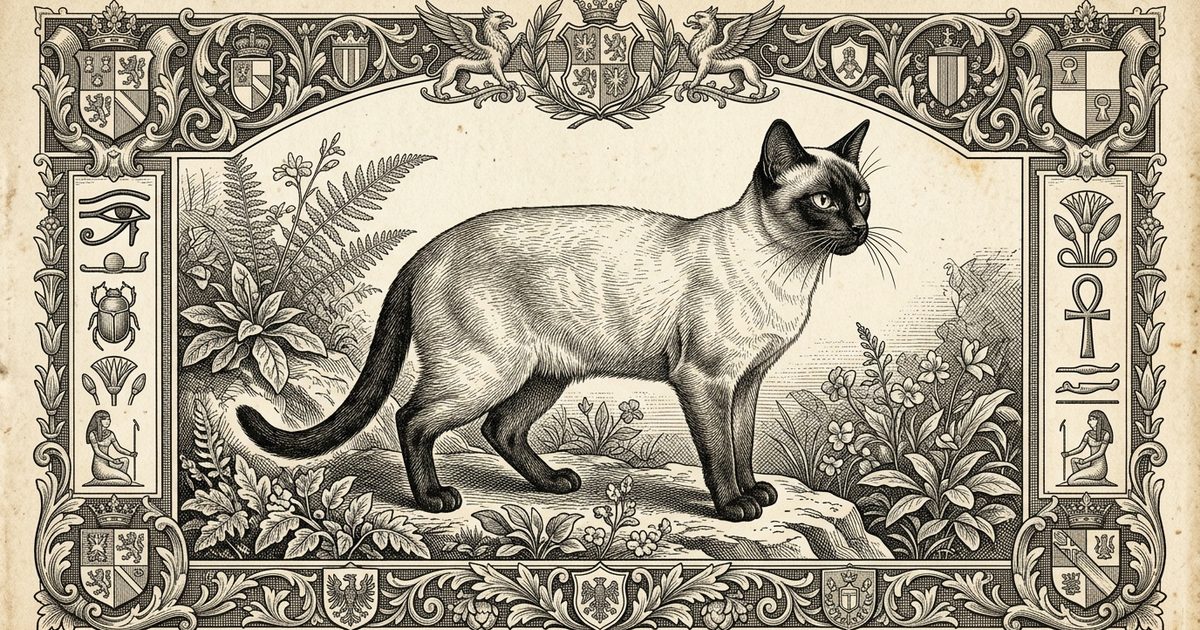
The "nine lives" saying is at least several centuries old and shows up across Egyptian, European, and English folklore. The number nine carried sacred and lucky meaning in many cultures, and cats — worshipped in Egypt, respected for hunting vermin, and astonishingly hard to kill — became the natural carrier of the legend.
Ancient Egypt and the sacred cat
The myth's oldest roots reach back to ancient Egypt, where cats weren't merely tolerated — they were revered. The goddess Bastet, depicted with the head of a cat, embodied home, fertility, and protection, and harming a cat was a serious offense. Cats guarded grain stores from vermin, a role so vital that their status tipped from useful into sacred. That reverence planted a lasting seed: a creature this protected, this valued, this closely tied to the gods, felt like more than an ordinary animal. It's a short emotional leap from "this cat is sacred" to "this cat is somehow beyond a single life" — and once that feeling took hold, folklore had fertile ground to grow in.
The number nine in folklore
So why nine, and not seven or three? In the European and Middle Eastern traditions that shaped English folklore, nine was a number of completeness and mystical weight. The Greeks honoured nine Muses; a human pregnancy lasts nine months; legal and religious rites often came in nines. The phrase "cat o' nine tails" and the "nine days' wonder" both lean on the same sense of nine as a number that meant a full measure of something. When a sacred, uncannily resilient animal needed a number attached to it, nine was the obvious choice — a complete, almost magical tally befitting a creature people already half-believed was supernatural.
The earliest written sayings
The phrase itself enters the written record in English by the mid-1500s. John Heywood's 1546 proverb collection lists "a cat hath nine lives," and the saying circulates in the broadside ballads and "Beware the cat" literary traditions that followed. Shakespeare's era knew it well enough to treat it as already old. Long before anyone asked whether cats really have nine lives, the line had hardened into idiom — the kind of saying that outlives any fact-check because it carries affection and admiration in every syllable. International Cat Care, which documents the history and cultural role of cats, traces how such beliefs travelled with trade and language across Europe. If you're curious how that real-world hardiness actually works, the science behind why cats survive falls is the other half of this story — and it's every bit as remarkable as the legend.
The Real Science: Why Cats Survive Falls
Cats really do survive falls that would kill a human, thanks to the righting reflex, an extremely flexible spine, and a low terminal velocity. Their loose skin and splayed legs in freefall act like a tiny parachute, which is why cats sometimes walk away from multi-story drops.
So when people ask whether cats actually have nine lives — the honest answer is one life, but a body remarkably well engineered to keep it. None of this is magic. It's anatomy and physics, the same forces that govern any falling object, applied to a small, loose-skinned, hyper-flexible predator. Understanding the mechanics doesn't diminish the wonder; if anything, it deepens it. Here's what's actually happening when your cat walks away from something that would put a person in hospital — and where the limits of that resilience lie.
The righting reflex — landing on their feet
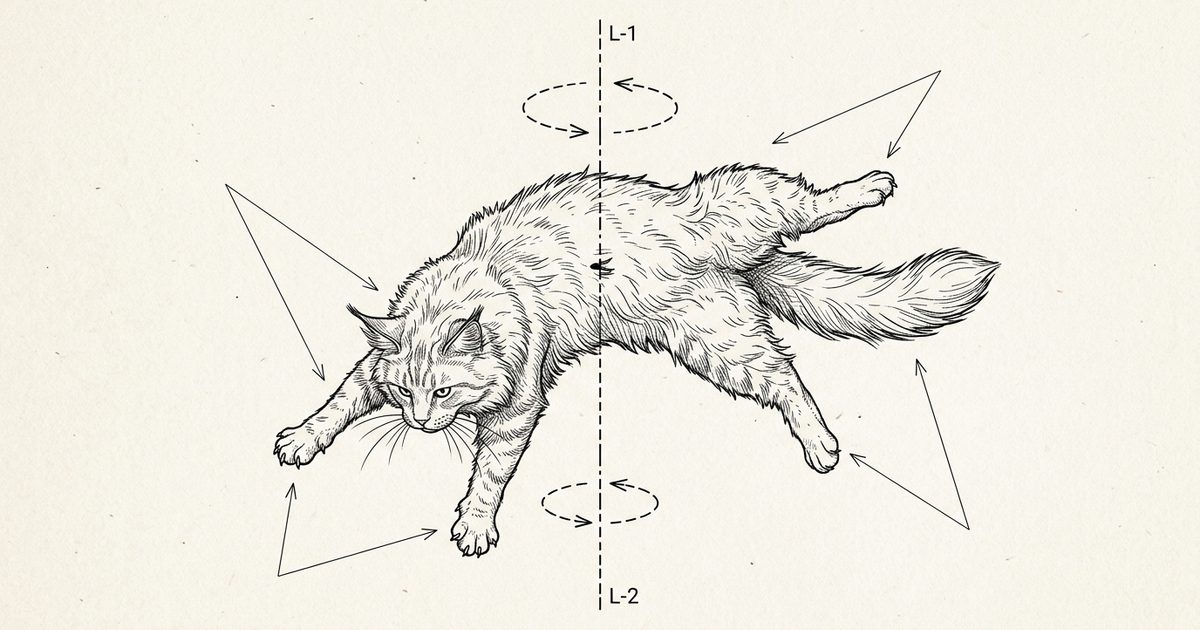
The famous "cats always land on their feet" has real science behind it, though with an important caveat we'll come to. When a cat falls, it doesn't simply tumble. It splits its body into two halves — front and rear — and rotates them in opposite directions, then brings them back into line. By repeating this twist, a cat can reorient itself fully in mid-air without violating the physics of angular momentum, because the two halves cancel each other out. The whole maneuver is driven by the vestibular system in the inner ear, which tells the cat almost instantly which way is down. Kittens begin developing this reflex at around three to four weeks and have it reasonably polished by seven weeks. You can read more about the body systems behind it in our guide to cat anatomy.
Flexible spine and loose skin
Two features make that mid-air twist possible. First, a cat's spine is exceptionally flexible — far more mobile between vertebrae than a human's — which lets the front and rear halves rotate semi-independently. Second, cats carry a generous layer of loose skin. That slack skin means the body can twist and the legs can reach within the skin envelope, so the skeleton rotates somewhat independently of the outer surface. The result is a body that can reorganize itself in flight, absorbing and redirecting force rather than taking it all in one rigid line.
Low terminal velocity and the parachute effect
Here's where the physics gets genuinely counterintuitive. When a cat falls from a great height, it instinctively spreads all four legs wide, increasing drag. Because cats are small and light relative to their surface area, their terminal velocity — the maximum speed they reach in freefall — is far lower than a human's, proportionally. A falling person accelerates toward roughly 200 km/h; a splayed cat settles somewhere closer to 100 km/h. There's also a much-debated clinical observation that falls from very high floors can sometimes be less fatal than mid-height drops — the idea being that once a cat reaches terminal velocity and stops accelerating, muscles relax and the body spreads out, improving the odds. The evidence is mixed and the data is messy, so it's best treated as a tendency rather than a guarantee — but the underlying physics is real. The Cornell Feline Health Center is a reliable source on feline fall injuries and the limits of these survival mechanisms.
High-rise syndrome
Veterinarians have a clinical name for all of this: high-rise syndrome. It describes the cluster of injuries seen in cats — frequently in summer, when windows are open — that fall from apartments and balconies. Survival rates are genuinely higher than you'd expect for a fall of that distance, which is precisely why the "nine lives" saying feels so intuitive to anyone who's watched a cat shake off a bad landing. But "higher than expected" is not the same as "unharmed." Cats do break jaws, legs, and pelvises; they do suffer lung and organ trauma; and some do not survive. The science explains why cats often walk away. It does not make them invincible. For practical guidance on keeping cats safe around open windows, International Cat Care offers clear, vet-reviewed advice.
Why Does the "9 Lives" Myth Persist?
The myth persists because cats genuinely walk away from accidents that would seriously injure other animals — falls, fights, near-misses — and humans notice. Each lucky escape reinforces the saying, even though the cat only has the one life she was born with.
There's a simple reason the "nine lives" idea refuses to die: cats keep seeming to prove it. Your cat knocks a vase off the shelf, lands badly, shakes herself, and walks off as if nothing happened. A neighbor's cat tumbles from a second-floor window and trots away. These moments feel like little miracles, and the easiest story to tell about a miracle is that the cat "used up one of her lives." The myth survives because it's a good fit for what we see — not because it's true.
Confirmation bias and lucky escapes
The catch is that we only remember the escapes. A cat that walks away from a fall becomes "another life used up," a small legend in the household. The cat that didn't walk away — the one hit by a car, the one that fell from a height her body couldn't compensate for — doesn't fit the story, so it quietly drops out of the narrative. Psychologists call this confirmation bias: we notice the cases that confirm what we already believe and forget the ones that don't. Over a lifetime of cat ownership, the surviving falls pile up in memory while the losses fade, and the "nine lives" count feels almost reasonable. A cat that survives a high fall isn't spending a spare life — she's using the one body and one set of reflexes she has, and getting lucky on top of that.

Cats in pop culture
The other reason the saying endures is that it's everywhere. Cartoons show cats flattened by anvils and re-inflated a second later; storybook cats survive impossible scrapes; the phrase "a cat has nine lives" shows up as an idiom in novels, songs, and everyday speech. Once a saying becomes culturally useful — warm, affectionate, slightly admiring — it outlives any factual check. Nobody pauses a cartoon to ask whether a cat really has spare lives, because the point of the phrase was never biology. It's a way of saying "isn't it remarkable how cats bounce back?" and that feeling is real. The cats are genuinely resilient; the number is just the story we wrapped around it.
Curious what your resilient survivor would say about all her close calls? Get a MeowMind reading — your resilient little survivor has stories to tell. Upload a photo and hear what your cat would say about her nine close calls.
The Danger of Believing Cats Have Nine Lives
The "nine lives" myth is harmful when it makes owners careless. Cats are seriously injured and killed by falls from windows and balconies, by cars, by dogs, and by preventable accidents every year. Resilient is not the same as invincible.
This is where the myth stops being charming and starts causing harm. If you believe a cat can fall from anything and walk away, you may not bother to fix the window screen, you may let a young cat out near a busy road, or you may wait too long after a fall because "she's a cat, she'll be fine." Real cats fill emergency clinics every summer with broken jaws, shattered pelvises, and ruptured lungs — injuries that are survivable with fast, expensive veterinary care, but that the cat would never have suffered if the window had a screen. Believing cats have spare lives can quietly cost a cat her only one.
Cats do not always land on their feet
The righting reflex is real, but it has limits. Cats need time and distance to rotate mid-fall, so very short drops — from a few feet up to roughly one or two storeys — don't give them enough room to flip over. Paradoxically, these short, fast falls can be more dangerous than higher ones, because the cat lands before her body has finished turning, often on her side, her chin, or her outstretched legs. Emergency vets routinely see fractured jaws, broken legs, and shattered pelvises from falls that were too low for the righting reflex to help. Landing on the feet is also not the same as landing uninjured — even a perfect feet-first landing transmits enormous force through the legs and spine. You can read more about the mechanics of falls and recovery from the Cornell Feline Health Center.
Windows, balconies, and screens
The single biggest preventable cause of fall injuries is unscreened windows and open balconies — what vets call high-rise syndrome. Cats don't fall because they're clumsy; they fall because they're curious, they chase bugs and birds, and they don't understand that the ledge leads to a long drop. The fix is straightforward and unglamorous: fit every window a cat can reach with a sturdy screen, keep balconies off-limits or screened in, and never assume a cat "knows" not to step off the edge. This isn't about being overprotective or scolding your cat for being a cat — it's about making her environment safe so her curiosity doesn't cost her the one life she has. A fitted screen costs almost nothing and prevents almost everything.

Outdoor risks
Beyond falls, the outdoor world carries risks the "nine lives" idea can't protect against: cars, dogs, larger predators, and fights with other cats that can lead to abscesses, infections, and diseases like FIV. None of these care how resilient your cat is. The myth shouldn't replace supervision, a proper understanding of real feline lifespan, and prompt vet care after any accident. Keeping an indoor or securely enclosed life — or supervising outdoor time — is one of the most reliable ways to protect the one life your cat actually has. International Cat Care offers detailed, practical guidance on keeping cats safe indoors and outdoors, and it's worth reading before you decide how much freedom to give a cat you love.
Do All Cultures Say Nine Lives?
No — the number varies by culture. English-speaking countries say nine, but in Spain, Italy, Portugal, Brazil, and parts of Latin America, cats are said to have seven lives. Arabic and some Middle Eastern traditions speak of six or seven. The idea is global; the number is local.
If you grew up hearing that cats have nine lives, you might assume the whole world agrees. It doesn't. The belief that cats are extraordinarily resilient turns up almost everywhere humans and cats live together — but the exact number attached to it shifts with language, region, and tradition. The question "do cats have 9 lives" has a different answer depending on who you ask — not because cats themselves differ, but because the saying does. Whatever the number, of course, a cat still has only the one real life we covered earlier.
Seven lives: southern Europe and Latin America
Across much of the Spanish- and Portuguese-speaking world, the proverb is siete vidas (seven lives) in Spain and Latin America, and sete vidas in Portugal and Brazil. A cat there "tiene siete vidas," not nine. The number travelled with the language — as Spanish and Portuguese spread through the Americas, the seven-lives version went with them, and it's still the default saying from Madrid to Mexico City to São Paulo. Italians, too, traditionally speak of sette vite. So if a friend from São Paulo tells you her cat has used up three of her seven lives, she isn't miscounting — she's just using her culture's number.

Other numbers and a shared thread
Other traditions land on still different figures. Some Arabic sayings speak of a cat having six lives; certain Middle Eastern and Turkish proverbs use seven. The exact count is debated even within a single language, so it's best taken as "several" rather than a fixed rule. What's striking is how consistent the underlying feeling is: nearly every culture that has lived alongside cats has felt moved to exaggerate their toughness into a magical number. We attach different digits to the same observation — that cats survive things they seemingly shouldn't — and that shared instinct, more than any particular number, is the real reason the legend endures. For a sense of just how astonishing that real-world resilience is, the Cornell Feline Health Center and International Cat Care both document the biology behind it.
The "9 Lives" Myth at a Glance — Summary
| Question | Short answer |
|---|---|
| How many lives do cats really have? | One — exactly like every other animal |
| Where does the "9 lives" myth come from? | Centuries of European and Egyptian folklore; nine was a sacred number |
| Why do cats survive falls that would injure us? | The righting reflex, a flexible spine, and low terminal velocity |
| Why does the myth persist? | Cats genuinely walk away from accidents — we notice and remember |
| What's the danger of the myth? | It can make owners careless; cats are resilient, not invincible |
| Do all cultures say nine lives? | No — many say seven, some say six; the number is local |
| Do cats always land on their feet? | Usually, given enough fall distance — but not always, and not always uninjured |
Curious What Your Cat Would Say?
Upload a photo and get a warm, personalized reading from your cat's perspective.
Start Your Free ReadingFrequently Asked Questions
Do cats really have nine lives?
No — cats have one life, exactly like every other mammal. The 'nine lives' idea is a centuries-old saying rooted in how often cats walk away from accidents that would seriously injure other animals, not in any real spare lives.
How many lives do cats actually have?
Exactly one. Cats are mammals bound to a single lifespan, with no biological mechanism that resets or restarts their life. A well-cared-for indoor cat typically lives 13–17 years, and many reach past 20 — but it's still one life.
Why do people say cats have nine lives?
Because cats genuinely survive falls, fights, and near-misses that would hospitalise a human. Over centuries, people noticed that resilience and wrapped it in a number — nine being a sacred, complete figure in the European folklore that shaped the English saying.
Do cats always land on their feet?
Usually, but not always. The righting reflex needs enough fall distance to rotate the body feet-down, so very short drops of a few feet can be more dangerous than higher ones — the cat lands before she's finished turning. Landing feet-first also isn't the same as landing uninjured.
Why do some countries say cats have seven lives?
The number is cultural, not biological. Spain, Italy, Portugal, Brazil, and much of Latin America use *siete* or *sete vidas* (seven lives), while some Arabic and Middle Eastern traditions say six. The belief in feline resilience is global; the number attached to it is local.
Can a cat survive a fall from any height?
No. Survival rates from falls are higher than you'd expect thanks to the righting reflex, a flexible spine, and low terminal velocity — but cats do break jaws, legs, and pelvises, and some do not survive. High-rise syndrome injures and kills cats every summer, and most cases are preventable with window screens.
Is the nine lives thing true at all?
Only as a saying. The kernel of truth is that cats are unusually resilient: they right themselves mid-fall, absorb impacts well, and recover from mishaps that would injure us. But that's one remarkable life doing the surviving — not nine.
Are cats really that resilient compared to other animals?
In some specific ways, yes. Their righting reflex, flexible spine, loose skin, and low terminal velocity give them a genuine edge in falls. But resilience isn't invincibility — cats are still seriously hurt and killed by cars, dogs, fights, and unscreened windows every year.
Sources & References
You Might Also Like
Kitten Teething: Timeline, Symptoms & How to Help
Kitten teething runs from 3 to 7 months as baby teeth fall out. Learn the timeline, signs to watch for, and how to soothe a teething kitten safely.
15 min readWhen Do Cats Stop Growing? A Complete Timeline
When do cats stop growing? Most cats reach adult size by 12-18 months, but large breeds like Maine Coons keep growing until 3-4 years. Full timeline inside.
14 min readCan Cats Eat Cherries? Flesh, Pit & Toxicity Facts
Can cats eat cherries? Pitted flesh is safe in tiny amounts — but the pit, stem, and leaves are toxic (cyanide precursors). Learn what's safe and what isn't.
15 min read