
How High Can Cats Jump? The Impressive Truth
If you've ever watched a cat launch from the floor to the top of a bookshelf in a single, effortless spring, you've probably wondered the same thing most owners do: how high can cats jump? The answer is genuinely astonishing — a healthy adult cat can clear roughly 5 to 8 feet (1.5 to 2.4 meters) straight up from a standing start. That is how high a cat jump reaches, and it places typical cat jump height at about five to six times the animal's own body length. It's the same explosive hardware your cat's wild ancestors used to ambush prey, escape up a tree, and reach safe perches — and it still hums inside every house cat today. Below we break down the real numbers, the biomechanics behind that launch, why evolution built a cat to fly, which breeds leap highest, and how to keep a leaping cat safe.
Key takeaways
- A healthy adult cat can jump roughly 5–8 feet (1.5–2.4 m) from a standing start — about 5–6 times its own body height.
- The leap comes from powerful hind legs, an extraordinarily flexible spine, and fast-twitch muscle packed into a light frame.
- Jumping is instinctive and mostly safe — but cat-proof high places and screen all upper-story windows to prevent high-rise falls.
How High Cats Jump — Quick Reference
| Question | Short answer | Detail |
|---|---|---|
| How high can cats jump? | ~5–8 ft / 1.5–2.4 m from a standing start | How high can cats jump? |
| Why can they jump so high? | Powerful hind legs, flexible spine, light frame | How do cats jump so high? |
| Which breeds jump the highest? | Athletic, lean types — Bengals, Savannah-types, Abyssinians | Which cats jump the highest? |
| Kitten vs senior jumping | Kittens are still learning; seniors lose height | What affects how high a cat can jump? |
| Is jumping safe for cats? | Yes, with cat-proofed landings and screened windows | Is jumping safe for cats? |
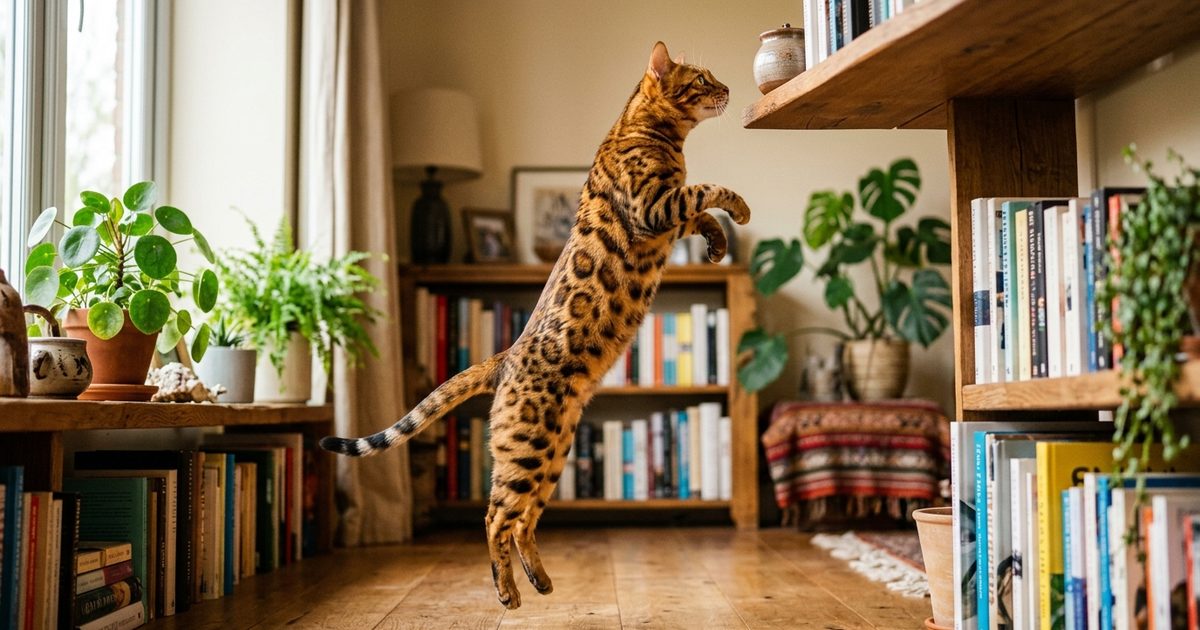
How High Can Cats Jump?
A healthy adult cat can jump five to six times its own body height from standing — about 5 to 8 feet, or 1.5 to 2.4 meters. That is like a person clearing a basketball hoop from a standstill, and height varies by breed, age, and health.
If you've ever watched your cat launch from the floor to the top of a bookshelf in a single, silent motion, the question "how high can cats jump" stops feeling academic. It looks impossible for an animal that size — and yet they do it casually, mid-yawn, on the way to a sunbeam. Cat jump height is one of those numbers that genuinely surprises people the first time they look it up, because it is not a marginal feat. It is an extreme one.
The honest answer, though, is a range, not a single figure. There is no official world record stamped on every domestic cat, and individual variation is large. What we can say with confidence is that a typical, healthy, adult house cat clears somewhere around 5 to 8 feet vertically from a standstill, and the most athletic individuals go higher. Let's break that down.
The standing vertical jump
When people quote cat jump height, they almost always mean the standing vertical — the leap a cat makes from a crouch, with no running start. This is the purest measure of raw jumping power, and it is the number that lands around five times the cat's own body height (measured to the shoulder), which works out to roughly 5 to 8 feet, or 1.5 to 2.4 meters, for an average adult.
That multiple is striking. Scaled to a human, a five-times-body-height standing jump would put you clearing a basketball hoop with room to spare. Very few animals of similar size come close. The power comes from the hind legs and the spine working together (we get into the biomechanics in the next section), but the headline is simple: even an ordinary house cat, no special breeding, is an extraordinary vertical jumper by any standard. The Cornell Feline Health Center covers feline musculoskeletal health in depth if you want the veterinary side of how those legs and joints stay capable.

Running jumps and horizontal distance
Add a run-up and the picture shifts. With a few strides of approach, a cat converts horizontal speed into extra distance, so running jumps cover more ground — useful for crossing gaps or reaching a far shelf. But the run-up mostly adds horizontal reach, not a dramatically higher vertical peak. The headline "how high can a cat jump" number remains the standing vertical, because that is the figure that reflects pure explosive launch power.
The run-up itself is worth appreciating: cats can hit near top sprint speed in just a few strides before leaving the ground. If you want the full picture of that horizontal speed and the gallop gait behind it, we cover it in our piece on how fast a cat can run — the short version is around 30 mph in a short burst, and that momentum is exactly what a running jump trades for distance.
Kittens, seniors, and the range
The 5-to-8-foot figure describes a cat in its prime — roughly young adult to middle age. At the edges of life, the number drops, for understandable reasons.
Kittens have the raw hardware but not the coordination. Their muscles and reflexes are still wiring together, so their jumps are enthusiastic, frequently miscalibrated, and occasionally into the side of a chair. They reach full leaping power only as they near physical maturity — see our guides on how to tell a cat's age and when cats stop growing for where that line falls.
Senior cats trend the other way. Muscle mass quietly decreases with age, joints lose range, and many older cats develop some degree of arthritis they hide well. A cat that used to clear the counter effortlessly may start asking for a mid-step, or stop jumping onto high surfaces altogether. That is not laziness — it is the same power-to-mass equation shifting against them, and it is worth paying attention to rather than pushing through.
How Do Cats Jump So High? The Biomechanics
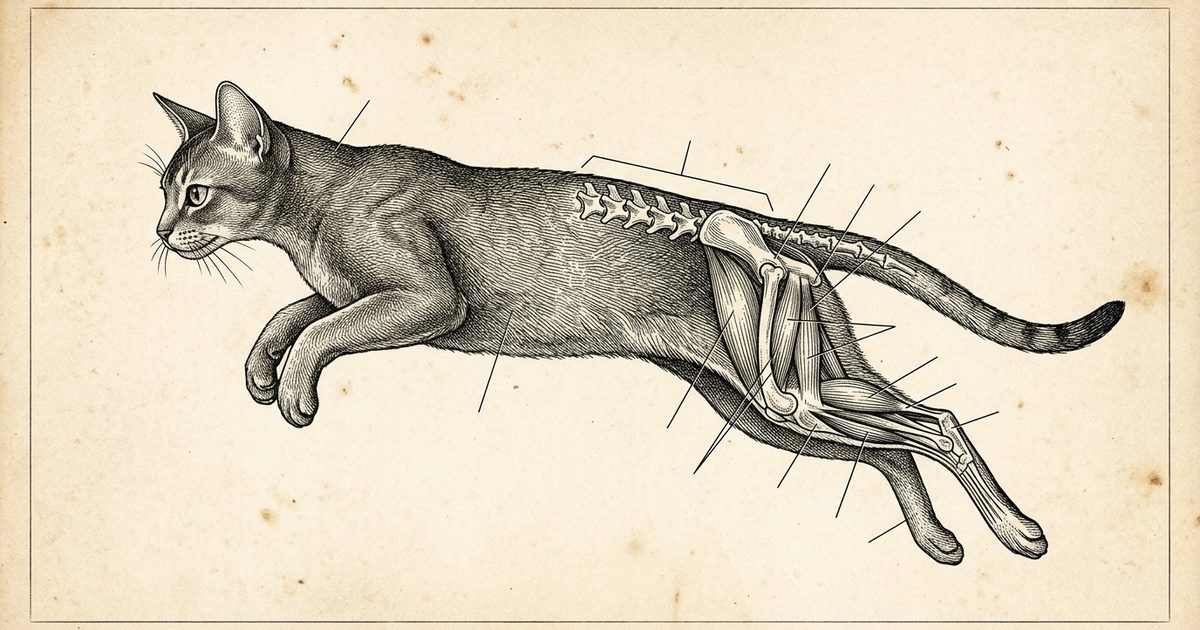
A cat's jump comes from powerful hind legs loaded with fast-twitch muscle, an extraordinarily flexible spine that arches then extends like a spring, and a light frame. The hind legs store energy in a crouch and release it in one explosive extension, while the spine lengthens the launch.
The number is impressive, but the engineering behind it is the real story. Cats are not just enthusiastic — they are built, from the skeleton outward, for exactly this motion. Three systems work together: a hind-limb power plant that stores and releases energy, a spine that acts as a lengthening spring, and a light frame with a tail that keeps the whole thing balanced in flight.
The hind-limb power plant
The launch begins in the hind legs. Before a cat leaves the ground, it drops into a deep crouch — and that crouch is not just wind-up theater. It stretches the muscles and tendons of the hind limb, loading them like a compressed spring. When the cat fires, the hind legs extend in one fast, coordinated burst, and the connective tissue recoils, returning stored elastic energy on top of the muscle's own contraction.
Two things make this especially effective. First, the tendons in the lower hind limb — functionally comparable to the Achilles mechanism in humans, though differently arranged — store meaningful energy during the crouch and give it back during extension. Second, cat hind-limb muscle is heavily dominated by fast-twitch fibers, the type built for rapid, forceful contraction rather than endurance. The result is a limb optimized for one explosive movement, not sustained effort. For the broader skeletal and muscular context behind those limbs, our cat anatomy overview walks through the structure.
The flexible spine as a spring
The hind legs supply the power, but the spine is what turns a strong push into a long, high arc. A cat's spine has more vertebrae than a human's, and the intervertebral discs between them are notably elastic. That gives the back an exceptional range of motion in both directions.
On takeoff, the cat arches its back sharply — which shortens the body and adds one more loaded spring to the launch. Mid-air, the spine reverses and unfurls, lengthening the body and extending the trajectory. On landing, that same flexibility absorbs impact by flexing again. The spine is doing three jobs across one jump: loading, extending, and cushioning. It is a big part of why cats can jump so high relative to their size, and why they so often stick the landing.
Light frame and the tail as balance
Power-to-weight ratio matters as much as raw power. Cats are lightly built for their muscle mass — a lean adult is a small package carrying a lot of fast-twitch strength, which is exactly the combination that produces a high vertical leap. Excess weight works directly against this equation, which is one reason lean cats jump better and land more safely than overweight ones.
The tail plays a subtler role: it acts as a counterweight in flight. As the cat leaves the ground, the tail helps manage rotation, allowing the body to reorient smoothly — the same principle a tightrope walker uses with a pole. International Cat Care covers feline orthopedics and locomotion in depth, including how this balance system functions and where it can break down.
The landing: why cats usually land on their feet
This is the part everyone knows, and it is worth being precise about. Cats possess a righting reflex — an inborn ability to rotate in mid-air and land on their feet, and it begins working surprisingly early in kittenhood. At moderate heights, it is remarkably effective, and it is a real piece of biomechanical engineering involving the eyes, inner ear, spine, and tail all working together.
But "usually" is doing important work in that sentence. The righting reflex has limits. It needs time and height to complete its rotation, and beyond a certain point the forces involved exceed what a cat's body can absorb. Cats are emphatically not invincible, and falls from upper-story windows cause serious injury and death every year — a pattern so well documented it has its own name, high-rise syndrome. We cover that in detail, including the non-obvious parts of the survival statistics and how to prevent it, in the safety section below. The short version: landing on their feet is real, but it is not a guarantee, and it is never a reason to leave a window unscreened.
Why Did Cats Evolve to Jump So High?
Cats evolved as ambush predators and tree-climbers. An explosive vertical leap let them pounce on prey from cover, escape larger predators by shooting up a tree, and reach elevated vantage points to watch and rest. Jumping is a survival tool, not a party trick.
A cat does not leap onto your kitchen counter for fun. The same spring that lifts a Bengal from floor to the top of a bookshelf is the spring its wildcat ancestors relied on to eat, to flee, and to sleep safely. Every piece of that motion was polished by natural selection long before there were kitchens.
Ambush hunting from cover
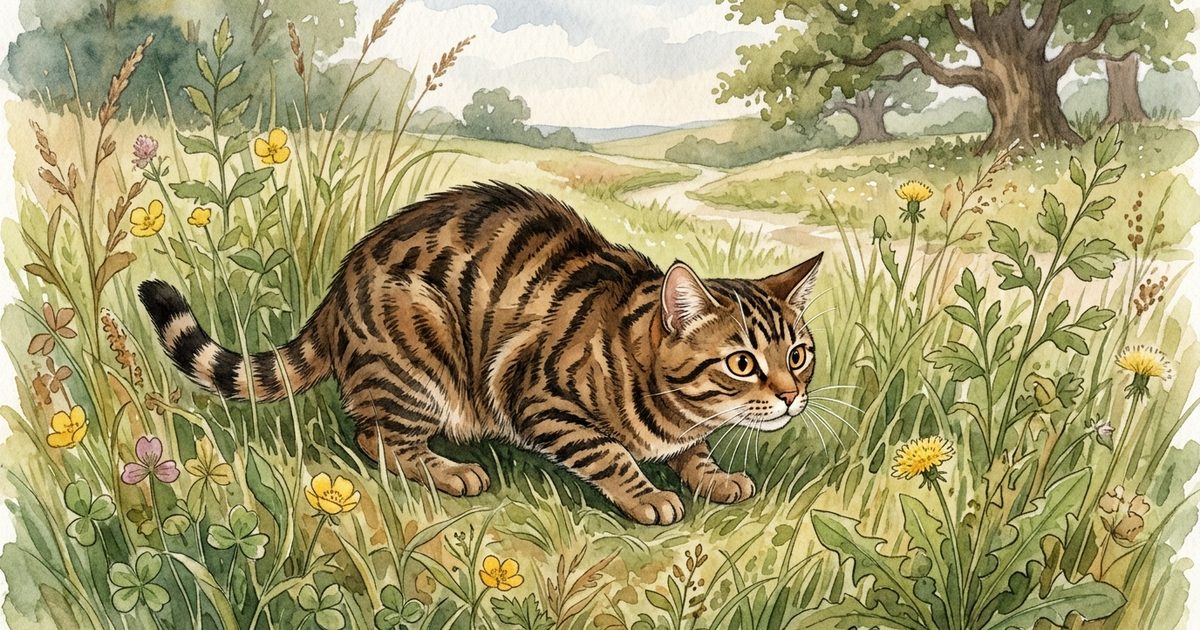
The classic cat hunt is not a long chase. A cat creeps low, body almost flat, eyes locked on the target — the same fixed stare you can read about in why cats stare — and then explodes forward and upward in a single pounce. One burst, one kill. That is far more energy-efficient for a small predator than sprinting a prey animal down across open ground, and it lets a cat hunt in grass, brush, or dim light where speed alone would fail.
The excitement that builds before the launch often leaks out as a rattling chirp or chatter at the window — the same prey-driven sound we unpack in why cats chirp. Your indoor cat pouncing a feather wand is running the full ancestral sequence, start to finish, just with a toy instead of a mouse.
Escaping predators up a tree
When a small predator is itself prey, the fastest exit is often straight up. A vertical leap that puts a cat six feet into a tree, out of a dog's or a coyote's reach, is the difference between surviving and not. This is why even a pampered house cat with no real threat in its life still bolts upward when startled — the reflex was never trained in, so it cannot be trained out. The leap is stored as a default escape program, ready to fire whether the trigger is a genuine danger or the sound of a dropped pan.
High vantage points and rest
Cats feel safer when they are above their surroundings. A high perch turns the world into something the cat watches rather than something it is exposed to, which is why a top-shelf, the crown of a cat tree, or the kitchen cabinet is always the preferred bed. Leaping up there is the modern version of climbing to a sturdy branch. The need for a secure, enclosed spot overlaps with why cats like boxes — both are ways a cat manufactures a feeling of safety — and once settled, the postures a cat adopts on a high perch mirror the same comfort signals found in the resting forms in our guide to cat sleep positions.
What Affects How High a Cat Can Jump?
Jump height depends on age, health, body condition, and the surface a cat leaps from. Young, lean, healthy cats in their prime jump highest; overweight cats, seniors with arthritis, and cats with muscle or joint disease jump noticeably lower — or stop jumping entirely.
The five-to-eight-foot range describes a healthy adult cat on a good day. The actual number for your cat, today, is a moving target, and most of the variables are things you can read or influence directly.
Age and life stage
Jumping is a learned and then a maintained skill. Kittens are still wiring together the coordination, timing, and landing reflex; they attempt ambitious leaps, miss, and learn. A cat reaches full jumping power once its body is fully grown, which for most breeds lines up with the timeline in when cats stop growing — usually somewhere in the first year to eighteen months. The prime window, where a cat is strong, lean, and well-coordinated, tends to run roughly from one to seven years. After that, muscle mass and joint mobility begin a slow decline, and jumps get shorter and more carefully chosen. Estimating where a cat sits on that arc is one reason owners check how to tell a cat's age.
Weight and body condition
Jumping is a power-to-mass problem. The more weight a cat carries that is not working muscle, the lower it gets lifted for the same effort — and the harder the landing lands. An overweight cat is not just jumping less high; it is also putting more load through its joints on every impact, which compounds over the years. A lean, well-muscled cat jumps higher and, more importantly, jumps safer.

Health: arthritis, injury, pain
A sudden drop in how high your cat jumps is one of the clearest early signs that something hurts. Cats are famously stoic; they rarely cry or limp, so owners have to infer pain from behavior. A cat that used to clear the counter and now hesitates, lands short, or refuses to jump at all may be signaling arthritis, an orthopedic injury, or another source of joint or back pain. This is a vet-check trigger, not a training problem — your vet diagnoses the cause. The Cornell Feline Health Center is explicit that a change in a cat's normal behavior, including reluctance to jump or climb, is a legitimate reason to call the vet.
Surface, traction, and motivation
The launch only works if the back feet can grip. A slick floor, a wobbly chair, or a polished shelf steals purchase at takeoff and shortens the jump before the cat even leaves the ground — which is one reason rugs and stable furniture matter more than owners expect. Motivation finishes the equation: a cat hunting real or fake prey, or fleeing a perceived threat, will jump noticeably higher than a bored cat half-heartedly reaching for a shelf. The body is capable of more than the cat usually asks of it.
Which Cats Jump the Highest? Breeds Known for Leaping
Athletic, lean breeds with wild ancestry — Bengals, Savannah-types, and Abyssinians — are widely reported as the highest jumpers, often clearing 8 feet or more. But jumping ability varies by individual far more than by breed, and many mixed-breed house cats leap just as high.
When people ask which cats jump the highest, the names that come up first are almost always the lean, athletic breeds with recent wild ancestry. These are the cats built like small leopards — long hind legs, dense muscle, and a frame engineered for explosive launch. The honest caveat, though, is that the breed rankings you'll read online are almost entirely owner-reported rather than measured, and they reflect a tendency, not a rule. The same general principles covered in cat anatomy — powerful hind limbs, a flexible spine, and a light frame — explain why these body types jump so well.
Athletic and wild-type breeds
The Bengal is the breed most often named as a top jumper, and it's easy to see why: Bengals carry recent Asian leopard cat ancestry, and they tend to be lean, muscular, and relentlessly athletic. Savannah-types (crosses with the serval, a wild cat famous for its vertical pounce) are reported by owners to clear extraordinary heights, and the lithe, muscular Abyssinian is right behind them. What these cats share isn't a specific measured record — it's a body plan: long, powerful hind legs and a low body-fat ratio that maximizes power-to-mass. That same build is why they're also standout horizontal athletes; the leap and the sprint draw on the same hind-limb engine, as we describe in how fast a cat can run.
Large and heavy breeds
At the other end of the spectrum, large breeds like the Maine Coon are strong and athletic, but their greater mass works against vertical launch. Jump height is ultimately a power-to-weight equation, and a heavy cat has more to lift per unit of muscle. Maine Coons can and do jump — they just don't reach the same heights relative to their size as a lighter cat. This is one reason a sudden drop in a big cat's willingness to jump can be worth a vet conversation; extra weight places more load on joints at every landing. Cornell's feline musculoskeletal guidance covers exactly this kind of weight-on-joints concern.
Mixed-breed house cats
Here's the part that matters for most readers: your average domestic shorthair is a fully capable jumper. Mixed-breed house cats carry the same feline blueprint — coiled hind legs, fast-twitch muscle, a spring-loaded spine — and routinely launch from floor to fridge with no pedigree required. So if you've been wondering how high house cats can jump, the answer is the same 5 to 8 feet a healthy adult of any lineage can clear. Breed colors the extremes; it doesn't set the ceiling for the cat on your floor. Per International Cat Care, ordinary domestic cats are no less physically complete than their purebred cousins — they simply haven't been labeled.

Is Jumping Safe for Cats? Home Proofing and High-Rise Syndrome
Jumping itself is safe for a healthy cat, but the landing surface matters: hard floors, cluttered shelves, and open windows cause real injuries. High-rise syndrome — cats falling from upper-story windows — is a well-documented seasonal emergency, and it is fully preventable with secured screens.
Cat-proofing high places at home
Most cats land their everyday leaps without a problem, but a few small changes at home turn risky landing zones into safe ones. Clear breakables off the shelves your cat targets — a knocked-over vase isn't just property damage, it's shattered glass on a launch path. Secure tall bookcases and freestanding shelving to the wall, because a cat that launches off a wobbly unit can bring the whole thing down on top of itself. Watch the surface at favorite landing spots: polished wood and tile give poor traction on takeoff and landing, so lay a non-slip mat or rug where your cat pushes off. Finally, give your cat legal launch targets — a stable, heavy-based cat tree gives it a sanctioned high perch to aim for instead of the fridge or the curtain rod.
High-rise syndrome
High-rise syndrome is the veterinary term for injuries sustained when a cat falls from a second-story window or higher. It peaks in warm months, when windows are left open and cats lounge on sills to watch birds and street noise — both irresistible lures. There is a counterintuitive pattern in the data: cats that fall from greater heights sometimes survive with fewer injuries than those that fall from mid-height. The working explanation involves the righting reflex and terminal velocity — from a mid-height fall, a cat reaches the ground still mid-righting and tensed; from a higher fall, it has time to fully rotate, relax, and spread its limbs, distributing the impact. This is a documented phenomenon worth understanding, not reassurance: high-rise falls still cause serious injury and death, and the only safe response is prevention. Install secured, cat-rated screens or reinforced window guards on every upper-story window — "just cracked" is not enough, because a determined cat can push through a gap. After any fall, watch for the body language of a stressed or hurt cat — hiding, flattened ears, panting, or reluctance to move all warrant an immediate vet visit. The Cornell Feline Health Center and International Cat Care both publish guidance on window safety and what to do if a fall happens.

When jumping might mean pain
A cat that suddenly stops jumping, hesitates, or stair-steps up via a chair is usually signaling pain — most often arthritis or an orthopedic injury — not laziness. We cover the full picture in the health red flags above, including why this is a vet-check trigger rather than a training issue.
Curious What Your Cat Would Say?
Upload a photo and get a warm, personalized reading from your cat's perspective.
Start Your Free ReadingHow High Cats Can Jump — Summary
| Question | Short answer |
|---|---|
| How high can a cat jump from standing? | Roughly 5–8 feet (1.5–2.4 m) for a healthy adult, or about 5–6 times its own body height |
| How does that compare to body height? | Around five to six times the cat's body height — like a person clearing a basketball hoop from a standstill |
| Why can cats jump so high? | Powerful fast-twitch hind legs, a flexible spine that acts like a spring, and a light frame with a counterbalancing tail |
| Which breeds jump the highest? | Athletic, lean, wild-type breeds — Bengals, Savannah-types, Abyssinians — though individual ability varies more than breed |
| Do kittens or seniors jump as high? | No — kittens are still building coordination and seniors lose muscle and joint range; both jump lower than a prime-age adult |
| What's the top safety tip for a jumping cat? | Screen every upper-story window to prevent high-rise syndrome, and keep breakables off launch and landing spots |
Frequently Asked Questions
How high can a healthy adult cat jump?
A healthy adult cat can jump roughly 5 to 8 feet, or 1.5 to 2.4 meters, straight up from a standing start — about five to six times its own body height. It's a range, not a fixed number, because individual fitness, breed, and age all shift the figure.
How high can a house cat jump compared to a wild cat?
Most house cats can clear the same 5 to 8 feet as their wild relatives, because the leap comes from the same shared feline blueprint of coiled hind legs and a spring-loaded spine. Wild cats simply use that hardware more often, in harsher stakes.
Why can cats jump so high?
Cats jump high thanks to powerful hind legs packed with fast-twitch muscle, an extraordinarily flexible spine that arches then extends like a spring, and a light frame with a counterbalancing tail. Together they turn a crouch into one explosive launch.
At what age do cats jump the highest?
Cats usually hit peak jumping power between roughly one and seven years old, when they're fully grown, lean, and well-coordinated. Kittens are still learning the timing, and seniors slowly lose muscle and joint range, so both jump lower.
Which cat breed jumps the highest?
Athletic, lean, wild-type breeds like Bengals, Savannah-types, and Abyssinians are most often named as top jumpers, reportedly clearing 8 feet or more. But those rankings are owner-reported, not measured, and many mixed-breed house cats leap just as high.
Do cats always land on their feet?
Cats have an inborn righting reflex that usually rotates them feet-down at moderate heights, but it is not guaranteed and it has real limits. At extreme heights the forces exceed what a cat's body can absorb, which is why high-rise falls still cause serious injury and death.
Is it safe for cats to jump from high shelves?
Everyday leaps are safe for a healthy cat as long as landings are clear, stable, and not slippery. The real danger is unscreened upper-story windows — falls from them cause high-rise syndrome, which is fully preventable with secured, cat-rated screens.
Why has my cat stopped jumping like it used to?
A sudden drop in jump height or a new habit of hesitating and stair-stepping is one of the clearest early signs of pain, most often arthritis or an orthopedic injury. Cats hide discomfort well, so treat this as a vet-check trigger, not a training problem.
Sources & References
You Might Also Like
Kitten Teething: Timeline, Symptoms & How to Help
Kitten teething runs from 3 to 7 months as baby teeth fall out. Learn the timeline, signs to watch for, and how to soothe a teething kitten safely.
15 min readWhen Do Cats Stop Growing? A Complete Timeline
When do cats stop growing? Most cats reach adult size by 12-18 months, but large breeds like Maine Coons keep growing until 3-4 years. Full timeline inside.
14 min readCan Cats Eat Cherries? Flesh, Pit & Toxicity Facts
Can cats eat cherries? Pitted flesh is safe in tiny amounts — but the pit, stem, and leaves are toxic (cyanide precursors). Learn what's safe and what isn't.
15 min read