
Can Cats Eat Peaches? Flesh, Pit, and What's Safe
Yes — cats can eat peaches, but only in the narrowest sense. If you've ever wondered can cats have peaches, the short version is: peeled flesh only, in a tiny piece, once in a while. The flesh of a ripe peach is non-toxic and safe for cats in small amounts as an occasional treat; the pit, leaves, and stems are not.
What makes a peach tricky is that the safe part and the dangerous part grow together. The sweet flesh is fine, but the woody pit it surrounds carries amygdalin — a compound that releases cyanide when chewed or crushed — and the same cyanogenic compounds run through the peach tree's leaves and stems. The pit is also a hard, round stone that can choke a cat or block the bowel. And nutritionally, a peach is mostly sugar and water, offering a cat almost nothing it actually needs. You can read more about feline-safe and toxic foods from the Cornell Feline Health Center, or browse International Cat Care for general feeding guidance.
Key takeaways
- The flesh of a ripe peach is safe for cats in small amounts, but the pit, leaves, and stems contain a cyanide precursor and must always be removed.
- The pit is a double hazard — it carries the same cyanogenic compounds as apple seeds AND is a hard woody object that can choke a cat or block the bowel.
- Peaches are mostly sugar and water with minimal nutritional value for a cat, and cats cannot taste sweetness, so any interest is curiosity and texture, not a craving.
Peaches for Cats — Quick Reference
| Peach part | Safe for cats? | Notes |
|---|---|---|
| Peeled flesh in tiny pieces | Yes — rare treat only | Remove all skin and pit first; a pea- to fingernail-sized piece is plenty |
| Peach pit | No — never | Carries amygdalin (cyanide precursor) and is a hard woody choking/blockage hazard |
| Peach leaves and stems | No — never | Same cyanogenic compounds as the pit; keep cats away from the plant |
| Canned peaches in syrup | No | Heavy syrup is concentrated sugar that spikes blood glucose — fresh flesh only |
| Dried peach with added sugar | No | Added sugar plus a chewy, sticky texture — choking and sugar hazard |
| Peach skin | No | Fuzzy, fibrous, and hard to digest; peel the fruit fully before offering flesh |
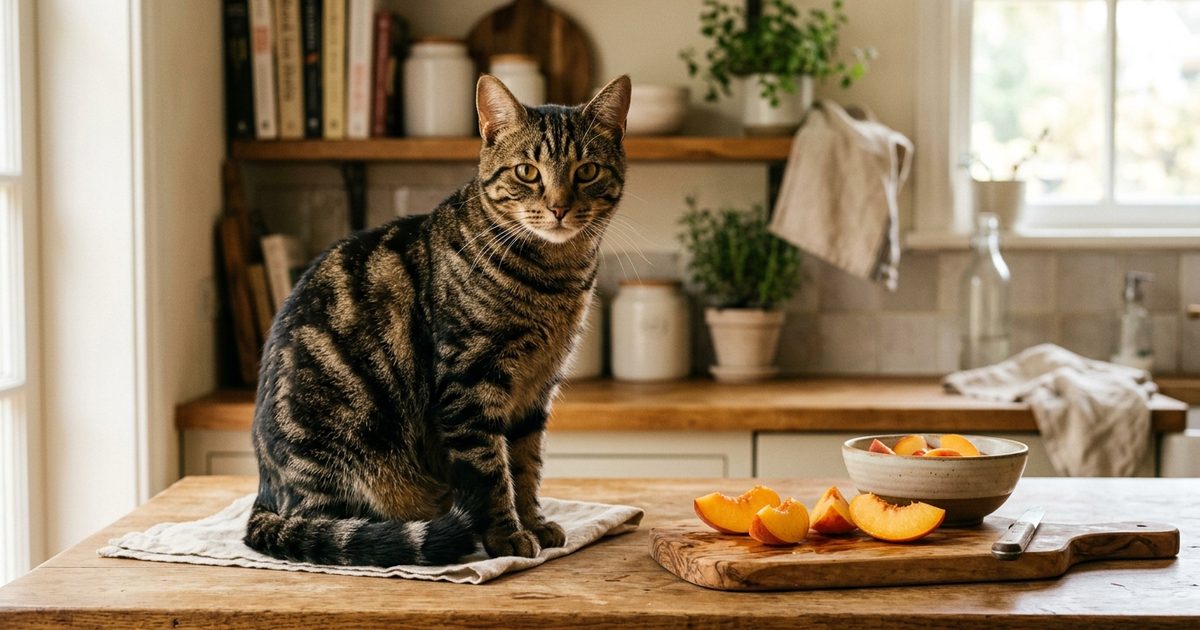
Can Cats Eat Peaches?
Yes — cats can eat the flesh of a ripe peach in small amounts as an occasional treat. The fruit itself is non-toxic, but the pit, leaves, and stems contain a cyanide precursor and must never be fed. Always peel and fully pit the peach before offering a tiny piece.
The short answer
So, can cats eat peaches? Yes, but with a clear boundary: only the flesh, only in tiny amounts, and only as an occasional treat — never as a regular part of the diet. The ripe fruit is non-toxic to cats, which is the good news. The bad news is that everything attached to that fruit — the pit, the leaves, and the stems — carries a cyanide precursor and has no place near your cat. The same logic applies to anyone asking can cats have peaches: the flesh is a permissible treat, prepared correctly, and nothing more. Think of peach as a once-in-a-while novelty, not a food.
Why peaches are an odd fit as a cat food
Here is the honest framing. Peaches are a sugary stone fruit built around water and carbohydrate, while your cat is an obligate carnivore whose metabolism runs on protein and fat, not on fruit sugar. Your cat's body simply does not need what a peach offers, and it has limited machinery for handling a carbohydrate load. So the question is not really "are peaches good for cats" — we answer that fully below — but rather "are peaches safe," and the answer is a qualified yes for the flesh only.

Are Peach Pits Dangerous for Cats?
Yes — peach pits are dangerous for cats. They contain amygdalin, a compound that releases cyanide when chewed or crushed, and they are hard and woody enough to choke a cat or block the intestine. Never let a cat chew, play with, or swallow a peach pit.
Amygdalin and cyanide in the pit
The woody stone inside a peach is not just a hard center — it is a chemical hazard. Peach pits contain amygdalin, a compound that releases hydrogen cyanide when it is crushed or chewed and meets enzymes in the gut. Cyanide interferes with how the body uses oxygen at the cellular level, which is why it is so dangerous in any dose for a small animal. If you have ever wondered can cats eat peach pits, the answer is a firm no. The same cyanogenic compounds live in the leaves and stems of the peach tree, so the pit is not the only part to keep away from your cat. The Cornell Feline Health Center is a reliable reference on foods and plant parts that are toxic to cats. And if you already know the apple rule, you will recognize this hazard: apple seeds carry the same amygdalin risk, which we cover in our guide to whether cats can eat apples.
The pit as a choking and blockage hazard
Even setting toxicity aside, the peach pit is a large, hard, round stone — and that alone is a physical danger to a cat. A cat that bites into or swallows one risks choking, or an intestinal obstruction that can require surgery to resolve. The signs of a blockage — repeated vomiting, lethargy, refusing food, or a painful abdomen — are an emergency, not a wait-and-see situation. So never give a cat a whole peach to play with or gnaw on, even if you think they will not actually swallow the pit. Cats bat, mouth, and chase objects far more eagerly than owners expect, and a pit left within reach is a genuine hazard regardless of intent.
Leaves and stems too
If you grow peaches or have a peach tree in the garden, the same caution extends outward from the pit. The leaves and stems of the peach tree carry the same cyanogenic compounds, so they are not safe for a cat to chew or nibble either. Of the entire tree, only the flesh of the ripe fruit is cat-safe. The ASPCA's guidance on Prunus plant toxicity is worth bookmarking if you have stone-fruit trees near where your cat roams.

Are Peaches Good for Cats?
Not really. A peach offers a little fiber, water, and vitamin C, but a complete commercial cat food already provides these in the right balance. For a cat, the sugar in a peach brings only downside — no meaningful nutritional upside.
Fiber, water, and vitamin C — real but redundant
Peaches do carry some genuinely useful-sounding things: dietary fiber for digestion, water (peaches are about 89% water), and a little vitamin C. On a human plate, that adds up to a healthy snack. On a cat's plate, it's mostly a solution in search of a problem.
A cat eating a complete commercial diet is already getting every nutrient it needs, in the proportions an obligate carnivore requires. The fiber, moisture, and vitamins in that food are measured and balanced; the trace amounts in a sliver of peach don't meaningfully add to or improve on them. That's the honest framing — a peach isn't harmful to a well-fed cat in tiny amounts, but there's no gap it fills. It isn't a supplement, a health food, or a remedy. The Cornell Feline Health Center is clear that a complete and balanced commercial diet should form the entire foundation of a cat's nutrition — treats are extras, never upgrades.
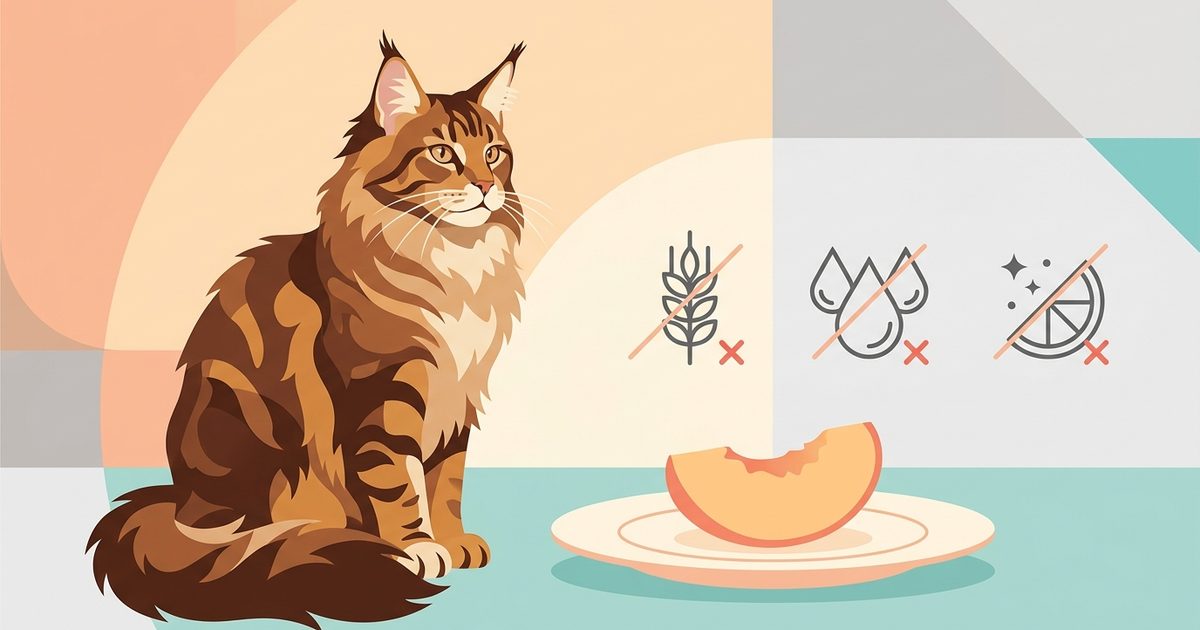
The sugar load
A medium peach holds around 13 grams of sugar. That's a modest number for a person; for a small animal with a carnivore's metabolism, it's a real load. Cats have no dietary requirement for carbohydrates, and their bodies are not built to handle regular sugar the way ours are. A one-off sliver won't harm a healthy cat, but sugar is something they neither need nor process efficiently — so every bit is pure cost with no nutritional return.
Cats can't taste the sweetness
Here's the strangest part: cats literally cannot taste what makes a peach a peach. Cats carry a non-functional version of the Tas1r2 gene, which means their sweet taste receptor doesn't work — they're effectively sweet-blind. So the sugar in a peach buys your cat no pleasure at all. Any interest they show is curiosity about a new texture or smell, not a craving. If you want the full story on why your cat can't taste sugar, we dig into it here.
How Should I Serve Peaches to My Cat?
Serve only peeled, fully pitted ripe peach flesh — cut into tiny, bite-sized pieces, with no skin, no pit, and no stem. Never hand a cat a whole or halved peach. Introduce a pea-sized piece first to check for stomach upset.
Preparation rules
If you're going to offer peach, the safe path is narrow but simple. First, peel the peach — the fuzzy skin is fibrous and harder for a cat to digest, and it can irritate the mouth. Next, remove the pit completely and discard it somewhere your cat absolutely cannot reach (a sealed bin, not the countertop). Then cut the flesh into pea- to fingernail-sized pieces; small pieces are far less of a choking risk for an animal that tends to gulp rather than chew. A ripe, soft peach is the right choice — underripe flesh is harder and less pleasant for a cat to manage.
Keep it to fresh, raw peach flesh only. No peach cobbler, no sweetened peach purée, no jam, and no dried peach — those forms pile on added sugar and turn a borderline treat into something clearly unsuitable. According to International Cat Care, any human food offered to a cat should be plain, unseasoned, and given in genuinely tiny amounts; that principle applies fully here.
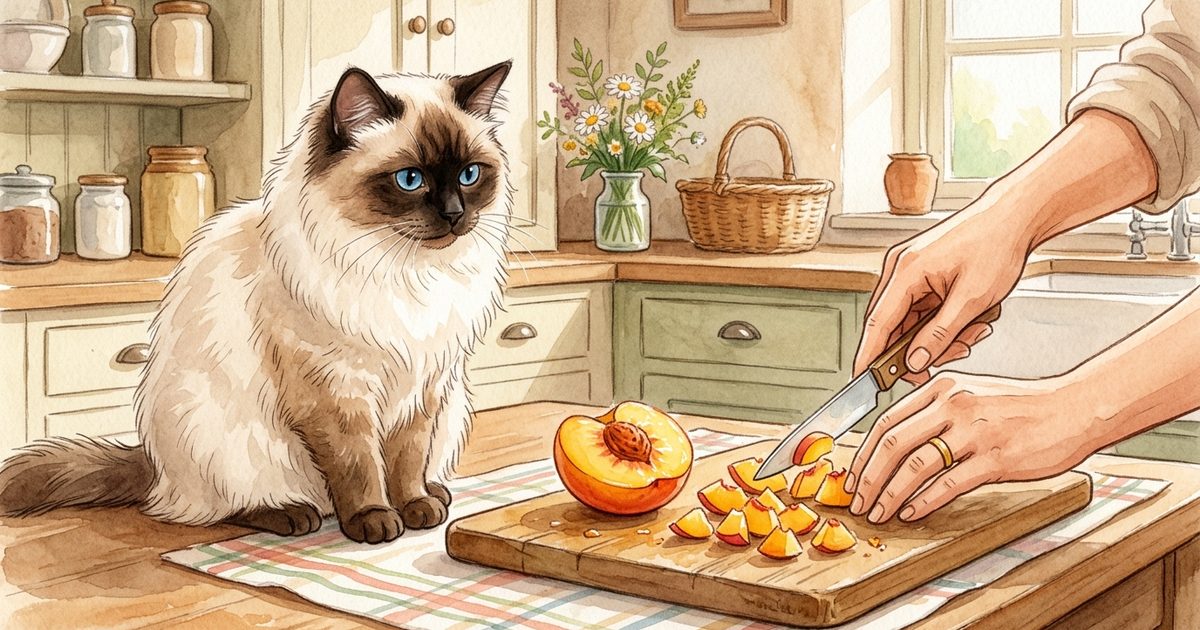
Never the pit, or a whole peach
The single most important rule: never hand a cat a whole or halved peach. A whole peach puts the pit within reach — and the pit is a triple threat. It carries the same cyanide-releasing compounds as apple seeds (we cover that amygdalin story in our can cats eat apples guide), it's hard and woody enough to choke a cat, and it's large enough to block the bowel. The pit must be fully removed before the fruit comes anywhere near your cat, not after. When in doubt, offer only pieces that are clearly flesh all the way through.
Introduce slowly
Even properly prepared, peach is new to most cats. Start with a single pea-sized piece, then wait and watch over the next 24 hours for any vomiting or diarrhea. If everything's fine, a slightly larger piece another day is reasonable — still rare, still tiny. Cats with diabetes, obesity, or a history of sensitive stomachs should skip peach entirely; for them, even a small sugar load isn't worth the risk. For the broader picture of where treats fit in a cat's diet, see our guide on what cats eat.
Can Cats Eat Canned Peaches?
No. Canned peaches are packed in heavy syrup — concentrated sugar that spikes a cat's blood glucose and offers nothing the body needs. Even "light syrup" varieties are far too sugary. If you want to share peach, use fresh ripe flesh only, peeled and pitted.
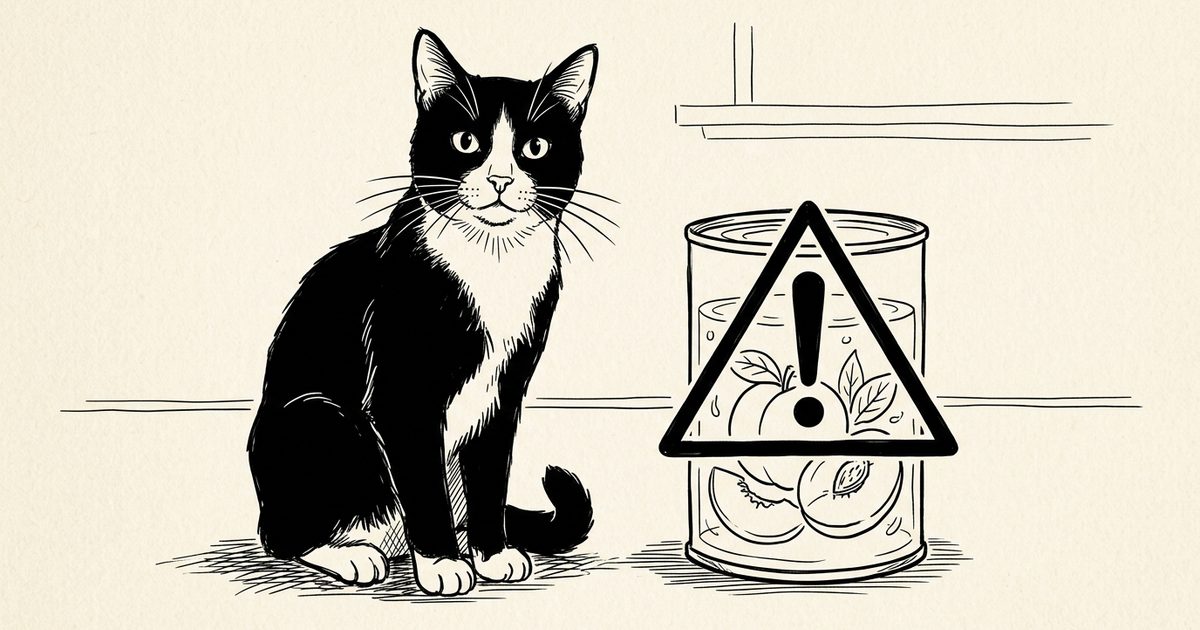
Why the syrup is the problem
Canned peaches sit in heavy syrup that is essentially dissolved sugar, and the canning process adds still more sugar on top of what the fruit already carries — so a single piece arrives in a concentrated sugar bath. For an obligate carnivore whose metabolism is built to run on protein and fat, not carbohydrates, a syrup-soaked slice is a far bigger sugar hit than a cube of fresh flesh would ever be. The Cornell Feline Health Center explains that cats have no dietary requirement for carbohydrates and limited capacity to handle sustained sugar loads, which is exactly why syrupy forms push a borderline treat into clearly-bad territory.
Diabetes and weight risk
Regular sugar loads raise the risk of obesity and diabetes in cats, and syrupy canned fruit delivers those loads in a form the body cannot quietly absorb. If your cat is diabetic or at risk, the cleanest rule is to treat all sugary human foods — syrupy canned fruit especially — as off-limits. You can read more about the disease context in our guide to cat diabetes. To be clear: "a little canned peach" is not a safe occasional treat in the way fresh flesh can be. The fresh form is the only one that is even borderline acceptable, and canned does not count as peach in the same sense.
Dried and other processed forms
Dried peaches and peach snacks usually carry added sugar and end up chewy and sticky — a choking hazard on top of a sugar hazard. The same logic applies: stick to fresh ripe flesh only, and leave anything processed on the shelf.
How Much Peach Can a Cat Eat?
A cat can have roughly a half-inch cube of peeled, pitted peach flesh as an occasional treat — at most once a week, and never more than about 10% of daily calories. Because of the sugar content, regular peach feeding raises the risk of obesity and diabetes, so keep it rare and tiny.
The 10% treat rule
Veterinary nutrition guidance holds that all treats combined should stay within roughly 10% of a cat's daily calories — the rest should come from a complete cat food. That ceiling matters because a cat's daily calorie budget is small: a typical adult cat eats around 200–250 calories a day, which means the entire treat allowance is about 20–25 calories. A half-inch cube of peach is only a few calories, so it fits comfortably under that cap. A whole half peach, though, easily blows past it on sugar alone — which is why "just a slice for her" is already far too much. If you want the broader picture of where treats fit in a cat's diet, our what cats eat guide lays out the full framework.
Frequency and portion size
For a healthy adult cat, a half-inch cube of peeled, pitted flesh, at most once a week, is the working ceiling. Smaller cats, and any cat that is overweight or diabetic, should have less or none — the sugar load that a healthy cat tolerates occasionally is one a vulnerable cat should not be exposed to at all. For most cats, the honest portion is even smaller: a single lick off a peeled slice is often more than enough to satisfy the curiosity that drew them to the fruit in the first place. Treat it as a rare change of texture, not a recurring part of the bowl, and the sugar stays well within bounds.
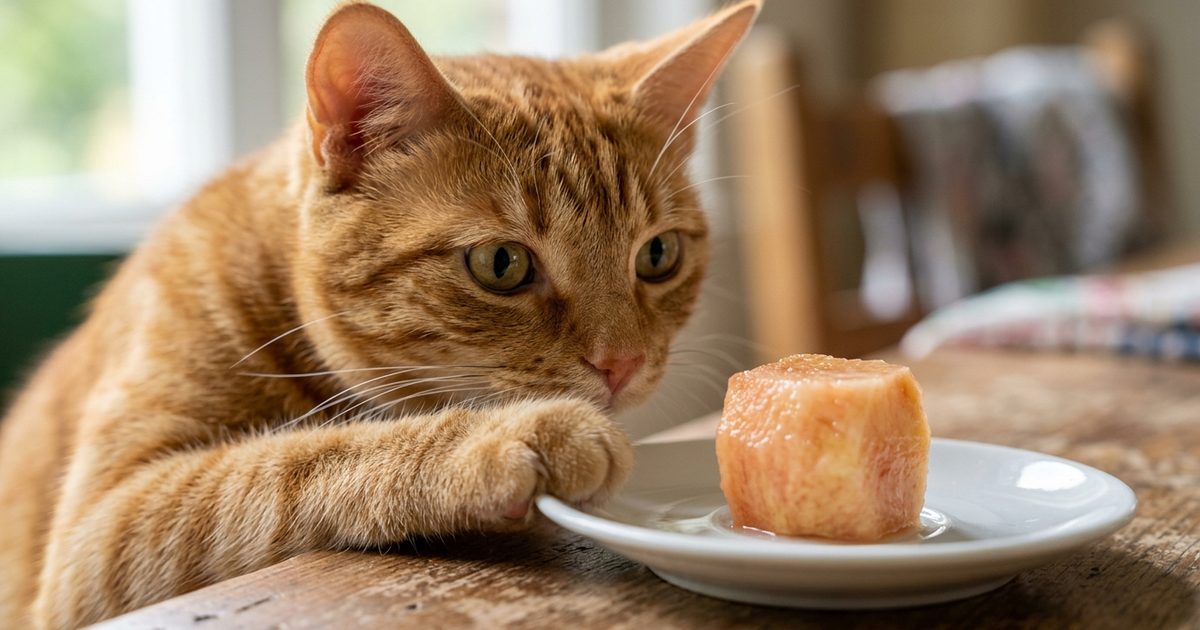
Peaches for Cats at a Glance — Summary
| Question | Short answer |
|---|---|
| Can cats eat peach flesh? | Yes — a tiny piece of peeled, fully pitted ripe flesh is safe as a rare treat |
| Can cats eat peach pits? | No — the pit carries a cyanide precursor and is a hard choking/blockage hazard |
| Are peach leaves and stems safe? | No — they carry the same cyanogenic compounds as the pit; keep cats away |
| Can cats eat canned peaches? | No — heavy syrup is concentrated sugar that spikes blood glucose |
| Can cats eat dried peaches? | No — added sugar and sticky, chewy texture make them a choking and sugar risk |
| How often can a cat have peach? | At most once a week, and only for a healthy adult cat |
| How much peach is safe? | Roughly a half-inch cube of flesh — never more than about 10% of daily calories |
Keep it fresh, peeled, pitted, and rare — that's the whole rule. When you're unsure, a single lick of a peeled slice is plenty for a curious cat.
Curious What Your Cat Would Say?
Upload a photo and get a warm, personalized reading from your cat's perspective.
Start Your Free ReadingFrequently Asked Questions
Can cats eat peach pits?
No — never. Peach pits contain amygdalin, which releases cyanide when chewed or crushed, and the pit is a hard woody stone that can choke a cat or block the bowel. Even if swallowed whole and passed, a cat's small body tightens the cyanide margin, so the pit must always be removed before the fruit comes near your cat.
Are peaches good for cats?
Not really. A peach offers some fiber, water, and vitamin C, but a complete commercial cat food already supplies these in the right balance for an obligate carnivore. For a cat, peach is mostly sugar and water with no meaningful nutritional upside — treat it as a rare novelty, not a health food.
Can cats eat canned peaches?
No. Canned peaches sit in heavy syrup that is essentially dissolved sugar, and even light-syrup varieties are far too sugary for a cat. The concentrated sugar spikes blood glucose and raises the risk of obesity and diabetes, so only fresh ripe flesh, peeled and pitted, is even borderline acceptable.
How much peach can I give my cat?
Roughly a half-inch cube of peeled, pitted ripe flesh, at most once a week, and never more than about 10% of daily calories. For a curious cat, a single lick of a peeled slice is often plenty. Overweight, diabetic, or sensitive-stomach cats should skip peach entirely.
Can kittens eat peaches?
It's best to wait. Kittens have smaller bodies, more sensitive digestive systems, and tighter sugar margins than adults, so even a tiny piece of sugary fruit carries more downside. A kitten's diet should stay focused on complete, balanced kitten food — save any fruit experiments for adulthood.
Why does my cat like peaches?
Curiosity, not craving. Cats carry a non-functional version of the Tas1r2 gene, so their sweet taste receptor doesn't work — they're effectively sweet-blind. Any interest in a peach is about the new texture or smell, not the sweetness itself. A sniff or a lick is exploration, not a sign the cat needs fruit.
Are peach leaves and stems safe for cats?
No. The leaves and stems of the peach tree carry the same cyanogenic compounds as the pit, so they are not safe for a cat to chew or nibble. If you grow peaches or have a tree nearby, the flesh of the ripe fruit is the only cat-safe part of the entire plant.
What should I do if my cat ate a peach pit?
Treat it as a potential emergency and call your vet or a pet poison helpline right away — don't wait for symptoms. The pit carries a cyanide precursor and is large enough to choke a cat or block the bowel. Watch for repeated vomiting, lethargy, refusing food, or a painful abdomen, and get professional guidance immediately.
Can cats eat dried peaches?
No. Dried peaches usually carry added sugar and become chewy and sticky, which makes them both a sugar hazard and a choking risk on top of the fresh fruit's natural sugar load. Stick to fresh ripe flesh only — peel it, pit it, and keep it to a tiny piece.
Sources & References
You Might Also Like
Kitten Teething: Timeline, Symptoms & How to Help
Kitten teething runs from 3 to 7 months as baby teeth fall out. Learn the timeline, signs to watch for, and how to soothe a teething kitten safely.
15 min readWhen Do Cats Stop Growing? A Complete Timeline
When do cats stop growing? Most cats reach adult size by 12-18 months, but large breeds like Maine Coons keep growing until 3-4 years. Full timeline inside.
14 min readCan Cats Eat Cherries? Flesh, Pit & Toxicity Facts
Can cats eat cherries? Pitted flesh is safe in tiny amounts — but the pit, stem, and leaves are toxic (cyanide precursors). Learn what's safe and what isn't.
15 min read