
Can Cats Eat Strawberries? Safety, Serving Size, and Risks
If you've ever wondered whether you can share a bite of fruit with your pet, the question can cats eat strawberries has a reassuring short answer: yes — strawberries are non-toxic to cats and safe in small amounts, provided the stems and leaves are removed and the portion stays tiny. They are a treat, not a food. The natural follow-up — are strawberries good for cats — has a less exciting answer: not really, because a cat on a complete diet gains little from a berry and takes on a small sugar load it doesn't need.
Here is the honest framing for the whole question. A small piece of ripe, washed, leaf-free strawberry once in a while won't harm a healthy adult cat, and the Cornell Feline Health Center confirms strawberries are among the fruits generally considered non-toxic to cats. But novelty and safety are not the same as nutrition — a strawberry is mostly water and a little sugar, with no payoff your cat's regular food doesn't already deliver. Below we break down the safety verdict, the serving method, the portion rule, and why a cat's apparent interest in strawberries has nothing to do with sweetness.
Key takeaways
- Strawberries are non-toxic to cats and safe in small amounts, but they are a treat, not a food — a complete diet already supplies everything your cat needs.
- Remove the green stems and leaves before serving; they are fibrous and can be mildly irritating to your cat's mouth and stomach. Serve a small piece or mashed, never a whole berry.
- Cats cannot taste sweetness, so any interest in strawberries is curiosity, smell, or texture — never a sweet craving the diet should satisfy.
Strawberries for Cats — Quick Reference
| Strawberry form | Safe for cats? | Notes |
|---|---|---|
| A small piece of ripe, washed strawberry | Yes, as a rare treat | Remove stem and leaves first; cut or mash small |
| Strawberry leaves and stems | No | Fibrous and mildly irritating; always remove the green calyx |
| Mashed strawberry | Yes, sparingly | A tiny smear is enough; ideal for a curious first taste |
| A whole strawberry | No | Too large — choking risk and far more sugar than a cat should have |
| Strawberry with added sugar or in jam | No | Concentrated sugar; raises obesity and diabetes risk |
| Dried or candied strawberries | No | Sugar-dense and often sulfur-treated; never feed |
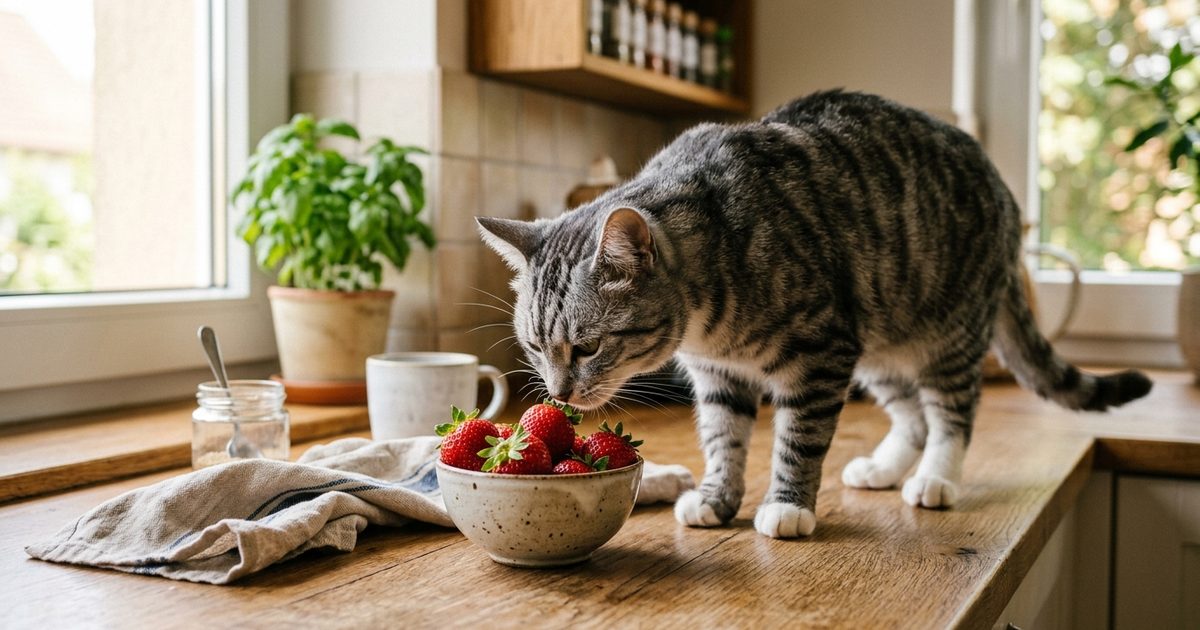
Can Cats Eat Strawberries?
Yes — cats can eat strawberries in small amounts as an occasional treat. They are non-toxic and safe, provided stems and leaves are removed and the portion stays tiny. A small piece of ripe strawberry once in a while is fine; it should never become a regular snack.
The short answer
If you've ever wondered whether you can share a bite of strawberry with your cat, the reassuring answer is yes — strawberries are non-toxic to cats and are generally safe in small amounts. The ASPCA lists the strawberry plant as non-toxic to cats, so a taste of the fruit itself is nothing to panic about.
But "safe" and "necessary" are two different words. A strawberry is a treat, not a food. Your cat gets everything it needs from a complete, balanced cat food, and a strawberry adds nothing it's missing. Think of it the way you'd think of a piece of cake for yourself — fine once in a while, never the foundation of a meal. A tiny piece, offered rarely, is the right way to frame it.
Why strawberries are unusual as a cat food
Strawberries are a sweet fruit, and that immediately makes them an odd fit for a cat. Cats are obligate carnivores — their metabolism is built to run on protein and fat from animal tissue, not on the carbohydrates and sugars that fruit provides. A cat's body simply isn't designed to extract value from a strawberry the way a human's is. Cats have no dietary requirement for carbohydrates, and their metabolism is poorly suited to handling sustained sugar loads.
This is also the heart of the question are strawberries good for cats: the honest answer is that, nutritionally, they sit outside what a cat actually needs. Strawberries are lower in sugar than many other fruits, which is why they're on the "borderline-acceptable" end of the fruit-treat spectrum — but "lower sugar than a banana" is a low bar when the comparison is against a species that has no dietary need for sugar at all.
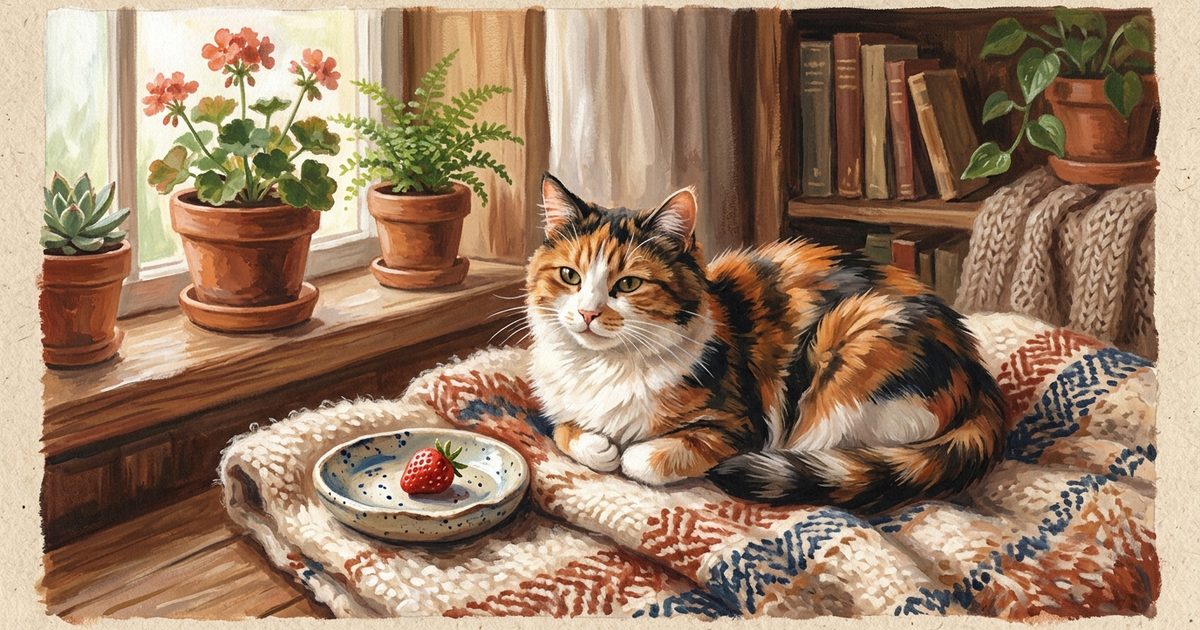
Are Strawberries Good for Cats?
Not really. Strawberries do contain vitamin C, fiber, and antioxidants, but cats synthesize their own vitamin C and a complete cat food already supplies what they need. For a cat, the sugar brings only a small downside — no meaningful nutritional upside.
Vitamin C, fiber, and antioxidants — real but redundant
It's true that strawberries carry a respectable nutrient profile — vitamin C, manganese, folate, fiber, and antioxidant compounds like anthocyanins (the pigments that give the fruit its red color). For a human, that's a genuinely useful package. For a cat, almost all of it is redundant.
The key reason is vitamin C. Cats, unlike humans, synthesize their own ascorbic acid in their liver — they don't depend on dietary sources at all. So the vitamin C in a strawberry isn't filling a gap; there is no gap. The same goes for the other micronutrients: a cat eating a complete commercial diet is already getting what it needs, and a strawberry doesn't meaningfully top anything up. The Cornell Feline Health Center is clear that a complete and balanced cat food should form the entirety of a cat's nutritional intake, with treats as a small exception rather than a supplement. Treat a strawberry as a tiny novelty, never as a health boost.
The sugar content
This is where strawberries earn their "rare treat" status. A cup of whole strawberries contains roughly 7 to 8 grams of sugar. That's lower than many fruits — a banana has more, and grapes have far more — which is part of why strawberries are sometimes considered one of the more acceptable fruit options for cats. But "lower" is relative: for an obligate carnivore with no dietary need for sugar, as covered above, any sugar is sugar the body has no plan for.
A single small piece of strawberry is well within what a healthy cat can process without issue, which is exactly why the occasional taste is fine. The problem only appears with regularity — sugary treats offered often can nudge a cat toward weight gain and raise the long-term risk of obesity and diabetes. International Cat Care advises keeping all treats and titbits to a small fraction of the daily diet precisely because of this kind of cumulative sugar and calorie load.
The bottom line on nutrition
Strip away the marketing and the picture is simple: non-toxic does not mean beneficial. A strawberry is mostly water, a little fiber, and a modest amount of sugar — and for a cat, that adds up to no real nutritional payoff. Safe to share once in a while; not something to feed with any purpose in mind.
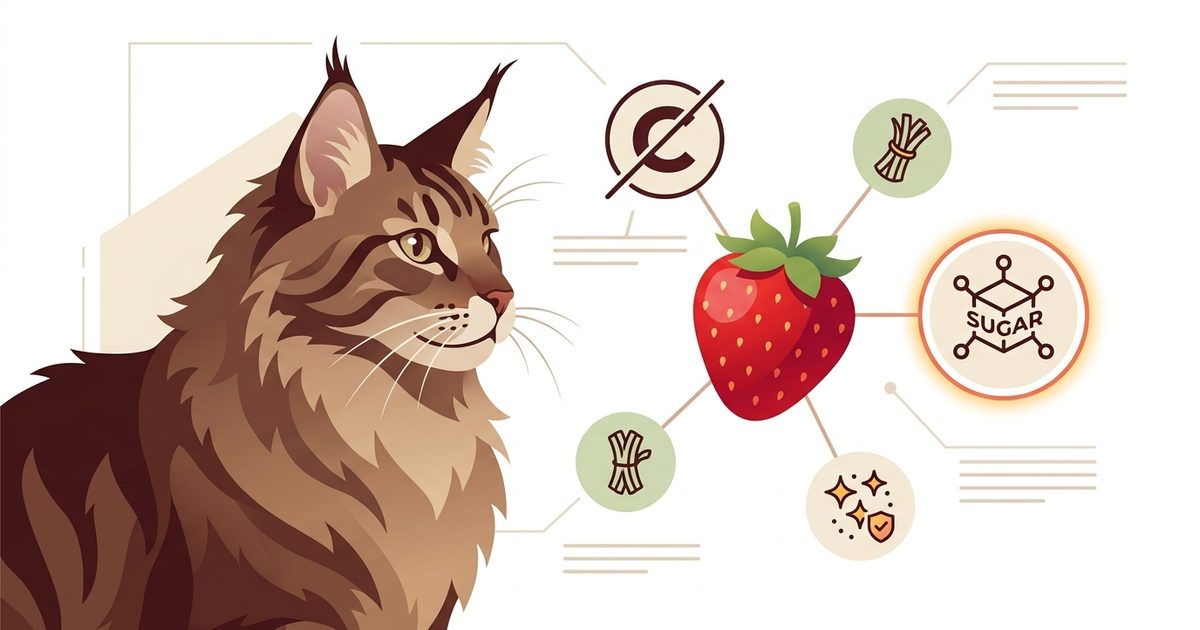
How Should I Serve Strawberries to My Cat?
Serve only ripe strawberries — washed, with the green stem and leaves removed, then cut or mashed into small bite-sized pieces. Never feed the leaves or stems, which can be mildly irritating. Offer a tiny piece first to check for stomach upset.
Preparation rules
Start with a ripe, red strawberry — ripe fruit is softer and far easier on a cat's digestion than an underripe one. Run it under clean water to rinse away any pesticide residue on the skin, even if you bought organic. Next, slice off the green leafy calyx and the stem, and discard both. From there, cut the flesh into small pieces no bigger than a pea, or mash it lightly with a fork — either form is safe, and mashing is gentler for older cats or kittens. Stick to fresh strawberry only: no strawberry jam, no sweetened yogurt with strawberry, no strawberry-flavored treats, and nothing dried or candied, all of which concentrate the sugar or add ingredients a cat should not have.
Remove the leaves and stems
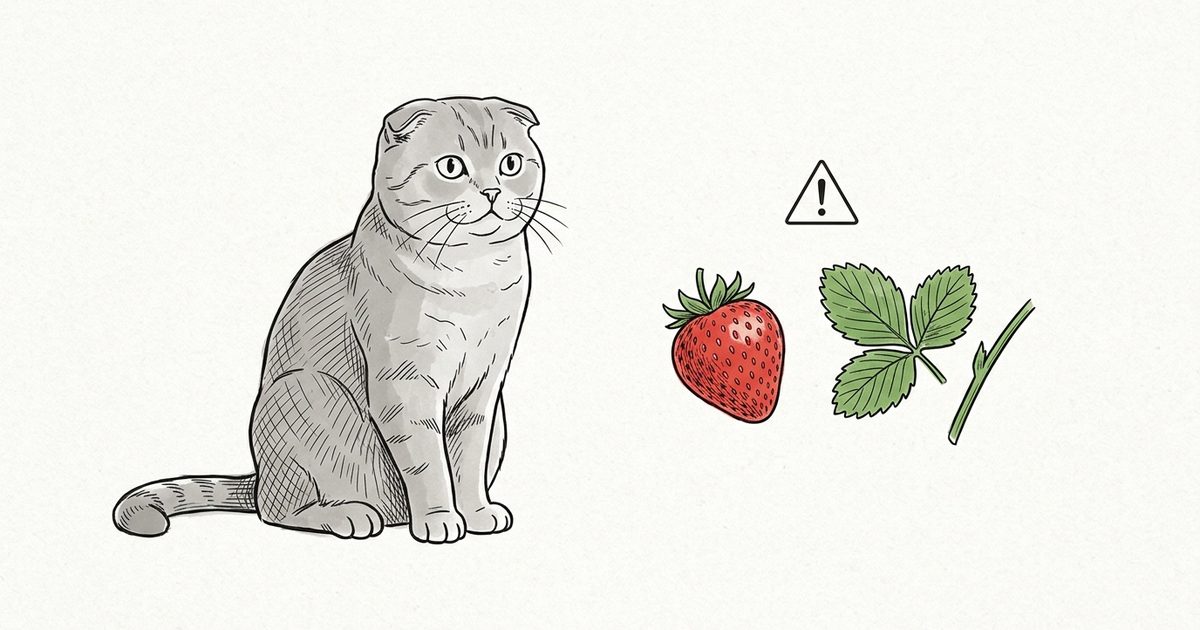
This is the part owners most often overlook. Can cats eat strawberry leaves? Not safely. The leaves and stems are fibrous and tough for a cat to digest, and they can be mildly irritating to the mouth and stomach. Some cats will nibble at the green calyx out of curiosity, but it offers nothing nutritionally and is best removed before serving. A cat that chews on the leaves may drool or show mild stomach upset. The simple rule: cut the calyx away and throw the leaves out — never feed them.
Introduce slowly
Any new food deserves a careful first try. Offer a single pea-sized piece, then watch your cat over the next 24 hours for vomiting or diarrhea. If all is well, you can treat occasionally. Cats with diabetes, obesity, or a known sensitive stomach should skip strawberry entirely — the sugar and fiber are not worth the risk for them.
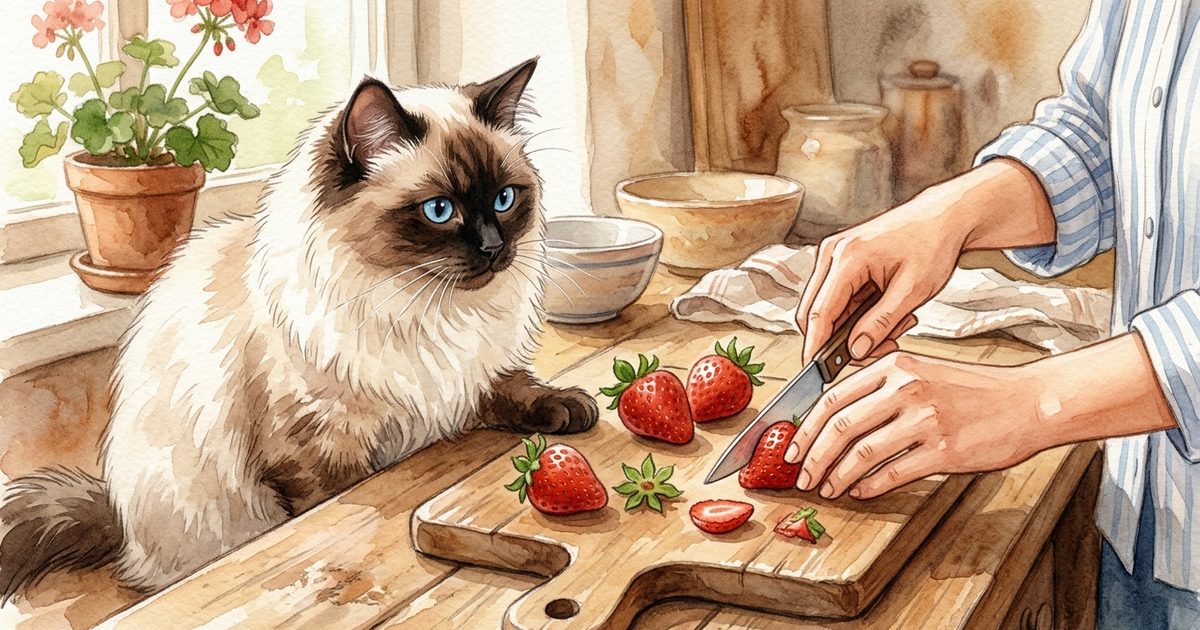
How Much Strawberry Can a Cat Eat?
A cat can have about half a small strawberry as an occasional treat — at most once a week, and never more than about 10% of daily calories. Because of the sugar content, regular strawberry feeding can contribute to weight gain, so keep it rare and tiny.
The 10% treat rule
Veterinarians generally recommend that all treats combined — not just strawberry, but everything outside a cat's complete food — stay under roughly 10% of daily calories. For a typical adult cat eating around 200–250 calories a day, that 10% ceiling is only about 20–25 calories of treats. Half a small strawberry is only around 2 calories, so it fits comfortably within the budget, but it is meant to be one of several small treats, not the whole allowance. This is also why a whole large strawberry is too much: at roughly 4–6 calories it eats up most of a cat's treat budget in a single fruit, on top of sugar the cat does not need. International Cat Care frames treats as a small, occasional part of the diet rather than a daily habit, and the 10% rule is the practical version of that guidance.
Frequency and portion size
For a healthy adult cat, half a small berry — or a single bite-sized piece — is the right portion, offered at most once a week. Smaller cats, senior cats, and those carrying extra weight or managing diabetes should have less, or none at all. Often, a single lick is plenty for a curious cat that just wants to share the moment with you; a full piece is rarely necessary. If you are looking for a berry treat with a lower sugar load, blueberries are a gentler alternative. The Cornell Feline Health Center offers detailed guidance on building a complete feline diet, which is where strawberry should never compete for room.
Do Cats Like Strawberries?
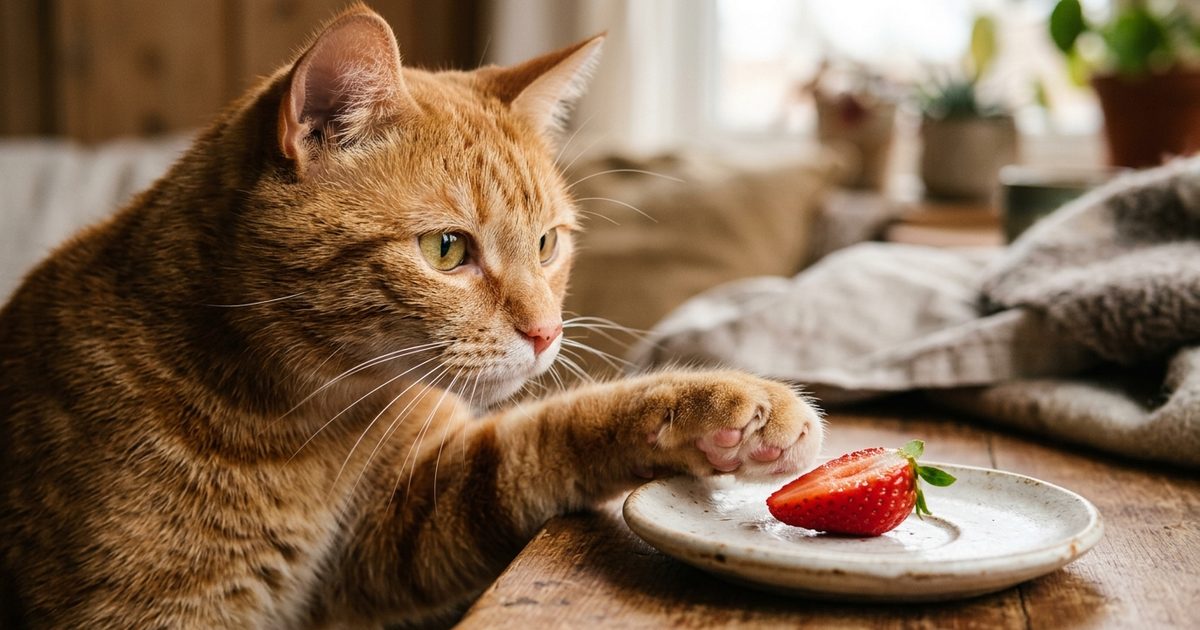
Some cats show interest in strawberries, but it is almost never about sweetness — cats cannot taste sweet at all. The attraction, when it exists, is novelty, the fruity smell, or the soft juicy texture. If a cat seems to enjoy strawberry, it is curiosity, not a craving.
So, do cats like strawberries? Some genuinely seem to — they sniff, paw, lick, or even try to carry a berry off. But the obvious explanation owners reach for — "she loves the sweet taste" — is the one thing that cannot be true. Cats are sweet-blind, so whatever is pulling your cat toward that strawberry, it isn't sugar. That changes what the interest means, and it changes how you should read it.
Cats can't taste sweet
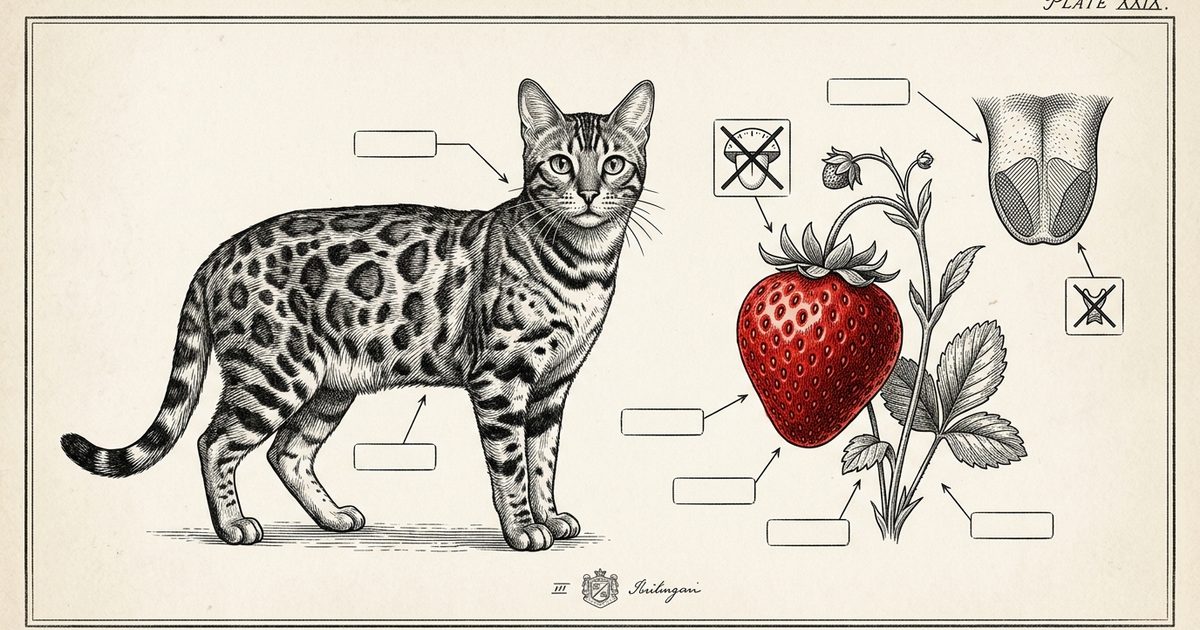
Cats lack a working sweet taste receptor. The gene that builds it, Tas1r2, is present in the cat genome but riddled with mutations that switch it off, so the receptor never assembles. The result is absolute: cats do not perceive sweetness, in a strawberry or anywhere else. This is why a cat's apparent fondness for fruit can't be a sugar craving the way ours would be — the signal never reaches the brain. For the full sensory-biology story behind that pseudogene, see our deep-dive on whether cats can taste sugar. The honest takeaway: don't assume a cat "loves" fruit the way a human does. Something else is doing the work.
What the interest really is
If not sweetness, then what? Usually it's one of four things. Novelty — a strawberry is a strange object on the counter, and cats investigate the new. Smell — the fruity, slightly fermented aroma is unlike anything in a cat's normal diet, so it earns a sniff. Texture — the soft, wet, yielding mouth-feel is interesting to a tongue used to dry kibble or dense meat. And social copying — your cat watched you eat it, and what you eat must be worth checking. None of these is a nutritional need. A sniff, a lick, or a playful bat is the whole story; it doesn't mean your cat's diet is missing anything a strawberry would supply.
What Are the Risks of Feeding Strawberries to Cats?
The main risks are the sugar load (weight gain if fed often), choking on a piece cut too large, mild mouth or stomach irritation from the leaves and stems, and digestive upset from the fiber and sugar. Any vomiting or diarrhea after a first taste warrants stopping and a vet call.
Strawberries are non-toxic, which is reassuring — but "won't poison your cat" is not the same as "free to feed freely." The real risks of feeding strawberries to cats are practical ones, and they all trace back to how a cat's body handles a food it was never built to eat. None of these are dramatic, but each is worth knowing before you offer that first berry. Cornell's Feline Health Center and International Cat Care both stress that the trouble with treats is rarely the single treat — it's the pattern.
Sugar and weight gain
Because cats are obligate carnivores with no use for sugar (as covered above), the relevant risk here is not one berry but the cumulative load. A single strawberry's sugar is modest, but offered daily it stacks up fast — and the weight gain that follows raises the long-term risk of feline obesity and diabetes. The protection is the frequency rule, not the single piece. One tiny taste does no harm; strawberry-as-a-daily-snack is where the risk actually lives.
Choking and the leaves
A piece cut too large is a choking hazard, plain and simple — strawberries are soft but slippery, and a cat that swallows a big chunk whole can block its airway or esophagus. Cut pieces small, no bigger than a pea. The leaves and stem are a separate obstruction concern (their fibrous, irritating nature is detailed under "Remove the leaves and stems" above): keep the calyx off every berry. Watch for signs of obstruction — repeated vomiting, lethargy, or refusing food — and treat any of them as an emergency vet visit, not a wait-and-see.
Digestive upset
Even a clean, well-cut piece can upset a sensitive stomach. The fiber and sugar a strawberry introduces are foreign to a cat used to meat-based meals, and the common result is mild vomiting or diarrhea within a few hours. This is usually self-limiting, but it's also your signal to stop offering strawberry to that cat. For guidance on when GI signs after a new food cross the line from "observe" to "call the vet," see our article on cat vomiting.
Strawberries for Cats at a Glance — Summary
| Question | Short answer |
|---|---|
| Can cats eat strawberries? | Yes — non-toxic and safe as a tiny occasional treat, but never a regular food |
| Are strawberries good for cats? | Not really; their nutrients are redundant for a cat and the sugar has no upside |
| Can cats eat strawberry leaves and stems? | No — remove them; they're fibrous and can mildly irritate the mouth and stomach |
| How much strawberry is safe? | About half a small berry at most, weekly, well under 10% of daily calories |
| Why does my cat like strawberries? | Curiosity, smell, or soft texture — cats can't taste sweet, so it's not a craving |
| Can cats eat strawberry jam? | No — jam is concentrated sugar with none of the safety of fresh ripe strawberry |
Curious What Your Cat Would Say?
Upload a photo and get a warm, personalized reading from your cat's perspective.
Start Your Free ReadingFrequently Asked Questions
Can cats eat strawberries every day?
No. Strawberries are non-toxic to cats, but the sugar load adds up quickly when fed daily, contributing to weight gain and raising the long-term risk of obesity and diabetes. Treat them as a rare weekly titbit, never a daily snack — a complete cat food already provides everything your cat needs.
Are strawberries good for cats?
Not really. Strawberries contain vitamin C, fiber, and antioxidants, but cats synthesize their own vitamin C and a complete cat food already supplies every nutrient they require. For a cat, the sugar in a strawberry brings a small downside and no meaningful nutritional upside, so it is a treat rather than a health food.
Can cats eat strawberry leaves and stems?
No. The green leafy calyx and stem are fibrous, hard for a cat to digest, and can mildly irritate the mouth and stomach. Always cut the calyx away and discard the leaves before offering any strawberry — never feed them, even if your cat nibbles at them out of curiosity.
How much strawberry can I give my cat?
About half a small ripe strawberry at most, offered no more than once a week. Cut or mash it into pea-sized pieces, and keep all treats combined under roughly 10% of your cat's daily calories. Smaller, senior, or overweight cats should have less, or none at all.
Can kittens eat strawberries?
It's best to wait. Kittens have sensitive, still-developing digestive systems and strict nutritional needs tied to growth, so sugary fruit offers them no benefit and carries a higher risk of stomach upset. If you do offer a taste, make it a tiny smear of mashed ripe strawberry — but kitten-formulated complete food is all they truly need.
Why is my cat obsessed with strawberries?
It's almost certainly curiosity, not a craving. Cats cannot taste sweetness — the Tas1r2 receptor gene is non-functional — so the attraction is novelty, the fruity smell, or the soft juicy texture. A cat that bats, sniffs, or licks a strawberry is investigating a strange object, not satisfying a nutritional need.
Can diabetic cats eat strawberries?
No, it's safest to skip them. Cats with diabetes cannot regulate blood sugar the way a healthy cat can, and even the modest sugar in a small strawberry is an unnecessary load. The fiber and sugar can also upset a diabetic cat's stomach, so keep all fruit treats off the menu and follow your vet's feeding plan.
Can cats eat strawberry jam?
No. Strawberry jam is concentrated sugar with none of the safety profile of a fresh ripe berry — a single spoonful can deliver more sugar than a cat should have in a week. Added sweeteners and pectin are also unsuitable for cats, so keep jam, syrups, and any sweetened strawberry products well away from your cat.
Sources & References
You Might Also Like
Kitten Teething: Timeline, Symptoms & How to Help
Kitten teething runs from 3 to 7 months as baby teeth fall out. Learn the timeline, signs to watch for, and how to soothe a teething kitten safely.
15 min readWhen Do Cats Stop Growing? A Complete Timeline
When do cats stop growing? Most cats reach adult size by 12-18 months, but large breeds like Maine Coons keep growing until 3-4 years. Full timeline inside.
14 min readCan Cats Eat Cherries? Flesh, Pit & Toxicity Facts
Can cats eat cherries? Pitted flesh is safe in tiny amounts — but the pit, stem, and leaves are toxic (cyanide precursors). Learn what's safe and what isn't.
15 min read