
Can Cats Eat Blueberries? The Best Fruit Treat & How Much
Can cats eat blueberries? Yes — they are non-toxic, low in calories, and among the lowest-sugar fruits you can offer, which makes them one of the better fruit-treat options for a healthy adult cat. But are blueberries good for cats in any meaningful sense? Not really — a cat on complete food already gets everything it needs, and a cat's obligate-carnivore metabolism runs on protein and fat, not the plant sugars and antioxidants a berry carries. The honest framing is "safe, low-cost, low-payoff": blueberries won't harm your cat in small amounts, and they won't do much for her either. The interest some cats show — a sniff, a bat, a curious lick — almost always comes down to the moisture, the firm pop of the skin, or simple mimicry, not a craving her diet is missing. Offered correctly, 2–3 washed berries now and then are a perfectly reasonable treat; offered carelessly, the same fruit can choke a small cat or quietly add sugar she can't use. The goal here is the verdict, the portion, and the few cautions worth knowing before you share one.
Key takeaways
- Blueberries are non-toxic to cats, low in sugar and calories, and one of the better fruit-treat options — safe for most healthy adult cats in small amounts.
- Serve 2–3 washed berries, fresh or frozen, whole or mashed for small cats, as a treat never a meal.
- Cats cannot taste sweetness — any interest is moisture, texture, or curiosity, not a craving the diet needs to satisfy.
Blueberries for Cats — Quick Reference
| Blueberry form | Safe for cats? | Notes |
|---|---|---|
| 2–3 fresh washed blueberries | Yes | The standard treat portion for a healthy adult cat |
| Frozen blueberries | Yes | Let them soften slightly first; the cold, firm texture appeals to some cats |
| Mashed blueberries | Yes | Best form for small cats, kittens, or cats that gulp — removes choking risk |
| Dried blueberries | No | Sugar is concentrated; far too sweet for a cat's small calorie budget |
| Blueberry-flavored yogurt or baked goods | No | Added sugar, dairy most cats can't digest, and unhealthy extras |
| Wild blueberries or berries from unknown plants | No | Unidentified berries may be toxic; never feed a berry you can't name |
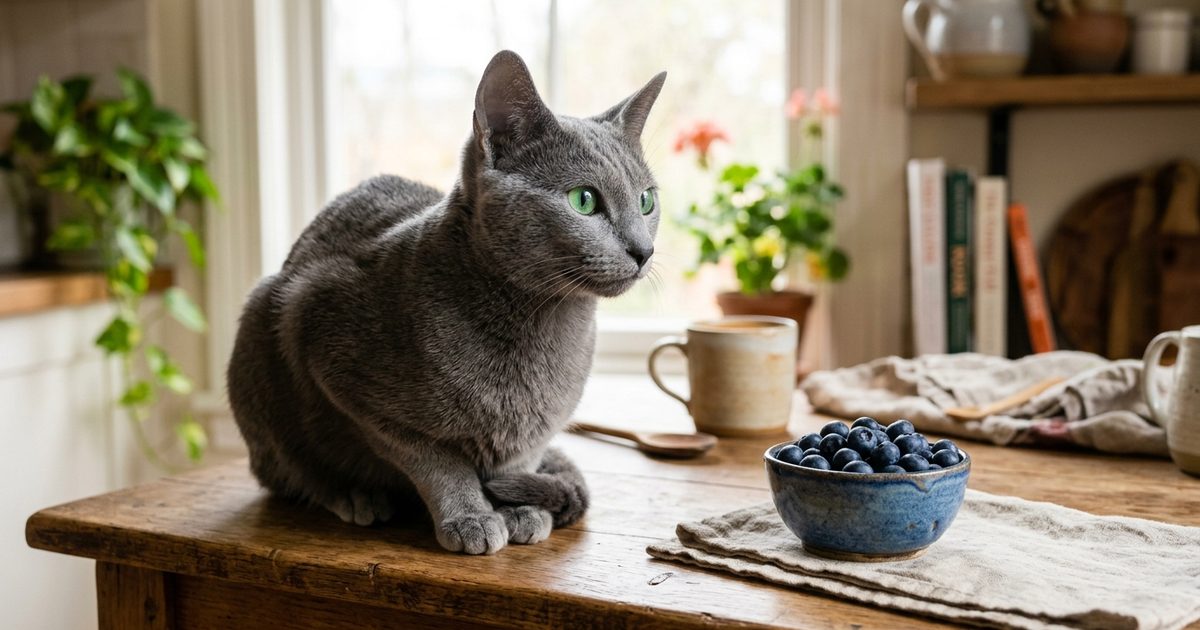
Can Cats Eat Blueberries?
Yes — cats can eat blueberries. They are non-toxic, low in calories, and low in sugar for a fruit, which makes them one of the better fruit treats you can offer a cat. They are still a treat, never a substitute for complete cat food.
The short answer
For most healthy adult cats, a blueberry is a safe, small treat. They're non-toxic, they carry very few calories, and their sugar content is low compared to almost every other fruit you might consider sharing. So if you've been wondering can cats have blueberries — yes, in modest amounts, offered occasionally, a blueberry won't harm your cat.
The key word is "treat." Blueberries are a treat, not a food. A cat's real nutrition comes from complete, protein-rich cat food. The berry is a tiny bonus, the way a square of dark chocolate is for you — pleasant, not load-bearing.
Why blueberries are unusual as a cat food
Cats are obligate carnivores, which means their metabolism is built to run on protein and fat from animal tissue, not on sugar or plant matter. A cat's body simply does not need what a blueberry offers. That's the honest backdrop whenever we ask are blueberries good for cats — by the cat's biology, no fruit is a dietary need.
But among fruits, blueberries are the least problematic. They're small, so one is already near a treat dose. They're low in sugar, they have no peel to remove, and they carry no hazardous seeds. There's almost no prep, and almost no downside — which is exactly what puts them at the top of the fruit-treat category, ahead of sweeter options like bananas or watermelon.
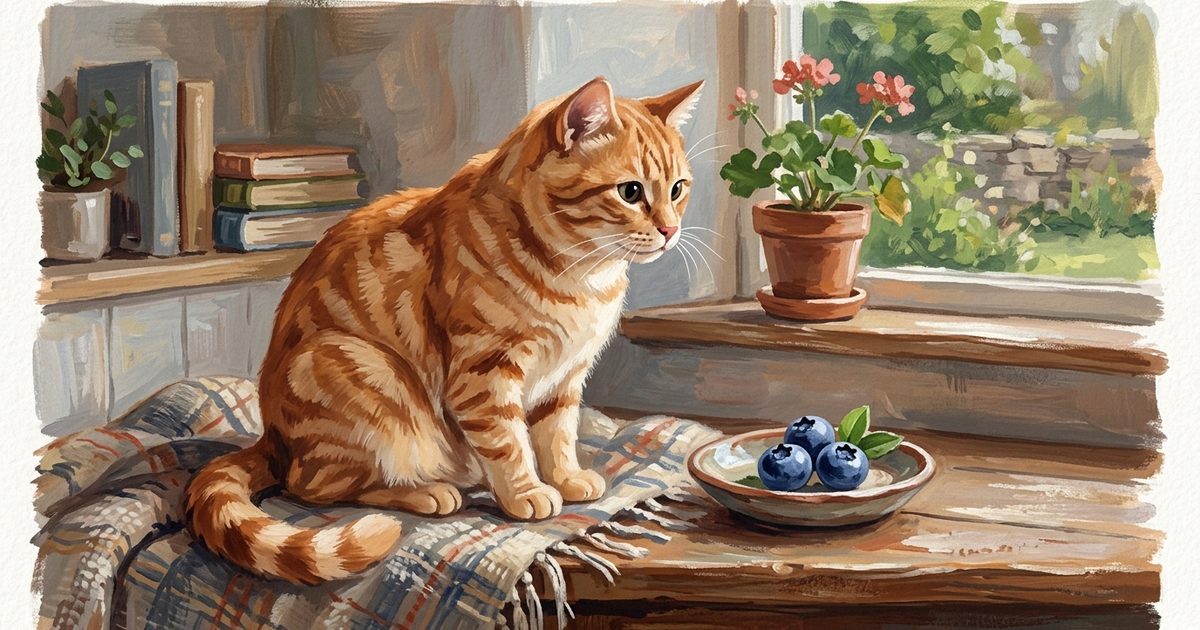
Are Blueberries Good for Cats?
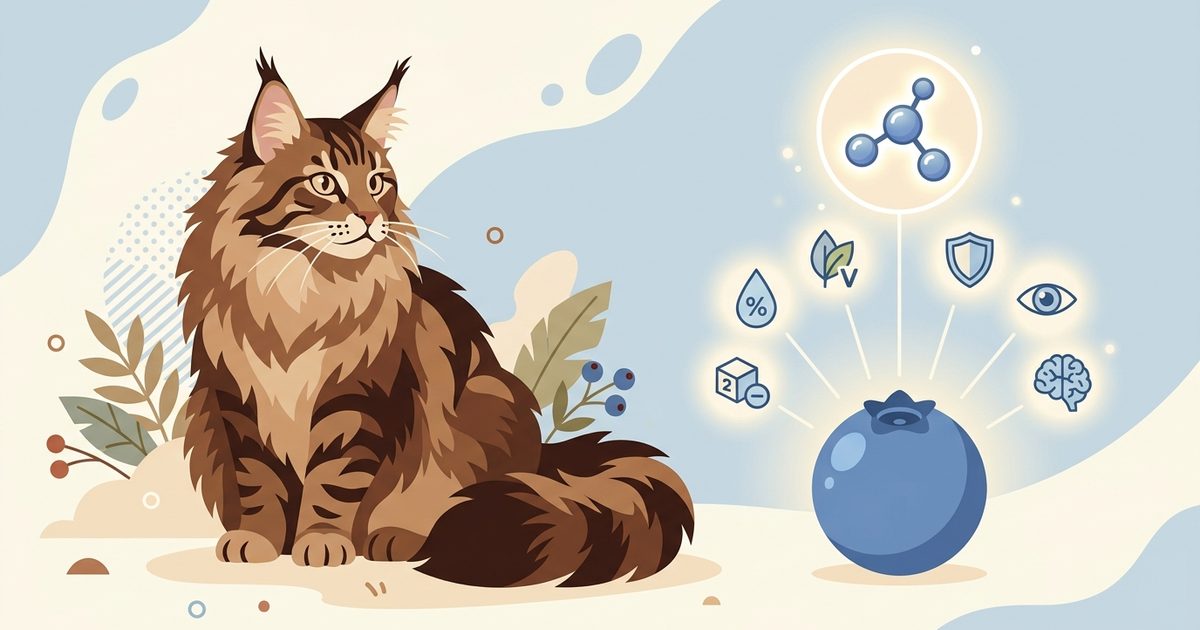
Blueberries contain antioxidants called anthocyanins and a little fiber and vitamin C, but a cat on complete food already gets what it needs. The real upside is that they're lower in sugar than most fruits — so the cost of offering one is small. Safe, not necessary.
Antioxidants and anthocyanins
The deep blue of a blueberry comes from anthocyanins — pigments that double as antioxidants. In humans, anthocyanins are well-studied for their role in cellular health, and that research is real. It's also the source of the "superfood" framing you'll see on packaging and wellness blogs.
Here's the honest part: a cat's metabolism does not benefit from fruit-borne antioxidants the way a human's does. Cats manufacture their own antioxidants (like vitamin C) internally, and a cat eating complete, balanced food is already getting everything it needs from that food. Adding a blueberry on top doesn't upgrade their health the way the marketing implies.
So please don't treat blueberries as a feline health supplement. If you want the authoritative overview of what a cat actually needs nutritionally, the Cornell Feline Health Center is an excellent, trustworthy starting point — and it does not list fruit anywhere on the essentials.
Low sugar — the genuine advantage
If blueberries have a real edge over other fruits, it's the sugar. Blueberries carry roughly 10 grams of sugar per 100 grams — meaningfully lower than bananas, grapes, or cherries, and comparable to strawberries, their closest cousin in the treat category.
That low sugar matters because a cat's small body has a small daily calorie budget, and excess sugar contributes to weight gain and raises the risk of diabetes over time. A single blueberry barely registers against that budget, which is precisely why blueberries have the widest safety margin of the common fruit treats. The International Cat Care guidance on treats and titbits is clear on this principle: treats should be rare, small, and never crowd out complete food.
The bottom line on nutrition
Non-toxic, low-calorie, low-sugar — and not necessary. A blueberry gives your cat a few calories without a meaningful nutritional payoff, but that low payoff comes with an equally low price. For a healthy adult cat, that's an acceptable trade for a small, occasional treat.
How Should I Serve Blueberries to My Cat?
Serve blueberries washed, fresh or frozen, whole for most cats or mashed for small cats and kittens. Offer 2-3 berries as a treat. Never add sugar, syrup, or seasoning, and skip blueberry-flavored yogurt and baked goods entirely.
Fresh or frozen, always washed
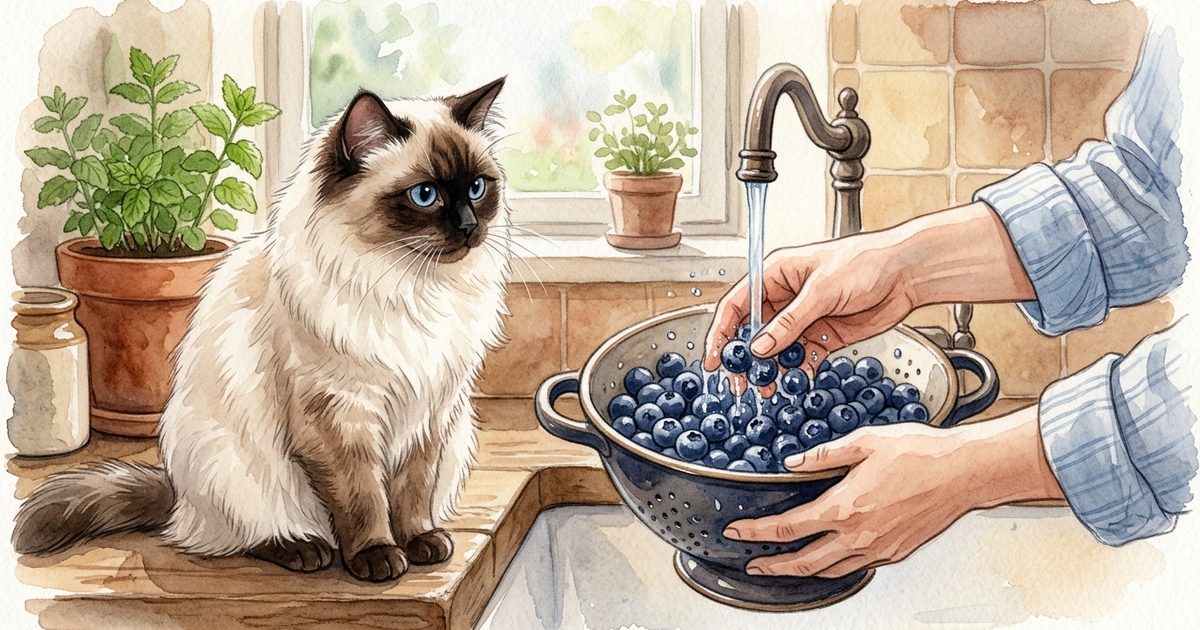
Rinse fresh blueberries under cool running water before offering them to your cat. A quick wash removes pesticide residue, surface dirt, and anything the berry picked up between the farm and your kitchen — the same reason you'd wash them for yourself. Frozen blueberries are just as safe, and some cats actively enjoy the firm, cold texture; let a frozen berry soften for a minute or two first so it isn't a jolt against the teeth. Whether fresh or frozen, choose plain berries only — nothing sweetened, syruped, or coated. As the Cornell Feline Health Center stresses, anything you add to a cat's food should be simple and unseasoned.
Whole or mashed
Most healthy adult cats can manage a whole blueberry without trouble. The catch is the skin: it's firm, and the berry itself is round and just the right size to roll to the back of a small throat. For small cats, kittens, or cats that gulp their food, that combination is a genuine choking risk. If your cat is on the small side or tends to swallow without much chewing, mash the berry with the back of a spoon or halve it before serving. It costs you nothing and removes the only real physical hazard a blueberry poses.
Forms to avoid
Skip the dried blueberries — drying concentrates the sugar into something closer to candy. Skip blueberry yogurt and jam, which add sugar and often dairy that cats can't digest well. And blueberry muffins, pancakes, or any baked goods are firmly off the menu. If you're exploring the wider sweet-treat category, our guides on whether cats can eat bananas and whether cats can eat watermelon cover the same core rule: plain, fresh, unsweetened, and only a little.
How Many Blueberries Can a Cat Eat?
About 2-3 blueberries, at most 1-2 times a week, for a healthy adult cat. All treats combined should stay under roughly 10% of daily calories. More than that, and the sugar and calories start to add up against a cat's small daily budget.
The 10% treat rule
The standard veterinary guideline is that all treats combined — blueberries, anything else — should stay under about 10% of a cat's daily calories. That ceiling exists because cats are small animals with small energy budgets: a typical adult cat eats around 200 calories a day, so the entire treat allowance is roughly 20 calories. A single blueberry is about 1 calorie, which means even two or three berries leave you well inside the limit. That's the real reason blueberries sit at the top of the fruit-treat category — their sugar and calorie cost per berry is so low that the 10% rule barely constrains them, unlike denser, sweeter fruits. International Cat Care makes the same point: treats should be occasional, small, and never displace complete food.
Frequency and portion size
For a healthy adult cat, two to three blueberries, one or two times a week, is a sensible ceiling — not a target to hit every week. A single berry is often plenty for a cat that's just curious about what you're eating. Smaller cats, overweight cats, and diabetic cats should have fewer, or none at all; if your cat falls into any of those groups, blueberries are best skipped rather than portioned down. For a comparable low-sugar fruit option, see whether cats can eat strawberries, and for the broader context of why fruit is only ever a sideline in a cat's diet, our guide on what cats eat covers the obligate-carnivore picture.
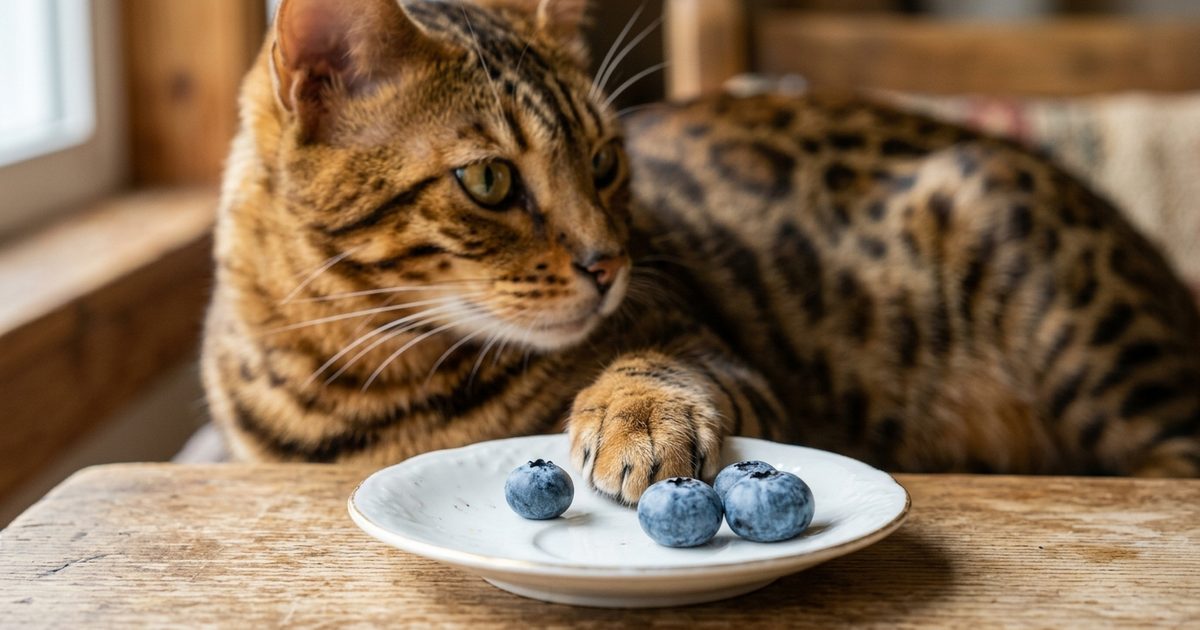
Why Do Some Cats Like Blueberries if They Can't Taste Sweet?
Cats cannot taste sweetness — they lack a working sweet receptor — so a cat drawn to blueberries is responding to the moisture, the firm pop of the skin, the novel smell, or simply mimicking the owner. It is curiosity and texture, not a craving the diet must satisfy.
It surprises many owners the first time they see it: a cat who bats a blueberry across the floor, licks it, or carries one off like a small prize. The natural assumption is that the cat likes the taste — that it finds the berry sweet and rewarding the way we do. That reading is understandable, but the biology doesn't support it. So do cats like blueberries? The honest answer is that they like the experience of a blueberry, not its flavor.
Cats can't taste sweet
Here is the key fact: cats are functionally sweet-blind. The receptor that lets most mammals detect sweetness depends on two genes working together, and in cats one of them — Tas1r2 — is non-functional, a broken pseudogene that no longer builds a working receptor. The result is a cat with no ability to perceive sweetness at all, from any source. So when your cat shows interest in a blueberry, a piece of cake, or anything else we'd call "sweet," the sweetness itself is invisible to them. We go into the full sensory biology — including the genetics and what it means for how cats experience food — in our deep-dive on whether cats can taste sugar. The takeaway here: a sniff, a bat, or a lick is genuine interest, but it isn't need. It tells you the berry caught your cat's attention, not that the diet is missing something.
What the interest really is
If it isn't sweetness, what is drawing the cat in? A few things, all perfectly feline. Blueberries are small, round objects that roll — a ready-made toy for a cat who likes to bat things. They're firm-skinned and burst slightly under pressure, which some cats find interesting as a mouth-feel. They carry a faint, novel smell that isn't part of the cat's usual world. And, like many animals who live alongside humans, cats watch what we do — a cat who sees you eating blueberries may simply want to investigate the object that has captured your attention. None of this justifies offering blueberries regularly. A cat's nutrition must come from complete, balanced cat food; a blueberry is a moment of curiosity, not a dietary contribution. Want to understand more about how cats actually experience their food and what drives their eating behavior? See our guide on what cats eat.
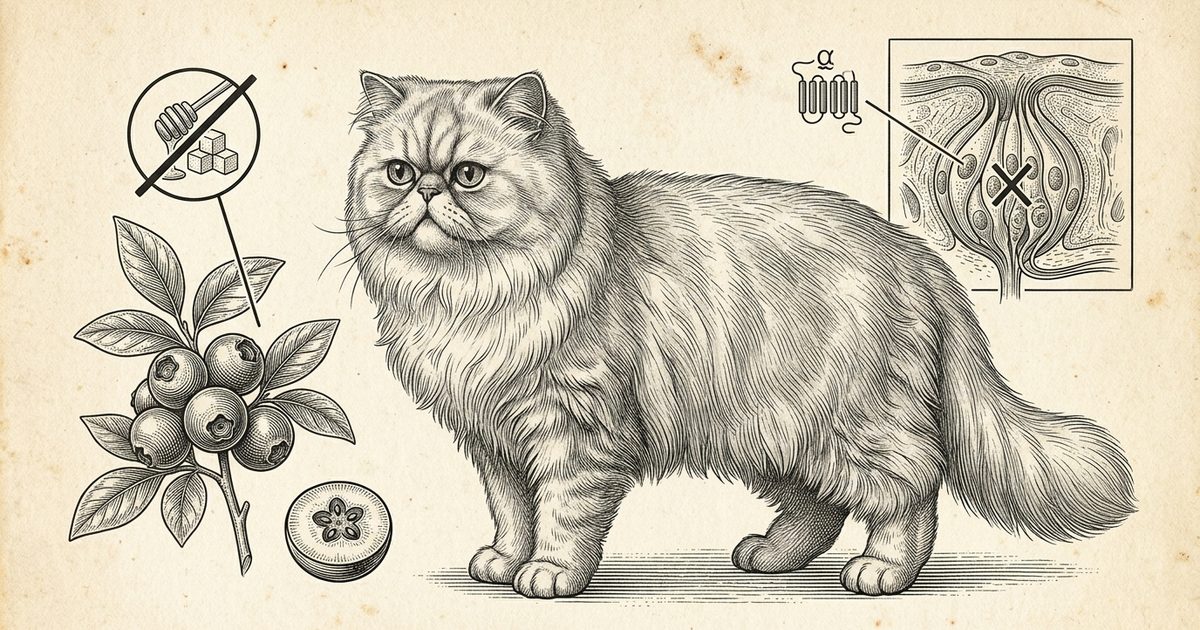
What Are the Risks and Cautions of Feeding Blueberries to Cats?
Blueberries are low-risk for a healthy cat, but they are not risk-free: the sugar caps frequency at a treat level, the firm round skin can choke small cats (so mash or halve), and blueberries must never replace complete cat food. Diabetic and overweight cats should skip them.
Blueberries sit near the safer end of the human-food spectrum for cats — non-toxic, small, and comparatively low in sugar. That's exactly why they work as an occasional treat rather than being off-limits entirely. But "low-risk" is not "no-risk," and the cautions below are the reason the treat rule exists. The Cornell Feline Health Center is clear that cats should receive the great majority of their nutrition from a complete and balanced diet, with anything outside that kept to small, occasional amounts.
Sugar load and frequency
Blueberries are low-sugar for a fruit — but they are not zero-sugar, and sugar adds up if a treat becomes a habit. Even a few berries offered every day contributes a steady trickle of sugar and calories that a cat's metabolism, built for protein and fat, doesn't need. Over time, regular fruit treats nudge a cat toward the same risks that drive obesity and diabetes in companion animals. International Cat Care notes that excess weight and poor diet patterns are among the leading contributors to feline diabetes. The protection isn't in any single berry — it's in the frequency rule: treats stay under roughly 10% of daily calories, and a blueberry stays a once-or-twice-a-week offering, not a daily one.
Choking — mash for small cats
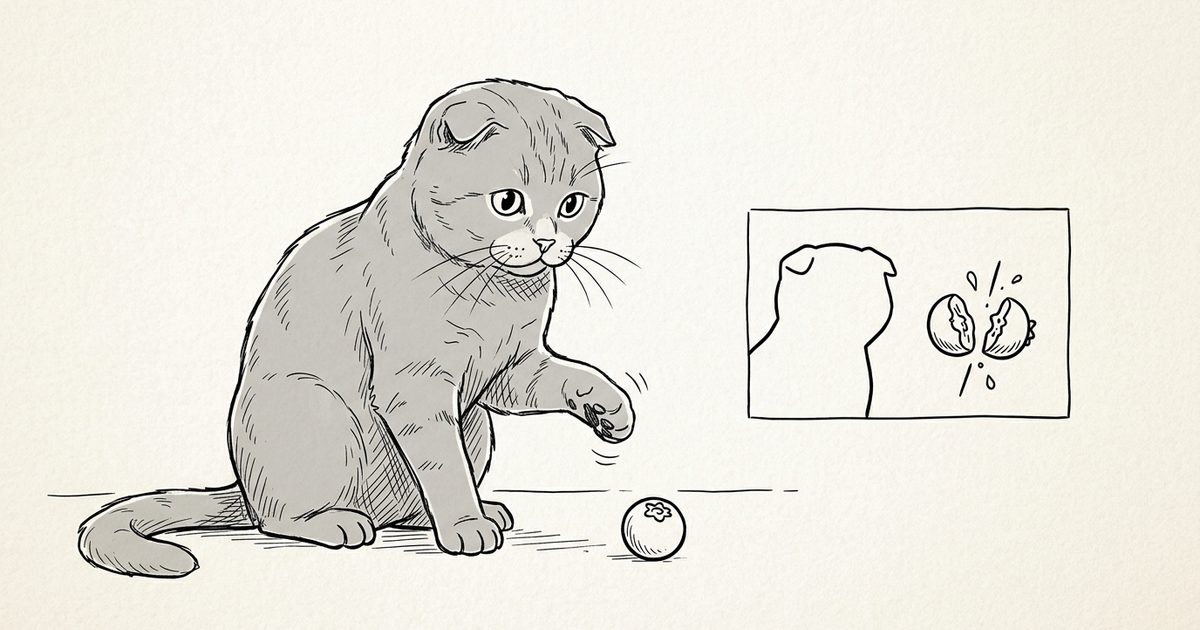
A blueberry is round and firm-skinned, and that shape is a genuine choking hazard for cats on the smaller end of the spectrum — kittens, small-framed adults, and any cat who eats fast or tends to gulp. The berry can lodge in the throat before the cat can chew it. The fix is simple: halve or mash the berry before offering it to a small cat, and never leave a bowl of whole berries within reach of a kitten. If you see gagging, excessive drooling, pawing at the mouth, distress, or labored breathing after a cat has eaten a berry, treat it as an emergency and contact a vet immediately.
Never a meal substitute
This is the caution that matters most: a blueberry is not food, in any meaningful sense, for a cat. It provides none of the protein, the taurine, the fat, or the complete and balanced nutrition a cat's body runs on. If fruit — any fruit — starts to displace real cat food, the cat drifts toward malnutrition even while appearing to eat. Offer a blueberry as a small, occasional moment of interest, and keep the actual diet anchored in complete cat food. If your cat shows gastrointestinal signs after trying a new food — vomiting, diarrhea, or loss of appetite — our guide on cat vomiting walks through when those signs warrant a vet visit. For the bigger picture of how fruit sits relative to an obligate carnivore's real needs, see what cats eat.
Curious What Your Cat Would Say?
Upload a photo and get a warm, personalized reading from your cat's perspective.
Start Your Free ReadingBlueberries for Cats at a Glance — Summary
| Question | Short answer |
|---|---|
| Can cats eat blueberries? | Yes — non-toxic, low in sugar and calories, one of the better fruit treats for cats |
| Are blueberries good for cats? | Safe but not necessary; antioxidants are real, low sugar is the genuine upside |
| How should I serve them? | Washed, fresh or frozen, whole for most cats or mashed for small cats |
| How many can a cat eat? | 2–3 berries, 1–2 times a week max, with all treats under ~10% of daily calories |
| Why do some cats like them? | Cats can't taste sweet — interest is moisture, texture, smell, or copying you |
| What are the risks? | Sugar caps frequency; firm round skin can choke small cats; never a meal substitute |
Frequently Asked Questions
Can cats eat blueberries every day?
No. Blueberries are a treat, not a daily food, because the small amount of sugar they carry still adds up against a cat's tight calorie budget. Offer them only once or twice a week, and keep all treats combined under roughly 10% of your cat's daily calories.
Are blueberries good for cats?
Safe, but not necessary. Blueberries contain real antioxidants and are lower in sugar than most fruits, but a cat on complete food already gets everything it needs from that food. The genuine upside is the low sugar, not any health benefit the berry adds.
How many blueberries can I give my cat?
About two to three berries, one or two times a week, for a healthy adult cat. Each berry is roughly one calorie, so even three stays well under the 10% treat allowance. Smaller, overweight, or diabetic cats should have fewer or none.
Can kittens eat blueberries?
Only if mashed or halved. A whole blueberry is round and firm-skinned, which is a real choking hazard for a small kitten. Never leave a bowl of whole berries within a kitten's reach, and keep the portion to a single mashed berry as an occasional treat.
Can cats eat frozen blueberries?
Yes. Frozen blueberries are just as safe as fresh, and some cats enjoy the firm, cold texture. Let a frozen berry soften for a minute or two first so it is not a jolt against the teeth, and still mash or halve it for small cats.
Why is my cat obsessed with blueberries?
Cats cannot taste sweetness, so the obsession is not about flavor. Your cat is responding to the moisture, the firm pop of the skin, the novel smell, or simply copying you. It is curiosity and texture, not a craving her diet needs to satisfy.
Can diabetic cats eat blueberries?
Best to skip them. Even though blueberries are low-sugar for a fruit, they still carry sugar a diabetic cat's metabolism does not need, and any added sugar complicates blood glucose management. Talk to your vet before offering any fruit to a diabetic cat.
Can cats eat blueberry yogurt?
No. Blueberry yogurt adds sugar and dairy that most cats cannot digest well, and the fruit flavoring offers nothing the cat can use. Stick to plain, fresh or frozen berries, washed, with nothing added.
Sources & References
You Might Also Like
Kitten Teething: Timeline, Symptoms & How to Help
Kitten teething runs from 3 to 7 months as baby teeth fall out. Learn the timeline, signs to watch for, and how to soothe a teething kitten safely.
15 min readWhen Do Cats Stop Growing? A Complete Timeline
When do cats stop growing? Most cats reach adult size by 12-18 months, but large breeds like Maine Coons keep growing until 3-4 years. Full timeline inside.
14 min readCan Cats Eat Cherries? Flesh, Pit & Toxicity Facts
Can cats eat cherries? Pitted flesh is safe in tiny amounts — but the pit, stem, and leaves are toxic (cyanide precursors). Learn what's safe and what isn't.
15 min read