Why Do Cats Push With Their Paws & Knock Things Over?
If you've ever watched your cat slowly, deliberately send a pen off the edge of your desk and then stare at you for a reaction, you've probably wondered why do cats push with their paws — and why they seem to love to knock things over so much. It's one of the most familiar (and occasionally infuriating) feline behaviors, and it happens every single day in homes around the world. Cat paws are remarkably dexterous instruments: they bat, scoop, press, and shove objects with precision that looks almost intentional. And in a way, it is. Behind the swatting and the tumbling water glass lies a blend of instinct, curiosity, and learned cleverness that runs far deeper than simple mischief. In this article I'll walk through the real science of why cats push, poke, and knock — from the hunting drive wired into every paw to the attention-seeking logic your cat has quietly figured out.
Key takeaways
- Pushing and knocking things over is instinctive feline behavior, not spite — it's driven by hunting drive, curiosity, and a cat's need for stimulation.
- Cats paw at objects to test whether they move like prey, to explore cause-and-effect, and because they've learned that a good swat gets a human's attention.
- Pushing is different from kneading — kneading is rhythmic pressing on soft surfaces for comfort, while pushing is a deliberate poke or shove aimed at objects.
- You can't eliminate the instinct, but enrichment, daily play, and a few cat-proofing habits make pushing and knocking far less frequent.
Why Cats Push & Knock Things — Quick Reference
| Reason | What it looks like | What it usually means |
|---|---|---|
| Hunting / prey-test | Slow, deliberate paw-swats at a moving or twitching object | Testing whether something behaves like prey |
| Curiosity / physics | Repeated pokes at a new object, watching it roll or fall | Exploring how the object reacts and moves |
| Attention-seeking | Knocking something off a surface while making eye contact with you | Learned cause-and-effect — "this gets a reaction" |
| Play / boredom | Frequent swatting at random objects, often when under-stimulated | Self-entertainment and burning off energy |
| Scent-marking | Pressing or rubbing paws on you, bedding, or familiar items | Depositing pheromones from paw-pad scent glands |
Why Do Cats Push & Knock Things? The Science
Cats push and knock things with their paws mainly to test whether objects move like prey (a leftover hunting instinct), to explore how the world reacts (curiosity), and to trigger a response from their humans (learned attention-seeking). Paw pads also carry scent glands, so pushing marks belongings as "theirs."
The full picture is more interesting than any single explanation, because when you ask why do cats push with their paws, the honest answer is that several different instincts are running at the same time — and your cat isn't picking one. A single swat that sends a pen off your desk can be prey-practice, physics homework, and a bid for your attention all at once. Feline behaviorists generally group the causes into five overlapping drives, and most house cats cycle through all of them depending on the object, the time of day, and whether anyone is watching.
What's striking is how much of this is hardwired. Cats are obligate carnivores whose predatory sequence — stalk, chase, pounce, grab, bite — is encoded deep in the brain, and that sequence doesn't switch off just because dinner comes from a can. A house cat with no prey to catch still has a full tank of predatory energy, and objects that move when pawed satisfy the "did I catch it?" loop in a way a sleeping human never can. So pushing, batting, and knocking things over isn't mischief — it's a cat's hunting software looking for something to run.
The secondary layer is learned. Cats are excellent at noticing cause and effect, especially when the effect is you. If a paw on a glass makes a human jump up from the couch, that's a highly repeatable experiment with a reliable reward. International Cat Care, a leading feline welfare charity, notes that cats quickly learn which behaviors produce attention, and pushing objects is one of the most effective — because it almost always works.
A leftover hunting instinct
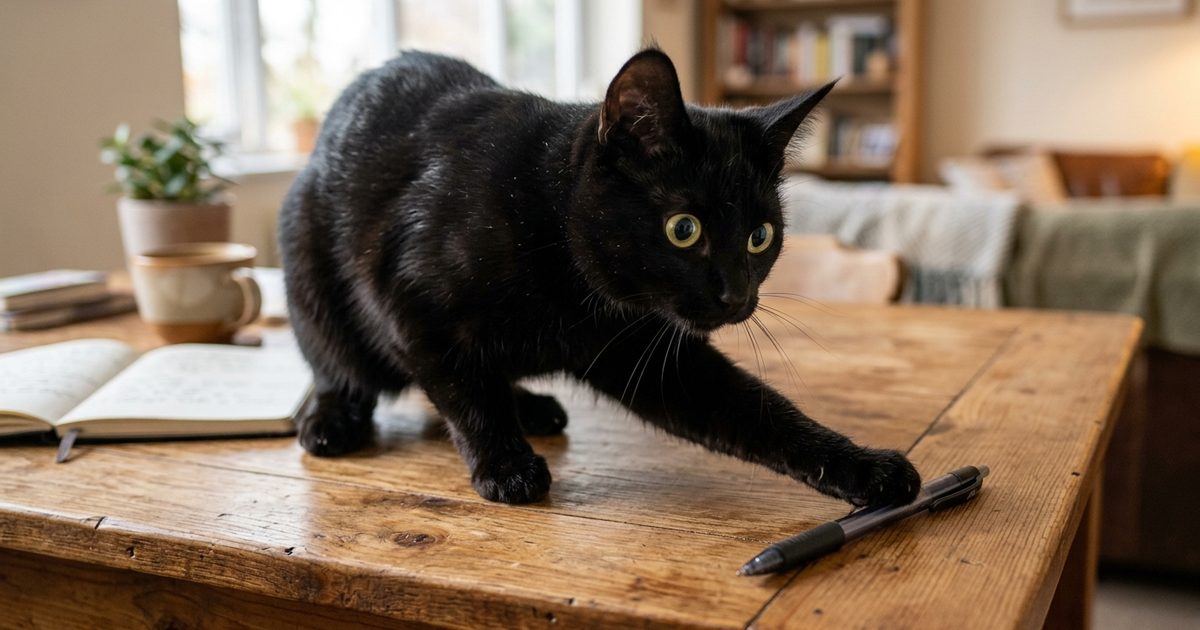
The strongest explanation for why cats push things is that a moving object triggers the predatory sequence. In the wild, a cat spots prey, stalks it, pounces, and uses its paws to test whether the prey is alive, injured, or dead. A pen that rolls when touched, a toy mouse that skitters, a crumpled receipt that flips — all of these mimic the movement of small prey, and the cat's brain responds the same way: bat it again, see what it does. When your cat paws an object and it moves, the hunting circuit lights up. This is why cats often seem more interested in the object after it starts moving than before — the movement is what makes it "prey." Objects that don't move when pawed usually lose a cat's interest fast.
Curiosity and exploring physics
Cats are investigative animals, and their paws are their primary exploratory tools — far more dexterous than most people realize. A cat uses its paws the way a human uses their hands: to poke, prod, lift, and test. When a cat bats a new object, it's partly asking a question: what happens if I do this? They seem genuinely fascinated by cause and effect — how things roll, slide, or make noise when touched. They have no concept of "expensive" or "fragile," only of "this object produces an interesting result when I apply force," which is why the experiment gets repeated. Read more about how cats use their paws to explore.
Attention-seeking
This is the explanation most cat owners intuitively reach for, and it's often correct. Cats learn cause and effect quickly, and one of the clearest cause-effect relationships in a cat's life is: I push thing → human appears. If you react to a knocked-over object — even negatively — you've just rewarded the behavior with attention. Veterinary behaviorists point out that from a cat's perspective, negative attention still counts as attention; the cat doesn't distinguish between "you came because you were pleased" and "you came because you were annoyed." It just learns: this works. Cats who are left alone for long stretches, or whose humans are busy and distracted, are especially prone to attention-driven knocking because the payoff is higher.
Play and self-entertainment
Boredom is the great amplifier of every other cause on this list. A cat with plenty of enrichment — daily interactive play, puzzle feeders, vertical space, things to watch — has less surplus predatory energy to spend on your belongings. A cat with nothing to do has an enormous amount of it. Indoor cats in particular live in environments far less stimulating than the outdoor territory their instincts were designed for, and pushing objects is a self-entertaining behavior that requires no partner and no special equipment. The solution isn't to suppress the instinct; it's to give it a better outlet. Daily play that lets a cat stalk, chase, and "catch" drains the same hunting drive that would otherwise find your water glass.
Scent marking with their paws
The least obvious — but scientifically well-documented — reason cats push and paw objects is scent marking. Cats carry scent glands in their paw pads, the same glands that come into play when they knead soft surfaces. Every time a cat paws, bats, or pushes an object, it can deposit pheromones that other cats can read but humans can't smell. The chemical message is essentially: I was here, and this is part of my territory. This is why cats often return to paw the same objects repeatedly — the same pen, the same spot on the desk, the same water bowl. They're refreshing a scent signature, the same way they rub their cheeks along furniture or headbutt their favorite people. You can read more about feline scent communication from the Cornell Feline Health Center.
Why Do Cats Knock Things Off Tables & Counters?
Cats knock things off tables because the fall delivers maximum feedback — motion, sound, and a human reaction in one event. Edges amplify every pushing instinct (hunting test, curiosity, attention-seeking), making elevated surfaces the richest cause-and-effect experiment available to a cat.
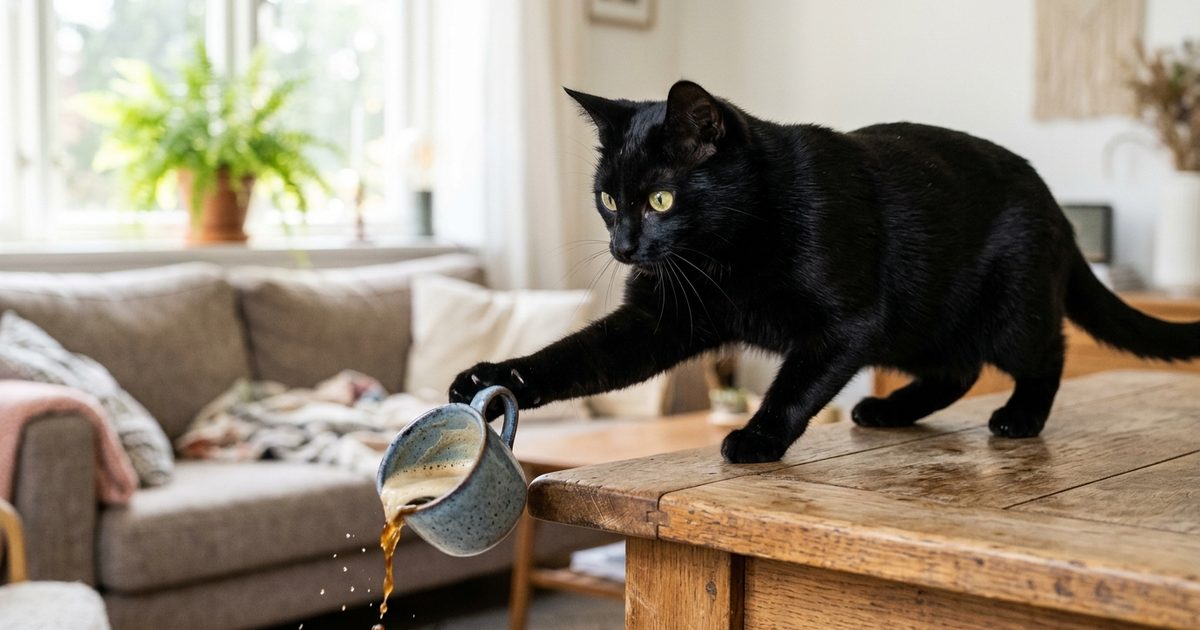
Knocking things off tables, counters, and shelves is the pushing behavior owners notice most — and once you understand the science above, the leap to gravity becomes obvious. When an object sits on an edge, every instinct we just covered (hunting test, curiosity, attention-seeking, boredom) gets amplified, because a fall produces the richest feedback of all: motion, sound, and a human reaction in one event.
Let's break down why cats are so drawn to the gravity game, and what it reveals about how they understand the world.
The gravity fascination
Cats push things off edges because they genuinely want to see what happens next. It's the same impulse you feel when you want to push a button on a new gadget: what does this thing do? Pushing an object from a height gives a cat visual, auditory, and physical feedback all at once. A small item falling, bouncing, and making a sound on impact is a rich sensory event for a cat — exactly the kind of thing that captures attention and invites another try.
Behavioral researchers describe this as part of feline exploratory behavior, in which cats use their paws as their primary investigative tools. A cat's paws are highly dexterous — they can bat, hook, tap, and gauge. When a cat slowly walks a pen across a desk until it falls, it's using the same sensory toolkit a wild cat uses to test whether prey will move. The object's response tells the cat something: weight, trajectory, sound, all stored for next time.
That's why cats will repeatedly test the same object. The memory gets refreshed, the action is inherently interesting, and the result varies (a mug sounds different from a pen). It's not spite; it's a satisfying, immediate cause-and-effect loop in the cat's mind. Anyone who has worked with cats recognizes this repetitive testing as a hallmark of curiosity and playful exploration — International Cat Care also notes it as an innate feline trait.
Why cats love elevated surfaces
Pushing things becomes far more interesting when the object is up high. Tables, counters, and shelves offer three things cats particularly love: an elevated vantage point, the dramatic payoff of gravity, and usually a human reaction.
Cats naturally climb to high places to survey their environment — a habit from wild ancestors who perched above to spot prey and avoid threats. Height gives them control, and control brings calm. But it also means anything placed near the edge of a high surface enters their "testable zone." When an object falls from height, the fall is longer, the impact louder, and the drama greater — all three reinforce the behavior. A low object's fall offers weak feedback; a glass on the counter's edge delivers a full sensory payoff in a cat's small brain.
That's why your counter attracts your cat more than your floor does. It's not that cats dislike counters; it's that a counter combines a tall perch, curious edge-near objects, and a human audience who reacts to every "crash." For a cat, that's a perfect scenario with every element in place: height, gravity, and attention.
Is knocking things over a sign of intelligence?
In short, yes — it does take a certain level of cognition, combining object permanence, cause-and-effect reasoning, and the deliberate use of paws to solve a problem. A cat that tests an item, watches its fall, and remembers the result is doing some fairly sophisticated thinking.
Here's what supports that view: cats show an understanding of object permanence — they know an item still exists even when they can't see it. They can connect "bat" with "fall," which shows a grasp of cause and effect. And cats selectively push certain items (usually light, noisy, or owner-associated ones), which suggests they distinguish which objects produce richer feedback.
That said, before crowning your cat a genius, a note of caution. No study has specifically measured the link between "knocking things over" and "feline intelligence," and the variation between cats likely has more to do with personality, age, and environment than with cognitive ability. The honest middle ground: this behavior does involve thinking, but a cat that does it isn't necessarily smarter than one that doesn't — it may simply live in a more interesting environment or have a more interactive human companion. Framing it as a sign of curiosity and problem-solving is the most accurate, non-exaggerated read.
Which cats knock things over most
Any cat can knock items off surfaces, but the behavior is most common in:
- Kittens and young cats. Their hunting and exploratory instincts are at peak activity, and they're still learning the rules of how the world works. Every edge is a new puzzle.
- Indoor-only cats. Fewer hunting opportunities mean the hunting drive gets redirected onto household objects. A cat with appropriate outlets indoors is less likely to "manufacture" entertainment from the counter.
- Under-stimulated or bored cats. Cats lacking toys, interactive play, or environmental enrichment will seek out things to do — and knocking objects provides both activity and attention.
- Cats closely bonded to humans who've learned to seek attention. If a cat has received feedback (the owner running over, laughing, or making a sound) from knocking, it learns this is an effective attention button. Even a negative reaction counts as attention to a cat.
On breed tendencies, some owners report that certain breeds (active, curious lines) seem to knock things more often, but this association is mostly anecdotal and lacks rigorous research backing. Generalizing it without proof misleads owners about specific breeds. Personality and living environment are far stronger predictors than breed: an active cat living in a home full of toys and daily play with its owner tends to knock less than a bored, solitary cat.
The takeaway: knocking behavior rises and falls with age and stimulation. If you have a young, indoor-only cat in an under-enriched home, you very likely have a "gravity tester." The good news is that the same principles — redirecting instinct, reducing feedback, and providing better outlets — are exactly what reduce the behavior, as we'll cover next.
Other Things Cats Push With Their Paws
Once you start watching for it, the answer to why do cats push with their paws stretches far beyond knocking things off tables. A cat's paw is its primary tool for exploring, manipulating, and testing the entire world within reach — and that instinct spills into everything from dinnertime to door handles. The same paw that bats a glass off a counter is the paw that nudges a kibble across the floor or pries open a kitchen cabinet. Here are the most common pushing behaviors you'll see at home, and what each one usually means.
Food and water bowls
Many cats push their food bowls around the floor, drag kibble out to eat it piece by piece, or nudge a water dish until it sits exactly where they want it. This looks fussy, but it's mostly instinct in action. In the wild, a cat eats small prey on the ground, often batting it into position or carrying it somewhere safer before settling down. Bowl-pushing recreates that foraging motion — your cat is "working" the food the way its ancestors worked a catch.
Some owners notice their cat pulls food out of the bowl and eats it off the floor instead. One commonly cited reason is whisker comfort: deep or narrow bowls can bend a cat's whiskers against the sides during eating, which some find unpleasant. The concept is widely discussed among cat lovers and breeders, though the scientific evidence is limited and many cats eat happily from deep bowls their whole lives. The safest general statement: if your cat consistently refuses to eat from a bowl but happily eats the same food off a flat plate or the floor, a wide, shallow dish is an easy, low-risk experiment. Also worth noting — cats often prefer their water source separate from their food, a leftover instinct to avoid contaminating drinking water with prey remains.
Doors, drawers, and cabinets
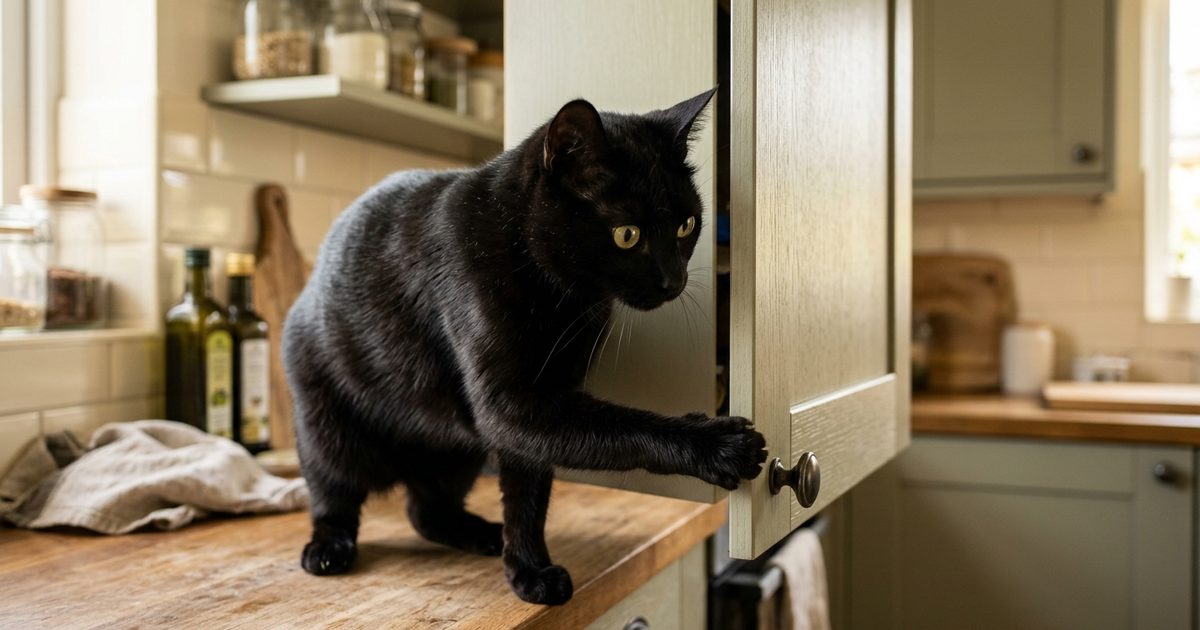
If your cat has ever hooked a paw under a closed door, slid open a kitchen drawer, or pried open a cabinet, you've watched feline problem-solving in real time. Cats are curious, dexterous, and persistent; they use their paws to investigate any gap, handle, or opening that promises something interesting on the other side. A closed door is a mystery, and a cat's instinct is to solve mysteries.
This is also why some cats become skilled at opening doors — they observe that pushing or pulling a handle produces a result, repeat it, and learn. It's the same cause-and-effect thinking behind knocking things off tables: I push this, something happens. Cats that have figured out lever handles or sliding doors are showing genuine associative learning, not random behavior. If your cat has become a relentless cabinet-opener, child-proof latches are usually the simplest fix — you're not stifling the cat, just redirecting that investigative energy toward appropriate toys and puzzles.
Pushing against you
When your cat presses a paw against your arm, pushes its face into your hand, or leans its whole body against your leg, it's usually stretching and scent-marking at the same time. Cats carry scent glands on their paw pads, cheeks, forehead, and flanks; pressing into you deposits pheromones that signal "this person is part of my world." A long, slow lean into your leg is a calm, affectionate version of marking — your cat is claiming you, gently.
The key distinction is motion. Kneading is rhythmic — paws pressing in and out, over and over, usually on a soft surface, often with purring and half-closed eyes. Pushing against you is a single, deliberate press or lean, not a repeated rhythm. If your cat climbs onto your lap and starts working its paws in and out against you, that's kneading — a different (and equally affectionate) behavior you can read all about in our guide to why do cats knead. The two are easy to tell apart once you're watching for the motion rather than the paws alone.
Curious what your cat is really telling you with all this paw-work? Get a MeowMind reading — upload a photo and hear what your cat would say.
Pushing vs Kneading — What's the Difference?
Pushing is a single, deliberate motion aimed at moving or testing an object; kneading is a rhythmic, repeated pressing on a soft surface that signals comfort and contentment. Watch the motion — one deliberate push versus a steady in-and-out rhythm tells you which is which.
Pushing and kneading both involve a cat's paws pressing against something, but they're completely different behaviors with different meanings. Pushing is a single, deliberate motion aimed at moving, testing, or exploring an object. Kneading is a rhythmic, repeated pressing — paws going in and out — almost always on a soft surface, and almost always a sign of contentment. The quickest way to tell them apart is to watch whether the motion repeats in a steady rhythm (kneading) or happens once as a deliberate act (pushing).
| Pushing with paws | Kneading (making biscuits) | |
|---|---|---|
| Behavior | Single deliberate push, bat, or press of an object | Rhythmic alternating paw-press, in and out |
| Motion | One motion — push, nudge, or hook | Repeated steady rhythm, often with extended and retracted claws |
| Surface | Objects, food, doors, you — anything reachable | Soft surfaces — your lap, blankets, beds |
| Meaning | Curiosity, hunting instinct, attention, scent-marking, problem-solving | Comfort, contentment, affection, self-soothing |
The reason the two get confused is that both end with a cat's paw pressing into something — and a cat that pushes against your leg and then starts rhythmically working its paws has simply moved from one behavior into the other. If you're trying to figure out what your cat is telling you, the motion is the giveaway: deliberate push versus steady rhythm. For the full picture of the rhythmic side — why cats knead, what the purring means, and what it tells you about your bond — see our deep dive on why do cats knead.
Common Myths About Cats Pushing & Knocking Things
Myth: Cats push or knock things over out of spite or malice. Fact: Many owners are convinced their cat looks faintly smug during a gravity experiment — and that subjective feeling is real, and not entirely baseless, because cats do learn that pushing equals an immediate human reaction. But animal behaviorists agree cats don't have the capacity for "spite" in the human sense; they aren't running a psychological script designed to punish you for coming home late. What they're doing is repeating a behavior that brings feedback, whether that's a prey-like response, a sound, or your attention. Both things can be true: the behavior is driven by instinct and learning, and the "on purpose" feeling you get is a byproduct of the cat successfully mastering cause and effect.
Myth: If your cat keeps knocking things over, it means your cat is unhappy. Fact: In most cases, it's the opposite. Pushing objects off edges is a typical hunting and play behavior for confident, relaxed cats — they feel safe enough to explore, test, and entertain themselves. The key to reading your cat is overall body language: ears up and forward, relaxed posture, and a slowly swaying tail signal playful fun; flattened ears, a thrashing tail, or a rigid body signal anxiety or irritation. The behavior alone doesn't tell you — your cat's body language does.
Myth: Only kittens push and knock things. Fact: Kittens do show the behavior more often, because they're at the peak of hunting-skill development and have boundless energy. But adult cats — even seniors in their teens — retain the instinct. Any mentally sharp cat will test an item that's within reach of an edge. Adult cats are usually less frantic about it, but the motivation is the same. That's why, when you look into why cats push with their front paws, you find it's a phenomenon that spans every age.
When Pushing Might Signal a Problem
Occasional pushing is healthy, but a sudden spike in frequency, compulsive repetition, or pushing paired with hiding or over-grooming can signal stress, anxiety, or understimulation — and warrants a vet check.
Occasional pushing and knocking is completely normal and healthy — but there are three shifts worth watching for. The first is compulsive, repetitive pushing: a cat repeatedly batting the same object back and forth, or making scratching motions at an empty surface with no object present, seemingly unable to stop. The second is a sudden spike in frequency: a cat that never touches items on tables suddenly starts knocking things down constantly. The third is behavior appearing in a context you can't explain as play — for instance, accompanied by over-grooming, hiding, or pacing.
These changes usually reflect not a behavior problem but underlying stress, anxiety, or understimulation. Changes in environment — a new pet, a move, a routine shift, even a strange cat appearing outside the window — can turn a cat's play behavior into restless repetition. The rule of thumb, as with any cat behavior: a sudden and persistent change is worth a vet consultation. International Cat Care and the Cornell Feline Health Center both offer reliable guidance on when behavioral changes warrant a health check. The pushing itself usually isn't the problem — but it's often the most visible clue.
How to Stop Your Cat Pushing & Knocking Things
You can't — and shouldn't — eliminate your cat's instinct to push and knock objects. It's part of their nature, just like scratching posts or purring. What you can do is redirect that energy into outlets that don't shatter your mugs. Here are concrete ways to do it.
- Prioritize environmental enrichment. A tired cat is a well-behaved cat. Provide puzzle feeders, toys that bounce and roll, vertical space to climb and watch from (cat trees, shelves), and a spot with a view of "cat TV" (birds or leaves outside the window). When your cat's hunting drive is satisfied elsewhere, the appeal of items on your tables drops dramatically.
- Don't reward it with a big reaction. When your cat knocks a pen off, if you shriek, jump up, run over, or lecture them — congratulations, you've just given them an "attention feast." Cats quickly learn that knocking equals instant human attention. Instead, calmly pick up the item and completely ignore the cat when they paw at something you don't want them to touch; conversely, give attention and reward when they play with their own toys.
- Cat-proof your valuables. This is the simplest and most effective step. Store breakables behind glass-doored cabinets, place heavier decor away from edges, use weighted bases for lightweight vases, and apply double-sided tape to counter edges you don't want them to jump on. You can't negotiate with gravity, but you can change the environment so the "gravity experiment" becomes boring.
- Redirect to appropriate toys. When you catch your cat eyeing an item at the table's edge, toss a bouncy ball, a mouse toy, or a food puzzle onto the floor before she makes her move. You're telling her: "here's something better to bat." After a few weeks of consistent redirection, she'll start seeking out the toys instead of your keys.
- Make interactive play a daily habit. Ten to fifteen minutes a day of wand-toy play — letting her run, pounce, and "catch" prey — burns the same hunting drive that fuels knocking. Treat it like brushing your teeth: a daily routine. Many indoor cats knock objects excessively not because of a behavior problem but simply because they're bored, and the fix is to keep them busy.
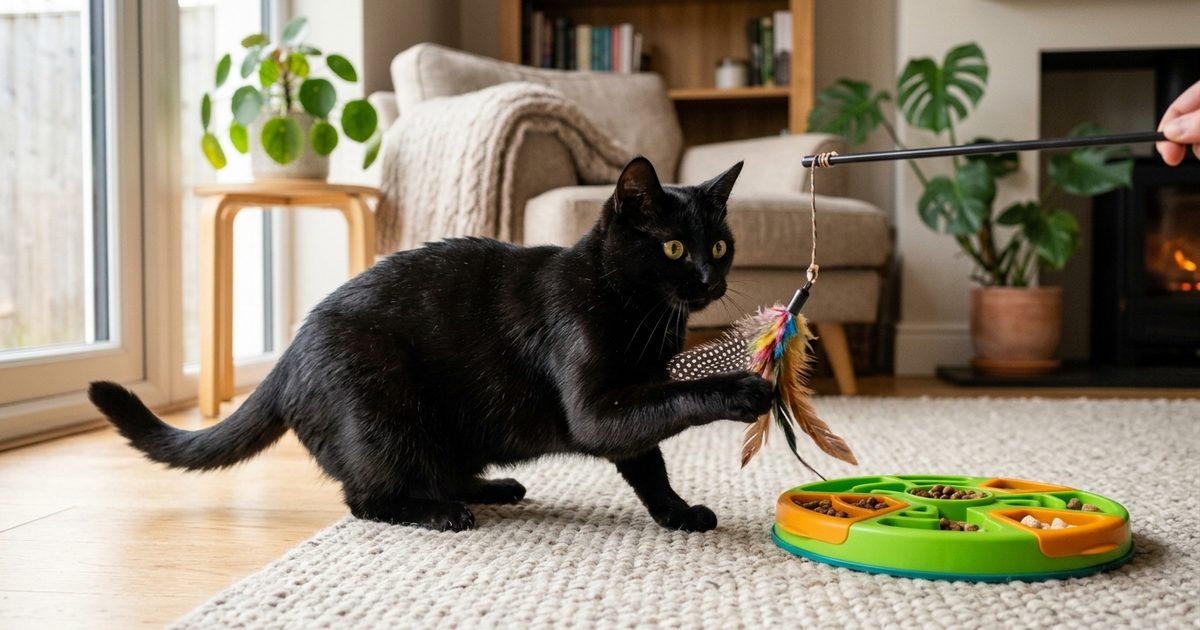
The key: it's not about stopping the behavior, but changing the target. A cat with rich enrichment, regular play, and no big-reaction payoff for knocking will usually dial the behavior back on their own — and you get to keep your mugs.
Pushing & Knocking at a Glance — Summary
| Question | Short answer |
|---|---|
| Why do cats push with their paws? | Instinct — testing objects like prey, exploring with curiosity, and marking belongings with paw-pad scent |
| Why do cats knock things off tables? | Gravity is entertaining, and the big reaction you give reinforces the habit |
| Is knocking things over a sign of intelligence? | Yes — it shows curiosity, object-permanence awareness, and cause-and-effect learning |
| How is pushing different from kneading? | Pushing moves objects; kneading is rhythmic pressing on soft surfaces for comfort and affection |
| Should I punish my cat for knocking things over? | No — redirect the energy into enrichment and cat-proof your valuables instead |
| When should I worry? | Only if the behavior suddenly spikes or becomes compulsive — a vet can rule out stress or understimulation |
Curious What Your Cat Would Say?
Upload a photo and get a warm, personalized reading from your cat's perspective.
Start Your Free ReadingFrequently Asked Questions
Why does my cat push things off the table?
It's almost always a mix of hunting instinct and attention. A paw-swat tests whether an object moves like prey, and if you react — even with a sigh — your cat learns the behavior works. Elevated surfaces like tables just make the 'experiment' more dramatic and rewarding.
Why do cats knock things over at night?
Cats are crepuscular, meaning their hunting drive peaks at dawn and dusk. If your cat has no appropriate outlet for that energy overnight — no play session, no puzzle feeder — knocking objects becomes self-entertainment. A tired cat who's hunted a wand toy before bed knocks far less.
Is my cat knocking things over for attention?
Very likely, yes. Cats are excellent cause-and-effect learners, and 'I push this, human appears' is one of the most reliable experiments in their life. Even scolding counts as attention from the cat's perspective, so the habit sticks. Ignoring the behavior and rewarding toy-play is the fix.
Why does my cat push his food bowl?
Bowl-pushing recreates the foraging motion cats use in the wild — batting prey into position before eating. Some cats also pull kibble out to eat off the floor, possibly for whisker comfort. If yours eats happily from a shallow dish but refuses a deep bowl, try a wide, flat plate instead.
Why does my cat push against me?
A slow, single press or lean against your leg is scent-marking — your cat has pheromone glands in its paw pads and is claiming you as part of its world. This is different from kneading, which is a rhythmic, repeated pressing on soft surfaces and usually a sign of comfort.
How do I stop my cat knocking things off surfaces?
You can't remove the instinct, but you can redirect it: provide daily interactive play to drain the hunting drive, cat-proof breakables behind glass doors and weighted bases, ignore the knocks rather than reacting, and offer push-friendly toys. A stimulated cat simply knocks less.
Is knocking things over a sign of a smart cat?
It does involve real cognition — object-permanence awareness, cause-and-effect reasoning, and deliberate paw use. But no study ties knocking specifically to higher intelligence, and personality and environment matter more than breed. The honest read: it shows curiosity and problem-solving, not necessarily genius.
Should I punish my cat for pushing things?
No. Punishment doesn't teach the lesson you intend — it just adds stress and can damage trust. The behavior is instinctive, not spiteful. The effective approach is management: redirect the energy into enrichment, avoid rewarding knocks with big reactions, and cat-proof what you can't afford to lose.
Sources & References
You Might Also Like
Kitten Teething: Timeline, Symptoms & How to Help
Kitten teething runs from 3 to 7 months as baby teeth fall out. Learn the timeline, signs to watch for, and how to soothe a teething kitten safely.
15 min readWhen Do Cats Stop Growing? A Complete Timeline
When do cats stop growing? Most cats reach adult size by 12-18 months, but large breeds like Maine Coons keep growing until 3-4 years. Full timeline inside.
14 min readCan Cats Eat Cherries? Flesh, Pit & Toxicity Facts
Can cats eat cherries? Pitted flesh is safe in tiny amounts — but the pit, stem, and leaves are toxic (cyanide precursors). Learn what's safe and what isn't.
15 min read