Cat Paw Anatomy: Toe Beans, Claws & Facts Every Cat Has
A cat paw is one of the most finely engineered pieces of anatomy in the animal kingdom — equal parts cushion, grip, weapon, and sensory instrument. This guide to cats paw anatomy walks you through every part of it, from the bony toes and famous toe beans to the retractable claws that stay razor-sharp between uses. You'll learn why your cat's front feet have an extra toe, what those soft pads actually do, and how a structure built for silent stalking also happens to be one of the most affectionate tools a cat owns.
Key takeaways
- Cats have five toes on each front foot (including a non-weight-bearing dewclaw) and four on each back foot — eighteen toes total in the standard count.
- The "toe beans" are the functional digital and central pads: shock absorbers, silent treads, and home to both scent glands and sweat glands.
- Cat claws are retractable, sliding into a skin sheath when not in use, which keeps them sharp and lets cats walk without a sound.
The Cat Paw at a Glance — Quick Reference
| Part of the paw | What it does | Cool fact |
|---|---|---|
| Toes (digits) | Carry the claws and digital pads; bear weight | Five on each front foot, four on each back |
| Dewclaw | The front "thumb" that never touches the ground | Doesn't wear down, so it needs regular trimming |
| Digital pads (toe beans) | Grip, cushion each toe, and secrete scent and sweat | Each bean pattern is unique, like a fingerprint |
| Metacarpal / metatarsal pad | The large central pad that absorbs the impact of every step | Cushions landings from heights up to several times the cat's body length |
| Claws | Grasping prey, climbing, gripping, and scratching | Retract into a skin sheath to stay sharp and silent |
| Carpal whiskers | Stiff sensory hairs on the back of the front wrist | Feel vibrations through the paw and ground |
What Makes Up a Cat's Paw? The Anatomy
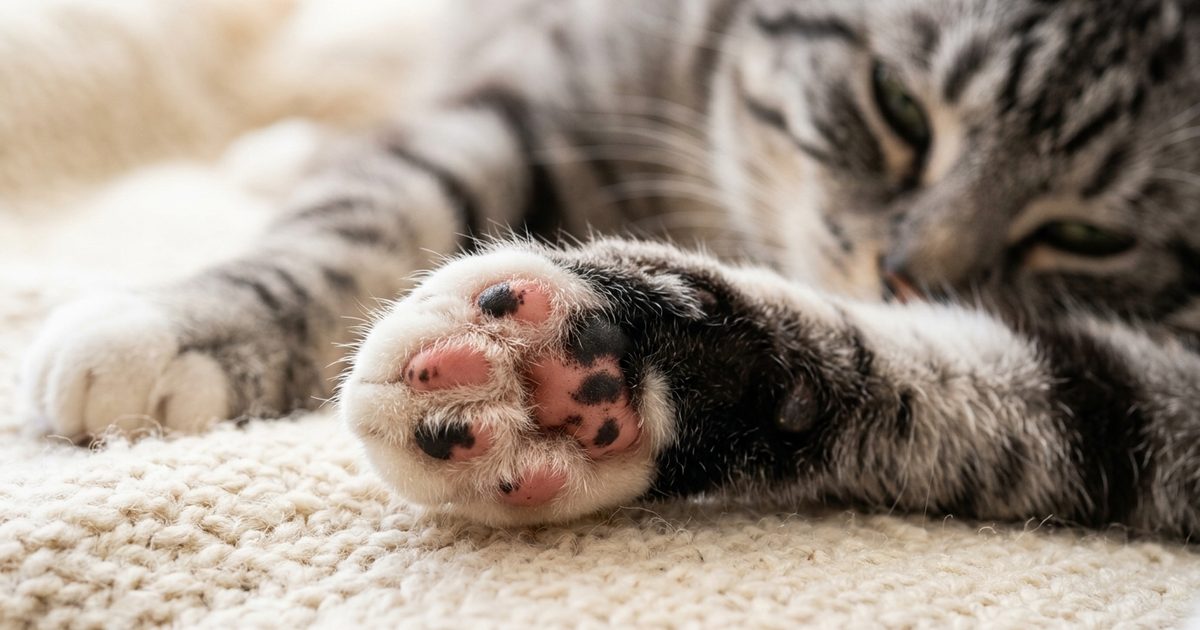
A cat paw has five toes on each front foot and four on each back foot, built on the same five-digit plan as our hands. The front "thumb" (dewclaw) sits higher up and never touches the ground, while the large central pad is the metacarpal pad that cushions every step.
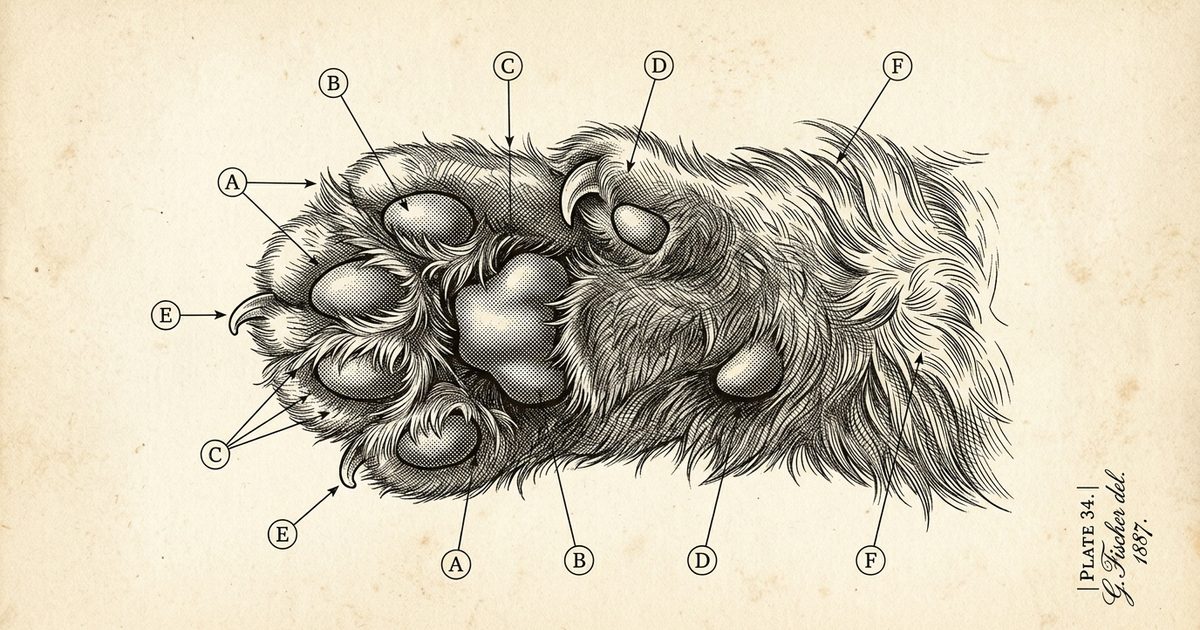
A cat's paw is a small, tightly engineered piece of anatomy — part shock absorber, part sensor array, part climbing tool. The structure is consistent enough that once you can read one cat paw, you can read nearly all of them. The variation comes in the details: toe count, pad color, and the hidden extras (like extra toes or wrist whiskers) that make each cat a little different.
Five toes front, four back
The standard count is five toes on each front paw and four on each back paw — 18 total. The front fifth toe is the dewclaw, a small "thumb" that sits higher up the inside of the paw and never touches the ground when the cat walks. Because it has no contact to wear it down, the dewclaw needs regular trimming (more on that in the claw care section). The back feet drop to four toes, which is an evolutionary streamlining: one fewer digit means a lighter, longer hind foot built for sprinting and explosive jumping rather than gripping. If you've ever wondered how many toes do cats have, the quick answer is 18 — unless you meet a polydactyl.
Polydactyl cats: extra toes
Some cats carry an extra dose of toes — a harmless genetic trait called polydactyly. A polydactyl cat can have six or seven toes on a single paw, occasionally more, and the extras are usually fully functional. Far from being a deformity, polydactyly is a normal inherited variant, and the most famous colony of these cats lives in Key West, Florida, at the former home of writer Ernest Hemingway, where dozens of six-toed descendants still roam the grounds. Most polydactyl cats are perfectly healthy; the only catch is that the extra toes sometimes sit at an odd angle, so those claws may need a little extra attention at trim time.
The pads: digital, metacarpal, metatarsal
The sole of a cat paw is a tidy set of pads, each with a job. The small pads under each toe are the digital pads — the "toe beans" — and there's one for every toe. Behind them sits one large central pad: the metacarpal pad on the front paws and the metatarsal pad on the back. Higher up the inside of the front leg, almost at the wrist, is a small, easily missed nub called the carpal pad, which adds extra grip when a cat is sprinting or pouncing. Together these pads distribute weight, absorb impact, and give the paw its traction — the same traction your cat leans on whenever she pushes and bats at objects.
Carpal whiskers: the paw's hidden sensors
If you part the fur on the back of your cat's front wrist, you'll find a few stiff, bristly hairs — these are the carpal whiskers. Unlike the prominent facial whiskers we usually notice, the carpal whiskers sit tucked away and act as a vibration sensor for the paw itself. They help a cat feel the ground, detect the faint movements of prey under paws or debris, and judge surface texture in the dark. They're the same kind of sensory structure we cover in our guide to cat whiskers, just relocated to the limbs — a reminder that the paw is as much a sensory organ as it is a foot.
What Are Toe Beans and What Do They Do?
Toe beans are the small digital pads under each toe. They work as shock absorbers for silent, high-impact landings, as grippy treads for climbing and sprinting, and they house both scent glands (for pawing territory) and sweat glands that leave a unique scent trail and cool the paw.
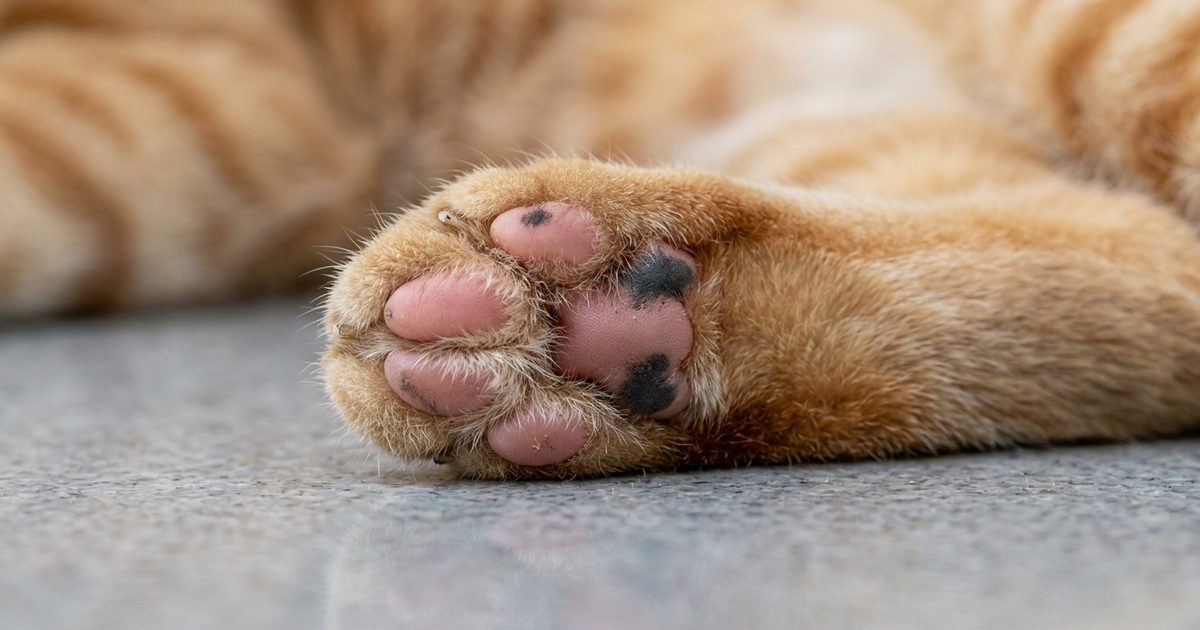
"Toe beans" is the affectionate name for the digital pads, but they're far more than a cute detail. Each bean is a layered cushion of fat and elastic tissue wrapped in tough, lightly textured skin — the same combination that makes a cat's footstep nearly silent and lets her stick a landing from heights that would buckle a stiffer limb. The same pads also do chemical work, secreting both scent and sweat, which is why a cat's paw is quietly one of her busiest organs.
Shock absorbers and silent walking
The padding inside each toe bean acts as a built-in shock absorber. When a cat lands from a jump or drops down from a perch, the spongy pad tissue compresses and spreads the force across the foot, sparing the bones and joints the jarring impact. That same cushioning, paired with the soft outer skin, is what allows the famously silent cat walk — the slow, deliberate heel-to-toe gait a stalking cat uses to close the distance on prey without making a sound. It's engineering in service of ambush: cushion for the joints, quiet for the hunt.
Scent glands and pawing territory
Between the paw pads sit scent glands that release pheromones when a cat presses, kneads, or scratches a surface. Every pawing gesture leaves a chemical signature, which is one reason cats paw and bat at objects so readily — they're not just testing texture, they're also laying down a scent mark that says this is part of my territory. It's the same instinct that drives scratching behavior, and it's woven into how cats communicate through body language and why they push and tap with their paws so often. The signature is unique to the cat; we can't smell it, but other cats can read it.
Sweat glands on the paws
Cats also sweat through their paw pads — it's one of the few places they can. There's no effective sweating across the body fur, so the toe beans carry the cooling load, secreting just enough moisture to regulate temperature and add grip on smooth surfaces. Those damp paw prints you sometimes see on the exam table at the vet are the same system working overtime: stress ramps up the secretion, leaving little nervous wet footprints behind. It's normal, not a sign of illness, and you can read the full breakdown in our article on whether cats sweat. The Cornell Feline Health Center and International Cat Care both note that paw-pad sweating is the cat's primary route for heat dissipation — a small mechanism doing a big job.
Why Do Cats Have Retractable Claws — and Why Do They Scratch?
Cat claws retract into a sheath of skin and ligament when not in use, which keeps them razor-sharp and lets cats walk silently. Cats scratch surfaces to shed the dead outer husk of each claw, stretch their back and shoulder muscles, and leave both a visual and a scent mark on their territory.
How the claws retract
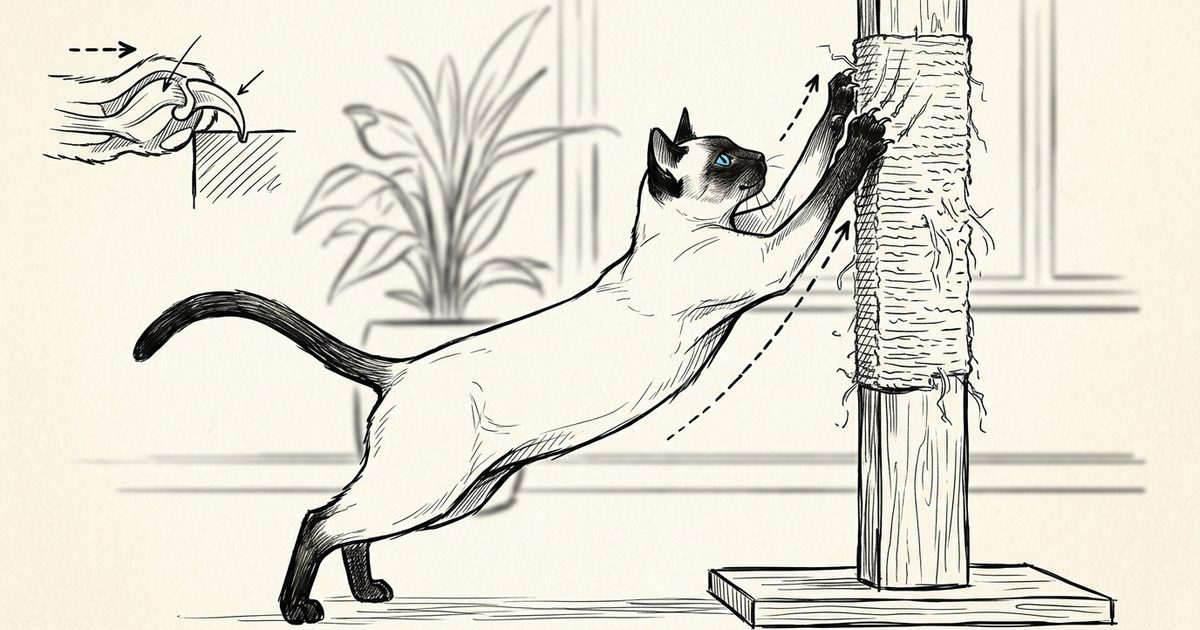
A cat's claw is held inside a bony slot by an elastic ligament that constantly pulls it back and up, off the ground. At rest, the claw sits tucked inside a fold of skin and fur — so the cat walks on its pads alone, completely silent. Extending the claws takes active work: a tendon in the foreleg must flex to push each claw forward and down, which is why a relaxed cat's claws stay hidden. This is the opposite of a dog's claws, which are fixed in place, always out, and click on every hard floor. It's one of the cleanest details in cat paw anatomy — a weapon the cat only draws when it needs one.
Why cats scratch (it's not destruction)
Scratching looks destructive, but it's one of the healthiest things a cat does. There are four reasons cats scratch, and all four are non-negotiable instincts:
- Shedding the worn claw husk. Each claw grows in layers; scratching peels off the dull outer shell to expose a fresh, sharp claw underneath.
- Stretching. A good scratch pulls through the back, shoulders, and paw tendons — it's a full-body stretch the cat can't get any other way.
- Visual marks. The claw gouges themselves are a sign other cats can read.
- Scent marks. Scent glands between the paw pads leave a chemical signature, layered onto the visual one.
So when a cat scratches your sofa, it isn't being naughty — it's maintaining its claws, stretching, and laying down territory all at once. The fix is never to stop the behavior; it's to give the cat the right surface (more on that below). If your cat also bats and paws at objects to test them, that's a different motion — read more on why cats push with their paws and how it fits into wider cat body language.
The dewclaw problem
The dewclaw is the cat's "thumb" — the fifth digit on the front foot, set higher up the inside of the leg. It never touches the ground, which means it never wears down the way the other claws do. In an indoor cat whose claws are trimmed rarely, the dewclaw is the one most likely to overgrow into a tight curl that can pierce back into the pad. It's the single claw worth checking every couple of weeks, no matter how reluctant your cat is about trims. We cover the full trimming routine below in the paw-care section.
Why declawing is never OK
Declawing is often presented as a "permanent nail trim," but it is neither permanent nor a trim — it is onychectomy, the surgical amputation of the last bone of each toe, claw and all. That's why the Cornell Feline Health Center and most modern veterinary bodies are blunt about it: declawing can cause chronic pain, changes in gait, litter-box avoidance (the litter hurts the surgical site), and a rise in biting, because the cat has lost its first line of defense. It's banned in dozens of countries and in a growing number of U.S. cities, and it is never the humane answer to a scratching problem.
What actually works: a sturdy, tall scratching post (the cat needs to stretch fully), claw trims every 2–3 weeks, and soft vinyl nail caps that cover each claw for a few weeks at a time. None of these punishes the cat, all of them protect your furniture, and none of them costs the cat a toe.
Get a MeowMind reading — ever wonder what your cat is really asking when she reaches out a paw to tap your hand? Upload a photo and hear your cat's little bean-tap in her own words.
Why Are Some Cat Paws Pink, Black, or Mixed?
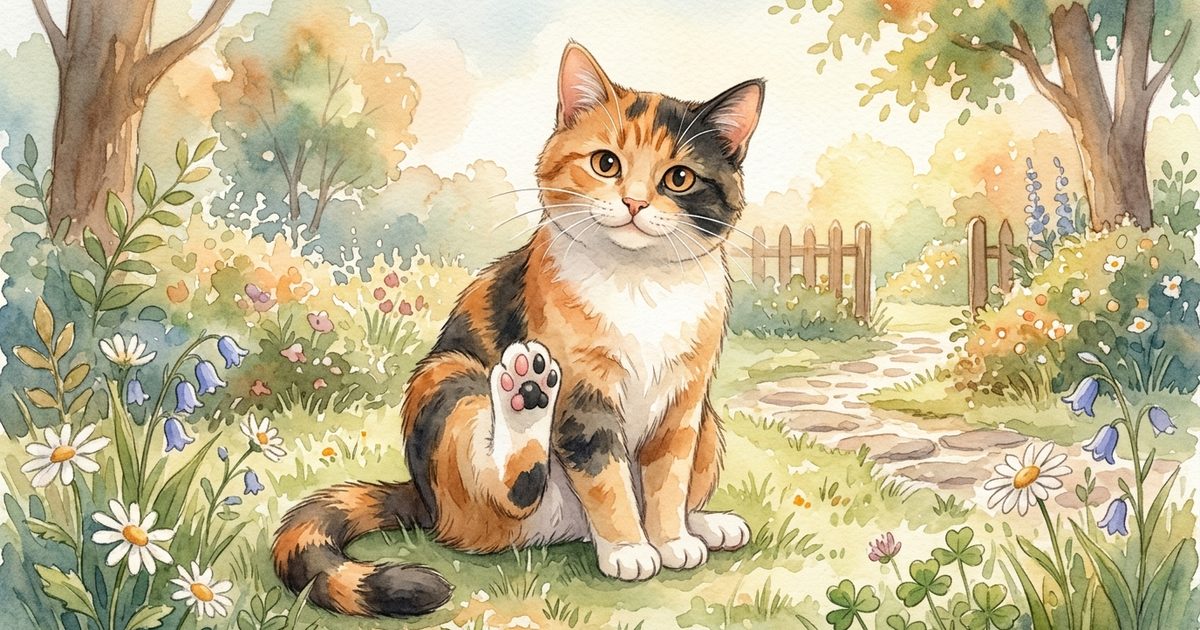
Cat paw-pad color matches the cat's fur and skin pigment: orange and white cats usually have pink toe beans, black and gray cats usually have black or dark gray ones, and multi-colored cats like calicos and tortoiseshells often show a mix of pink and black on the very same paw.
Pink, black, and multi-colored beans
The pigment rule is simple: melanin in the skin shows up as melanin in the paw pads. A white-coated or orange-coated cat carries little pigment in its skin, so its toe beans come out pink. A black, dark gray, or dark-tabby cat carries more melanin, so the beans are black or dark gray. The eye-catching cases are the multi-colored cats — calicos and tortoiseshells — whose patchwork coats come from random X-chromosome pigment activation. That patchwork reaches all the way to the feet, so a single calico paw can carry a pink bean, two black ones, and a mottled pink-and-black one side by side. It's purely pigment following the fur pattern down to the toes.
Does paw color mean anything?
No — paw-pad color is purely cosmetic. It's tied to fur genetics, not to health or temperament, and a black-pawed cat can be every bit as gentle (or as feisty) as a pink-pawed one. The old idea that "pink paws mean a friendly cat" doesn't hold up; what you're really seeing is just coat color. If you want to read a cat's mood, watch the whole animal — ears, tail, eyes, and posture — not the color of the beans. See our guide on cat body language for the full picture.
Polydactyl paws and paw color together
The one genuinely new wrinkle: on a polydactyl cat, those extra toes carry extra toe beans, and each bean follows the cat's pigment color. So a polydactyl orange tabby can sport a whole extra row of pink beans, while a polydactyl black cat gets a fan of extra dark ones. Everything else about polydactyl paws — the harmless-variant framing, the Hemingway colony, the occasional angled claw — is covered in the anatomy section above.
How Do You Take Care of a Cat's Paws?
Paw care means trimming the claws every 2–3 weeks (especially the dewclaw), checking the pads weekly for cuts, cracks, swelling, or stuck debris, and watching for overgrown claws in indoor cats whose nails never wear down on rough ground.
Most paw problems are quietly preventable. A few minutes every couple of weeks — a trim, a quick pad check — is all it takes to keep your cat walking silently and pain-free. Here is the short, vet-aligned routine.
Trim claws regularly
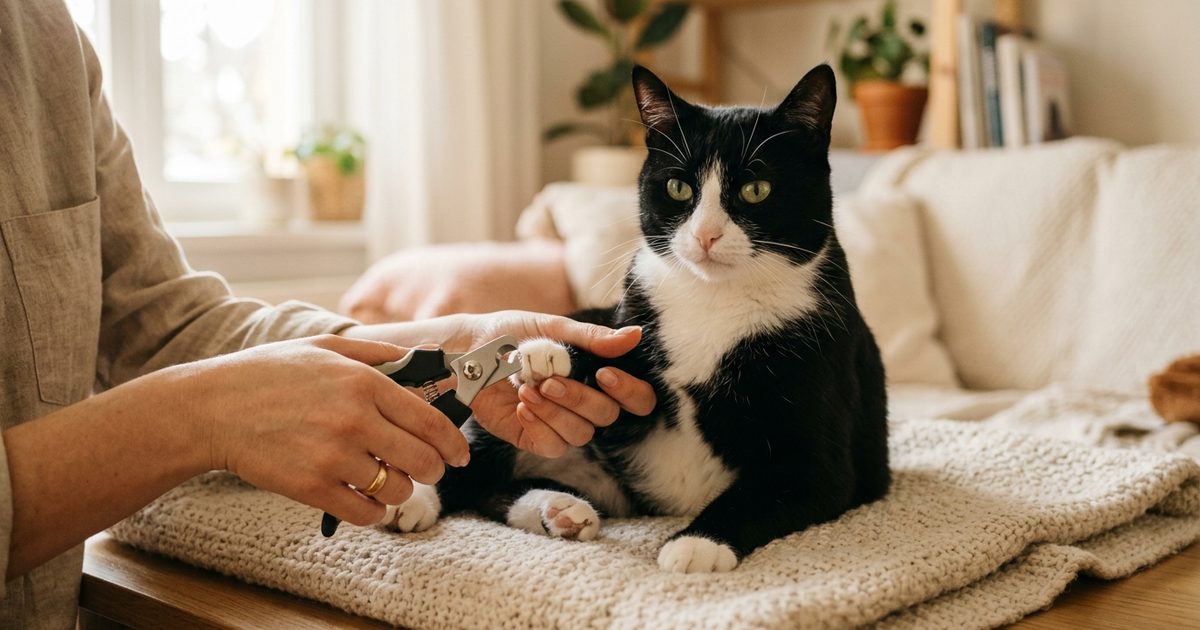
Aim for a trim every 2–3 weeks. You only need to clip the sharp curved tip, well clear of the pink quick inside the claw — that pink line is the blood vessel and nerve, and cutting into it bleeds and hurts. On a white claw you can see the quick easily; on a dark claw, snip only the thin hooked end to stay safe.
Use purpose-built cat claw clippers (scissor-type or guillotine-type both work). Human nail clippers can crush a claw sideways and splinter it. If you have never trimmed before, International Cat Care's step-by-step guide is the clearest reference — wrap your cat gently in a towel, take one toe at a time, and reward with a treat so the ritual stays calm.
Check the pads
Once a week, while your cat is relaxed, gently turn up each paw and look. A healthy pad is smooth, supple, and slightly springy to the touch — not dry, cracked, or flaky. Check for:
- cuts or scrapes, often from rough edges or sharp litter;
- cracks from dry indoor air or cold weather;
- redness, swelling, or a pad that feels hot;
- foreign objects — a splinter, a clump of litter, or a grass awn wedged between the beans;
- burns, in summer, from sun-baked pavement.
A dry, flaky pad usually just needs a humidified room and time; a bleeding, swollen, or very tender pad does not.
Indoor cats' claws grow faster
Indoor cats live on carpet and laminate, not rough ground, so their claws never wear down the way an outdoor cat's would. Left alone, they curve longer and longer — and the dewclaw covered above is the one most at risk, since it sits high and never touches the floor at all.
Senior indoor cats are the highest-risk group: they groom less, move less, and their nails grow thick and brittle. If you cannot manage a trim yourself, a vet or groomer nurse can do it in minutes — better a routine appointment than an embedded claw.
When to see the vet
Some paw issues need a professional, not home care. Call your vet if you notice any of the following:
- limping, or suddenly favoring one leg;
- persistent licking or chewing at a single paw;
- a claw growing into the pad — do not pull it yourself;
- a pad that is bleeding, swollen, warm, or oozing;
- reluctance to put any weight on the foot.
Cats hide pain well, so a paw held up or tucked away is a real signal. For a deeper overview of when a paw problem crosses from maintenance into a vet visit, the Cornell Feline Health Center covers the warning signs in plain language.
Fun Facts About Cat Paws
Cats are left- or right-pawed (females lean right, males lean left), a cat's paw prints are unique like a human fingerprint, kneading ("making biscuits") is a paw motion kittens use to stimulate milk flow, and the front paws carry small carpal whiskers that feel vibrations through the ground.
A cat's paw is more than a foot — it is a fingerprint, a preference, a comfort tool, and a vibration sensor, all packed into one. Here are the surprises worth knowing.
Cats are left- or right-pawed
Cats show genuine handedness, or lateralization. In food-reach tasks, females tend to favor the right paw while males lean left, and some cats are firmly one-sided while others are more mixed. It is not a myth — researchers have measured the paw a cat reaches with over dozens of trials and found a consistent preference, just as in people. It is also why your cat tends to lead with the same paw when batting at a toy — something we explore in our guide to why cats push and bat with their paws.
Paw prints are like fingerprints
The arrangement of the toe beans — the size, spacing, and pattern of each pad — is unique to each individual cat. No two cats leave the same print, in the same way no two humans share a fingerprint. It is a charming piece of identification trivia rather than a forensic tool; do not expect to dust your sofa for cat prints. But it does mean those little muddy tracks by the door belong to your cat, and only yours.
Kneading uses the paws
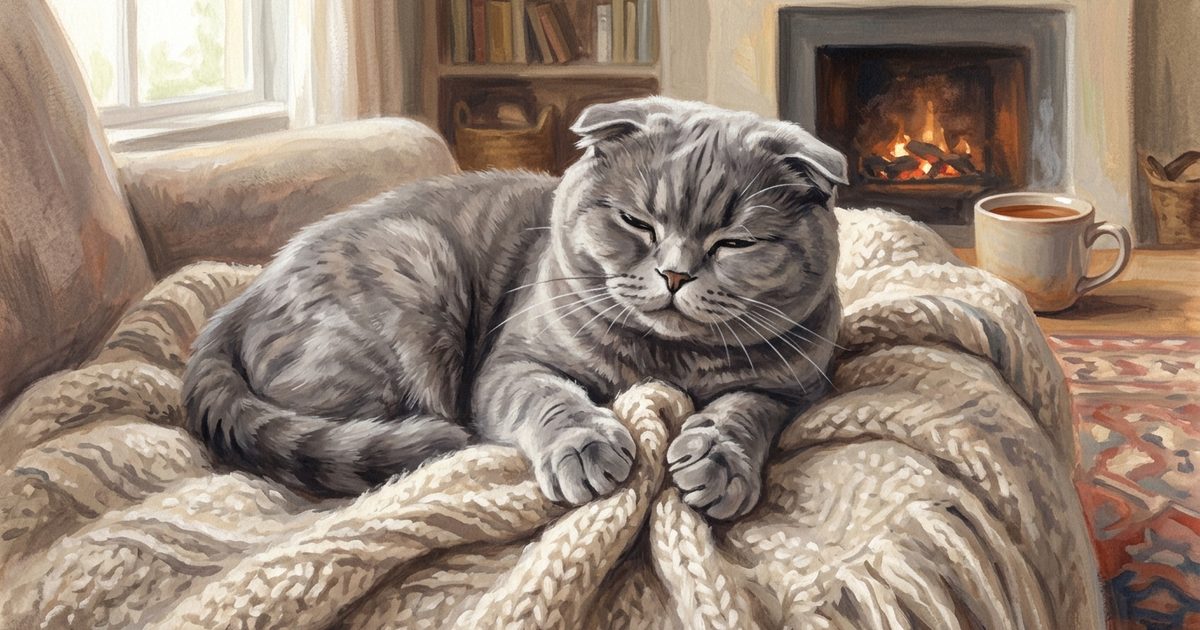
Kneading — the slow, rhythmic pressing of the front paws in and out, affectionately called "making biscuits" — begins as a survival reflex. Newborn kittens knead their mother's belly to stimulate the flow of milk while nursing. In adulthood, the motion returns whenever a cat feels safe, content, and bonded: on your lap, on a soft blanket, often while purring with eyes half-closed. It is a paw-powered comfort behavior carried forward from the first weeks of life. For the full deep dive into what kneading means at every age — including why some cats drool while doing it — see our dedicated article on why cats knead.
Why does my cat put her paw in the water bowl?
If your cat dips a paw into the water before drinking, she is doing something sensible rather than something odd. Cats use the paw to check the water level, because their whiskers cannot feel depth and they dislike their face bumping an unseen surface. A paw touch also creates ripples, and moving water is more attractive to a cat than still water — it reads as fresher. And if the bowl is deep and narrow, her whiskers brush the sides uncomfortably, so she fishes the water up with a paw instead.
The simple fix: switch to a shallow, wide bowl (or a running pet fountain), and the paw-dipping often stops on its own.
Cat Paws at a Glance — Summary
Your cat's paws are a single elegant package of shock-absorbing pads, razor-sharp retractable claws, scent and sweat glands, and hidden carpal whiskers — every part of that cat paw anatomy is engineered for silent stalking, climbing, and communication. Here's the whole thing on one page.
| Question | Short answer |
|---|---|
| How many toes does a cat have? | Five on each front foot, four on each back foot (18 total) — front dewclaw never touches the ground |
| What are toe beans? | The small digital pads under each toe; they cushion landings, grip surfaces, and house scent and sweat glands |
| Do cats sweat through their paws? | Yes — paw pads are a cat's main sweat surface, which is why nervous cats leave damp prints at the vet |
| Why do cats scratch? | To shed the worn claw husk, stretch back and shoulder muscles, and leave visual and scent marks |
| Are polydactyl cats healthy? | Usually yes — polydactyly is a harmless genetic variant, not a deformity; some just need extra claw trims |
| Is declawing OK? | No — declawing is onychectomy, amputation of the last toe bone; it causes lasting pain and is banned in many places |
| Are cats left- or right-pawed? | Yes — females tend to favor the right paw, males the left, on food-reach tasks |
| How often should I trim my cat's claws? | Every 2–3 weeks, and check the dewclaw more often since it never wears down naturally |
That's the whole paw in one frame: a multi-tool your cat walks on, signals with, and defends herself with. Keep the claws trimmed, the pads checked, and the scratching post stocked — and if you'd like to know what your cat is really telling you when she taps your hand with one of those little beans, a MeowMind reading can translate it for you.
Curious What Your Cat Would Say?
Upload a photo and get a warm, personalized reading from your cat's perspective.
Start Your Free ReadingFrequently Asked Questions
How many toes does a cat have?
A cat has five toes on each front foot and four on each back foot, for 18 total. The front fifth toe is the dewclaw — a small 'thumb' that sits high on the leg and never touches the ground, so it never wears down on its own.
What are toe beans on a cat?
Toe beans are the small digital pads under each toe. They cushion landings, give grip for climbing and sprinting, and house both scent glands (for marking territory) and sweat glands that cool the paw and leave a unique scent trail.
Do cats sweat through their paws?
Yes. Cats sweat mainly through their paw pads, not across their body fur. That's why a stressed cat at the vet often leaves small damp paw prints behind — the sweat glands ramp up under anxiety, which is normal, not a sign of illness.
Why do cats scratch furniture?
Cats scratch to shed the dull outer husk of each claw and expose a fresh sharp one, to stretch the back and shoulder muscles, and to leave both a visual gouge and a scent mark from glands in the paw pads. It's healthy instinct, not destruction.
Are polydactyl cats healthy?
Usually yes. Polydactyly is a harmless inherited genetic variant, not a deformity — the famous Hemingway cats of Key West are polydactyl. The only catch is that extra toes sometimes sit at an angle, so those claws may need a little extra trimming.
Is declawing a cat cruel?
Yes. Declawing is not a nail trim — it is onychectomy, the amputation of the last bone of each toe. It can cause lasting pain, gait change, litter-box avoidance, and rising biting, and it is banned in many countries and cities.
Are cats left- or right-pawed?
Yes. Cats show a genuine paw preference. On food-reach tasks, females tend to favor the right paw and males the left, though some cats are more evenly mixed. It's a real, measured handedness, just like in people.
How often should I trim my cat's claws?
Trim every 2–3 weeks, snipping only the sharp hooked tip clear of the pink quick. Check the dewclaw especially often, since it never touches the ground and is the claw most likely to overgrow and curl back into the pad.
Why does my cat put her paw in the water bowl?
Cats dip a paw to check the water level (their whiskers can't feel depth), to ripple the surface since moving water reads as fresher, or because a deep narrow bowl brushes their whiskers uncomfortably. Switching to a shallow wide bowl usually stops it.
Sources & References
You Might Also Like
Kitten Teething: Timeline, Symptoms & How to Help
Kitten teething runs from 3 to 7 months as baby teeth fall out. Learn the timeline, signs to watch for, and how to soothe a teething kitten safely.
15 min readWhen Do Cats Stop Growing? A Complete Timeline
When do cats stop growing? Most cats reach adult size by 12-18 months, but large breeds like Maine Coons keep growing until 3-4 years. Full timeline inside.
14 min readCan Cats Eat Cherries? Flesh, Pit & Toxicity Facts
Can cats eat cherries? Pitted flesh is safe in tiny amounts — but the pit, stem, and leaves are toxic (cyanide precursors). Learn what's safe and what isn't.
15 min readA message, in your cat's voice
Upload a photo, get a warm note written from your cat's perspective — just for fun. Plus 121 vet-cited articles, offline.