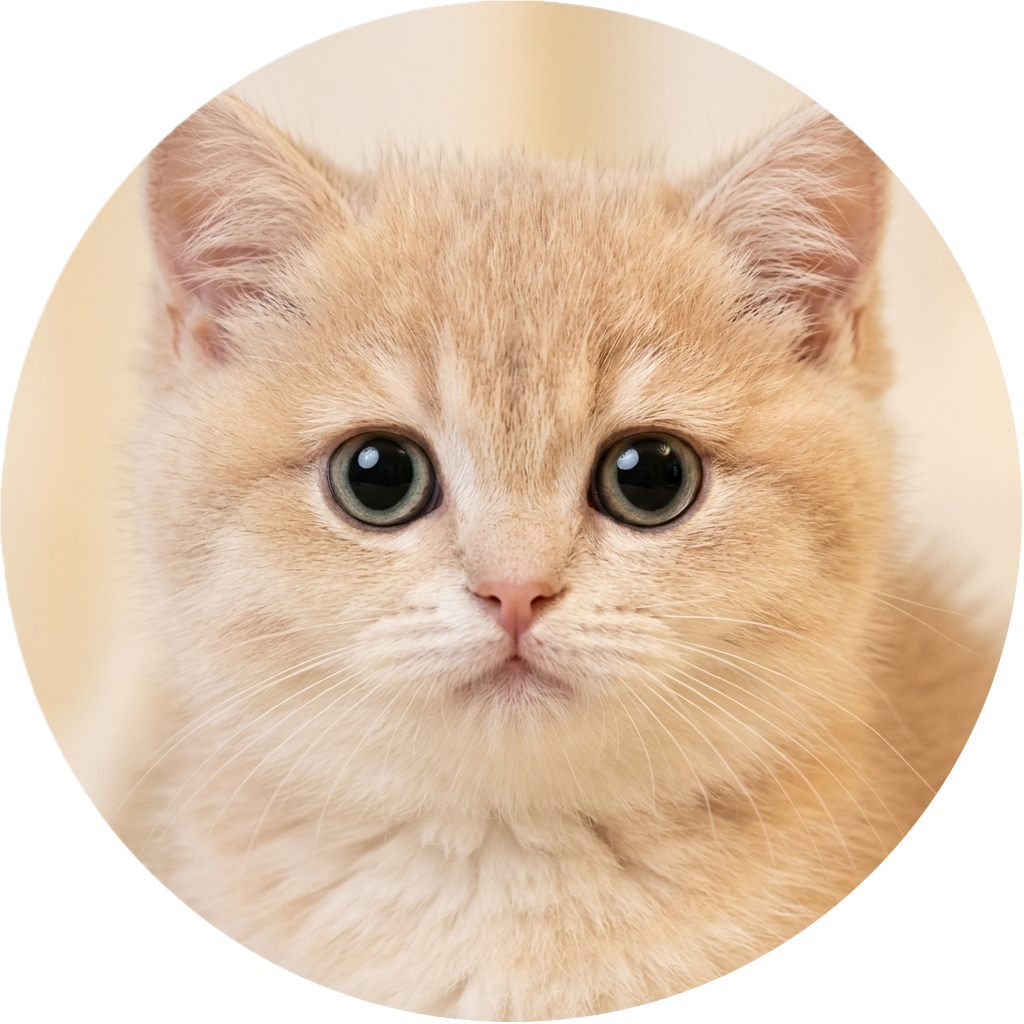
Cat Whiskers: What They Do, Why They Matter, Never Trim
Cat whiskers are one of the most misunderstood parts of a cat's body — often treated as decoration when they are, in fact, a sophisticated sensory system wired straight into the nervous system. If you've ever wondered why do cats have whiskers, the short answer is that cat whiskers (technically called cat vibrissae) let a cat feel the world in ways its eyes and ears can't, from judging whether a gap is wide enough to squeeze through to sensing the air move when a mouse twitches. This guide breaks down what whiskers are made of, how they work, where they grow, and why you should never, ever trim them.
Key takeaways
- Cat whiskers are sensory organs, not decoration — each one is rooted deep in a nerve-rich follicle that turns the hair into a touch sensor.
- Whiskers let cats navigate tight spaces, detect nearby movement through air currents, protect the face, and signal mood — so they enable both navigation and communication.
- Never trim a cat's whiskers: they shed and regrow on a natural cycle, and cutting them removes a primary sensory tool that can leave a cat disoriented.
Cat Whiskers — Quick Reference
| Whisker location | What it senses | Why it matters |
|---|---|---|
| Muzzle (sides of the upper lip) | Touch, air currents, gap width | The body-width gauge — judges whether an opening is passable |
| Above the eyes (supraorbital) | Objects nearing the face | Triggers a protective blink; guards the eyes |
| Under the chin (mandibular) | Close-range contact near the mouth | Helps assess objects and prey at the face |
| Back of the forelegs (carpal) | Contact inside the paw | Guides the killing bite when prey is held |
| The whole whisker system | Combined near-field sensory input | A cat's radar for navigating, hunting, and self-protection |
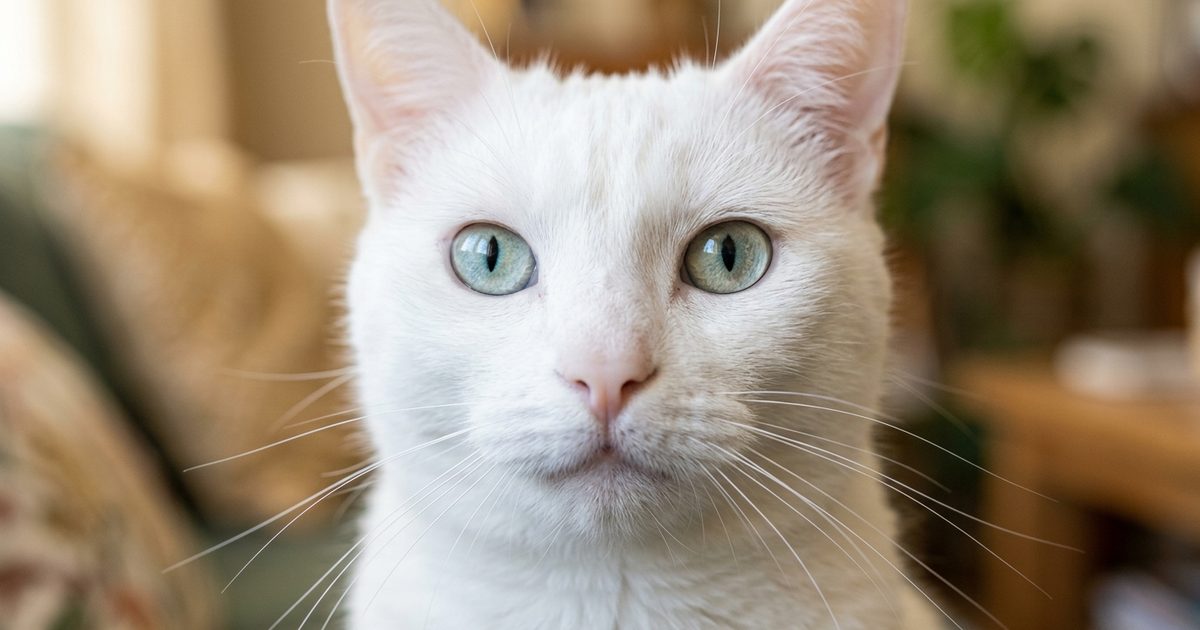
What Are Cat Whiskers? More Than Just Thick Hairs
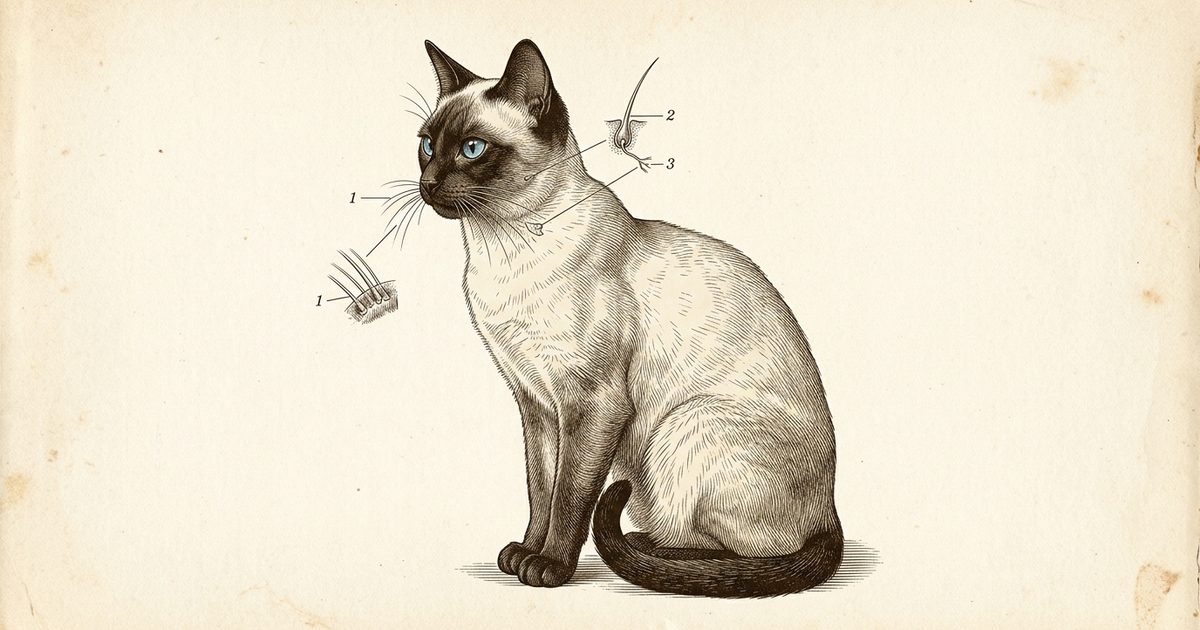
Cat whiskers, or vibrissae, are specialized sensory hairs rooted about three times deeper than normal fur and wired directly into the nervous system. Each follicle is packed with nerve endings that turn the hair into a touch sensor — so a whisker is really a sensory organ, not decoration.
It's easy to look at a cat's face and assume those long, stiff hairs are simply a more dramatic version of the rest of the coat. They're not. Whiskers are structurally and functionally a different kind of hair, built for a completely different job. Where ordinary fur insulates and protects the skin, whiskers collect information about the space immediately around the cat's body and feed it to the brain in real time. Understanding that single distinction — sensory organ, not thick hair — is the key to almost everything that follows, from why cats can squeeze through gaps to why trimming whiskers is harmful.
Vibrissae vs. regular fur
The scientific name for these hairs is vibrissae, and they differ from regular fur in several concrete ways. A whisker is thicker, stiffer, and tapered rather than uniform along its length. More importantly, it is embedded in a special follicle — a blood-filled sinus — that acts like an amplifier, magnifying the slightest bend of the hair into a strong signal the nervous system can read. Ordinary fur follicles don't have this structure. International Cat Care, a leading feline welfare authority, describes vibrissae as highly specialized tactile hairs whose follicles are richly supplied with nerves and blood vessels — a description that places them closer to a sense organ than to a coat. So when a whisker bends, even by a fraction of a millimetre, the cat feels it the way you'd feel a fingertip brush against your skin.
How whisker nerve endings work
Inside each whisker follicle sit clusters of mechanoreceptors — nerve endings that fire when they're mechanically deformed. The moment a whisker is bent, those receptors convert the movement into electrical signals that travel up the nerve to the brain. What's striking is how much brain real estate the whiskers command: in the somatosensory cortex, the part of the brain that maps touch from the body, the whiskers occupy a disproportionately large region arranged as a one-to-one map, often called a "barrel" for each whisker. This is why the signal is so precise — a cat doesn't just feel that something touched a whisker, it can tell which whisker, in which direction, and how hard. That resolution is what turns a patch of stiff hairs into a genuine sensory organ.
Do whiskers grow back?
Yes — whiskers shed and regrow on a natural cycle, much like the rest of the coat. You may occasionally find a loose whisker on the floor; that's normal turnover, not a sign of illness, and a new whisker grows back in its place over weeks. The important distinction is between natural shedding, which is healthy, and trimming or plucking, which is not. A naturally shed whisker falls out only when its replacement is already on the way. A cut whisker, by contrast, leaves the cat with a gap in its sensory field for as long as regrowth takes — and during that time the cat is working with incomplete information about the space around it.
What Do Cat Whiskers Actually Do?
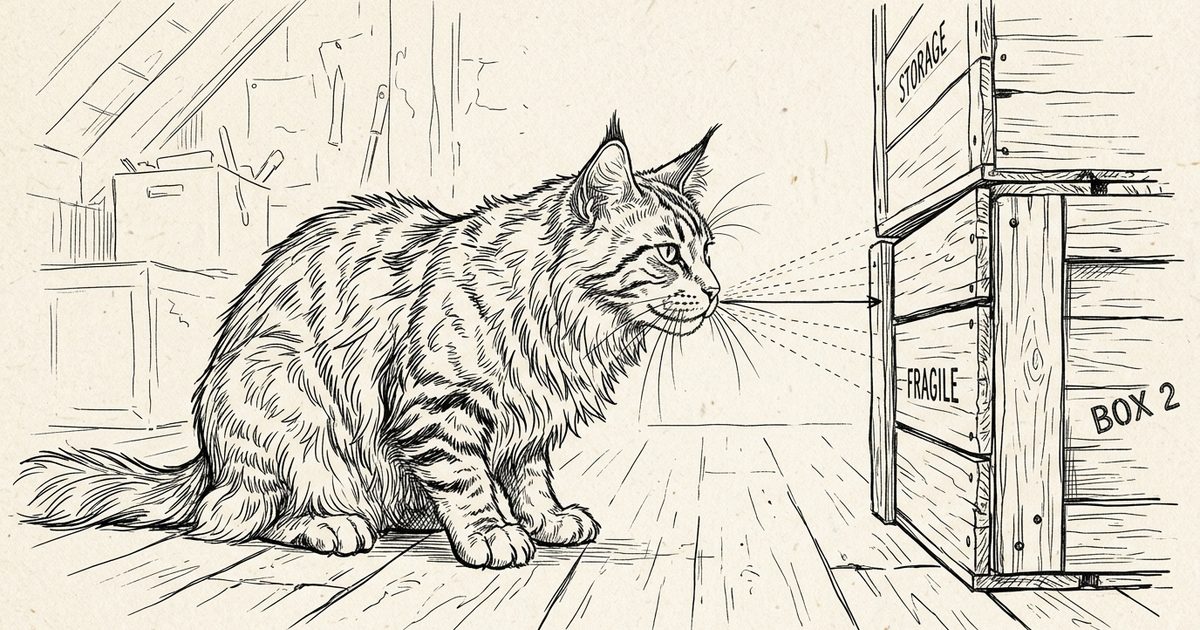
Whiskers work as a cat's near-field radar. The muzzle whiskers span roughly the width of the body so a cat can judge whether a gap is passable, while all whiskers detect tiny air-current shifts caused by nearby movement — letting a cat navigate, hunt, and protect its face in near-darkness.
If the anatomy explains what a whisker is, the function explains why cats have them at all. The whisker system gives a cat a continuous, real-time sense of everything within a few centimetres of its body — a zone where vision is too slow, too narrow, or simply unavailable. Cats are crepuscular hunters, most active at dawn and dusk when light is low, and their eyes are tuned for that world (we cover the limits of feline vision in can cats see in the dark). Whiskers fill in the gaps vision leaves behind, and they do several distinct jobs at once.
Spatial navigation and measuring gaps
The most famous whisker function is the body-width gauge. The longest muzzle whiskers, fanned out to either side, span approximately the widest part of the cat's body. By brushing them against the edges of an opening, a cat can judge almost instantly whether it can fit through — without having to commit and risk getting stuck. This is why cats seem to deliberate at a gap before squeezing through: they're literally measuring it. It's also why a cat whose whiskers have been trimmed starts misjudging openings, getting wedged, or refusing to pass through spaces it would normally clear. Remove the gauge and the measurement fails.
Detecting air currents and prey
Beyond touch, whiskers are exquisitely sensitive to moving air. Anything that displaces air near the cat — a mouse shifting in the leaf litter, a draft from a crack, an object or animal approaching — sends a pressure wave the whiskers can detect even when the cat can't see the source. This is the same mechanism that lets a blind or low-vision cat still navigate a room confidently: the whiskers build a tactile map of nearby surfaces and movement. In hunting, this matters at the decisive moment, because the prey is often held close to the face where the cat's binocular vision is weakest. The whiskers take over, tracking the prey's movements through air and contact until the killing bite lands. Combined with the carpal whiskers on the forelegs (which we cover alongside broader paw anatomy in cat paw), this gives the cat a complete close-range sensory net.
Protecting the eyes and face
The shorter, curved whiskers above each eye — the supraorbital whiskers — work as a face guard. When something brushes them, the reflex is an immediate blink, closing the eyelid before the object reaches the eye itself. For an animal that pushes its face into undergrowth, pounces through brush, and wrestles prey at close range, this is genuine protective hardware. The blink reflex triggered by the supraorbital whiskers is one of the fastest protective responses in the feline body, and it operates below conscious thought — the eye is already shutting by the time the cat registers the threat.
Balance and body awareness
Whiskers also contribute to proprioception — the body's sense of where it is in space. The constant stream of tactile and air-current input from whiskers on the muzzle, eyes, chin, and legs gives the brain a reference frame for the position and orientation of the head relative to nearby surfaces. This is part of why cats move with such precise spatial confidence even in low light, and why a cat deprived of whisker input can look momentarily unsteady or misjudge a jump. The whiskers aren't the whole balance system — the inner ear does the heavy lifting — but they are a meaningful input the brain normally relies on, and their loss is felt immediately.
Where Do Cats Have Whiskers?
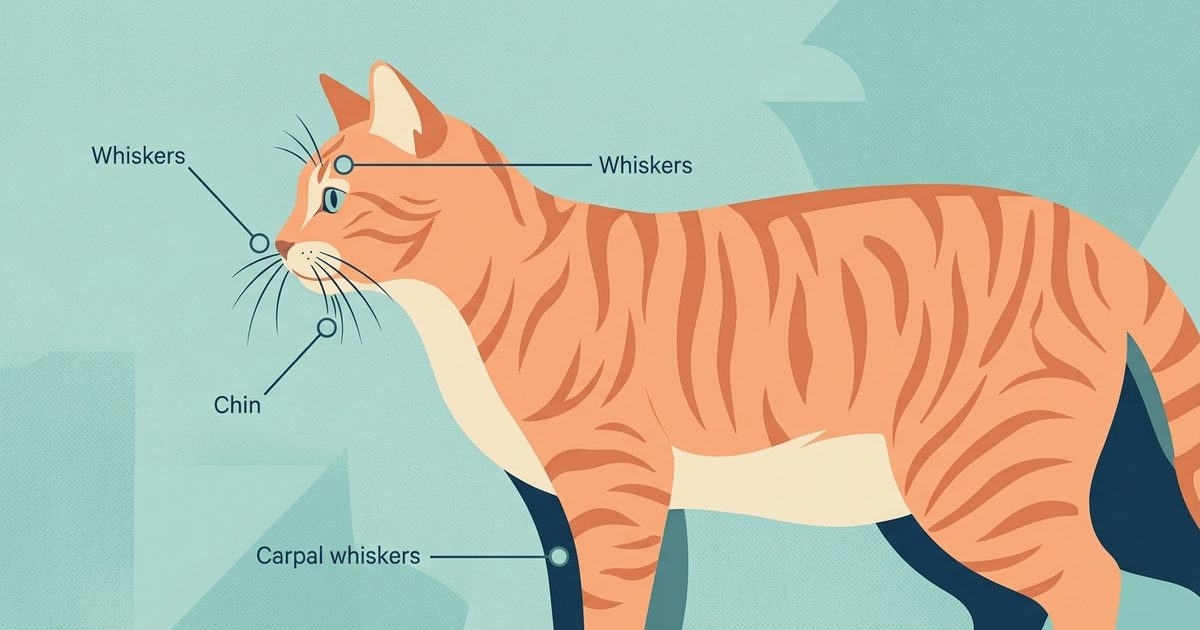
Most people only notice the long muzzle whiskers, but cats have whiskers on the muzzle, above each eye, under the chin, and on the back of the front legs, called carpal whiskers. Each cluster has its own sensing job, from face protection to helping the paw grip prey.
The muzzle whiskers get all the attention, and it's easy to assume that's the whole system. It isn't. A cat's whiskers are distributed across its head and forelegs in several distinct fields, each wired into the nervous system for a different purpose — navigation, eye protection, prey handling, and ground sensing. Cat whiskers are a whole-body sensory map, not a single feature.
Muzzle whiskers (the famous ones)
These are the ones everyone pictures — the long, stiff whiskers arranged in four or so rows on each side of the upper lip, with a few shorter ones further back toward the cheek. They fan out in a rough radial pattern around the muzzle, creating a wide sensory field that extends well beyond the cat's face. Because they span roughly the width of the body, the muzzle set doubles as a built-in measuring gauge for whether a gap is passable — the reason a confident cat can judge a hole without slowing down.
Above the eyes (supraorbital)
Higher up, above each eye, sits a smaller cluster of shorter, gently curved whiskers. These are the supraorbital whiskers, and their main job is guarding the eyes. When something brushes against them — a blade of grass, an insect, your hand reaching to pet — the touch triggers a fast blink reflex before the object reaches the eye itself. Think of them as an early-warning perimeter for one of the most vulnerable parts of the face.
Carpal whiskers — on the back of the legs
The least-known whiskers aren't on the head at all. On the underside of each front wrist, tucked into the fur on the back of the foreleg, are the carpal whiskers. These come into play when a cat has caught prey and is holding it in the paw: the carpal whiskers feel the prey's position and tiny movements even when the cat can't see it, guiding the claws and the killing bite with precision. They also help the paw sense the ground and the shape of whatever it's gripping. You can read more about the broader anatomy these sit within in our guide to the cat paw.
Chin and other spots
Finally, there are the smaller mandibular whiskers under the chin and along the lower jaw, plus a scattering of thicker tactile hairs on the backs of the forelegs beyond the wrist cluster. Together these smaller fields fill in the gaps the big muzzle whiskers can't reach, giving the cat near-complete tactile coverage of the space immediately around its face and front feet. The Cornell Feline Health Center describes the vibrissal system as one of the most important ways cats gather information about their immediate surroundings.
What Do Whiskers Say About a Cat's Mood?
Whiskers move with emotion: pushed forward and fanned out usually means a curious or hunting cat, while whiskers flattened back against the face often signals fear or stress. Reading whiskers alongside ears, tail, and posture gives a much fuller picture of how your cat is feeling.
Because the tiny muscles at the base of each whisker can rotate and angle them, whisker position shifts with a cat's emotional state. A relaxed cat holds its whiskers in a neutral, slightly drooping fan; an alert or aroused cat moves them deliberately. It's one of the quieter body-language signals, but once you learn to read it, whisker position becomes a surprisingly reliable clue to what your cat is feeling.

Forward and fanned — curious or hunting
When a cat is interested in something — a toy, a bird outside the window, a new smell, you walking in the door — the muzzle whiskers rotate forward and spread into a wider fan. This serves a double purpose: emotionally, it signals engaged attention; functionally, it opens up the sensory field so the cat can gather more tactile information about whatever has caught its interest. A hunting cat often holds this forward-and-fanned set along with dilated pupils and a fixed stare. It's the whisker signature of a cat whose whole attention has locked onto something.
Pinned back — scared or stressed
The opposite position is whiskers pulled back and flattened against the face. A frightened or highly stressed cat draws the whiskers backward, often together with ears pinned flat, wide-open eyes, and a tucked or thrashing tail. Flattening the whiskers protects them — pulling these sensitive structures out of harm's way the same way the ears fold back. This is the whisker position most often seen at the vet, during a loud argument, or when a cat feels cornered. For the full picture of how this fits with other fear signals, see our guide to cat body language, and for how attention and stare factor in, why cats stare.
Reading whiskers with the whole cat
Here's the important caveat: never read whiskers alone. A single signal is ambiguous — forward whiskers can mean curiosity, but also the focused intensity of a cat about to pounce on your ankle. The reliable read comes from combining whisker position with everything else. Soft eyes, a relaxed or gently swaying tail, forward-facing ears, and a loose body turn the same forward whiskers into a clear sign of friendly interest — the whisker set you'll often see when a cat is showing affection. Wide eyes, a twitching tail, and flattened ears turn forward whiskers into something more charged. Always let the rest of the cat confirm what the whiskers suggest.
Curious what your cat would say if she could put her mood into words? Get a MeowMind reading — upload a photo and hear what those whiskers are telling you, in her own voice.
Should You Trim a Cat's Whiskers?
Never trim a cat's whiskers. They shed and regrow on their own cycle, and cutting them removes a cat's main tool for sensing space and movement, which can cause disorientation, stress, and even injury from misjudging gaps or failing to protect the face.
It's a surprisingly common question, and the answer is the same every time: no. Trimming cat whiskers does not tidy them up the way a haircut tidies fur — it amputates a working sensory organ. Each whisker is wired into the nervous system, and shortening it blunts the very input a cat relies on to move safely through the world. If a whisker looks ragged or uneven, that is a sign of natural shedding, not a grooming problem to fix with scissors.
What happens if whiskers are cut
Without full-length whiskers, a cat loses its near-field radar almost overnight. The muzzle whiskers that normally span the width of the body can no longer gauge whether a gap is passable, so the cat may misjudge doorways, get stuck trying to squeeze through spaces it would normally avoid, or bump its face into furniture it couldn't sense coming. The above-eye whiskers, which normally trigger a protective blink, stop guarding the face as well.
The behavioral signs are often the most visible part. A cat with trimmed whiskers may seem disoriented, hesitant to jump, reluctant to navigate in low light, or unusually clingy and anxious. Some hide; others pace. The distress usually eases as the whiskers regrow over several weeks, but during that window the cat is genuinely operating with less information about its own body and surroundings. This is exactly why every veterinary and behavior source — including International Cat Care — is explicit that whiskers should never be cut.
They shed naturally — let them
Finding a long, loose whisker on the rug is not a warning sign — it's a normal part of how cat whiskers renew themselves. Like other hairs, each whisker goes through a growth, rest, and shed cycle, and a healthy cat will drop one every so often as a fresh one grows in behind it. There's nothing to do about it, and nothing missing.
The only thing worth knowing is that occasional shedding is normal while sudden, widespread whisker loss is not. If most of your cat's whiskers fall out at once, or the skin beneath looks red or sore, that's a reason to call your vet rather than a reason to wait.
Grooming around whiskers
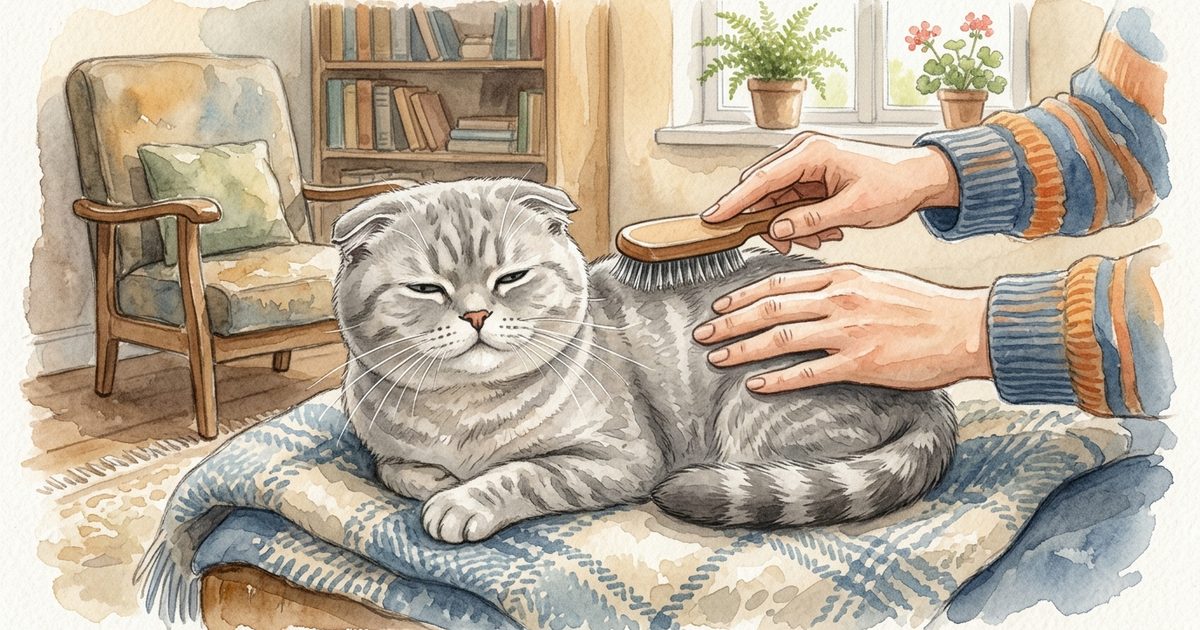
You can absolutely groom your cat's face — just around the whiskers, not on them. A soft, damp cloth wiped gently over the muzzle and forehead is fine for everyday cleaning, and most cats accept it readily if you keep the pressure light and the sessions short.
What you should never do is pluck, cut, or apply harsh products to the whisker area. Plucking tears the follicle (and its dense nerve supply) out by the root, which is painful and damaging; strong soaps or astringents can irritate the sensitive skin of the muzzle; and as we've covered, cutting serves no purpose at all. Keep grooming gentle, and leave the whiskers themselves alone — your cat is already managing them perfectly.
Is Whisker Fatigue Real? What the Evidence Says
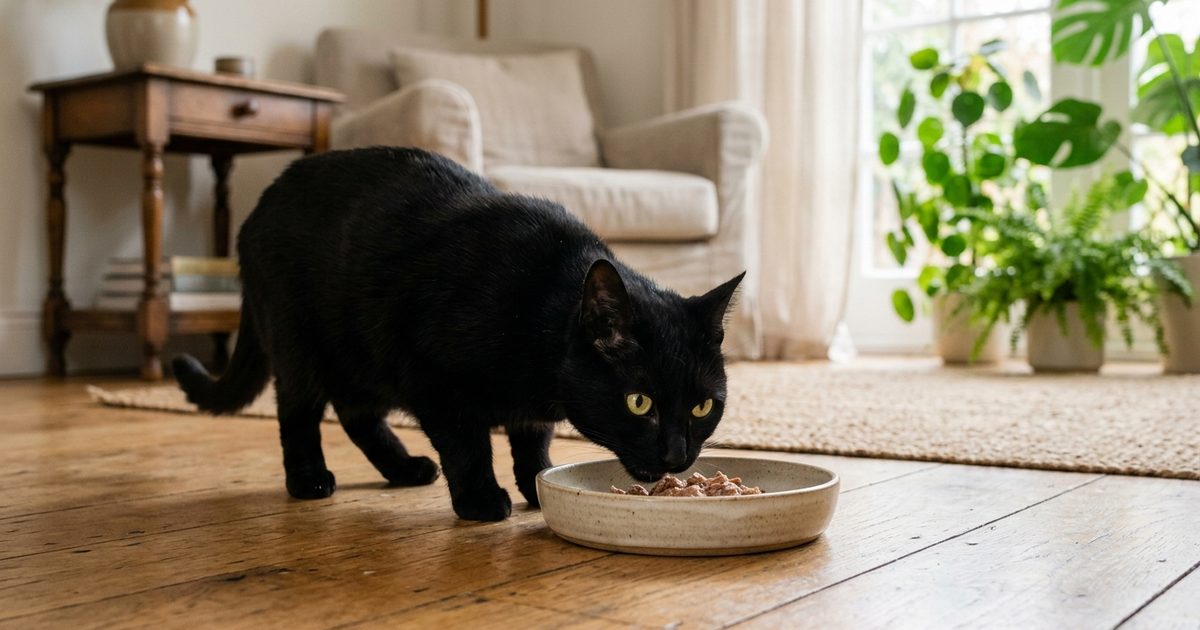
Whisker fatigue is the idea that repeatedly bumping whiskers against the sides of a food or water bowl overstimulates the sensitive nerve endings, causing stress at mealtimes. The concept is widely discussed by owners and groomers, but formal scientific evidence is limited — so treat it as a plausible hypothesis, not a proven diagnosis.
If your cat pulls food out of the bowl to eat off the floor, approaches the dish hesitantly, or leaves water unfinished, you may have heard the term "whisker fatigue" — and you're right to want a clear answer. The honest one is that the idea is plausible, widely reported by thoughtful owners, and still short of being a formal veterinary diagnosis.
The whisker fatigue hypothesis
The hypothesis goes like this: a deep or narrow bowl forces a cat to push its head inside to reach the food, and with every bite the muzzle whiskers press and bend against the rim. Because those whiskers are packed with nerve endings, the constant stimulation — touch after touch, meal after meal — is thought to become irritating or even mildly stressful, the way a persistent tag scratching your neck gets under your skin.
Owners who believe their cats experience it describe a recognizable cluster of signs: food scooped onto the floor before eating, water left untouched in a deep bowl, anxious pacing around mealtimes, or a cat that eats only from the center and leaves the edges. None of these signs are unique to whisker fatigue, which is part of why pinning down a firm diagnosis is hard.
What the evidence does and doesn't show
Here is where it's important to be precise. "Whisker fatigue" is not currently an established veterinary diagnosis with a defined clinical test. You won't find it listed as a disease in standard references, and the formal research on it is limited. What exists is a large body of owner and groomer observation, plus the fact that the underlying anatomy — sensitive whiskers meeting a hard bowl edge — is real.
The practical upshot is that a wide, shallow bowl or a flat plate is a low-cost, low-risk thing to try if your cat seems uncomfortable eating. Many owners report it helps; some see no change. Either way, you've spent very little to run a gentle experiment at home. The Cornell Feline Health Center covers feline feeding behavior and when changes in eating habits warrant attention, and it's a sound reference if you want to read further.
When to look beyond the bowl
If switching to a wide, shallow bowl doesn't resolve the problem, the bowl probably isn't the cause. Persistent changes in how a cat eats or drinks are far more often explained by dental pain, nausea, gastrointestinal upset, or stress — all of which need a different response than new dishware. A cat that suddenly eats less, drops food, paws at its mouth, or avoids the water dish altogether is giving you a reason to see a vet rather than keep shopping for bowls. Treating whisker fatigue as the first, easy thing to trial is reasonable; treating it as the answer when nothing changes is not.
Cat Whiskers at a Glance — Summary
| Question | Short answer |
|---|---|
| What are cat whiskers? | Specialized sensory hairs called vibrissae, rooted far deeper than normal fur and wired straight into the nervous system. |
| What do they do? | They act as near-field radar — gauging gaps, sensing air currents, hunting, and protecting the face in low light. |
| Where do cats have whiskers? | On the muzzle, above each eye, under the chin, and on the back of the front legs (the carpal whiskers). |
| What do whiskers say about mood? | Fanned forward usually means curious or hunting; flattened back against the face often signals fear or stress. |
| Should you trim them? | Never. Trimming removes a primary sensory tool and can cause disorientation, stress, and even injury. |
| Do they grow back? | Yes — cat whiskers shed and regrow on a natural cycle, so finding a loose one on the floor is perfectly normal. |
| Is whisker fatigue real? | It's a plausible idea owners report, but not an established veterinary diagnosis — try a wide, shallow bowl if eating seems uneasy. |
Curious What Your Cat Would Say?
Upload a photo and get a warm, personalized reading from your cat's perspective.
Start Your Free ReadingCat Whiskers at a Glance — Summary
| Question | Short answer |
|---|---|
| What are cat whiskers? | Specialized sensory hairs called vibrissae, rooted far deeper than normal fur and wired straight into the nervous system. |
| What do they do? | They act as near-field radar — gauging gaps, sensing air currents, hunting, and protecting the face in low light. |
| Where do cats have whiskers? | On the muzzle, above each eye, under the chin, and on the back of the front legs (the carpal whiskers). |
| What do whiskers say about mood? | Fanned forward usually means curious or hunting; flattened back against the face often signals fear or stress. |
| Should you trim them? | Never. Trimming removes a primary sensory tool and can cause disorientation, stress, and even injury. |
| Do they grow back? | Yes — cat whiskers shed and regrow on a natural cycle, so finding a loose one on the floor is perfectly normal. |
| Is whisker fatigue real? | It's a plausible idea owners report, but not an established veterinary diagnosis — try a wide, shallow bowl if eating seems uneasy. |
Frequently Asked Questions
What are cat whiskers made of, and are they just thick hairs?
No — cat whiskers, or vibrissae, are specialized sensory hairs rooted far deeper than normal fur, each seated in a blood-filled follicle packed with nerve endings. They are built to collect information about the space around a cat, making them closer to a touch organ than to thick fur.
What do cat whiskers actually do for a cat?
They act as a cat's near-field radar. The muzzle whiskers gauge whether a gap is wide enough to pass through, all whiskers detect tiny air-current shifts from nearby movement, and the above-eye whiskers trigger a protective blink — letting a cat navigate, hunt, and guard its face even in near-darkness.
Where else do cats have whiskers besides their muzzle?
As well as the muzzle, cats have whiskers above each eye (supraorbital), under the chin (mandibular), and on the back of the front legs (carpal whiskers). The carpal set helps the paw feel prey and guide the killing bite when the cat can't see what it's holding.
Can a cat's whiskers tell you how it is feeling?
Yes — whiskers move with emotion. Whiskers pushed forward and fanned out usually mean a curious or hunting cat, while whiskers flattened back against the face often signal fear or stress. Always read them alongside ears, tail, and posture rather than on their own.
Should you ever trim a cat's whiskers?
Never. Trimming removes a primary sensory tool and can leave a cat disoriented, hesitant, and at risk of bumping into things or misjudging gaps. Whiskers shed and regrow on their own natural cycle, so there is no grooming reason to cut them.
Do cat whiskers grow back if they fall out?
Yes. Whiskers go through a normal growth, rest, and shed cycle, so finding a loose one on the floor is perfectly healthy and a fresh whisker grows back over several weeks. The distinction that matters is natural shedding, which is fine, versus cutting or plucking, which is not.
Is whisker fatigue real?
Whisker fatigue is a plausible, widely reported idea — that deep or narrow bowls overstimulate the whiskers at mealtimes — but it is not an established veterinary diagnosis, and formal evidence is limited. Trying a wide, shallow bowl is a low-cost experiment; if eating problems persist, see a vet for other causes.
Why does my cat have a loose whisker on the floor?
It's a normal part of how whiskers renew themselves. Like other hairs, each whisker has a growth, rest, and shed cycle, and a healthy cat will drop one every so often as a new one grows in behind it. There is nothing to fix, and nothing missing.
Why does my cat pull food out of the bowl to eat on the floor?
It can be a sign of whisker discomfort from a deep bowl, but the same habit also appears with dental pain, nausea, or simple preference. Switching to a wide, shallow bowl is a reasonable first trial; if the behavior continues or comes with eating less, a vet visit is the safer next step.
Sources & References
You Might Also Like
Kitten Teething: Timeline, Symptoms & How to Help
Kitten teething runs from 3 to 7 months as baby teeth fall out. Learn the timeline, signs to watch for, and how to soothe a teething kitten safely.
15 min readWhen Do Cats Stop Growing? A Complete Timeline
When do cats stop growing? Most cats reach adult size by 12-18 months, but large breeds like Maine Coons keep growing until 3-4 years. Full timeline inside.
14 min readCan Cats Eat Cherries? Flesh, Pit & Toxicity Facts
Can cats eat cherries? Pitted flesh is safe in tiny amounts — but the pit, stem, and leaves are toxic (cyanide precursors). Learn what's safe and what isn't.
15 min read