
Can Cats Eat Broccoli? The Honest Answer on This Safe Veg
So you've spotted broccoli on your plate and caught your cat eyeing it. Can cats eat broccoli? Yes — but only in tiny amounts, and only if it's prepared the right way. To answer whether is broccoli good for cats and how to think about broccoli for cats, here's the honest verdict in short order.
Yes — cats can eat broccoli. It is non-toxic and safe for healthy adult cats in small amounts, plain and cooked. But it's not a health supplement: cats are obligate carnivores whose complete food already meets every nutritional need, and broccoli offers little real benefit beyond being a low-calorie treat. Think of it as an occasional snack, never part of their meals.
Key takeaways
- Broccoli is non-toxic and safe for cats in small amounts — a plain steamed or boiled floret is fine as an occasional treat.
- It is not a superfood for cats. Cats synthesize their own vitamin C and their complete cat food already has everything they need, so broccoli is a filler treat, not a supplement.
- Always cook it plain and cut it small (raw broccoli is a choking hazard and hard to digest), keep portions tiny, and stop if it causes gas or loose stool.
Broccoli for Cats — Quick Reference
| Broccoli form | Safe for cats? | Notes |
|---|---|---|
| A small plain steamed floret | Yes | The best form — soft, plain, easy to digest in tiny pieces |
| Plain boiled broccoli | Yes | Fine if unsalted and unseasoned; cut into small pieces |
| Raw broccoli | Not recommended | Tough and fibrous — a choking hazard and hard to digest |
| Broccoli with butter, oil, salt, or seasoning | No | Fat, salt, and spices upset a cat's stomach; many seasonings are harmful |
| Broccoli cheese casserole or soup | No | Dairy, fat, salt, and often onion or garlic, which are toxic to cats |
| Broccoli stems vs florets | Florets preferred | Stems are tougher and more fibrous; soft floret tips are gentler on a cat's gut |
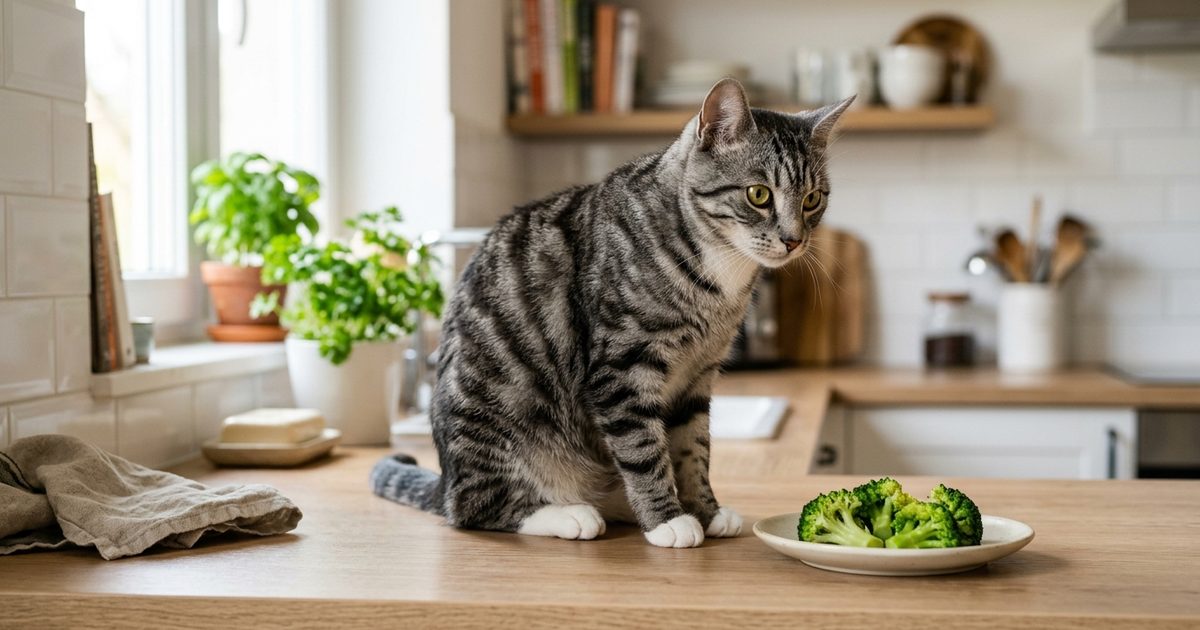
Can Cats Eat Broccoli?
Yes — cats can eat broccoli. It is non-toxic and safe in small amounts as an occasional treat, but it is not nutritionally necessary. Cats are obligate carnivores that get everything they need from complete cat food. Broccoli is a safe snack, never a meal substitute.
The short answer
For a healthy adult cat, the short answer is a reassuring yes — but with honest framing. Broccoli is non-toxic to cats, and a small, plain, cooked piece is safe as an occasional treat. So if you've been wondering "can cats have broccoli," the verdict is that a tiny floret now and then won't harm your cat.
What keeps this answer honest is the second half: broccoli is safe, but it isn't needed. Your cat's complete food already covers every nutrient broccoli contains. Think of it the way you might a cracker or a piece of plain rice — fine to share, never a substitute for a real meal. For kittens or cats with sensitive digestion, it's best skipped.
Why broccoli is an odd fit for a cat
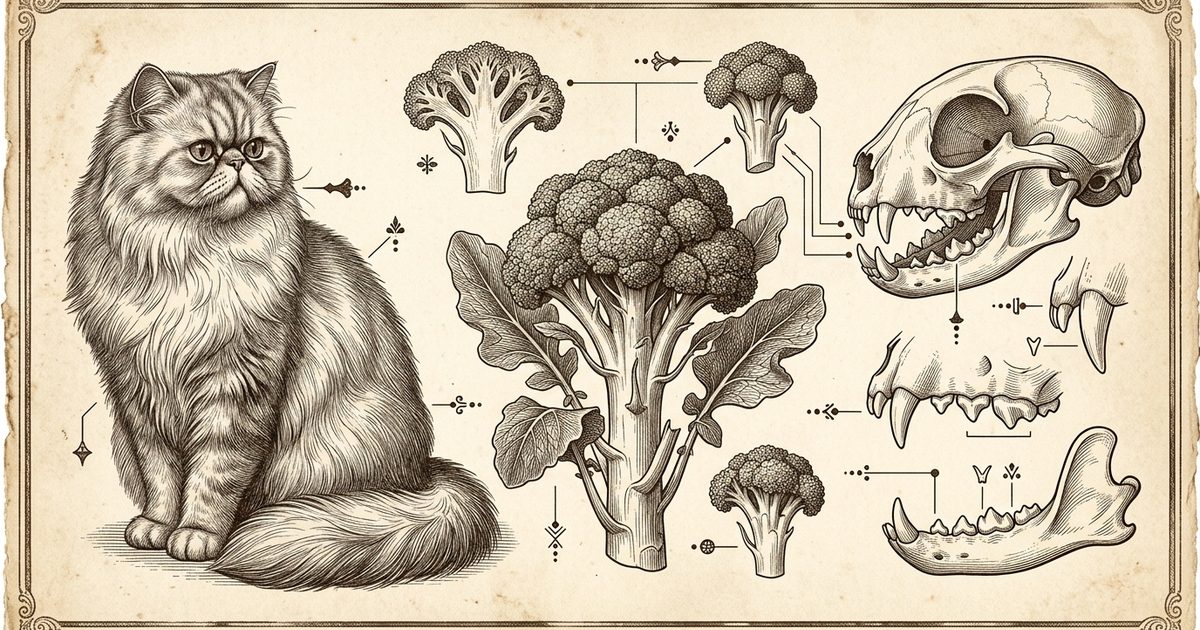
Broccoli is a cruciferous vegetable — a dense, fibrous plant food built for an omnivore's gut. Cats, though, are obligate carnivores. Their metabolism runs on animal protein and fat, and their bodies are tuned to extract nutrients from meat, not from plant matter. So broccoli offers very little that a cat's biology is actually designed to use.
The key distinction here is that "safe" and "beneficial" are two different things. A tiny plain piece of broccoli won't hurt your cat — which is why it counts as safe — but it also won't do anything meaningful for her health. If you'd like the broader picture of how a cat's obligate-carnivore diet works, our guide on what cats eat walks through it.
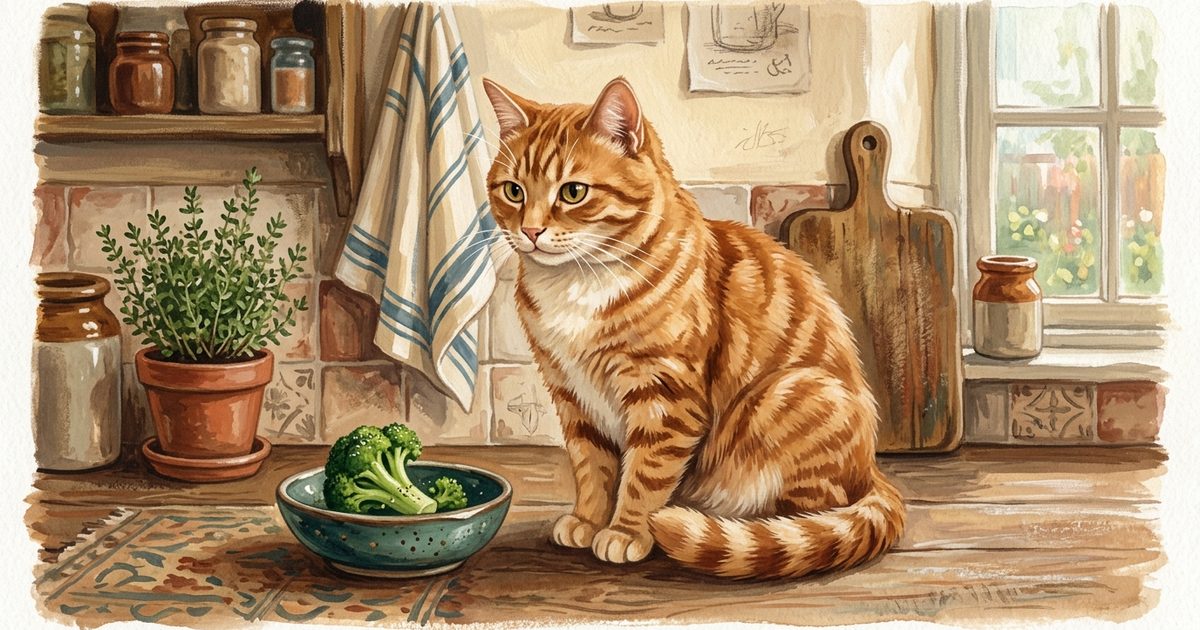
Is Broccoli Good for Cats?
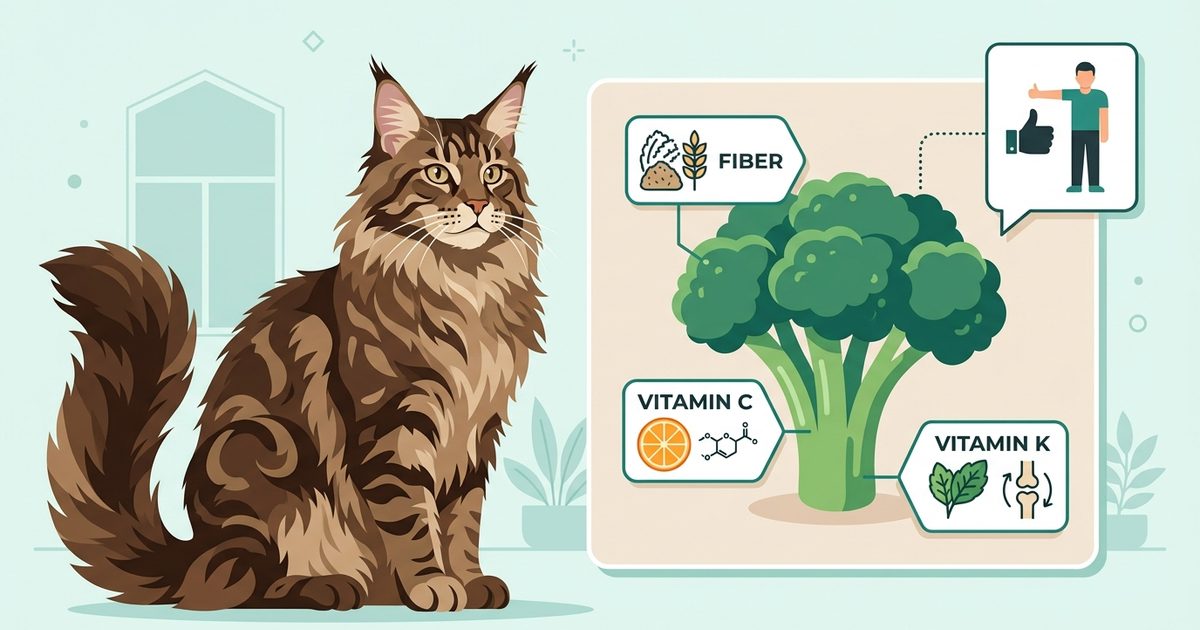
Broccoli has fiber and some vitamins C and K, but cats synthesize their own vitamin C and their complete food already covers their needs. The superfood label is a human one. For cats, broccoli is just a low-calorie snack, not a meaningful health boost.
Fiber and vitamins — what's actually in it
If you're asking "is broccoli good for cats," the honest answer is that it contains some real things — dietary fiber, vitamin C, vitamin K, and modest potassium — but very few of them matter for a cat the way they do for a person. The fiber is the most relevant piece, and even that is minimal compared to the fiber already balanced into a complete cat food.
The bigger point is vitamin C. Humans must get it from food; cats synthesize their own. So the very angle that makes broccoli a nutritional standout for people simply doesn't transfer to your cat. A cat eating a complete diet is already meeting her vitamin C and K needs internally. The Cornell Feline Health Center is a reliable source on how cats meet their nutritional needs from complete, animal-protein-based food rather than from vegetables.
Fiber type matters more than fiber amount
One detail worth knowing: broccoli's fiber is mostly insoluble. That is the kind that adds bulk and passes through largely intact, which is fine in trace amounts but does nothing therapeutic for a cat's gut. Pumpkin, by contrast, is rich in soluble fiber, which absorbs water and regulates stool consistency — which is exactly why vets reach for pumpkin, not broccoli, when a cat has loose stool or constipation. The distinction, not the quantity, is what makes one functional and the other merely a filler.
The "superfood" label doesn't apply
Broccoli's famous reputation rests on human biology — its antioxidants, its vitamin C, and the cancer-prevention studies conducted in people. None of that maps cleanly onto an obligate carnivore. A cat's body doesn't draw the same protective benefit from cruciferous vegetables that a human body does.
So it's important not to present broccoli as a health supplement, a cancer-preventive, or a wellness boost for your cat. It's a low-calorie snack that's safe in tiny amounts — nothing more. For a clear, vet-aligned view of where treats fit into a cat's overall diet, International Cat Care offers straightforward guidance on how to think about extras and titbits without displacing complete food.
Contrast with pumpkin
This is where the honest comparison matters. Pumpkin is the rare vegetable vets actively recommend for cats — its soluble fiber has a genuine therapeutic use for both loose stool and constipation. Broccoli has no equivalent role. If you're ever weighing whether cats can eat pumpkin against broccoli, the distinction is simple: pumpkin is a functional food with a digestive purpose; broccoli is just a filler treat.
How Should I Serve Broccoli to My Cat?
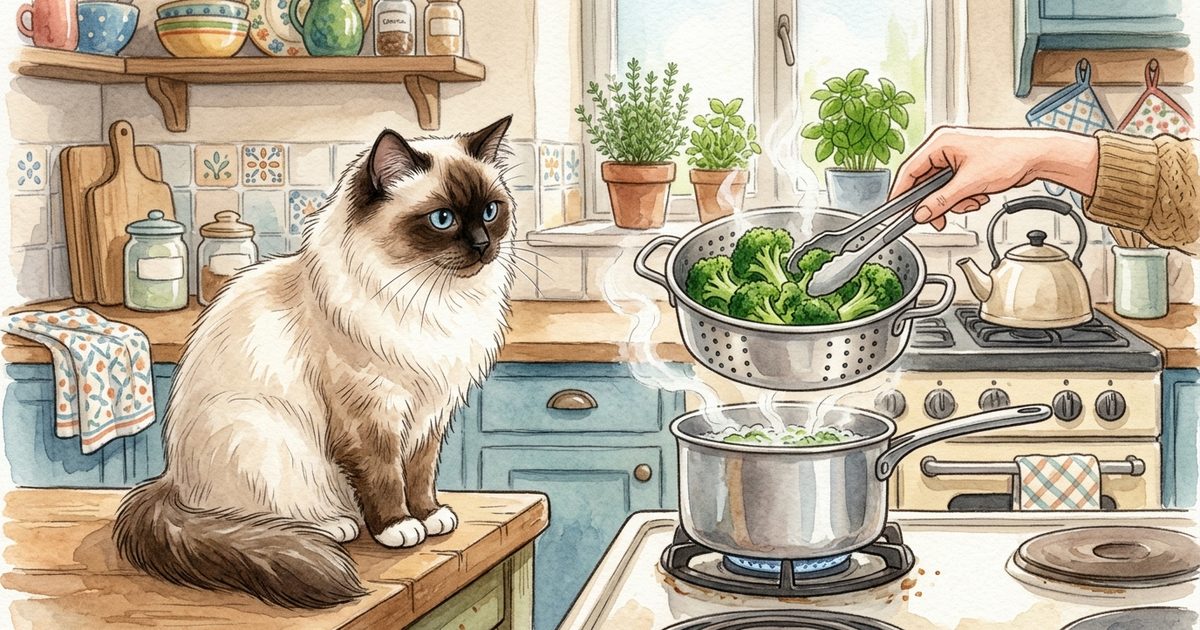
Serve broccoli steamed or boiled plain, in small bite-sized pieces, never raw. Use no butter, oil, salt, garlic, or seasoning. A single small floret, cut up, is plenty for one treat, and all extras combined stay under ten percent of daily calories.
The right preparation is what turns a safe vegetable into a safe treat. Broccoli for cats comes down to three rules: cook it plain, cut it small, and skip every form that has extra ingredients added.
Always cook it plain
Steam or boil the broccoli until it's soft enough to squish between your fingers. Cooking softens the tough fibrous structure so your cat can digest a small amount, and it lowers the choking risk considerably. Serve it completely plain — no butter, no oil, no salt, no spices, no garlic, no onion. Garlic and onion are in the Allium family and are toxic to cats, damaging their red blood cells even in small amounts. The Cornell Feline Health Center is clear that plain, unseasoned foods are the only safe way to share anything from your kitchen with a cat.
Cut it small
Even cooked, a whole floret is a choking hazard for a cat — their teeth and throat are built for meat, not chunks of cruciferous vegetable. Cut the cooked broccoli into pea-sized to small-fingernail-sized pieces. The stem is tougher and more fibrous than the floret, so prefer the soft floret tips and set the thick stalk aside.
Forms to avoid
Skip raw broccoli entirely — it's fibrous, hard to digest, and a choking risk. Skip anything seasoned, oiled, or salted, including the broccoli off your own dinner plate. Skip broccoli cheese casserole (dairy, fat, and often onion) and broccoli soup (salt, dairy, and thickeners). The same plain-and-cooked rule applies to other safe vegetables — see our guides on can cats eat carrots and can cats eat pumpkin for the broader pattern.
How Much Broccoli Can a Cat Eat?
A tiny piece — one or two small bite-sized floret pieces, occasionally, not daily. All treats combined should stay under roughly ten percent of daily calories. More than that risks gas, bloating, and loose stool, because cruciferous vegetables are gas-forming even in cats.
Portion size is where "safe" meets "too much." Broccoli won't harm a healthy cat in small amounts, but cruciferous vegetables are gas-forming, and a cat's gut is far more sensitive to that than the calorie count suggests.
The 10% treat rule
A widely used guideline is that all treats combined should stay under roughly 10% of a cat's daily calories. Broccoli is very low in calories, so the calorie ceiling is generous — but that is not the real limit. The real limit is the gut. Cruciferous vegetables produce gas and can upset a cat's digestion at far smaller amounts than the calorie math would allow. International Cat Care notes that treats should remain a small, occasional part of the diet precisely because a cat's digestive system is not built to process much plant matter at all.
Frequency and signs to watch
Think of broccoli as an occasional treat, not a daily habit — a tiny piece once in a while is the right rhythm. Introduce it slowly and watch for gas, bloating, soft stool, or any change in the litter box. If loose stool develops, stop the broccoli and give the gut a rest; see our guide on cat diarrhea for when GI upset warrants a vet visit. Smaller cats, overweight cats, and cats with sensitive stomachs should have less — or none at all.
Why Do Some Cats Eat Broccoli?
Cats drawn to broccoli are usually after the crunch and texture, the novelty of it, or they're mimicking you eating. It is not a nutritional craving. Cats are obligate carnivores with no biological need for vegetables. Curiosity, not deficiency, explains the nibble.
If your cat dives for your broccoli, it's easy to read it as a sign she "needs greens." She doesn't. The pull is sensory and social, not nutritional — and understanding why helps you keep the treat harmless rather than habitual.
Crunch and texture curiosity
Many cats are simply attracted to the firm crunch of a vegetable or the novelty of a new mouth-feel. A sniff, a bat, a quick nibble — these are acts of exploration, the same curiosity that makes a cat investigate a cardboard box or a dropped leaf. Cats experience the world through their mouths and paws, and a strange-textured object is interesting precisely because it's strange.
The key point, and one worth generalizing: do not interpret a cat eating broccoli as a signal to add vegetables to her diet. A curious nibble tells you about her exploratory nature, not about a gap in her nutrition. Her complete cat food already supplies everything she needs, and the Cornell Feline Health Center is clear that cats are obligate carnivores whose metabolism runs on animal protein, not plant matter. The crunch is entertainment — not a dietary request.
Mimicking the owner
The other common reason is simpler: cats often want whatever their human is eating. You sit down with a plate, and suddenly that food is the most fascinating object in the room. This is social mimicry — a sign your cat wants to share your moment, not that she needs what you're having.
Offering a tiny plain piece is harmless, but it should not become a habit that displaces complete cat food. Broccoli is a treat, not a staple, and a cat who expects a vegetable side with every meal is being set up for a diet that lacks the protein, taurine, and fat she actually requires. For the full picture of what a cat's diet should look like, see our guide on what cats eat — the obligate-carnivore context that broccoli sits entirely outside of. Curiosity is sweet; just let it stay occasional.
Is Broccoli Beneficial for Cats?
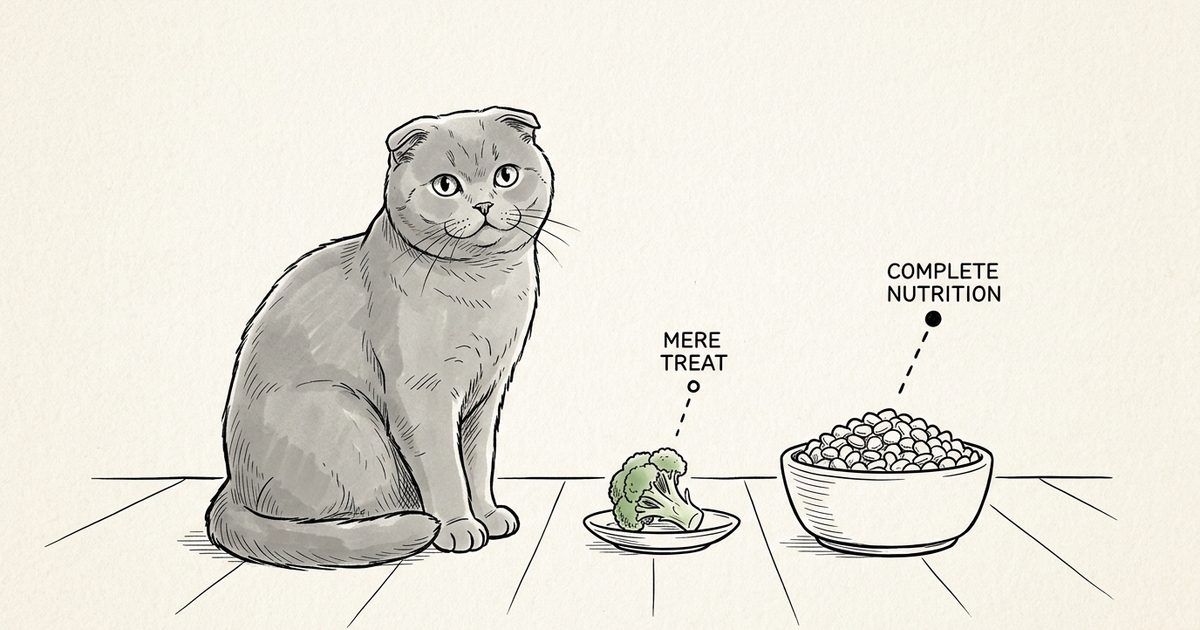
As shown above, broccoli offers no real health benefit beyond being a low-calorie, safe-in-tiny-amounts treat. A cat's complete food already provides every nutrient broccoli contains, and cats synthesize their own vitamin C — so it functions as enrichment, not supplementation.
When it's fine, and when to skip it
Broccoli is fine for a healthy adult cat that shows genuine interest, served as a rare plain cooked treat. Skip it for cats with sensitive stomachs, any history of GI upset, or kittens — whose digestion and nutritional needs are far more delicate and unforgiving of a filler treat. For the broader picture of what a cat actually needs, see our guide on what cats eat.
Never a meal substitute
Broccoli lacks the protein, taurine, and fat a cat requires to thrive — it is a treat only. Displacing real food with vegetables causes malnutrition over time, because nothing in a floret substitutes for complete cat food. If your cat shows GI signs like vomiting after a new food, that's worth a vet visit — see our guide on cat vomiting for when to call.
Broccoli for Cats at a Glance — Summary
| Question | Short answer |
|---|---|
| Can cats eat broccoli? | Yes — non-toxic and safe as a tiny, plain, cooked treat |
| Is broccoli good for cats? | Minimally; their complete food already covers every nutrient in it |
| Can cats eat raw broccoli? | No — raw is a choking hazard and hard for cats to digest; cook it plain |
| How much broccoli can a cat eat? | One or two pea-sized pieces, occasionally — never daily |
| Why do some cats eat broccoli? | Crunch, texture, or mimicking you — curiosity, not a nutritional craving |
| Can kittens eat broccoli? | Best avoided; their digestion and nutrition needs are too delicate |
| Does broccoli help cats like pumpkin? | No — pumpkin has real digestive benefits; broccoli has none |
Curious What Your Cat Would Say?
Upload a photo and get a warm, personalized reading from your cat's perspective.
Start Your Free ReadingFrequently Asked Questions
Can cats eat broccoli safely?
Yes. Broccoli is non-toxic to cats, and a small, plain, cooked piece is safe as an occasional treat for a healthy adult cat. It's not nutritionally necessary — their complete food already covers every need — but a tiny steamed or boiled floret now and then won't harm them.
Is broccoli good for cats, or just safe?
Just safe, really. Broccoli contains some fiber and vitamins C and K, but cats synthesize their own vitamin C and their complete diet already meets those needs. The famous 'superfood' label belongs to human biology, not feline — so broccoli is a low-calorie snack, not a health boost.
Can cats eat raw broccoli?
Not recommended. Raw broccoli is tough, fibrous, and a choking hazard for cats, and it's harder for them to digest. A tiny raw nibble isn't an emergency, but the safe serving form is plain steamed or boiled broccoli cut into pea-sized pieces.
How much broccoli can I give my cat?
A tiny piece — one or two pea-sized pieces, occasionally and never daily. While broccoli is very low in calories, cruciferous vegetables are gas-forming, so the real limit is your cat's gut, not the calorie count. Stop if it causes gas or loose stool.
Can kittens eat broccoli?
Best avoided. A kitten's digestion and nutritional needs are far more delicate than an adult cat's, and broccoli offers no benefit to support that growth phase. Stick to complete kitten food, and save any vegetable treats until she's a healthy, grown cat.
Why does my cat like broccoli?
Usually the crunch, the novel texture, or simply because she's mimicking you eating. It is not a nutritional craving — cats are obligate carnivores with no biological need for vegetables. A curious nibble tells you about her exploratory nature, not a gap in her diet.
Can cats eat broccoli with butter or salt?
No. Butter, oil, salt, garlic, and seasonings all upset a cat's stomach, and garlic and onion are toxic and damage red blood cells. Only plain, unseasoned, steamed or boiled broccoli is safe — never the broccoli off your own dinner plate.
Does broccoli help cats with digestion like pumpkin?
No. Pumpkin is the rare vegetable vets actively recommend for cats because its soluble fiber has a genuine therapeutic use for both loose stool and constipation. Broccoli has no equivalent digestive role and is gas-forming, so too much can actually cause GI upset.
Sources & References
You Might Also Like
Kitten Teething: Timeline, Symptoms & How to Help
Kitten teething runs from 3 to 7 months as baby teeth fall out. Learn the timeline, signs to watch for, and how to soothe a teething kitten safely.
15 min readWhen Do Cats Stop Growing? A Complete Timeline
When do cats stop growing? Most cats reach adult size by 12-18 months, but large breeds like Maine Coons keep growing until 3-4 years. Full timeline inside.
14 min readCan Cats Eat Cherries? Flesh, Pit & Toxicity Facts
Can cats eat cherries? Pitted flesh is safe in tiny amounts — but the pit, stem, and leaves are toxic (cyanide precursors). Learn what's safe and what isn't.
15 min read