
Can Cats Eat Celery? The String Hazard Most Owners Miss
Yes, cats can eat celery — it is non-toxic and safe in small amounts, which is why questions like is celery good for cats and how to prepare celery for cats come up so often. The catch most owners miss is the tough fibrous strings that run the length of a celery stalk, which are the real choking and digestive-obstruction risk rather than the celery itself. Plain, de-stringed, and cut into tiny pieces, a small piece or two is a harmless, hydrating treat.
Key takeaways
- Celery is non-toxic and safe for cats in small amounts — a tiny, de-stringed piece is fine as an occasional treat.
- The tough fibrous strings running the length of a stalk are a real choking and digestive-obstruction risk — always remove them or cut across them into very small pieces first.
- Celery is almost all water with a little fiber, so it offers no real nutritional benefit to cats — it is a low-calorie, hydrating snack, not a supplement.
Celery for Cats — Quick Reference
| Celery form | Safe for cats? | Notes |
|---|---|---|
| A small de-stringed raw piece | Yes, occasionally | Best everyday form — plain, no strings |
| Lightly cooked plain celery | Yes | Steam or boil, nothing added |
| Whole celery stalk with strings | No | Strings can choke or obstruct the gut |
| Celery with peanut butter or dip | No | Fat, sugar, sometimes xylitol |
| Celery leaves | Not recommended | Tougher, more fibrous, more bitter |
| Celery salt or seasoned celery | No | Sodium and spices are harmful |
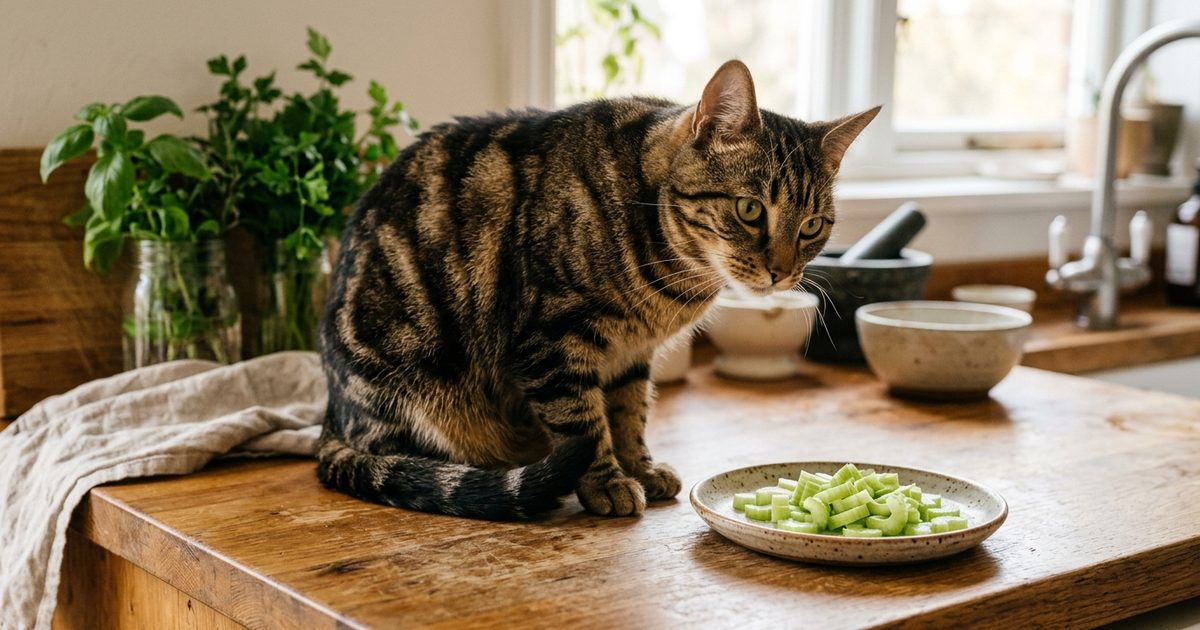
Can Cats Eat Celery?
Yes — cats can eat celery. It is non-toxic and safe in small amounts, and its high water content can help with mild hydration. But celery is not nutritionally necessary, because cats are obligate carnivores that get everything they need from complete cat food. Think of it as a watery treat, never a meal.
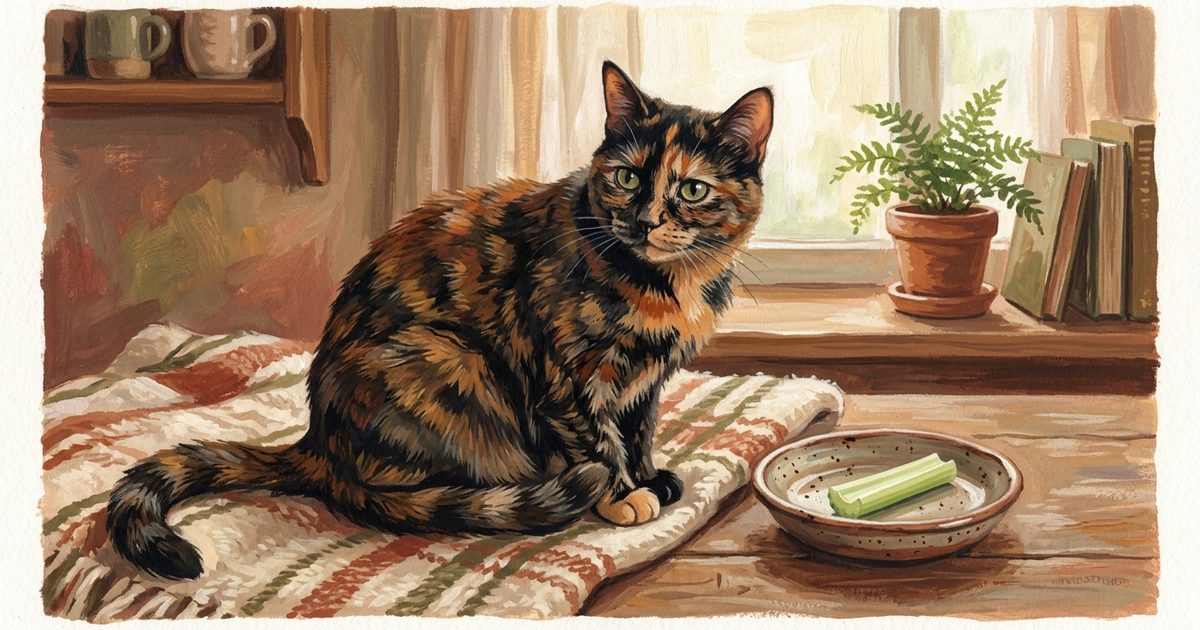
The short answer
Yes, cats can eat celery — plain, non-toxic celery is safe for a healthy adult cat in small amounts. If you're wondering can cats have celery, the verdict is reassuring: it will not poison your cat, and a tiny piece now and then does no harm. The one condition is the tough fibrous strings running down the stalk, which are a genuine choking and obstruction risk and must be removed or cut across before serving (we cover the how and why below). For a healthy adult cat, a small de-stringed piece is fine as an occasional hydrating snack — but it is a treat, never a replacement for the meat-based nutrition your cat actually lives on.
Why celery is a strange fit for a cat
Celery is a watery stalk vegetable; your cat is an obligate carnivore whose metabolism runs on animal protein and fat, not plant matter. Your cat's body simply does not need what celery offers — so "safe" and "beneficial" are two different things here. The one trait that is mildly useful is the high water content, which can offer a tiny hydration bump for cats that under-drink. But even that is trivial next to the water bowl or a portion of wet food, so it is best read as a harmless curiosity rather than a nutritional strategy.
Is Celery Good for Cats?
Not really. Celery is about 95% water with a little fiber and trace vitamins, and a cat on complete food already meets all those needs. The "low-calorie health food" reputation is a human one; for cats, celery is a hydrating snack, not a health boost. Safe, but not beneficial.
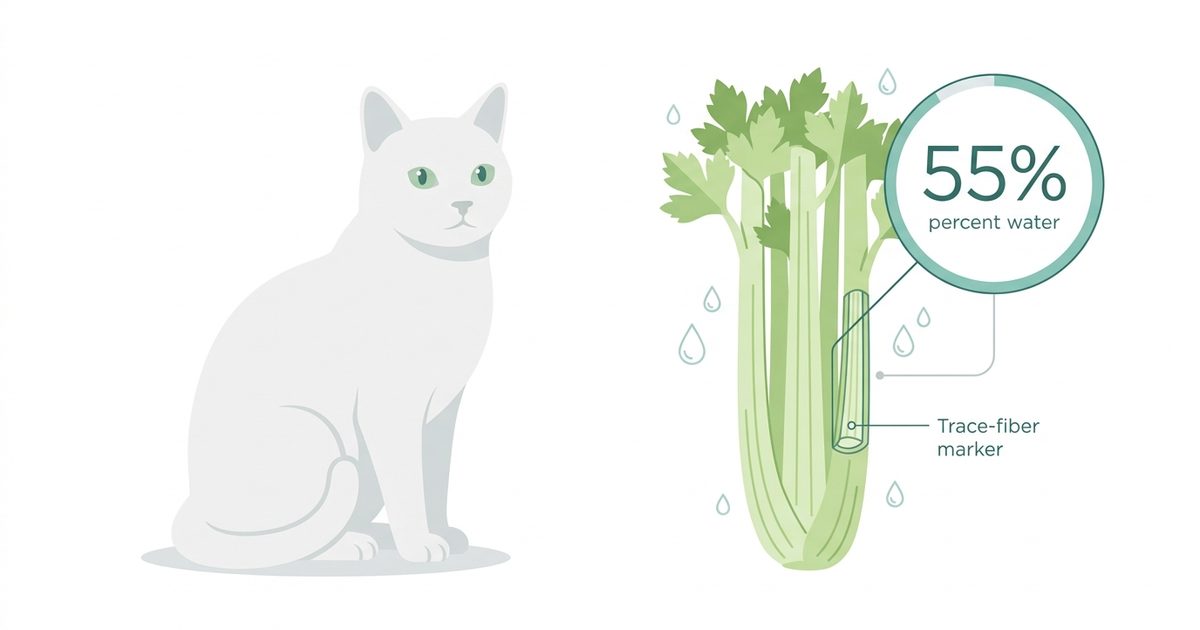
What is actually in celery
If you are asking is celery good for cats, it helps to look at what celery actually contains. Celery is roughly 95% water, with small amounts of dietary fiber, vitamin K, vitamin C, potassium, and folate. For humans those read as "light and healthy," but a cat eating complete food already covers every one of those nutrients — and unlike us, cats synthesize their own vitamin C, so the trace amount in celery is redundant. The water content is the only marginally useful trait for cats (a little extra hydration), and even that is minor next to their water bowl or wet food. The Cornell Feline Health Center is a reliable reference for what complete feline nutrition actually requires — and plant water and trace plant vitamins are not on that list.
The "low-calorie health food" label doesn't transfer
Celery's fame as a diet food is built on human goals — low calories, hydration, and fiber for satiety. A cat's obligate-carnivore metabolism does not value plant water or trace plant vitamins the same way, and cats do not need "low-calorie snacks" the way a dieting human might; they need complete, meat-based nutrition. So it is worth being clear-eyed: celery is not a health supplement, a weight-loss tool, or a "detox" food for your cat — it is simply a safe, watery treat. International Cat Care offers sound guidance on how treats and titbits fit into a cat's diet, and the short version is that they should stay occasional, not medicinal.
Contrast with pumpkin
The honest comparison: pumpkin is the rare vegetable vets actively recommend for cats, because its soluble fiber genuinely helps with both diarrhea and constipation. Celery has no equivalent therapeutic use — it offers no digestive remedy, just water and crunch. If you are reaching for a vegetable that actually does something for your cat's gut, pumpkin is the functional food; celery is the filler treat.
What About the Strings?
Celery's tough fibrous strings are the real risk. They can lodge in a cat's throat, get stuck between teeth, or pass undigested into the gut and cause obstruction or irritation. Always peel the strings off or cut the celery across the grain into very small pieces before offering any to your cat.
Why the strings are a hazard
A celery stalk is reinforced by long, tough, fibrous vascular bundles — the pale "strings" that run its full length. They are hard to chew through and nearly indigestible, which is fine for a human with grinding molars but a problem for a cat. Your cat's teeth are built for shearing meat, not grinding fibrous plant matter, and the Cornell Feline Health Center notes that cats' dentition is adapted to a carnivorous diet. A string can catch in the throat and cause choking or gagging, wedge between teeth or across the roof of the mouth, or travel down into the intestines where it may irritate the lining or, in a worst case, contribute to a linear-foreign-body obstruction.
This is celery's single most distinctive risk, and it's the one owners most often miss — because to us, the strings barely register. To be clear: serious obstruction from a small piece is uncommon, so this isn't a reason to panic. It is, however, a reason to never skip the prep.
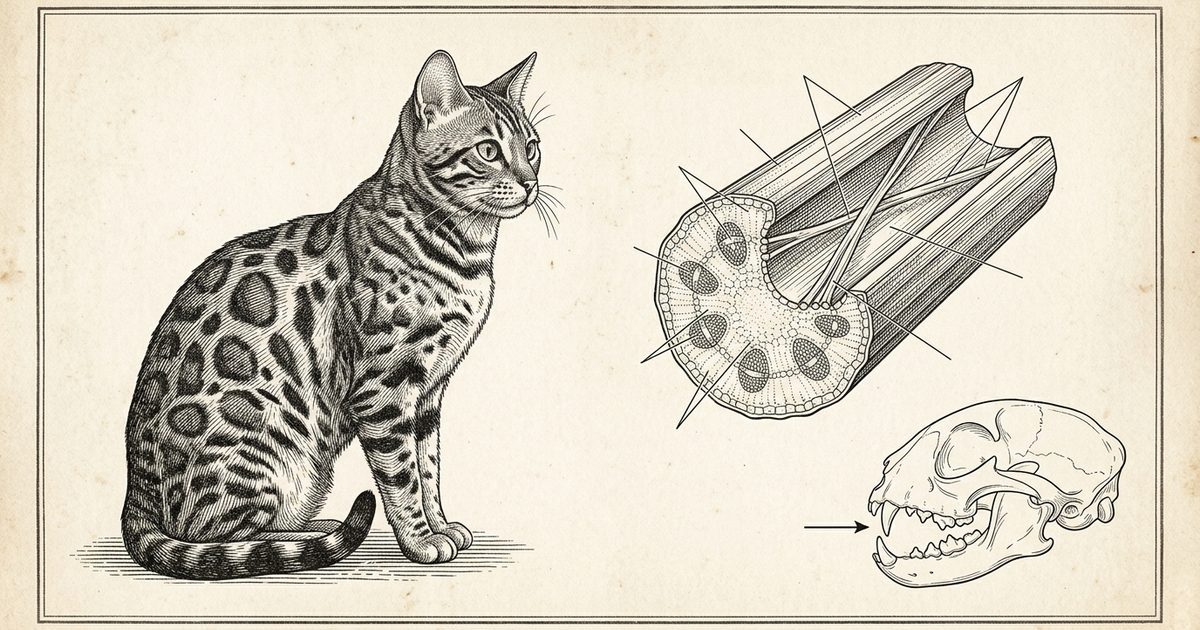
How to remove the strings
Two practical methods, either of which works:
- Strip them lengthwise. Run a vegetable peeler — or the back of a knife blade — down the stalk to pull off the tough outer strings in long ribbons.
- Cut across them. Slice the celery crosswise into pea-sized to small-fingernail-sized pieces. This severs every string into short, safe segments rather than leaving long strands intact.
Both is best, but either alone is acceptable. What you must never do is hand a cat a long strip or a whole stalk. The same hard-chunk prep logic applies to other safe vegetables — see our guide on whether cats can eat carrots for the parallel rule on another root vegetable.
A note on celery leaves
Celery leaves come from the same plant and are equally non-toxic, but they are tougher, more fibrous, and noticeably more bitter than the stalk — and their slender stems carry their own choking and irritation risk. They are not a recommended treat form. If you want to offer celery, stick to the soft inner stalk pieces, peeled and cut small.
How Should I Serve Celery to My Cat?
Serve celery de-stringed and cut into very small pieces, plain — raw small pieces or lightly cooked both work. Use no salt, no butter, no oil, no dip, no seasoning. A single small piece or two, offered on its own, is plenty for one treat.
De-string and cut small
This step isn't optional. Peel the strings off or cut the celery crosswise into pea-sized to small-fingernail-sized pieces, as covered above. The part that catches people out is assuming a "small piece" is automatically safe — but a small piece with a long string still running through it can still tangle in the throat or gut. Deal with the strings first, every time. For celery for cats, the softer inner stalks are the better choice over the tough outer ones.
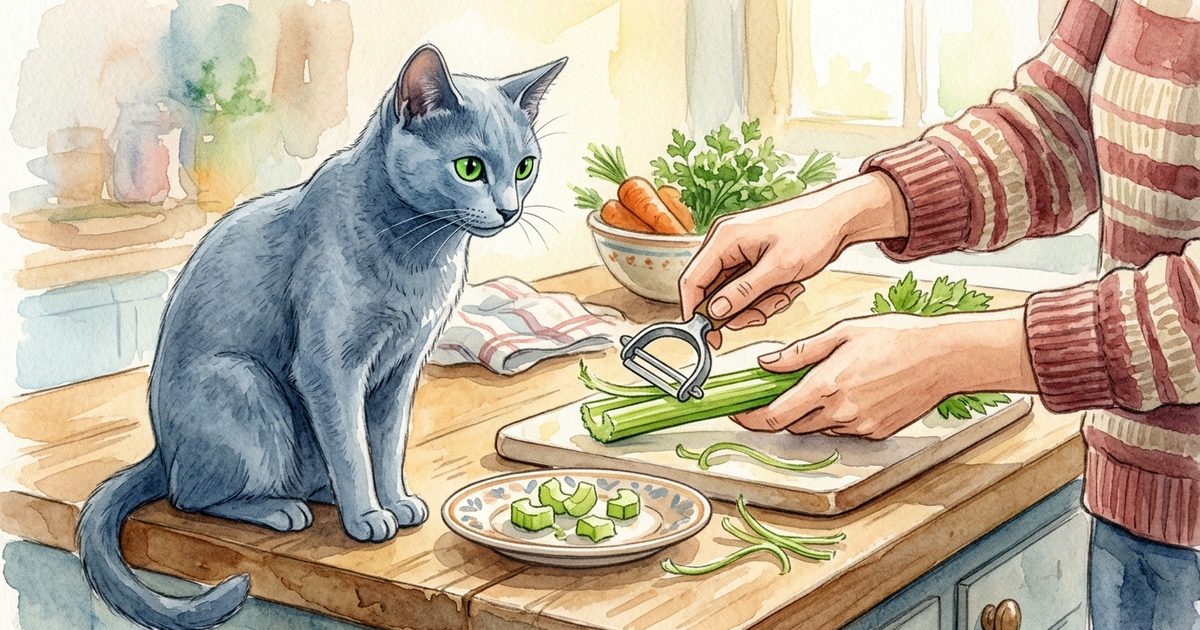
Raw small pieces or lightly cooked
Unlike carrots, which must be cooked, celery can be served raw if it has been de-stringed and cut small — its high water content keeps it soft enough that a raw piece isn't a hard-chunk hazard the way a raw root vegetable is. Light steaming or boiling is also fine, and it softens the flesh further for cats with sensitive teeth or digestion. Whichever you choose, both forms must be plain: no oil, no butter, no salt, no spices, and absolutely no garlic or onion, which are toxic to cats and sometimes share a prep board with celery. For the broader safe-vegetable prep rule, see our guide on whether cats can eat broccoli.
Forms to avoid
Keep celery away from your cat in these forms: whole stalks or long strips (the strings), celery with peanut butter or any dip (added fat, sugar, and sometimes xylitol), celery salt or seasoned celery dishes (sodium and spices), and celery cooked into soups or stews with onion or cream. For more on how other safe vegetables compare — both carrots and pumpkin have their own distinct prep rules.
How Much Celery Can a Cat Eat?
Very little. One or two small, de-stringed pieces, occasionally — not daily. All treats combined should stay under roughly 10% of daily calories. More than that can cause loose stool from the combination of water and fiber, because a cat's gut is not built for plant matter.
The 10% treat rule and the real limit
The standard veterinary guidance is that all treats combined — every snack beyond complete cat food — should stay under about 10% of a cat's daily calories. That cap exists to keep treats from crowding out the complete nutrition a cat actually needs, and you can read more about it from the Cornell Feline Health Center. For celery, the calorie math is almost laughably generous: it is mostly water, so you'd struggle to reach 10% of a cat's calories with it even if you tried.
But the calorie ceiling is not the real limit — the gut is. Celery's water plus fiber can loosen a cat's stool at amounts far smaller than the calorie math suggests, because a cat's short, meat-adapted digestive tract simply isn't built to process plant matter. A piece that looks tiny in your hand can still be a lot for that tract. So translate the rule practically: one or two small, de-stringed pieces, offered occasionally, is the sensible ceiling.
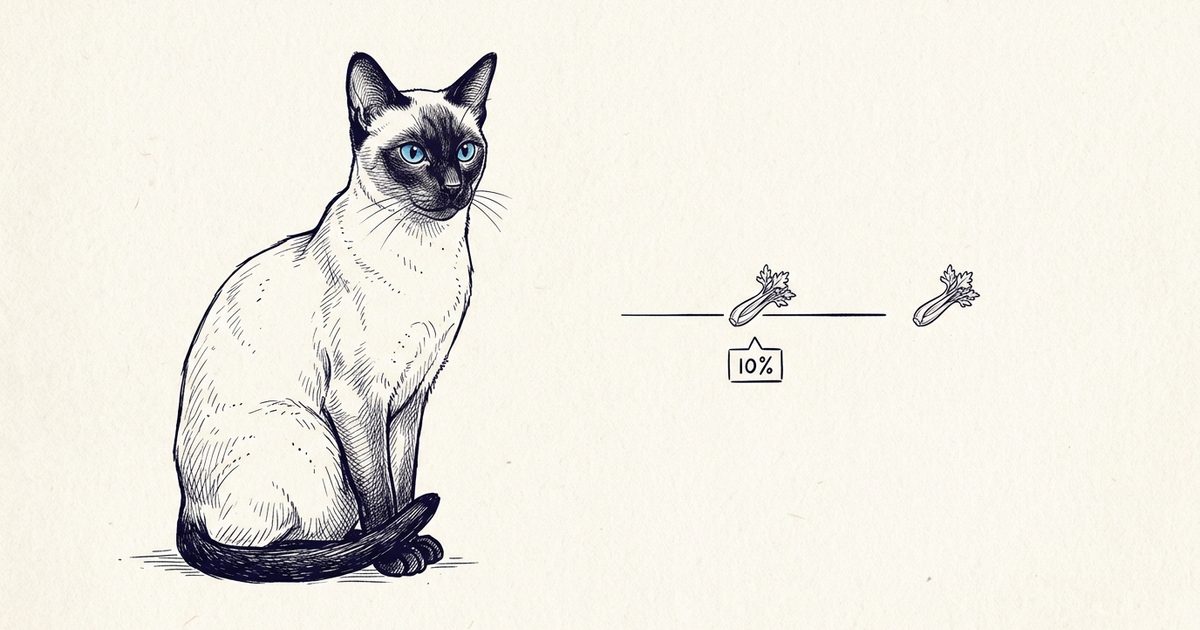
Frequency and signs to watch
A small piece once in a while — not a daily habit. Celery works best as an occasional curiosity, the kind of thing you hand over when your cat is begging for a bite of what you're eating. Introduce it slowly the first time, then watch what happens at the litter box over the next day or two.
The signs to watch for are soft stool, gas, or a sudden change in litter-box habits. Because of the high water content, a large amount offered all at once can cause a sudden, watery stool rather than a gradual upset — another reason portion size matters more than frequency. If loose stool does develop, stop the celery and see our guide to cat diarrhea for when GI upset crosses the line into a vet visit. Smaller cats, overweight cats, sensitive-stomach cats, and very young or very old cats should have less, or none at all — their systems tolerate plant matter least.
Why Do Some Cats Eat Celery?
Cats drawn to celery are usually after the crunch, the water, or the novelty — or they are mimicking you eating it. It is not a nutritional craving: cats are obligate carnivores with no biological need for vegetables. Curiosity and texture, not deficiency.
Crunch, water, and curiosity
When a cat goes after celery, the attraction is usually sensory. The crisp snap of a fresh stalk is a novel mouth-feel — most of what cats encounter is either soft (meat, wet food) or crunchy in a dry-kibble way, and a vegetable's fibrous crunch is genuinely different. Then there's the water. Celery is surprising in the mouth for an animal that eats mostly dry matter, and cats fed primarily dry food can find that hydrating sensation interesting, since many cats chronically under-consume water. International Cat Care notes that low water intake is one of the quieter risks of dry-food-heavy diets, so a cat seeking out a watery vegetable isn't acting strangely.
What this isn't, though, is a signal. A sniff, a bat, a curious nibble is exploration — a cat investigating something new in its environment — not proof that the diet lacks a vitamin or a fiber. Don't read a cat eating celery as a sign you should add vegetables to its meals. Cats are obligate carnivores; they have no biological requirement for plant matter, and their interest is about texture and novelty, not nutrition.
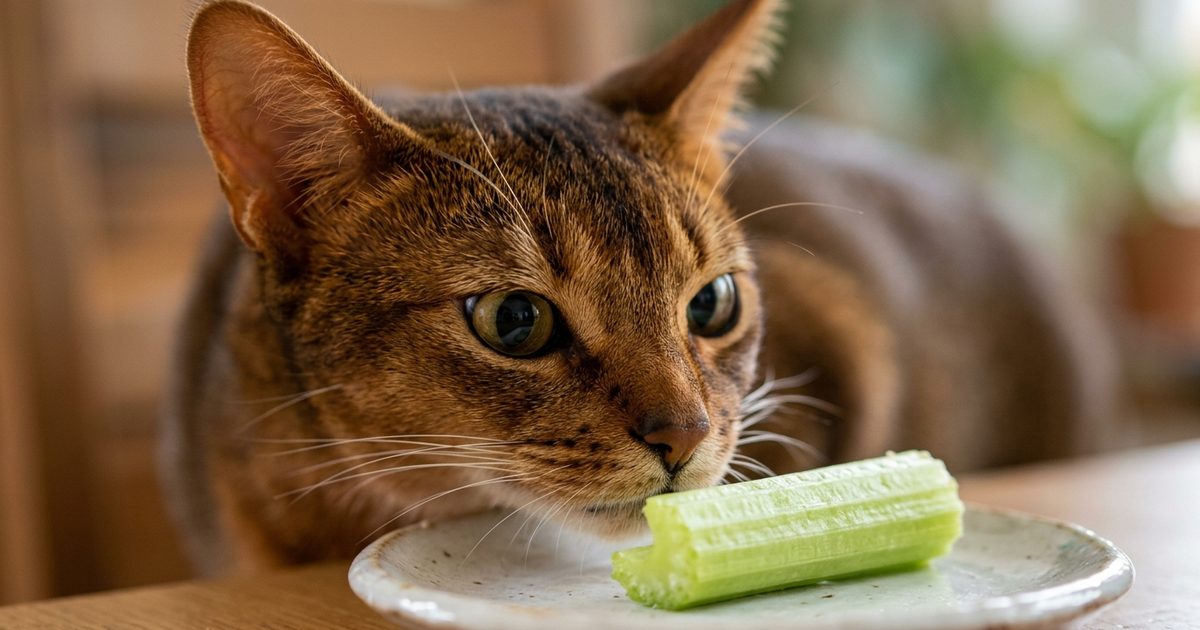
Mimicking the owner
The other common reason is simpler: cats want what you're eating. A cat watches you crunch through a stalk of celery and decides it must be worth having — the same impulse that sends a paw into your cereal bowl or toward your sandwich. Offering a tiny de-stringed piece to share the moment is harmless, and it can be a nice bit of bonding. What it shouldn't become is a habit that displaces complete cat food, which is where a cat's real nutrition comes from — see our overview of what cats eat for the obligate-carnivore diet context.
The scenario genuinely worth guarding against isn't the celery itself — it's the seasoned celery. A cat stealing a piece off a plate of celery with dip, salt, or shared alongside onion is the real risk, because the dip adds fat and sometimes xylitol, the salt adds sodium, and onion is outright toxic to cats. So if your cat is drawn to your snack, the safe move is to set aside a plain, de-stringed piece before you add anything to yours.
Celery for Cats at a Glance — Summary
Celery is safe for cats in small amounts, but the strings are the part that actually bites. Here's the whole verdict on one page — every question, the honest short answer, no hedging.
| Question | Short answer |
|---|---|
| Can cats eat celery? | Yes — non-toxic and safe in tiny de-stringed amounts, but not needed; a watery treat, never a meal |
| Are celery strings dangerous? | Yes, this is the real risk — peel them off or cut across them, or skip the celery |
| Can cats eat raw celery? | Yes, if de-stringed and cut into very small pieces; light cooking is optional, not required |
| How much celery is safe? | One or two small pieces, occasionally — never daily, and never a whole stalk |
| Are celery leaves okay? | Not recommended — tougher, more fibrous, and more bitter than the stalk |
| Can cats eat celery with peanut butter? | No — skip the dip; fat, sugar, and sometimes xylitol add risk for no benefit |
| Does celery help digestion or hydration? | Not therapeutically — it's safe and mildly hydrating, but no digestion boost; that's pumpkin's job, not celery's |
The pattern across every row is the same: plain, de-stringed, cut small, offered occasionally. Stray from that and the risk rises — not because celery is toxic, but because the strings, the seasonings, and the portions are what actually cause trouble.
Curious What Your Cat Would Say?
Upload a photo and get a warm, personalized reading from your cat's perspective.
Start Your Free ReadingFrequently Asked Questions
Can cats eat celery safely?
Yes — plain celery is non-toxic and safe for a healthy adult cat in small amounts, and its high water content can even add a little hydration. Serve it de-stringed and cut into very small pieces, plain, as an occasional treat and never a meal.
Are celery strings dangerous for cats?
Yes — the tough fibrous strings are celery's single most distinctive risk for cats. They can choke, wedge between teeth, or pass undigested into the gut and cause irritation or obstruction. Always peel them off or cut across them into very small pieces first.
Can cats eat raw celery?
Yes, raw celery is fine if it has been de-stringed and cut into very small pieces. Unlike carrots, celery is soft enough raw thanks to its high water content, so cooking is optional, not required. Light steaming or boiling also works if your cat prefers it softer.
How much celery can I give my cat?
Very little — one or two small, de-stringed pieces, occasionally rather than daily. Celery is so low in calories the treat cap is generous, but its water and fiber can loosen a cat's stool at amounts smaller than the calories suggest, since a cat's gut is not built for plant matter.
Can kittens eat celery?
It is best not to offer celery to kittens. Their smaller throats and still-developing digestive tracts tolerate fibrous plant matter least, and the string hazard is sharper at that size. Stick to complete kitten food, which supplies everything a growing kitten needs.
Why does my cat like celery?
Cats drawn to celery are usually after the crunch, the surprising water content, or simple novelty — or they are mimicking you eating it. It is not a nutritional craving, since cats are obligate carnivores with no biological need for vegetables. Curiosity and texture, not deficiency.
Can cats eat celery with peanut butter?
No — skip the dip. Peanut butter and other dips add fat, sugar, and sometimes xylitol, and the sticky-plus-string combination raises obstruction risk. If you want to share, set aside a plain, de-stringed piece before adding anything to yours.
Does celery help cats with digestion or hydration?
Only in the most minor sense. Celery is mildly hydrating because it is mostly water, but it has no therapeutic effect on digestion and is not a remedy for diarrhea or constipation the way pumpkin is. If you want a vegetable that actually helps your cat's gut, reach for pumpkin instead.
Are celery leaves safe for cats?
Celery leaves are the same plant and equally non-toxic, but they are tougher, more fibrous, and noticeably more bitter than the stalk, and their slender stems carry their own choking and irritation risk. They are not a recommended treat form — stick to soft, peeled inner stalk pieces.
Sources & References
You Might Also Like
Kitten Teething: Timeline, Symptoms & How to Help
Kitten teething runs from 3 to 7 months as baby teeth fall out. Learn the timeline, signs to watch for, and how to soothe a teething kitten safely.
15 min readWhen Do Cats Stop Growing? A Complete Timeline
When do cats stop growing? Most cats reach adult size by 12-18 months, but large breeds like Maine Coons keep growing until 3-4 years. Full timeline inside.
14 min readCan Cats Eat Cherries? Flesh, Pit & Toxicity Facts
Can cats eat cherries? Pitted flesh is safe in tiny amounts — but the pit, stem, and leaves are toxic (cyanide precursors). Learn what's safe and what isn't.
15 min read