Can Cats Eat Corn? The Honest Truth About Cobs & Cat Food
If you're wondering whether can cats eat corn, the short answer is yes — in a small, plain form — but it's more complicated than a simple yes or no. The same golden kernels that land on your dinner plate are non-toxic to cats, yet questions like is corn bad for cats and the long-running debate over corn in cat food show that "safe" and "good for them" are two very different things. Corn shows up in cat bowls in many forms — fresh, popped, canned, on the cob, and ground into kibble — and each carries its own rules, risks, and misconceptions. This guide walks through every form so you know exactly what's harmless, what's risky, and what's an emergency.
Key takeaways
- Plain cooked corn kernels are non-toxic and safe for cats in small amounts, but they offer cats little real nutrition — a tolerated treat, not a health food.
- The corn cob is genuinely dangerous — never let a cat chew or swallow it, as it can cause a life-threatening intestinal blockage.
- Corn is a common cheap filler in commercial cat food — not harmful in itself, but not a quality ingredient either, and corn-free food isn't automatically better.
Corn for Cats — Quick Reference
| Corn form | Safe? | Notes |
|---|---|---|
| Plain cooked kernels | Yes, in small amounts | Non-toxic; a few kernels as an occasional treat |
| Corn on the cob | No — the cob is dangerous | Cob can cause an intestinal blockage emergency |
| Raw corn | Not recommended | Hard to digest; a small nibble is unlikely to harm |
| Popcorn | Only plain, air-popped | No butter, salt, or caramel — a piece or two at most |
| Canned corn | Check the label | Often high in added salt or sugar; avoid if seasoned |
| Corn in cat food | Generally safe, debated | Common filler; not harmful, but an inferior protein to meat |
Can Cats Eat Corn?
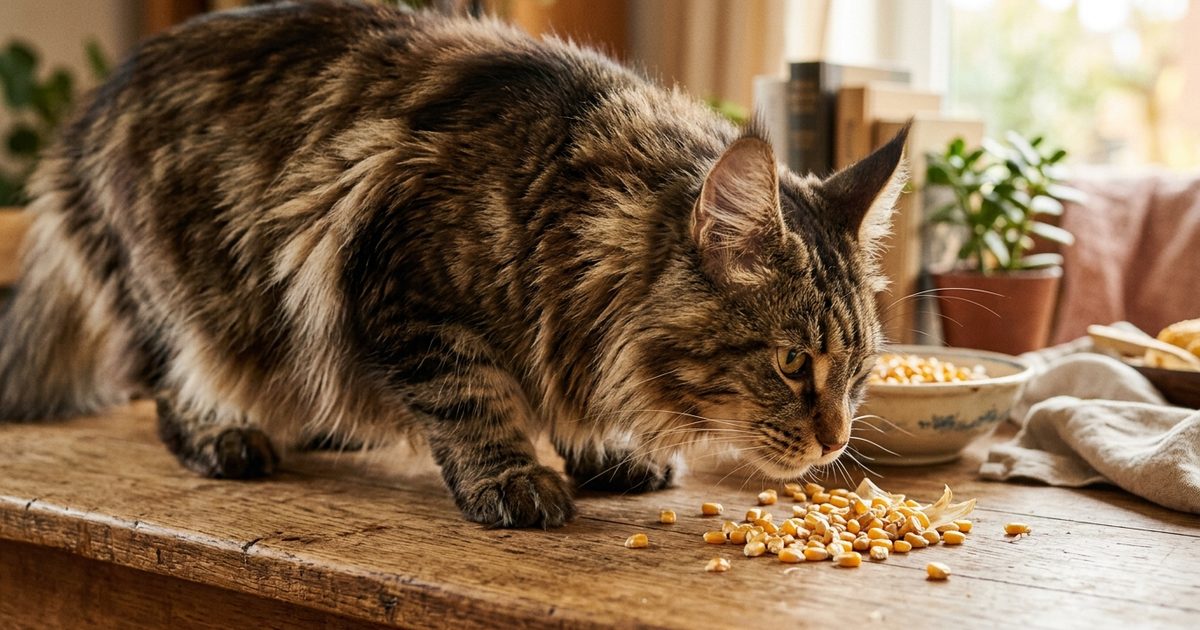
Yes — plain cooked corn kernels are non-toxic and safe for cats in small amounts. But corn is mostly carbohydrates and offers cats little real nutrition, so it is a harmless treat rather than a beneficial one — safe does not mean useful.
The short verdict
The honest verdict on corn is "safe but empty." A few plain cooked kernels won't harm a healthy cat — corn isn't toxic to felines the way some human foods are, and you don't need to panic if one tumbles off your plate and your cat snaps it up. What corn won't do is nourish your cat in any meaningful way: it's largely carbohydrate a cat has no dietary use for, with only a little fiber as a mild plus. It's the feline equivalent of eating a plain cracker — harmless, filling for a moment, nutritionally forgettable.
One important separation before we go further: the kernel is the only part we're calling safe. The cob the kernels grow on is a different matter entirely — tough, indigestible, and capable of causing a serious blockage. We cover the cob in full in our section on corn on the cob below, because it deserves its own warning.
Cooked, off the cob, plain
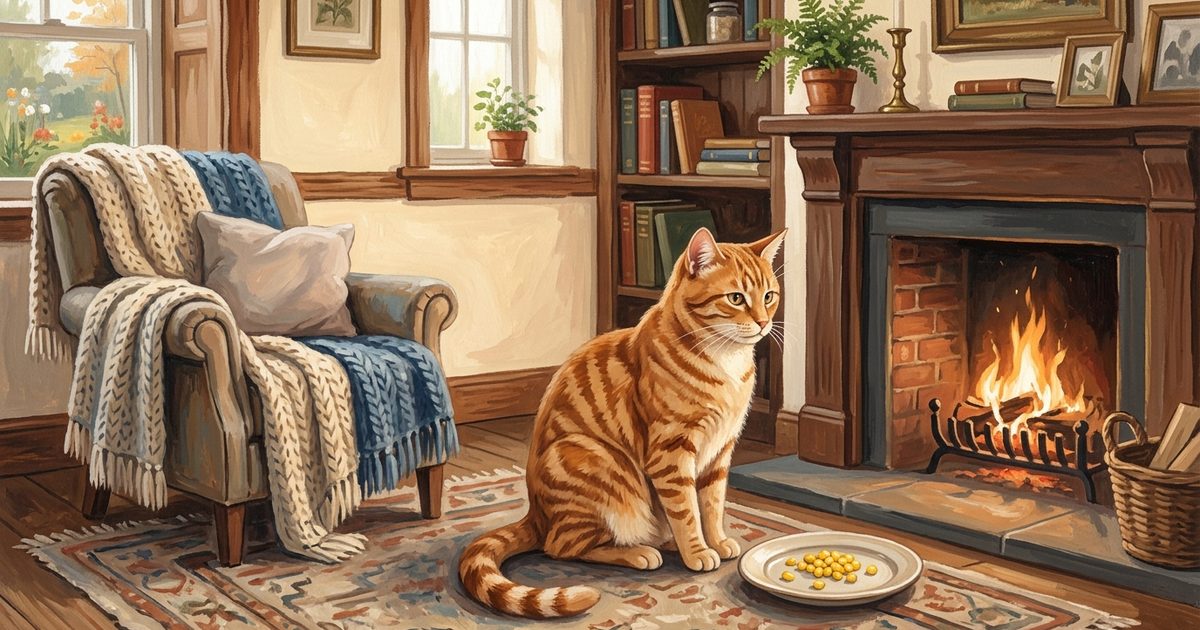
Three conditions turn corn from "risky form" into "safe treat," and all three matter:
- Cooked — steamed or boiled kernels are far easier for a cat's short digestive tract to break down than raw starch.
- Off the cob, kernels only — never serve corn still attached to the cob; the cob is the single most dangerous part of this whole food for cats.
- Plain — no butter, no salt, no seasoning. Cats' sodium tolerance is low, and added fats can trigger gastrointestinal upset.
Stick to those three and corn stays harmless. The sections that follow dig into why the cob is an emergency, how to serve corn safely, whether popcorn counts, and the bigger debate about corn as a cat-food filler.
Does Corn Have Nutritional Value for Cats?
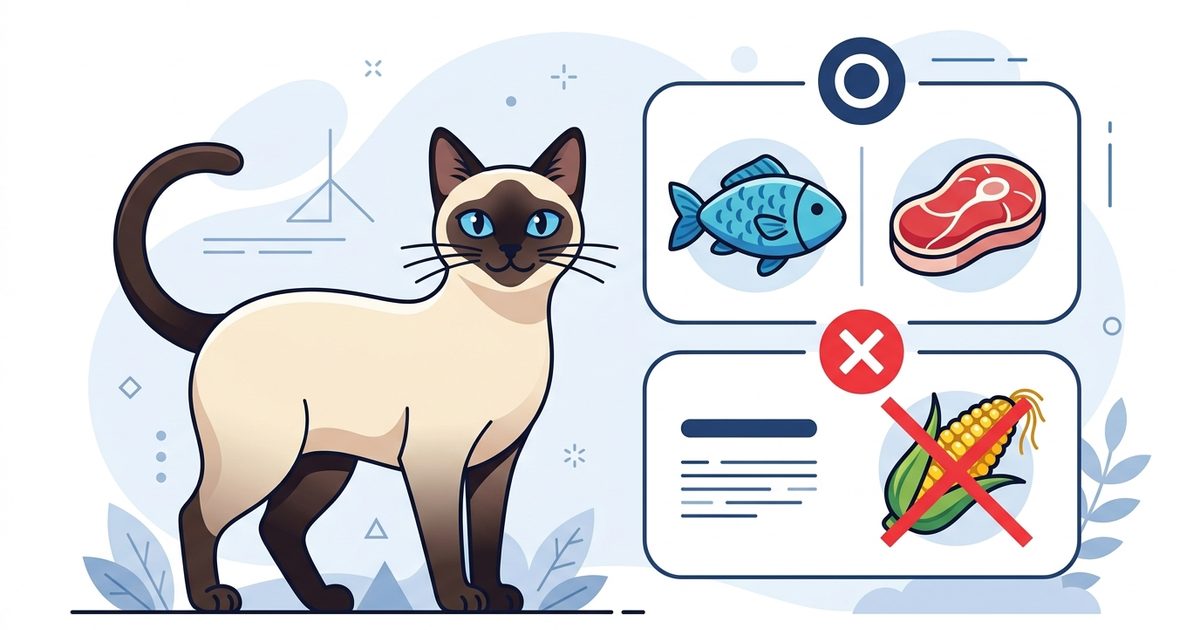
Not much. Corn is mostly carbohydrates with some fiber, and cats are obligate carnivores that have no dietary need for carbs — they run on animal protein and fat. Any nutrients in corn are incidental, which is why it shows up in cat food as a cheap filler, not a quality ingredient.
Cats are obligate carnivores
Cats are obligate carnivores, which means their bodies are built — at every level, from teeth to metabolism — to derive nutrition from animal tissue. Unlike humans or dogs, cats lack the enzymatic machinery to efficiently convert plant starch into usable energy, and they have specific nutritional requirements that plant foods simply cannot meet. They need high levels of protein, they need fat for energy, and critically they need taurine — an amino acid found in animal tissue that cats cannot synthesize in adequate amounts themselves. A taurine deficiency can lead to serious heart and eye damage. Corn contains no meaningful taurine, little quality protein, and a carbohydrate load a cat's body isn't designed to process efficiently. The Cornell Feline Health Center is a clear, authoritative resource on what cats actually require — and the picture is unambiguously meat-first.
Mostly carbs, a little fiber
Strip corn down to its macronutrient profile and you get mostly carbohydrate, a modest amount of plant protein, and a little dietary fiber. Of all of it, the fiber is the only element that's mildly useful to a cat — it can help stool formation in small amounts, which is why a touch of pumpkin is sometimes recommended for cats with loose stools (see our piece on can cats eat pumpkin for a human food that's genuinely useful). The vitamins corn contains are largely inaccessible to cats: for example, the beta-carotene that gives corn its golden color is converted poorly into vitamin A by feline metabolism, because cats evolved to get pre-formed vitamin A directly from liver and other animal tissues. The protein is there in small amounts, but its amino acid profile is inferior to meat. For the full picture of what a cat's diet should actually look like, our guide to what cats eat lays out the obligate-carnivore framework in detail.
Why corn is a filler, not a feature
If corn is so nutritionally thin for cats, why is it everywhere in commercial cat food? The answer is economics. Corn is cheap, calorie-dense, shelf-stable, and easy to process into kibble — all properties that make it an efficient way to bulk up a bag of food at low cost. There's nothing inherently toxic about it; the issue is what it displaces. Every gram of corn in a food is a gram not taken up by animal protein — the ingredient your cat actually needs. That tension between cost and quality is the engine behind the long-running debate over corn in cat food, which we take on directly in the section on why corn is so debated.
Can Cats Eat Corn on the Cob?
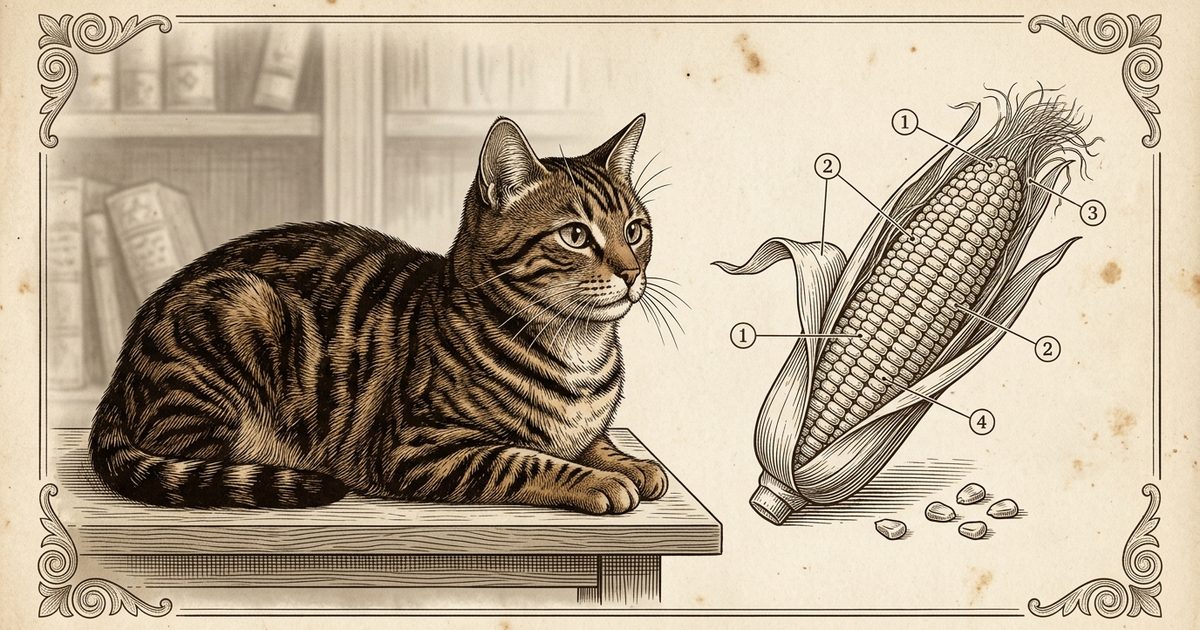
No — never let a cat eat the corn cob. The kernels are fine off the cob, but the cob itself is tough, indigestible, and can cause a life-threatening intestinal blockage. If your cat chews or swallows any part of the cob, treat it as a potential emergency and call your vet.
This is the one part of corn where "non-toxic" gives you no comfort. A cooked kernel that slips off the cob is harmless; the cob underneath it is a different substance entirely — and a different kind of risk. Corn on the cob combines two things a cat's digestive tract handles badly: a hard, woody core and the temptation to gnaw it.
Why the cob is dangerous
The cob is the tough, fibrous core that holds the kernels, and it is built to resist breakdown. Where a kernel is mostly soft starch that cooking softens further, the cob is a dense, woody cylinder of lignified tissue — the same structural idea that makes corncobs useful as fuel and absorbents. A cat's stomach acid and digestive enzymes, tuned for breaking down meat and bone, make almost no progress on it.
When a cat gnaws a piece off the cob, that fragment doesn't dissolve. It stays hard and roughly the size it was swallowed, and as it moves from the stomach into the narrow loops of the small intestine it can wedge in place. Once lodged, it blocks the passage of food and fluid — a mechanical obstruction. This is a physical hazard, not a toxin; there is no poison in the cob to worry about, only its refusal to pass through. International Cat Care covers this class of risk in their guidance on gastrointestinal foreign bodies, where indigestible objects a cat swallows become stuck and require urgent removal.
Signs of a blockage
A blockage rarely announces itself dramatically. The signs tend to build and can look, at first, like a mild stomach upset: repeated vomiting (often soon after eating or drinking), a sudden loss of appetite, and noticeable lethargy. A cat may sit hunched or guard its belly, and you might see straining in the litter box with little or nothing produced — constipation, or an inability to pass stool at all because nothing is getting through.
These symptoms warrant an immediate vet visit rather than a wait-and-see, because an obstruction doesn't resolve on its own and can damage the intestine the longer it sits. I'm describing the pattern in general, not diagnosing your cat — only a vet can confirm whether a blockage is present and how to treat it. If your cat has eaten cob and shows any of these signs, treat the combination as the signal, not either piece alone.
What to do if your cat ate the cob
Call your vet or the nearest emergency clinic immediately, even if your cat seems fine — the right moment to act is before symptoms set in, not after. Do not induce vomiting unless a vet explicitly tells you to; a jagged cob fragment can do more damage coming back up. The vet decides the response based on what and how much was swallowed, which may mean monitoring, imaging, or surgery.
How Should I Serve Corn to My Cat?
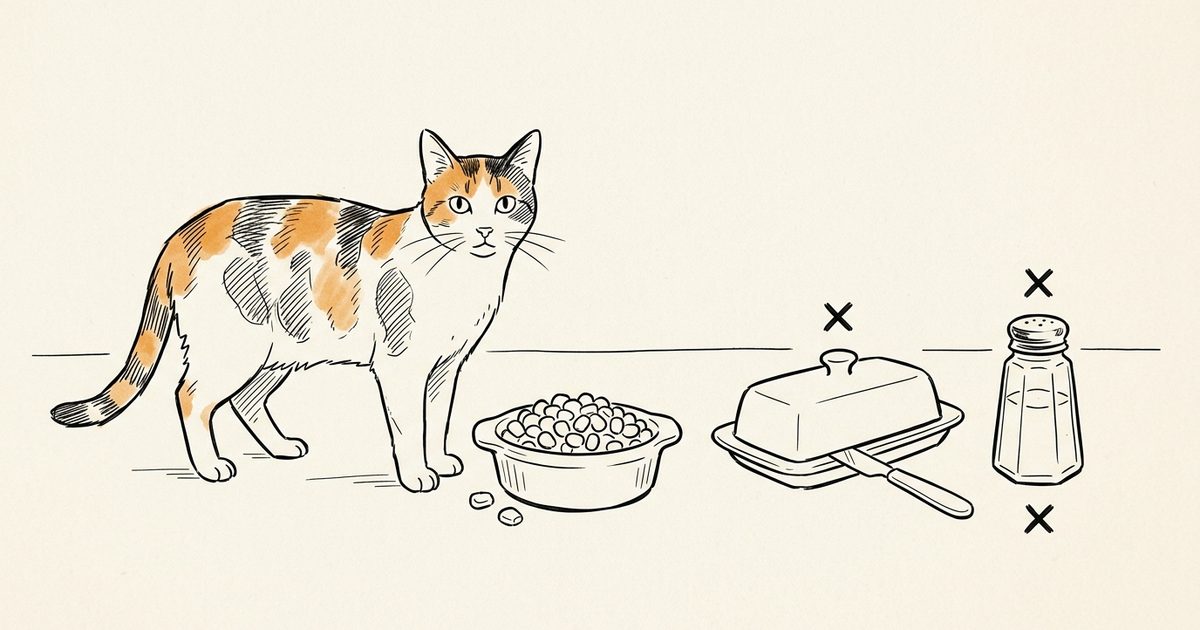
If you share corn, give only cooked kernels off the cob, plain, with no butter, salt, or seasoning — just a few kernels as an occasional treat. Never serve corn on the cob, raw corn, or any seasoned, buttered, or salted preparation.
Serving corn safely to a cat comes down to stripping away almost everything that makes corn appealing to humans. The plain cooked kernel is the only form that fits; every embellishment — the butter, the salt, the cob it grew on — turns a harmless nibble into a problem.
Cooked kernels, plain
Start by steaming or boiling the corn until the kernels are soft, then let it cool to room temperature — a cat's mouth is sensitive to heat, and kernels hold warmth longer than you'd expect. Strip the kernels off the cob before they ever reach your cat; the cob should never be part of the serving, as we covered above. Offer only a few kernels — three or four is plenty for a single treat, not a bowlful.
Plain matters more than you might think. Cats have a low tolerance for sodium compared to people; what registers as lightly salted to you is a meaningful dose for an animal a fraction of your size. Added fat, especially butter, is the other concern: a greasy kernel can trigger gastrointestinal upset, and fatty human foods are implicated in pancreatitis, a painful inflammation of the pancreas. Cooking the kernel and leaving it untouched is the whole preparation.
What to avoid
Keep butter, margarine, and oil off the kernels — added fat upsets a cat's stomach and raises pancreatitis risk. Skip all salt and seasoning, including spice blends, garlic and onion powders, and anything labeled "seasoned." Creamed corn is out; it's a high-fat, high-sodium preparation, not a vegetable. Canned corn needs a label check, because many brands add salt or sugar — even "no salt added" should be rinsed. Raw corn is hard for a cat to digest and not recommended beyond a curious nibble. And the cob is off-limits entirely, in any form.
How much is too much
A useful baseline for any treat, corn included, is the 10% rule: treats of all kinds should stay under 10% of your cat's daily calories, with the rest coming from complete food. Even within that budget, corn is a poor choice — a shred of plain cooked chicken or fish gives your cat actual protein for the same number of calories. Reach for corn as a novelty, not a habit.
Can Cats Eat Popcorn?
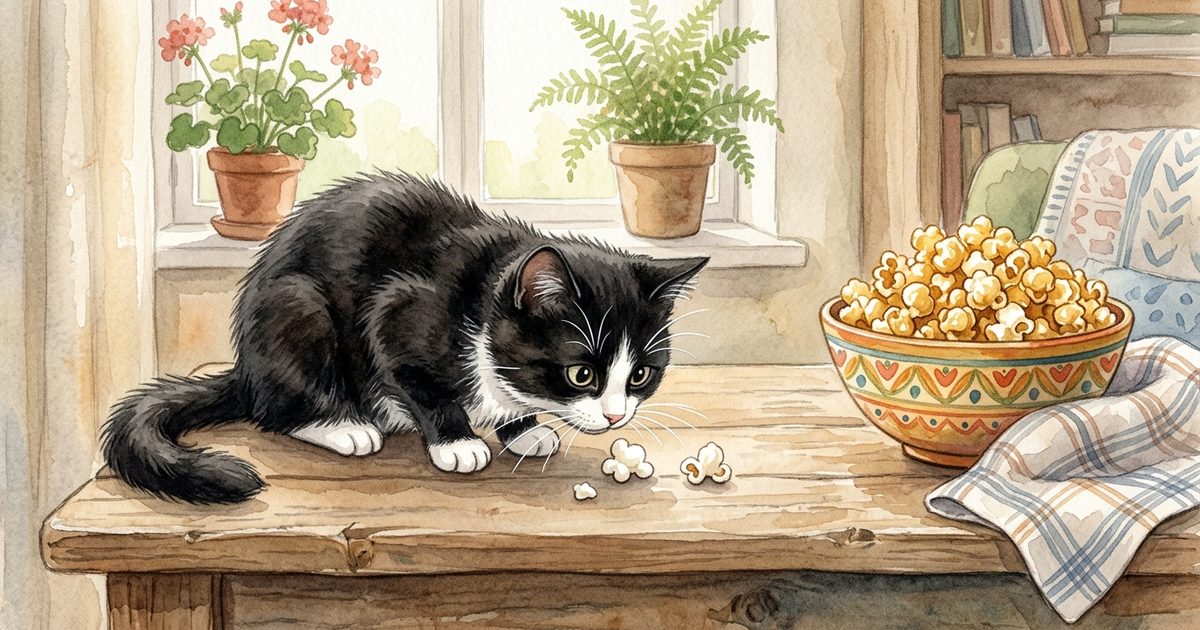
Plain, air-popped popcorn is safe for cats in tiny amounts — a piece or two. But buttered, salted, caramel, or microwave popcorn with flavorings is not. Popcorn is the same corn, just puffed, so the same empty-carb logic applies: safe but pointless.
Plain air-popped is okay in tiny amounts
If you drop a flake of plain, air-popped popcorn and your cat steals it, there's no need to worry. A piece or two, completely unseasoned, is non-toxic and harmless as an occasional novelty. Nutritionally, popping the kernel changes almost nothing — it's still the same starchy carbohydrate a cat has no dietary need for, just puffed with hot air instead of cooked in water. So while a stray flake won't hurt, it isn't doing your cat any favors either. Think of it the same way as a single kernel of plain cooked corn: tolerated, not beneficial.
Buttered, salted, and caramel popcorn are not safe
Movie-night popcorn is where the trouble starts. Butter and oil pile on fat that can trigger gastrointestinal upset and, in heavier amounts, pancreatitis — a painful inflammation of the pancreas. Salted popcorn brings a sodium load cats aren't built to handle. Caramel and microwave varieties add sugar and artificial flavorings that are genuinely unsuitable for a cat's system, and International Cat Care repeatedly stresses that fatty, salty human snacks are a common cause of dietary distress in cats. There's also a physical hazard: hard unpopped "old maids" hide among the fluffy flakes and are a genuine choking risk. We walk through all of this in the dedicated can cats eat popcorn deep-dive.
Generalize the rule
There's a useful pattern hiding here. The plain, single-ingredient, unseasoned version of a food is often tolerable to a cat; the coated, salted, sweetened, or processed version almost never is. It holds for corn, it holds for popcorn, and it holds across most human snacks — including a slice of plain bread versus the buttered kind.
Why Is Corn in Cat Food So Debated?
Corn is a common cheap filler in commercial cat food, and opinions split. Critics argue it bulks up food at the expense of meat protein. Defenders note corn gluten is a protein source. The honest position: corn isn't harmful, but it's an inferior protein to meat — and corn-free food isn't automatically better.
The cheap-filler argument
Corn turns up in budget cat food for simple economic reasons: it's inexpensive, calorie-dense, and shelf-stable. That makes it an efficient way to add bulk and hold a kibble together. The criticism isn't that corn is toxic — it isn't — but that when corn sits high on the ingredient list, it can displace the animal protein a cat actually needs, meaning less meat per serving than the bag implies. The practical takeaway is to read the ingredient list: named meats (chicken, turkey, salmon) appearing first is a better sign than corn, corn meal, or grain blends dominating the top spots.
Corn gluten as a protein source
The industry's defense is corn gluten meal — a concentrated plant protein that legitimately raises the "crude protein" number printed on the label. The catch is biological. Cats are obligate carnivores, and as the Cornell Feline Health Center explains, their bodies are built to run on animal protein with a specific amino acid profile and high digestibility. Plant protein like corn gluten can pad the percentage, but it's an inferior match for what a cat actually absorbs and uses — so a higher protein number isn't always a better protein number.
Corn-free isn't automatically better
Here's the part both extremes tend to skip: removing corn does not, by itself, make a cat food good. What matters is the overall formula — named meats leading the ingredient list, complete and balanced nutrition, and compliance with AAFCO standards. A corn-free food that leans on low-quality fillers or unnamed "meat by-products" can still be a poor diet. Corn isn't the villain, and its absence isn't a guarantee of quality; the whole ingredient panel is what tells the truth.
Corn for Cats at a Glance — Summary
| Question | Short answer |
|---|---|
| Can cats eat corn kernels? | Yes — plain cooked kernels are safe in small amounts, but nutritionally empty |
| Can cats eat corn on the cob? | No — the cob is a dangerous obstruction hazard, never let a cat chew it |
| Can cats eat raw corn? | Not recommended — hard to digest beyond a nibble off the cob |
| Can cats eat popcorn? | Only plain air-popped in tiny amounts; never buttered, salted, or caramel |
| Can cats eat canned corn? | Only if unsalted and unsweetened; check the label first |
| Is corn bad for cats in cat food? | Not harmful, but a cheap filler inferior to named meat protein |
| Is corn gluten a quality protein? | It boosts the label number but is biologically inferior to animal protein |
Curious What Your Cat Would Say?
Upload a photo and get a warm, personalized reading from your cat's perspective.
Start Your Free ReadingFrequently Asked Questions
Can cats eat corn safely?
Yes, plain cooked corn kernels are non-toxic and safe for cats in small amounts. A few kernels as an occasional treat won't harm a healthy cat. But corn is mostly carbohydrates a cat has no use for, so it's a tolerated snack rather than a healthy one.
Can cats eat corn on the cob?
No. The kernels are fine off the cob, but the cob itself is tough and indigestible, and can cause a life-threatening intestinal blockage. Never let a cat chew or swallow any part of the cob. If it happens, call your vet immediately.
Is corn bad for cats?
Not in the toxic sense. Plain cooked corn is safe, but it offers cats little real nutrition because they're obligate carnivores that run on animal protein. The danger is the cob, not the kernels, and corn in cat food is a cheap filler rather than a quality ingredient.
Can cats eat popcorn?
Only plain, air-popped popcorn in tiny amounts — a piece or two. Buttered, salted, caramel, or microwave popcorn with flavorings is not safe, and hard unpopped kernels are a choking hazard. Popcorn is the same corn, so it's safe but nutritionally pointless.
Can cats eat raw corn?
Not recommended beyond a curious nibble. Raw corn is hard for a cat's short digestive tract to break down, and cooking softens the starch. If your cat takes a small bite off the cob, it's unlikely to harm them, but it's not a good treat choice.
Can cats eat canned corn?
Only if it's unsalted and unsweetened — check the label first. Many canned corn brands add significant salt or sugar, which aren't suitable for cats. Even no-salt-added varieties should be rinsed before serving, and only a few kernels at most.
Why is corn in cat food?
Corn is cheap, calorie-dense, and shelf-stable, which makes it an efficient way to bulk up kibble at low cost. It isn't harmful in itself, but it displaces animal protein a cat actually needs. Corn gluten meal is used to raise the crude-protein number, though it's biologically inferior to meat.
What happens if a cat eats a corn cob?
Treat it as a potential emergency. A swallowed cob fragment doesn't dissolve and can lodge in the stomach or intestine, causing a mechanical blockage. Watch for vomiting, loss of appetite, lethargy, or straining in the litter box, and call your vet immediately — do not induce vomiting unless told to.
Sources & References
You Might Also Like
Can Cats Eat Popcorn? Plain Yes, But the Rest Is Danger
Can cats eat popcorn? Plain air-popped only, 1-2 pieces. Buttered, salted, caramel and microwave are not safe. Why cats can't taste it, and the kernel hazard.
16 min readKitten Teething: Timeline, Symptoms & How to Help
Kitten teething runs from 3 to 7 months as baby teeth fall out. Learn the timeline, signs to watch for, and how to soothe a teething kitten safely.
15 min readWhen Do Cats Stop Growing? A Complete Timeline
When do cats stop growing? Most cats reach adult size by 12-18 months, but large breeds like Maine Coons keep growing until 3-4 years. Full timeline inside.
14 min read