
Can Cats Eat Bread? The Honest Answer (Safe Amounts & Risks)
If you've ever wondered can cats eat bread, you're not alone — it's one of the most common questions cat owners ask, usually right after a slice slips off the counter and a quick mouth snatches it. The short version: plain baked bread is non-toxic in tiny amounts, but the question splits in two directions fast — can cats eat bread dough (no, that's an emergency) and is bread bad for cats when it becomes a regular treat (yes, slowly, in a quiet way most owners don't notice). Bread sits in an awkward spot for cats: it won't poison them the way a grape or a garlic clove can, but it also gives their bodies nothing they actually need. This guide walks through what's safe, what's genuinely dangerous, and how to think about sharing human food with a species built very differently from us.
Key takeaways
- Plain baked bread is non-toxic for cats in tiny amounts, but it carries no nutritional value — it's mostly refined carbohydrate and water.
- Raw bread dough is a veterinary emergency: live yeast produces alcohol and keeps expanding in the warm stomach.
- Flavored breads (garlic, onion, raisin, many nuts) contain ingredients that are genuinely toxic to cats and should never be shared.
Can Cats Eat Bread — Quick Reference
| Bread type | Safe? | Notes |
|---|---|---|
| Plain baked bread | In tiny amounts | Non-toxic, but nutritionally empty; pea-sized piece only |
| Raw bread dough | No — emergency | Yeast produces alcohol; dough expands in the stomach |
| Garlic or onion bread | No | Alliums damage red blood cells; seasoning concentrates the toxin |
| Raisin or nut bread | No | Raisins risk kidney failure; many nuts are toxic |
| Whole grain bread | Barely | "Less bad" than refined, but still mostly carbs cats don't need |
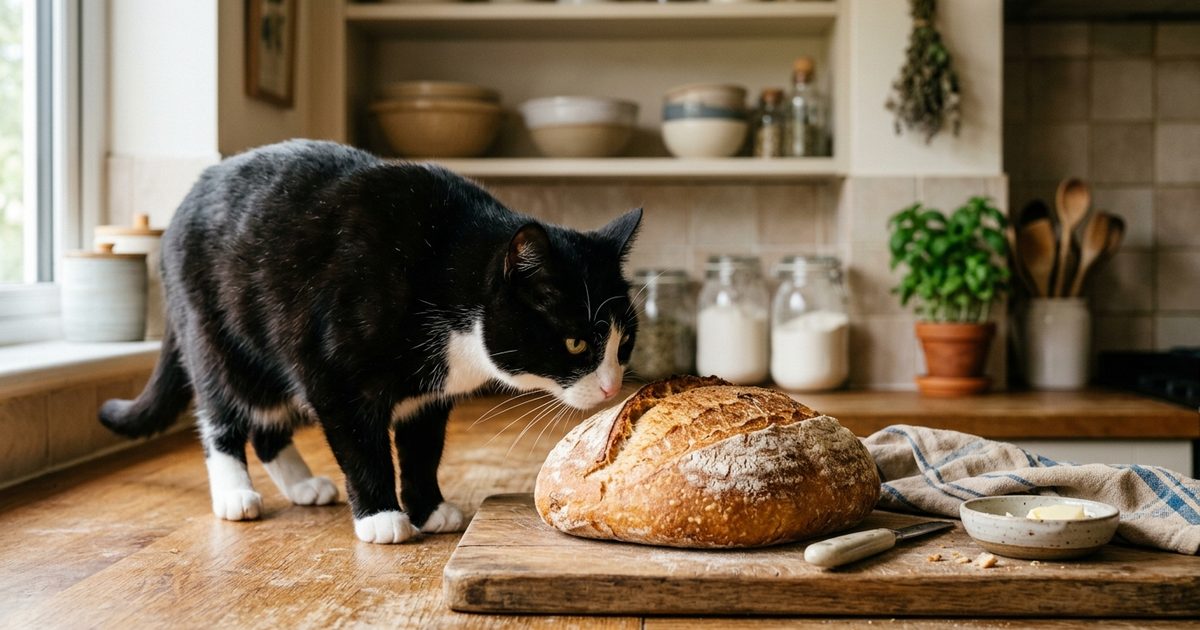
Can Cats Eat Bread?
Yes — a small piece of plain baked bread is non-toxic and won't harm a healthy cat. But bread has no nutritional value for cats: it's mostly refined carbohydrates and water, so it fills them up without giving their bodies anything they actually need.
That blockquote is the honest answer in one breath, and it's worth sitting with because the details matter. "Can cats eat bread" sounds like a yes-or-no question, but the truthful answer is conditional — safe if it's plain, if it's fully baked, and if it's a tiny amount given rarely. Step outside any of those conditions and the picture changes.
The short verdict
For a healthy adult cat, a crumb of plain baked bread — the kind you'd tear off a loaf for yourself — is not a poison. A cat's body can process it without immediate harm, and you don't need to panic if a small piece disappears from the table. The Cornell Feline Health Center is clear that cats should be eating a complete, meat-based diet, and bread simply isn't part of that picture — but a one-off taste won't send your cat to the vet. The honest framing is "safe but pointless": bread passes through without hurting your cat, and it also passes through without helping her in any way.
Why the answer isn't a simple yes
The complication is that "bread" is a broad word covering very different things. Plain baked bread is the safe end of the spectrum. Raw bread dough is the dangerous end — a genuine emergency we cover in detail below, because live yeast ferments into alcohol and the dough keeps rising inside a warm stomach. Flavored breads sit in between and are often worse than people assume: garlic, onion, raisins, and certain nuts are toxic to cats even in small amounts. So the verdict holds only within narrow boundaries — plain, baked, and tiny. Step outside them, and the same word "bread" describes something a cat should never eat. If your cat has helped herself to something more than a plain crumb, the safest move is to identify exactly what kind of bread it was before deciding what to do next — and when in doubt, check what foods are unsafe for cats before treating anything as harmless.
Why Isn't Bread Good for Cats?
Cats are obligate carnivores — their bodies are built to run on animal protein and fat, not carbohydrates. Bread is mostly starch, so a cat's digestive system extracts little nutrition from it while it still takes up stomach space that should go to real food.
Cats are obligate carnivores
"Obligate carnivore" isn't a preference — it's a biological fact. Cats evolved to meet nearly all their nutritional needs from prey: muscle meat, organ tissue, and bone. Their livers and kidneys are tuned to a steady intake of animal protein and fat, and they rely on it for essential nutrients their own bodies can't manufacture, like taurine, vitamin A (they can't convert plant beta-carotene efficiently), and arachidonic acid. A piece of bread contains none of these.
Cats do produce some amylase — the enzyme that breaks down starch — but in far smaller amounts than humans or dogs. They can tolerate a little carbohydrate, but they have no established dietary requirement for it; energy in a healthy cat diet comes primarily from protein and fat. The Cornell Feline Health Center, a leading authority on cat health, is clear that cats thrive on diets built around high-quality animal protein — which is exactly what bread is not. So when you wonder whether bread is bad for cats, the honest framing is "not a poison, but not a food their biology is built for."
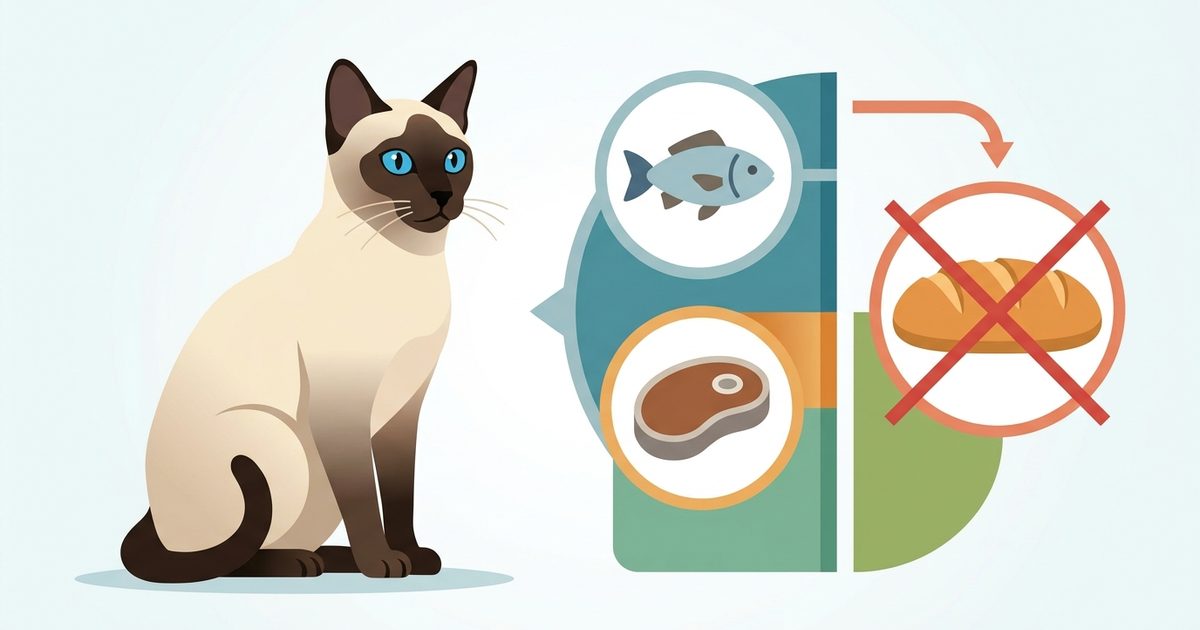
Empty calories and displacement
A slice of plain bread is mostly carbohydrate and water, with only trace protein and virtually no vitamins or minerals your cat actually needs. It delivers calories — sometimes a surprising number for a small animal — without the protein, taurine, or micronutrient payoff of even a small portion of complete cat food.
The real harm isn't the bread itself; it's what it pushes aside. A cat with bread sitting in its stomach feels full, and a full cat tends to skip the meal that would have given them the nutrition they actually need. Over time, that kind of nutritional displacement — filling up on empty carbs instead of a complete feline diet — is a quiet, cumulative negative, especially for indoor cats who already eat close to their daily calorie limit. Bread fills; it doesn't nourish.
Is Raw Bread Dough Dangerous for Cats?
Yes — raw bread dough is an emergency. Yeast ferments the sugars and produces alcohol, which a cat can absorb and become poisoned by, while the dough keeps expanding in the warm stomach, causing painful bloating and possible rupture.
Yeast fermentation and alcohol poisoning
The danger in raw dough is live yeast. Once swallowed, the yeast keeps working: it feeds on the sugars in the dough and produces ethanol and carbon dioxide as byproducts. Unlike humans, cats are extremely sensitive to alcohol — a small amount relative to their body weight is enough to cause toxicity. The ethanol is absorbed through the stomach lining and into the bloodstream quickly.
Signs to watch for include wobbliness or unsteadiness, depression or lethargy, a drop in body temperature, and slowed or shallow breathing. A cat that has eaten raw dough may also drool, vomit, or seem disoriented. This is not a "wait and see" situation — alcohol poisoning in a small animal can progress quickly, and the smaller the cat, the faster the risk escalates. If you even suspect your cat got into bread dough, treat it as a vet emergency, not a tummy upset.
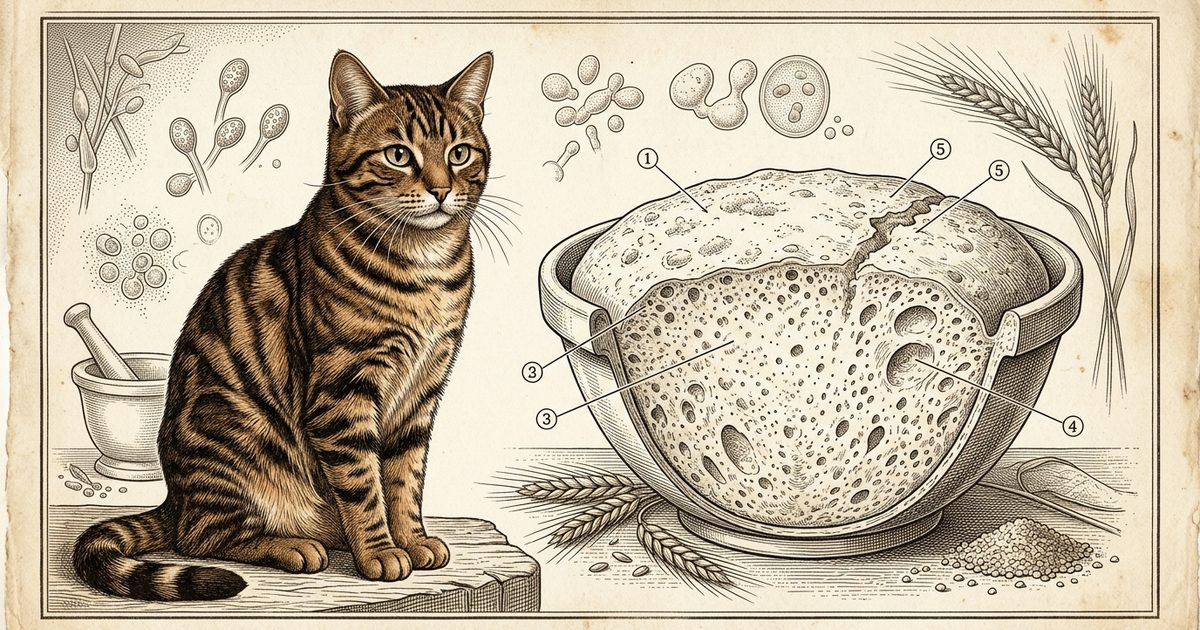
Dough expansion in the stomach
A cat's stomach is warm and moist — exactly the environment dough needs to rise. So the same yeast that produces alcohol also keeps expanding the dough after it's swallowed, stretching the stomach wall and causing painful gastric distension. In serious cases, the pressure can be severe enough to compromise breathing or blood flow, and there is a real, if rare, risk of stomach rupture.
This is why raw dough is in a different category from baked bread. You're not dealing with one risk but two at once: chemical poisoning from the alcohol and a physical emergency from the expanding mass. The International Cat Care guidance on toxic foods treats ethanol and raw yeast dough as a recognized hazard for exactly this reason — it's one of the few kitchen items that's genuinely dangerous rather than merely unsuitable.
What to do if your cat ate raw dough
Call your veterinarian or a pet poison helpline immediately — do not wait for symptoms to appear. Tell them what your cat ate, roughly how much, and when. Let the vet decide whether to induce vomiting, give activated charcoal, or monitor for alcohol toxicity; attempting home treatment can make things worse. Raw dough ingestion is time-sensitive, and early intervention makes a meaningful difference.
What About Flavored Bread?
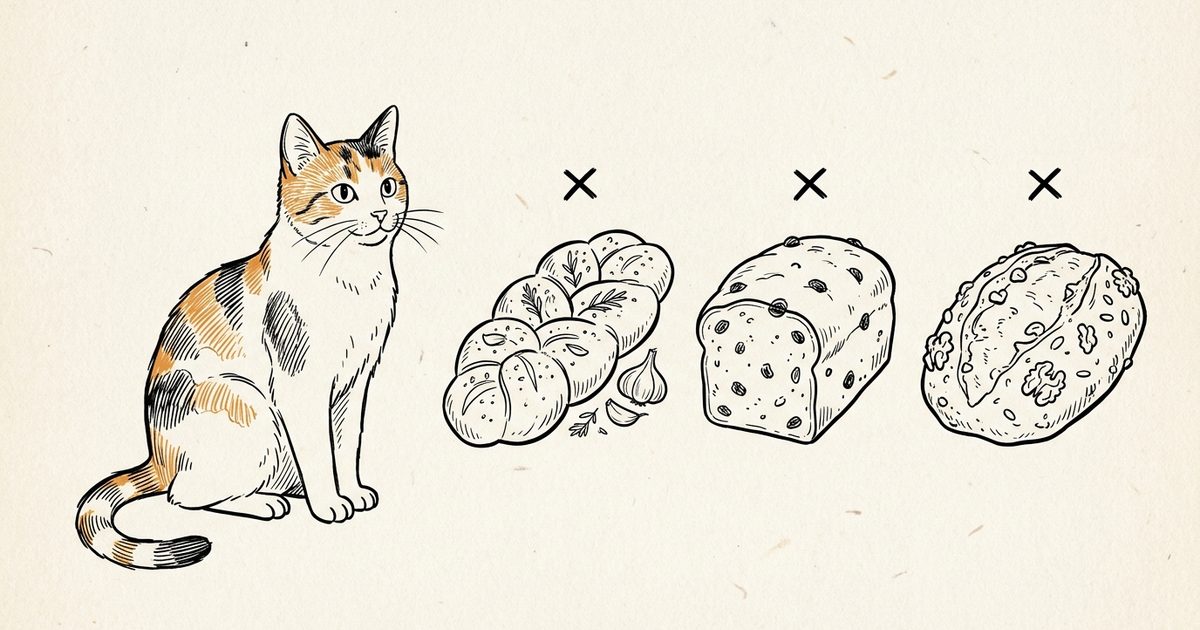
Flavored breads are riskier than plain — garlic bread, onion bread, raisin bread, and many nut breads contain ingredients that are genuinely toxic to cats. Even a small amount of these can cause serious harm, so flavored breads should never be shared with your cat.
Plain baked bread may be harmless in a crumb-sized piece, but the moment you add flavorings, the math changes entirely. The same loaf that's merely "empty" can become actively dangerous once garlic, onion, raisins, nuts, chocolate, or certain sweeteners are baked into it. The toxicity doesn't come from the bread itself — it comes from the ingredients folded into the dough, and many of those ingredients are concentrated in seasonings, fillings, or toppings, making a flavored slice far worse than a plain one. If you're wondering whether can cats eat bread once it's been dressed up, the honest answer is that most flavored varieties fall firmly into the "avoid" category.
Garlic and onion breads
Garlic and onion — whether fresh, dried, powdered, or cooked into a loaf — belong to the allium family, and alliums damage cats' red blood cells. The damage can lead to a condition called hemolytic anemia, where red blood cells rupture faster than the body can replace them. What makes garlic and onion breads especially risky is concentration: a seasoning blend or garlic butter spread can pack far more allium into a single bite than a slice of bread dusted with a little onion powder suggests. The Cornell Feline Health Center lists onions and garlic among the foods to keep away from cats, and there is no established safe threshold — so the safest move is none at all.
Raisin and nut breads
Raisins and grapes are linked to acute kidney failure in cats and dogs, and notably, no one has been able to establish a safe dose — the toxic principle itself isn't fully identified, which means even a single raisin is a gamble rather than a measured risk. Raisin bread concentrates several raisins into one slice, and a curious cat that picks out the sweet pieces can ingest more than you'd expect. Many nut breads add another layer of concern: macadamia nuts are documented as toxic to pets, and other nuts bring high fat and mold risk. "Just a bite" is not a safe framing here. If you want to understand the underlying hazard in depth, our guide to can cats eat grapes walks through why even small amounts warrant caution.
Sweet and spiced breads
Sweet breads pile on sugar your cat doesn't need, and a few recipes use xylitol — a sweetener that raises serious concern in dogs and is best avoided in cats until more is known. Spiced loaves often feature cinnamon, which is irritating in large amounts and is covered in our can cats have cinnamon article. Chocolate breads and chocolate-chip loaves carry the same theobromine risk as any chocolate product. The unifying rule: if a bread's flavor comes from an ingredient you wouldn't hand your cat on its own, it doesn't become safe by being baked into a loaf.
How Much Bread Can a Cat Eat?
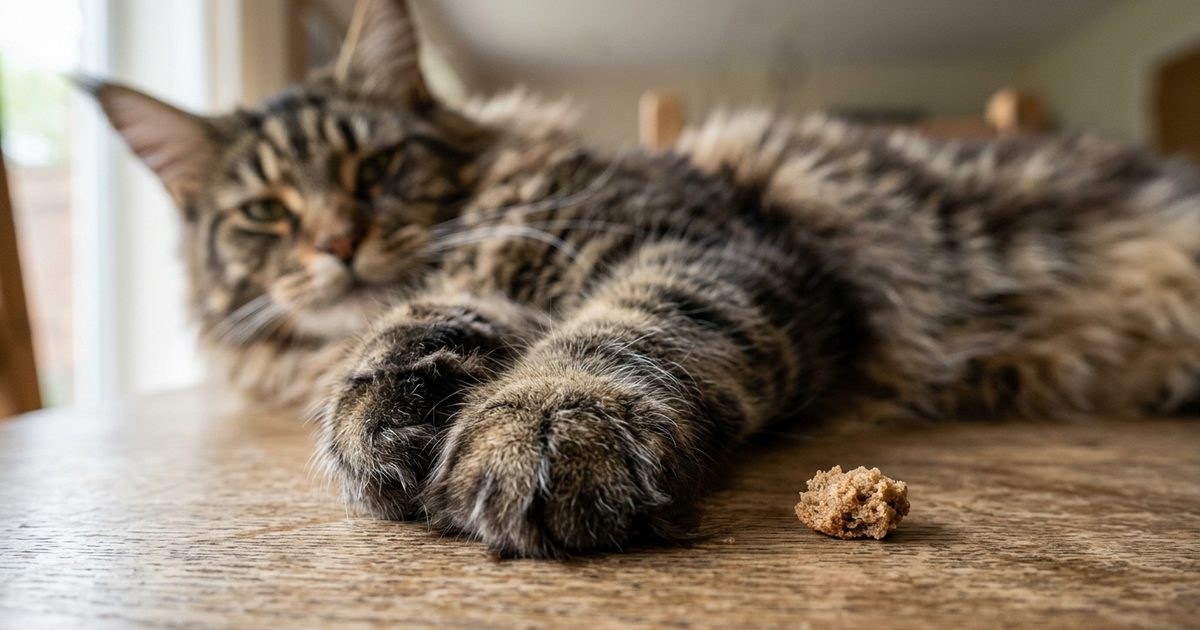
If you share plain baked bread, keep it to a tiny piece — roughly the size of a pea or a small crumb — and only occasionally as a treat. Treats of any kind should stay under 10 percent of a cat's daily calories, and bread is far from the best treat choice.
A pea-sized crumb is a useful mental image because it's deliberately small — small enough that it can't meaningfully displace a meal or spike calorie intake, and small enough that even a sensitive stomach is unlikely to object. The goal isn't to find the maximum a cat can tolerate; it's to keep the share so trivial that it barely registers nutritionally.
The portion rule
Think "crumb," not "slice." A full slice of sandwich bread is already far too much for a cat — it's a meaningful chunk of a small animal's daily stomach capacity, and it's almost entirely starch. The pea-sized guideline exists because anything larger starts to compete with real food for space and calories. Frequency matters just as much as size: bread is an occasional novelty, not a daily ritual. Sharing a tiny piece once in a rare while is harmless for most healthy cats; turning it into a habit is where the slow harms begin to add up.
Treats vs meals
The widely cited guideline from veterinary nutritionists is that treats of all kinds — bread included — should make up no more than 10 percent of a cat's daily caloric intake, with the remaining 90 percent coming from complete-and-balanced cat food. That 10 percent is a ceiling, not a target, and bread eats into it fast while returning almost no nutritional value. Far better treat choices exist: a small piece of plain cooked chicken or a bit of salmon gives your cat protein and moisture it can actually use. If you're reaching for bread, think of it as a last-resort treat — something for the rare moment when nothing better is on hand — rather than a staple.
What Are the Risks of Feeding Bread?
Regular bread adds empty calories that contribute to weight gain, can displace nutritionally complete cat food, and may cause mild stomach upset in sensitive cats. The biggest long-term risk is obesity — a slow, cumulative harm, not a sudden one.
None of these risks are dramatic in the moment, which is exactly why they're easy to underestimate. A crumb today doesn't make a cat sick. But bread, shared often enough, quietly works against the things that keep a cat lean and well-nourished.
Weight gain and obesity
Bread is calorie-dense for its size and nutrient-empty for its species — a combination that matters more for cats than for humans. Indoor cats, in particular, live with low activity levels, so even small surpluses in daily calories tend to be stored rather than burned. A slice of bread might be a trivial snack for a person, but for a 4 kg cat, those same calories represent a meaningful fraction of a day's energy budget, with zero protein, taurine, or vitamins in return. Over months and years, that mismatch is exactly how indoor cats slide into overweight and obese territory. According to International Cat Care, excess weight is one of the most common and most preventable welfare issues in pet cats.
Digestive upset
Cats not accustomed to carbohydrates can react to even a small piece of bread with gas, a loose stool, or mild bloating — their digestive systems simply aren't built to process a load of refined starch efficiently. These reactions are usually mild and self-limiting, resolving on their own within a day. Still, an uncomfortable cat is an uncomfortable cat, and there's no nutritional upside that justifies the risk of an upset stomach.
Nutritional displacement
The subtler harm is displacement. A cat with a stomach full of bread feels less hungry and eats less of its actual food — the complete, balanced diet that supplies the protein, taurine, and vitamins its body depends on. Done rarely, the effect is negligible; done regularly, it creates a slow shortfall in exactly the nutrients bread can't provide. This is the same displacement principle we discuss in can cats eat rice: any filling human food that edges out complete cat food is working against the cat, even when the food itself isn't toxic.
Bread for Cats at a Glance — Summary
| Question | Short answer |
|---|---|
| Can cats eat plain bread? | Yes, non-toxic in a tiny piece, but nutritionally empty |
| Is raw bread dough dangerous? | Yes — an emergency: yeast makes alcohol and the dough expands |
| Are flavored breads safe? | No — garlic, onion, raisin, and nut breads are genuinely toxic |
| How much bread is okay? | A pea-sized crumb, only occasionally, never a slice |
| Biggest long-term risk? | Obesity from empty calories that displace real cat food |
| What if my cat ate raw dough? | Call your vet or poison helpline immediately — do not wait |
The pattern across every question is the same: baked and plain is harmless in a crumb, raw or flavored is genuinely risky, and bread never earns a place in your cat's daily diet. If you're ever unsure whether something is safe to share, lean on what your cat's body is built for — animal protein, not pantry carbs.
Curious What Your Cat Would Say?
Upload a photo and get a warm, personalized reading from your cat's perspective.
Start Your Free ReadingFrequently Asked Questions
Can cats eat plain white bread?
Yes, a tiny crumb of plain baked white bread is non-toxic for a healthy cat. But it offers no nutrition — it's mostly refined carbohydrate and water — so it should stay a rare treat, never a regular snack or meal replacement.
Can cats eat bread dough?
No — raw bread dough is a veterinary emergency. Live yeast ferments into alcohol that poisons cats, and the dough keeps expanding inside the warm stomach. Call your vet or a poison helpline immediately if your cat eats any.
How much bread is safe for a cat?
No more than a pea-sized crumb of plain baked bread, given only occasionally. Treats of all kinds should stay under 10 percent of daily calories, and bread returns almost no nutritional value for that budget.
Is toasted bread okay for cats?
Plain toast is no safer or more nutritious than soft bread — toasting doesn't add anything a cat needs and can make it dry and harder to digest. The same rules apply: tiny piece, plain, and only rarely.
Can cats eat whole wheat or multigrain bread?
Whole grain is 'less bad' than refined white bread for humans, but the difference barely matters for cats. Either way it's still mostly carbohydrate they don't need, and multigrain loaves often contain seeds, nuts, or sweeteners that add risk.
Why does my cat love bread?
Some cats are drawn to the smell and soft texture of bread, and a few seem genuinely excited by yeast aromas. Curiosity isn't the same as nutrition — liking it doesn't make it good for them, so keep any share to a tiny crumb.
Can kittens eat bread?
Kittens should not eat bread. Their growing bodies need complete, protein-dense kitten food, and their small stomachs are even more easily filled and displaced by empty carbs. Save any human-food sharing for healthy adults.
What should I do if my cat ate garlic or raisin bread?
Treat it as a potential emergency. Garlic and onion damage red blood cells, and raisins can cause kidney failure with no known safe dose. Call your vet or a pet poison helpline right away with the amount and timing.
Is bread bad for cats if given every day?
Yes, over time it becomes a real problem. Daily bread adds empty calories that contribute to obesity, fills the stomach so your cat eats less real food, and creates a slow shortfall in protein, taurine, and vitamins. Keep it rare.
Sources & References
You Might Also Like
Kitten Teething: Timeline, Symptoms & How to Help
Kitten teething runs from 3 to 7 months as baby teeth fall out. Learn the timeline, signs to watch for, and how to soothe a teething kitten safely.
15 min readWhen Do Cats Stop Growing? A Complete Timeline
When do cats stop growing? Most cats reach adult size by 12-18 months, but large breeds like Maine Coons keep growing until 3-4 years. Full timeline inside.
14 min readCan Cats Eat Cherries? Flesh, Pit & Toxicity Facts
Can cats eat cherries? Pitted flesh is safe in tiny amounts — but the pit, stem, and leaves are toxic (cyanide precursors). Learn what's safe and what isn't.
15 min read