
Can Cats Eat Rice? The Honest Answer (Safe Amounts & Risks)
If you're wondering can cats eat rice, the short answer is yes — plain cooked white rice is safe for cats in small amounts, and it's the same grain vets reach for when a cat has an upset stomach. From there it gets more conditional: whether can cats eat white rice vs brown matters, and whether is rice good for cats turns out to be a different question from whether it's merely harmless. Rice isn't toxic, but as an obligate carnivore your cat gets almost nothing useful from it — so "safe to eat" and "worth eating" are two separate things. Here's how to tell them apart.
Key takeaways
- Plain cooked white rice is safe for cats in small amounts — non-toxic, and the form vets use in a bland diet for mild diarrhea.
- Rice has no real nutritional value for cats; it's mostly carbohydrates their bodies don't need, so it acts as a filler rather than a food.
- Vets use a temporary chicken-and-rice bland diet to rest the gut and help bind loose stool during short-term digestive upset.
Rice for Cats — Quick Reference
| Rice type | Safe? | Notes |
|---|---|---|
| Plain cooked white rice | Yes | Safe in small amounts; the form used in bland diets |
| Plain cooked brown rice | Yes, with caveats | More fiber but harder for a cat to digest |
| Uncooked raw rice | No | Hard to digest, contamination risk |
| Rice in cat food | Yes | Present as a binder/filler, not a nutritional need |
| Seasoned or fried rice | No | Salt, garlic, onion, and oil are toxic to cats |
Can Cats Eat Rice?
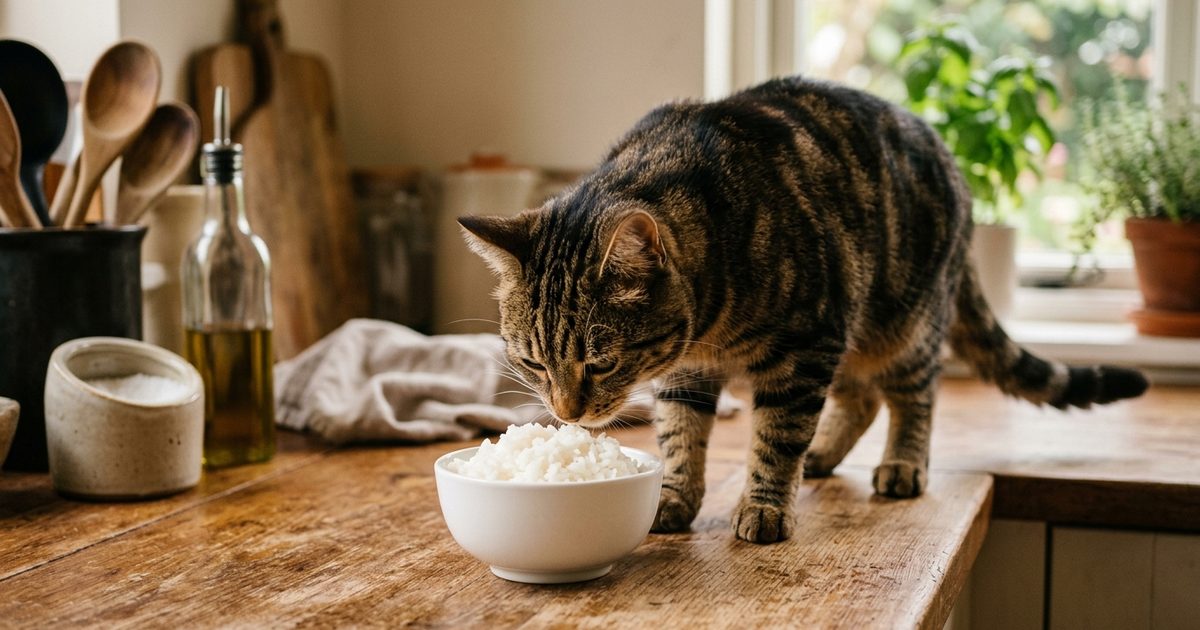
Yes — plain cooked white rice is safe for cats in small amounts. It isn't toxic, and vets often pair it with boiled chicken as a short-term bland diet when a cat has an upset stomach or diarrhea. As a regular food, though, rice gives a cat almost nothing nutritionally.
The short verdict
The honest one-word answer is yes — cats can eat rice, and if your cat steals a grain or two off the floor, there's no reason to panic. Plain cooked white rice is non-toxic to cats, and you'll even see it listed among the ingredients in some commercial cat foods, where it works as a cheap binder that holds kibble together and adds bulk to wet food. That presence on a label is about manufacturing convenience and cost, not feline nutrition.
The framing worth remembering is "safe but not needed." A bite of plain rice won't harm your cat, but it also won't do anything for her that her regular food doesn't already do better. Rice fills space in the bowl without contributing the protein, taurine, or moisture your cat actually runs on — so the question of can cats eat rice has a clearer answer than the question of whether they should.
When "safe" doesn't mean "good"
"Safe" here is conditional, and that's the part most owners miss. Rice is safe for a cat if it's plain — no salt, no butter, no garlic or onion seasoning, no soy sauce. It's safe if it's fully cooked and soft; raw or crunchy rice is genuinely hard on a cat's digestive tract. And it's safe if it's a small amount, given occasionally rather than as a steady part of meals.
Those conditions matter because they separate two very different uses of rice. There's a legitimate medicinal use — the classic boiled-chicken-and-rice bland diet a vet may suggest for a cat with mild diarrhea — and there's the everyday risks of feeding rice regularly, where empty carbohydrates quietly add up. Both come up later in this article, because the line between "harmless in a pinch" and "a bad habit" depends entirely on how, when, and how much.
Does Rice Have Any Nutritional Value for Cats?
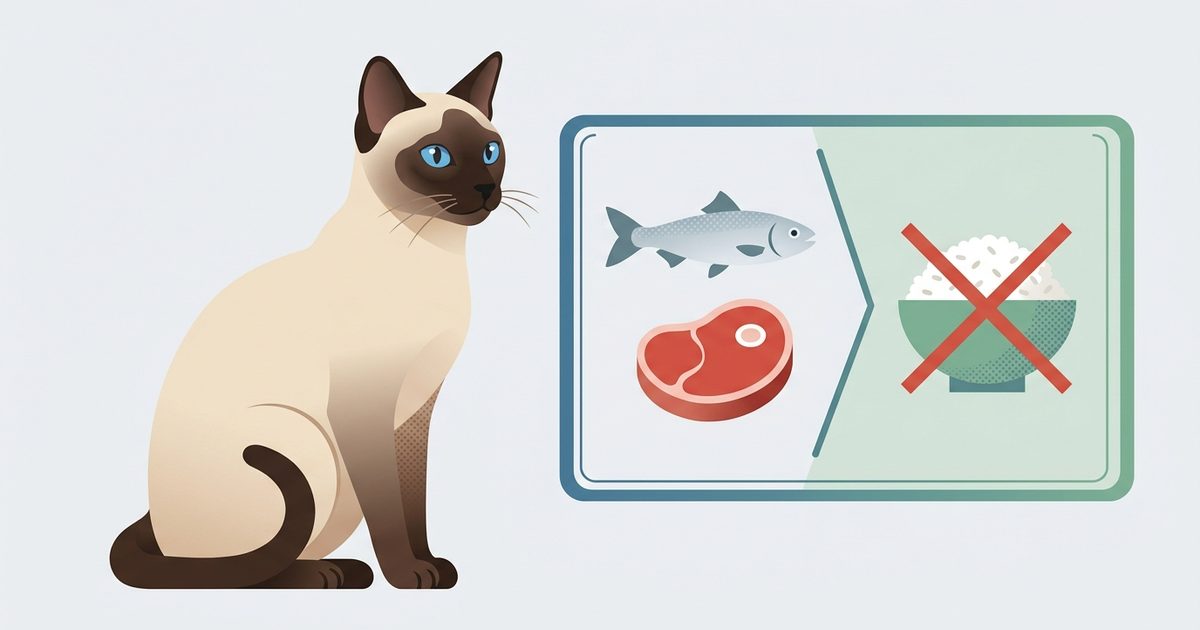
Not really. Rice is mostly carbohydrates, and cats — as obligate carnivores — have no dietary need for carbs. Rice gives a cat calories and fullness without the protein, taurine, or vitamins their bodies actually run on, so nutritionally it acts as a filler, not a food.
Cats are obligate carnivores
A cat is an obligate carnivore, which means her body is built — biologically and biochemically — to run on animal tissue, not plants. Her teeth, her short acidic digestive tract, and her enzymes are all tuned for meat. She produces only limited amounts of the enzymes needed to break down carbohydrates, and she lacks the metabolic pathways that let humans and dogs turn a steady carb intake into usable energy efficiently. That's not a flaw; it's the design of a hunter.
Two requirements make rice especially poor fuel for a cat. The first is protein — and specifically high-quality animal protein, which supplies the amino acids a cat can't synthesize on her own. The second is taurine, an amino acid found almost exclusively in animal tissue, essential for a cat's heart, eyes, and reproduction. Rice contains neither in any meaningful amount. The Cornell Feline Health Center is a reliable starting point for understanding what a complete feline diet actually requires, and rice doesn't appear on that list in any role except filler.
Why rice shows up in cat food anyway
So if rice has so little to offer a cat, why is it in some cat foods at all? The answer is practical, not nutritional. In dry kibble, a starchy grain like rice helps bind the pieces together, holds the shape during extrusion, and keeps the food affordable. In some wet foods, it adds bulk and texture. Rice is cheap, shelf-stable, and easy to manufacture with — none of which makes it necessary for the cat eating the food.
This is the gap between "it's in my cat's food" and "my cat needs it." A formulated commercial diet is balanced around the nutrients a cat requires, and the rice inside it is playing a structural role, not a nutritional one. If you want the broader picture of what a cat's diet should actually be built on, our guide to what cats eat walks through the proper framework — meat-forward, moisture-rich, and complete in the ways rice can never be.
White Rice vs Brown Rice — Which Is Better for Cats?
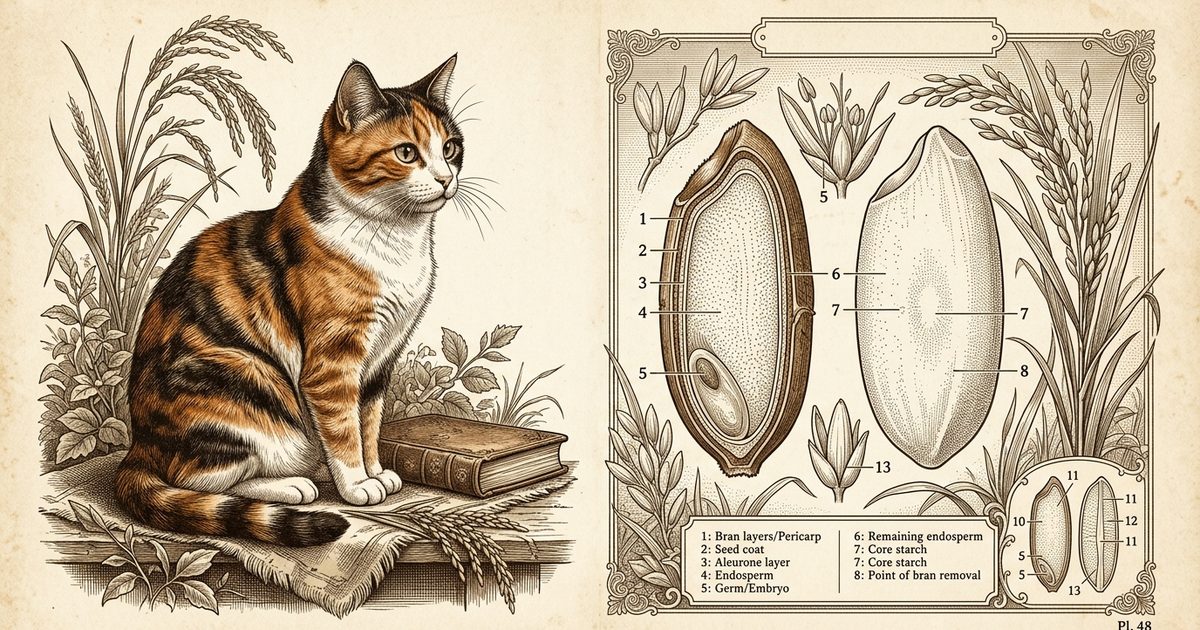
White rice is the better choice for cats. It's more processed, which paradoxically makes it easier for a cat's short digestive tract to break down. Brown rice carries more fiber and nutrients for humans, but the bran layer is harder for cats to digest and offers them little real benefit.
Why white rice is easier to digest
White rice starts as brown rice and then has its outer bran layer and germ milled away, leaving mostly the starchy endosperm. For humans that sounds like a loss, but for a cat it's a gain. Without the fibrous bran, the starch structure is simpler and softer, and there's far less roughage for the gut to wrestle with.
This matters because a cat's digestive tract is short — built to process meat quickly, not to ferment tough plant fiber. Lower fiber and a simpler starch mean white rice passes through gently, with minimal work for the GI tract to do. That gentleness is the entire point of offering rice to a cat in the first place. Whether the question is can cats eat white rice safely or which variety to reach for, the answer leans the same direction: plain, cooked, white.
Brown rice — more fiber, less suited to cats
Brown rice keeps its bran layer intact, which is exactly why it's labeled the "healthier" choice in human nutrition. The bran adds fiber, vitamins, and minerals. But that logic doesn't transfer to an obligate carnivore.
Cats have a short colon designed for meat, not for breaking down bulky plant fiber. The bran that benefits a human gut can sit heavy in a cat's, and in cats not accustomed to grains it can cause gas, bloating, or loose stool. The same grain-digestibility principle applies across grains — it's why we walk through a similar caution when asking whether cats can eat corn. "Healthier for humans" is a human framework; for a cat, the gentler, more processed grain is the more appropriate one.
Cooking matters more than color
If there's one thing that outweighs the white-vs-brown debate, it's the cooking state. Fully cooked, soft, plain rice of either type is far easier on a cat than rice that's undercooked or raw. Uncooked rice — white or brown — is hard for cats to break down and can cause stomach discomfort, which is why we cover it among the risks further down.
Why Is Rice Used for Cats With Diarrhea?
Vets often recommend a temporary bland diet of plain boiled white rice mixed with boiled chicken for mild diarrhea or an upset stomach. The rice is easy to digest, bland enough to rest the gut, and its starchy texture helps bind loose stool — but it's a short-term tool, not a regular diet.
The bland diet explained
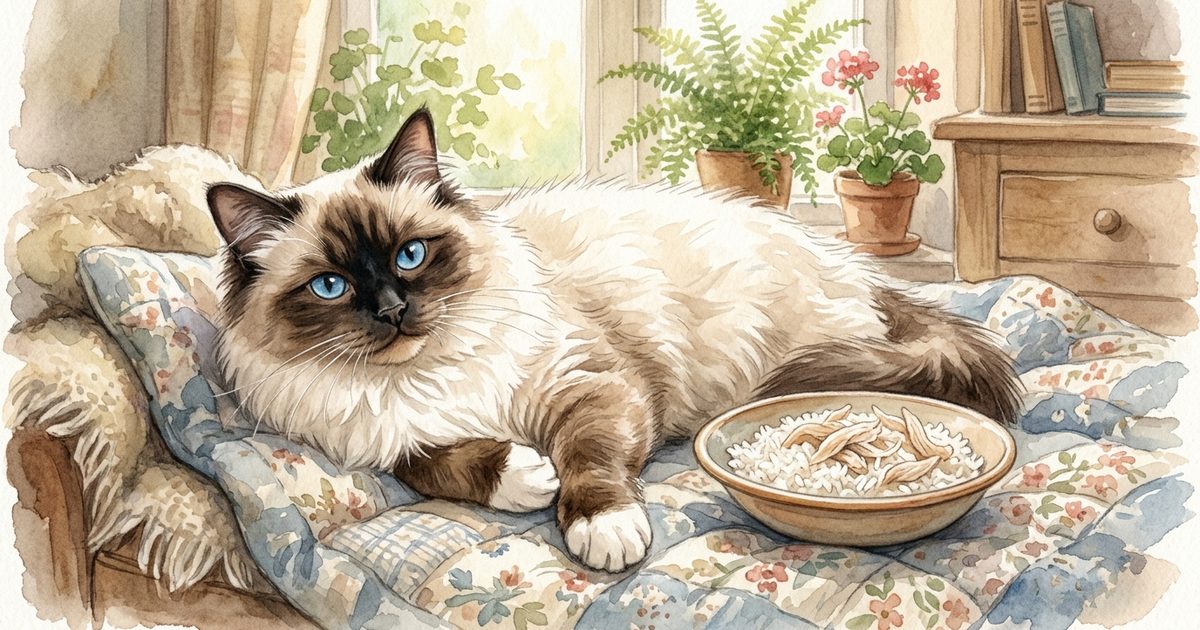
The classic home bland diet is boiled chicken and white rice — simple, plain, and deliberately boring to a cat's GI tract. The chicken provides easy protein; the rice provides gentle bulk. Two rules are non-negotiable: everything must be plain, and nothing may be seasoned. No salt, no oil, no broth with onion or garlic — a cat's recovering gut cannot handle added flavor, and some seasonings are outright toxic.
Proportions matter too. The mix should be mostly chicken with a smaller portion of rice — think a spoonful of rice folded into a larger amount of shredded boiled chicken. The chicken is the nutritional half of this pair, and you can read more about preparing it in our guide on whether cats can eat chicken. Keep the bland diet going for only a day or two, then gradually transition back to your cat's normal food.
How rice helps bind stool
White rice earns its place in the bland diet through a mild binding effect. Its easily digested starch helps firm up loose stool without irritating the gut lining, and because it's so bland it lets an overworked digestive tract essentially take a break. This is exactly why white rice is preferred over brown here — brown's bran fiber would work against the resting-and-binding goal.
The principle is simple: give the gut something effortless to process so it can recover. Rice isn't treating the underlying cause of the diarrhea; it's managing the symptoms while the gut heals. For the full picture on causes, red flags, and when home care ends, see our guide on cat diarrhea.
When bland diet isn't enough
A bland diet is a tool for mild, short-lived upset — not a substitute for veterinary care. If the diarrhea lasts more than a day or two despite the bland diet, or if you notice blood in the stool, repeated vomiting, lethargy, or a cat that's refusing water, those are vet-visit triggers, not home-care cases.
This isn't something to diagnose yourself. Persistent or severe symptoms can point to infection, parasites, inflammatory bowel disease, or other causes that need real treatment rather than rice and chicken. International Cat Care offers reliable guidance on digestive upsets and when a cat with diarrhea should be seen by a vet. When in doubt, the safest call is always to pick up the phone and ask.
How Much Rice Can a Cat Eat?
If you share plain cooked white rice, keep it to a small spoonful at most, and only occasionally as a treat — never as a meal replacement. Treats of any kind should stay under 10 percent of a cat's daily calories, and rice is one of the least useful treats you can offer.
The portion rule
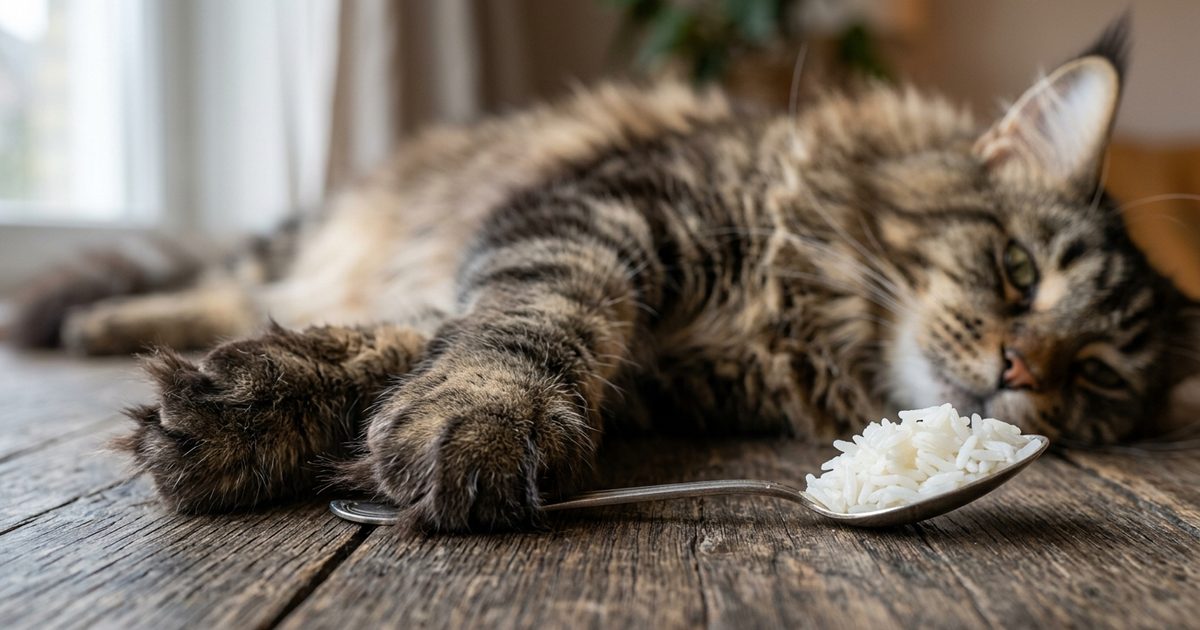
For an average adult cat, a teaspoon to a tablespoon of cooked white rice is the ceiling — and that's a rare spoonful, not a daily one. Rice is calorie-dense for what it delivers: a tablespoon holds roughly 15–20 calories of almost pure carbohydrate, and an indoor cat's entire daily budget is often only 200–250 calories. That single spoonful can quietly eat into a meaningful slice of the day's allowance while giving back almost no protein, taurine, or anything the cat actually runs on.
The widely cited guideline is that treats of any kind — rice included — should make up no more than 10 percent of a cat's daily caloric intake. With rice, you'll hit that ceiling well before you hit anything useful. Think of it as a sometimes-food for variety, offered a couple of times a month at most, never as a recurring snack or a way to "round out" a meal.
Better treat alternatives
Because rice gives a cat so little back, it's really a last-resort treat — the thing you share when you're eating rice yourself and your cat is staring. For treats that actually do something for your cat, plain cooked chicken and plain cooked salmon are both dramatically better choices: they're animal protein, they carry the amino acids and taurine a cat's body is built around, and most cats find them genuinely exciting in a way a grain never will be.
The honest framing is this: rice isn't dangerous in tiny amounts, but it's also not a treat your cat is better off for having. Reach for the meat-based options first, and let rice stay a novelty rather than a habit.
What Are the Risks of Feeding Rice to Cats?
Regular rice adds empty carbohydrates that can contribute to weight gain and raise long-term diabetes risk, may cause mild digestive upset in cats not used to carbs, and uncooked rice is hard to digest and can carry contamination. None of this is an emergency, but it's reason not to make rice a habit.
Empty carbs and weight gain
This is the slow-burn risk, not an acute one. Rice delivers calories without the protein, taurine, or micronutrients a cat actually needs — so every spoonful of rice in effect displaces something more useful from the day's diet while still counting toward the calorie total. Indoor cats, who often lead low-activity lives, are especially vulnerable: those extra calories have nowhere to go and accumulate quietly as fat. Over months and years, chronic empty-carb feeding nudges a cat along the well-documented path from overweight to obesity to insulin resistance — the same trajectory that links feline obesity to diabetes in cats. The risk isn't a single serving; it's the habit.
Digestive upset
Cats unaccustomed to grains can react to even small amounts of rice with gas, bloating, or loose stool. Their short digestive tract is tuned for meat, not starch, so a sudden carb hit can briefly unsettle things. This is usually mild and self-limiting — it passes on its own within a day — but it's a sign the gut would rather you'd offered something else. International Cat Care notes that digestive upsets from dietary change are common and typically resolve once the food is removed.
Uncooked rice
Raw or dry rice is a different matter. The hard, dry grains are difficult for a cat to break down and can cause stomach discomfort, and dry rice carries a low-but-real risk of bacterial or mycotoxin contamination from how it's stored and handled. Always cook rice fully before offering any to a cat — the same "cook it, don't hand it over raw" principle that applies to bread and other grain-based human foods. The shared lesson is straightforward: empty carbs are unhelpful, but the uncooked state is where real risk creeps in.
Seasoned, fried, and risotto rice
This is where rice crosses from "unhelpful" into "genuinely risky." Flavored rice dishes — soy sauce (which is loaded with salt), garlic or onion seasoning, oil, butter, the rich ingredients in risotto — carry the same ingredient-toxicity hazards as any seasoned human food. Garlic and onion are toxic to cats, excess salt is harmful, and heavy fats can trigger GI upset or worse. The caution generalizes: if the rice on your plate tastes interesting to you, it almost certainly contains something that's bad for your cat. Plain, cooked, and unseasoned is the only version that belongs near a cat's bowl.
Rice for Cats at a Glance — Summary
| Question | Short answer |
|---|---|
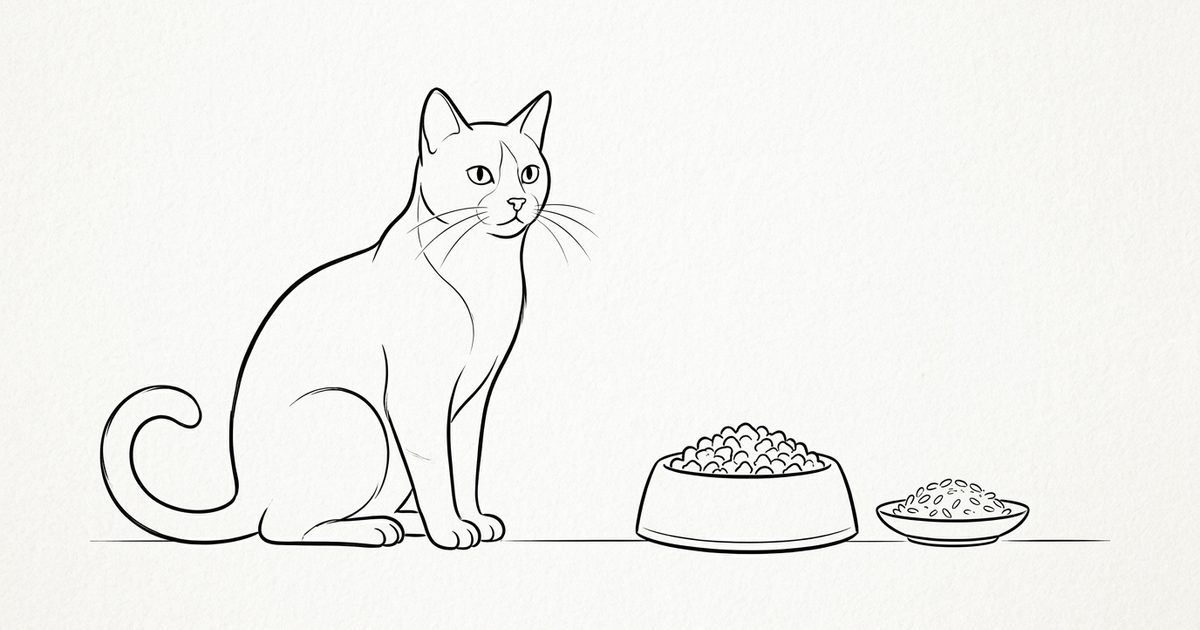
| Can cats eat rice? | Yes — plain cooked white rice is safe in small amounts, and it's not toxic to cats |
| Is rice good for cats? | No — it's mostly empty carbohydrates with no real nutritional value for a cat |
| White or brown rice? | White is the better choice — easier to digest, gentler on a cat's short GI tract |
| Can rice help with diarrhea? | Yes — as a short-term chicken-and-rice bland diet to rest the gut and bind stool |
| How much is safe? | A teaspoon to a tablespoon, occasional treat only, never a meal replacement |
| Is uncooked rice safe? | No — cook it first; raw rice is hard to digest and carries a small contamination risk |
The honest bottom line: a small spoonful of plain cooked white rice won't hurt your cat, and it has one legitimate, short-term job — resting an upset stomach as part of a bland diet. Beyond that, rice gives your cat almost nothing she actually needs, and feeding it regularly just adds empty carbs she can't use. If you want to treat her, there are far better options — a sliver of boiled chicken or salmon gives her real nutrition rice never will. When in doubt, lean on the complete feline diet framework rather than reaching for grains.
Curious What Your Cat Would Say?
Upload a photo and get a warm, personalized reading from your cat's perspective.
Start Your Free ReadingRice for Cats at a Glance — Summary
| Question | Short answer |
|---|---|
| Can cats eat rice? | Yes — plain cooked white rice is safe in small amounts, and it's not toxic to cats |
| Is rice good for cats? | No — it's mostly empty carbohydrates with no real nutritional value for a cat |
| White or brown rice? | White is the better choice — easier to digest, gentler on a cat's short GI tract |
| Can rice help with diarrhea? | Yes — as a short-term chicken-and-rice bland diet to rest the gut and bind stool |
| How much is safe? | A teaspoon to a tablespoon, occasional treat only, never a meal replacement |
| Is uncooked rice safe? | No — cook it first; raw rice is hard to digest and carries a small contamination risk |
The honest bottom line: a small spoonful of plain cooked white rice won't hurt your cat, and it has one legitimate, short-term job — resting an upset stomach as part of a bland diet. Beyond that, rice gives your cat almost nothing she actually needs, and feeding it regularly just adds empty carbs she can't use. If you want to treat her, there are far better options — a sliver of boiled chicken or salmon gives her real nutrition rice never will. When in doubt, lean on the complete feline diet framework rather than reaching for grains.
Curious What Your Cat Would Say?
Upload a photo and get a warm, personalized reading from your cat's perspective.
Start Your Free ReadingCurious What Your Cat Would Say?
Upload a photo and get a warm, personalized reading from your cat's perspective.
Start Your Free ReadingFrequently Asked Questions
Can cats eat white rice?
Yes — plain cooked white rice is safe for cats in small amounts. It's non-toxic, easier to digest than brown rice, and it's the form vets use in a short-term chicken-and-rice bland diet. Never share rice that's salted, buttered, or seasoned.
Can cats eat brown rice?
Technically yes, but it's not the better choice. Brown rice keeps its bran layer, which adds fiber but is harder for a cat's short digestive tract to break down and can cause gas or loose stool. White rice is gentler and more appropriate for cats.
Can cats eat uncooked rice?
No. Raw or dry rice is hard for a cat to break down and can cause stomach discomfort, and it carries a small risk of bacterial or mycotoxin contamination from storage. Always cook rice fully and let it cool before offering any to your cat.
How much rice can I give my cat?
At most a teaspoon to a tablespoon of plain cooked white rice, and only occasionally as a treat — never as a meal replacement. Treats of any kind should stay under 10 percent of a cat's daily calories, and rice is one of the least useful treats you can offer.
Is rice good for cats with diarrhea?
As a short-term tool, yes. Vets often suggest a temporary bland diet of plain boiled chicken mixed with a little white rice to rest the gut and help bind loose stool. It manages symptoms for a day or two but doesn't treat the underlying cause — if diarrhea persists, see your vet.
Why is rice in some cat foods?
Rice shows up in some commercial cat foods because it's cheap, shelf-stable, and helps bind kibble together or add bulk to wet food. It plays a structural manufacturing role, not a nutritional one — presence on a label doesn't mean cats need it.
Can kittens eat rice?
It's best to avoid giving rice to kittens. Their digestive systems are still developing and they need complete, calorie-dense nutrition from properly formulated kitten food to grow. A grain offers them nothing useful and could upset a young gut.
What should I do if my cat ate seasoned or fried rice?
Watch for vomiting, diarrhea, lethargy, or loss of appetite, since seasoned rice often contains salt, garlic, onion, or oil — all harmful or toxic to cats. If the dish had garlic or onion, or symptoms appear, call your vet or a pet poison hotline right away rather than waiting.
Is rice toxic to cats?
No — plain rice is not toxic to cats. The real risks come from how it's prepared: seasonings like garlic and onion are toxic, excess salt is harmful, and uncooked rice is hard to digest. Plain, fully cooked white rice in small amounts is the only safe form.
Sources & References
You Might Also Like
Kitten Teething: Timeline, Symptoms & How to Help
Kitten teething runs from 3 to 7 months as baby teeth fall out. Learn the timeline, signs to watch for, and how to soothe a teething kitten safely.
15 min readWhen Do Cats Stop Growing? A Complete Timeline
When do cats stop growing? Most cats reach adult size by 12-18 months, but large breeds like Maine Coons keep growing until 3-4 years. Full timeline inside.
14 min readCan Cats Eat Cherries? Flesh, Pit & Toxicity Facts
Can cats eat cherries? Pitted flesh is safe in tiny amounts — but the pit, stem, and leaves are toxic (cyanide precursors). Learn what's safe and what isn't.
15 min read