
Can Cats Eat Ham? Why Plain Cooked Is Best Avoided
Can cats eat ham? It's one of the most googled "can my cat eat this" questions, and the honest answer sits in an awkward middle zone: not toxic, but not a good treat either. So is ham bad for cats? Not in the panic-inducing way chocolate or onions are — a tiny piece of plain cooked ham won't poison your cat. The real problem is that ham is a processed, high-sodium meat built for human palates, and your cat's kidneys were never designed to filter that kind of salt load on a regular basis.
Key takeaways
- Small amounts of plain cooked ham aren't toxic to cats, but the high sodium and preservatives make it a poor regular treat.
- A literal one-off unseasoned crumb is unlikely to harm; routine feeding, glazed ham, or seasoned ham is risky.
- Plain cooked lean chicken or turkey is the healthier swap when your cat wants a savory bite.
Forms of Ham — Quick Reference
| Form of ham | Safe for cats? | Key concern |
|---|---|---|
| Plain cooked ham | Only a tiny piece, rarely | High sodium even when lean |
| Deli / sliced ham | Not recommended | Saltier and more processed than home-cooked |
| Seasoned or glazed ham | Avoid | Onion/garlic powder, sugar glazes, preservatives |
| Ham bone | Never | Cooked bones splinter and can puncture the gut |
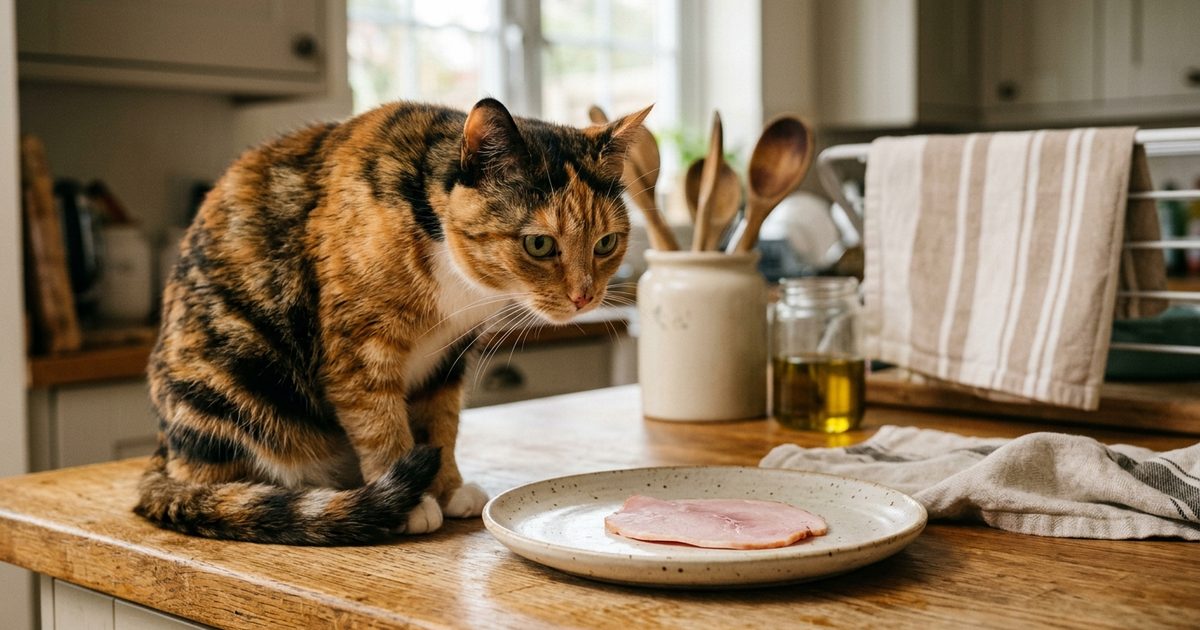
Can Cats Eat Ham?
Small amounts of plain cooked ham are technically safe for cats — it isn't toxic. But ham isn't a good treat: it's a processed, high-sodium meat that cats' kidneys weren't built to handle. A one-off tiny piece won't harm; regular feeding isn't recommended.
That blockquote is the heart of the answer, so let's unpack why "not toxic" and "good for your cat" are two very different bars. Ham is pork, and pork muscle itself isn't poisonous to felines — cats are obligate carnivores, and lean meat is exactly what their biology runs on. What turns ham into a questionable treat isn't the animal it came from, but everything humans do to it afterward: the curing, the salt, the preservatives, the glazes. By the time a slice of ham reaches your kitchen, it's a processed food, and processed foods are where cat and human diets sharply diverge.
This is worth being precise about, because the internet is full of confidently wrong answers. Some sources say "ham is fine, it's just meat"; others treat any pork as forbidden. Neither captures the real picture. The Cornell Feline Health Center is clear that cats do best on diets formulated for their specific nutritional needs, and that human foods — even non-toxic ones — should be occasional extras, never a staple. So the question isn't really "will ham kill my cat?" For plain cooked ham in tiny amounts, the answer is no. The better question is whether ham earns a place in your cat's life at all, and for most cats the honest answer is: rarely, if ever, and only in a crumb-sized piece. If you want a deeper comparison of where ham sits against other pork products like bacon, see our guide on whether cats can eat bacon.
Technically safe, but not recommended
The phrase "technically safe" does a lot of quiet damage. When owners hear that plain cooked ham isn't toxic, it easily morphs into "ham is a fine treat," which then becomes a daily slice off the deli platter. That drift is exactly what gets cats into trouble. "Non-toxic" only means a single small exposure won't send your cat into acute crisis — it says nothing about what happens when sodium and preservatives accumulate week after week.
There's a meaningful gap between a one-off event and a habit, and we'll spell out that threshold fully in the "tiny piece won't hurt" caveat below. For now, the short version: a fingernail-sized piece of plain, unseasoned, unglazed ham once in a long while is very unlikely to harm a healthy adult cat, but "once in a while" has a way of becoming "every time I make a sandwich," and that's where a technically-safe food stops being safe in practice. If you're already in the habit of sharing, the cleaner move is to swap in a small piece of plain cooked chicken — your cat gets the savory reward without the salt load. You can read more on the overall feline diet in our guide to what cats eat.
Why cats are drawn to ham
If ham isn't great for cats, why do they beg for it so hard? The answer is simple and has nothing to do with nutrition. Ham is salty and rich in savory umami compounds, and cats — like humans — are wired to find those flavors irresistible. Palatability is a powerful hook, but it isn't the same as nutritional suitability; plenty of foods cats crave are ones their bodies aren't built to handle regularly.
So when people ask can cats eat cooked ham because their cat goes wild for it, the enthusiasm is real but it isn't a green light. International Cat Care notes that cats' strong preferences for salty, savory flavors don't reflect what's healthy for them — a cat's taste for a food tells you it's appealing, not that it's appropriate. The salt that makes ham tempting to your cat is precisely the ingredient that makes it a poor choice, which is the central irony of the whole question.
Ham vs Bacon vs Plain Chicken — What's the Difference?
Ham is processed pork — leaner than bacon but still high in salt. Bacon is fattier and smoked; both are processed meats to avoid. Plain cooked chicken or turkey is the better choice: a whole-food lean protein without curing salt or preservatives.
When people wonder whether cats can eat ham, the comparison that actually matters isn't pork versus poultry — it's processed versus whole. Ham, bacon, and plain cooked chicken sit at very different points on that line, and the difference explains why one is a fine treat and the other two aren't.
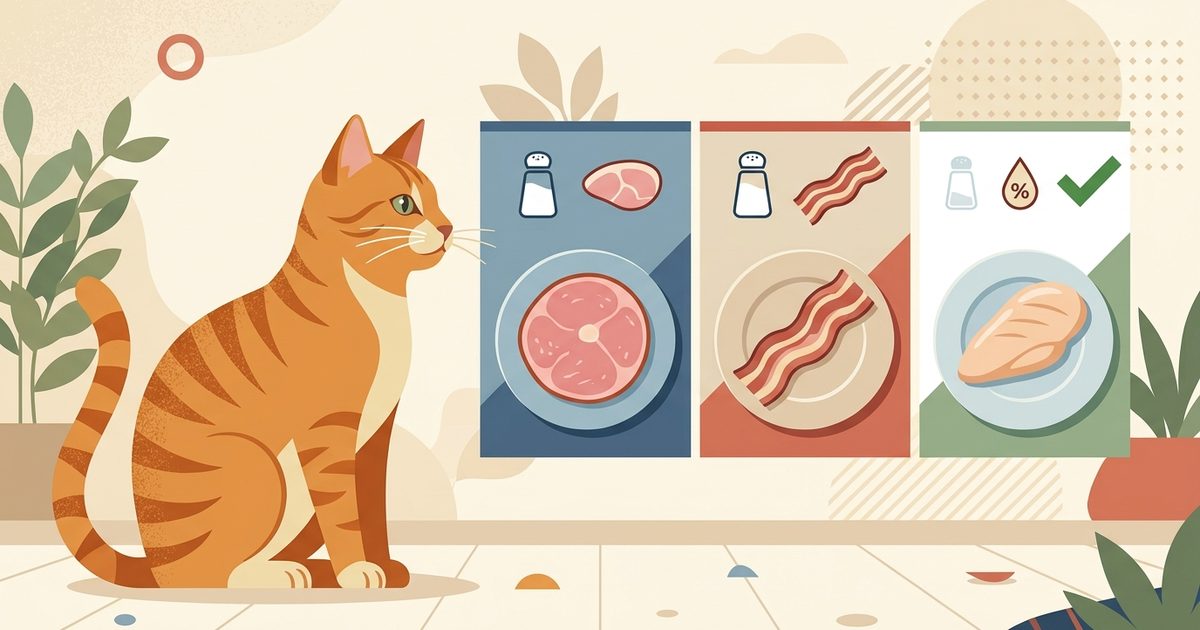
Ham vs bacon — both processed pork
Ham and bacon come from the same animal, and both are cured, which means salt is built into them rather than sprinkled on top. Ham is typically leaner — it carries less rendered fat than a strip of bacon — but it's about equally salty because, as we established above, the curing process is what concentrates the sodium, not the cut of meat. Bacon goes further: it's also smoked, and it holds onto more fat that renders out when cooked. So while ham is the milder of the two, "leaner" doesn't translate to "safer" — the salt load is the real disqualifier, and it's present in both. If you want the full breakdown of the fattier, smoked side of this family, our can cats eat bacon guide covers why a single strip is already too much.
Ham vs plain cooked chicken or turkey
Set the processed pork aside and the contrast sharpens. Plain cooked chicken or turkey is a whole-food lean protein — no curing salt, no smoke, no preservatives, just meat that's been cooked without seasoning. That's why it's the treat vets tend to reach for: it gives a cat protein and moisture without the additives ham brings. As we saw above, it's the curing that disqualifies ham, not the pork itself — so a small piece of plain cooked chicken is the recommended swap, and our can cats eat chicken and can cats eat turkey guides walk through how to prepare either one safely.
The key takeaway: processing, not the animal
Strip the labels away and one principle holds across all of these foods: fresh, lean, unseasoned meat is a reasonable occasional treat for a cat; cured, smoked, or heavily processed meat is not. That rule generalizes beyond ham and bacon — it applies to deli meats, sausages, and salted cuts of any animal. The animal the meat comes from matters far less than what humans did to it before it reached the plate. So when the question is "can cats eat ham," the honest answer is shaped less by the pork than by the curing.
Why Is Ham Not Ideal for Cats?
Ham is suboptimal for cats because of its high sodium (salt poisoning and kidney strain), preservatives like nitrates and nitrites used in curing, and its fat content. These make pancreatitis and salt-poisoning risks real, especially for small or senior cats.
Three things in ham do the damage, and sodium is the biggest. The others — curing preservatives and fat, plus whatever glaze or seasoning the ham was finished with — stack on top. None of them are toxic in the way onion or garlic is, which is why a tiny piece won't poison a cat on the spot. But together they're exactly why ham sits firmly in the "not a good treat" column.
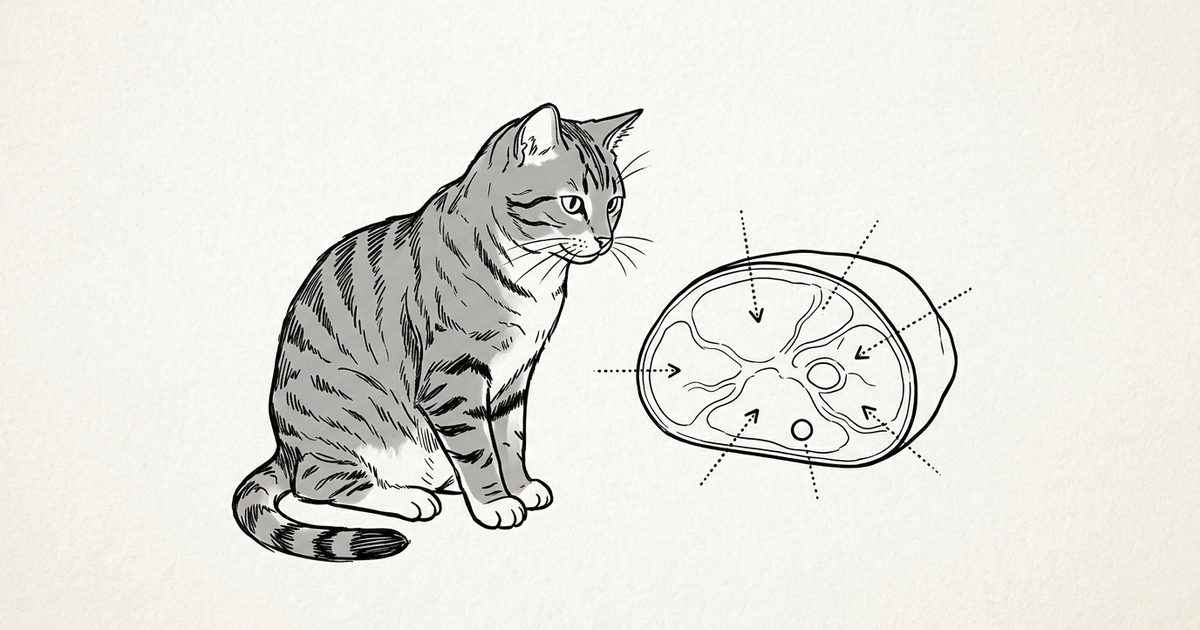
High sodium — the biggest concern
A cat's sodium tolerance is far lower than a human's, because cats evolved as obligate carnivores getting most of their water and minerals from prey — their kidneys weren't built to unload the salt loads that a human dinner carries. Curing concentrates sodium regardless of how lean the ham is, so even a small slice can push a small cat toward an uncomfortable fraction of its daily sodium ceiling. At higher amounts, excess salt can cause salt poisoning (sodium ion toxicosis), with signs like vomiting, diarrhea, lethargy, increased thirst, and in serious cases neurological symptoms. International Cat Care covers sodium toxicosis in more depth; the practical takeaway is that "just a little ham" is a much bigger sodium event for a 4 kg cat than it looks like to us.
Preservatives: nitrates and nitrites
Commercial ham is cured with nitrates and nitrites — compounds that preserve color and hold off bacterial growth during processing. These are part of what separates ham categorically from a fresh piece of pork: the meat has been chemically treated for shelf life and appearance, not just cooked. "Uncured" labels can mislead, because uncured ham usually relies on celery-derived nitrates, which are the same compounds under a different name. So the processing distinction holds whether the package says cured or not — the ham a cat would eat is still a preserved, salted product, not fresh meat.
Fat, glazes, and seasonings
The fat marbled through ham adds calories a house cat doesn't need, and fatty meals are linked to pancreatitis — a painful inflammation of the pancreas that can land a cat at the vet. Glazes pile on more trouble: honey, maple, and brown-sugar coatings add sugar cats have no use for, and seasoned hams may carry onion or garlic powder, both of which are genuinely toxic to cats and can damage red blood cells. This is the same fat-and-pancreatitis risk that makes bacon a poor choice — our can cats eat bacon guide covers that mechanism in detail. For the broader picture of how processed foods fit (or don't) into a cat's diet, the Cornell Feline Health Center is a reliable reference.
Deli ham vs home-cooked ham
Deli or pre-sliced ham tends to be saltier and more heavily processed than a piece roasted at home — it's engineered for shelf life, thin slices, and uniform flavor. A home-roasted ham is a milder version of the same category, but it's still cured, still salty, and still processed pork. Neither is a good regular treat; the home-cooked one is simply the lesser of two processed options rather than a genuinely safe one.
How Much Ham Is Too Much for a Cat?
There's no healthy serving of ham for cats. Even a small piece carries significant salt relative to a cat's body weight. A tiny plain unseasoned crumb once is unlikely to harm; a slice, regular feeding, or glazed or seasoned ham is risky.
Why even a small piece is a lot
The dose problem comes down to simple arithmetic. An average adult cat weighs around 4 to 5 kilograms — roughly a fifteenth of a typical adult human. Yet the salt in a piece of ham doesn't scale down with the cat. A thin slice of deli ham can hold several hundred milligrams of sodium, which is a meaningful fraction of the amount feline kidneys are built to process in a whole day. Curing concentrates that salt into the meat, so the lean look of the slice is misleading: it reads as "just protein" but behaves in a cat's body like a large, sudden sodium hit. This is why the math consistently favors avoidance rather than portion control — there's no cutting a "cat-safe" piece from a food that's already oversalted at the human serving size. As for the one-off-versus-habit question, that threshold is spelled out fully in the caveat below.
Cats most at risk
Some cats have an even thinner margin. Kittens have small bodies and immature kidneys, so the same crumb hits a far larger relative dose. Senior cats often have declining kidney function that they're already compensating for, and an unexpected salt load tips that balance. Cats with diagnosed kidney or heart disease are the most vulnerable, because their organs are already working hard to manage fluid and sodium. Small-bodied cats generally reach a concerning dose on less food than a large, muscular cat would. None of this is a diagnosis — it's a reason the safe threshold is lower than many owners assume, and why "just a little" is riskier the smaller, older, or less healthy the cat.
The "tiny piece won't hurt" caveat
There's a narrow truth hidden in that phrase, and it's worth stating plainly so it isn't stretched — this is the threshold referenced throughout the article. A literal one-off crumb of plain, unseasoned, cooked ham — dropped on the floor and snapped up once — is very unlikely to harm a healthy adult cat; the cat's body handles that trace load without trouble. What the phrase gets wrong is the leap from "once is fine" to "this is a reasonable treat": occasional trace exposure is not the same as routine feeding, and ham's appeal is exactly what turns a one-time crumb into a slice, then a habit. The principle is general — a food that's harmless at trace levels can still be a poor choice as a recurring part of a cat's diet.
What Can I Give My Cat Instead of Ham?
Safer alternatives include a small piece of plain cooked chicken or turkey, commercial cat treats, or ham-flavored cat treats if you want the savory flavor without the salt and preservatives. Plain lean cooked meat is the closest healthy swap.
Plain cooked chicken or turkey
If your cat loves the savory, meaty appeal of ham, plain cooked chicken or turkey is the closest healthy substitute. Both are lean whole-food proteins with no curing salt, no preservatives, and no added sugar — cooked through, unseasoned, with skin and bones removed, a small piece gives your cat the protein-rich taste it craves without the sodium load that disqualifies ham. This is the recommended protein treat for cats, and it's why we cover whether cats can eat chicken and whether cats can eat turkey as their own topics — each is a genuinely good occasional treat in a way ham is not.
Commercial and ham-flavored cat treats
Commercial cat treats are formulated for feline nutrition, with sodium levels controlled to a cat's needs rather than a human palate. That makes them a far safer way to deliver a savory reward. Ham-flavored cat treats are a particularly neat workaround if your cat has fallen for the taste of ham: they capture the savor without the human-food salt, preservatives, and fat that make real ham a poor choice. You get the flavor your cat loves without trading away its health for it. For the broader picture of how treats fit into a balanced feline diet, our guide on what cats eat walks through the essentials.
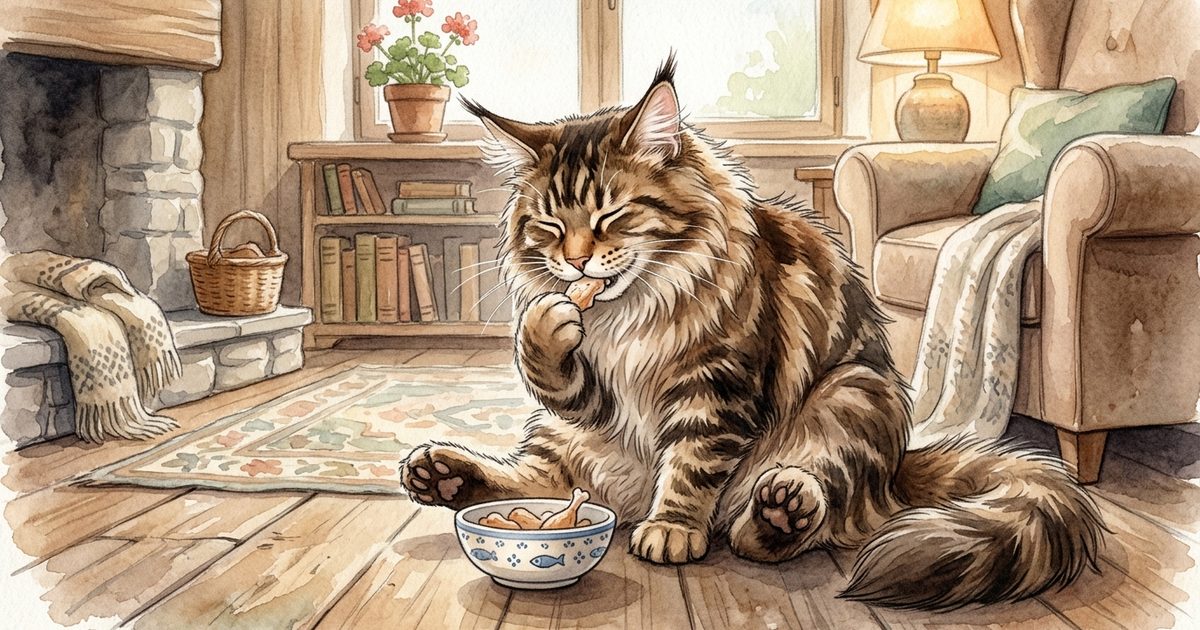
Can Cats Eat Ham Bones?
Never give a cat a cooked ham bone — or any cooked bone. Cooking makes bones brittle, so they splinter into sharp shards that can puncture the mouth, throat, stomach, or intestines. This is a serious surgical emergency, not a treat.
There's one clear rule about bones: raw is (sometimes) debated, cooked is never okay. A bone from a roasted ham looks like a natural item a cat might enjoy gnawing on — in fact, that bone has been made dangerous by the cooking process. Cooked bones don't bend or break cleanly under pressure; they splinter. That's why nearly every veterinary source classifies cooked bones — chicken, beef, pork, or ham — as a serious gastrointestinal risk rather than an occasional chew toy. This principle applies to any cooked bone, not just ham, but ham is the most common relevant bone a kitchen is likely to produce.
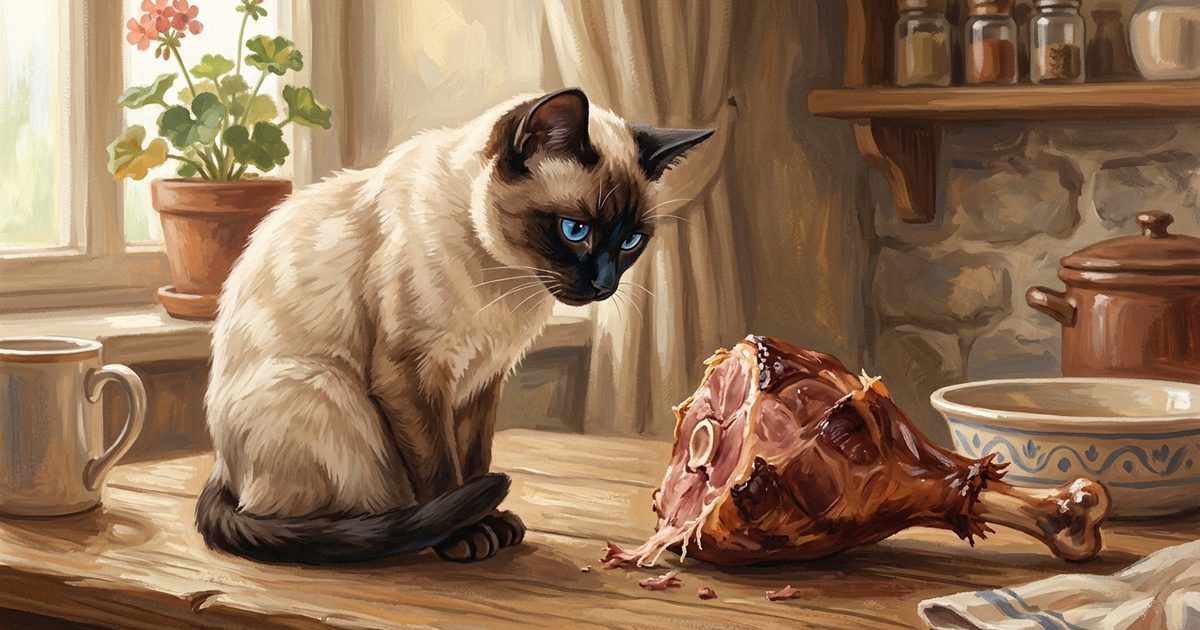
Why cooked bones are dangerous
Cooking a bone changes its physical structure. High heat drives off moisture and rigidifies the mineral matrix, turning bone from slightly flexible to brittle — much like a charred stick that snaps into sharp splinters under load rather than breaking cleanly. When a cat bites down on a cooked bone, fragments splinter into needle- and blade-like shards that can lodge in the gums, puncture the throat, or be swallowed into the stomach. Once in the intestines, sharp fragments can lacerate the gut wall, causing perforation, obstruction, or internal bleeding — injuries that usually require surgery to repair. Raw bones are less prone to splintering but carry their own controversies (bacterial risk, tooth fracture, nutritional imbalance) and are not a guaranteed safe option either; if you're unsure, swap all bones for a safe dental treat.
What to do if your cat ate a cooked bone
If your cat has eaten or chewed a cooked bone, do not induce vomiting unless a vet explicitly instructs it — vomiting can push sharp fragments through the esophagus a second time. Watch closely for drooling, gagging, vomiting, lethargy, loss of appetite, or abdominal tenderness (your cat flinching, growling, or guarding when you touch its belly). Any of these signs is a reason to call your vet or a pet poison hotline immediately rather than waiting. When in doubt, just call — the Cornell Feline Health Center is a reliable starting point for gastrointestinal emergency information, and an emergency clinic can confirm whether fragments remain via X-ray. If you want safer foods to offer instead, see the alternatives in the what-can-I-give-my-cat section — chicken or turkey.
Ham and Cats — Quick Summary
| Question | Short answer |
|---|---|
| Can cats eat ham? | Technically yes in tiny amounts — not toxic, but not recommended as a treat |
| Is ham toxic to cats? | No, plain cooked ham isn't toxic — but the sodium and preservatives make it unhealthy |
| Can cats eat deli ham? | Best avoided — deli ham is saltier and more processed than home-cooked |
| Can cats eat ham bones? | Never — cooked bones splinter and can puncture the digestive tract |
| How much ham is safe? | Only a one-off unseasoned crumb; there's no healthy regular serving |
| What's a safer treat than ham? | Plain cooked chicken or turkey, or ham-flavored cat treats |
Curious What Your Cat Would Say?
Upload a photo and get a warm, personalized reading from your cat's perspective.
Start Your Free ReadingFrequently Asked Questions
Can cats eat a small piece of ham?
A literal one-off crumb of plain, unseasoned, cooked ham is very unlikely to harm a healthy adult cat — it isn't toxic. But even that small piece carries real salt relative to a cat's body weight, so ham shouldn't become a regular treat or a sandwich-sharing habit.
Is ham toxic to cats?
No, plain cooked ham isn't toxic the way chocolate, onions, or garlic are. The problem isn't poisoning — it's the sodium, curing preservatives like nitrates, and fat, which strain a cat's kidneys and pancreas over time. Seasoned or glazed ham, however, can contain genuinely toxic onion or garlic powder.
Can cats eat deli ham or sliced ham?
Best avoided. Deli and pre-sliced ham are engineered for shelf life and uniform flavor, so they're saltier and more heavily processed than a home-roasted piece. Even a single thin slice can hold several hundred milligrams of sodium — a meaningful load for a small cat.
Can kittens eat ham?
Not recommended. Kittens have small bodies and immature kidneys, so the same crumb delivers a much larger relative sodium dose than it would in an adult cat. Stick to kitten-formulated food and plain commercial treats until a cat is fully grown.
How much ham is too much for a cat?
There's no healthy serving of ham for cats — any piece carries significant salt relative to their body weight. A one-off unseasoned crumb is the ceiling for 'unlikely to harm'; a full slice, regular feeding, or any glazed or seasoned ham crosses into risky territory.
Can cats eat ham bones?
Never give a cat a cooked ham bone, or any cooked bone. Cooking makes bones brittle so they splinter into sharp shards that can puncture the mouth, throat, stomach, or intestines — a serious surgical emergency, not a treat. If your cat ate one, call your vet immediately.
What are safer treats than ham for cats?
Plain cooked, unseasoned chicken or turkey is the closest healthy swap — lean whole-food protein without curing salt or preservatives. Commercial cat treats, including ham-flavored ones, are formulated with sodium controlled to feline needs and give the savory taste without the human-food salt load.
What should I do if my cat ate seasoned or glazed ham?
Watch closely for vomiting, diarrhea, drooling, lethargy, or loss of appetite, and call your vet or a pet poison hotline right away if any appear. Seasoned and glazed hams may contain onion or garlic powder, which is genuinely toxic to cats and can damage red blood cells — don't wait for symptoms to worsen.
Is lean ham healthier for cats because it's low in fat?
Partially true on fat, but false overall. Lean ham carries less rendered fat than bacon, yet the curing process concentrates just as much sodium, and the preservatives remain. Leanness doesn't remove the salt and additives that disqualify ham as a regular treat.
Sources & References
You Might Also Like
Kitten Teething: Timeline, Symptoms & How to Help
Kitten teething runs from 3 to 7 months as baby teeth fall out. Learn the timeline, signs to watch for, and how to soothe a teething kitten safely.
15 min readWhen Do Cats Stop Growing? A Complete Timeline
When do cats stop growing? Most cats reach adult size by 12-18 months, but large breeds like Maine Coons keep growing until 3-4 years. Full timeline inside.
14 min readCan Cats Eat Cherries? Flesh, Pit & Toxicity Facts
Can cats eat cherries? Pitted flesh is safe in tiny amounts — but the pit, stem, and leaves are toxic (cyanide precursors). Learn what's safe and what isn't.
15 min read