Do Cats Like Music? What Science Says About Cat Music
Do cats like music? It's one of those questions every cat owner eventually asks while their pet stares blankly at a speaker. The honest answer surprises most people: cats are largely indifferent to the music we love — but music for cats, specifically cat music built around feline frequencies, is a different story. Researchers have shown that cats genuinely respond to the right kind of sound, and that discovery is changing how we think about enrichment, calming, and what "a song" even means to a different species.
Key takeaways
- Cats are mostly indifferent to human music — pop, rock, and classical alike — because it's tuned to our vocal range, not theirs.
- They do respond to species-specific music composed from purr-rate tempos, suckling sounds, and high bird-like frequencies, orienting toward and even rubbing the speaker.
- Soft classical and slow ambient tones can calm some cats; loud, bass-heavy music tends to raise stress.
Cats and Music — Quick Reference
| Music type | Do cats respond? | Best for |
|---|---|---|
| Human pop & rock | Largely indifferent | Background only — for you, not them |
| Classical (soft, slow) | Mildly calming for some cats | Quiet company, light relaxation |
| Species-specific cat music | Strong response — approach, rub, purr | Enrichment, calming, alone-time |
| White noise & slow tones | Can mask startling sounds | Sleep, reducing stress triggers |
| Loud, bass-heavy | Often raises stress | Avoid around sensitive cats |
Do Cats Like Music? The Honest Answer
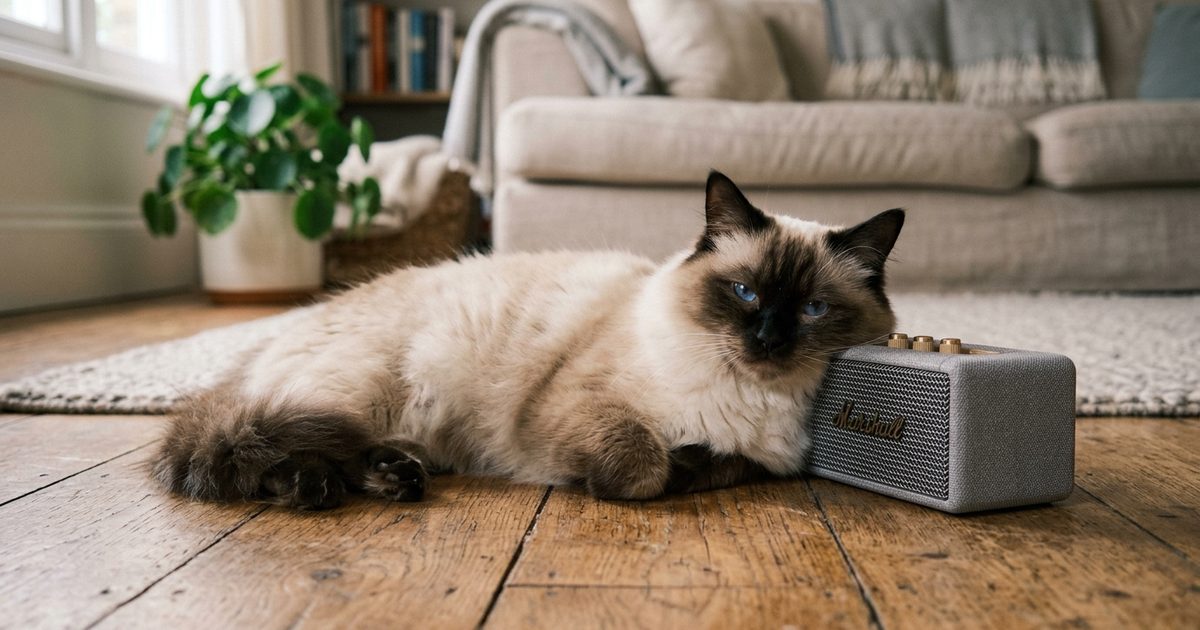
Mostly, no. Cats are indifferent to the music we love — pop, rock, or classical alike — because it's pitched for our vocal range. But when music is built around their own frequencies and purr-rate tempos, cats orient toward it, rub the speaker, and purr. The kind matters more than the volume.
That distinction — between "our music" and "music" — is the whole key. For decades, owners assumed cats simply didn't care for music, and in a broad sense that's true: put on your favorite album and most cats will do exactly nothing. But that doesn't mean music leaves them cold. It means human music is composed for human ears, in a frequency band and at tempos that match how we communicate. Cats live in a different sensory world.
The turning point came when researchers stopped asking "do cats like our music?" and started asking "is there music cats would like?" The answer, it turns out, is yes — and the evidence is striking. When music is pitched to a cat's vocal range and built around the rhythms of purring, suckling, and the chirps cats use at prey, they respond with clear, measurable interest: head turns, approaches, rubbing against the speaker, sometimes purring. These are the same behaviors a cat shows toward something genuinely engaging — not the flatline response they give to Bach or pop.
So if you've been playing your cat your playlist and gotten nothing back, you haven't proven she dislikes music. You've proven she's discerning. The question worth asking isn't whether cats like music — it's what kind of music speaks their language.
Indifferent, not deaf
Here's the crucial nuance: when your cat ignores your music, it isn't because she can't hear it. Cats have spectacular hearing — broader and more sensitive than ours across much of the range, tuned especially to the high, faint sounds of small prey. The issue isn't volume or acuity; it's relevance. Human melody sits largely in the mid-range of our vocalizations, a band cats aren't built to prioritize. They hear your playlist perfectly well — it just doesn't mean anything to them. For the full anatomy of how the feline ear works and why cats tune into some frequencies and not others, see our deep dive on cat hearing.
When cats DO respond
Cats do respond — powerfully — when music hits their band. The sounds that move them are the sounds they already use to communicate and self-soothe: the rhythmic hum of purring, the quick chirps and trills aimed at birds outside a window, the soft suckling of a kitten feeding. When composers build music from those ingredients — high frequencies in the octave above human speech, tempos matched to purring — cats stop ignoring the speaker and start engaging with it. They turn toward it, walk up to it, rub against it the way they rub a person they like. That response is real and repeatable, and it points straight to the research we'll unpack next.
The Science of "Cat Music" — Snowdon & Teie's Research
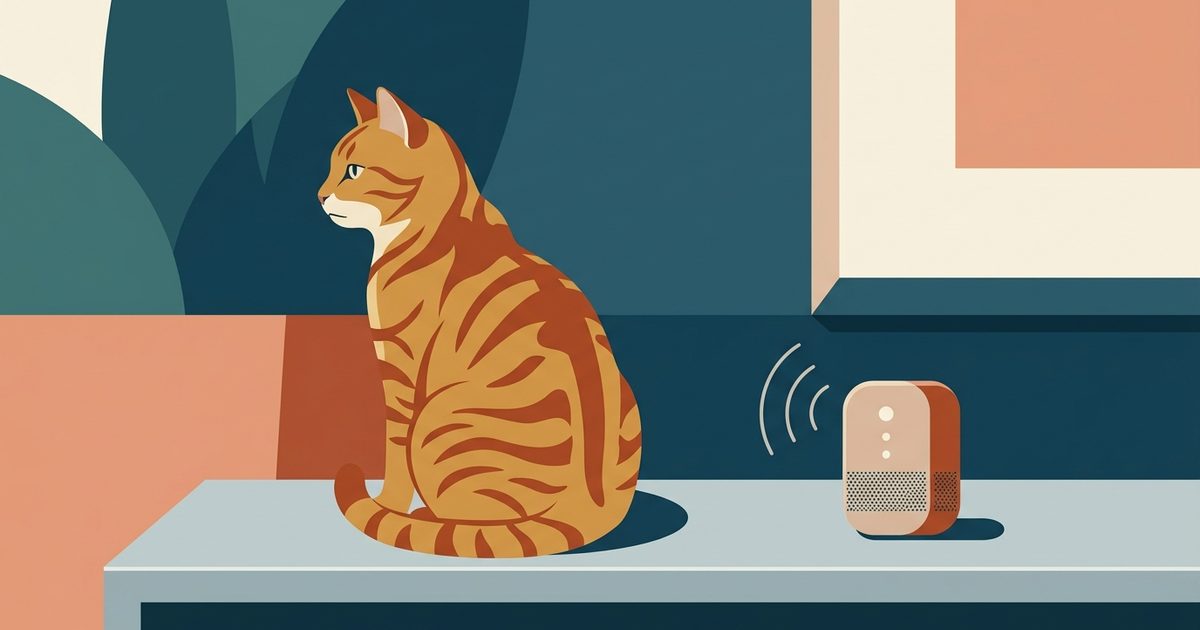
In a 2015 University of Wisconsin study, Charles Snowdon and David Teie played cats music built from feline vocal ranges and purr-rate tempos. The cats oriented toward the speaker, approached it, and rubbed against it — responses they didn't give to Bach. This "species-specific music" remains the strongest evidence that cats genuinely like the right kind of music.
Ever wonder what your cat actually hears when the music plays? Get a MeowMind reading — upload a photo and let her describe her own soundtrack in her own words.
How the music was built
Snowdon and Teie didn't write human songs and hope for the best. They designed music from the ground up around how cats communicate. The compositions lean heavily on high frequencies — much of the content sits in the octave above human speech, where feline vocalizations and kitten calls naturally live. Tempos were drawn from the rhythms cats already produce: the steady pulse of purring, the rhythmic suckling of a nursing kitten, the rapid chirping aimed at prey. Melodic motifs mimic bird calls and the trills cats exchange with each other.
The design principle is simple and, once stated, almost obvious: every species responds most to sound in its own vocal and emotional range. Music pitched for humans lands on cats the way a conversation shifted down two octaves would land on us — audible, but alien. Build the music where the cat already listens, and the cat listens.
What the cats did
When the cats heard the species-specific tracks, they responded with unmistakable interest. They turned their heads toward the speaker, walked up to it, rubbed against it, and in some cases purred — the same affiliative behaviors they direct at trusted beings, not the neutral stillness they showed to human classical pieces. Notably, age mattered: younger cats (under about five) and older cats (over ten) responded more strongly than middle-aged cats, likely because the young are more exploratory of novel sounds and the senior cats more attuned to soothing ones. You can read the original findings in their Applied Animal Behaviour Science paper on species-appropriate music for cats.
Why this matters
This research quietly reframes the entire question. "Do cats like music?" stops being about whether they enjoy our songs and becomes a better question: is there music they respond to on their own terms? The answer is yes — measurably, repeatedly, and in ways that suggest genuine engagement rather than mere tolerance. That shifts music from a human habit we assume cats share into a real form of feline enrichment, the kind the Cornell Feline Health Center highlights as part of a cat's environmental well-being. It also opens a practical door: if cats like the right music, then the right music can do real work — calming, comforting, and enriching their daily lives.
Why Human Music Doesn't Land — Cats Hear Differently
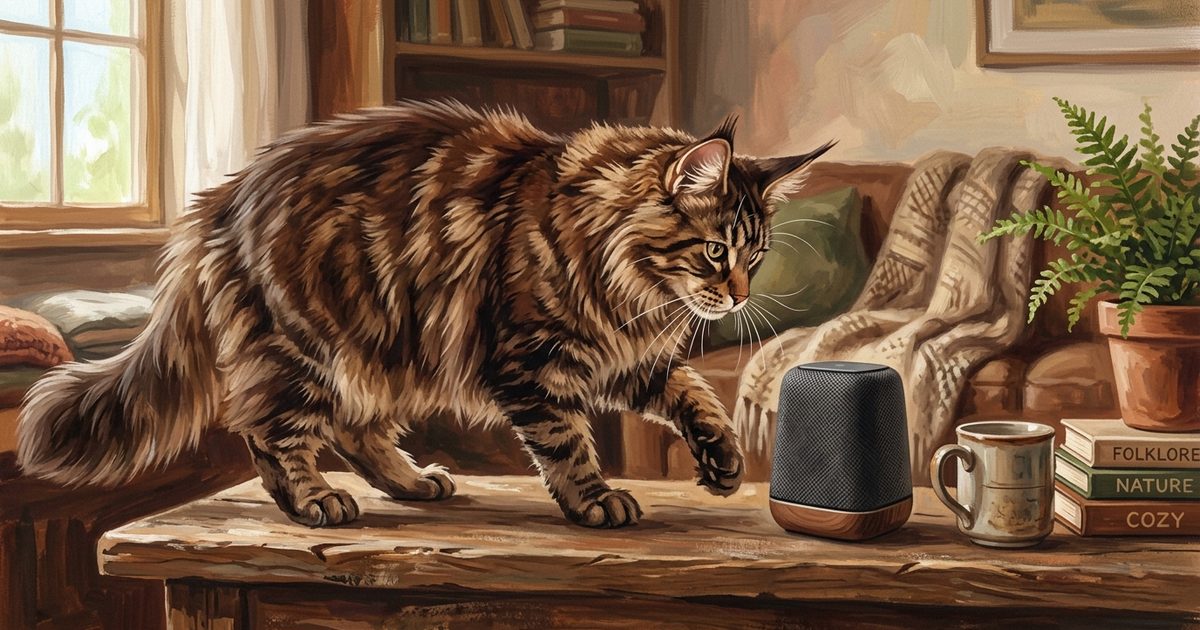
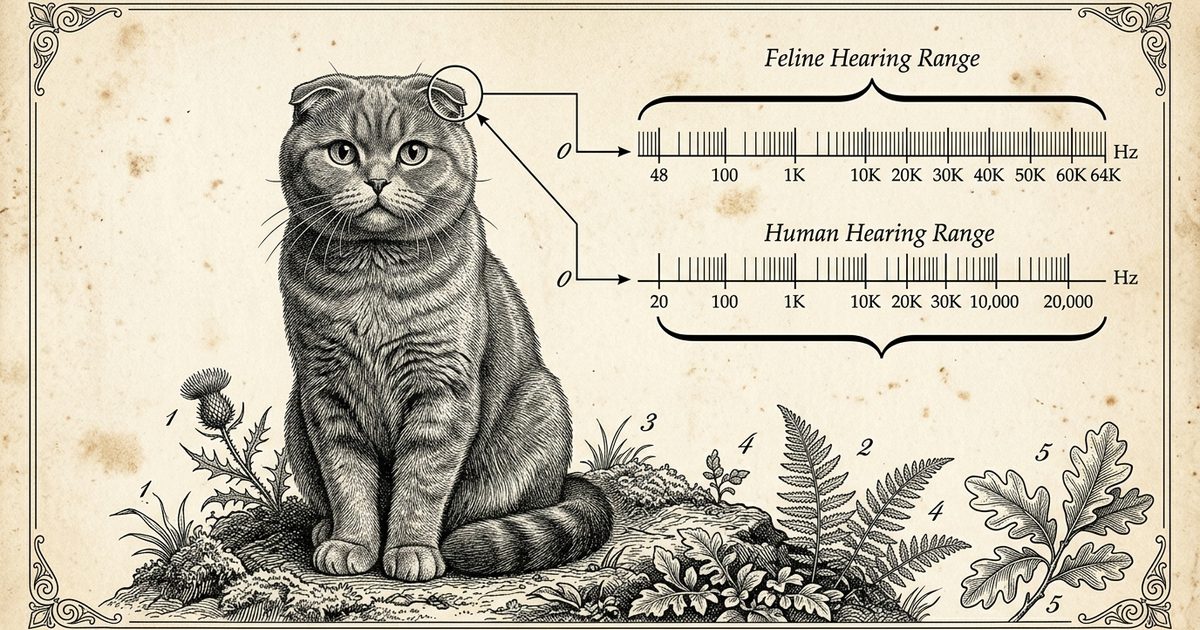
Cats hear a far wider range than we do — up to around 85 kHz versus our 20 kHz — tuned to the high, faint sounds of prey, not the mid-range of human melody. Most of our music falls outside the band cats attend to, so your playlist may read to them as background hum.
The frequency gap
A cat's hearing range runs from roughly 48 Hz up to about 85 kHz. Ours stops near 20 kHz. That extra octave-and-a-half on top is exactly where cats are most sensitive — the high, thin frequencies of a mouse squeak, a cricket, a kitten's call. Human melody, by contrast, lives mostly between 250 Hz and 4 kHz: the band our own ears evolved to care about. So when you play your favorite song, the largest share of its sonic information sits in a range your cat's auditory system simply isn't optimized to notice. For the full anatomy — how the feline ear achieves that range and why it evolved for hunting — we go deep in our article on cat hearing; here, the key point is that the mismatch is sensory, not emotional.
Tempo and rhythm mismatch
Frequency is only half of it. Cats communicate through vocalizations with tempos and rhythms that don't map onto human music. A purr cycles around 25–150 Hz; a trill, chirp, or meow arrives in short bursts that fall outside the 4/4 and 3/4 frameworks most human songs are built on. This is why species-specific music is composed around purr-rate tempos and vocal patterns — to match the rhythmic language cats actually listen to — rather than borrowing our time signatures.
Familiarity helps a little
There's a small caveat: cats are perfectly capable of learning an association. If you always play a particular album when you get home from work, or a certain playlist at mealtime, your cat may come to perk up at those opening notes. But that's classical conditioning — the song has become a cue that predicts food or your arrival — not evidence that your cat enjoys the music itself. It's worth separating the two, because it's easy to mistake a learned "dinner signal" for genuine musical preference.
Can Music Actually Relax Cats? The Calming Evidence
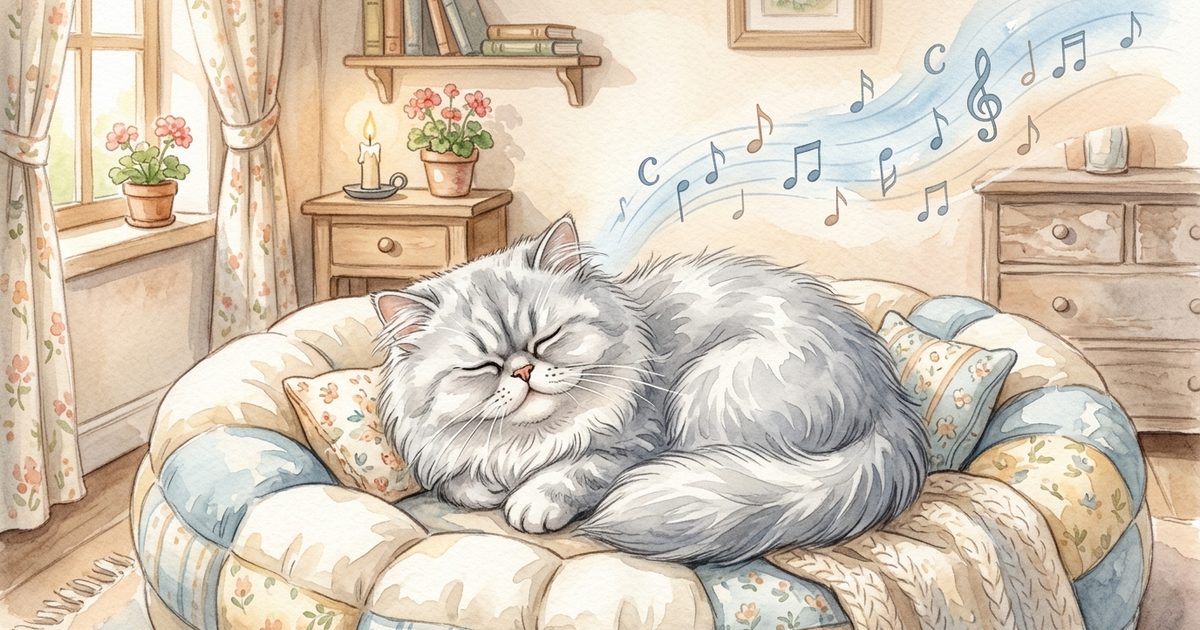
Yes — under controlled conditions. In shelter and veterinary studies, cats listening to species-specific or slow, low-stimulation music showed lower stress scores, more resting, and fewer hiding behaviors. Classical also helped in some studies, while heavy metal and loud pop raised stress. The right music is a real, low-cost calming tool.
Shelter and vet studies
The calming evidence comes mainly from shelters and veterinary clinics — high-stress environments where stress reduction is both measurable and badly needed. In these settings, cats listening to slow, low-stimulation or species-specific music have shown lower cat stress scores (CSS), more time spent resting, and fewer hiding or freezing behaviors during examinations and kennel stays. Classical music produced some calming in a subset of studies, while silence or pop tended to show little effect. It's fair to generalize the direction — the right kind of music reduces stress — while holding the size of the effect loosely: many of these studies are small, contexts vary, and individual cats respond differently. For a broader look at how environment shapes feline welfare, International Cat Care is a reliable reference on enrichment and stress management in both homes and shelters.
What genres calm vs stress
The pattern that emerges across the research is fairly consistent. Slow tempos, simple harmonic structure, and pitches that overlap with feline vocal ranges — that is, species-specific cat music and gentle classical — tend to produce calm. Loud volume, heavy bass, sudden dynamic shifts, and unpredictable arrangements — think metal, EDM, or thumping pop — tend to do the opposite, raising stress and prompting cats to withdraw. It makes intuitive sense: cats are already equipped with a built-in self-soothing hum — the purr, which sits right in the 25–150 Hz band that calm music echoes back to them.
Music and anxious cats
For a cat that struggles with separation anxiety, car rides, vet visits, or a new home, music can be one useful layer in a broader enrichment stack — alongside hiding spots, pheromones, play, and predictable routine. It is not a cure on its own, and it works best when the cat already associates the sound with safety. Used consistently, low calm music can take the edge off a stressful event, but persistent anxiety, withdrawal, or changes in eating and grooming habits deserve attention beyond the playlist. If your cat seems persistently low or withdrawn, it's worth reading up on whether cats get depressed and talking to your vet.
What Music Should I Play for My Cat?
Start with species-specific cat music — designed for feline hearing and backed by the strongest evidence. Soft, slow classical is a reasonable second choice. Keep the volume low, avoid heavy bass and sudden passages, and leave long silent gaps for sleep. Trial a few types for a week and watch your cat.
Species-specific cat music
The clearest starting point is music written for cats. The best-known body of work comes from composer David Teie, who built his "Music for Cats" from the feline vocal ranges and purr-rate tempos that came out of the Snowdon research. You can find it at MusicforCats.com, and several cat-relaxation playlists on the major streaming services draw on the same design principles. What to expect: tracks that sound odd to human ears — high, fluttering motifs, long purring swells, occasional bird-like calls — because they are pitched where cats listen, not where we do. That strangeness is the point. This is the category with the strongest research behind it, so it's the most rational first trial.
Classical and ambient
If species-specific music isn't available, the calmer end of human music is a fair compromise. Solo piano, slow strings, and gentle ambient pieces tend to land better than most genres because they stay quiet, keep a slow tempo, and avoid sudden dynamic jumps — the things that pull a cat out of rest. Think Erik Satie over Beethoven. It isn't pitched to feline hearing the way Teie's work is, so expect a milder response, but for background calm it does the job. Keep the volume low enough that you could comfortably hold a conversation over it.
What to avoid
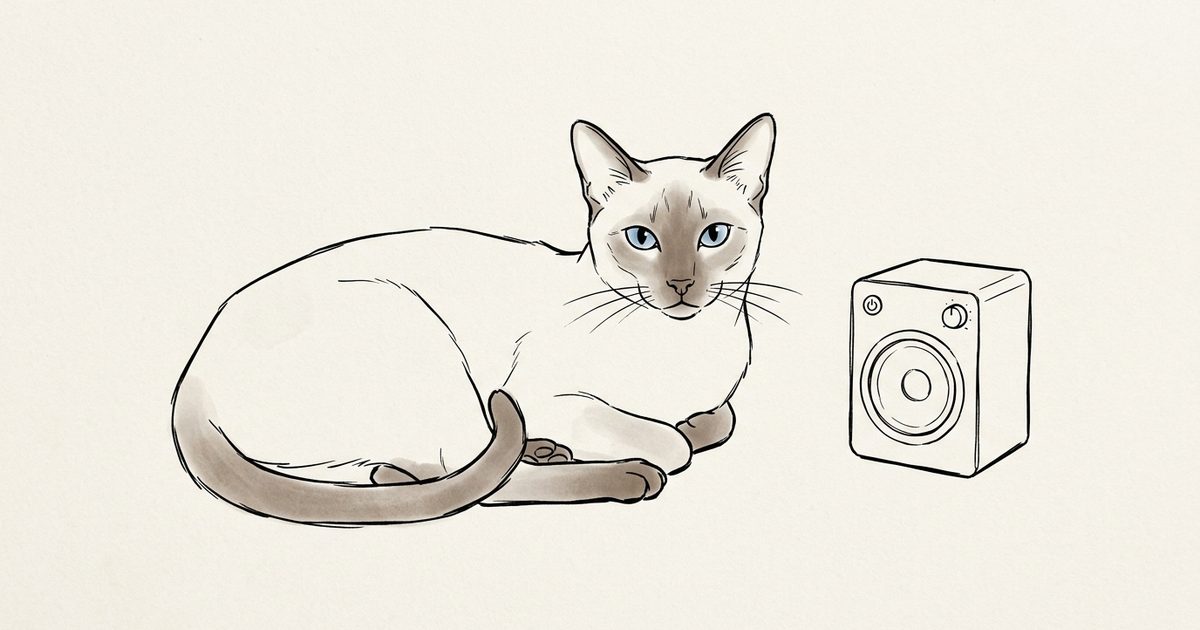
The short list of what to skip: heavy metal, EDM, thumping bass, loud television audio, and anything with unpredictable volume — sudden crashes, drops, or sharp transitions. Cats are wired to notice abrupt sounds (a survival trait), and bass-heavy music vibrates through the floor and body in ways that read as threat rather than groove. This isn't a lecture about taste — play what you love on your own headphones — only a note that for the hours your cat is sharing the room, predictable and soft serves her better. And remember that a relaxed cat is usually a sleeping cat; if the music you've chosen is working, you'll see more deep, undisturbed sleep, not less.
How to Tell If Your Cat Likes the Music
Watch the body. A cat enjoying music has relaxed ears, soft or half-closed eyes, a loose tail, slow blinks, and may settle near the speaker, knead, or purr. A stressed cat flattens the ears, widens the eyes, flicks or thumps the tail, hides, or leaves. Your cat's body is the only review that matters.
Relaxed signals
The clearest signs that music is landing well are the same signals cats give when they feel safe anywhere. Ears sit forward or neutrally upright; the gaze goes soft, sometimes drifting into a slow blink; the tail hangs loose or curls gently rather than twitching; and the cat may settle near the speaker, begin kneading, purr, or simply fold into a loaf and drop off to sleep. Approaching the speaker and rubbing against it — the response Snowdon and Teie recorded — is the strongest signal of genuine interest. If you'd like the full vocabulary of feline relaxation, our guide to cat body language walks through each cue; for the music trial, you're looking for any cluster of these soft, open signals.
Stress signals
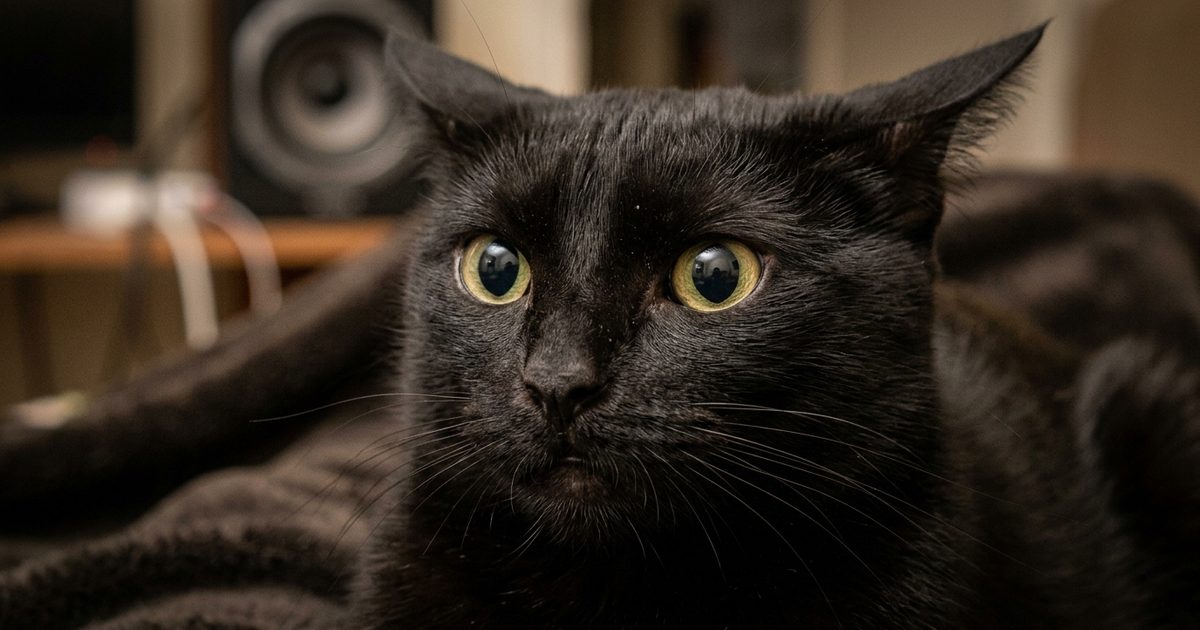
The opposite cluster means the music isn't working — or is actively too much. Watch for ears rotating back or flattening against the head, pupils dilating wide, the tail thumping or twitching sharply, a tense crouch, hiding under furniture, or the cat simply leaving the room. Vocal protest — a low growl or an unhappy yowl — is a late-stage signal. None of this means your cat "hates music"; it means this music, at this volume, is crossing her threshold. The fix is straightforward: turn it down, switch to something softer, or give her quiet. Some cats genuinely prefer silence, and honoring that is the right call.
Curious What Your Cat Would Say?
Upload a photo and get a warm, personalized reading from your cat's perspective.
Start Your Free ReadingCats and Music at a Glance — Summary
If you've scrolled this far, here's the quick-reference version — every answer backed by the research above, condensed to one line so you can decide what to queue up for your cat tonight.
| Question | Short answer |
|---|---|
| Do cats like human music? | Rarely — human tempos and frequencies sit outside a cat's vocal range, so most human tracks register as background noise rather than enjoyment. |
| Do cats like any music at all? | Yes — when music is composed around feline vocal frequencies and heart-rate tempos, cats consistently approach and orient toward the speaker. |
| What kind of music do cats like best? | Species-specific "cat music," gentle classical, and slow tempos with rising melodic contours similar to kitten vocalisations. |
| Can music calm a stressed cat? | Often yes — calming classical and specially composed feline music reduce stress markers in shelter and clinical settings. |
| Should I leave music on when I'm out? | Only at low volume and short trials — silence is fine for confident cats; reserve audio for mildly anxious or newly homed cats, and watch the response. |
| Does classical music relax cats? | Generally yes — slow classical pieces are linked to more resting and calmer behaviour, though results vary by individual. |
| How do I know if my cat likes the music? | Kneading, slow blinks, relaxed posture, and settling near the speaker say yes; pinned ears, a flicking tail, or leaving the room say turn it off. |
The honest takeaway: cats do like music — just on their own frequency terms. Start soft, read your cat's body language, and let their ears be the judge.
Frequently Asked Questions
Do cats like music the same way humans do?
Not quite. Cats are largely indifferent to the music humans enjoy, because human songs sit in a frequency band cats aren't built to prioritize. But cats do respond to music composed around their own vocal ranges and purr-rate tempos — a different kind of music for a different kind of ear.
What kind of music do cats like best?
Species-specific cat music has the strongest evidence behind it. Soft, slow classical is a reasonable second choice. In general, cats prefer quiet tracks with slow tempos and high, bird-like or purring frequencies, and tend to dislike loud, bass-heavy, or unpredictable music.
Does classical music calm cats?
Often yes, though less reliably than species-specific music. Slow classical pieces with gentle dynamics have been linked to lower stress scores and more resting behavior in shelter and clinical studies. Sudden or loud classical passages can have the opposite effect, so keep the volume low.
Can music reduce my cat's stress at the vet?
It can help. In veterinary and shelter studies, cats listening to calming music showed lower stress scores and fewer hiding behaviors. Music is a useful, low-cost layer alongside gentle handling, hiding spots, and pheromones — not a replacement for them.
Should I leave music on for my cat when I'm not home?
Only at low volume, and only if your cat responds well. Confident, relaxed cats are often fine in silence. For anxious or newly homed cats, soft music or species-specific cat music can help — but trial it briefly first and leave long quiet gaps for sleep.
How do I know if my cat dislikes the music I'm playing?
Watch the body. Flattened ears, wide pupils, a twitching or thumping tail, hiding, or leaving the room all say the music is too much. If you see these signals, turn it down, switch to something softer, or give your cat quiet — some cats simply prefer silence.
Do kittens respond differently to music than adult cats?
They tend to. In the Snowdon and Teie research, younger cats (under about five) and older cats (over ten) responded more strongly than middle-aged cats. Kittens are more exploratory toward novel sounds, while senior cats often respond well to soothing, slow tones.
Is there music made specifically for cats?
Yes. Composer David Teie's Music for Cats, built from the feline vocal ranges and purr-rate tempos that came out of the Snowdon research, is the best-known example. Several cat-relaxation playlists on major streaming services draw on the same design principles.
Can cats hear music that humans can't?
Yes — cats hear up to around 85 kHz, far beyond our 20 kHz ceiling, and they're most sensitive to the high, thin frequencies of prey. Much of human melody sits below the band cats attend to, which is one reason our music often reads as background hum to them.
Sources & References
You Might Also Like
Kitten Teething: Timeline, Symptoms & How to Help
Kitten teething runs from 3 to 7 months as baby teeth fall out. Learn the timeline, signs to watch for, and how to soothe a teething kitten safely.
15 min readWhen Do Cats Stop Growing? A Complete Timeline
When do cats stop growing? Most cats reach adult size by 12-18 months, but large breeds like Maine Coons keep growing until 3-4 years. Full timeline inside.
14 min readCan Cats Eat Cherries? Flesh, Pit & Toxicity Facts
Can cats eat cherries? Pitted flesh is safe in tiny amounts — but the pit, stem, and leaves are toxic (cyanide precursors). Learn what's safe and what isn't.
15 min read