
Are Orchids Toxic to Cats? The Good News for Plant Lovers
When you ask "are orchids poisonous to cats," the short answer is reassuring: no, true orchids are not toxic to cats. The ASPCA lists orchids (Orchidaceae) — including the popular Phalaenopsis moth orchid — on its non-toxic plant list, making them one of the safest flowering houseplants you can keep around a curious cat. So if you're researching whether orchids are safe for cats after a nibbled leaf, you can exhale. The real things to watch aren't the plant itself but what may be on or around it — pesticides, fertilizers, and the bark-and-moss potting medium your cat might dig in. Orchids are not the same as lilies, which are genuinely dangerous; with orchids, the worry is mild stomach upset, not poisoning.
Key takeaways
- True orchids, including the popular Phalaenopsis moth orchid, are listed as non-toxic to cats by the ASPCA.
- The real risks are not the plant itself but pesticides, fertilizers, and the potting medium or soil it grows in.
- If your cat eats orchid leaves or flowers, watch for mild stomach upset and call the vet only if symptoms are severe or the plant was chemically treated.
Orchids and Cats — Quick Reference
| Question | Short answer | Action |
|---|---|---|
| Are orchids toxic to cats? | No — true orchids are ASPCA-listed as non-toxic | Relax; a nibbled leaf is not an emergency |
| Which orchids are safe? | Phalaenopsis, Cattleya, Dendrobium, Oncidium, Paphiopedilum | Confirm the species if the plant is unlabeled |
| What are the real risks? | Pesticides, fertilizers, and the bark/moss potting medium | Rinse new plants; cover the medium |
| Are look-alikes safe? | Not automatically — only true orchids are confirmed | Identify any unnamed plant before assuming |
| What if my cat eats one? | Usually mild stomach upset only | Monitor; call the vet if symptoms are severe |
| Is an orchid a good houseplant? | Yes — non-toxic, long-blooming, beautiful | Use a stable pot and keep the medium covered |
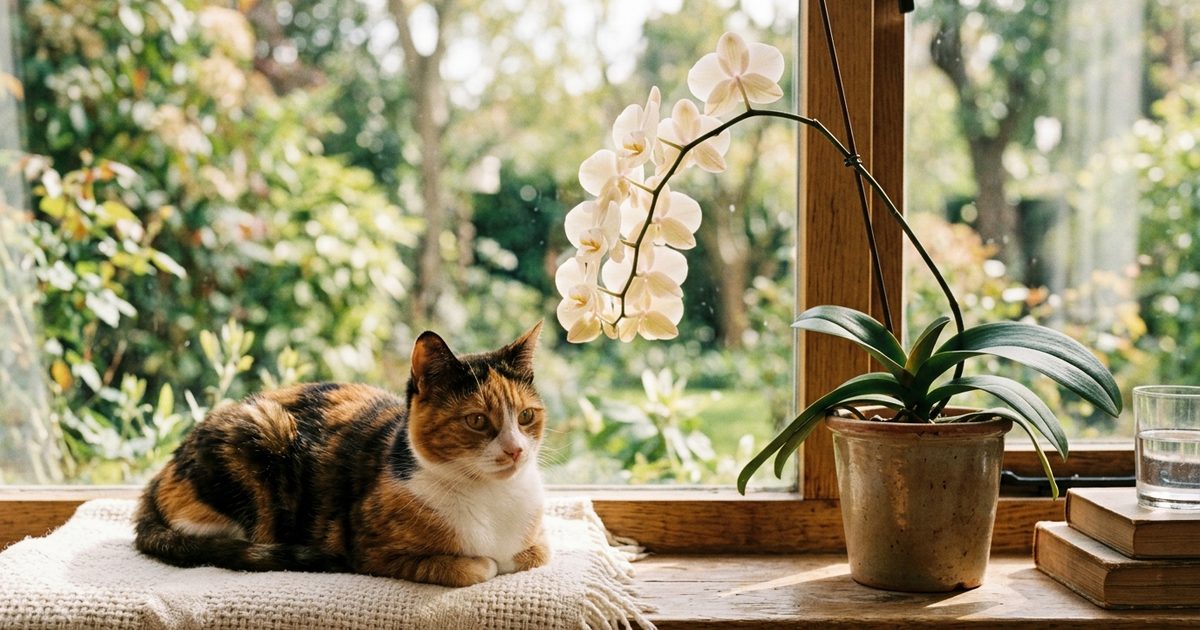
Are Orchids Toxic to Cats? The Short Answer
No. True orchids are not toxic to cats. The ASPCA lists orchids (Orchidaceae) — including the popular Phalaenopsis moth orchid — on its non-toxic plant list, so a chewed leaf or petal carries no poisoning risk from the plant itself. Orchids are among the safest flowering houseplants you can keep around a cat.
No — orchids are non-toxic to cats
The single most reliable answer comes from the ASPCA Toxic and Non-Toxic Plants list, which places orchids (the family Orchidaceae) firmly on the non-toxic side. Unlike lilies or tulips, orchid tissue simply does not contain the compounds that make those flowers dangerous to a cat's kidneys or gastrointestinal tract. Across the whole Orchidaceae family, the safety profile is consistent — though, as with any plant, it's wise to confirm the exact species rather than assume, because new hybrids and mislabeled gift plants do exist. For everyday orchids from a florist or garden center, the reassurance holds. The Cornell Feline Health Center likewise treats orchid ingestion as a low-concern event.
Safe even if chewed or nibbled
Cats investigate the world with their mouths, so a bitten leaf or a paw-swiped petal is a realistic scenario, not a catastrophe. A small taste of orchid is not an emergency — there is no toxin to absorb, no kidney cascade to fear. The contrast with lilies is sharp and worth holding in mind: in the article on whether lilies are toxic to cats, even a single bite of petal or a lick of pollen can be lethal. Orchids sit at the opposite end of that spectrum, which is exactly why they're recommended for cat homes.
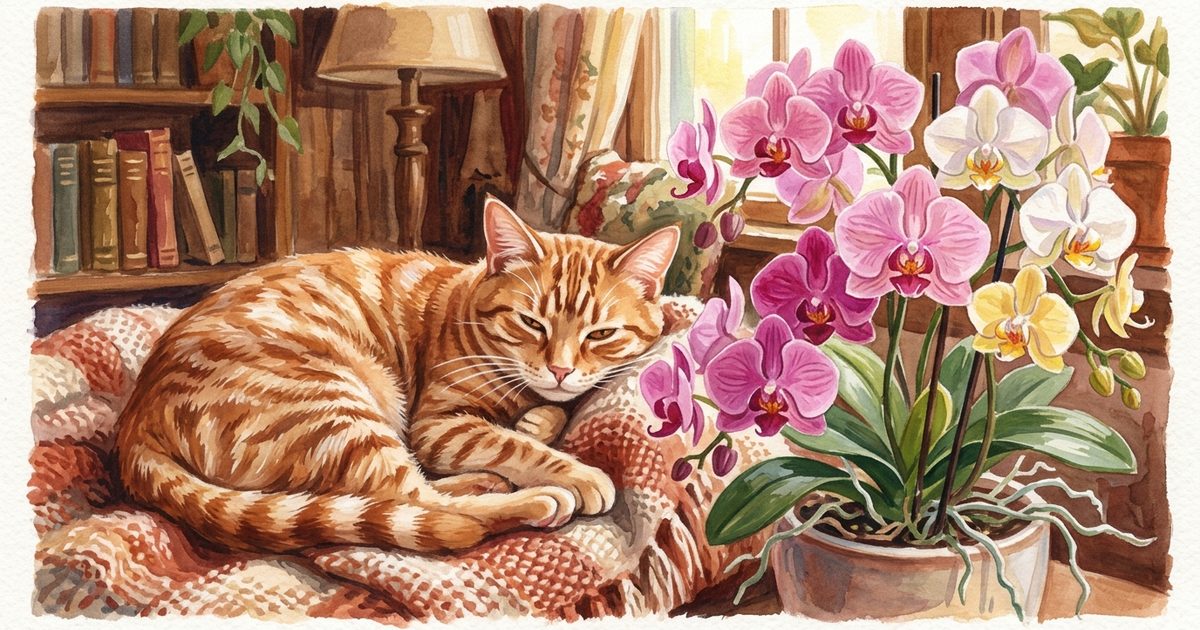
Which Orchids Are Safe for Cats?
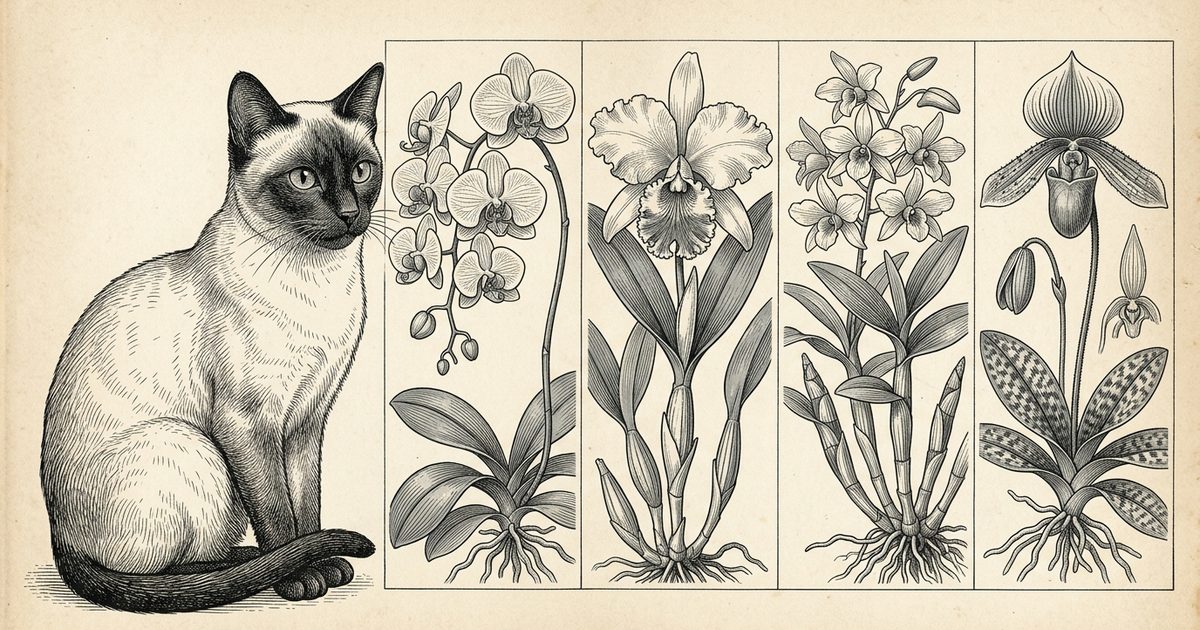
The orchids commonly sold as houseplants are all cat-safe: Phalaenopsis (the moth orchid), Cattleya, Dendrobium, Oncidium, and Paphiopedilum (the lady slipper) all appear on the ASPCA non-toxic list. The plant itself is safe — the real caution is the potting medium, moss, and any fertilizer or pesticide residue on it, not the orchid.
Phalaenopsis — the moth orchid
The Phalaenopsis, or moth orchid, is the orchid you'll find at almost every grocery store and florist — arching stem, broad flat blooms, often white or pink. It's explicitly non-toxic to cats, and its flowers can last for weeks or even months, which is part of why it's the default "safe orchid" for cat households. If you're searching whether Phalaenopsis is safe for cats or whether moth orchids are toxic to cats, the answer is the same reassuring no: this is the most accessible and most confirmed-safe orchid you can bring home.
Other safe orchid genera
Beyond the moth orchid, the genera most commonly kept as houseplants — Cattleya (the corsage orchid), Dendrobium, Oncidium (the "dancing lady"), and Paphiopedilum (the lady slipper) — are all members of Orchidaceae and all carried on the ASPCA non-toxic list. As a family, orchids lean safe, though it's still good practice to confirm the species of any plant before assuming, since the trade occasionally mislabels or sells hybrids under loose names. For the well-known genera above, the safety record is consistent and well-documented.
The real caution is the medium, not the plant
Where orchids do pose a small risk is everything around the plant, not the plant itself — the bark, moss, perlite, and any chemical residue a digging cat might reach. We cover the medium risk in detail in Real Risks below.
What Are the Real Risks of Orchids Around Cats?
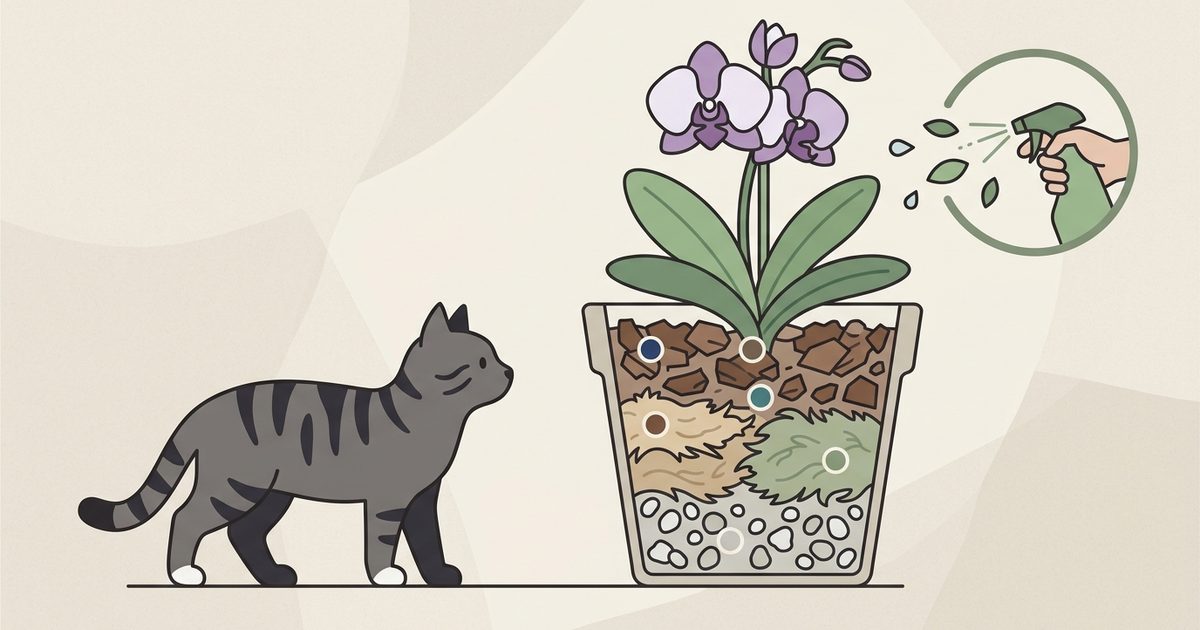
The orchid plant itself is safe, but three real risks remain: pesticide and fertilizer residue, mild gastrointestinal upset if your cat eats a large amount of plant material, and the potting medium that can irritate the gut or, rarely, cause a blockage. None rival lily poisoning.
The non-toxic label covers the orchid's tissue, not everything that comes with it. A plant bought from a store, potted in bark, sprayed at some point in its life, and parked on a windowsill a curious cat can reach is a small system of moving parts — and most of the genuine caution lives in those parts, not in the bloom. Here is where to look.
Pesticides and fertilizers
Commercially grown orchids are frequently treated with systemic pesticides or fertilizers that linger in the leaves and soil long after the plant reaches your home. A cat that chews treated foliage can ingest those residues, and the chemicals — not the orchid — are what would cause trouble. The safe move is to rinse a new plant thoroughly when you bring it home, avoid chemical sprays once it's yours, and ask the seller how the plant was grown. It is reasonable to assume some treatment history on any store-bought orchid rather than assume one is chemical-free.
Gastrointestinal upset from volume
Even perfectly safe plant material can upset a cat's stomach when eaten in quantity. The issue here is roughage and mechanical irritation — leaves and petals are not part of a cat's natural diet — not poison. A cat that has eaten a sizable amount of orchid may drool, vomit once or twice, or have loose stool, then return to normal. This is the body rejecting unfamiliar bulk. For the broader picture of when vomiting is routine and when it isn't, our guide to cat vomiting walks through the full workup; the short version is that minor, self-resolving signs from a non-toxic plant usually need only watching.
The pot and potting medium
The potting medium is the most underrated risk. Orchids grow in bark chips, sphagnum moss, and perlite — loose, interesting-textured material that a determined cat digging in the pot can pull out and swallow. Enough of it can irritate the gastrointestinal lining or, in rarer cases, cause a blockage. The practical fixes are placement out of easy reach and covering the medium with a layer of mesh or stones so the cat cannot get to it. For more on arranging a home so plants and cats coexist safely, see our cat-safe plants guide.
Orchids vs Orchid Look-Alikes — Are All "Orchids" Safe?
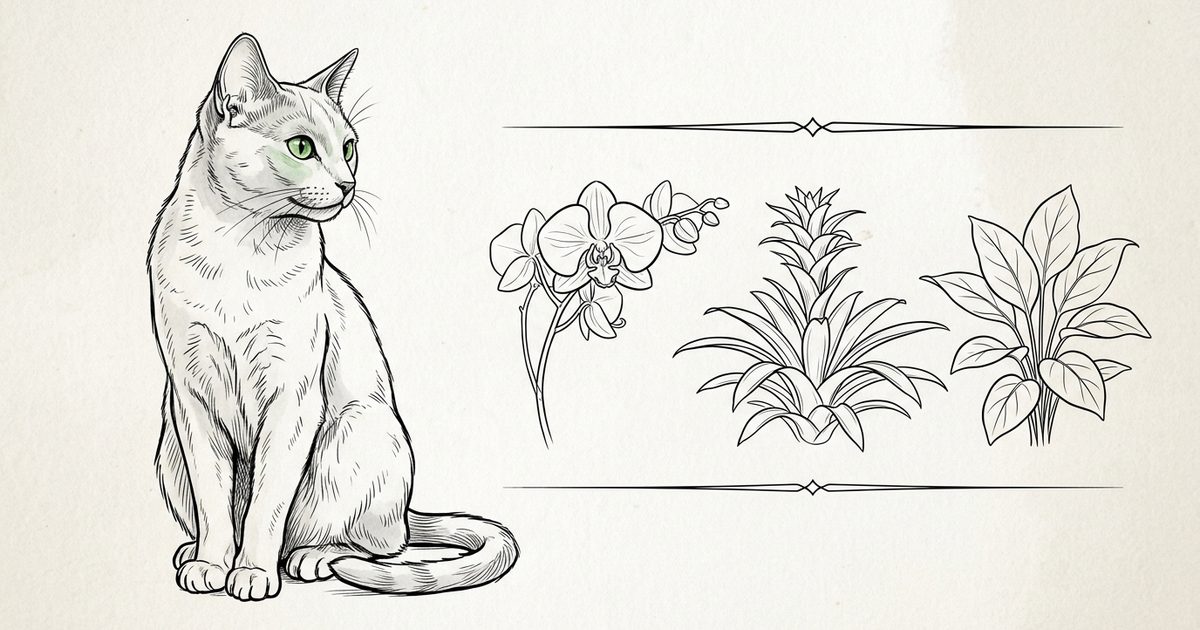
Only true orchids (Orchidaceae) are confirmed non-toxic. Some plants share an orchid-like name or appearance but are different species — iris-flowered look-alikes, mislabeled sale plants, or common houseplants that simply resemble an orchid. Identify the plant before assuming it is safe, especially for one received unnamed.
The reassurance about orchids is real, but it attaches to a specific family of plants — not to everything that gets called an orchid. A gift bloom with no label, a florist's loose naming, or a houseplant that happens to look orchid-like all sit outside the guarantee. The discipline is simply to verify.
True orchids vs look-alikes
The Orchidaceae family is well-defined, and the ASPCA's non-toxic listing applies to true orchids within it — Phalaenopsis, Cattleya, Dendrobium, and the rest we covered above. But the plant world is full of orchid-like species: some gesneriads, certain bromeliads, and assorted tropical houseplants that mimic an orchid's form without belonging to the family. Plants sold loosely as "orchids," or named with "orchid" in a common name, are not automatically covered by the safe-plant status. The general rule is sound: the ASPCA confirmation belongs to true orchids, not to every plant an owner might point at and call an orchid.
When you can't identify the plant
A gift plant, an unlabeled purchase, a specimen that has lost its tag — these are common, and the safe move is always to identify before assuming. The caution is not theoretical: in the same category of popular gift flowers, lilies are lethal to cats and tulips carry real toxicity. Those contrasts are exactly why an unnamed bloom deserves a moment of verification rather than a casual "it's probably fine." When in doubt, the ASPCA's toxic and non-toxic plant list is the reference to check.
Bogus "orchids are toxic" claims
You will still find older lists and casual blogs that flag orchids as toxic to cats. These almost always come from one of two errors: confusing a true orchid with a toxic look-alike, or overgeneralizing from a single misidentified case. The authoritative counter-evidence is the ASPCA's own non-toxic listing, which places Orchidaceae firmly on the safe side. Cornell's Feline Health Center and International Cat Care echo the same position. When a confident-sounding blog contradicts the primary veterinary source, trust the source — and trust the bloom.
What Should I Do If My Cat Eats an Orchid?
Usually, nothing urgent is needed. A bite of a true orchid is not toxic, so watch for mild vomiting, drooling, or diarrhea over the next few hours. Call your vet if symptoms are severe or persistent, if the plant may have been chemically treated, or you cannot confirm it is a true orchid.
The reason this is usually a non-event is the same reason orchids are on the ASPCA's non-toxic list: the plant tissue simply does not contain the compounds that make ingestion dangerous. A cat that takes an exploratory bite of a leaf or petal is getting roughage, not poison. Most of the time the cat walks away, and nothing happens at all.
Watch for mild GI upset
What does "normal" look like after a nibble? A small amount of plant material may cause one bout of vomiting or a little loose stool as the stomach reacts to the roughage — not to a toxin. Outside of that single episode, your cat should act like herself: alert, interested in food, drinking water, and behaving normally. Minor gastrointestinal signs from non-toxic plants almost always self-resolve within a few hours as the material passes. If you want the fuller picture of when vomiting is routine versus a concern, our guide to cat vomiting walks through the broader workup — but for an orchid bite in an otherwise well cat, observation is usually enough.
When to call the vet
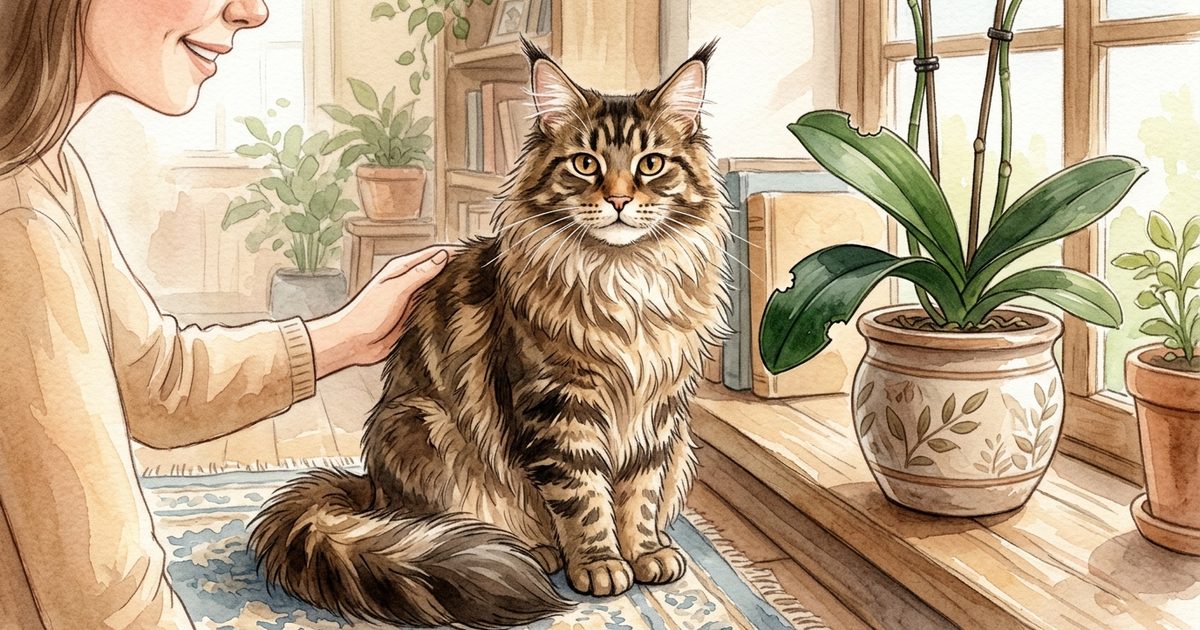
A few signs move the situation from "watch" to "call." Reach out to your vet if you see repeated vomiting, lethargy, refusal to eat or drink, or anything that suggests a blockage — especially if your cat was digging in the pot and may have swallowed bark chips, moss, or perlite from the potting medium. Call right away if you know or suspect the plant was chemically treated with pesticides or fertilizers, or if you simply cannot confirm that the plant is a true orchid rather than a look-alike. The practical rule is simple: when you are unsure, err toward calling. The ASPCA Animal Poison Control Center and the Cornell Feline Health Center are both reliable resources for guidance in that moment of uncertainty.
Why Orchids Are a Good Cat-Safe Houseplant
Orchids are one of the best flowering houseplants for cat owners: they are ASPCA-confirmed non-toxic, bloom for weeks or months, and thrive in the same bright indirect light cats love to nap in. With a stable pot and a covered medium, an orchid is a safe, beautiful choice for you and your cat.
For a cat household that still wants living color indoors, orchids solve a real problem. They give you the drama of a flowering plant without the gamble of a toxic one — and that contrast is the whole point.
Safe, beautiful, and long-lasting
The practical case is straightforward. Orchids are non-toxic, their blooms are dramatic and long-lasting — often holding for weeks, sometimes months — and a healthy plant keeps reblooming year after year with minimal ongoing cost. They are also everywhere: grocery stores, florists, and garden centers carry the moth orchid reliably. What makes this worth saying out loud is the contrast with the popular flowers that are genuinely dangerous. Keeping lilies or tulips in a cat home means managing real poisoning risk with every vase; an orchid removes that risk entirely. For the broader catalog of plants that share that safe status, our cat-safe plants guide walks through the full list.
Protecting both the plant and the cat
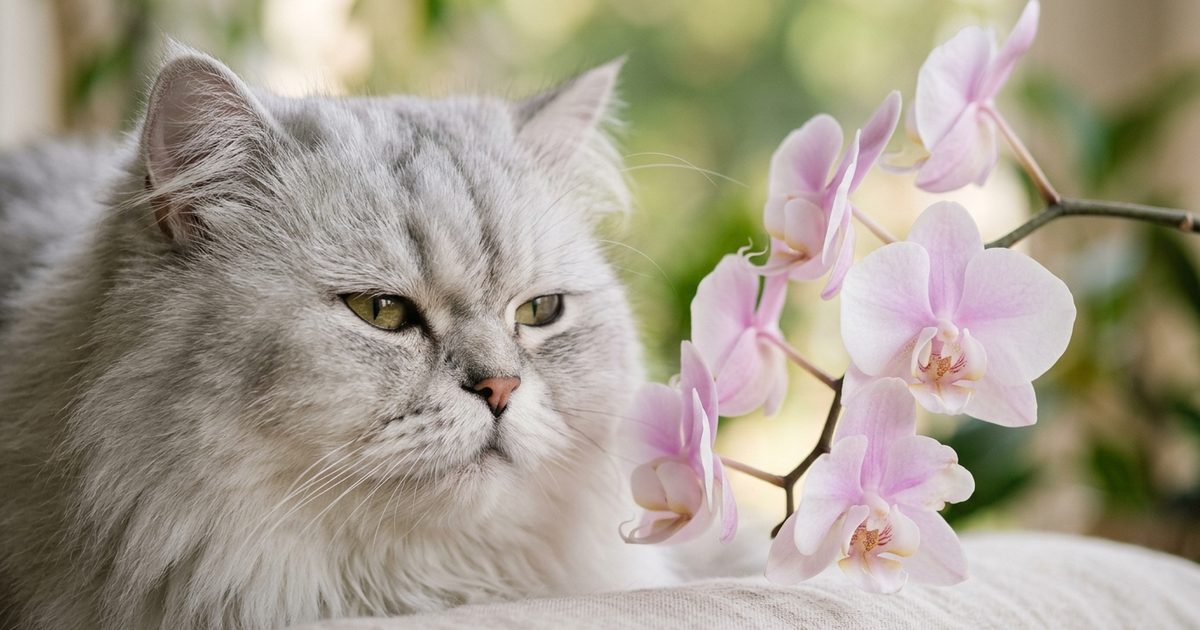
A few simple habits let the orchid and the cat coexist without drama. Placement matters most: a sturdy stand or a spot out of a leaping cat's usual path keeps the plant upright and the medium undisturbed. If your cat is a digger, cover the potting medium with a layer of mesh or decorative stones so the bark and moss stay put — and keep up the pesticide rinse we covered above for any new plant. And if you want another flowering option built on the same safe-but-verify logic, are roses toxic to cats covers the true-rose case as a companion safe bloom.
Orchids and Cats — Quick Summary
| Question | Short answer |
|---|---|
| Are orchids toxic to cats? | No — the ASPCA lists true orchids (Orchidaceae), including Phalaenopsis, as non-toxic. |
| Which orchids are safe for cats? | Phalaenopsis, Cattleya, Dendrobium, Oncidium, and Paphiopedilum are all cat-safe. |
| What are the real risks? | Pesticide and fertilizer residue, mild GI upset from volume, and the potting medium — not the plant itself. |
| Are orchid look-alikes safe? | Only true orchids are confirmed safe; identify any unnamed plant before assuming. |
| What if my cat eats an orchid? | Usually nothing urgent — watch for mild vomiting or diarrhea over a few hours. |
| When should I call the vet? | If symptoms are severe or persistent, the plant may have been treated, or you can't identify it. |
| Are orchids a good cat-safe houseplant? | Yes — non-toxic, long-blooming, and beautiful, with a covered medium and stable pot. |
Curious What Your Cat Would Say?
Upload a photo and get a warm, personalized reading from your cat's perspective.
Start Your Free ReadingFrequently Asked Questions
Are orchids toxic to cats?
No. The ASPCA lists true orchids (Orchidaceae), including the popular Phalaenopsis moth orchid, on its non-toxic plant list. The orchid tissue itself does not contain the compounds that make flowers like lilies or tulips dangerous to cats.
Are Phalaenopsis orchids safe for cats?
Yes. The Phalaenopsis, or moth orchid, is the orchid most commonly sold at grocery stores and florists, and it is explicitly listed as non-toxic to cats by the ASPCA. It is the most accessible and best-confirmed safe orchid for cat households.
What happens if a cat eats an orchid?
Usually very little. A bite of a true orchid is non-toxic, so the most you may see is mild stomach upset — a single bout of vomiting or loose stool from the roughage. Most cats show no symptoms at all and return to normal within a few hours.
Are all orchids safe for cats?
All true orchids in the Orchidaceae family are considered non-toxic, including Phalaenopsis, Cattleya, Dendrobium, Oncidium, and Paphiopedilum. But plants that merely resemble orchids or are mislabeled are not automatically safe — confirm the species before assuming.
Can orchid potting soil or moss hurt my cat?
The potting medium is the most underrated risk. Bark chips, sphagnum moss, and perlite can be pulled out and swallowed by a digging cat, causing gastrointestinal irritation or, rarely, a blockage. Covering the medium with mesh or stones is the practical fix.
Are orchids safer than lilies for cats?
Yes — dramatically. Orchids sit on the ASPCA non-toxic list, while lilies are genuinely lethal: even a single bite of petal or a lick of pollen can cause fatal kidney failure in cats. Orchids are the safe option where lilies are the dangerous one.
What should I do if my cat vomits after eating an orchid?
One bout of vomiting from a small nibble is usually the body rejecting roughage, not poison, and tends to self-resolve. Call your vet if vomiting is repeated, your cat is lethargic or refuses food and water, or you suspect the plant was chemically treated.
Are orchids a good houseplant for cat owners?
Yes. Orchids are ASPCA-confirmed non-toxic, their blooms last for weeks or even months, and they rebloom year after year. With a stable pot, a covered medium, and no chemical sprays, an orchid is one of the best flowering houseplants a cat owner can keep.
Sources & References
You Might Also Like
Kitten Teething: Timeline, Symptoms & How to Help
Kitten teething runs from 3 to 7 months as baby teeth fall out. Learn the timeline, signs to watch for, and how to soothe a teething kitten safely.
15 min readWhen Do Cats Stop Growing? A Complete Timeline
When do cats stop growing? Most cats reach adult size by 12-18 months, but large breeds like Maine Coons keep growing until 3-4 years. Full timeline inside.
14 min readCan Cats Eat Cherries? Flesh, Pit & Toxicity Facts
Can cats eat cherries? Pitted flesh is safe in tiny amounts — but the pit, stem, and leaves are toxic (cyanide precursors). Learn what's safe and what isn't.
15 min read