
Do Cats Watch TV? What They Actually See on Screen
If you've ever caught your cat glued to the screen — ears forward, pupils wide, tracking every flutter of a bird across the panel — you've probably wondered: do cats watch tv, or is it just a flicker of light they happen to notice? The honest answer is both. Many cats genuinely pay attention to moving images, and modern screens make that far more likely than the old flickering sets did. What they actually perceive, and whether it's good for them, is more interesting than a simple yes or no.
Key takeaways
- Many cats show real, sustained attention to moving images on TV — especially fast-moving prey like birds and rodents — though reactions vary enormously by personality and breed.
- Cats see the motion on screen clearly, but their vision is tuned for movement and low light, not fine detail or narrative, so a screen is more "moving shapes" than a story to them.
- Watching TV can be mild enrichment for an indoor cat, but some cats get frustrated or overstimulated by prey they can't catch — short, monitored sessions are the safest approach.
Cats and TV — Quick Reference
| Question | Short answer | Section |
|---|---|---|
| Do cats watch TV? | Yes — many do, with reactions from a glance to full-on swatting and chirping. | Do Cats Watch TV? |
| Why are cats attracted to TV? | Their visual system is tuned to fast motion, and modern screens look smooth to them. | Why Are Cats Attracted to TV? |
| What do cats see on screen? | Movement clearly, but little fine detail, color, or narrative. | What Do Cats Actually See on the Screen? |
| What kind of TV do cats like? | Fast, small prey animals — birds, rodents, fish — filmed close up. | What Kind of TV Do Cats Like? |
| Is watching TV good enrichment? | Often harmless and mildly enriching, but can overstimulate some cats. | Is Watching TV Good Enrichment for Cats? |
| Do cats recognize animals on screen? | Debated — they likely respond to motion, not to "that's a bird." | Do Cats Recognize the Animals on Screen? |
Do Cats Watch TV?
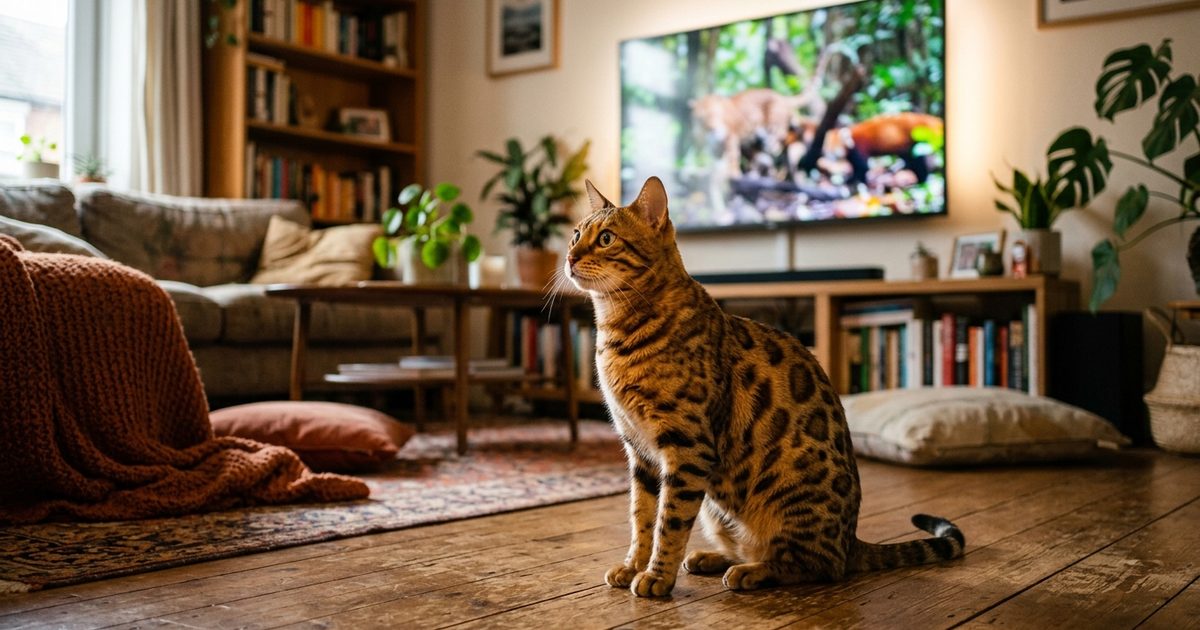
Yes — many cats watch TV. Some glance and lose interest, while others stare intently, swat at the screen, or chirp at moving animals. Reactions vary by personality and breed, but many indoor cats show clear attention to moving images on a modern screen.
If you've ever walked into the living room and found your cat planted in front of the screen, pupils blown wide, tracking something you couldn't even see — you've already met a cat that watches TV. The behavior is common enough that whole channels of "cat TV" content exist to serve it. But what looks like a cat binge-watching a nature documentary is really a series of small prey-detection reflexes firing one after another, and the way each cat responds depends far more on the individual than on anything universal about cats as a species.
How cats typically react
Reactions fall along a spectrum, and most cats land somewhere predictable on it:
- Complete indifference — the cat doesn't register the screen at all, or glances once and walks away.
- A brief glance — eyes track motion for a second or two, then lose interest.
- Fixed staring — the cat locks onto the screen for a minute or more, body still, pupils dilating.
- Pawing at the screen — a paw lifts and swipes toward the moving shape, sometimes repeatedly.
- Vocalizing — chattering, chirping, or that distinctive jaw-vibration cats make at prey they can't reach.
That chattering sound is the same one your cat makes at a bird through a window — it's a frustration vocalization, not excitement. If you've heard it, our piece on why cats chirp breaks down exactly what that sound means.
Why some cats ignore the TV
Plenty of cats never react to a screen, and that's perfectly normal. A few things explain it. Personality matters more than anything: a low-arousal, mellow cat may simply not find moving pixels interesting enough to bother with. Age plays a role too — kittens and young cats tend to react more vigorously than seniors whose reflexes have slowed. Prior exposure counts; a cat that grew up around always-on TVs often learns to filter them out as background.
There's also a deeper sensory reason. Cats hunt with smell, sound, and three-dimensional motion — and a flat screen offers none of those confirmations. There's no scent, no real depth, no heat signature. A cautious cat that relies on smell to confirm "this is prey" gets nothing back from the screen, and may decide the whole thing is not worth stalking. The body language of a fixed stare tells you when the cat has actually committed; with the TV, many cats never reach that point.
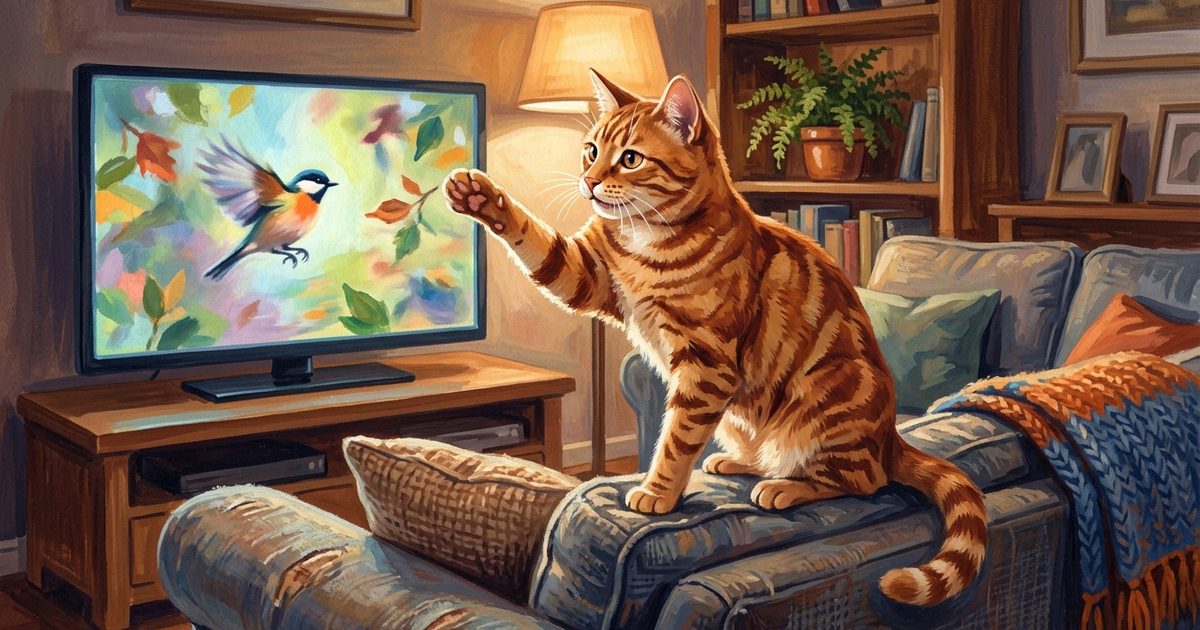
Why Are Cats Attracted to TV?
Cats are drawn to TV because their visual system is tuned to detect fast motion, and screens are full of it. Cats have a high flicker-fusion rate — around 70-80 Hz — so modern high-refresh screens look smooth to them, where old CRTs often flickered like a strobe.
Curious what's really going through her head when she locks onto the screen? Get a MeowMind reading — upload a photo and hear her describe the hunt in her own words.
Motion and prey drive
A cat's eyes are built for one job above all others: detecting movement. Where human vision prioritizes fine detail and color, the feline visual system is optimized for spotting the dart of a mouse across a field or the flicker of a bird taking off. The retina is dense with motion-sensitive cells, and the brain devotes a lot of processing power to anything that moves quickly and erratically.
That wiring doesn't switch off just because the motion is on a screen. When a small animal darts across the TV, it triggers the same orienting response a real bird would: ears swivel, pupils dilate, the body goes still. The cat isn't deciding whether the creature is "real" in any sophisticated sense — the reflex fires on motion alone. This is also why the chattering and chirping sometimes shows up: the prey-drive circuit is fully engaged, with no way to complete it. You can read more about that vocalization in our guide to why cats chirp.
Flicker fusion: why modern screens work
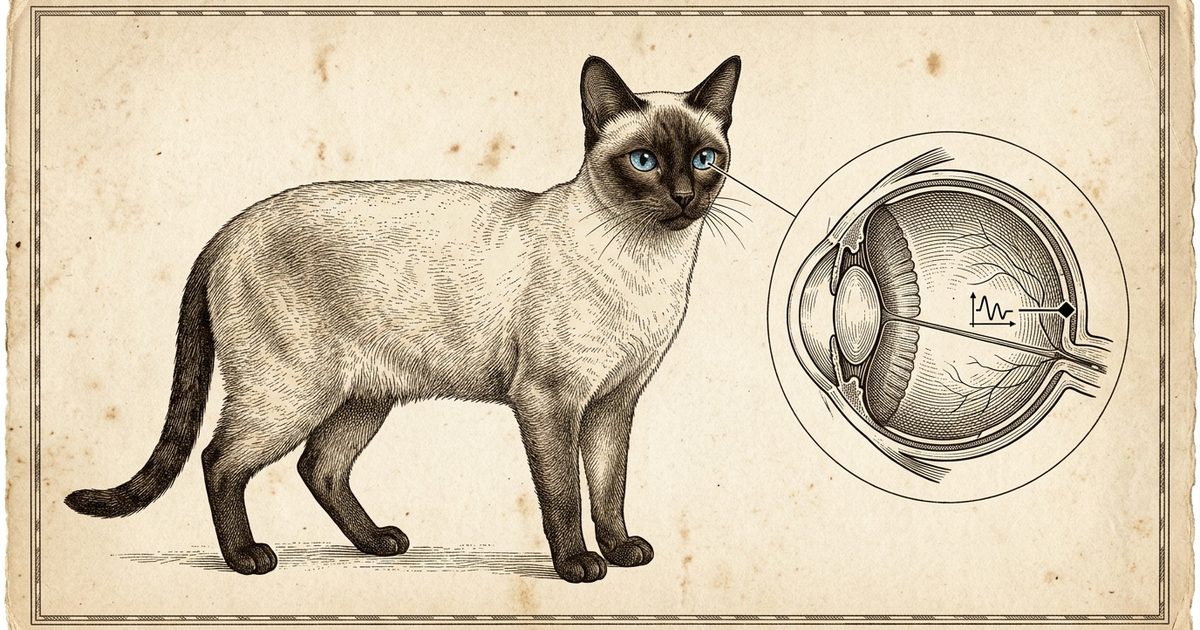
Here's where the technology itself matters. Cats perceive a flickering light source as steady at a higher rate than humans do — what scientists call the critical flicker-fusion frequency. For humans that threshold sits around 50-60 Hz; for cats it's estimated at roughly 70-80 Hz. International Cat Care notes that this higher temporal resolution is part of what makes feline vision so good at tracking fast-moving prey.
The practical consequence: an old CRT television, which refreshed at 50 or 60 Hz, looked to a cat like a strobe light flickering on and off — disorienting and barely watchable. That's the source of the old "cats can't see TV" belief, and it was largely true for the technology of the era. Modern OLED and LCD panels typically run at 120 Hz or higher, well above the cat's flicker-fusion threshold. To a cat watching a current screen, the image looks smooth and continuous, which is exactly why screen-watching behavior has become so much more common in the last decade. (The full picture of how cats perceive their environment is bigger than motion alone — their low-light and rod vision is a separate story, covered in how cats see in the dark.)
Sound can pull them in too
Motion is the main hook, but sound plays a supporting role. Nature shows are full of high-frequency cues — birdsong, the squeak of a rodent, the rustle of small animals in undergrowth — and cats can hear into registers that are inaudible to humans. A burst of birdsong can pull a cat's attention to the screen even before it spots the movement, the same way a real bird call outdoors will. Our write-up on cat hearing covers that high-frequency range in depth, so we won't re-derive it here; the short version is that a soundtrack full of prey sounds gives the screen an extra, audible layer of "this is interesting."
What Do Cats Actually See on the Screen?
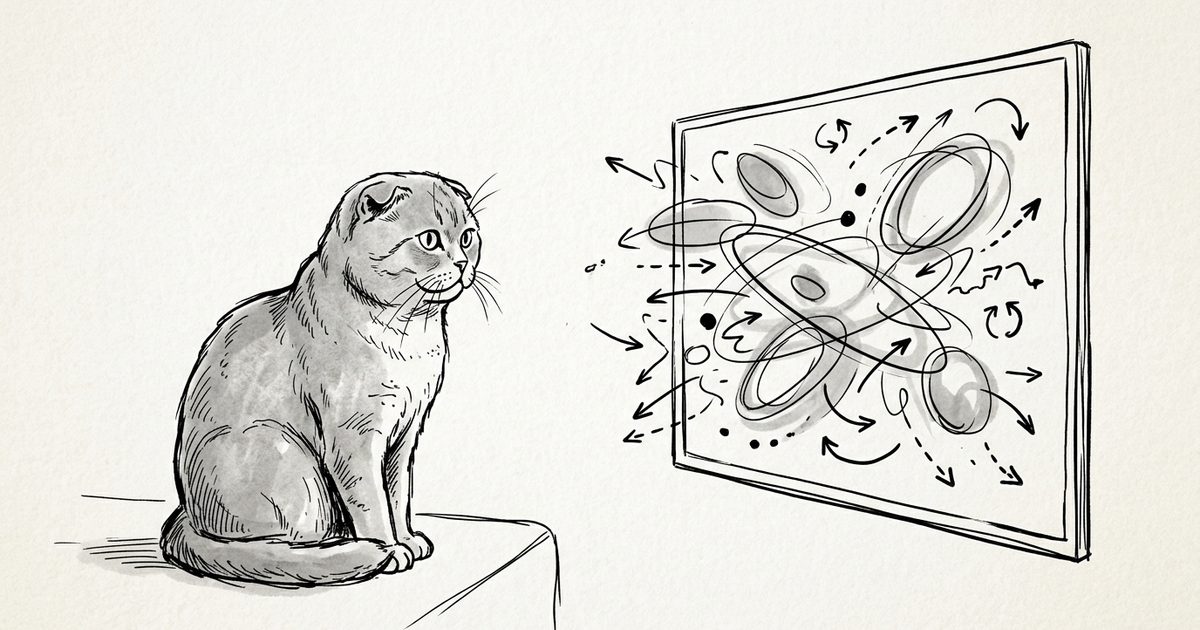
Cats see the movement on screen clearly, but they almost certainly don't perceive the narrative, fine detail, or color the way humans do. Their vision is tuned for motion and low light — so a screen is more "moving shapes" than "a story."
Motion yes, narrative no
When your cat locks onto a bird flitting across the screen, what's grabbing her is the motion — the darting, swooping trajectory — not the plot, the narrator, or the human characters. A cat's visual cortex is built to detect movement far more than to interpret context or follow a storyline. That's why a wildlife documentary with frequent prey-animal footage tends to hold a cat's attention better than a slow human drama, no matter how acclaimed. The on-screen animal is doing the work; everything around it is, to your cat, largely background. This also explains why a cat might snap to attention for thirty seconds and then lose interest the moment the action stops — once the motion goes, so does the stimulus.
Color and detail limits
Here's where perception gets interesting. Cats are dichromatic, meaning their color world is shifted toward blues and greens while reds appear muted or grayish — so the lush sunset tones in a nature documentary aren't landing the way they land for you. Their eyes are also optimized for the low-light, high-motion world of dawn and dusk hunting, which we dig into in can cats see in the dark — that same rod-heavy, tapetum-boosted design trades fine detail for sensitivity. At typical couch distance, your cat likely can't resolve the fine pixel detail of a modern screen at all; what she perceives is closer to a blur of moving shapes and contrast than a crisp image. According to International Cat Care, feline vision prioritizes detecting movement over resolving static detail — exactly the trade-off that makes a screen "interesting motion" rather than "a picture."
What Kind of TV Do Cats Like?
Cats tend to like videos showing fast, small, moving animals — birds, rodents, fish, and insects — filmed close up. Commercial "cat TV" videos and live critter cams are designed around exactly these triggers, and many cats watch with full focus for minutes at a time.
Birds, rodents, and fast prey
The sweet spot for feline attention is small prey moving at the right speed — think songbirds hopping, squirrels darting, or mice scurrying across the frame. These hit the size and velocity cues that a cat's visual system evolved to flag as worth tracking. A close-up of a bird flitting branch to branch will usually outperform a slow, wide landscape shot of grazing animals, even if the latter looks more cinematic to us. The closer and faster the prey moves within the frame, the stronger the orienting response. That prey-drive fixation is the same mechanism behind the chattering and chirping some cats do at windows — and if you've heard it, our piece on why cats chirp breaks down what that sound means.
"Cat TV" videos and live cams
A whole genre of content has grown up around this. Search "videos for cats" on YouTube and you'll find hours-long compilations of birds at feeders, fish in tanks, and mice in close-up, often paired with high-frequency squeaks and chirps designed to pull in a cat's hearing as well as her vision. Livestream "critter cams" — real-time bird feeders, squirrel yards, and aquariums — work on the same principle, and many owners leave them running as background enrichment. Typically a cat watches with full focus for a few minutes before the novelty wears off and she wanders away; sessions rarely stretch beyond ten to fifteen minutes, and that's completely normal.
Less popular content
Human faces, talking heads, slow dialogue scenes, and static landscapes tend to hold little appeal — there's not enough of the right kind of motion. That said, individual cats vary widely. Some ignore screens entirely, while a few seem transfixed by anything that moves. Personality, age, and prior exposure all play a role, so if your cat couldn't care less about the nature channel, she's not broken — she's just being a cat.
Is Watching TV Good Enrichment for Cats?
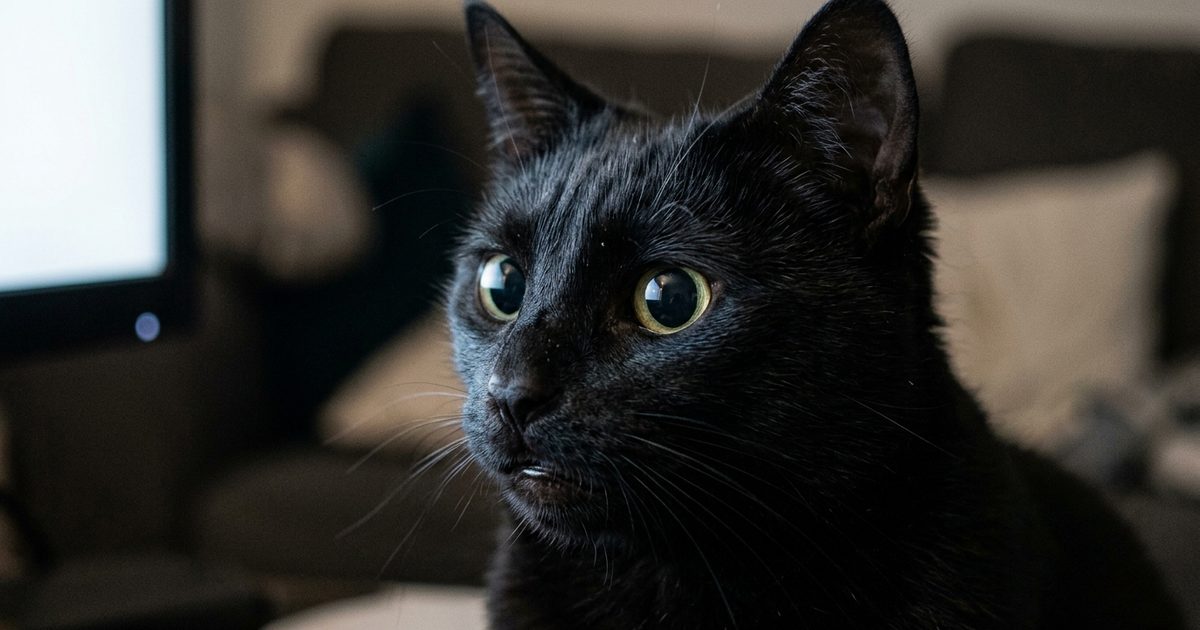
For most cats, watching TV is harmless and can be mild enrichment — something to break up an indoor day. The catch is prey frustration: some cats get agitated or vocal when they can't catch what's on screen, so watch your cat's reaction the first few times.
Screen time sits in an odd middle ground for a cat that watches TV: it's neither essential nor dangerous on its own. What tips it one way or the other is the individual cat — its age, personality, prey drive, and how much other stimulation it already gets in a day. For an indoor-only cat in a small apartment, a few minutes of moving images on a screen can genuinely add variety to a stretch of hours that would otherwise be spent dozing. For a cat already swimming in toys, windows, and play sessions, the same screen may do very little. The honest answer is that TV is best treated as a sometimes-supplement, never a centerpiece.
When TV is enriching
For indoor cats — especially those in single-cat homes or without safe outdoor access — sensory variety is one of the harder things to provide. A cat watching birds dart across a screen for ten minutes is getting movement, sound, and a mild orienting challenge that a still room can't offer. It pairs well with other low-effort enrichment: a window perch for real-world watching, a puzzle feeder at mealtimes, or a scratching post nearby. Because cats are crepuscular and naturally most active at dawn and dusk, scheduling screen time around those activity peaks tends to match when a cat is already awake and looking for something to do — not when it would rather be sleeping.
When it overstimulates
The same prey drive that pulls a cat to the screen can tip into frustration, because the on-screen animal can never actually be caught. For some cats this barely registers; for others it escalates quickly. Signs to watch for are dilated pupils, persistent vocalizing — chattering, growling, or yowling at the screen — a thrashing or thumping tail, and a body that goes rigid and forward-weighted. In the most intense cases a cat may redirect that arousal into a swat at a nearby human, another pet, or whatever is closest. Reading the fixed-stare body language tells you which version you're dealing with: a relaxed, soft-bodied watcher is fine; a coiled, pupil-blown watcher is winding up. When you see the latter, the right move is simply to turn it off. The Cornell Feline Health Center covers environmental enrichment and stress in indoor cats in more depth, and is a reliable reference for the wider picture of feline welfare.
Curious whether your cat's screen habit is normal — or want to try the right kind of cat TV? See our guide to videos for cats and pick content built around the prey triggers above.
Practical tips
Keep sessions short — five to fifteen minutes is plenty for most cats — and rotate the content so the same clip doesn't lose its novelty. Never use TV as a substitute for interactive play with a wand or lure toy, which lets the cat actually catch and bite something. And each time you put something new on, watch your cat's reaction the first few minutes for the overstimulation signs above.
Do Cats Recognize the Animals on Screen?

It's debated. Most evidence suggests cats respond to the motion and shape of on-screen animals rather than recognizing "that's a bird" or "that's a mouse." A darting shape fires the orienting reflex regardless of species — so motion, not identity, drives the response.
This is one of those questions where it's easy to read more into a cat's behavior than is actually there. A cat that launches itself at the screen the moment a sparrow appears certainly looks like it knows it's looking at a bird. But the simpler, better-supported explanation is that the cat is responding to the same cues it would respond to outside: small, fast, erratically moving shapes. Whether the shape is a real sparrow, a high-definition video of one, or a cartoon mouse bouncing across the screen, the orienting response fires the same way. What we can't confidently say is that the cat parses "bird" or "mouse" as a concept — only that it detects movement worth tracking.
Motion over identity
The feline visual system is built to prioritize movement and contrast over fine detail, which is exactly the kind of information a fleeing prey animal broadcasts. When a cat locks onto a darting shape on a screen, what's driving that attention is the motion itself — the speed, direction changes, and size of the moving object — not a conscious classification of what the object is. That's why a crudely animated cartoon mouse can trigger the same pounce attempt as a wildlife documentary: the cat isn't recognizing "mouse," it's recognizing "small thing moving like prey." The orienting response is sensory, and it fires long before any higher-level recognition could.
Anecdotes vs evidence
Plenty of owners report that their cat only reacts to one specific species on screen — birds but not fish, or squirrels but not insects — and those reports feel like strong evidence of recognition. They're consistent with a simpler explanation, though: cats have individual prey preferences shaped by early experience, and they'll track the kinds of motion they're already drawn to in the real world. A cat that loves watching songbirds outside the window will light up at on-screen birdsong and fluttering, but that's a motion-and-sound match, not proof the cat knows it's watching a robin. Without controlled studies — and the literature here is thin — it's fair to treat the recognition question as genuinely open. Motion almost certainly does most of the work; whether identity ever does is something we can't yet claim.

Cats and TV at a Glance — Summary
| Question | Short answer |
|---|---|
| Do cats watch TV? | Yes — many do, with reactions ranging from a glance to intense staring and swatting |
| Why are cats attracted to TV? | Their visual system is tuned to fast motion, and modern screens look smooth to them |
| What do cats actually see on screen? | Movement clearly, but not the narrative, fine detail, or color humans perceive |
| What kind of TV do cats like? | Close-up footage of fast, small prey — birds, rodents, fish, and insects |
| Is watching TV good enrichment? | Mild enrichment for most cats, but overstimulation is a real risk — keep sessions short |
| Do cats recognize the on-screen animals? | Debated; they almost certainly track motion more than they recognize species identity |
Curious What Your Cat Would Say?
Upload a photo and get a warm, personalized reading from your cat's perspective.
Start Your Free ReadingFrequently Asked Questions
Do cats actually watch TV?
Yes — many cats genuinely watch TV, with reactions ranging from a brief glance to intense staring, pawing, and chirping at the screen. It varies enormously by personality, breed, and age, but a sizable share of indoor cats show clear, sustained attention to moving images on modern screens.
Why does my cat stare at the TV?
Your cat stares because her visual system is tuned to fast motion, and a screen is full of it — small prey darting across the frame triggers the same orienting response a real bird would. Fixed staring with dilated pupils means the prey-detection circuit is fully engaged.
What kind of videos do cats like to watch?
Cats tend to prefer close-up footage of fast, small animals — birds, rodents, fish, and insects. Commercial cat TV videos and live critter cams are built around exactly these triggers, and most cats focus on them for a few minutes before the novelty wears off.
Can cats see what's on the screen clearly?
Cats see the movement clearly, but not the fine detail, color, or narrative humans perceive. Their vision is tuned for motion and low light, and at typical couch distance they likely can't resolve the pixel detail — so a screen is more moving shapes than a crisp picture.
Is it OK to leave the TV on for my cat when I'm out?
It can be fine as mild background enrichment for a relaxed cat, but it's not a substitute for interactive play. Some cats get frustrated or overstimulated by prey they can't catch, so it's safest to try short monitored sessions before leaving it on unattended.
Why does my cat paw at or swat the TV screen?
Pawing at the screen is a pounce attempt — the cat's prey drive is fully engaged by the moving shape and she's trying to catch it. It's usually harmless play, but if it comes with growling, a thrashing tail, or dilated pupils, the arousal is tipping into frustration and it's time to turn it off.
Why does my cat chirp at animals on TV?
That chattering or chirping is the same frustration vocalization cats make at birds through a window — the prey-drive circuit is fully fired up with no way to complete the catch. The on-screen animal triggers the reflex even though the cat can never reach it.
Can watching TV frustrate or stress out my cat?
Yes, for some cats. The same prey drive that pulls a cat to the screen can tip into frustration because the on-screen animal can never be caught. Watch for dilated pupils, persistent vocalizing, a thrashing tail, or redirected swats — signs it's time to turn it off.
Do cats recognize the specific animals they see on TV?
It's debated. Most evidence suggests cats respond to the motion and shape of on-screen animals rather than recognizing 'that's a bird' or 'that's a mouse' as a category. A cat swatting at a moving shape is tracking motion, not necessarily knowing what species it is.
Sources & References
You Might Also Like
Kitten Teething: Timeline, Symptoms & How to Help
Kitten teething runs from 3 to 7 months as baby teeth fall out. Learn the timeline, signs to watch for, and how to soothe a teething kitten safely.
15 min readWhen Do Cats Stop Growing? A Complete Timeline
When do cats stop growing? Most cats reach adult size by 12-18 months, but large breeds like Maine Coons keep growing until 3-4 years. Full timeline inside.
14 min readCan Cats Eat Cherries? Flesh, Pit & Toxicity Facts
Can cats eat cherries? Pitted flesh is safe in tiny amounts — but the pit, stem, and leaves are toxic (cyanide precursors). Learn what's safe and what isn't.
15 min read