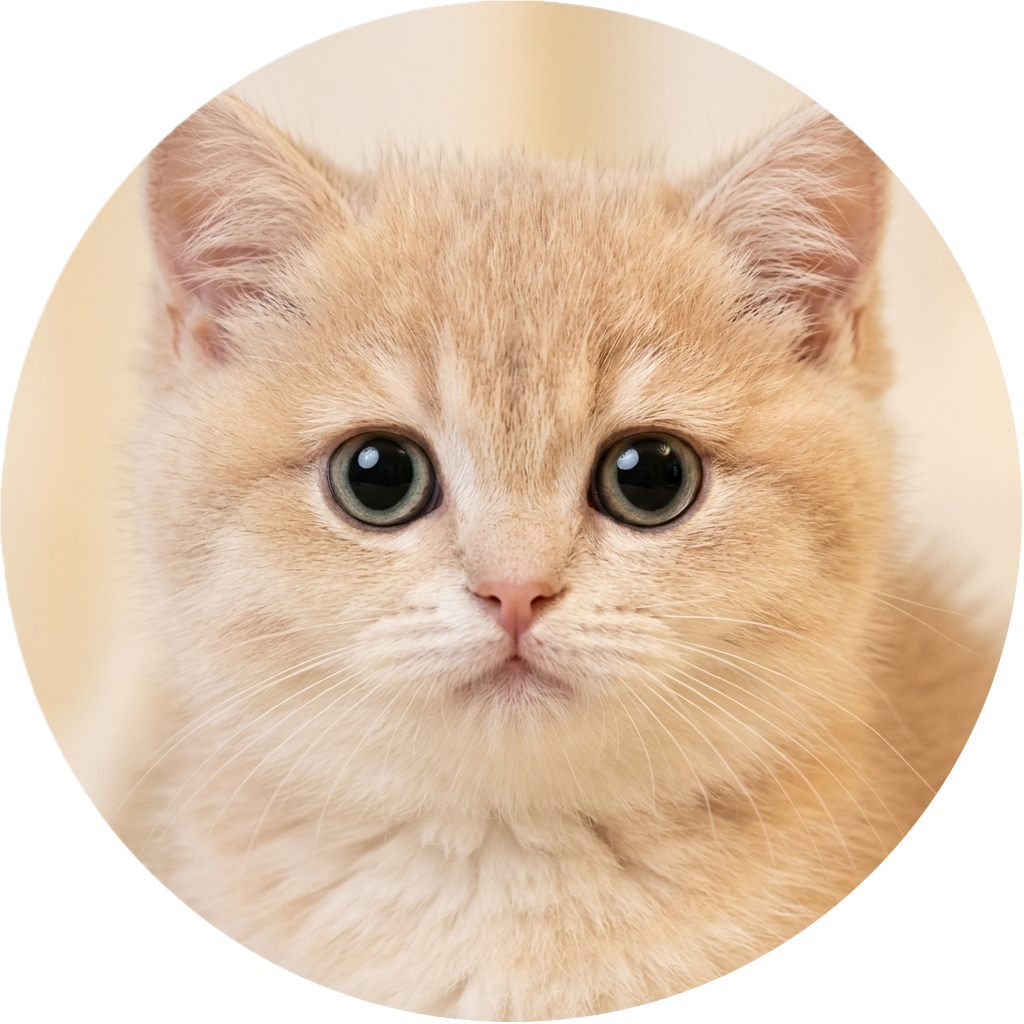
Why Do Cats Hate Water? The Truth May Surprise You
If you're wondering why do cats hate water, the honest answer is that most of them dislike it — but not all of them do. Search for why cats hate water and you'll find a thousand viral clips of cats resisting bathtubs, which feeds the idea that water is every cat's enemy. The deeper question — why are cats afraid of water in the first place — has a more interesting answer than simple fear.
The aversion isn't a phobia. It's a combination of three things working together: an evolutionary history in dry, arid landscapes where swimming was never useful; the physical reality that wet fur loses its insulation, becomes heavy, and takes a long time to dry; and a sensory system — those exquisitely sensitive whiskers and guard hairs — that running water can easily overwhelm. Strip those away, and a few breeds and countless individual cats turn out to genuinely enjoy water.
This article breaks down the real reasons behind the stereotype, the breeds that break it, and how to handle a bath when one is genuinely necessary — without turning it into a fight.
Key takeaways
- Not all cats hate water — many tolerate it calmly, and breeds like the Maine Coon, Turkish Van, and Bengal actively enjoy playing in it.
- The aversion traces to arid-region ancestry (African wildcat roots) and the genuine physical discomfort of wet fur — lost insulation, extra weight, slow drying, and whisker overstimulation.
- Most cats need no routine bathing at all; when a bath is medically necessary, low-stress techniques work, and forcing a cat into water is never safe.
Cats and Water — Quick Reference
| Question | Short answer | Detail |
|---|---|---|
| Do all cats hate water? | No — many tolerate it, and several breeds actively enjoy it. | See: Do All Cats Hate Water? |
| Why do most cats dislike it? | Their ancestors came from dry regions where swimming was never part of survival. | See: The Evolutionary Story |
| Why does water feel bad to a cat? | Wet fur loses insulation, gets heavy, dries slowly, and overstimulates the whiskers. | See: The Physical Reasons |
| Which cats actually like water? | Maine Coons, Turkish Vans, Bengals, Turkish Angoras — plus many curious mixed breeds. | See: Which Cats Actually Like Water? |
| How do you bathe a cat that hates water? | Only when necessary — short, shallow, warm, calm, and reward with treats. | See: How to Bathe Safely |
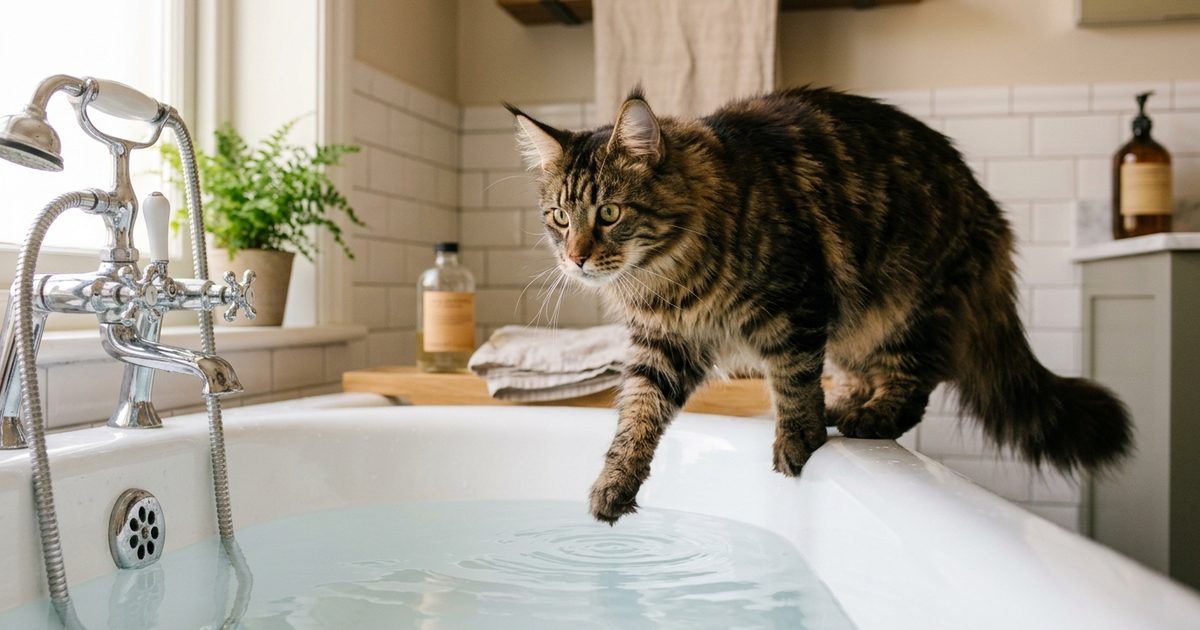
Do All Cats Hate Water?
No — not all cats hate water. Many tolerate it, and some breeds actively enjoy it. Maine Coons, Turkish Vans, Bengals, and Turkish Angoras are famous for playing with running water, dipping paws in fountains, and even swimming. Individual personality matters as much as breed.
The "cats hate water" belief is one of the most stubborn pet stereotypes out there, and like a lot of confident common knowledge, it's only half right. Aversion to water is genuinely common in domestic cats — but it is not universal, and treating it as a fixed law makes the picture blurrier, not clearer. Some cats tolerate getting wet with quiet annoyance. A smaller but real group actively seek water out, treating a dripping tap or a shallow puddle as something worth investigating. When people ask why do cats hate water, the honest answer begins with "most do — but not all of them."
The myth of the universal water-hating cat
The stereotype survives for two simple reasons. First, most cats genuinely do avoid deep water and resist being bathed, so everyday experience keeps reinforcing it. Second, the internet runs on footage of cats fighting baths and clawing at sinks — a panicking cat is dramatic and shareable, a calm cat tolerating a rinse is not. Viral clips show you the memorable exceptions to a quieter truth.
Aversion is common, but it is a tendency, not a rule. The cat inching toward a running faucet, ears forward and tail still, is showing curiosity, not fear — and reading that wary-but-curious stance is mostly about cat body language, not the water itself. Plenty of cats stand somewhere in the middle: not eager to swim, but perfectly willing to share a shower or pat at a stream.
Why some cats are drawn to water
The faucet-drinking cat is so common it barely surprises owners anymore. Many cats prefer running water to a still bowl — the movement signals freshness, and a moving target is simply more interesting to paws that evolved to bat and grab. Some cats splash in their water dish, fish out floating toys, or sit on the edge of a tub watching droplets fall.
Breed tendencies show up here, too. Maine Coons, Turkish Vans, Bengals, and Turkish Angoras are repeatedly reported by owners and breed clubs as water-curious, though it's worth keeping those claims in perspective — they describe tendencies, not guarantees. A mixed-breed tabby can be just as fascinated by a tap as any pedigreed swimmer. There is a real difference between a cat that tolerates water and one that enjoys it, and that line usually has more to do with individual temperament and early positive exposure than with any label on the cat's papers.
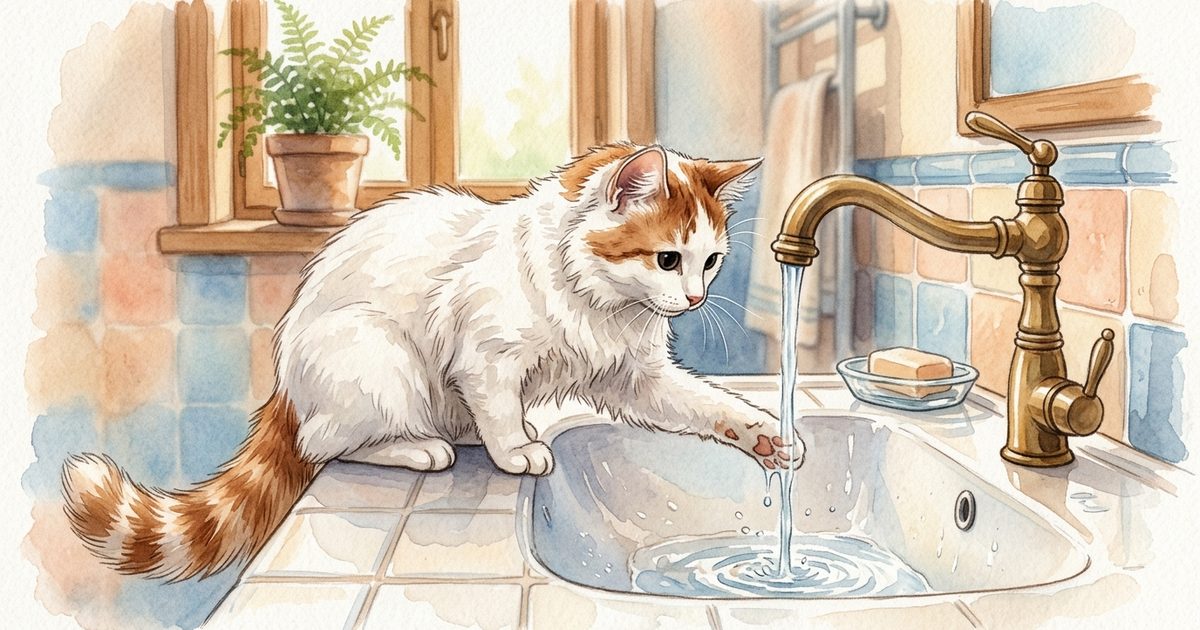
Why Do Most Cats Dislike Water? The Evolutionary Story
Domestic cats descend from African wildcats that lived in arid, dry regions with little standing water. Their ancestors never needed to swim to hunt or escape, so there was no evolutionary pressure to enjoy being wet. To a cat, water is simply unfamiliar and offers no reward.
If most cats would rather not be wet, the explanation is less about fear and more about ancestry. Domestic cats inherited a world in which water was scarce and irrelevant to survival, and that history is still written into how they respond to it today.
Descended from desert cats
The domestic cat's wild ancestor is the African wildcat, Felis lybica, an animal shaped by dry, open landscapes across North Africa and the Near East. Its prey — small rodents, birds, lizards — lived on land, not in water. Hunting meant stalking through dry grass, not diving in after fish. In an environment where standing water was rare and sometimes dangerous, there was simply no advantage in seeking it out. The Cornell Feline Health Center notes that much of normal feline behavior — from hunting style to social structure — traces back to this arid-land origin.
Contrast this with animals built for water. Otters, beavers, and seals evolved to chase prey underwater, so swimming is woven into their instincts. Among cats, the fishing cat (Prionailurus viverrinus) is the striking exception: a wild species native to South and Southeast Asia that genuinely hunts in streams and swims with webbed front paws. It is the proof that cats can evolve toward water when the habitat demands it — and, by existing, it confirms how unusual the water-avoiding majority is.
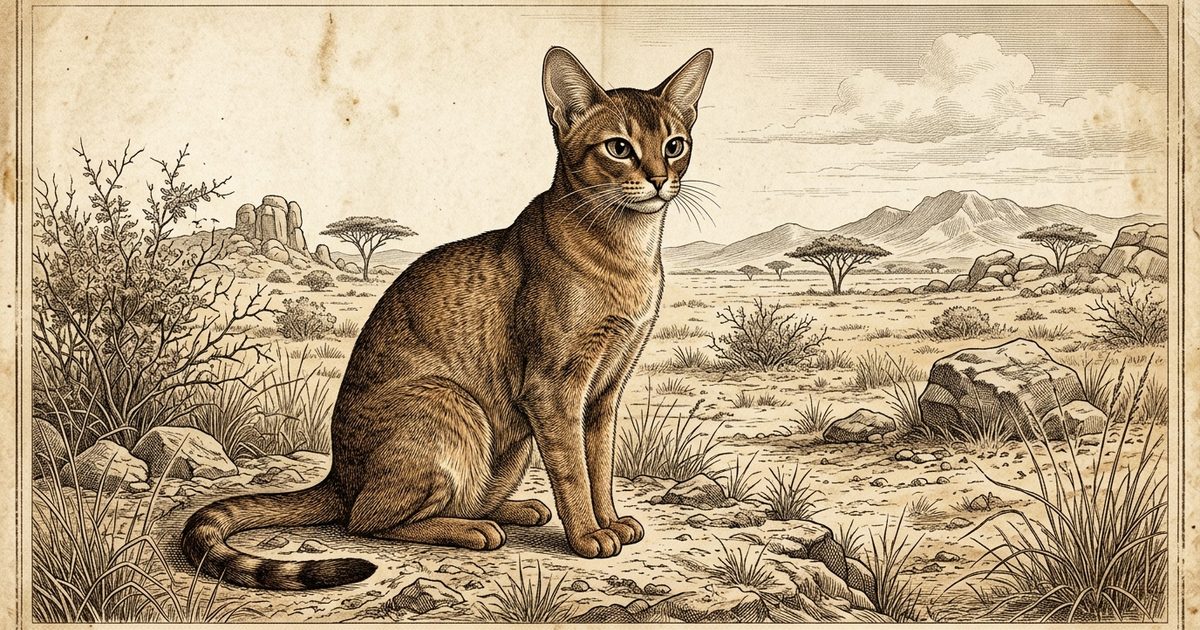
No evolutionary reason to swim
Domestic cats hunt on solid ground and escape threats by climbing or darting into cover — not by taking to the water. Swimming was never a tool their ancestors reached for, so there was never any reward pushing the species toward comfort with it. Evolution doesn't give animals traits they don't need; it quietly drops the ones that don't pay off. To a cat, water is simply an unfamiliar element with nothing useful inside it. That reframes the whole question: most cats aren't phobic about water so much as indifferent, with the discomfort of being wet layered on top.
Lack of early positive exposure
There's a second, more personal layer. Kittens learn what is safe and what isn't during an early socialization window, and in most homes water simply never appears there as something pleasant. A cat that never encountered shallow, warm water as a kitten has no stored memory telling it "this is fine" — so the default response is caution, the same novelty-driven wariness behind why cats hiss at anything unfamiliar. Early positive exposure can tip a cat toward curiosity; its absence leaves the cautious default in place. Reading the resulting body tension — flattened ears, a flicking tail, a low posture — comes back to the same cat body language cues that apply anywhere a cat meets something new.
Why Does Water Feel Uncomfortable to a Cat? The Physical Reasons
A cat's coat is a built-in insulation system. When soaked, fur loses its insulating air layer, clumps, and weighs the cat down — leaving them cold, heavy, and slow to dry. Their highly sensitive skin and whiskers also get overstimulated by the pressure of running water.
If you've ever wondered why do cats hate water so viscerally, the answer lives partly in their coat. Domestic cats carry roughly 130,000 hairs per square inch in some breeds, and every one of those hairs is part of a temperature-control system. Soak that system and it doesn't just get wet — it fails. The discomfort your cat feels isn't a phobia of the water itself; it's the body's response to what water does to it.
Want to know how your cat really feels about bath time? Get a MeowMind reading — upload a photo and let her explain her side of the story in her own words.
Wet fur loses its insulation
A cat's coat works in two layers: long guard hairs on top and a dense, downy undercoat beneath. The undercoat traps a thin layer of warm air against the skin, holding body heat in and cold out. When water saturates the fur, those fine hairs collapse against each other and the air layer is squeezed out — leaving the skin directly exposed to the cold.
Because cats are small animals with a high surface-area-to-weight ratio, they lose body heat quickly once that insulation is gone. A soaked cat can drop temperature fast enough to start shivering within minutes. This is also why cats groom so compulsively after getting wet — licking and fluffing restores the coat's structure, re-fluffs the undercoat, and re-establishes the air layer that keeps them warm. Read more about that restorative process in our guide to why cats groom themselves.
The coat becomes heavy and slow to dry
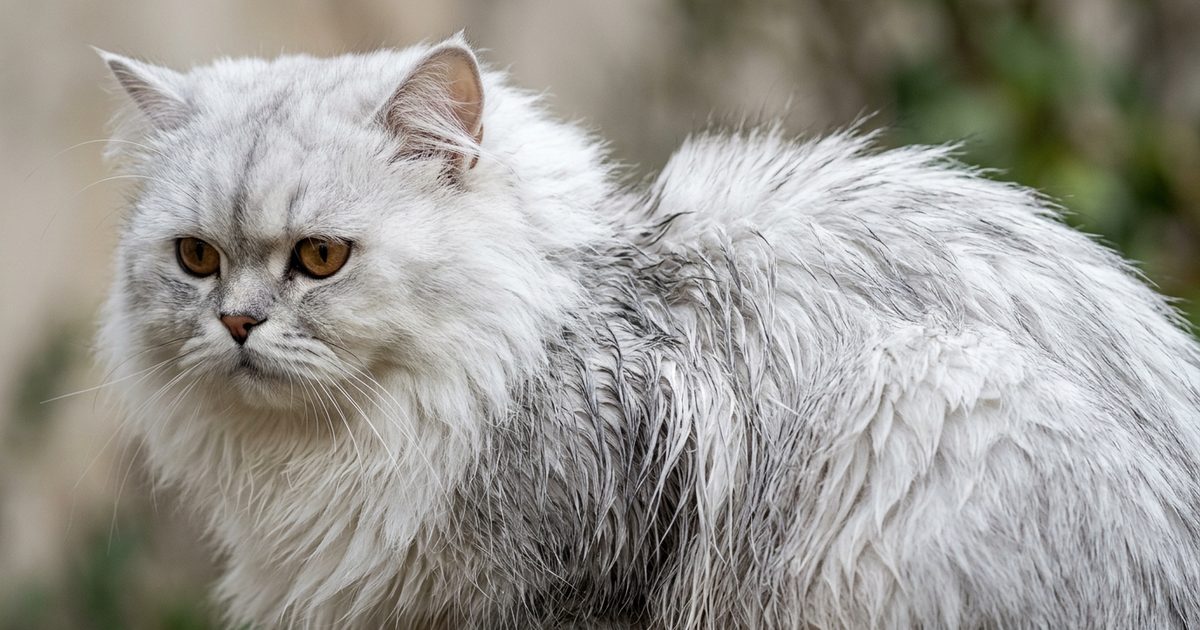
A cat's coat also holds onto water stubbornly. Once saturated, the fur traps liters of liquid between its layers, adding real weight to a small body. A long-haired cat can carry enough trapped water to feel genuinely burdened — moving becomes heavier, slower, and clumsier.
Then comes the drying problem. Cats can't shake themselves dry the way a dog does; their fur holds moisture far longer, and a thick coat can stay damp for hours. For an animal evolved to be agile and alert, that prolonged cold-wet-slow state is genuine vulnerability. In the wild, a slow and cold cat is an easy target. The discomfort, in other words, is less about the moment of getting wet and more about the long, cold aftermath. Cats aren't afraid of water per se — they're averse to what it does to their body for hours afterward.
Sensory overload from sensitive skin and whiskers
Cats also feel water through one of the most sensitive tactile systems in the animal kingdom. Their whiskers (vibrissae) and the long guard hairs across their body are not ordinary hairs — they're packed with nerve endings that detect the faintest air current, the lightest touch, the smallest shift in space. A cat can feel a fly land on a single whisker.
Now flood that system with the chaotic, uneven pressure of running water or a spray. Every droplet registers as a strong signal; the bath tap, the showerhead, a submersion all dump a torrent of input onto receptors built for nuance. The result isn't pain — it's overstimulation, the sensory equivalent of a loud noise you can't turn off. For a cat, that's deeply stressful. International Cat Care, a leading feline welfare authority, describes whiskers and the skin's nerve-rich coat as central to how a cat reads and regulates its world — so when water drowns that signal in noise, the cat wants out. Understanding this reframes a lot of feline behavior: it's not irrational fear, it's a finely tuned sensory system protecting itself.
Which Cats Actually Like Water?
Some breeds are known for liking water: Maine Coons, Turkish Vans (the "swimming cat"), Bengals, Turkish Angoras, and Savannahs. Their water-friendly traits trace to coat texture, curiosity, and — in Bengals and Savannahs — wild hybrid ancestry. Individual personality still matters more than breed.
For all the talk of cats hating water, a meaningful minority go the other way — splashing in fountains, joining their humans in the shower, even paddling in shallow tubs. The water-loving cat isn't a myth; it's a real pattern, and it tends to cluster around a few recognizable breeds.
Maine Coon and Turkish Van: the famous water lovers
The Maine Coon is the gentle giant of the cat world, and its coat has a secret — a light oiliness that makes the fur naturally water-repellent. That oily coat, developed in cold New England winters, means a Maine Coon tolerates and often seeks out water without the soaked, weighted-down feeling other cats hate. Owners regularly report Maine Coons batting at faucet streams, trailing them into the shower, and playing with their water bowls.
The Turkish Van earned the nickname "the swimming cat" for a reason. Named after Turkey's Lake Van region, where it developed alongside real bodies of water, the breed has a history of fondness for swimming that's unusual among domestic cats. Vans often delight in water play and, like the Maine Coon, will happily join a human at the sink or tub. These breeds show that water affinity can be bred in — though as we cover in how to tell a cat's age, coat texture and temperament cues also shift across a cat's life stages, so a curious kitten of any breed may be more water-brave than the same cat as a settled adult.
Bengal, Savannah, and the wild-hybrid factor
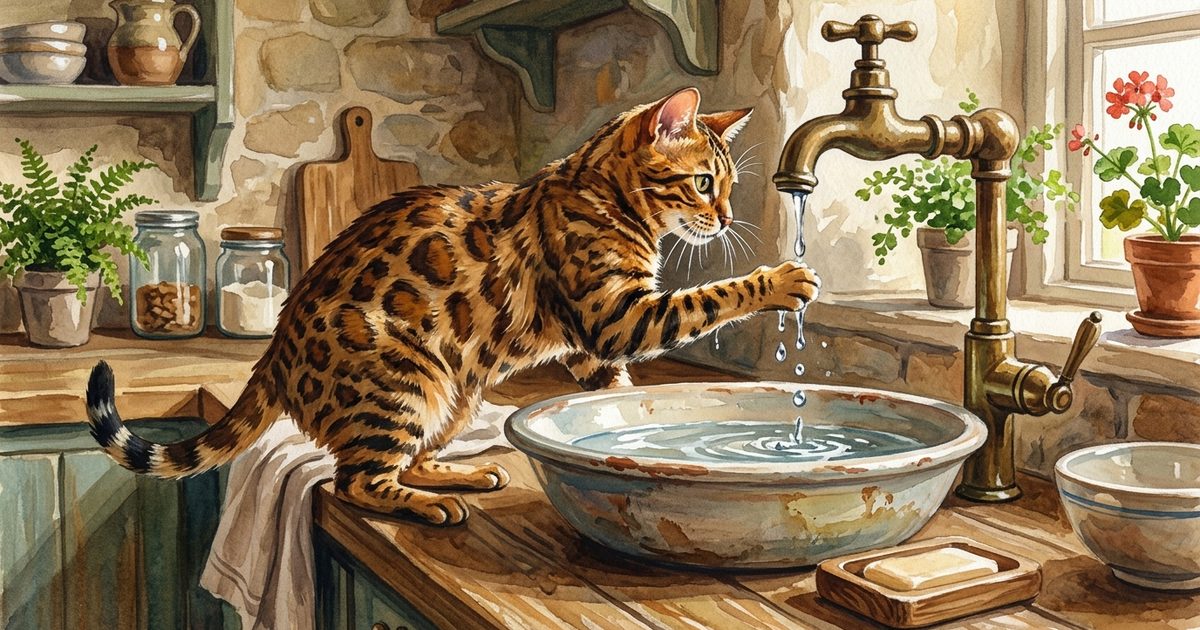
The Bengal — a wild-looking spotted golden-brown cat, like a small leopard — is famously drawn to water, along with its hybrid cousin the Savannah. Bengals carry Asian Leopard Cat ancestry; Savannahs descend from the African Serval. Both wild cousins routinely hunt near and in water in their native ranges, and owners widely report the domestic hybrid versions splashing in water dishes, attacking running taps, and even dropping toys into their bowls to fish them back out.
The honest framing here is tendency, not guarantee. The hybrid-ancestry hypothesis is appealing and widely shared by breed clubs, but controlled evidence linking specific ancestry to water play is limited. What's clear is that Bengals and Savannahs show water interest far more often than the average domestic cat — a generalized tendency worth noting, not a rule.
Mixed-breed cats and individual personality
And then there are the ordinary cats — the tabbies, the domestics, the "just a cat" cats — who also love water. Plenty of mixed-breed cats develop an obsession with a dripping faucet, a running bath, or a shallow puddle in the sink. In these cats there's no special coat and no exotic ancestry to explain it; what explains it is temperament, curiosity, and the role of early exposure.
A kitten that encounters shallow water in a positive, low-pressure way is far more likely to seek it out as an adult, regardless of breed. The takeaway is that breed shapes tendencies, but personality dominates outcomes. If your cat loves water — whatever breed it is — that's a quirk worth celebrating. If it doesn't, that's the more common story, and it's not a flaw; it's the same body, the same sensory system, doing exactly what it evolved to do.
How Do You Bathe a Cat That Hates Water?
Most cats rarely need baths — their tongues handle coat care. When a bath is necessary, for fleas, a skin condition, something toxic on the coat, or a vet's instruction, keep it short, shallow, warm, and calm: trim nails, use a non-slip mat, avoid the face and ears, then reward.
When a bath is actually necessary
For the vast majority of healthy cats, no routine bathing is needed — their tongues handle coat maintenance far better than we can. But a handful of situations genuinely call for water. A flea or parasite treatment may require a medicated shampoo to support the process. Certain skin conditions — including fungal infections like ringworm — sometimes respond better when a vet-directed medicated wash is part of the plan. If your cat gets something toxic or foul on the coat (paint, motor oil, skunk spray), a thorough rinse becomes a safety matter, not a grooming preference. And older cats carrying extra weight or coping with arthritis may simply stop being able to reach everywhere on their own, so a careful bath steps in where self-grooming can't. Outside of these cases, a healthy cat is better left to its own devices. The International Cat Care guidance is clear: bathing should be reserved for genuine need, not routine.
Low-stress bathing technique, step by step
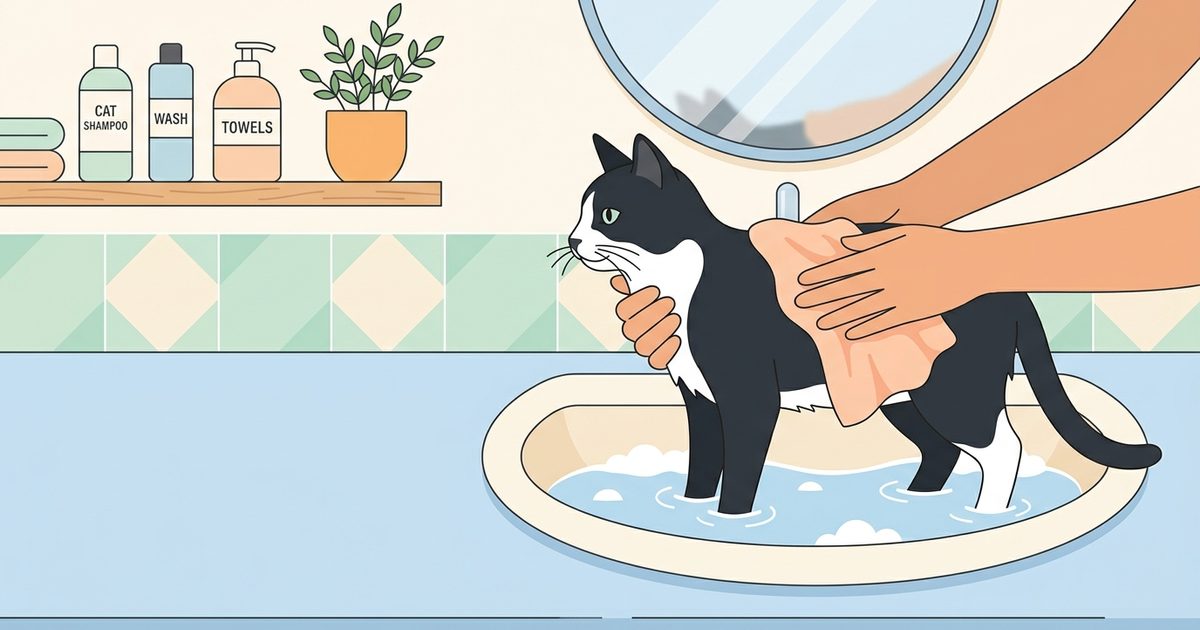
If a bath truly is necessary, the goal is to get in and out quickly with as little stress as possible. Aim for under ten minutes from wet to dry.
- Tire your cat out first — a 15-minute play session lowers arousal and makes everything that follows calmer.
- Trim claws and brush out mats — this protects you and removes tangles that tighten and trap soap when wet.
- Use a sink, not a deep tub — place a folded towel or non-slip mat on the bottom so your cat has secure footing (sliding triggers panic).
- Fill only 2–3 inches of warm water — body temperature, never hot. Deep water is terrifying; shallow water is manageable.
- Pour gently with a cup — never spray. Keep water away from the face, ears, and eyes entirely.
- Use cat-formulated shampoo only — dog shampoos and human products can contain permethrins and other ingredients toxic to cats.
- Rinse thoroughly — leftover residue irritates sensitive feline skin and can cause licking and dermatitis.
- Wrap immediately in a towel and blot dry — skip the hair dryer entirely; its heat and noise are a fast track to panic.
Keep your own energy low and slow throughout. Cats read our tension as readily as they read water depth.
Alternatives to a full bath
If the situation doesn't strictly require water, you have better options. Waterless cat shampoo or foam lets you freshen a coat without any rinsing at all. Spot-cleaning with a warm damp cloth handles small messes — a paw, a chin, the rear — without escalating to a full bath. Regular brushing does more for coat health than most owners realize; it distributes oils, removes loose fur, and complements the work cats already do when they groom themselves. And for a cat who genuinely can't tolerate water — or for a coat condition beyond home care — a professional groomer or your vet can step in safely, often with experience and restraints that keep the cat calmer than a panicked owner with a cup.
Is It Safe to Make a Cat Swim or Get Wet?
Never force a cat into water, never submerge its head, and never spray its face. Cats can swim instinctively, but a panicked cat can inhale water, scratch wildly, or go into shock. If your cat dislikes water, respect it — safer ways exist to cool or clean a cat.
Cats can swim — but panic is the real danger
This distinction matters: physical capability is not the same as safety. Most cats, if placed in water, will instinctively dog-paddle — the motion is hardwired. But instinctive swimming says nothing about whether the cat is safe or calm. The real danger is panic. A frightened cat may inhale water, claw frantically at anything — including you — in its scramble to escape, or in extreme cases tip into a stress response that looks like shock. None of that is about the water itself; it's about the cat losing footing and control. This is the same reason cats pant when overheated — the body is signaling distress, and the right response is to remove the stressor, not push through it. Knowing your cat can swim is not a reason to make it swim.
Safer ways to cool and clean a cat
If your goal is to cool a hot cat, water immersion is the wrong tool. Cooling mats and a fan moving air across the room do most of the work. Brushing out loose fur improves airflow through the coat and is genuinely effective — that undercoat is insulation you don't need in summer. For targeted relief, a damp cloth over the paws or the ears (small, well-vascularized areas) cools without the panic a full wet-down triggers. Never use ice or cold-water immersion; the shock to a warm cat's system does more harm than the heat you're trying to relieve.
Positive association — building comfort slowly
A small number of cats genuinely enjoy water, and for the rest, comfort can sometimes be built — but only on the cat's terms. Let a curious cat investigate a shallow bowl of water or a dripping faucet on its own; don't guide the paw in. Place treats near the water, not in it, so the cat associates the area with reward without being forced to make contact. The line that matters most: never reward or repeat forced contact. A cat that learns water always comes with choice may grow relaxed around it; a cat that learns water comes with restraint learns only to fear it more.
Curious What Your Cat Would Say?
Upload a photo and get a warm, personalized reading from your cat's perspective.
Start Your Free ReadingCats and Water at a Glance — Summary
| Question | Short answer |
|---|---|
| Do all cats hate water? | No — many tolerate it, and breeds like Maine Coons, Turkish Vans, and Bengals often enjoy it |
| Why do most cats dislike water? | Their ancestors came from arid regions and never needed to swim, so water feels unfamiliar and unrewarding |
| Why does water physically feel bad? | Wet fur loses its insulating air layer, becomes heavy and slow to dry, and overstimulates sensitive skin and whiskers |
| Which cats actually like water? | Maine Coons, Turkish Vans, Bengals, and Savannahs — and many mixed-breed cats drawn to dripping faucets |
| When should you bathe a cat? | Only when necessary — fleas, medicated skin treatment, a toxic substance on the coat, or when a vet advises it |
| Is it safe to force a cat into water? | No — never force or submerge a cat; panic, not the water itself, is the real danger |
The throughline is simple: why do cats hate water is really a question about ancestry, coat physics, and sensory comfort — not fear. Most cats have no reason to seek water out, and getting wet has real physical costs for a small, meticulously groomed animal. A few breeds break the pattern, and the occasional tabby at the faucet proves personality matters as much as pedigree. When a bath is genuinely needed, it stays short, shallow, and calm — and when your cat says no, the kind answer is to listen.
Frequently Asked Questions
Why do cats hate water when dogs seem to like it?
It comes down to ancestry. Dogs were often bred to retrieve from water or work in wet conditions, while domestic cats descend from arid-region wildcats that never needed to swim. Dogs got a reason to enjoy water through breeding; cats simply never did.
Can cats swim if they fall in water?
Yes, most cats can instinctively dog-paddle if they end up in water. But swimming ability isn't the same as safety — a panicked cat can inhale water or injure itself trying to escape. Always lift a fallen cat out calmly rather than assuming it will manage on its own.
Which cat breeds actually like water?
Maine Coons, Turkish Vans, Bengals, Turkish Angoras, and Savannahs are the breeds most often reported enjoying water. They play with running taps, paddle in shallow water, and sometimes even swim. Still, individual personality matters as much as breed.
How often should I bathe my cat?
Most healthy cats never need a routine bath — their tongues handle coat care far better than we can. Baths are reserved for genuine need: fleas, medicated skin treatment, a toxic substance on the coat, or a vet's instruction. Otherwise, let your cat self-groom.
Is it cruel to give a cat a bath?
Not when it's truly necessary and done calmly. A short, shallow, warm bath for a medical reason is responsible care, not cruelty. What is unkind is forcing a cat into deep water, spraying its face, or bathing routinely when the cat clearly hates it and has no need.
Why does my cat play with running water from the faucet?
Running water signals freshness, and a moving stream is simply more interesting to paws built to bat and grab. Many cats prefer flowing water to a still bowl. Curiosity, breed tendency, and early positive exposure all shape which cats take this further into real water play.
How do I dry my cat after a bath without stressing them?
Wrap your cat immediately in a thick towel and blot — do not rub roughly. Skip the hair dryer entirely; its heat and noise are a fast track to panic. Keep blotting with dry towels and let your cat finish the job through grooming in a warm, quiet room.
What should I do if my cat falls into water accidentally?
Lift your cat out calmly and right away, then wrap it in a dry towel in a warm room. Blot rather than rub, and let self-grooming do the rest. Watch for shivering, lethargy, or coughing — if any appear, call your vet, as inhaled water can cause problems hours later.
Do kittens hate water as much as adult cats?
Not always. Kittens are in their socialization window, so gentle, positive exposure to shallow warm water can build lasting comfort. A kitten that learns water is safe may stay more relaxed around it as an adult. Without that early exposure, the cautious default usually takes over.
Sources & References
You Might Also Like
Kitten Teething: Timeline, Symptoms & How to Help
Kitten teething runs from 3 to 7 months as baby teeth fall out. Learn the timeline, signs to watch for, and how to soothe a teething kitten safely.
15 min readWhen Do Cats Stop Growing? A Complete Timeline
When do cats stop growing? Most cats reach adult size by 12-18 months, but large breeds like Maine Coons keep growing until 3-4 years. Full timeline inside.
14 min readCan Cats Eat Cherries? Flesh, Pit & Toxicity Facts
Can cats eat cherries? Pitted flesh is safe in tiny amounts — but the pit, stem, and leaves are toxic (cyanide precursors). Learn what's safe and what isn't.
15 min readA message, in your cat's voice
Upload a photo, get a warm note written from your cat's perspective — just for fun. Plus 121 vet-cited articles, offline.