
Can Cats Eat Pineapple? Safety, Bromelain, and How Much
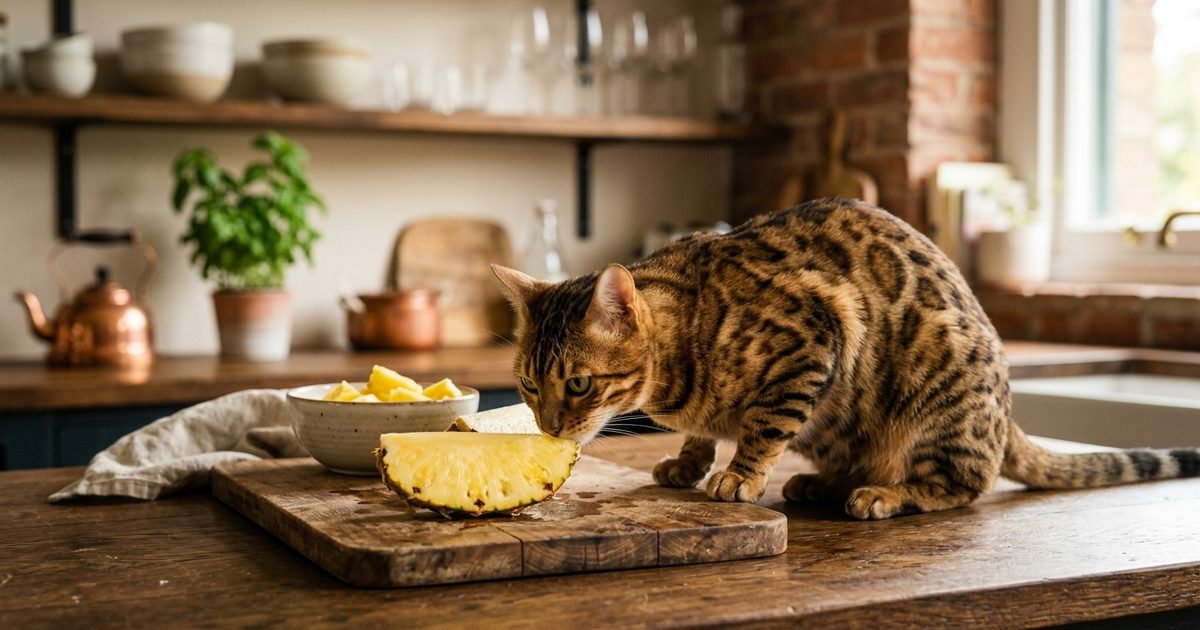
Can cats eat pineapple? Yes — the flesh is technically non-toxic, so a curious lick or a tiny piece of ripe flesh won't poison your cat. But is pineapple good for cats? Not really. Pineapple is unusually high in sugar and acid, and it carries an enzyme called bromelain that other sweet fruits don't — the same reason fresh pineapple makes your own mouth tingle. For an obligate carnivore whose body runs on protein and fat, that combination makes pineapple a poor treat rather than a healthy one, kept on the table only because the ripe flesh is, strictly speaking, safe in the smallest amounts.
Key takeaways
- Pineapple flesh is non-toxic to cats but very high in sugar and acid, so it's a poor treat, not a healthy one.
- Bromelain, an enzyme in pineapple, can irritate a cat's mouth and stomach — only a tiny piece of fresh ripe flesh is safe.
- Cats cannot taste sweetness, so any interest in pineapple is curiosity and texture, not a craving.
Pineapple for Cats — Quick Reference
| Pineapple form | Safe for cats? | Notes |
|---|---|---|
| A tiny piece of fresh ripe flesh | Yes — rare treat only | Soft flesh only, pea-sized start |
| Pineapple core, skin, leaves | No | Choking, digestive, and physical-injury hazards |
| Canned pineapple | No | Packed in syrup; too much sugar even with bromelain denatured |
| Pineapple juice | No | Concentrated sugar and acid, no fiber benefit |
| Dried pineapple | No | Sugar-dense and sticky, a choking risk |
| Cooked pineapple in baked goods | No | Added sugar, fats, and often toxic ingredients like xylitol or chocolate |
Can Cats Eat Pineapple?
Yes — cats can eat a tiny piece of fresh, ripe pineapple flesh as an occasional treat; the flesh is non-toxic. But pineapple is high in sugar and acid and carries an enzyme that can irritate a cat's mouth and gut, so it is a poor choice — safe only in the smallest amounts.
The short answer
The honest verdict is that can cats eat pineapple resolves to a cautious yes with a big asterisk. The ripe flesh is not poisonous, so a minuscule taste won't harm a healthy cat. But pineapple sits near the bottom of the list of sensible treats: it is loaded with sugar, sharply acidic, and it contains bromelain, an enzyme that can make a cat's mouth and stomach uncomfortable on contact. Think of it as a rare curiosity to share, never as food. A pea-sized piece once in a long while is the entire safe window — anything beyond that brings cost without benefit.
Why pineapple is unusual as a cat food
Pineapple is a tropical fruit that humans bred specifically for intense sweetness and bright acidity — the very things that make it appealing to us. Cats, though, are obligate carnivores whose metabolism runs on protein and fat, not carbohydrates. Their bodies simply do not need what pineapple offers, and the acid and enzyme load actively works against them. So is pineapple good for cats? Not really. A cat's complete commercial diet already supplies everything it requires, and pineapple mostly adds sugar and irritation on top of a system that wasn't built to handle either. That's the gap between "non-toxic" and "a good idea."
Why Is Pineapple Suboptimal for Cats?
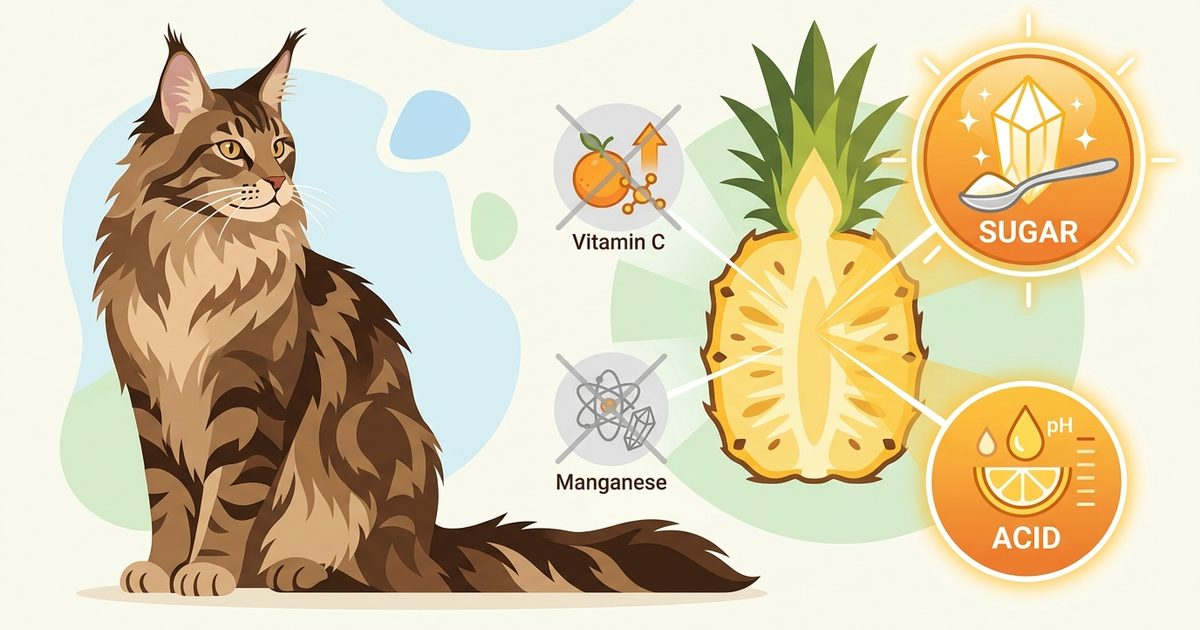
Pineapple is suboptimal for cats because it is unusually high in sugar and acid while offering no nutrient a complete cat food does not already supply. Worse, cats cannot taste sweetness, so the sugar brings only downside — weight gain and blood-sugar stress — with no pleasure payoff the cat can even perceive.
Very high sugar and acidity
A single cup of pineapple carries roughly 16 grams of sugar, and it is notably acidic on top of that. For a human that is a moderate snack; for a cat it is a serious load. Cats have no dietary requirement for carbohydrates, and their bodies are not built to handle sustained sugar intake the way ours are. The acidity compounds the problem by irritating the lining of the digestive tract, which is part of why even a modest portion can cause queasiness or loose stools in a sensitive cat. The Cornell Feline Health Center emphasizes that cats thrive on complete, meat-based nutrition — there is no gap in that diet that a sugary fruit is needed to fill.
Vitamin C and manganese — real but redundant
It is true that pineapple contains vitamin C, manganese, and some fiber, and you will sometimes see it promoted as a "nutritious" treat on that basis. But those nutrients are not anything a cat on a complete diet is actually missing. Cats synthesize their own vitamin C in the liver, and the manganese and fiber in commercial food already cover their needs. Presenting pineapple as a supplement overstates what it can do. As International Cat Care puts it, treats and titbits should complement a complete diet, not substitute for it — and a high-sugar fruit is a poor way to deliver a nutrient the cat already has.
Cats can't taste the sweetness
Here is the strangest part of the whole story: the sugar that makes pineapple so appealing to humans is, in a real sense, invisible to a cat. Cats lack a working sweet taste receptor — the Tas1r2 gene that builds it is non-functional — so they cannot taste sweetness at all. That means all the sugar in pineapple delivers zero pleasure payoff to your cat while still carrying every downside: weight gain, blood-sugar stress, and digestive irritation. If you're wondering do cats like pineapple, any interest is almost certainly driven by the smell, the moisture, or the novelty of the texture — not by anything sweet. You can read the full sensory-biology breakdown in our article on whether cats can taste sugar.
What About Bromelain — Is It Dangerous?
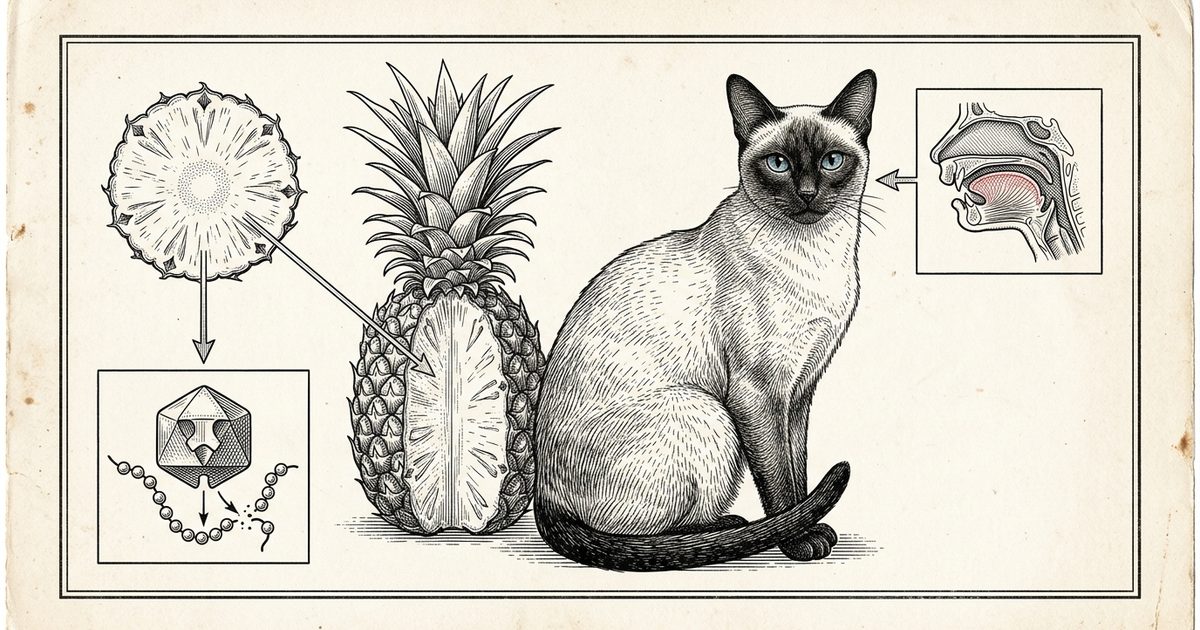
Bromelain is a protein-digesting enzyme found in pineapple. In sensitive cats it can irritate the mouth, lips, and stomach lining on contact, causing tingling or mild upset. It is not toxic, but it is the main reason fresh pineapple feels prickly — and why fresh pineapple is rougher on a cat than other sweet fruits.
What bromelain actually does
Bromelain is a protease — a family of enzymes whose job is to break protein molecules apart. It is the reason fresh pineapple makes your own mouth tingle or feel raw after a few slices, and the same reason pineapple juice is used as a meat tenderizer: it is literally digesting protein on contact. In a cat's mouth, throat, and stomach, that same enzymatic action can irritate the delicate mucous membranes lining the digestive tract. The effect is real, but it is irritation, not poisoning — a cat that mouths a piece of pineapple may drool, smack its lips, or seem mildly uncomfortable, and the sensation usually passes once the pineapple is gone. It is the one thing about pineapple that bananas, watermelon, and other sweet fruits simply do not bring to the bowl.
Fresh vs. canned — does processing matter?
Heat changes the picture. Cooking and the canning process denature — that is, deactivate — bromelain, so canned pineapple is enzymatically gentler than fresh. If you are asking whether can cats eat canned pineapple purely on the enzyme front, it is technically less irritating. But there is a catch that outweighs that advantage: canned pineapple is packed in heavy syrup, which makes it even higher in sugar than the fresh fruit. You remove the enzyme only by adding more of the thing that is already the bigger problem. The net result is that canned pineapple is not a better choice — it simply trades one issue for a worse one.
The bottom line on bromelain
Bromelain is not a toxin. It is an irritant, and a mild one in the small amounts a cat would actually consume. Its real role here is to make fresh pineapple the prickliest of the sweet fruits you might be tempted to share — which reinforces the rule of tiny amounts, rarely, rather than changing the overall verdict on whether cats can eat pineapple.
How Should I Serve Pineapple to My Cat?
Serve only a tiny piece of fresh, ripe pineapple flesh — no skin, core, leaves, juice, or added sugar. Cut it small enough to prevent choking, and offer a pea-sized taste first to check for any mouth or stomach irritation. Fresh ripe flesh, in a minuscule amount, is the only safe form.
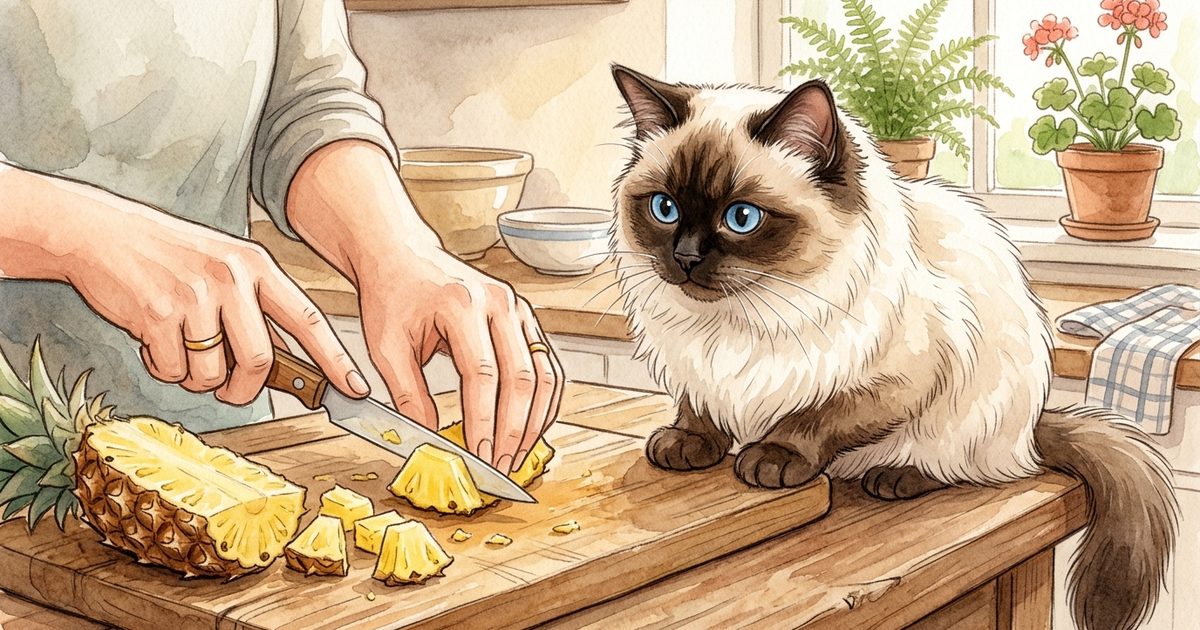
Preparation rules
Start with the soft, ripe flesh only — the part that is yellow, fragrant, and gives slightly to pressure. Peel away the tough outer skin, cut out the fibrous core, and strip off the spiky crown leaves entirely; none of those belong in a cat's mouth. Cut the flesh into tiny pieces, small enough that choking is not a possibility. Never offer pineapple juice, dried pineapple, or pineapple baked into cakes or pastries — each concentrates the sugar, and dried and baked forms add ingredients a cat's body has no use for. The Cornell Feline Health Center is clear that cats do best on a complete, balanced diet, and any treat should sit firmly outside that core nutrition.
Never the skin, core, or leaves
The skin is tough, heavily pesticide-exposed, and a choking hazard; the core is dense, fibrous, and nearly impossible for a cat's short digestive tract to break down; the leaves are sharp, stiff, and can cause real physical injury to the mouth, throat, or intestines. None of these are food — they are hazards dressed up as parts of a fruit. The safe move is to discard all three entirely and serve only the flesh.
Introduce slowly
Even with the flesh prepared correctly, offer a pea-sized test portion first, then watch your cat over the next 24 hours for mouth tingling, drooling, vomiting, or diarrhea. If any of those appear, pineapple is not for your cat. And some cats should skip it altogether: those with diabetes, obesity, a sensitive stomach, or mouth and dental issues are all poor candidates. Because cats are obligate carnivores built to run on protein and fat, pineapple is never more than a curiosity — and for many cats, it is not worth even that.
How Much Pineapple Can a Cat Eat?
A cat can have one or two tiny chunks of fresh, ripe pineapple flesh — no more than once every week or two, and never exceeding about 10% of daily calories. Because of the sugar load, regular pineapple feeding raises the risk of obesity and diabetes, so keep it rare and minuscule.
The 10% treat rule
Veterinary nutritionists use a simple ceiling: all treats, snacks, and extras combined should total no more than about 10% of a cat's daily calories — the other 90% should come from a complete and balanced cat food. A typical adult cat eats roughly 200–250 calories a day, which means the entire treat budget is around 20–25 calories. A single one-inch chunk of pineapple is already 8–10 calories of almost pure sugar, so even that "small" piece eats up a large share of the allowance and leaves almost no room for anything else. A full slice is wildly over budget — closer to 40 calories — which is why portion control matters more than any other rule with this fruit. Treats are meant to be a tiny occasional pleasure, not a meaningful part of the meal.
Frequency and portion size
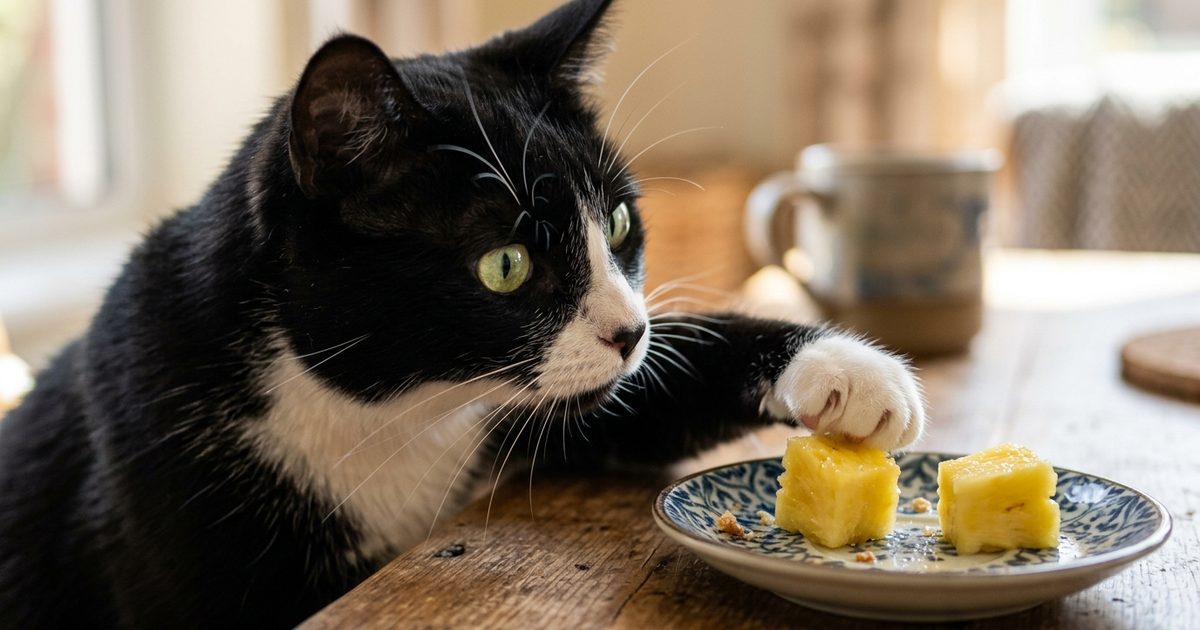
For a healthy adult cat, one or two tiny chunks of fresh ripe flesh, offered at most every week or two, is the ceiling — not the target. Smaller cats, senior cats, and especially overweight or diabetic cats should have less, or none at all; the sugar in pineapple is the exact thing their metabolism handles worst, and a moment of curiosity is not worth a blood-sugar spike. Often a single lick of juice on your fingertip is more than enough for a cat who just wants to investigate what you are eating — most lose interest after the first taste. For why a chronic sugar load matters more than any single treat, see our deep dive on cat diabetes; and if you want a sweet-fruit alternative that is far more defensible thanks to its high water content, can cats eat watermelon is the better-angled choice.
What Happens If a Cat Eats Too Much Pineapple?
Eating too much pineapple can cause mouth and lip irritation from bromelain and acidity, plus vomiting or diarrhea from the sugar and fiber load. Diabetic and overweight cats are most at risk. If irritation, repeated vomiting, or lethargy appear, stop feeding pineapple and call your vet.
Mouth irritation from bromelain and acid
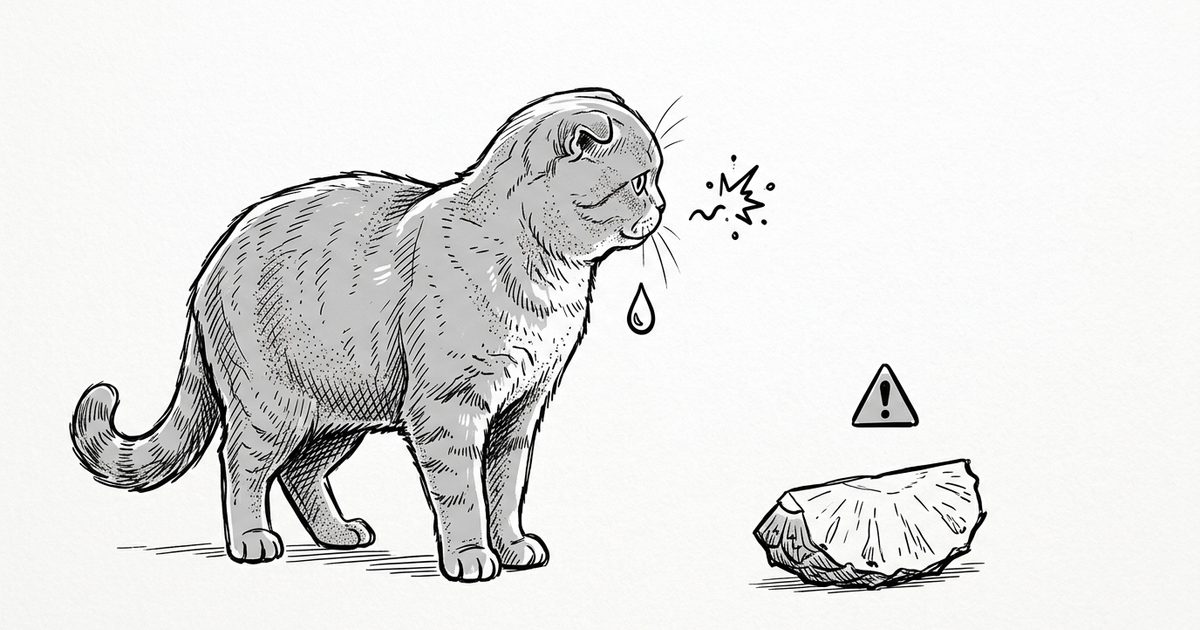
The same bromelain enzyme that makes fresh pineapple tingle on a human tongue works on a cat's mouth lining too, and the fruit's natural acidity amplifies the effect. Together they can cause a tingling or prickly sensation, mild drooling, lip-smacking, or slight redness around the mouth and lips shortly after a cat tastes it. The reaction is uncomfortable but not dangerous — it is mechanical irritation, not poisoning — and it almost always settles on its own once the pineapple is stopped and the cat has had some water. A cat that drools or pulls away after a lick is telling you the fruit does not agree with it, and that is a good reason not to offer it again.
Digestive upset
Further down, the fiber and sugar load can trigger vomiting or diarrhea in cats with sensitive stomachs, especially if the portion was larger than intended or the fruit was not fully ripe. A single soft stool that resolves within a day is usually no cause for alarm, but repeated vomiting, blood in the stool, or lethargy are different signals — see our guides on cat vomiting and cat diarrhea for exactly when gastrointestinal signs after a new food warrant a vet visit rather than watchful waiting.
Long-term sugar risk
The real danger of pineapple is not one chunk — it is the habit. Cats fed sugary treats regularly take in empty calories that quietly drive weight gain, and obesity is the single biggest risk factor for feline diabetes. Because cats cannot taste sweetness, there is no payoff that justifies the metabolic cost, so the protection is the frequency rule above, not agonizing over the size of a single piece. The chronic consequence of a sweet-tooth habit is covered in full in our article on cat diabetes.
Pineapple for Cats at a Glance — Summary
| Question | Short answer |
|---|---|
| Can cats eat pineapple? | Yes — fresh ripe flesh only, in a tiny amount, as a rare treat |
| Is pineapple good for cats? | No — non-toxic, but mostly sugar and acid with no nutrient a complete cat food lacks |
| Can cats eat canned pineapple? | No — bromelain is denatured, but the heavy syrup makes it even higher in sugar |
| How much can a cat eat? | 1–2 tiny chunks, once every week or two, never more than ~10% of daily calories |
| What if a cat eats too much? | Mouth irritation, vomiting, diarrhea — stop and watch; call your vet if signs are severe |
| What about the core, skin, and leaves? | Never feed them — choking, digestive, and physical-injury hazards |
Curious What Your Cat Would Say?
Upload a photo and get a warm, personalized reading from your cat's perspective.
Start Your Free ReadingFrequently Asked Questions
Can cats eat pineapple?
Yes — cats can eat a tiny piece of fresh, ripe pineapple flesh as a rare treat because the flesh itself is non-toxic. But pineapple is high in sugar, acid, and an enzyme called bromelain that can irritate a cat's mouth and gut, so it stays a poor choice kept safe only in the smallest amounts.
Is pineapple good for cats?
Not really. Pineapple is non-toxic, but for a cat it is mostly sugar and acid with no nutrient a complete cat food does not already supply. Cats even make their own vitamin C, so the vitamin and mineral content is redundant rather than beneficial.
Can cats eat canned pineapple?
No. Canning does denature the bromelain enzyme, making canned pineapple less irritating on that front, but it is packed in heavy syrup that pushes the sugar even higher than fresh. That trade makes canned pineapple a worse overall choice, not a safer one.
How much pineapple can I give my cat?
One or two tiny chunks of fresh ripe flesh, no more than once every week or two, and never above about 10% of daily calories. Even a single one-inch chunk eats up a large share of a cat's small treat budget, so keep portions minuscule and rare.
Can kittens eat pineapple?
It's best to skip pineapple for kittens entirely. Their digestive systems are still developing, their calorie budget is tiny, and they have even less margin for sugar, acid, and enzyme irritation than an adult cat does — so the small risk is not worth taking.
Why does my cat want pineapple?
Cats cannot taste sweetness, so the interest is never a sugar craving. What draws a cat in is the smell, the moisture, or the novelty of the soft, juicy texture — simple curiosity about whatever you happen to be eating, rather than a genuine appetite for the fruit.
Can diabetic cats eat pineapple?
No. Diabetic cats are the poorest candidates for pineapple because their metabolism handles sugar worst, and even a small piece can trigger an unwanted blood-sugar spike. The sugar brings no benefit a cat can even taste, so diabetic and overweight cats should skip it altogether.
Can cats eat the pineapple core or skin?
Never. The core is fibrous and nearly impossible for a cat's short digestive tract to break down, the skin is tough and pesticide-exposed, and the leaves are sharp enough to injure the mouth, throat, or intestines. Only the soft ripe flesh is edible — discard the rest.
Is bromelain in pineapple toxic to cats?
No, bromelain is not a toxin — it's a protein-digesting enzyme that can irritate the mucous membranes of the mouth and gut on contact, causing tingling, drooling, or mild upset. It's the same reason fresh pineapple makes your own mouth tingle, and it makes fresh pineapple the prickliest of the sweet fruits.
Sources & References
You Might Also Like
Kitten Teething: Timeline, Symptoms & How to Help
Kitten teething runs from 3 to 7 months as baby teeth fall out. Learn the timeline, signs to watch for, and how to soothe a teething kitten safely.
15 min readWhen Do Cats Stop Growing? A Complete Timeline
When do cats stop growing? Most cats reach adult size by 12-18 months, but large breeds like Maine Coons keep growing until 3-4 years. Full timeline inside.
14 min readCan Cats Eat Cherries? Flesh, Pit & Toxicity Facts
Can cats eat cherries? Pitted flesh is safe in tiny amounts — but the pit, stem, and leaves are toxic (cyanide precursors). Learn what's safe and what isn't.
15 min read